
Designbased Research Overview Design thinking models Design Thinkers
Design-based Research
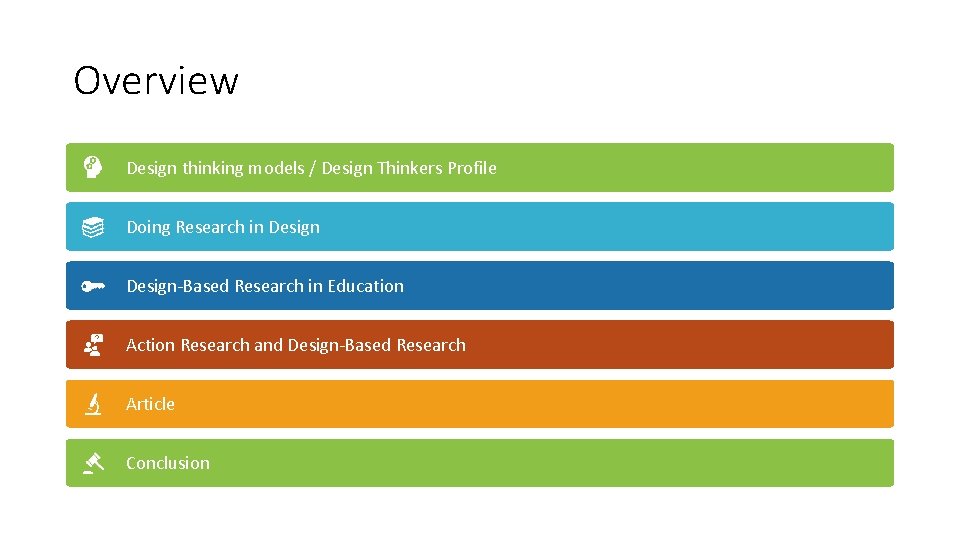
Overview Design thinking models / Design Thinkers Profile Doing Research in Design-Based Research in Education Action Research and Design-Based Research Article Conclusion
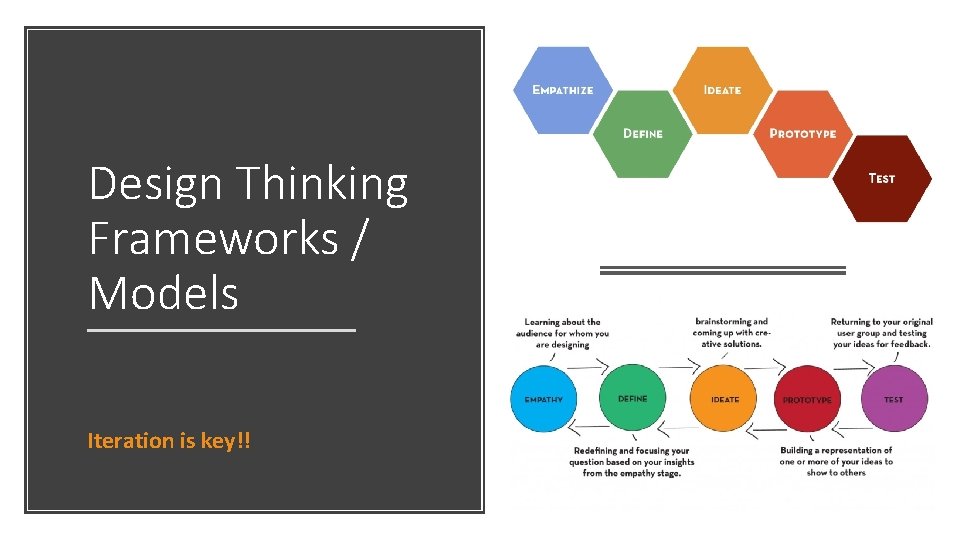
Design Thinking Frameworks / Models Iteration is key!!

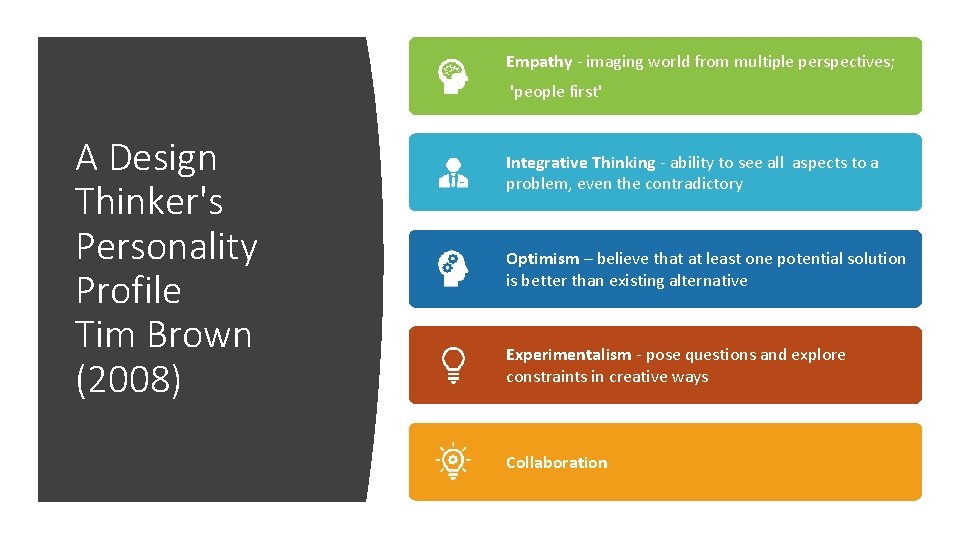
Empathy - imaging world from multiple perspectives; 'people first' A Design Thinker's Personality Profile Tim Brown (2008) Integrative Thinking - ability to see all aspects to a problem, even the contradictory Optimism – believe that at least one potential solution is better than existing alternative Experimentalism - pose questions and explore constraints in creative ways Collaboration
Design Thinking Research (2012) “A design thinker goes out into the field, holds dialogues with different stakeholders, observes, immerses him or herself into another person’s world. In this way, design thinkers also use all their analytical as well as their creative senses and abilities” (p. 80).
Doing Research in Design: Crouch and Pearce (2012) “Understanding the cyclical nature of thinking and doing design, and understanding how these processes feedback and influence one another, enables the designer to move seamlessly from understanding the process of design into an understanding of the processes of research”(p. xi) “The designer needs to objectively assess a problem in order to be able to solve it productively in just the same way as the research aspires to the condition of objectivity, as impossible as that condition might be, in order to critically examine information” (p. 11).
Doing Research in Design: Crouch and Pearce (2012) • “The problem and the question about the problem move backwards and forwards with one another, and it is this asking of questions that stimulates ways of finding solutions just as much as determining what the problem might be” (p. 19) • Designing and researching are processes of initiating change in the manmade world; therefore, it seems logical that they can work together to create change. • “The philosophy of praxis would suggest that the role of the researcher is not only to research the nature of design but also to contribute to the formation of ideas about design is for”(p. 44)
Design-based Research in Education: The Basics • Similar interchanged terms include “design experiments”, design research”, development research”, “design development”, and “formative research” • Most current researchers on the topic credit Brown (1992) for providing the basis of this style of research in education • “An effective intervention should be able to migrate from our experimental classroom to average classrooms operated by and for average students and teachers, supported by realistic technological and personal support” (Brown, 1992, p. 143)
Edleson (2002) Bereiter (2002) "An important characteristic of design research is that it eliminates the boundary between design and research" Design and research typically take place sequentially, however in design research, the goal is to explicitly exploit "the design process as an opportunity to advance the researchers understanding of teaching, learning, and educational systems. " (Edleson, p. 107) Design research is not defined by methodology. All sorts of methods may be employed. What defines design research is its purpose: Sustained innovative development. (Bereiter, p. 326) “Design research is part of the design process; if separated from it, it ceases to be design research. ” (p. 326)
The Design Collective (2003) • “Design-based researchers regularly find themselves in the dual intellectual roles of advocate and critic. " - this results in "necessary tension. As a result design-based research typically triangulates multiple sources of data to connect intended and unintended outcomes (p. 7). • Validity is found through the very process, which requires iteration. Iteration is a typical process of design and therefore design-based research. Therefore, the iteration and the partnership between researcher and practitioners leads to validation. • Important warning: there needs to be rigor in the design-research process, the process can't become a euphemism for "anything goes" research or oversimplified interventions.
• Pragmatic: refines both theory and practice 5 Key Characteristics: Wang and Hannafin (2005) Building on and drawing from Design Collective(2003), Edelson (2002), van den Akker (1999), Brown (1992) and others • Grounded: theory-driven, conducted in real-world settings, design-process is embedded and studied through • Interactive, iterative, and flexible: Collaboration necessary, processes cycle through • Integrative: mixed methods to maximize credibility; methods vary at different phases as new needs and issues emerge • Contextual: all process, findings, and changes are documented, results are connected with design process and the setting
”Design Narrative Form” – Hoadly (2010) • "In the context of design-based research, we must endeavor to meet the challenge of replicability by adequately describing our research" ( Hoadly, p. 454) • Hoadly (2010) believes researchers can achieve this through the use of 'design narrative form' by reflecting on the evolution of designs and research overtime. He believe that narrative is one of the best ways to make sense of design-based research.
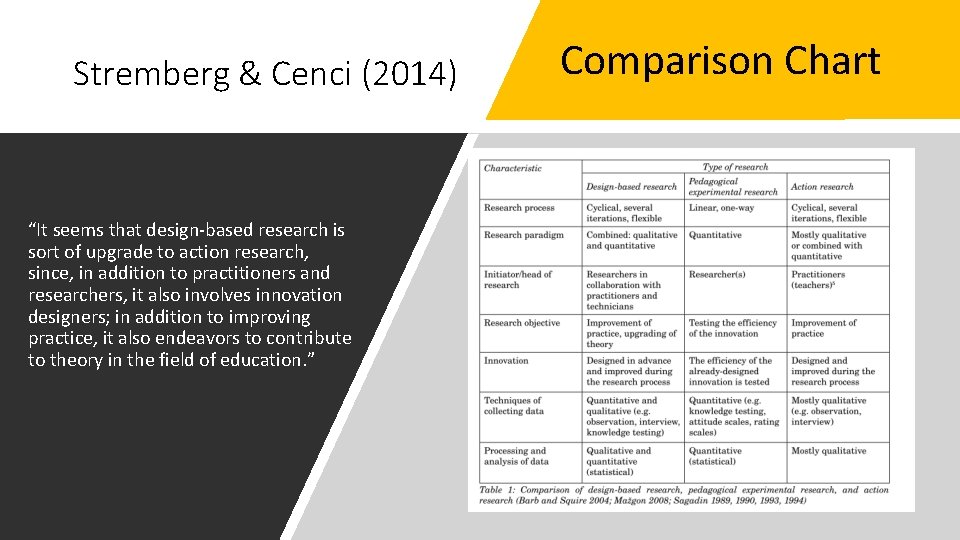
Stremberg & Cenci (2014) “It seems that design-based research is sort of upgrade to action research, since, in addition to practitioners and researchers, it also involves innovation designers; in addition to improving practice, it also endeavors to contribute to theory in the field of education. ” Comparison Chart
Additional Resources / Researchers in education Zheng (2015) – Literature review - 162 studies related to DBR utilizing content analysis method Educational Design Research (2013) Tjeerd - van den Akker, Jan, Bannan, Brenda, Kelly, Anthony E. , Nieveen, Nienke, Plomp, “design research stems from the complex nature of educational reforms worldwide”
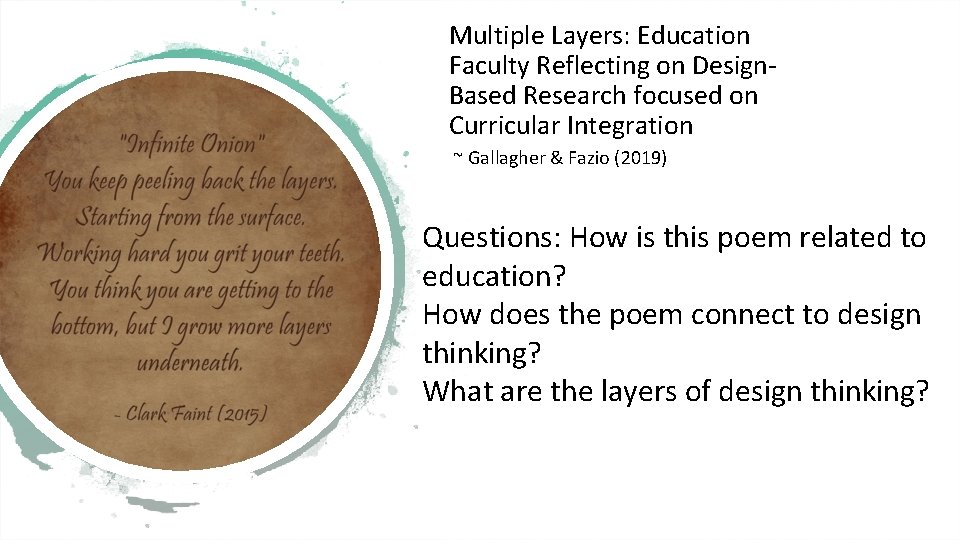
Multiple Layers: Education Faculty Reflecting on Design. Based Research focused on Curricular Integration ~ Gallagher & Fazio (2019) Questions: How is this poem related to education? How does the poem connect to design thinking? What are the layers of design thinking?
Key Components of the Article • Completed at a middle school • Used design-based research as a model to help teachers move towards disciplinary literacy (integration or science and literacy) • Qualitative – discussions, debriefings, journal reflections • Coded into three key categories: 1. researchers' impressions of the teachers' practices 2. misunderstandings around integration and disciplinary- base literacy 3. researchers' experiences of participating in DBR • Three categories = three themes of the poem • Themes describe the insights of the researchers
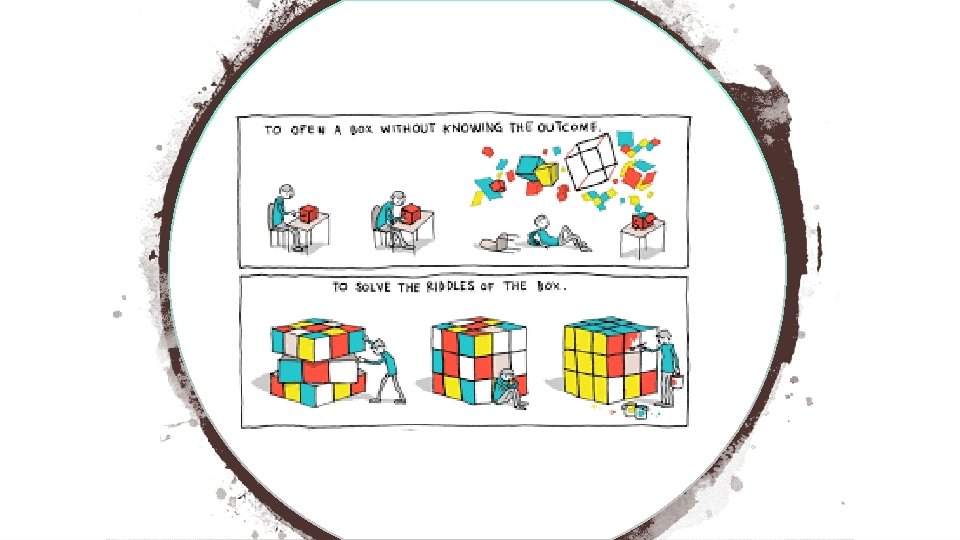
Key Conclusions • Peeling back of the layers = seeing that if teacher's do not have a strong knowledge of the curriculum, it is difficult to make it to the bottom layer. • Key components: iterative nature, scaffolding • More iterations would be needed to help to continue to 'inch teachers' along the continuum of integration • Responsive nature of DBR is a valuable component of establishing collaboration and subsequent movement towards changed integration practices • Participants expressed appreciation for the value of DBR • The authors "came to respect the utility of DBR as a theoretical framework, research method, professional learning intervention and facilitative or [their] own professional learning" (p. 54).
• Design-research utilizes qualitative research methods (and sometimes mixed methods) to collect data • A "reciprocal research and design process and methodology", where the solutions are ongoing and are reciprocal and related to each other in organic ways" Final Thoughts • An iterative cycle that includes observation and reflection is essential, with the reflective phase leading to adjustments in the initial plan and so forth • Researchers and the participants are often coinvestigators • What is to be investigated is developed and implemented as a partnership • The collaboration results in goals being tailored for the needs of a local context as well as with the researcher's agenda
Works Cited Anderson, T. , & Shattuck, J. (2012). Design-based research: A decade of progress in education research? Educational Researcher, 41(1), 16– 25. Bannan-Ritland, B. (2007). The role of design in research: The integrative learning design framework. Educational Researcher, 32(1), 21– 24. Bell, P. (2004). On theoretical breadth of design-based research in education. Educational Psychologist, 39(4), 243– 253. Bereiter, C. (2002). Design research for sustained innovation. Cognitive Studies, 9(3), 321– 327. Brown, A. L. (1992). Design experiments: Theoretical and methodological challenges in creating complex interventions in classroom settings. The Journal of the Learning Sciences, 2(2), 141– 178.
Brown, T. (2008). Design thinking. Harvard Business Review, 86(6), 252. Buchanan, R. (1999). Design research and the new learning. Design Issues, 17(4), 3– 24. Cobb, P. , Confrey, J. , Di. Sessa, A. , Lehrer, R. , & Schauble, L. (2007). Design experiments in educational research. Educational Researcher, 32(1), 3– 4. Collective, T. D. -B. R. (2003). Design-based research: An emerging paradigm for educational inquiry. Educational Research, 32(1), 5– 8. Collins, A. , Joseph, D. , & Bielaczyc, K. (2004). Design research: Theoretical and methodological Issues. Journal of the Learning Sciences, 13(1), 15– 42. Crouch, C. , & Pearce, J. (2012). Doing Research in Design. London: Berg Edelson, D. C. (2002). Design research What we learn when we engage in design. The Journal of the Learning Sciences, 11(1), 105– 121.
Gallagher, T. L. , & Fazio, X. (2019). Multiple layers: Education faculty reflecting on Design-Based Research focused on curricular integration. Qualitative Research in Education, 8(1), 27. Hoadley, C. M. (2004). Methodological alignment in design-based research. Educational Psychologist, 39(4), 203– 212. Kennedy-Clark, S. (2013). Research by design: Design-based research and the higher degree research student. Journal of Learning Design, 6(2), 26– 32. Meinel, C. , & Leifer, L. (2012). Design thinking research. In Design Thinking Research: Studying Co-Creation in Practice. New York: Springer Sandoval, W. A. , & Bell, P. (2004). Design-based research methods for studying learning in context: Introduction. Educational Psychologist, 39(4), 199– 201.
Scheer, A. , Noweski, C. , & Meinel, C. (2011). Transforming constructivist learning into action: Design Thinking in education. Design and Technology Education: An International Journal, 17(3), 8– 19. van den Akker, J. , Bannan, B. , Kelly, A. E. , Nieveen, N. , & Plomp, T. (2013). Educational design research. (T. Plomp & N. Nieveen, Eds. ), Neatherland: Netherlands Institute for Curriculum Development. Wang, F. , & Hannafin, M. J. (2005). D-based research and technologyenhanced learning environments. Educational Technology Research and Development, 53(4), 5– 23. Zheng, L. (2015). A systematic literature review of design-based research from 2004 to 2013. Journal of Computers in Education, 2(4), 399– 420.
- Slides: 25