
Designated Education Officers Orientation Office of Academic Affiliations

- Slides: 19
Designated Education Officers Orientation Office of Academic Affiliations Funding Health Professions Education Christopher T. Clarke, Ph. D, CFO and Cynthia Miller, Director of Fiscal Operations
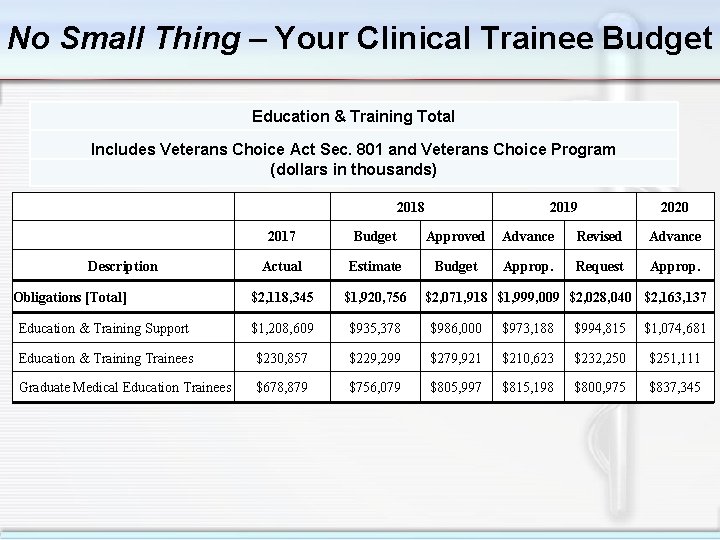
No Small Thing – Your Clinical Trainee Budget Education & Training Total Includes Veterans Choice Act Sec. 801 and Veterans Choice Program (dollars in thousands) 2017 Budget Approved Advance Revised Advance Actual Estimate Budget Approp. Request Approp. $2, 118, 345 $1, 920, 756 Education & Training Support $1, 208, 609 $935, 378 $986, 000 $973, 188 $994, 815 $1, 074, 681 Education & Training Trainees $230, 857 $229, 299 $279, 921 $210, 623 $232, 250 $251, 111 Graduate Medical Education Trainees $678, 879 $756, 079 $805, 997 $815, 198 $800, 975 $837, 345 Description Obligations [Total] 2018 2019 2020 $2, 071, 918 $1, 999, 009 $2, 028, 040 $2, 163, 137
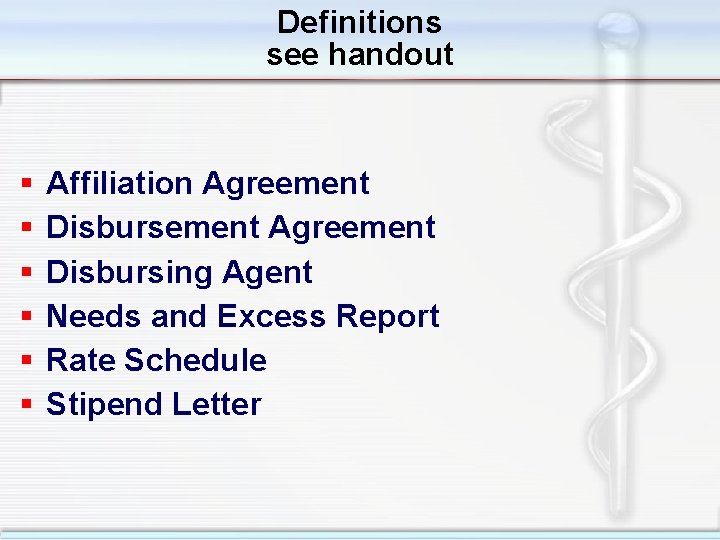
Definitions see handout § § § Affiliation Agreement Disbursement Agreement Disbursing Agent Needs and Excess Report Rate Schedule Stipend Letter
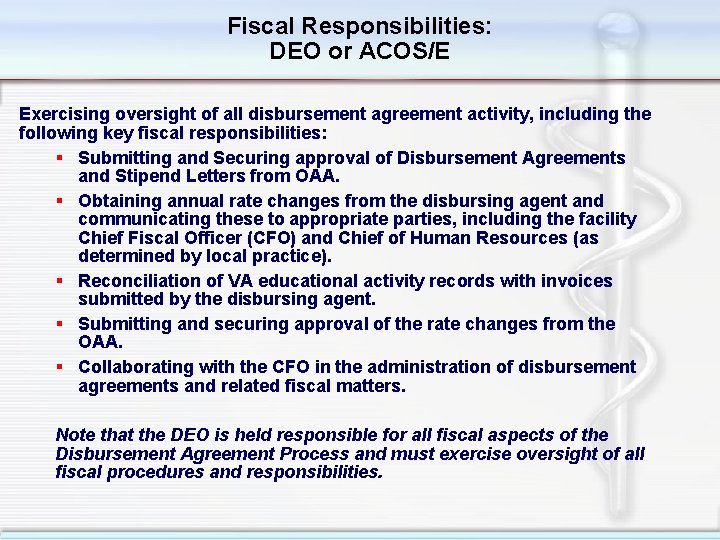
Fiscal Responsibilities: DEO or ACOS/E Exercising oversight of all disbursement agreement activity, including the following key fiscal responsibilities: § Submitting and Securing approval of Disbursement Agreements and Stipend Letters from OAA. § Obtaining annual rate changes from the disbursing agent and communicating these to appropriate parties, including the facility Chief Fiscal Officer (CFO) and Chief of Human Resources (as determined by local practice). § Reconciliation of VA educational activity records with invoices submitted by the disbursing agent. § Submitting and securing approval of the rate changes from the OAA. § Collaborating with the CFO in the administration of disbursement agreements and related fiscal matters. Note that the DEO is held responsible for all fiscal aspects of the Disbursement Agreement Process and must exercise oversight of all fiscal procedures and responsibilities.
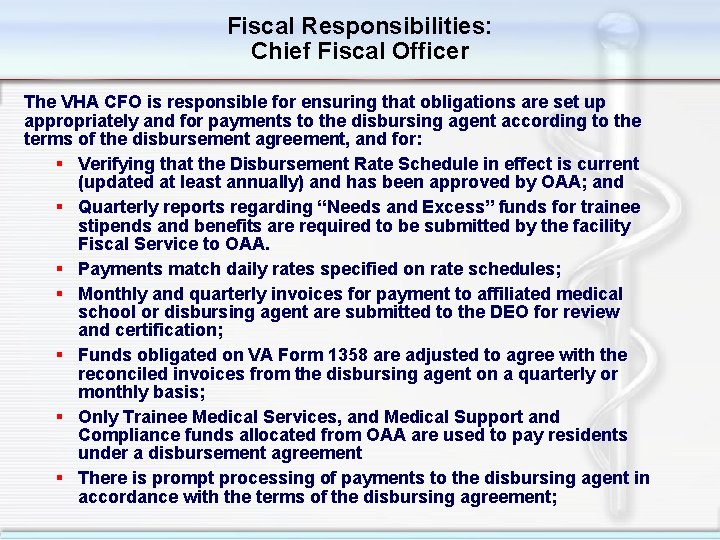
Fiscal Responsibilities: Chief Fiscal Officer The VHA CFO is responsible for ensuring that obligations are set up appropriately and for payments to the disbursing agent according to the terms of the disbursement agreement, and for: § Verifying that the Disbursement Rate Schedule in effect is current (updated at least annually) and has been approved by OAA; and § Quarterly reports regarding “Needs and Excess” funds for trainee stipends and benefits are required to be submitted by the facility Fiscal Service to OAA. § Payments match daily rates specified on rate schedules; § Monthly and quarterly invoices for payment to affiliated medical school or disbursing agent are submitted to the DEO for review and certification; § Funds obligated on VA Form 1358 are adjusted to agree with the reconciled invoices from the disbursing agent on a quarterly or monthly basis; § Only Trainee Medical Services, and Medical Support and Compliance funds allocated from OAA are used to pay residents under a disbursement agreement § There is prompt processing of payments to the disbursing agent in accordance with the terms of the disbursing agreement;
Disbursement Agreements Audit Touch Points § Current Affiliation Agreement § Current Disbursement Agreement § Approved Current Rate and Stipend Letters for each Affiliate § Number of Billed Residents § Chief Residents § Invoice Reconciliation and payment § Needs and Excess Reporting Activity
Stipend Trainees Audit Touch Points § Current Stipend Letter if Physician/Dental Residents § Stipend Rates are up to date in HRIS § Stipends for OAA Trainees must be paid using OAA funds § Removed trainees from OAA funding when done with rotation (trainees converted to employees) § Clear payroll on-boarding and off-boarding SOP § Only OAA authorized and approved positions can be paid by OAA funding § Stipends funded for less than 2080 hours (e. g. , PT, OT, social work, etc. ) must be tracked. At the time the trainee has been paid for the approved number of hours they must be transferred to WOC appointment
OAA Budget Process Execution § Issuance of Initial Target Allowance § Sent to VHA Fiscal Service § VHA Fiscal sends to VAMC Quarterly § Adjustments via Quarterly Needs and Excess Report § July 1 st – Forth Quarter Target Allowance § For New Position Starts § Goes out in addition to Initial Target Quarterly Amount
Field/OAA Fiscal Timelines § Sept – OAA releases the upcoming FY’s Target Allowance (Trainee Funding) to VHA Fiscal Service § Oct – VHA Finance Office releases the quarterly Target Allowance to VAMCs (depending on Congress, i. e. , budget impacts, Finance’s release of funds could be delayed) § Dec – Needs/Excess (1 st qtr). § Jan/Feb – begin submitting updated Rate Schedules and Stipend Memos § March – Needs/Excess (2 nd qtr) § June – Needs/Excess (3 nd qtr) § July – New Academic Year (position starts) § Aug – Needs/Excess (4 th qtr); and the release of funds for 4 th qtr position starts § This NE call is early due to VACO Fiscal Service changes in cut-off times. This will result in you having to work with the affiliates to ‘estimate’ the 4 th qtr bills.
Rate Schedules § A disbursement agreement rate schedule is a payroll mechanism by which VA allows a disbursing agent to centrally administer salary payments and fringe benefits for medical and dental residents assigned to a VA facility. § Rate Schedules must be updated at least annually. § You can begin submitting your updated rates in January. § They may updated more often if needed, i. e. , every time rates change. § Rate Schedules are used for: (among other things) § Calculations in the Target Allowance. § Analyze Needs/Excess requests. § Rate Schedules are used to help Verify Bills and Costs when questions arise in our office regarding Needs/Excess requests.
Needs and Excess Report § The quarterly needs and excess report is a mechanism by which field facilities report a need for additional funds or an excess of funds in a particular program for their trainees. § Each facility uses the needs and excess table to indicate the name of the program, the needs/excess code for that program and the additional amount needed or to be withdrawn.
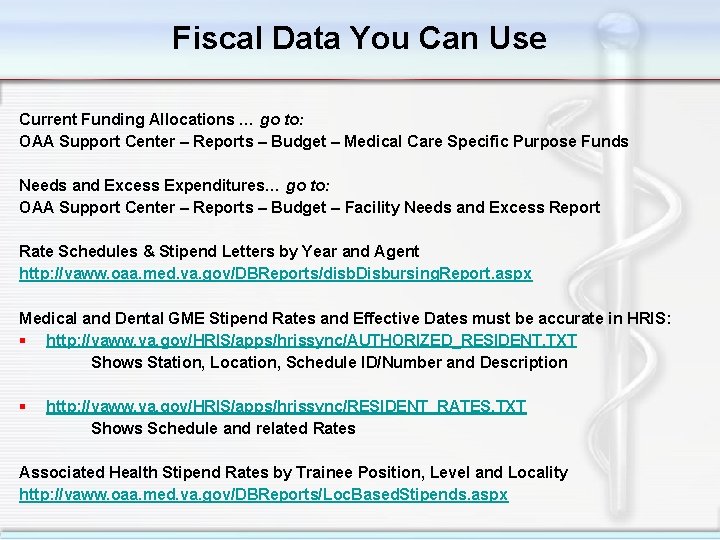
Fiscal Data You Can Use Current Funding Allocations … go to: OAA Support Center – Reports – Budget – Medical Care Specific Purpose Funds Needs and Excess Expenditures… go to: OAA Support Center – Reports – Budget – Facility Needs and Excess Report Rate Schedules & Stipend Letters by Year and Agent http: //vaww. oaa. med. va. gov/DBReports/disb. Disbursing. Report. aspx Medical and Dental GME Stipend Rates and Effective Dates must be accurate in HRIS: § http: //vaww. va. gov/HRIS/apps/hrissync/AUTHORIZED_RESIDENT. TXT Shows Station, Location, Schedule ID/Number and Description § http: //vaww. va. gov/HRIS/apps/hrissync/RESIDENT_RATES. TXT Shows Schedule and related Rates Associated Health Stipend Rates by Trainee Position, Level and Locality http: //vaww. oaa. med. va. gov/DBReports/Loc. Based. Stipends. aspx
VERA Educational Support Supplement Indirect Facility Support § Requested with OAA’s President’s Budget § Reserved for administrative costs associated with graduate medical education and associated health training programs § Allocated by ARC directly to VA Medical Centers as part of Veterans Equitable Resource Allocation (VERA) Funding § Administered by VA Medical Centers § Established by 1997 EDM § New Calculation Methodology approved 2017
VESS Intended Use To cover the portion of salary of VA staff who are instructors for residents and trainees (paid and unpaid) in approved training programs; Administrative support such as personnel, supplies, accreditation fees, books, and other program costs necessary to manage clinical education programs, and Educational Cost Contracts.
VESS New Model Started in FY 17 New calculation uses both GME and Non-GME FTE Was Mis-Understood
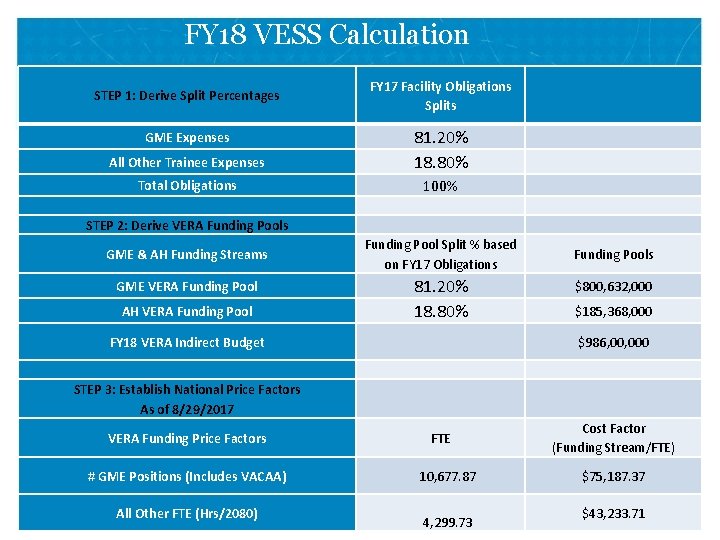
FY 18 VESS Calculation STEP 1: Derive Split Percentages FY 17 Facility Obligations Splits All Other Trainee Expenses 81. 20% 18. 80% Total Obligations 100% GME Expenses STEP 2: Derive VERA Funding Pools GME & AH Funding Streams GME VERA Funding Pool AH VERA Funding Pool Split % based on FY 17 Obligations 81. 20% 18. 80% FY 18 VERA Indirect Budget Funding Pools $800, 632, 000 $185, 368, 000 $986, 000 STEP 3: Establish National Price Factors As of 8/29/2017 VERA Funding Price Factors # GME Positions (Includes VACAA) FTE 10, 677. 87 VETERANS HEALTH ADMINISTRATION All Other FTE (Hrs/2080) 4, 299. 73 Cost Factor (Funding Stream/FTE) $75, 187. 37 $43, 233. 71
VERA Indirect Funding Reports Allocation Resource Center http: //vaww. arc. med. va. gov/ § FY 18 VERA Specific Purpose Funding § FY 18 Position Distribution § MCAS – Medical Center Allocation System
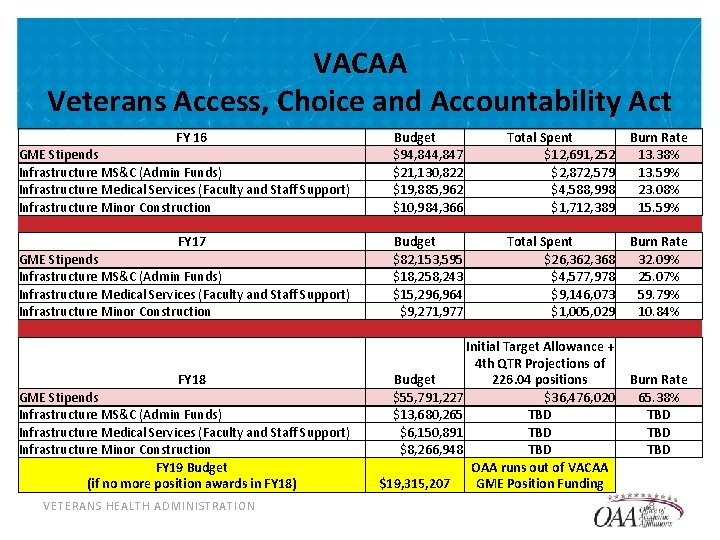
VACAA Veterans Access, Choice and Accountability Act FY 16 GME Stipends Infrastructure MS&C (Admin Funds) Infrastructure Medical Services (Faculty and Staff Support) Infrastructure Minor Construction FY 17 GME Stipends Infrastructure MS&C (Admin Funds) Infrastructure Medical Services (Faculty and Staff Support) Infrastructure Minor Construction FY 18 GME Stipends Infrastructure MS&C (Admin Funds) Infrastructure Medical Services (Faculty and Staff Support) Infrastructure Minor Construction FY 19 Budget (if no more position awards in FY 18) VETERANS HEALTH ADMINISTRATION Budget $94, 847 $21, 130, 822 $19, 885, 962 $10, 984, 366 Total Spent $12, 691, 252 $2, 872, 579 $4, 588, 998 $1, 712, 389 Burn Rate 13. 38% 13. 59% 23. 08% 15. 59% Budget $82, 153, 595 $18, 258, 243 $15, 296, 964 $9, 271, 977 Total Spent $26, 362, 368 $4, 577, 978 $9, 146, 073 $1, 005, 029 Burn Rate 32. 09% 25. 07% 59. 79% 10. 84% Initial Target Allowance + 4 th QTR Projections of Budget 226. 04 positions $55, 791, 227 $36, 476, 020 $13, 680, 265 TBD $6, 150, 891 TBD $8, 266, 948 TBD OAA runs out of VACAA $19, 315, 207 GME Position Funding Burn Rate 65. 38% TBD TBD 18
Questions O F F I C E O F A C A D E M I C A F F I L I A T I O N S