
Design YOUR hypothetical experiment Remember that all experiments
Design YOUR (hypothetical) experiment Remember, that all experiments are not the same… Some require significantly more work to set up than others. The easiest to control is called a PRODUCT TEST.
Controlled Product Test Experiments • The easiest type of experiment to control is something called a product test. • This type of experiment allows you to keep everything closely controlled, and then just change a single part (product) as your independent variable. • These are particularly desirable for making an easy control setup. • All you need to do is have one group not receive the product
Think of some product • Now, think of a (school appropriate) product that you use because you believe it does something. • Go to the Teams assignment page and type in this product. • Then, fill out the “problem” for what you don’t know about this product.
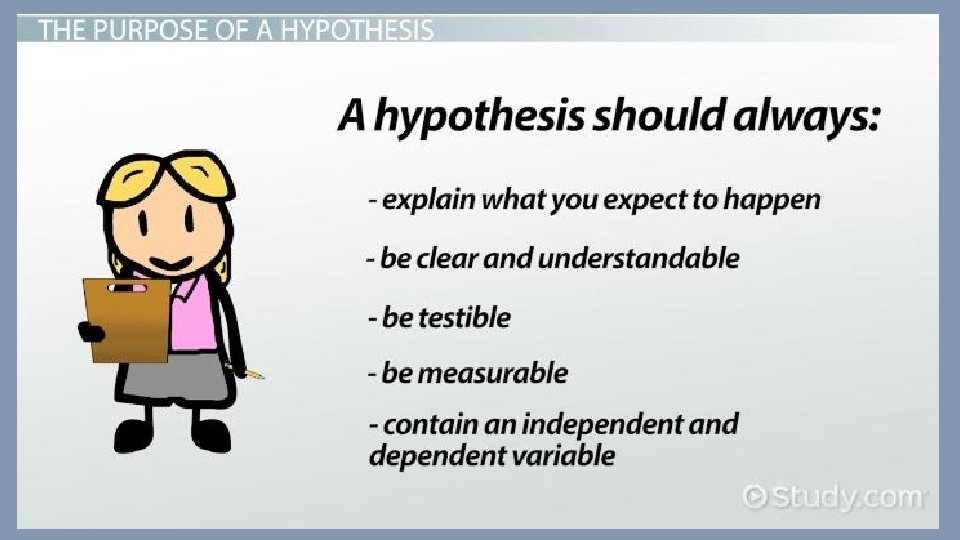
H: • A testable hypothesis, which is clearly stated WITH what is expected to occur in the experiment. • What is testable? • What do you think this product does for you? • How would you be able to measure what it does for you?
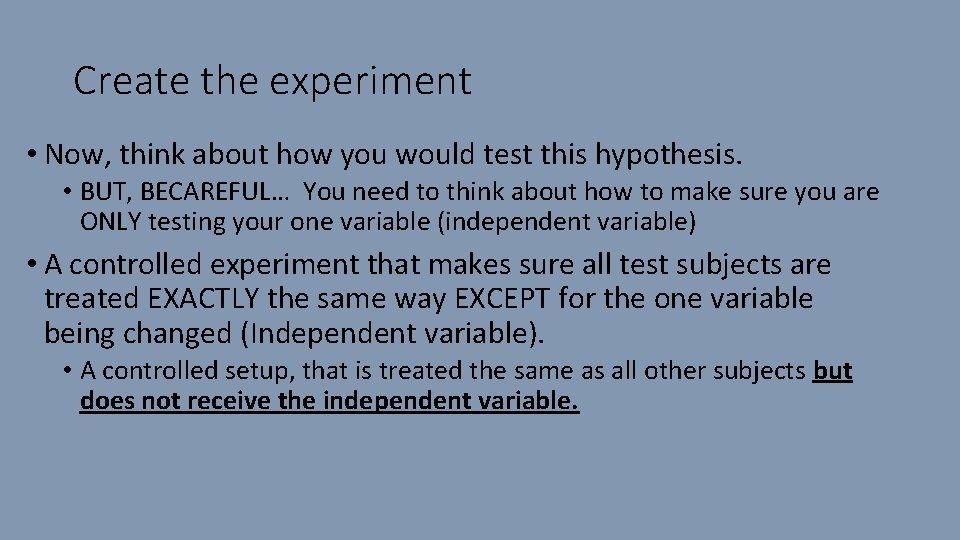
Create the experiment • Now, think about how you would test this hypothesis. • BUT, BECAREFUL… You need to think about how to make sure you are ONLY testing your one variable (independent variable) • A controlled experiment that makes sure all test subjects are treated EXACTLY the same way EXCEPT for the one variable being changed (Independent variable). • A controlled setup, that is treated the same as all other subjects but does not receive the independent variable.
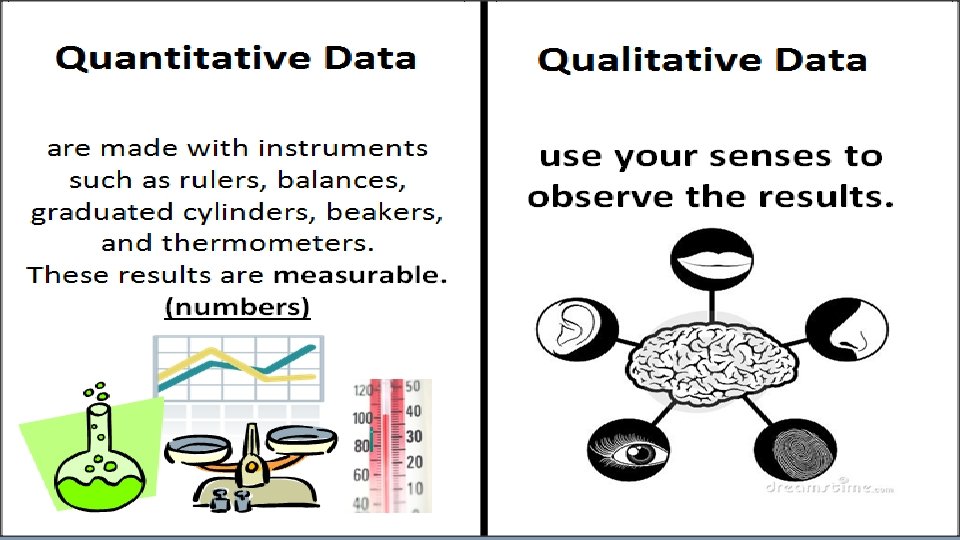
Dependent Variable AND Observations • Data collection (dependent variable) that shows trends and quantitative (numerical) data. • All observations should also be recorded. • This is your qualitative observations
Proper Conclusion • A conclusion that starts by restating your hypothesis and discussing if it was correct or not using the actual data from the experiment. • Should always: • • Include data reference Error Further study Relevance to science/world
Peer Review • Any good experiment should be able to stand up to “peer review” (which is why we should trust in the accuracy of science. ) • This means • Experimental data should be reproducible • Procedure should be written in a way that it can be reproduced exactly • Data and trends should be illustrated so anyone can read it • Conclusion should be defended and tied to the data • This is why, even though an experiment/publication/scientist CAN BE WRONG, but science itself is above conspiracy as a whole.
- Slides: 10