
Design Tools for Architectured Bioinspired ActuatorsSensors N Vermaak
Design Tools for Architectured Bio-inspired Actuators/Sensors N. Vermaak 1, G. Michailidis 2, G. Parry 1, R. Estevez 1, G. Allaire 2, Y. Bréchet 1 1 Univ. Grenoble SIMAP; 2 Ecole Polytechnique CMAP March 15, 2013 Workshop for the Cours Architectures hiérarchisées : les leçons du vivant
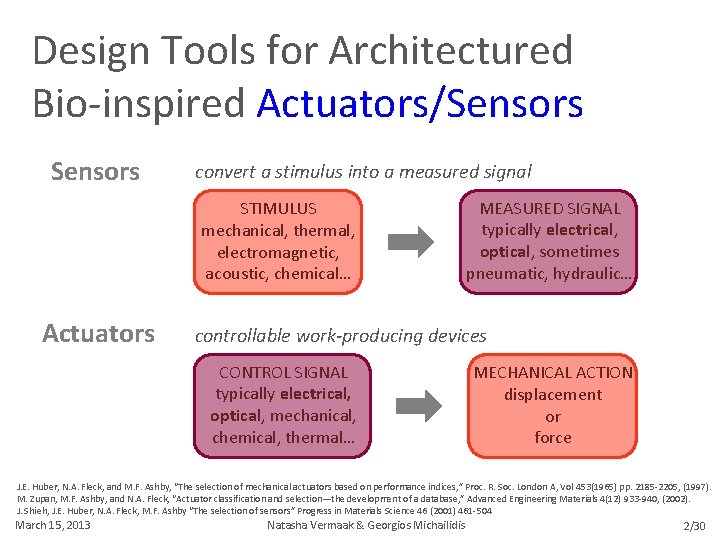
Design Tools for Architectured Bio-inspired Actuators/Sensors convert a stimulus into a measured signal STIMULUS mechanical, thermal, electromagnetic, acoustic, chemical… Actuators MEASURED SIGNAL typically electrical, optical, sometimes pneumatic, hydraulic… controllable work-producing devices CONTROL SIGNAL typically electrical, optical, mechanical, chemical, thermal… MECHANICAL ACTION displacement or force J. E. Huber, N. A. Fleck, and M. F. Ashby, “The selection of mechanical actuators based on performance indices, ” Proc. R. Soc. London A, Vol 453(1965) pp. 2185 -2205, (1997). M. Zupan, M. F. Ashby, and N. A. Fleck, “Actuator classification and selection—the development of a database, ” Advanced Engineering Materials 4(12) 933 -940, (2002). J. Shieh, J. E. Huber, N. A. Fleck, M. F. Ashby “The selection of sensors” Progress in Materials Science 46 (2001) 461 -504 March 15, 2013 Natasha Vermaak & Georgios Michailidis 2/30

Design Tools for Architectured Bio-inspired Actuators/Sensors convert a stimulus into a measured signal MEASURED SIGNAL STIMULUS typically electrical, mechanical, thermal, optical, sometimes electromagnetic, acoustic, chemical… Y. Forterre, J. M. Skothelm, J. Dumals, pneumatic, L. Mahadevan, “Howhydraulic… the Venus Flytrap Snaps”, Nature http: //en. wikipedia. org/wiki/Bimetallic_strip Vol. 433, No. 27, pp. 421 -425, 2005. Actuators controllable work-producing devices CONTROL SIGNAL typically electrical, optical, mechanical, chemical, thermal… MECHANICAL ACTION displacement or force J. E. Huber, N. A. Fleck, and M. F. Ashby, “The selection of mechanical actuators based on performance indices, ” Proc. R. Soc. London A, Vol 453(1965) pp. 2185 -2205, (1997). M. Zupan, M. F. Ashby, and N. A. Fleck, “Actuator classification and selection—the development of a database, ” Advanced Engineering Materials 4(12) 933 -940, (2002). J. Shieh, J. E. Huber, N. A. Fleck, M. F. Ashby “The selection of sensors” Progress in Materials Science 46 (2001) 461 -504 March 15, 2013 Natasha Vermaak & Georgios Michailidis 3/30
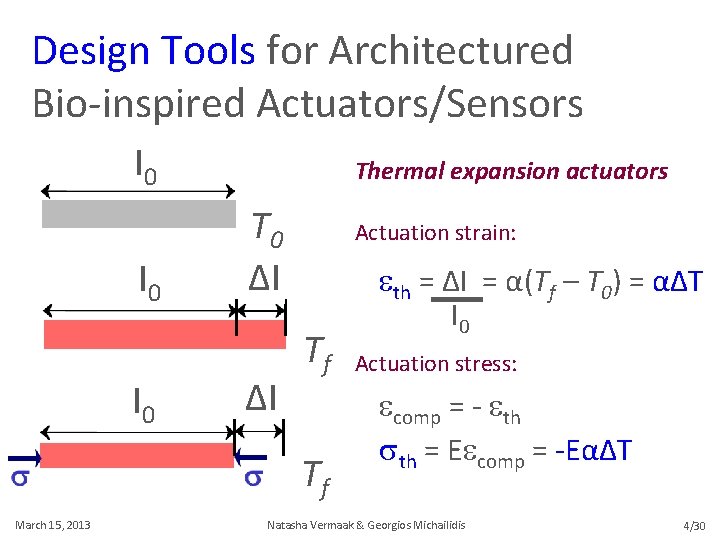
Design Tools for Architectured Bio-inspired Actuators/Sensors l 0 l 0 Thermal expansion actuators T 0 Δl Δl Actuation strain: Tf Tf March 15, 2013 eth = Δl = α(Tf – T 0) = αΔT l 0 Actuation stress: ecomp = - eth sth = Eecomp = -EαΔT Natasha Vermaak & Georgios Michailidis 4/30
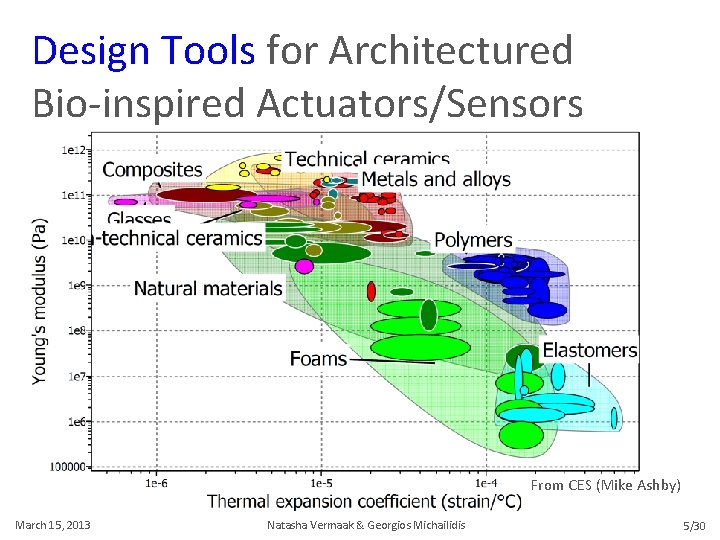
Design Tools for Architectured Bio-inspired Actuators/Sensors From CES (Mike Ashby) March 15, 2013 Natasha Vermaak & Georgios Michailidis 5/30
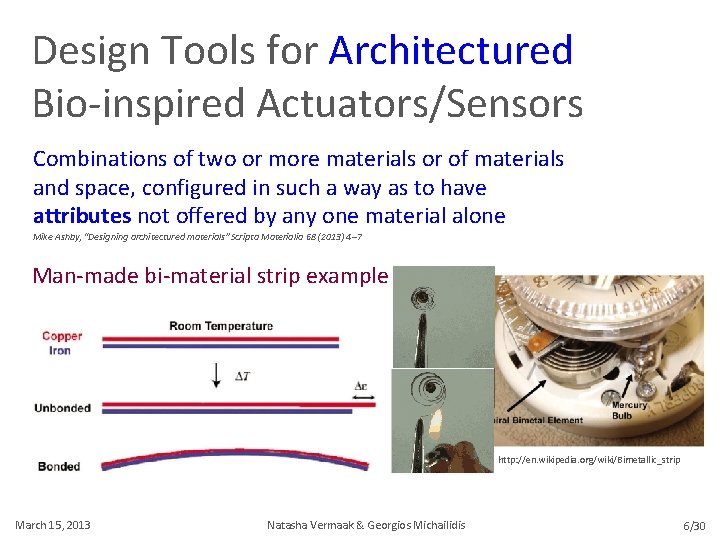
Design Tools for Architectured Bio-inspired Actuators/Sensors Combinations of two or more materials or of materials and space, configured in such a way as to have attributes not offered by any one material alone Mike Ashby, “Designing architectured materials” Scripta Materialia 68 (2013) 4– 7 Man-made bi-material strip example http: //en. wikipedia. org/wiki/Bimetallic_strip March 15, 2013 Natasha Vermaak & Georgios Michailidis 6/30

Design Tools for Architectured Bio-inspired Actuators/Sensors Combinations of two or more materials or of materials and space, configured in such a way as to have attributes not offered by any one material alone Mike Ashby, “Designing architectured materials” Scripta Materialia 68 (2013) 4– 7 Biological bi-material strip example Mechanics Without Muscle: Biomechanical Inspiration from the Plant World, MARTONE et al, Integrative and Comparative Biology, pp. 1– 20; doi: 10. 1093/icb/icq 122 J. W. C. Dunlop, R. Weinkamer, and P. Fratzl, “Artful interfaces within biological materials”, Materials Today Vol. 14, No. 3, pp. 7078, 2011. March 15, 2013 Natasha Vermaak & Georgios Michailidis 7/30
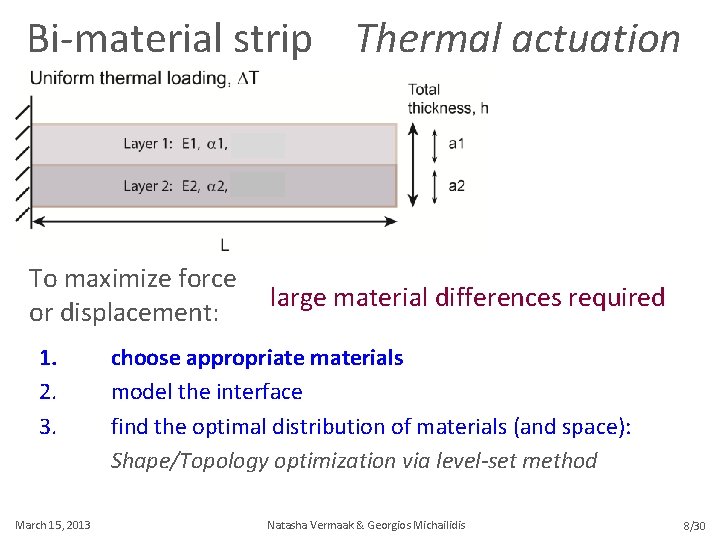
Bi-material strip Thermal actuation To maximize force or displacement: 1. 2. 3. March 15, 2013 large material differences required choose appropriate materials model the interface find the optimal distribution of materials (and space): Shape/Topology optimization via level-set method Natasha Vermaak & Georgios Michailidis 8/30
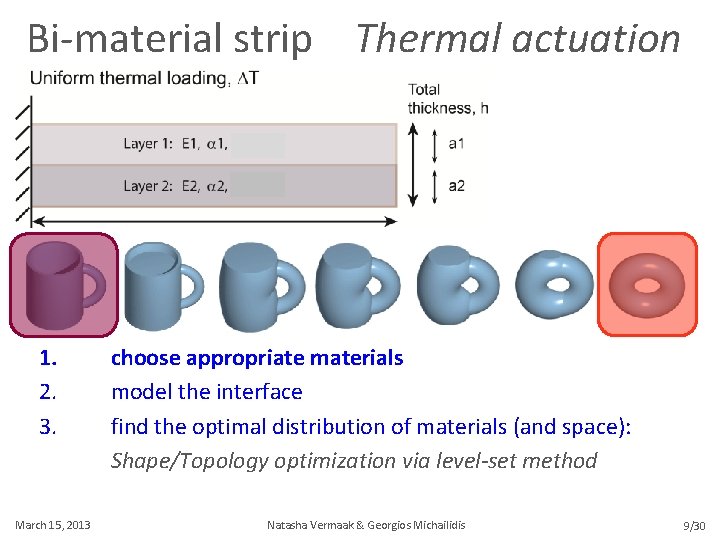
Bi-material strip Thermal actuation To maximize force or displacement: 1. 2. 3. March 15, 2013 large material differences required choose appropriate materials model the interface find the optimal distribution of materials (and space): Shape/Topology optimization via level-set method Natasha Vermaak & Georgios Michailidis 9/30

Design Tools for Architectured Bio-inspired Actuators/Sensors From CES (Mike Ashby) March 15, 2013 Natasha Vermaak & Georgios Michailidis 10/30

Young’s Modulus (E) Usually, stronger bonds ~ steeper potential energy wells ~ stiffer materials ~ ↑E March 15, 2013 Natasha Vermaak&Georgios. Michailidis 11/30
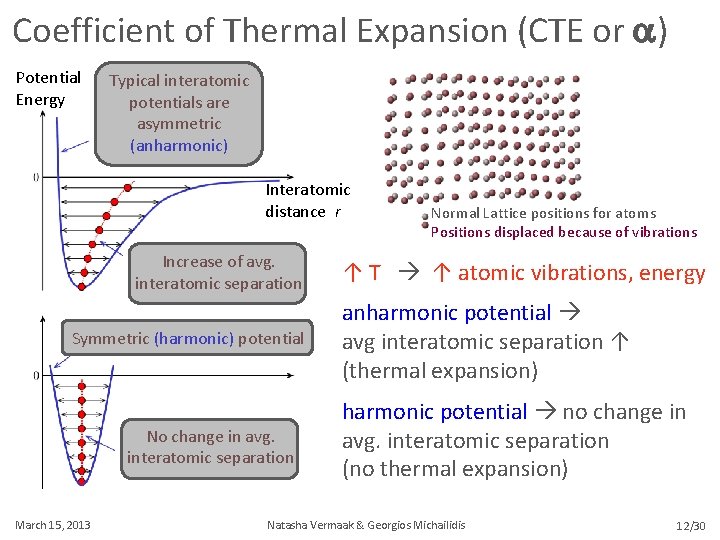
Coefficient of Thermal Expansion (CTE or a) Potential Energy Typical interatomic potentials are asymmetric (anharmonic) Interatomic distance r Increase of avg. interatomic separation Symmetric (harmonic) potential No change in avg. interatomic separation March 15, 2013 Normal Lattice positions for atoms Positions displaced because of vibrations ↑ T ↑ atomic vibrations, energy anharmonic potential avg interatomic separation ↑ (thermal expansion) harmonic potential no change in avg. interatomic separation (no thermal expansion) Natasha Vermaak & Georgios Michailidis 12/30
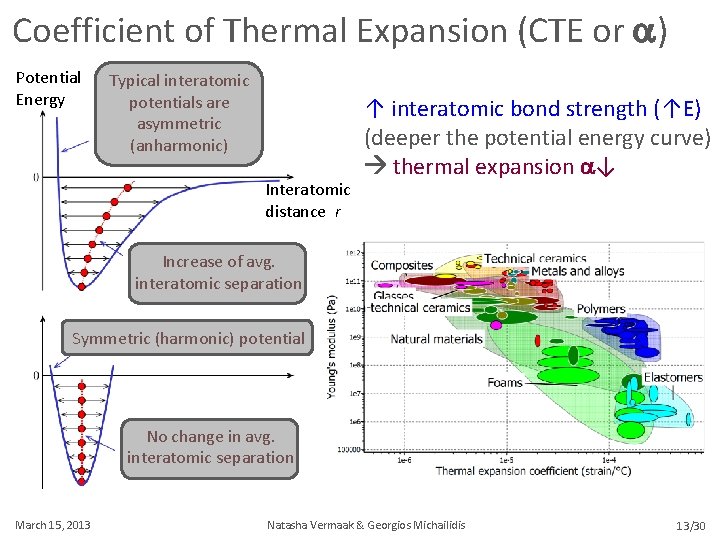
Coefficient of Thermal Expansion (CTE or a) Potential Energy Typical interatomic potentials are asymmetric (anharmonic) Interatomic distance r ↑ interatomic bond strength (↑E) (deeper the potential energy curve) thermal expansion a↓ Increase of avg. interatomic separation Symmetric (harmonic) potential No change in avg. interatomic separation March 15, 2013 Natasha Vermaak & Georgios Michailidis 13/30
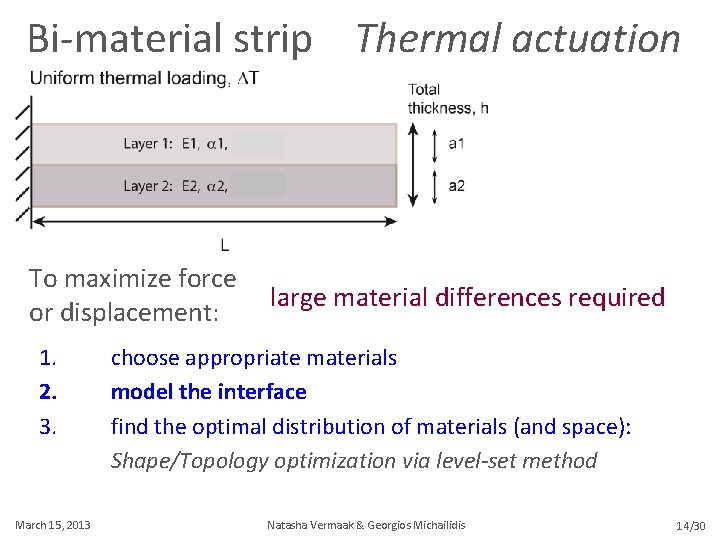
Bi-material strip Thermal actuation To maximize force or displacement: 1. 2. 3. March 15, 2013 large material differences required choose appropriate materials model the interface find the optimal distribution of materials (and space): Shape/Topology optimization via level-set method Natasha Vermaak & Georgios Michailidis 14/30
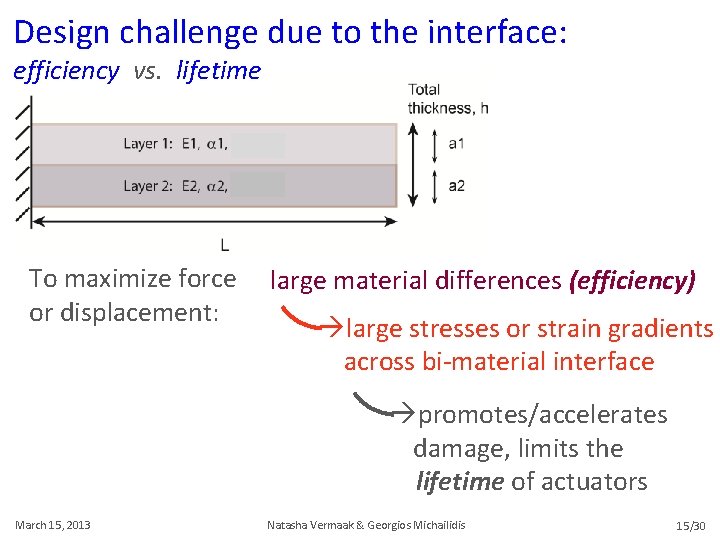
Design challenge due to the interface: efficiency vs. lifetime To maximize force or displacement: large material differences (efficiency) large stresses or strain gradients across bi-material interface promotes/accelerates damage, limits the lifetime of actuators March 15, 2013 Natasha Vermaak & Georgios Michailidis 15/30
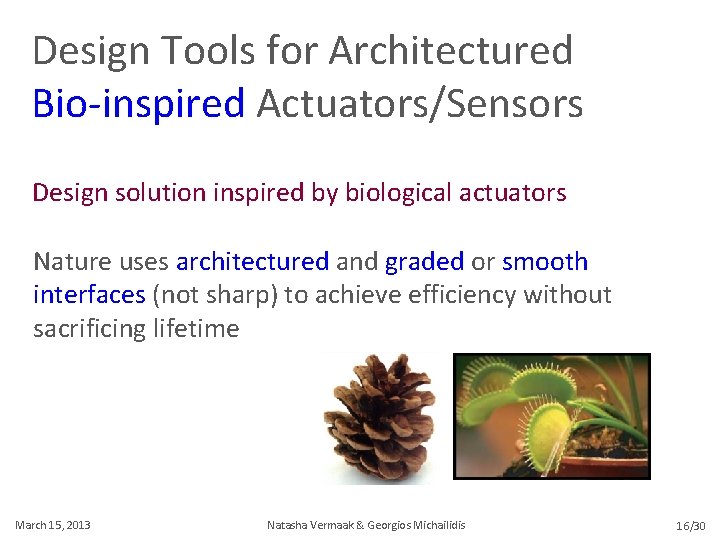
Design Tools for Architectured Bio-inspired Actuators/Sensors Design solution inspired by biological actuators Nature uses architectured and graded or smooth interfaces (not sharp) to achieve efficiency without sacrificing lifetime March 15, 2013 Natasha Vermaak & Georgios Michailidis 16/30
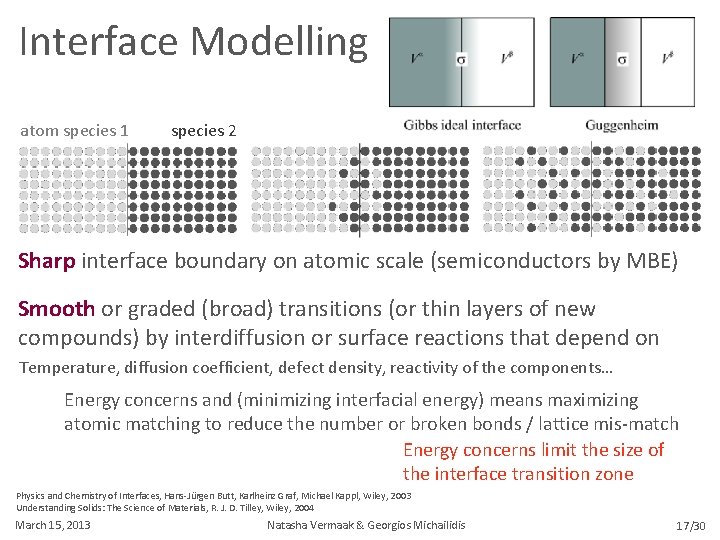
Interface Modelling atom species 1 species 2 Sharp interface boundary on atomic scale (semiconductors by MBE) Smooth or graded (broad) transitions (or thin layers of new compounds) by interdiffusion or surface reactions that depend on Temperature, diffusion coefficient, defect density, reactivity of the components… Energy concerns and (minimizing interfacial energy) means maximizing atomic matching to reduce the number or broken bonds / lattice mis-match Energy concerns limit the size of the interface transition zone Physics and Chemistry of Interfaces, Hans-Jürgen Butt, Karlheinz Graf, Michael Kappl, Wiley, 2003 Understanding Solids: The Science of Materials, R. J. D. Tilley, Wiley, 2004 March 15, 2013 Natasha Vermaak & Georgios Michailidis 17/30
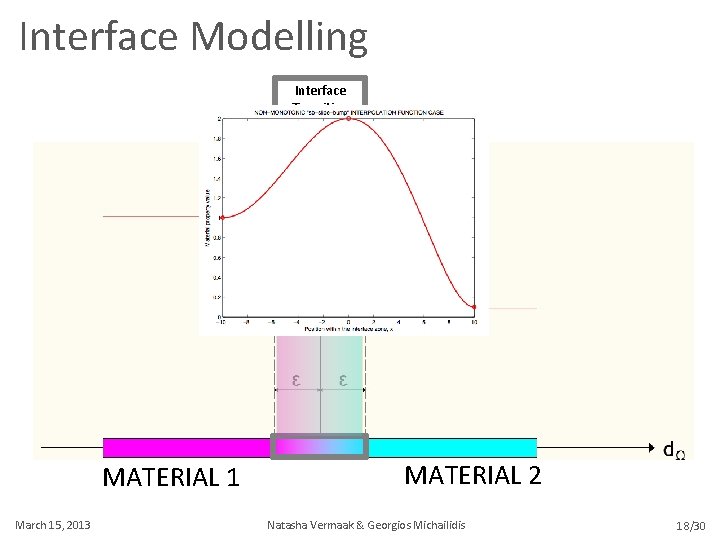
Interface Modelling Interface Transition ZONE MATERIAL 1 March 15, 2013 MATERIAL 2 Natasha Vermaak & Georgios Michailidis 18/30
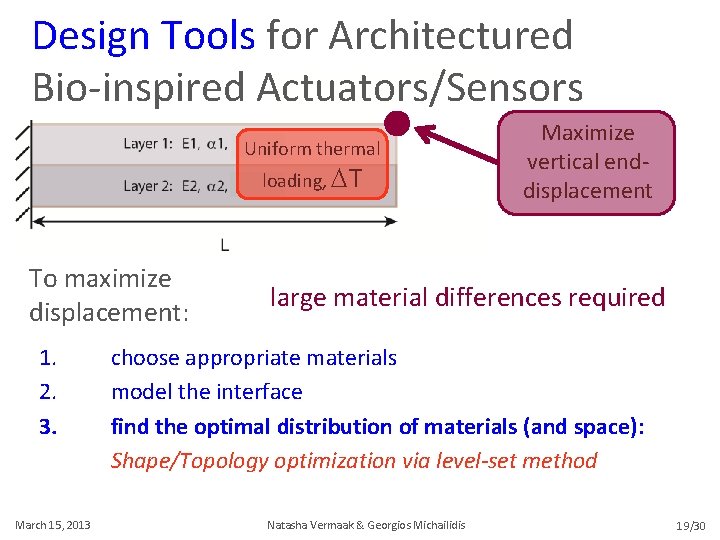
Design Tools for Architectured Bio-inspired Actuators/Sensors Uniform thermal loading, DT To maximize displacement: 1. 2. 3. March 15, 2013 Maximize vertical enddisplacement large material differences required choose appropriate materials model the interface find the optimal distribution of materials (and space): Shape/Topology optimization via level-set method Natasha Vermaak & Georgios Michailidis 19/30
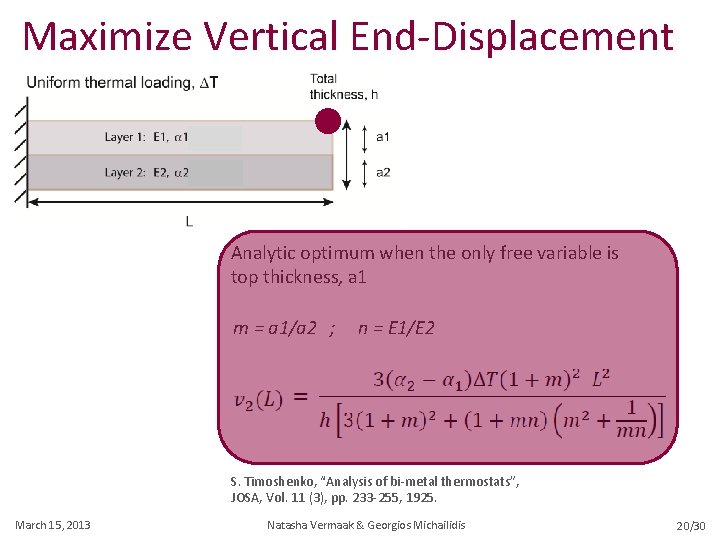
Maximize Vertical End-Displacement Analytic optimum when the only free variable is top thickness, a 1 m = a 1/a 2 ; n = E 1/E 2 S. Timoshenko, “Analysis of bi-metal thermostats”, JOSA, Vol. 11 (3), pp. 233 -255, 1925. March 15, 2013 Natasha Vermaak & Georgios Michailidis 20/30
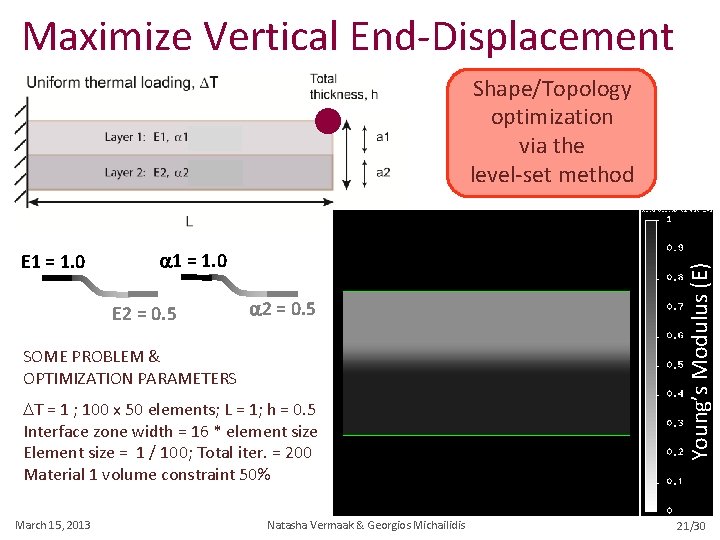
Maximize Vertical End-Displacement E 1 = 1. 0 a 1 = 1. 0 E 2 = 0. 5 a 2 = 0. 5 SOME PROBLEM & OPTIMIZATION PARAMETERS DT = 1 ; 100 x 50 elements; L = 1; h = 0. 5 Interface zone width = 16 * element size Element size = 1 / 100; Total iter. = 200 Material 1 volume constraint 50% March 15, 2013 Natasha Vermaak & Georgios Michailidis Young’s Modulus (E) Shape/Topology optimization via the level-set method 21/30
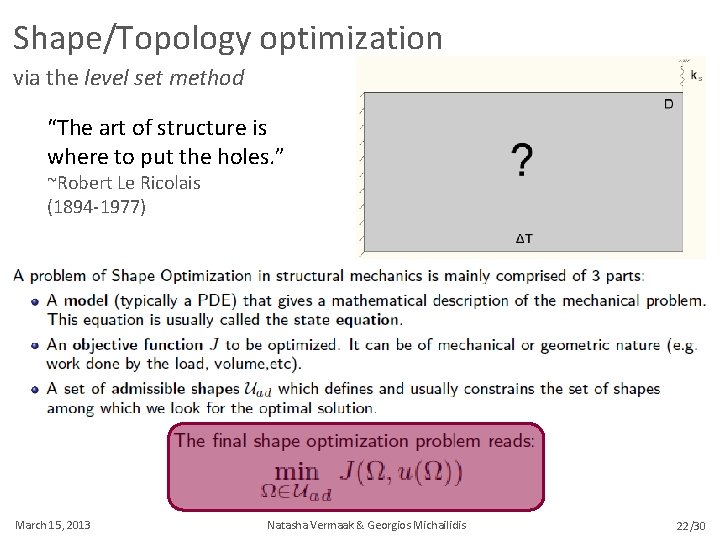
Shape/Topology optimization via the level set method “The art of structure is where to put the holes. ” ~Robert Le Ricolais (1894 -1977) March 15, 2013 Natasha Vermaak & Georgios Michailidis 22/30
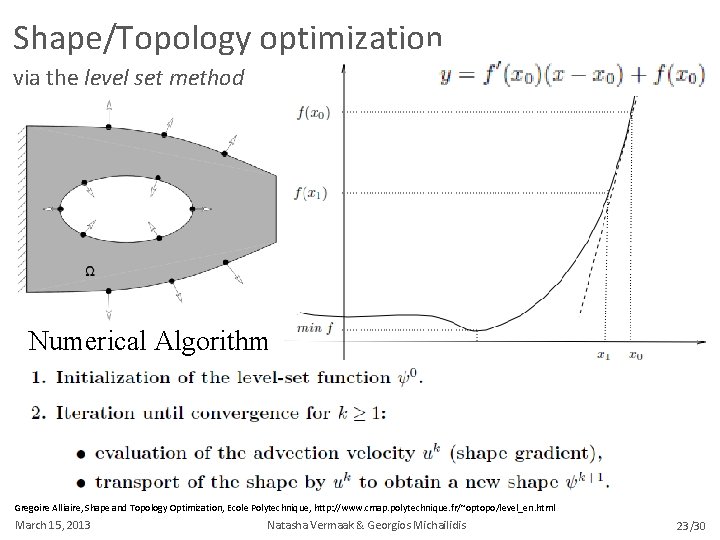
Shape/Topology optimization via the level set method Numerical Algorithm Gregoire Alliaire, Shape and Topology Optimization, Ecole Polytechnique, http: //www. cmap. polytechnique. fr/~optopo/level_en. html March 15, 2013 Natasha Vermaak & Georgios Michailidis 23/30
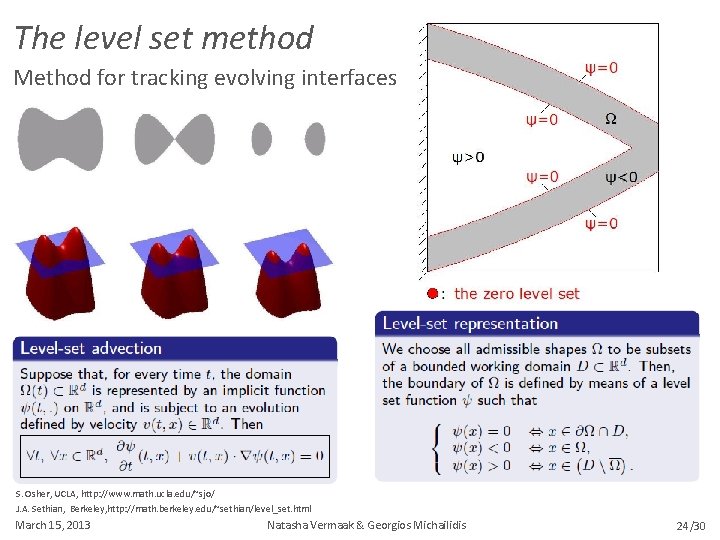
The level set method Method for tracking evolving interfaces S. Osher, UCLA, http: //www. math. ucla. edu/~sjo/ J. A. Sethian, Berkeley, http: //math. berkeley. edu/~sethian/level_set. html March 15, 2013 Natasha Vermaak & Georgios Michailidis 24/30
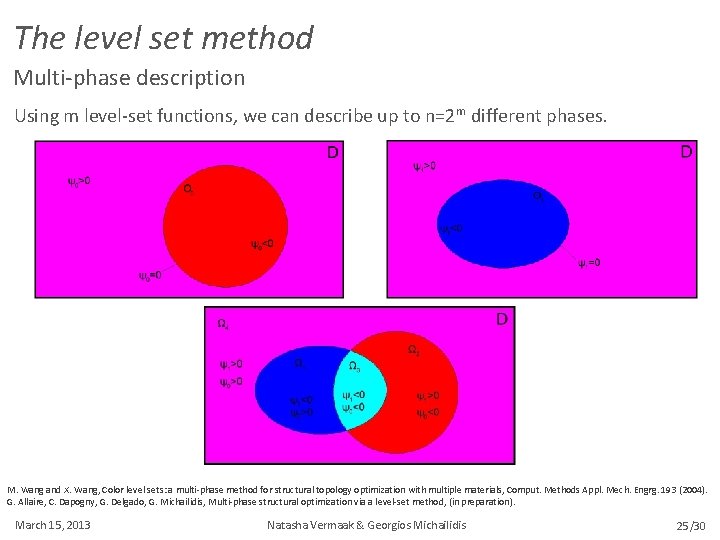
The level set method Multi-phase description Using m level-set functions, we can describe up to n=2 m different phases. M. Wang and X. Wang, Color level sets: a multi-phase method for structural topology optimization with multiple materials, Comput. Methods Appl. Mech. Engrg. 193 (2004). G. Allaire, C. Dapogny, G. Delgado, G. Michailidis, Multi-phase structural optimization via a level-set method, (in preparation). March 15, 2013 Natasha Vermaak & Georgios Michailidis 25/30
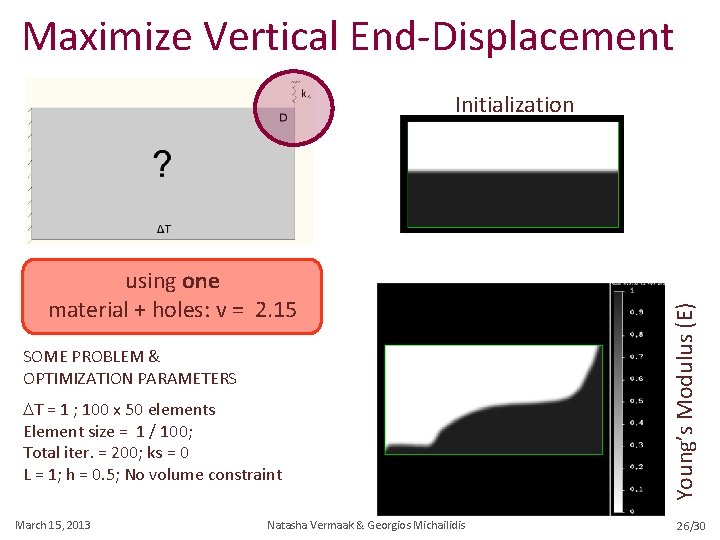
Maximize Vertical End-Displacement using one material + holes: v = 2. 15 SOME PROBLEM & OPTIMIZATION PARAMETERS DT = 1 ; 100 x 50 elements Element size = 1 / 100; Total iter. = 200; ks = 0 L = 1; h = 0. 5; No volume constraint March 15, 2013 Natasha Vermaak & Georgios Michailidis Young’s Modulus (E) Initialization 26/30
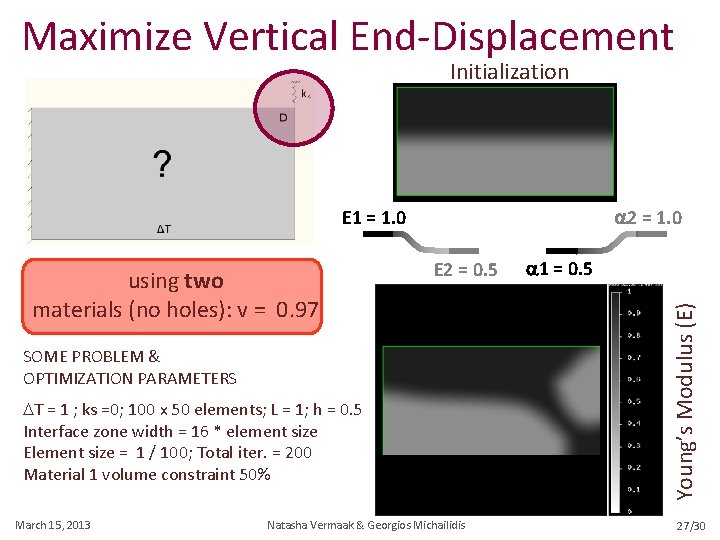
Maximize Vertical End-Displacement Initialization a 2 = 1. 0 E 1 = 1. 0 SOME PROBLEM & OPTIMIZATION PARAMETERS DT = 1 ; ks =0; 100 x 50 elements; L = 1; h = 0. 5 Interface zone width = 16 * element size Element size = 1 / 100; Total iter. = 200 Material 1 volume constraint 50% March 15, 2013 Natasha Vermaak & Georgios Michailidis a 1 = 0. 5 Young’s Modulus (E) using two materials (no holes): v = 0. 97 E 2 = 0. 5 27/30
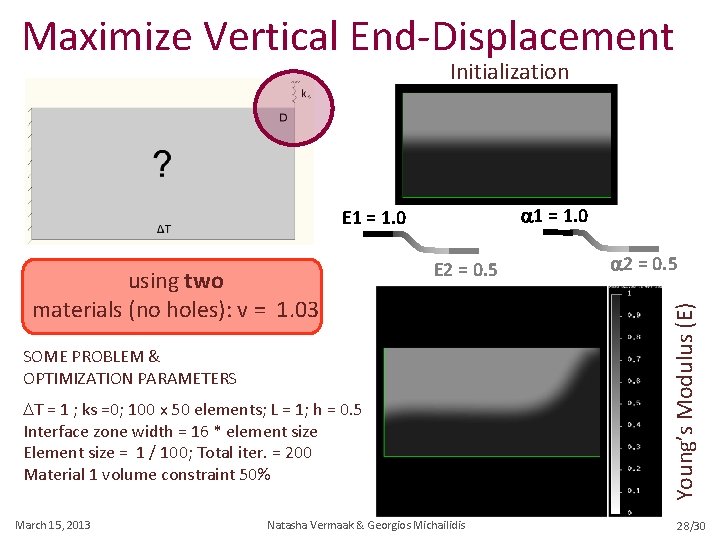
Maximize Vertical End-Displacement Initialization a 1 = 1. 0 using two materials (no holes): v = 1. 03 E 2 = 0. 5 SOME PROBLEM & OPTIMIZATION PARAMETERS DT = 1 ; ks =0; 100 x 50 elements; L = 1; h = 0. 5 Interface zone width = 16 * element size Element size = 1 / 100; Total iter. = 200 Material 1 volume constraint 50% March 15, 2013 Natasha Vermaak & Georgios Michailidis a 2 = 0. 5 Young’s Modulus (E) E 1 = 1. 0 28/30
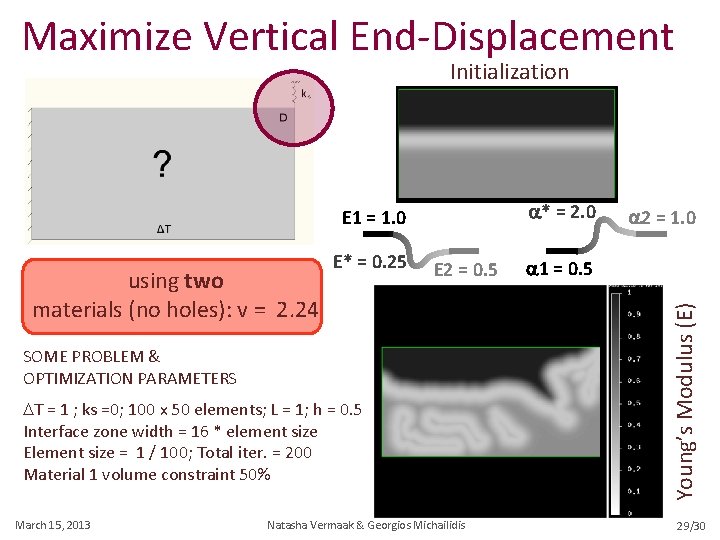
Maximize Vertical End-Displacement Initialization a* = 2. 0 using two materials (no holes): v = 2. 24 E* = 0. 25 E 2 = 0. 5 SOME PROBLEM & OPTIMIZATION PARAMETERS DT = 1 ; ks =0; 100 x 50 elements; L = 1; h = 0. 5 Interface zone width = 16 * element size Element size = 1 / 100; Total iter. = 200 Material 1 volume constraint 50% March 15, 2013 Natasha Vermaak & Georgios Michailidis a 2 = 1. 0 a 1 = 0. 5 Young’s Modulus (E) E 1 = 1. 0 29/30
Design Tools for Architectured Bio-inspired Actuators/Sensors N. Vermaak 1, G. Michailidis 2, G. Parry 1, R. Estevez 1, G. Allaire 2, Y. Bréchet 1 1 Univ. Grenoble SIMAP; 2 Ecole Polytechnique CMAP March 15, 2013 Workshop for the Cours Architectures hiérarchisées : les leçons du vivant
- Slides: 30