
Design The elements of design are space line
- Slides: 29
Design The elements of design are: space, line, shape, form, texture, and color
Space �Space: The area provided for a particular purpose. �Divisions of space can provide a sense of privacy and security. �A fence or hedge outdoors screens out unwanted views/noise. � Furniture and partial walls can accomplish the same goal inside a house.
�Clustering furniture and accessories into groups or using dividers can make large rooms seem more intimate. �Too much furniture reduces the space in a room until it feels overcrowded. �Objects grouped into large units will create a more ordered space.
Line �Line: The visual direction of a design. �Can be used to emphasize a pleasing element or disguise an undesirable one. �In design, one type of line should dominate. Others can be added for interest.
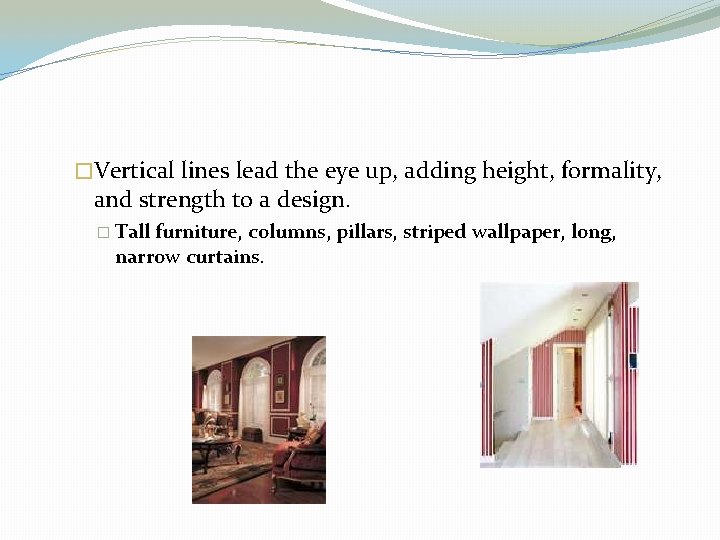
�Vertical lines lead the eye up, adding height, formality, and strength to a design. � Tall furniture, columns, pillars, striped wallpaper, long, narrow curtains.
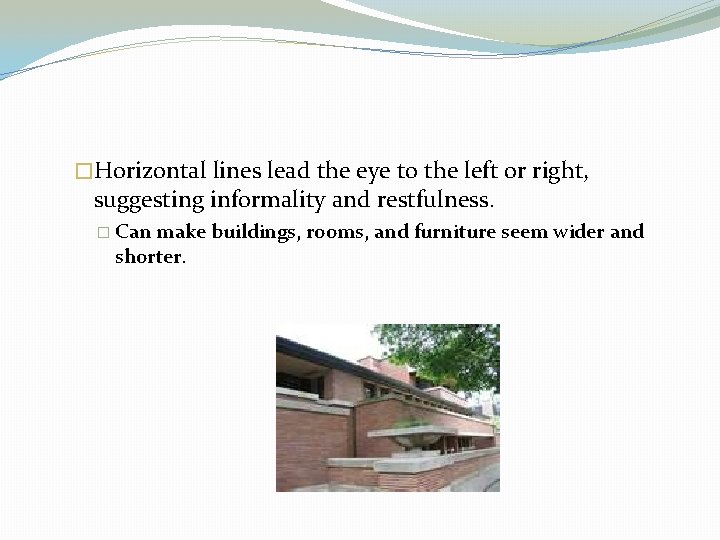
�Horizontal lines lead the eye to the left or right, suggesting informality and restfulness. � Can make buildings, rooms, and furniture seem wider and shorter.
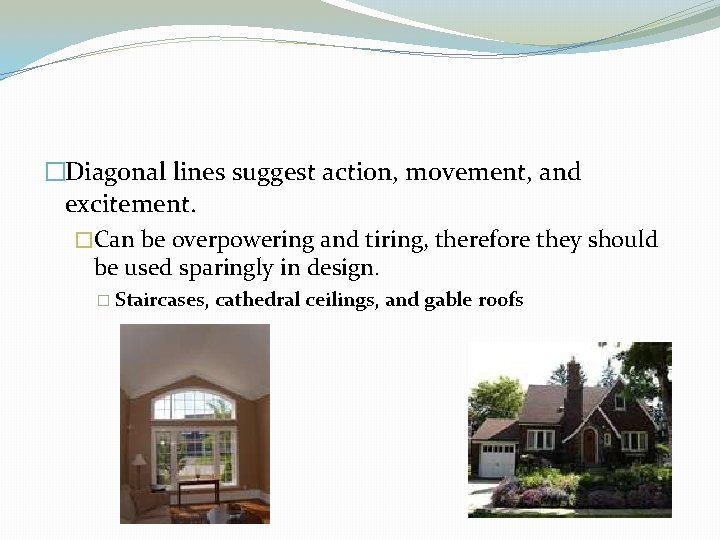
�Diagonal lines suggest action, movement, and excitement. �Can be overpowering and tiring, therefore they should be used sparingly in design. � Staircases, cathedral ceilings, and gable roofs
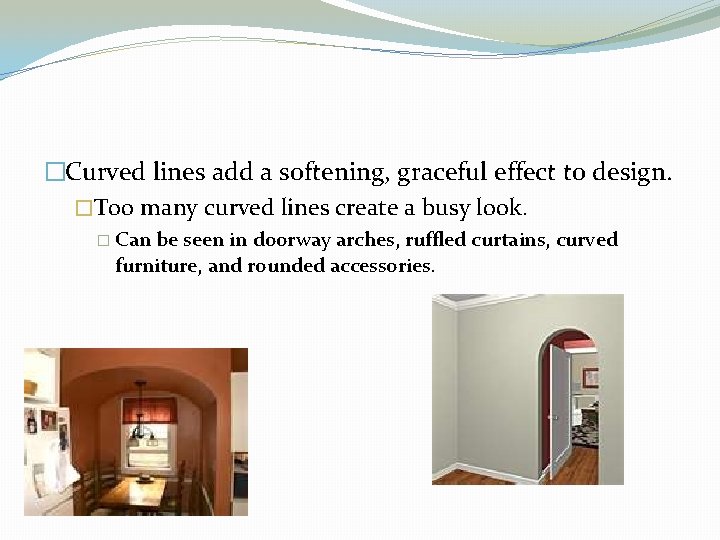
�Curved lines add a softening, graceful effect to design. �Too many curved lines create a busy look. � Can be seen in doorway arches, ruffled curtains, curved furniture, and rounded accessories.
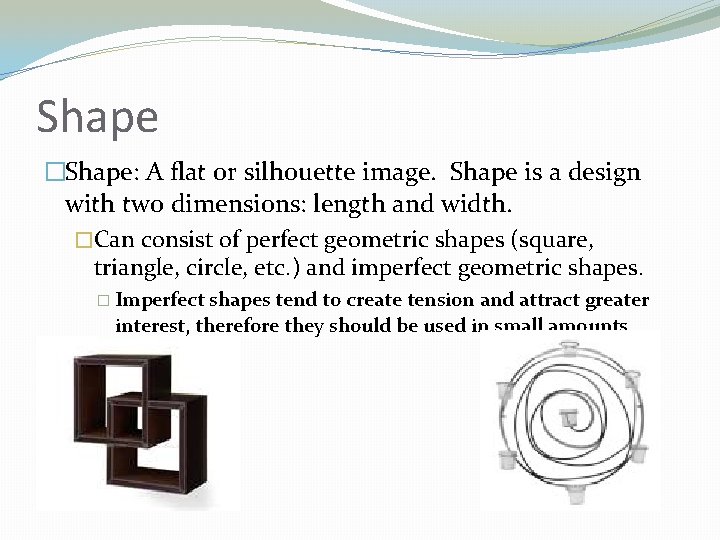
Shape �Shape: A flat or silhouette image. Shape is a design with two dimensions: length and width. �Can consist of perfect geometric shapes (square, triangle, circle, etc. ) and imperfect geometric shapes. � Imperfect shapes tend to create tension and attract greater interest, therefore they should be used in small amounts.
Form �Form: The outlined edges of a three-dimensional object. �Common geometric forms: cubes, pyramids, cones, and spheres. Other examples would be found in furniture and architecture. �A room is more pleasing if the form of the dominant piece is repeated in minor pieces and accessories within a room.
Texture �Texture: A surface’s tactile quality. �Tactile refers to the perception of touch. Not only how a surface feels but also how it appears to feel. �Ribbed, crinkled, rough, and smooth are some words used to describe various textures. �A room with the same texture throughout is monotonous, but too many different textures can appear disjointed and distracting. � Most well-designed rooms have a dominant texture with accents of contrasting textures.
�Texture can affect color by subduing or intensifying it. �Smooth surfaces reflect more light than rough surfaces, making them look lighter and brighter. �Rough surfaces absorb more light making them look darker and less intense.
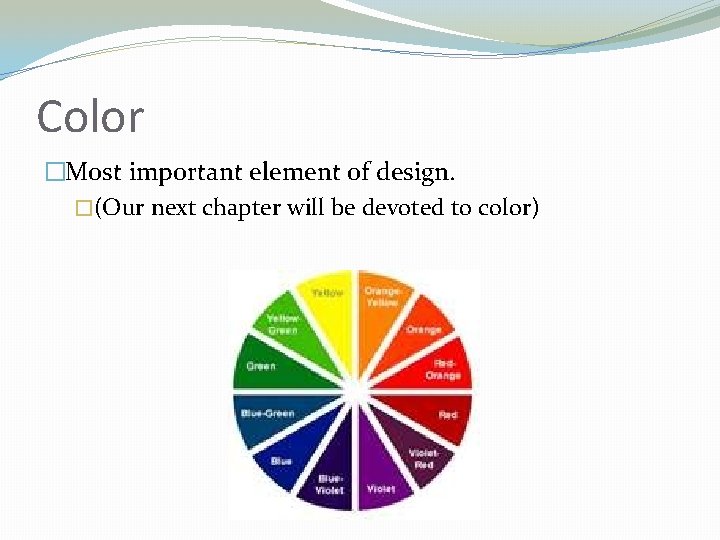
Color �Most important element of design. �(Our next chapter will be devoted to color)
Principles of Design �Principles of design are guidelines to follow when working with the elements of design. �Proportion, scale, balance, emphasis, and rhythm.
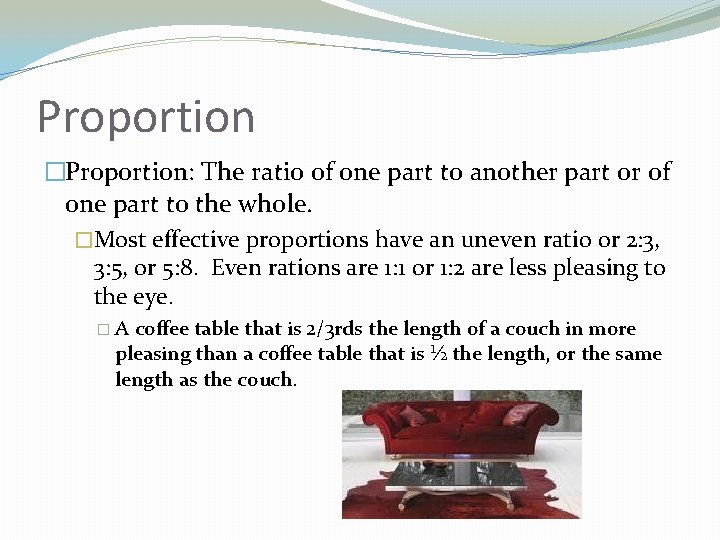
Proportion �Proportion: The ratio of one part to another part or of one part to the whole. �Most effective proportions have an uneven ratio or 2: 3, 3: 5, or 5: 8. Even rations are 1: 1 or 1: 2 are less pleasing to the eye. �A coffee table that is 2/3 rds the length of a couch in more pleasing than a coffee table that is ½ the length, or the same length as the couch.
�Golden Section: A series of numbers that progress by the sum of the two previous numbers. � 2: 3, 3: 5, 5: 8, 8: 13, 13: 21, and so forth.
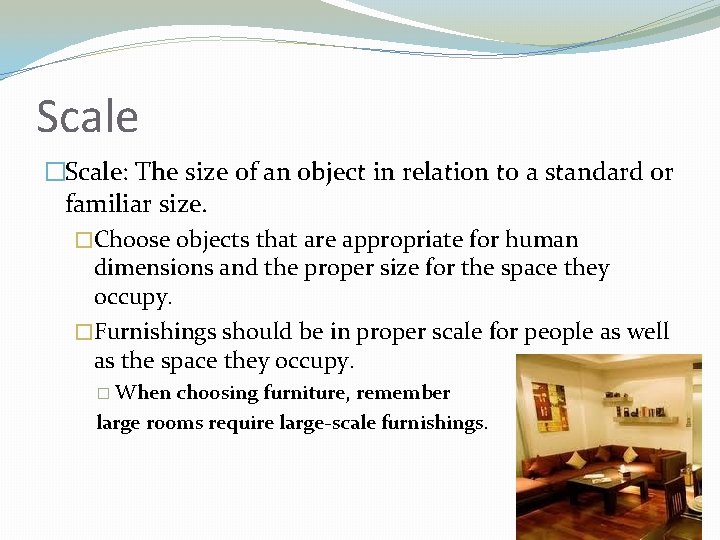
Scale �Scale: The size of an object in relation to a standard or familiar size. �Choose objects that are appropriate for human dimensions and the proper size for the space they occupy. �Furnishings should be in proper scale for people as well as the space they occupy. � When choosing furniture, remember large rooms require large-scale furnishings.
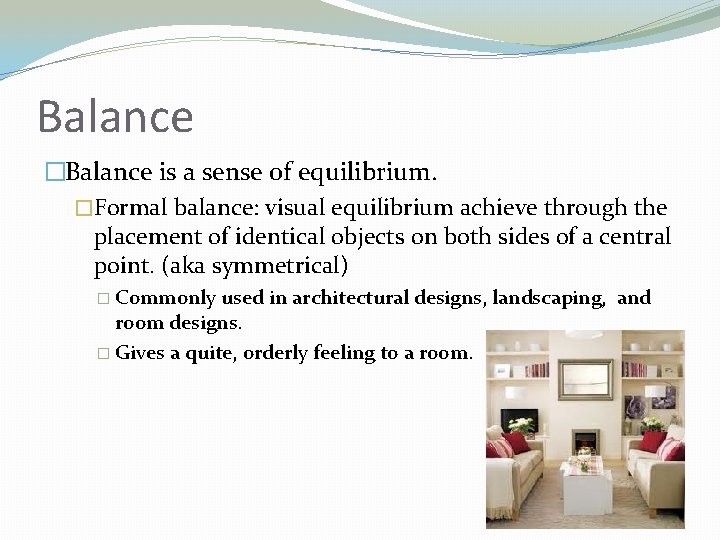
Balance �Balance is a sense of equilibrium. �Formal balance: visual equilibrium achieve through the placement of identical objects on both sides of a central point. (aka symmetrical) � Commonly used in architectural designs, landscaping, and room designs. � Gives a quite, orderly feeling to a room.
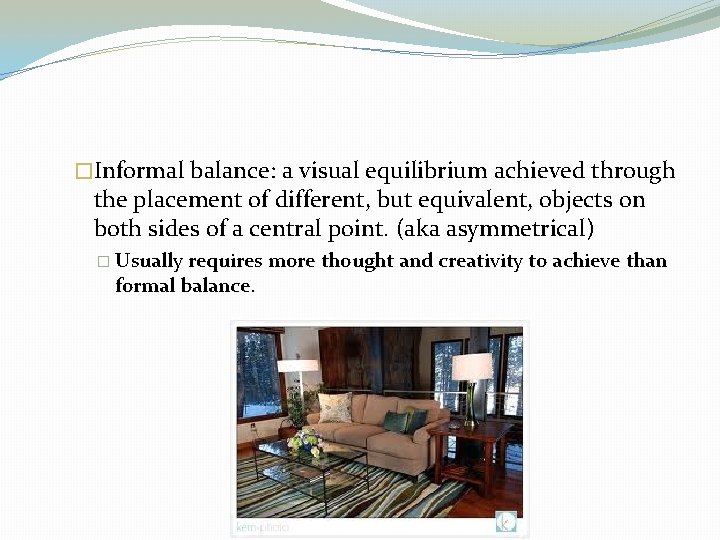
�Informal balance: a visual equilibrium achieved through the placement of different, but equivalent, objects on both sides of a central point. (aka asymmetrical) � Usually requires more thought and creativity to achieve than formal balance.
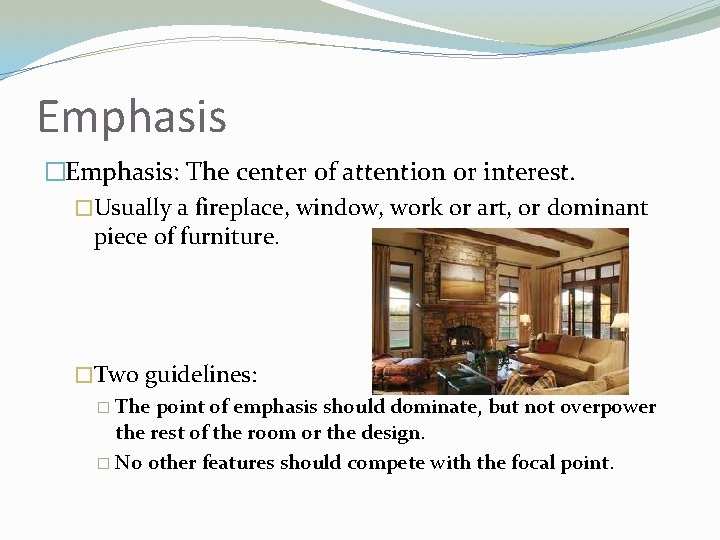
Emphasis �Emphasis: The center of attention or interest. �Usually a fireplace, window, work or art, or dominant piece of furniture. �Two guidelines: � The point of emphasis should dominate, but not overpower the rest of the room or the design. � No other features should compete with the focal point.
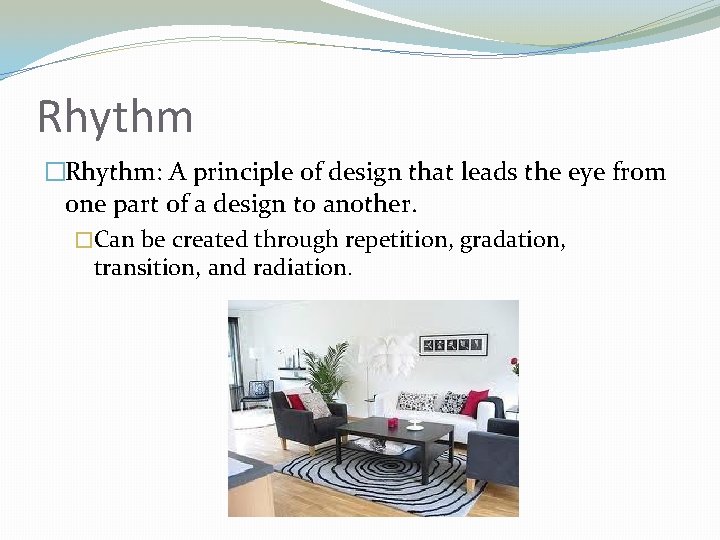
Rhythm �Rhythm: A principle of design that leads the eye from one part of a design to another. �Can be created through repetition, gradation, transition, and radiation.
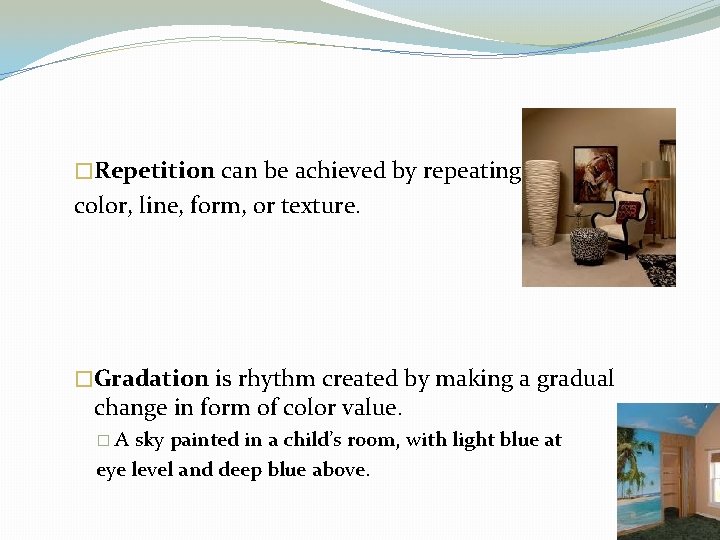
�Repetition can be achieved by repeating color, line, form, or texture. �Gradation is rhythm created by making a gradual change in form of color value. �A sky painted in a child’s room, with light blue at eye level and deep blue above.
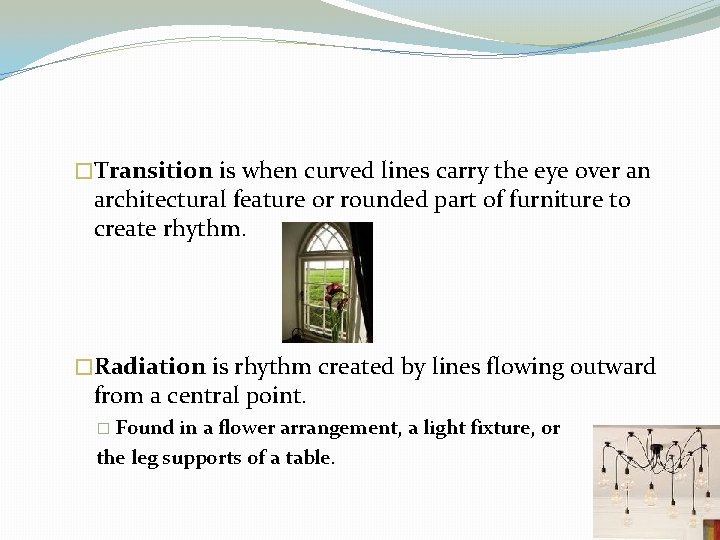
�Transition is when curved lines carry the eye over an architectural feature or rounded part of furniture to create rhythm. �Radiation is rhythm created by lines flowing outward from a central point. � Found in a flower arrangement, a light fixture, or the leg supports of a table.
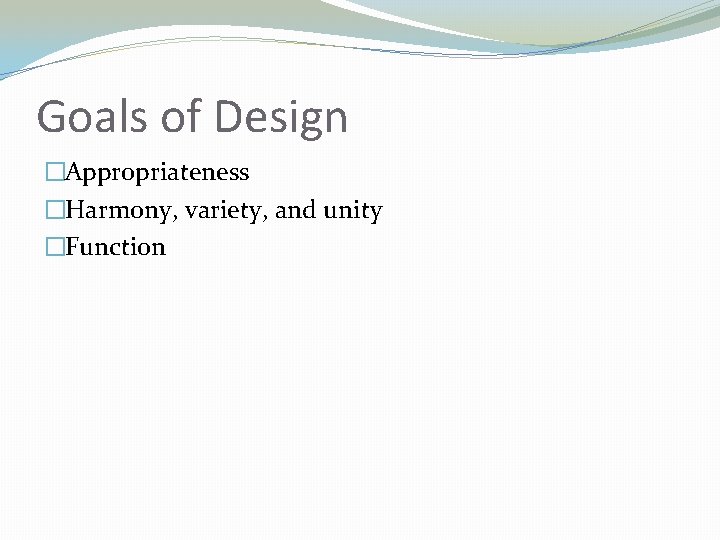
Goals of Design �Appropriateness �Harmony, variety, and unity �Function
Appropriateness �Good design should be appropriate for its intended function and for the lifestyle of the household. �The furniture and accessories in a living room should be conducive to relaxing, conversing, and entertaining. �Good design is appropriate when it addresses the personality, needs, and values of family members.
Harmony, Variety, and Unity �Harmony is an agreement among the parts. It results when unity and variety are combined. �A single design idea is executed, and similar shapes and forms are repeated. �Unity is the appearance of all parts seeming to belong together. It is achieved by repeating certain elements of design. �A dominant type of line, shape, form, texture, or color should be apparent in designs that have unity.
�Variety is the use of contrasting features to prevent monotony. �Contrasting lines, forms, textures, ad colors add variety to a unified design. �Variety and unity work very well together when one or more design elements are held constant while others change. � When light browns and beiges are used throughout a room for unity, splashes of blue will add variety.
Function �Function refers to the intended use or purpose of a structure, room, or object. �“Form follows function” is a guideline for good design. �A chair should be attractive, but more importantly, its form should allow a person to sit comfortably.
Accessories in Design �Accessories complete the total room design. �Accessories should reflect the personalities of the household members and give individuality to a design. �Functional accessories include things that serve a purpose for the household members. �Lamps provides light, etc.