
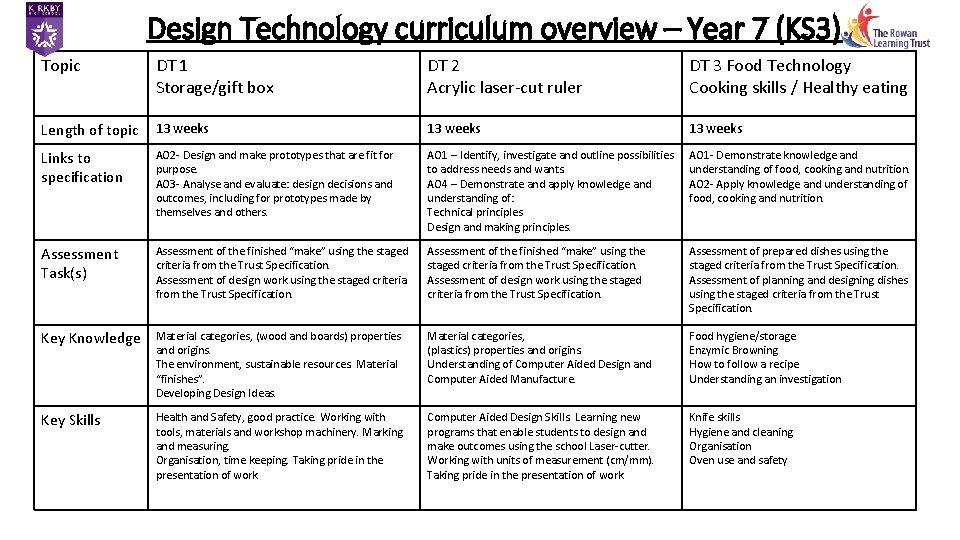
Design Technology curriculum overview Year 7 KS 3
- Slides: 10
Design Technology curriculum overview – Year 7 (KS 3) Topic DT 1 Storage/gift box DT 2 Acrylic laser-cut ruler DT 3 Food Technology Cooking skills / Healthy eating Length of topic 13 weeks Links to specification AO 2 - Design and make prototypes that are fit for purpose. AO 3 - Analyse and evaluate: design decisions and outcomes, including for prototypes made by themselves and others. AO 1 – Identify, investigate and outline possibilities to address needs and wants. AO 4 – Demonstrate and apply knowledge and understanding of: Technical principles Design and making principles. AO 1 - Demonstrate knowledge and understanding of food, cooking and nutrition. AO 2 - Apply knowledge and understanding of food, cooking and nutrition. Assessment Task(s) Assessment of the finished “make” using the staged criteria from the Trust Specification. Assessment of design work using the staged criteria from the Trust Specification. Assessment of prepared dishes using the staged criteria from the Trust Specification. Assessment of planning and designing dishes using the staged criteria from the Trust Specification. Key Knowledge Material categories, (wood and boards) properties and origins. The environment, sustainable resources. Material “finishes”. Developing Design Ideas. Material categories, (plastics) properties and origins. Understanding of Computer Aided Design and Computer Aided Manufacture. Food hygiene/storage Enzymic Browning How to follow a recipe Understanding an investigation Key Skills Health and Safety, good practice. Working with tools, materials and workshop machinery. Marking and measuring. Organisation, time keeping. Taking pride in the presentation of work Computer Aided Design Skills. Learning new programs that enable students to design and make outcomes using the school Laser-cutter. Working with units of measurement (cm/mm). Taking pride in the presentation of work. Knife skills Hygiene and cleaning Organisation Oven use and safety
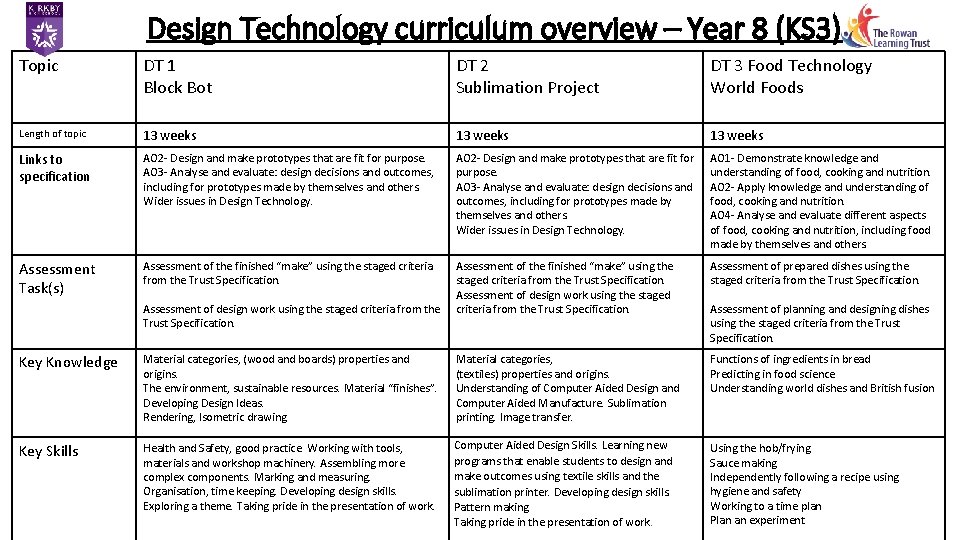
Design Technology curriculum overview – Year 8 (KS 3) Topic DT 1 Block Bot DT 2 Sublimation Project DT 3 Food Technology World Foods Length of topic 13 weeks Links to specification AO 2 - Design and make prototypes that are fit for purpose. AO 3 - Analyse and evaluate: design decisions and outcomes, including for prototypes made by themselves and others. Wider issues in Design Technology. AO 1 - Demonstrate knowledge and understanding of food, cooking and nutrition. AO 2 - Apply knowledge and understanding of food, cooking and nutrition. AO 4 - Analyse and evaluate different aspects of food, cooking and nutrition, including food made by themselves and others. Assessment Task(s) Assessment of the finished “make” using the staged criteria from the Trust Specification. Assessment of design work using the staged criteria from the Trust Specification. Assessment of prepared dishes using the staged criteria from the Trust Specification. Assessment of design work using the staged criteria from the Trust Specification. Assessment of planning and designing dishes using the staged criteria from the Trust Specification. Key Knowledge Material categories, (wood and boards) properties and origins. The environment, sustainable resources. Material “finishes”. Developing Design Ideas. Rendering, Isometric drawing. Material categories, (textiles) properties and origins. Understanding of Computer Aided Design and Computer Aided Manufacture. Sublimation printing. Image transfer. Functions of ingredients in bread Predicting in food science Understanding world dishes and British fusion Key Skills Health and Safety, good practice. Working with tools, materials and workshop machinery. Assembling more complex components. Marking and measuring. Organisation, time keeping. Developing design skills. Exploring a theme. Taking pride in the presentation of work. Computer Aided Design Skills. Learning new programs that enable students to design and make outcomes using textile skills and the sublimation printer. Developing design skills. Pattern making. Taking pride in the presentation of work. Using the hob/frying Sauce making Independently following a recipe using hygiene and safety Working to a time plan Plan an experiment
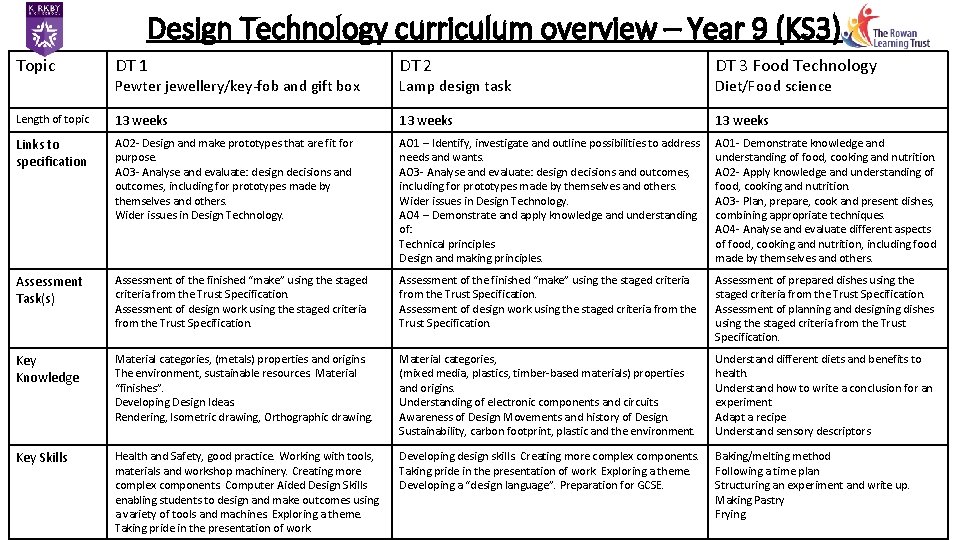
Design Technology curriculum overview – Year 9 (KS 3) Topic DT 1 DT 2 DT 3 Food Technology Length of topic 13 weeks Links to specification AO 2 - Design and make prototypes that are fit for purpose. AO 3 - Analyse and evaluate: design decisions and outcomes, including for prototypes made by themselves and others. Wider issues in Design Technology. AO 1 – Identify, investigate and outline possibilities to address needs and wants. AO 3 - Analyse and evaluate: design decisions and outcomes, including for prototypes made by themselves and others. Wider issues in Design Technology. AO 4 – Demonstrate and apply knowledge and understanding of: Technical principles Design and making principles. AO 1 - Demonstrate knowledge and understanding of food, cooking and nutrition. AO 2 - Apply knowledge and understanding of food, cooking and nutrition. AO 3 - Plan, prepare, cook and present dishes, combining appropriate techniques. AO 4 - Analyse and evaluate different aspects of food, cooking and nutrition, including food made by themselves and others. Assessment Task(s) Assessment of the finished “make” using the staged criteria from the Trust Specification. Assessment of design work using the staged criteria from the Trust Specification. Assessment of prepared dishes using the staged criteria from the Trust Specification. Assessment of planning and designing dishes using the staged criteria from the Trust Specification. Key Knowledge Material categories, (metals) properties and origins. The environment, sustainable resources. Material “finishes”. Developing Design Ideas. Rendering, Isometric drawing, Orthographic drawing. Material categories, (mixed media, plastics, timber-based materials) properties and origins. Understanding of electronic components and circuits. Awareness of Design Movements and history of Design. Sustainability, carbon footprint, plastic and the environment. Understand different diets and benefits to health. Understand how to write a conclusion for an experiment Adapt a recipe Understand sensory descriptors Key Skills Health and Safety, good practice. Working with tools, materials and workshop machinery. Creating more complex components. Computer Aided Design Skills enabling students to design and make outcomes using a variety of tools and machines. Exploring a theme. Taking pride in the presentation of work. Developing design skills. Creating more complex components. Taking pride in the presentation of work. Exploring a theme. Developing a “design language”. Preparation for GCSE. Baking/melting method Following a time plan Structuring an experiment and write up. Making Pastry Frying Pewter jewellery/key-fob and gift box Lamp design task Diet/Food science
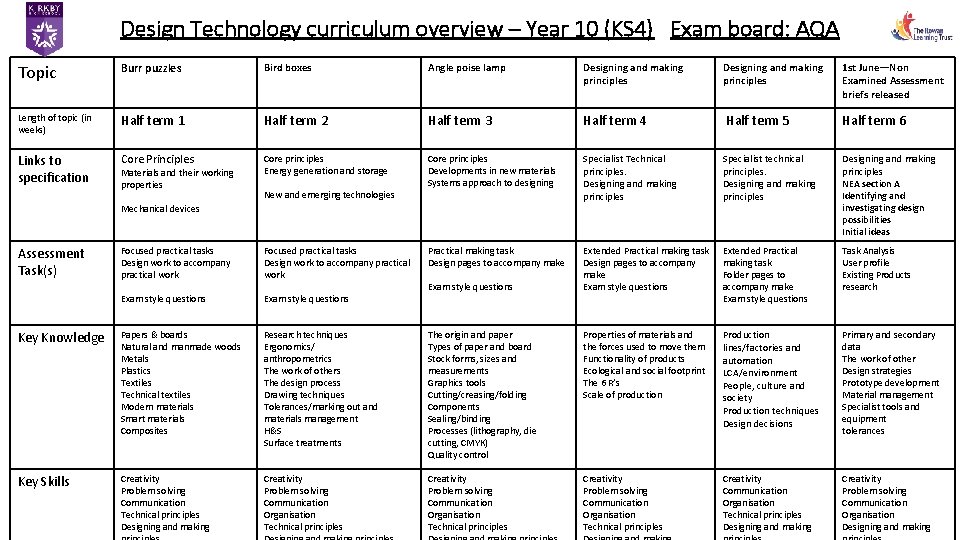
Design Technology curriculum overview – Year 10 (KS 4) Exam board: AQA Topic Burr puzzles Bird boxes Angle poise lamp Designing and making principles 1 st June—Non Examined Assessment briefs released Length of topic (in weeks) Half term 1 Half term 2 Half term 3 Half term 4 Half term 5 Half term 6 Links to specification Core Principles Core principles Energy generation and storage Core principles Developments in new materials Systems approach to designing Specialist Technical principles. Designing and making principles Specialist technical principles. Designing and making principles NEA section A Identifying and investigating design possibilities Initial ideas Practical making task Design pages to accompany make Extended Practical making task Design pages to accompany make Exam style questions Extended Practical making task Folder pages to accompany make Exam style questions Task Analysis User profile Existing Products research Materials and their working properties New and emerging technologies Mechanical devices Assessment Task(s) Focused practical tasks Design work to accompany practical work Exam style questions Key Knowledge Papers & boards Natural and manmade woods Metals Plastics Textiles Technical textiles Modern materials Smart materials Composites Research techniques Ergonomics/ anthropometrics The work of others The design process Drawing techniques Tolerances/marking out and materials management H&S Surface treatments The origin and paper Types of paper and board Stock forms, sizes and measurements Graphics tools Cutting/creasing/folding Components Sealing/binding Processes (lithography, die cutting, CMYK) Quality control Properties of materials and the forces used to move them Functionality of products Ecological and social footprint The 6 R’s Scale of production Production lines/factories and automation LCA/environment People, culture and society Production techniques Design decisions Primary and secondary data The work of other Design strategies Prototype development Material management Specialist tools and equipment tolerances Key Skills Creativity Problem solving Communication Technical principles Designing and making Creativity Problem solving Communication Organisation Technical principles Creativity Communication Organisation Technical principles Designing and making Creativity Problem solving Communication Organisation Designing and making Exam style questions
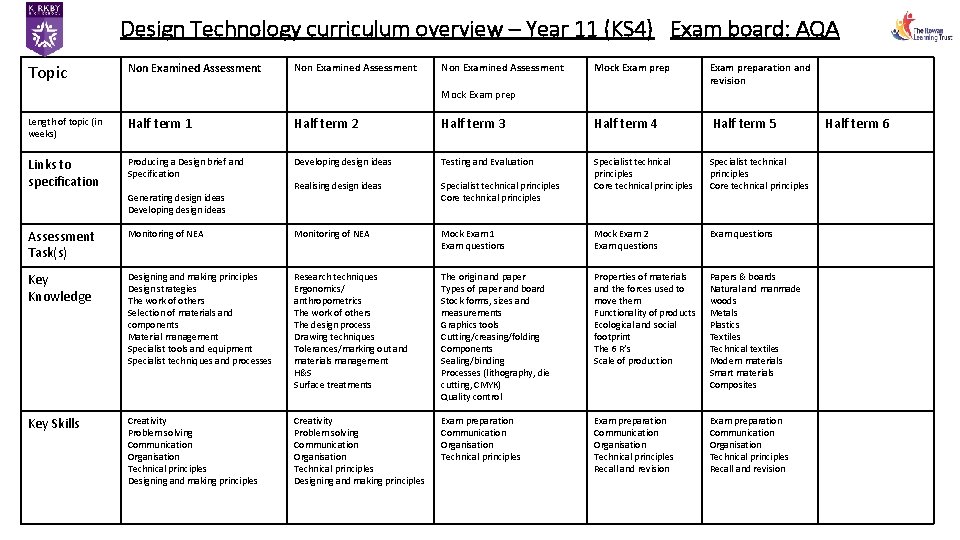
Design Technology curriculum overview – Year 11 (KS 4) Exam board: AQA Topic Non Examined Assessment Mock Exam preparation and revision Half term 5 Mock Exam prep Length of topic (in weeks) Half term 1 Half term 2 Half term 3 Half term 4 Links to specification Producing a Design brief and Specification Developing design ideas Testing and Evaluation Realising design ideas Specialist technical principles Core technical principles Generating design ideas Developing design ideas Assessment Task(s) Monitoring of NEA Mock Exam 1 Exam questions Mock Exam 2 Exam questions Key Knowledge Designing and making principles Design strategies The work of others Selection of materials and components Material management Specialist tools and equipment Specialist techniques and processes Research techniques Ergonomics/ anthropometrics The work of others The design process Drawing techniques Tolerances/marking out and materials management H&S Surface treatments The origin and paper Types of paper and board Stock forms, sizes and measurements Graphics tools Cutting/creasing/folding Components Sealing/binding Processes (lithography, die cutting, CMYK) Quality control Properties of materials and the forces used to move them Functionality of products Ecological and social footprint The 6 R’s Scale of production Papers & boards Natural and manmade woods Metals Plastics Textiles Technical textiles Modern materials Smart materials Composites Key Skills Creativity Problem solving Communication Organisation Technical principles Designing and making principles Exam preparation Communication Organisation Technical principles Recall and revision Half term 6
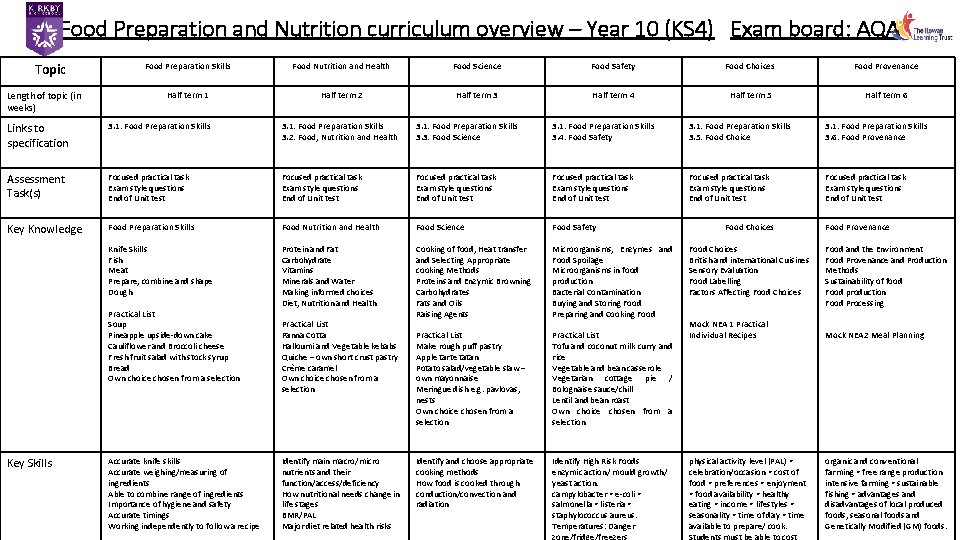
Food Preparation and Nutrition curriculum overview – Year 10 (KS 4) Exam board: AQA Topic Length of topic (in weeks) Food Preparation Skills Food Nutrition and Health Food Science Food Safety Food Choices Food Provenance Half term 1 Half term 2 Half term 3 Half term 4 Half term 5 Half term 6 Links to specification 3. 1: Food Preparation Skills 3. 2: Food, Nutrition and Health 3. 1: Food Preparation Skills 3. 3: Food Science 3. 1: Food Preparation Skills 3. 4: Food Safety 3. 1: Food Preparation Skills 3. 5: Food Choice 3. 1: Food Preparation Skills 3. 6: Food Provenance Assessment Task(s) Focused practical task Exam style questions End of Unit test Focused practical task Exam style questions End of Unit test Key Knowledge Food Preparation Skills Food Nutrition and Health Food Science Food Safety Knife Skills Fish Meat Prepare, combine and shape Dough Protein and Fat Carbohydrate Vitamins Minerals and Water Making informed choices Diet, Nutrition and Health Cooking of food, Heat transfer and Selecting Appropriate cooking Methods Proteins and Enzymic Browning Carbohydrates Fats and Oils Raising Agents Microorganisms, Enzymes and Food Spoilage Microorganisms in food production Bacterial Contamination Buying and Storing Food Preparing and Cooking Food Practical List Make rough puff pastry Apple tarte tatan Potato salad/vegetable slaw – own mayonnaise Meringue dish e. g. pavlovas, nests Own choice chosen from a selection Practical List Tofu and coconut milk curry and rice Vegetable and bean casserole Vegetarian cottage pie / Bolognaise sauce/chill Lentil and bean roast Own choice chosen from a selection Identify and choose appropriate cooking methods How food is cooked through conduction/convection and radiation Identify High Risk Foods enzymic action/ mould growth/ yeast action. campylobacter • e-coli • salmonella • listeria • staphylococcus aureus. Temperatures: Danger zone/fridge/freezers Practical List Soup Pineapple upside-down cake Cauliflower and Broccoli cheese Fresh fruit salad with stock syrup Bread Own choice chosen from a selection Key Skills Accurate knife skills Accurate weighing/measuring of ingredients Able to combine range of ingredients Importance of hygiene and safety Accurate timings Working independently to follow a recipe Practical List Panna Cotta Halloumi and Vegetable kebabs Quiche – own short crust pastry Crème caramel Own choice chosen from a selection Identify main macro/micro nutrients and their function/access/deficiency How nutritional needs change in life stages BMR/PAL Major diet related health risks Food Choices British and international Cuisines Sensory Evaluation Food Labelling Factors Affecting Food Choices Mock NEA 1 Practical Individual Recipes physical activity level (PAL) • celebration/occasion • cost of food • preferences • enjoyment • food availability • healthy eating • income • lifestyles • seasonality • time of day • time available to prepare/ cook. Students must be able to cost Food Provenance Food and the Environment Food Provenance and Production Methods Sustainability of food Food production Food Processing Mock NEA 2 Meal Planning organic and conventional farming • free range production intensive farming • sustainable fishing • advantages and disadvantages of local produced foods, seasonal foods and Genetically Modified (GM) foods.
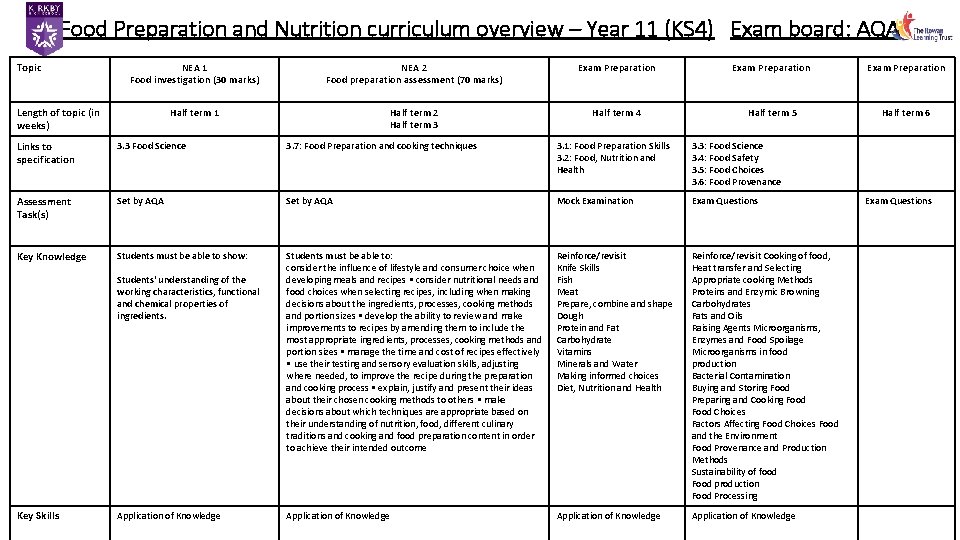
Food Preparation and Nutrition curriculum overview – Year 11 (KS 4) Exam board: AQA Topic NEA 1 Food investigation (30 marks) NEA 2 Food preparation assessment (70 marks) Exam Preparation Half term 1 Half term 2 Half term 3 Half term 4 Half term 5 Half term 6 Length of topic (in weeks) Links to specification 3. 3 Food Science 3. 7: Food Preparation and cooking techniques 3. 1: Food Preparation Skills 3. 2: Food, Nutrition and Health 3. 3: Food Science 3. 4: Food Safety 3. 5: Food Choices 3. 6: Food Provenance Assessment Task(s) Set by AQA Mock Examination Exam Questions Key Knowledge Students must be able to show: Students must be able to: consider the influence of lifestyle and consumer choice when developing meals and recipes • consider nutritional needs and food choices when selecting recipes, including when making decisions about the ingredients, processes, cooking methods and portion sizes • develop the ability to review and make improvements to recipes by amending them to include the most appropriate ingredients, processes, cooking methods and portion sizes • manage the time and cost of recipes effectively • use their testing and sensory evaluation skills, adjusting where needed, to improve the recipe during the preparation and cooking process • explain, justify and present their ideas about their chosen cooking methods to others • make decisions about which techniques are appropriate based on their understanding of nutrition, food, different culinary traditions and cooking and food preparation content in order to achieve their intended outcome Reinforce/revisit Knife Skills Fish Meat Prepare, combine and shape Dough Protein and Fat Carbohydrate Vitamins Minerals and Water Making informed choices Diet, Nutrition and Health Reinforce/revisit Cooking of food, Heat transfer and Selecting Appropriate cooking Methods Proteins and Enzymic Browning Carbohydrates Fats and Oils Raising Agents Microorganisms, Enzymes and Food Spoilage Microorganisms in food production Bacterial Contamination Buying and Storing Food Preparing and Cooking Food Choices Factors Affecting Food Choices Food and the Environment Food Provenance and Production Methods Sustainability of food Food production Food Processing Application of Knowledge Students' understanding of the working characteristics, functional and chemical properties of ingredients. Key Skills Application of Knowledge Exam Questions
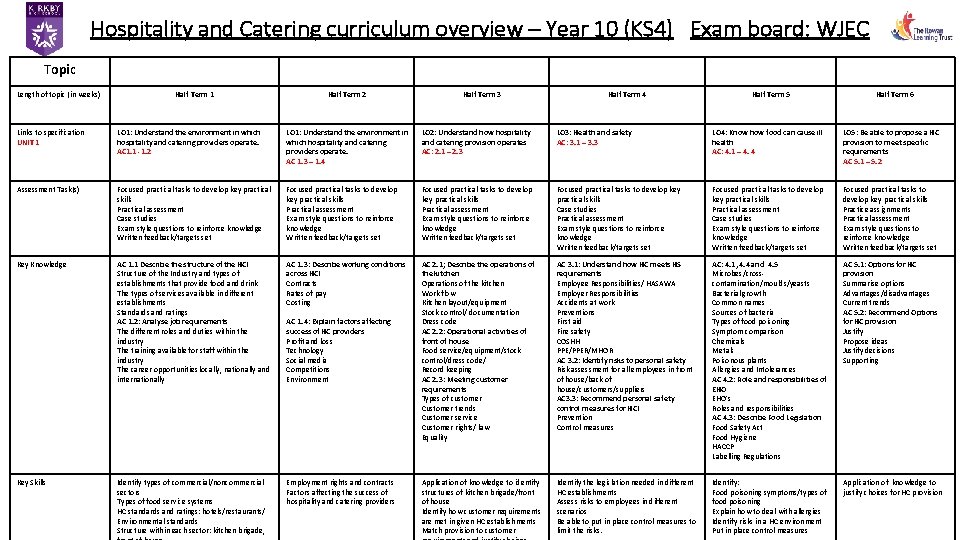
Hospitality and Catering curriculum overview – Year 10 (KS 4) Exam board: WJEC Topic Length of topic (in weeks) Half Term 1 Half Term 2 Half Term 3 Half Term 4 Half Term 5 Half Term 6 Links to specification UNIT 1 LO 1: Understand the environment in which hospitality and catering providers operate. AC 1. 1 -1. 2 LO 1: Understand the environment in which hospitality and catering providers operate. AC 1. 3 – 1. 4 LO 2: Understand how hospitality and catering provision operates AC: 2. 1 – 2. 3 LO 3: Health and safety AC: 3. 1 – 3. 3 LO 4: Know how food can cause ill health AC: 4. 1 – 4. 4 LO 5: Be able to propose a HC provision to meet specific requirements AC 5. 1 – 5. 2 Assessment Task(s) Focused practical tasks to develop key practical skills Practical assessment Case studies Exam style questions to reinforce knowledge Written feedback/targets set Focused practical tasks to develop key practical skills Practical assessment Exam style questions to reinforce knowledge Written feedback/targets set Focused practical tasks to develop key practical skills Case studies Practical assessment Exam style questions to reinforce knowledge Written feedback/targets set Focused practical tasks to develop key practical skills Practical assessment Case studies Exam style questions to reinforce knowledge Written feedback/targets set Focused practical tasks to develop key practical skills Practice assignments Practical assessment Exam style questions to reinforce knowledge Written feedback/targets set Key Knowledge AC 1. 1 Describe the structure of the HCI Structure of the Industry and types of establishments that provide food and drink The types of services available in different establishments Standards and ratings AC 1. 2: Analyse job requirements The different roles and duties within the industry The training available for staff within the industry The career opportunities locally, nationally and internationally AC 1. 3: Describe working conditions across HCI Contracts Rates of pay Costing AC 2. 1; Describe the operations of the kitchen Operations of the kitchen Work flow Kitchen layout/equipment Stock control/ documentation Dress code AC 2. 2: Operational activities of front of house Food service/equipment/stock control/dress code/ Record keeping AC 2. 3: Meeting customer requirements Types of customer Customer trends Customer service Customer rights/ law Equality AC 3. 1: Understand how HC meets HS requirements Employee Responsibilities/ HASAWA Employer Responsibilities Accidents at work Preventions First aid Fire safety COSHH PPE/PPER/MHOR AC 3. 2: Identify risks to personal safety Risk assessment for all employees in front of house/back of house/customers/suppliers AC 3. 3: Recommend personal safety control measures for HCI Prevention Control measures AC: 4. 1, 4. 4 and 4. 5 Microbes/crosscontamination/moulds/yeasts Bacterial growth Common names Sources of bacteria Types of food poisoning Symptom comparison Chemicals Metals Poisonous plants Allergies and Intolerances AC 4. 2: Role and responsibilities of EHO's Roles and responsibilities AC 4. 3: Describe Food Legislation Food Safety Act Food Hygiene HACCP Labelling Regulations AC 5. 1: Options for HC provision Summarise options Advantages/disadvantages Current trends AC 5. 2: Recommend Options for HC provision Justify Propose ideas Justify decisions Supporting Identify types of commercial/noncommercial sectors Types of food service systems HC standards and ratings: hotels/restaurants/ Environmental standards Structure within each sector: kitchen brigade, Employment rights and contracts Factors affecting the success of hospitality and catering providers Application of knowledge to identify structures of kitchen brigade/front of house Identify how customer requirements are met in given HC establishments Match provision to customer Identify the legislation needed in different HC establishments Assess risks to employees in different scenarios Be able to put in place control measures to limit the risks. Identify: Food poisoning symptoms/types of food poisoning Explain how to deal with allergies Identify risks in a HC environment Put in place control measures Application of knowledge to justify choices for HC provision Key Skills AC 1. 4: Explain factors affecting success of HC providers Profit and loss Technology Social media Competitions Environment
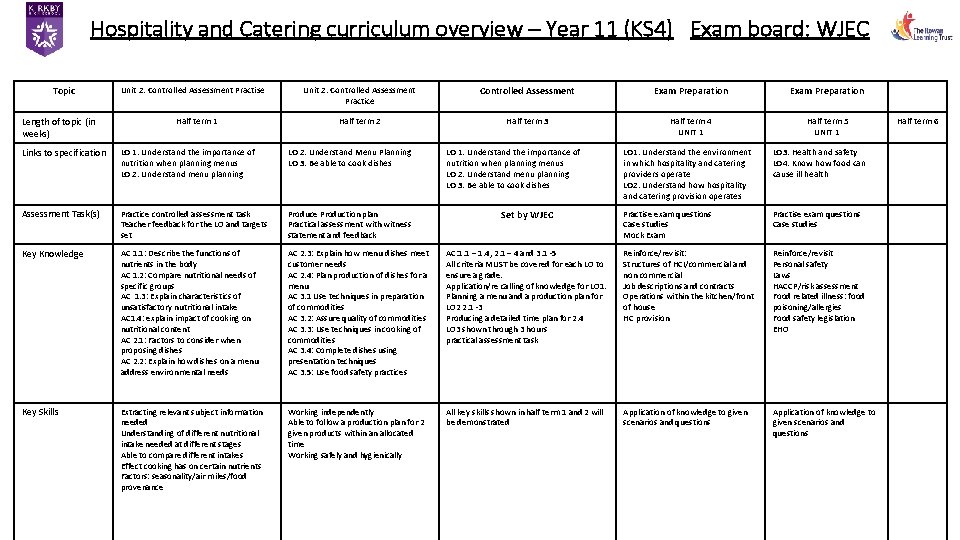
Hospitality and Catering curriculum overview – Year 11 (KS 4) Exam board: WJEC Topic Length of topic (in weeks) Unit 2: Controlled Assessment Practise Half term 1 Unit 2: Controlled Assessment Practice Controlled Assessment Exam Preparation Half term 2 Half term 3 Half term 4 UNIT 1 Half term 5 UNIT 1 Links to specification LO 1: Understand the importance of nutrition when planning menus LO 2: Understand menu planning LO 2: Understand Menu Planning LO 3: Be able to cook dishes Assessment Task(s) Practice controlled assessment task Teacher feedback for the LO and targets set Produce Production plan Practical assessment with witness statement and feedback Key Knowledge AC 1. 1: Describe the functions of nutrients in the body AC 1. 2: Compare nutritional needs of specific groups AC 1. 3: Explain characteristics of unsatisfactory nutritional intake AC 1. 4: explain impact of cooking on nutritional content AC 2. 1: Factors to consider when proposing dishes AC 2. 2: Explain how dishes on a menu address environmental needs AC 2. 3: Explain how menu dishes meet customer needs AC 2. 4: Plan production of dishes for a menu AC 3. 1 Use techniques in preparation of commodities AC 3. 2: Assure quality of commodities AC 3. 3: Use techniques in cooking of commodities AC 3. 4: Complete dishes using presentation techniques AC 3. 5: Use food safety practices Key Skills Extracting relevant subject information needed Understanding of different nutritional intake needed at different stages Able to compare different intakes Effect cooking has on certain nutrients Factors: seasonality/air miles/food provenance Working independently Able to follow a production plan for 2 given products within an allocated time Working safely and hygienically LO 1: Understand the importance of nutrition when planning menus LO 2: Understand menu planning LO 3: Be able to cook dishes LO 1: Understand the environment in which hospitality and catering providers operate LO 2: Understand how hospitality and catering provision operates LO 3: Health and safety LO 4: Know how food can cause ill health Practise exam questions Case studies Mock Exam Practise exam questions Case studies AC: 1. 1 – 1. 4, 2. 1 – 4 and 3. 1 -5 All criteria MUST be covered for each LO to ensure a grade. Application/re calling of knowledge for LO 1. Planning a menu and a production plan for LO 2 2. 1 -3 Producing a detailed time plan for 2. 4 LO 3 shown through 3 hours practical assessment task Reinforce/revisit: Structures of HCI/commercial and non commercial Job descriptions and contracts Operations within the kitchen/front of house HC provision Reinforce/revisit Personal safety Laws HACCP/risk assessment Food related illness: food poisoning/allergies Food safety legislation EHO All key skills shown in half term 1 and 2 will be demonstrated Application of knowledge to given scenarios and questions Set by WJEC Half term 6
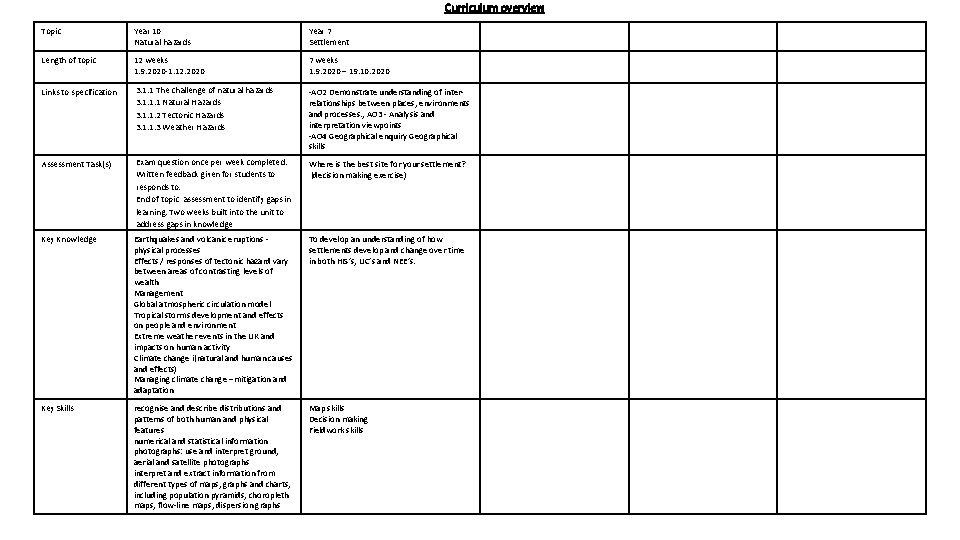
Curriculum overview Topic Year 10 Natural hazards Year 7 Settlement Length of topic 12 weeks 1. 9. 2020 -1. 12. 2020 7 weeks 1. 9. 2020 – 19. 10. 2020 Links to specification 3. 1. 1 The challenge of natural hazards 3. 1. 1. 1 Natural Hazards 3. 1. 1. 2 Tectonic Hazards 3. 1. 1. 3 Weather Hazards -AO 2 Demonstrate understanding of interrelationships between places, environments and processes. , AO 3 - Analysis and interpretation viewpoints -AO 4 Geographical enquiry Geographical skills Assessment Task(s) Exam question once per week completed. Written feedback given for students to responds to. End of topic assessment to identify gaps in learning. Two weeks built into the unit to address gaps in knowledge Where is the best site for your settlement? (decision making exercise) Key Knowledge Earthquakes and volcanic eruptions physical processes Effects / responses of tectonic hazard vary between areas of contrasting levels of wealth Management Global atmospheric circulation model Tropical storms development and effects on people and environment Extreme weather events in the UK and impacts on human activity Climate change i(natural and human causes and effects) Managing climate change –mitigation and adaptation To develop an understanding of how settlements develop and change over time in both HIS’s, LIC’s and NEE’s. Key Skills recognise and describe distributions and patterns of both human and physical features numerical and statistical information photographs: use and interpret ground, aerial and satellite photographs interpret and extract information from different types of maps, graphs and charts, including population pyramids, choropleth maps, flow-line maps, dispersion graphs Map skills Decision making Fieldwork skills