
Design Team 8 Fluorescent Detection using Optical Fibers
Design Team 8: Fluorescent Detection using Optical Fibers with Cardiac Myocytes Team Members: Paul Clark Martin Garcia Chris Gorga John Ling III Giordano Lo Regio Advisors/Assistants: Dr. Franz Baudenbacher Raghav Venkat Tobias Meyer
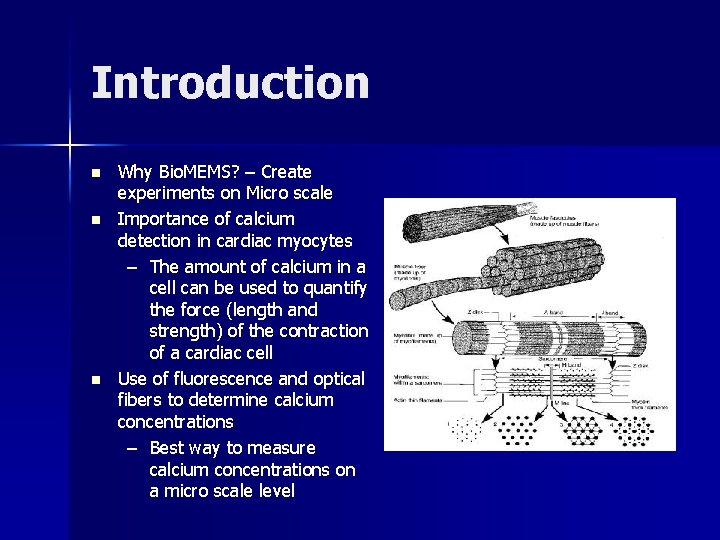
Introduction n Why Bio. MEMS? – Create experiments on Micro scale Importance of calcium detection in cardiac myocytes – The amount of calcium in a cell can be used to quantify the force (length and strength) of the contraction of a cardiac cell Use of fluorescence and optical fibers to determine calcium concentrations – Best way to measure calcium concentrations on a micro scale level
Marketable Motivation n Customer/User – Researchers – Decreased amount of dye needed n Business – Decreased amount of funding for research n Society – Improved diagnosis/treatment based on findings
Completed Work A three channel, photographic mask has been developed n First step of clean room certification achieved n A Lab. View module is completed to record the magnitude of the fluorescence signal n Strategy in place n
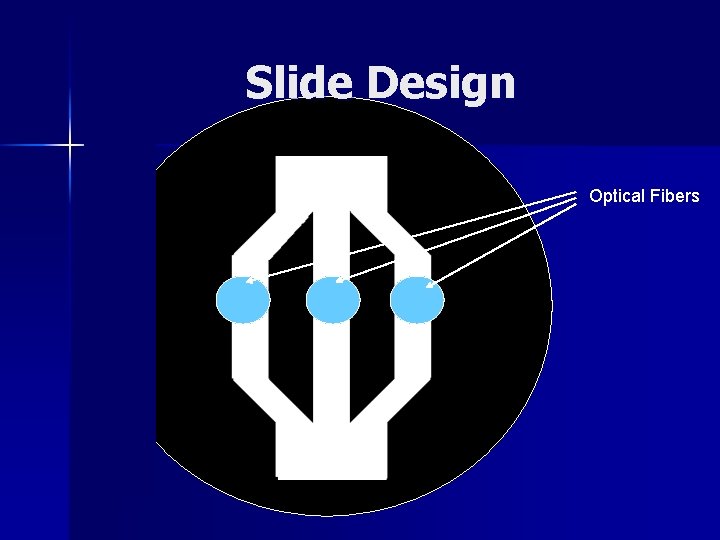
Slide Design Optical Fibers
Current Work Fabricating prototype devices while waiting for the completion of clean room certification n Perfecting the Lab. View module n Casting PDMS devices with different size optical fibers n – Therefore the minimum dye concentration necessary for detection can be found
Future Work – improve limit of detection n Once the minimum dye concentration has been found… – Chopper – Expect signal with narrow bandwidth n Lock-in amplifier to remove noise – Combines DC and AC amplifiers with a series of low and high pass filters
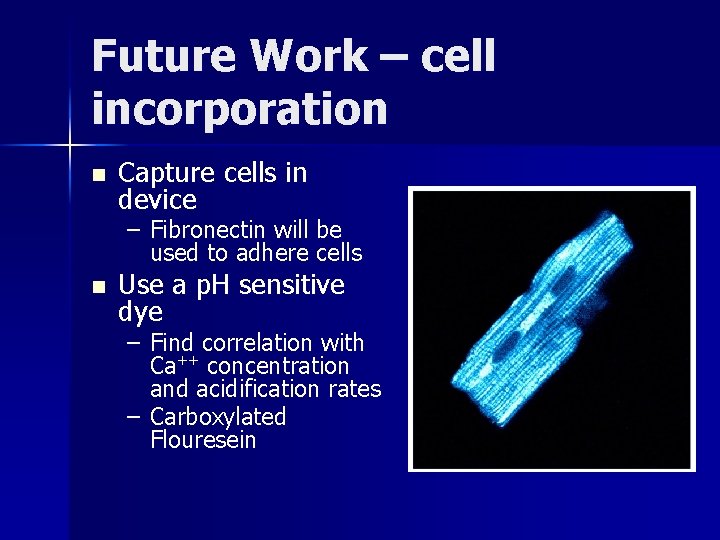
Future Work – cell incorporation n Capture cells in device – Fibronectin will be used to adhere cells n Use a p. H sensitive dye – Find correlation with Ca++ concentration and acidification rates – Carboxylated Flouresein
Timeline n n n Week of January 22 – Obtain clean room certification – Begin casting optical fibers in PDMS Week of January 29 – Prepare various flourescein concentrations and begin data acquisition with all 3 optical fiber diameters Week of February 5 – Adapt device to incorporate cells – Test device
- Slides: 9