
Design Sample Build a Swing Today As a
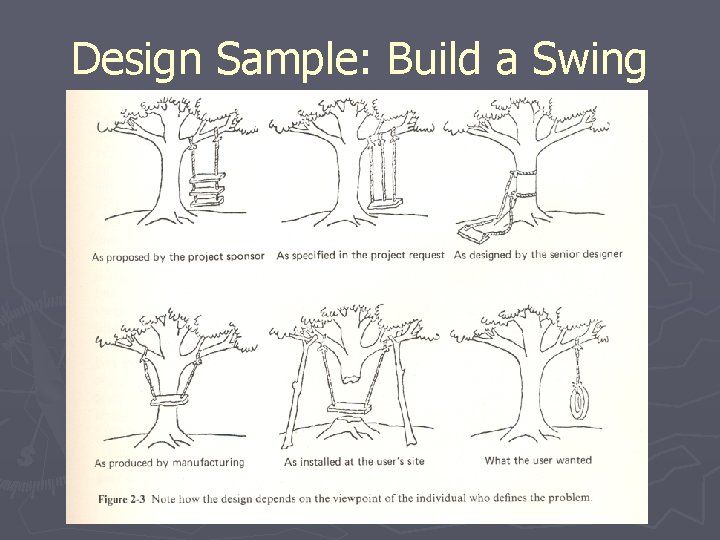
Design Sample: Build a Swing
Today ► As a class we will walk through a design cycle process that your team will complete while conquering the challenge. ► You will be introduced to your next robotic challenge. (The biggest yet!!) ► If time, you will get started on the project (Unless Smith talks too long. )
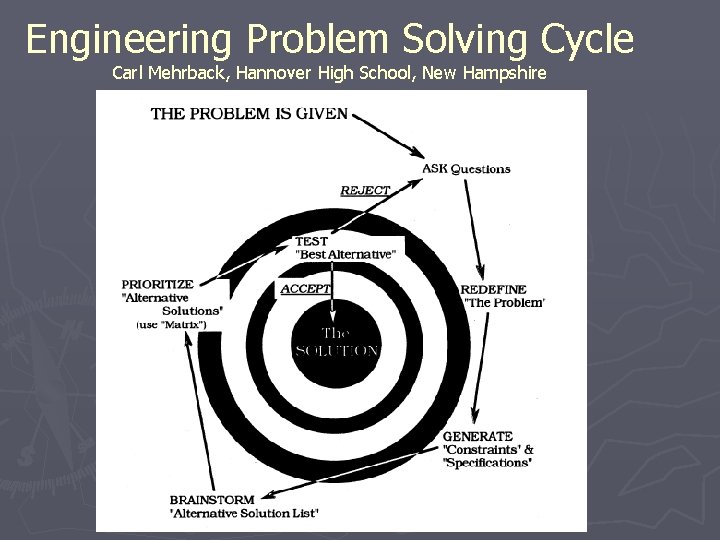
Engineering Problem Solving Cycle Carl Mehrback, Hannover High School, New Hampshire
Working on this project. ► ► ► Ask questions: Worksheet on Soccer Rules Redefine the problem: Create a three+ sentence problem statement describing this challenge. Generate constraints: Create a list of at least 8 design constraints and specifications for this challenge. Include items like, size of robot, scoring, time to complete project, … Brainstorm: Create a list of at least 15 ideas for your robots. There is no such thing as a bad idea. Prioritize: Build a matrix evaluating your brainstorm ideas using your design specifications. § Use this to pick the design you will first implement. ► Test ► Cycle § Build/program § Each team member must describe at least one improvement made to the robot design that occurred after testing.
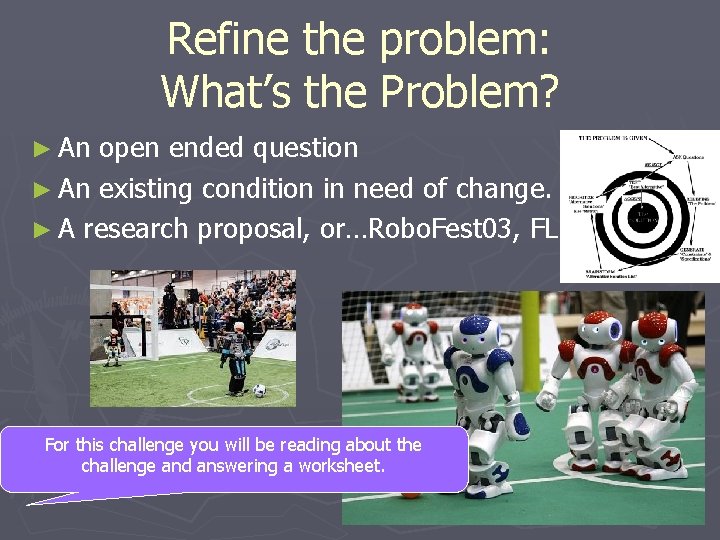
Refine the problem: What’s the Problem? ► An open ended question ► An existing condition in need of change. ► A research proposal, or…Robo. Fest 03, FLL For this challenge you will be reading about the challenge and answering a worksheet.
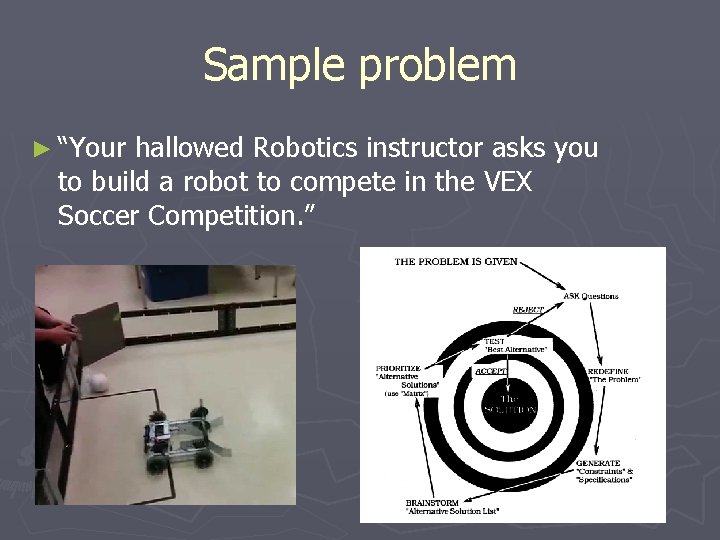
Sample problem ► “Your hallowed Robotics instructor asks you to build a robot to compete in the VEX Soccer Competition. ”
What’s the real problem? ► Good problem solvers assume that the initial problem statements reflects both the customer’s bias and notion of the desired solution. ► There is always more to the problem statement than first meets the eye.
Sample ► “Your hallowed Robotics instructor asks you to build a robot to use for this week’s training and challenges. ” ► Key phrases: ► Build a robot ► Used in this weeks training. ► Used for challenge ► Possible redefinition: “I need to build a simple robot that will able to play soccer, and win!!!”
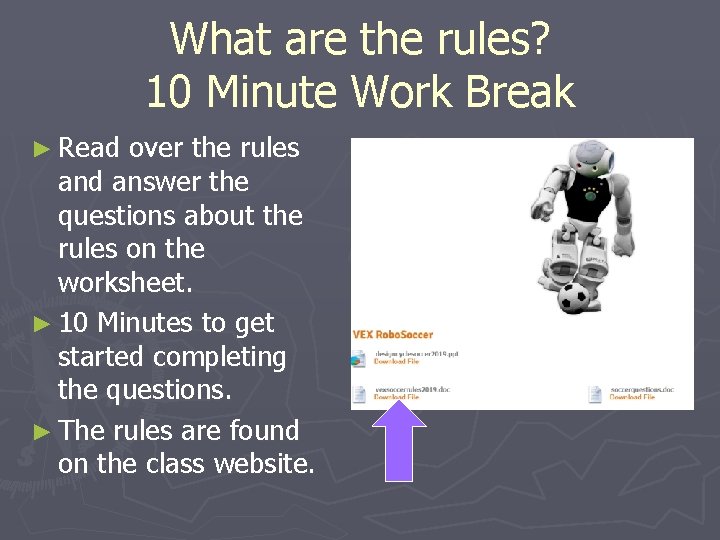
What are the rules? 10 Minute Work Break ► Read over the rules and answer the questions about the rules on the worksheet. ► 10 Minutes to get started completing the questions. ► The rules are found on the class website.
Set up Google Sheets (Each. Persons. Name_Soccer) and Share with smithtitanrobotics@gmail. com ► Slide #1: Title Page: VEX Soccer Challenge, Your Name, Today’s date (5 pts) (5/28/2019) ► Slide #2: Redefine the problem: Using what you have learned from reading the rules: Create a three+ sentence problem statement describing this challenge. (5 points) (5/28/2019)
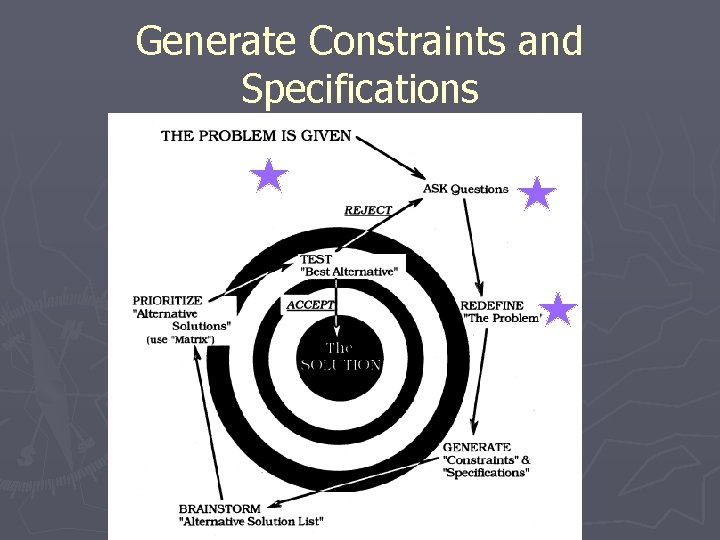
Generate Constraints and Specifications
Generate constraints (Rules/limitations) What are the constraints? ► ► ► What conditions must be met for a satisfactory solution? Research Interview an expert. § § § ► What questions do you have? What challenges will you see? What does a VEX Robot look like? Robo. FEST? How much time will there be for building robots? Economical, feasible, practical, reliable, size, performance. …
With a partner, generate 8+ Constraints ► Slide #3: List 8+ Design Constraints (5/30/2019)
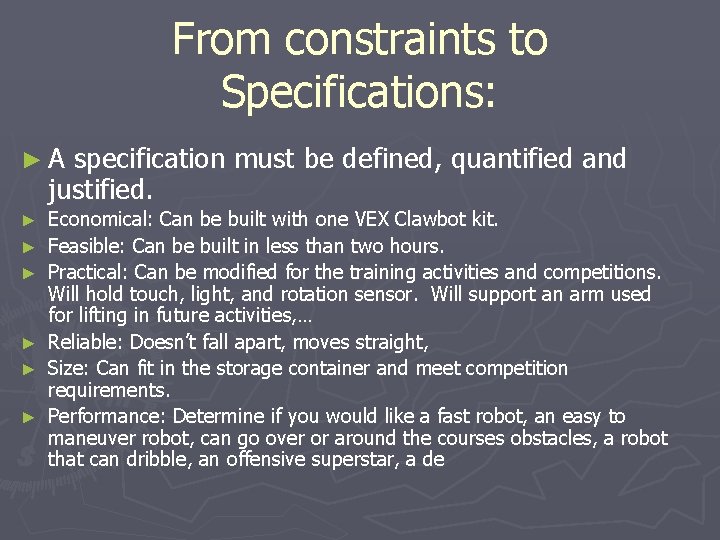
From constraints to Specifications: ►A specification must be defined, quantified and justified. ► ► ► Economical: Can be built with one VEX Clawbot kit. Feasible: Can be built in less than two hours. Practical: Can be modified for the training activities and competitions. Will hold touch, light, and rotation sensor. Will support an arm used for lifting in future activities, … Reliable: Doesn’t fall apart, moves straight, Size: Can fit in the storage container and meet competition requirements. Performance: Determine if you would like a fast robot, an easy to maneuver robot, can go over or around the courses obstacles, a robot that can dribble, an offensive superstar, a de
With a partner come up with 8+ specifications. Things a successful robot can do. ► Slide #4: List of 8+ Design Specifications (5 pts) (5/30/2019)
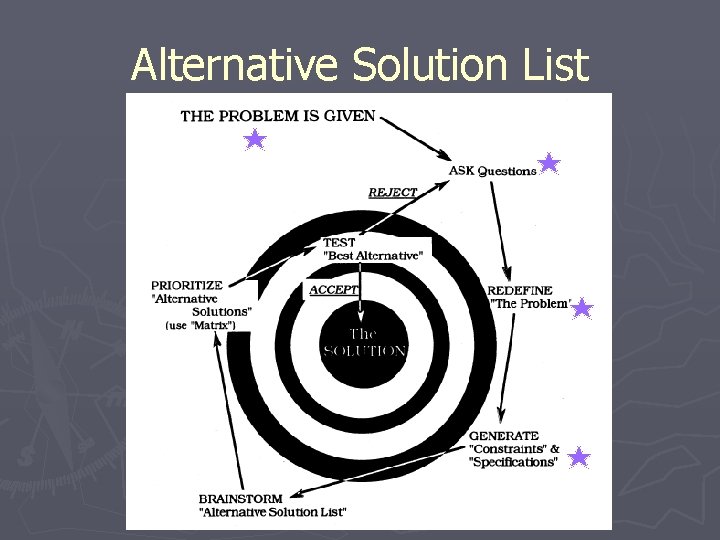
Alternative Solution List
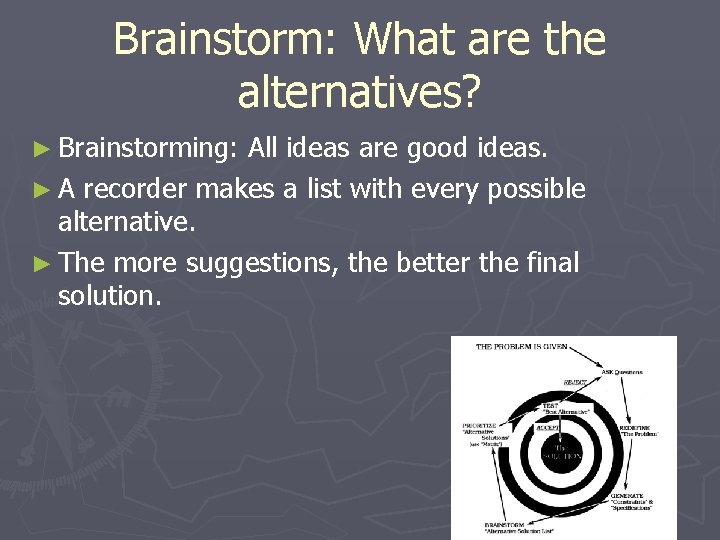
Brainstorm: What are the alternatives? ► Brainstorming: All ideas are good ideas. ► A recorder makes a list with every possible alternative. ► The more suggestions, the better the final solution.
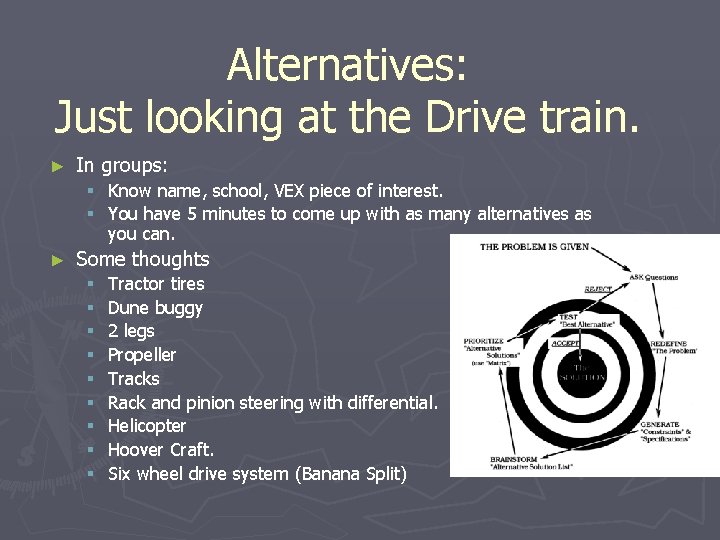
Alternatives: Just looking at the Drive train. ► In groups: § Know name, school, VEX piece of interest. § You have 5 minutes to come up with as many alternatives as you can. ► Some thoughts § § § § § Tractor tires Dune buggy 2 legs Propeller Tracks Rack and pinion steering with differential. Helicopter Hoover Craft. Six wheel drive system (Banana Split)
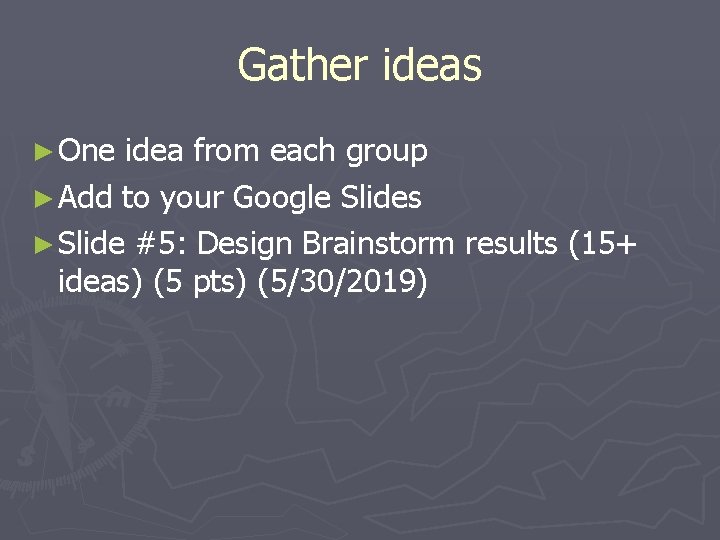
Gather ideas ► One idea from each group ► Add to your Google Slides ► Slide #5: Design Brainstorm results (15+ ideas) (5 pts) (5/30/2019)
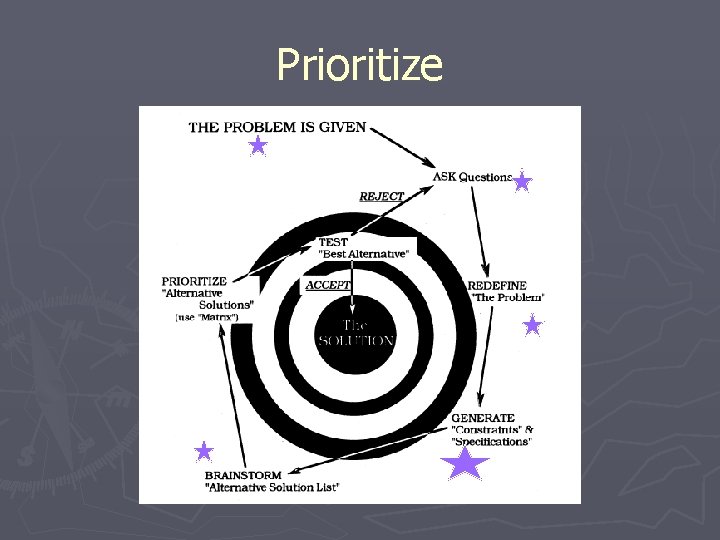
Prioritize
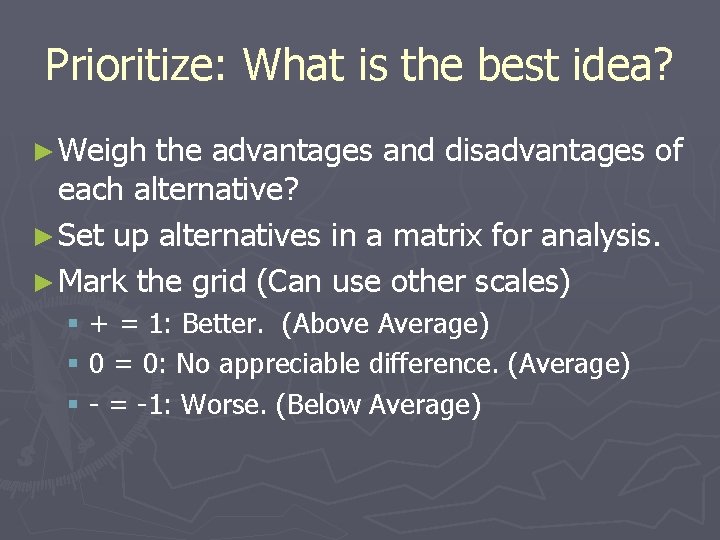
Prioritize: What is the best idea? ► Weigh the advantages and disadvantages of each alternative? ► Set up alternatives in a matrix for analysis. ► Mark the grid (Can use other scales) § + = 1: Better. (Above Average) § 0 = 0: No appreciable difference. (Average) § - = -1: Worse. (Below Average)
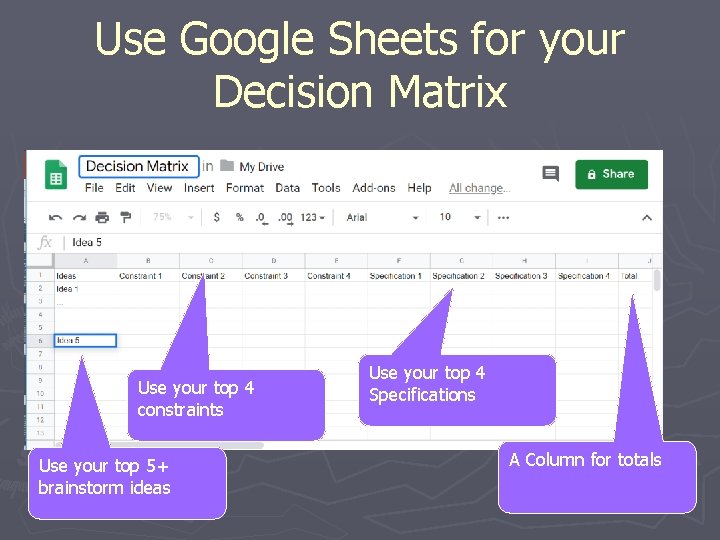
Use Google Sheets for your Decision Matrix Use your top 4 constraints Use your top 5+ brainstorm ideas Use your top 4 Specifications A Column for totals
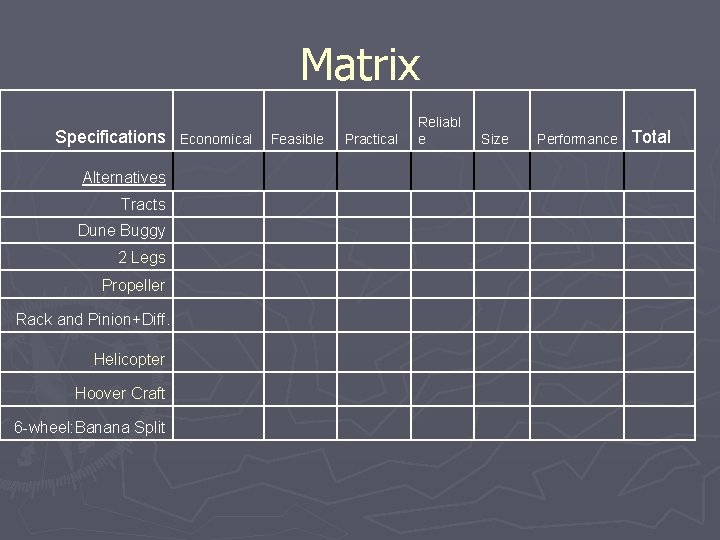
Matrix Specifications Alternatives Tracts Dune Buggy 2 Legs Propeller Rack and Pinion+Diff. Helicopter Hoover Craft 6 -wheel: Banana Split Economical Feasible Practical Reliabl e Size Performance Total
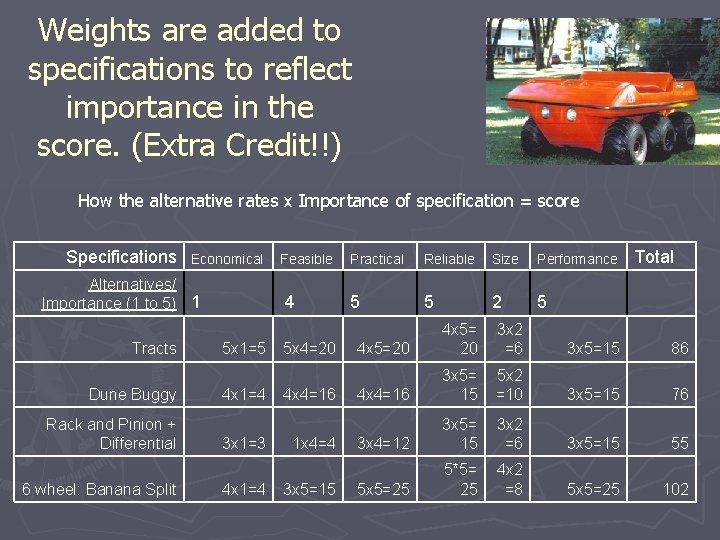
Weights are added to specifications to reflect importance in the score. (Extra Credit!!) How the alternative rates x Importance of specification = score Specifications Economical Alternatives/ Importance (1 to 5) 1 Tracts Dune Buggy Rack and Pinion + Differential 6 wheel: Banana Split 5 x 1=5 4 x 1=4 3 x 1=3 4 x 1=4 Feasible Practical Reliable Size Performance Total 4 5 5 2 5 5 x 4=20 4 x 4=16 1 x 4=4 3 x 5=15 4 x 5=20 4 x 5= 20 3 x 2 =6 3 x 5=15 86 4 x 4=16 3 x 5= 15 5 x 2 =10 3 x 5=15 76 3 x 4=12 3 x 5= 15 3 x 2 =6 3 x 5=15 55 5 x 5=25 5*5= 25 4 x 2 =8 5 x 5=25 102

Copy and Paste the Matrix into your Google Slides ► Slide #6: Decision Matrix (10 pts) (5/30/2019)
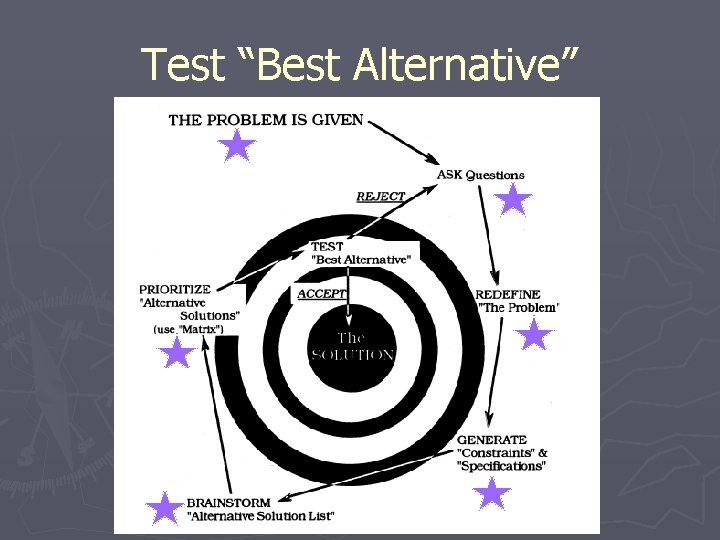
Test “Best Alternative”
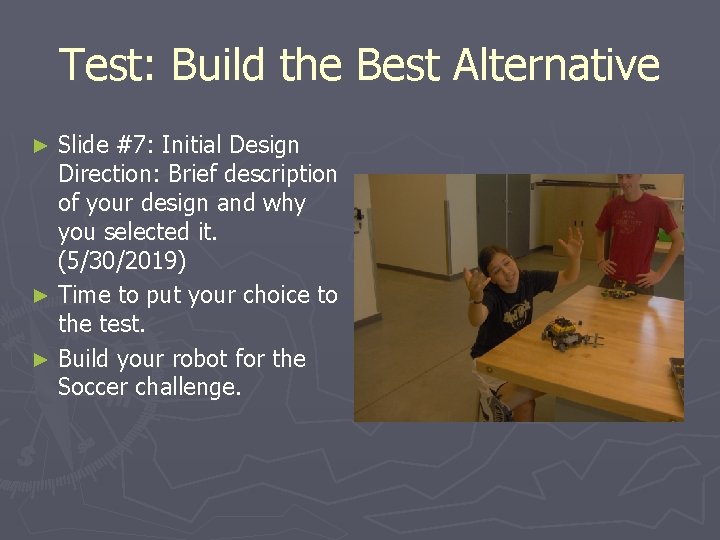
Test: Build the Best Alternative Slide #7: Initial Design Direction: Brief description of your design and why you selected it. (5/30/2019) ► Time to put your choice to the test. ► Build your robot for the Soccer challenge. ►
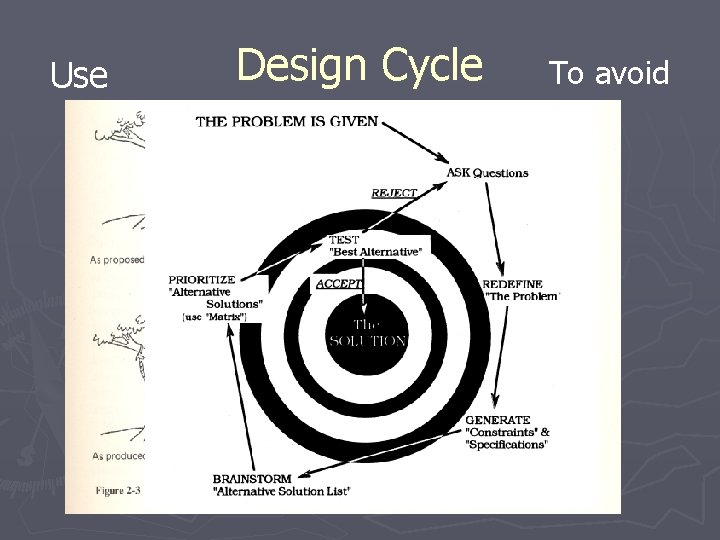
Use Design Cycle To avoid
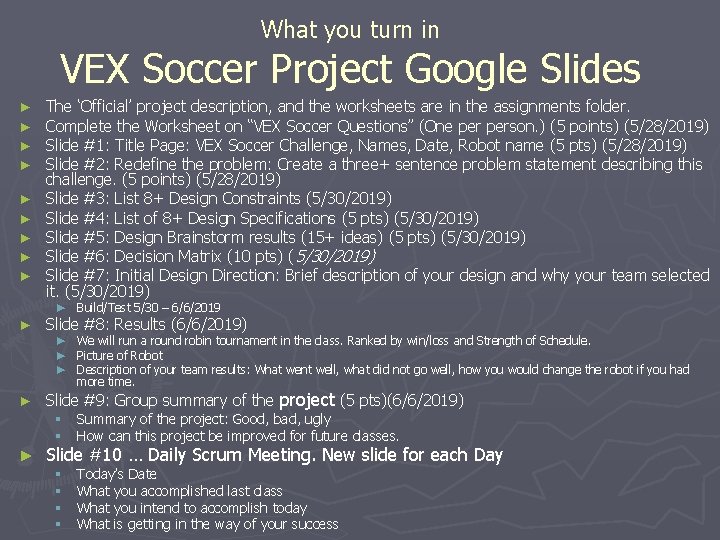
What you turn in VEX Soccer Project Google Slides ► ► ► ► ► The ‘Official’ project description, and the worksheets are in the assignments folder. Complete the Worksheet on “VEX Soccer Questions” (One person. ) (5 points) (5/28/2019) Slide #1: Title Page: VEX Soccer Challenge, Names, Date, Robot name (5 pts) (5/28/2019) Slide #2: Redefine the problem: Create a three+ sentence problem statement describing this challenge. (5 points) (5/28/2019) Slide #3: List 8+ Design Constraints (5/30/2019) Slide #4: List of 8+ Design Specifications (5 pts) (5/30/2019) Slide #5: Design Brainstorm results (15+ ideas) (5 pts) (5/30/2019) Slide #6: Decision Matrix (10 pts) (5/30/2019) Slide #7: Initial Design Direction: Brief description of your design and why your team selected it. (5/30/2019) ► Build/Test 5/30 – 6/6/2019 ► Slide #8: Results (6/6/2019) ► ► ► We will run a round robin tournament in the class. Ranked by win/loss and Strength of Schedule. Picture of Robot Description of your team results: What went well, what did not go well, how you would change the robot if you had more time. Slide #9: Group summary of the project (5 pts)(6/6/2019) § § Summary of the project: Good, bad, ugly How can this project be improved for future classes. § § Today’s Date What you accomplished last class What you intend to accomplish today What is getting in the way of your success Slide #10 … Daily Scrum Meeting. New slide for each Day
- Slides: 29