
Design Review UL Vibration Test Apparatus May 13
Design Review UL Vibration Test Apparatus May 13, 2013 1: 30 PM Est.
Project & Team Information Project: UL Vibration Test Apparatus Project Number: 13471 Customer: Eaton Corporation (previously Cooper Crouse-Hinds Industries) Customer Contacts: Joe Manahan Ed Leubner RIT Faculty Guide: Dr. Benjamin Varela Project Team: February 21, 2013 Walter Bergstrom Sean Coots Spencer Crandell Mark Ellison UL Vibration Test Apparatus 2
Presentation Overview 1) Detailed Design Review Overview Appendix: UL Test Stand Project Background February 21, 2013 UL Vibration Test Apparatus 3
Detailed Design Review • Discussed Design: – Adjustment Mechanism – Crank Arm • Key Action Items: – Adjustment Mechanism Strength – Crank Arm • Actions Taken: – Crank Arm to be a single piece February 21, 2013 UL Vibration Test Apparatus 4
Final Design February 21, 2013 UL Vibration Test Apparatus 5
Variations from Design February 21, 2013 UL Vibration Test Apparatus 6
Setup February 21, 2013 UL Vibration Test Apparatus 7
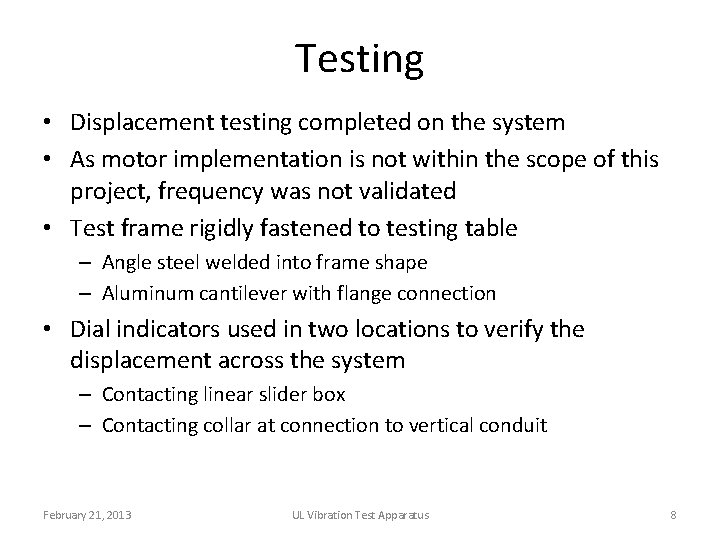
Testing • Displacement testing completed on the system • As motor implementation is not within the scope of this project, frequency was not validated • Test frame rigidly fastened to testing table – Angle steel welded into frame shape – Aluminum cantilever with flange connection • Dial indicators used in two locations to verify the displacement across the system – Contacting linear slider box – Contacting collar at connection to vertical conduit February 21, 2013 UL Vibration Test Apparatus 8
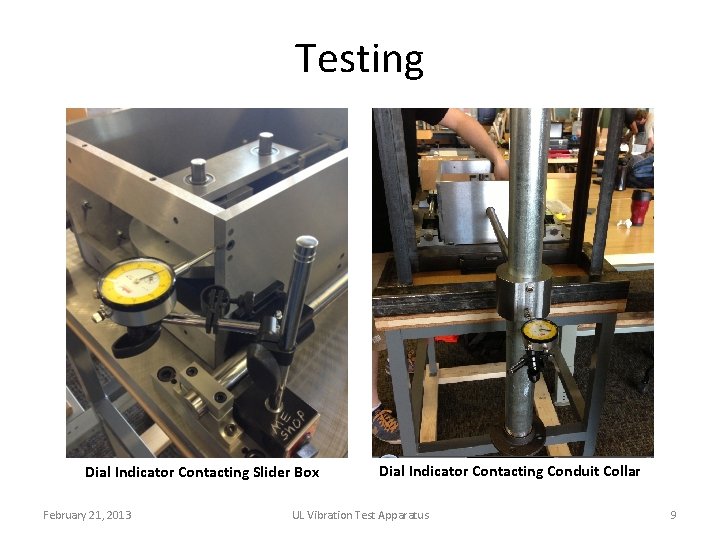
Testing Dial Indicator Contacting Slider Box February 21, 2013 Dial Indicator Contacting Conduit Collar UL Vibration Test Apparatus 9
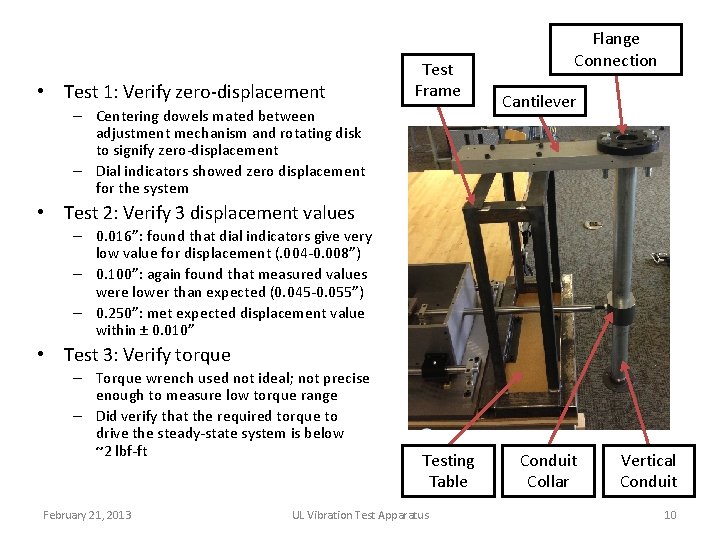
• Test 1: Verify zero-displacement Test Frame – Centering dowels mated between adjustment mechanism and rotating disk to signify zero-displacement – Dial indicators showed zero displacement for the system Flange Connection Cantilever • Test 2: Verify 3 displacement values – 0. 016”: found that dial indicators give very low value for displacement (. 004 -0. 008”) – 0. 100”: again found that measured values were lower than expected (0. 045 -0. 055”) – 0. 250”: met expected displacement value within ± 0. 010” • Test 3: Verify torque – Torque wrench used not ideal; not precise enough to measure low torque range – Did verify that the required torque to drive the steady-state system is below ~2 lbf-ft February 21, 2013 Testing Table UL Vibration Test Apparatus Conduit Collar Vertical Conduit 10
Testing Conclusions • Zero-displacement point is validated • Displacement measurements do not agree at low eccentric values, but they do at higher distances – Postulated that the dial indicators are not precise enough to accurately measure low eccentric distances • Torque measurement has a high degree of uncertainty due to the low level of precision associated with the torque wrench used during testing • Recommended: – Purchase more precise dial indicator (re-test) – Purchase more precise torque wrench (re-test) February 21, 2013 UL Vibration Test Apparatus 11
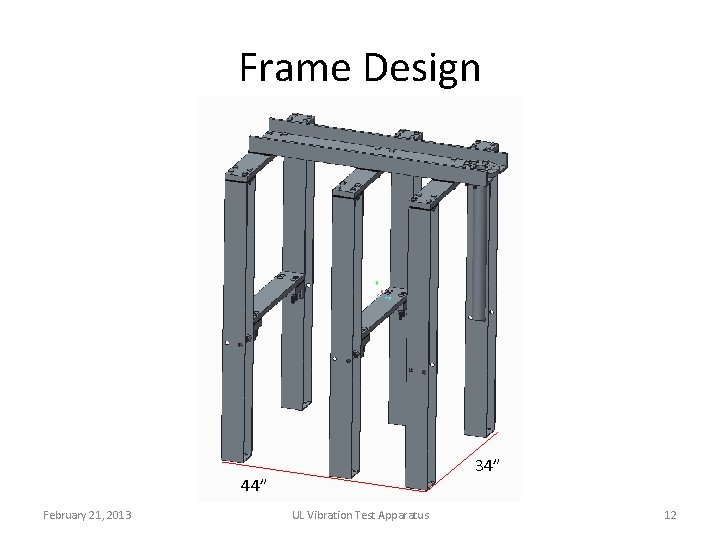
Frame Design 34” 44” February 21, 2013 UL Vibration Test Apparatus 12
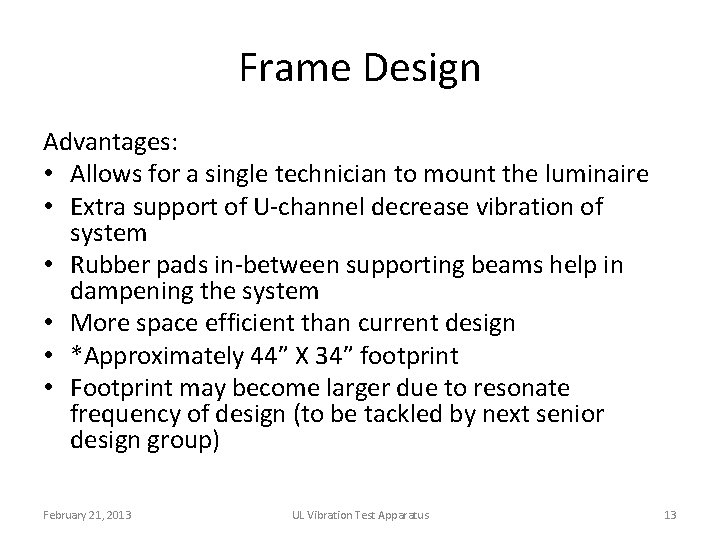
Frame Design Advantages: • Allows for a single technician to mount the luminaire • Extra support of U-channel decrease vibration of system • Rubber pads in-between supporting beams help in dampening the system • More space efficient than current design • *Approximately 44” X 34” footprint • Footprint may become larger due to resonate frequency of design (to be tackled by next senior design group) February 21, 2013 UL Vibration Test Apparatus 13
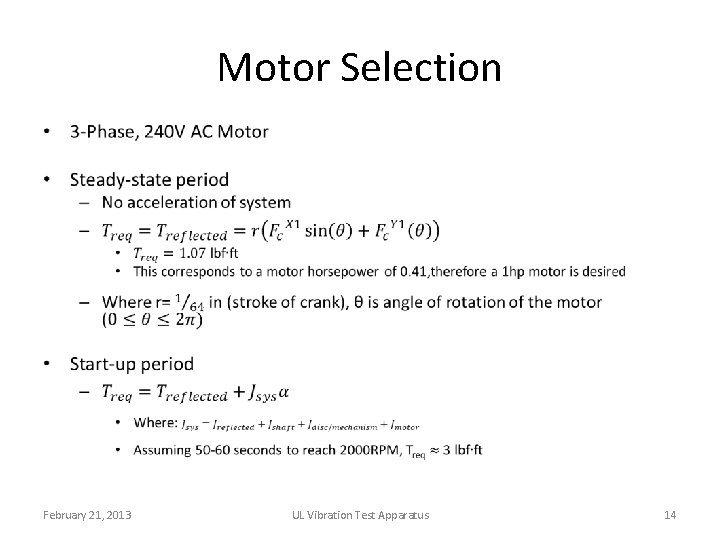
Motor Selection • February 21, 2013 UL Vibration Test Apparatus 14
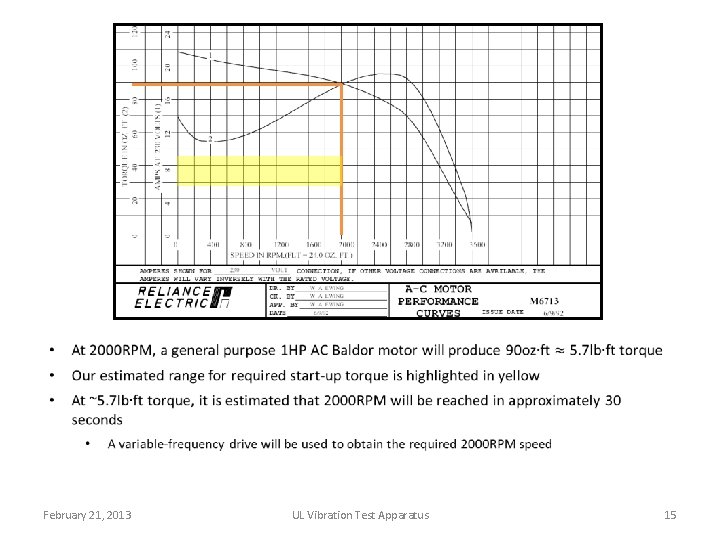
February 21, 2013 UL Vibration Test Apparatus 15
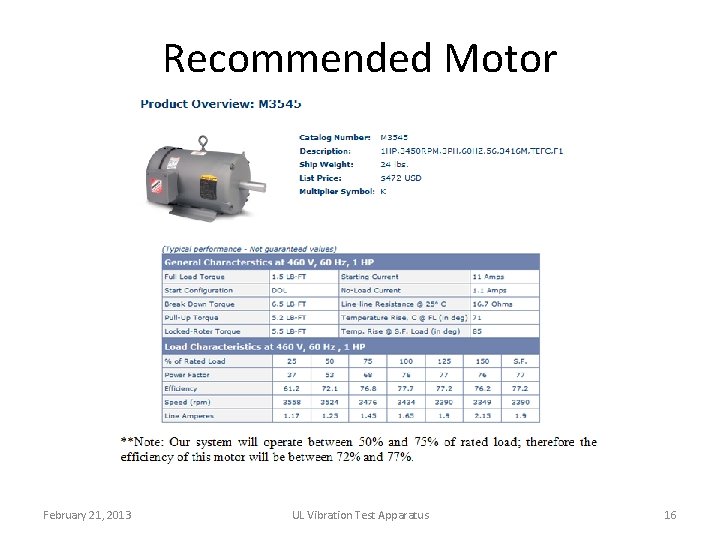
Recommended Motor February 21, 2013 UL Vibration Test Apparatus 16
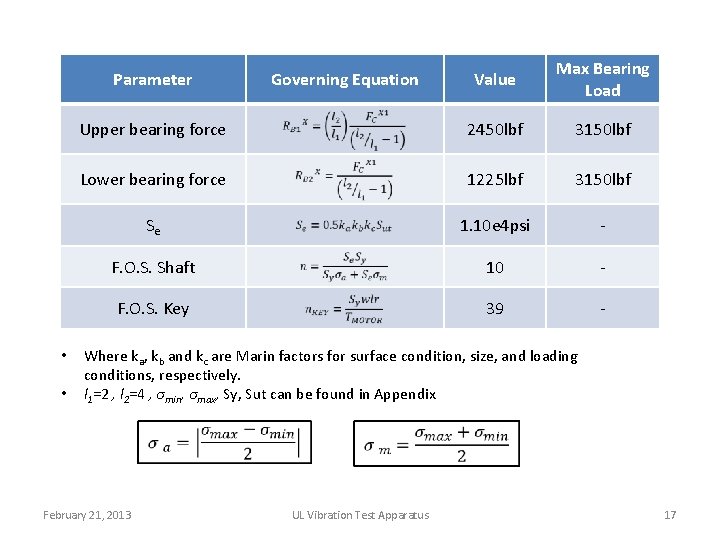
Value Max Bearing Load Upper bearing force 2450 lbf 3150 lbf Lower bearing force 1225 lbf 3150 lbf Se 1. 10 e 4 psi - F. O. S. Shaft 10 - F. O. S. Key 39 - Parameter • • Governing Equation Where ka, kb and kc are Marin factors for surface condition, size, and loading conditions, respectively. l 1=2 , l 2=4 , σmin, σmax, Sy, Sut can be found in Appendix February 21, 2013 UL Vibration Test Apparatus 17
Lubrication • Drive Shaft Bearings: Double sealed flange mount bearings with easy access grease zerk fittings. • Linear Bearings: Double sealed closed bearings with easy access grease zerk fittings. • Crank Arm Bearings: Double Sealed roller bearings pre-packed with grease. Easy access for lubrication by taking off Polycarbonate cover. February 21, 2013 UL Vibration Test Apparatus 18
Budget February 21, 2013 UL Vibration Test Apparatus 19
Questions For Customer February 21, 2013 UL Vibration Test Apparatus 20
Open Discussion • Any questions? • Design concerns not discussed? February 21, 2013 UL Vibration Test Apparatus 21

Appendix UL Test Standard and Project Background

Project Background • • To pass safety requirements for certification the luminaires must meet a series of Underwriters Laboratories Inc. Standards. A Vibration Test Stand is currently being used by Cooper Crouse-Hinds to test pendant mount luminaires according to section 33 of the UL 844 Standard. The Current Vibration Test Stand is outdated, has multiple design flaws, and design documentation and drawings are non-existent. Cooper Crouse-Hinds would like a new modernized Vibration Test Stand to be developed that addresses some of the design flaws of the current system while maintaining UL 844 Test Standards. This new Design must also have a Lab. View interface and control capability integrated into the system. February 21, 2013 UL Vibration Test Apparatus 23
Design Goals over Winter/Spring MSD Note: It has been decided that this apparatus will be developed in multiple Senior Design Sequences. • Provide customer with two design concepts for vibration mechanism • Develop a final design of the vibration mechanism. • Design a steel test frame that will support the vibration mechanism and the vertical conduit. • Design but do not develop steel frame for entire vibration test machine. • Develop a full set of engineering drawings. • Calculate and select the required drive train system components. • Purchase materials, machine components, and assemble the vibration mechanism and test frame. • Test the mechanism to ensure that it meets 1/32” deflection requirement February 21, 2013 UL Vibration Test Apparatus 24
Summary of UL 844 Vibration Test Standard LUMINAIRES FOR USE IN HAZARDOUS (CLASSIFIED) LOCATIONS – UL 844 Section 33 – Vibration Test Standards • • • Luminaire is to be subjected to 35 hours of vibration testing. Luminaire assembly is to be attached to a 26 -1/2” long conduit via NPT threading. The other end of the NPT threaded pipe is to be secured to the hub of a rigid mounting frame so that the conduit hangs vertically. The conduit should correspond to the smallest size of threaded conduit hub that is designed to attach to the Luminaire being tested. The horizontal force to be applied to the system in order to obtain the deflection must me located 4” above the location of the conduit where the Luminaire attaches. The deflection must be 1/32” with 1/16” total deflection per cycle. The system must run at 2000 cycles/min. February 21, 2013 UL Vibration Test Apparatus 25
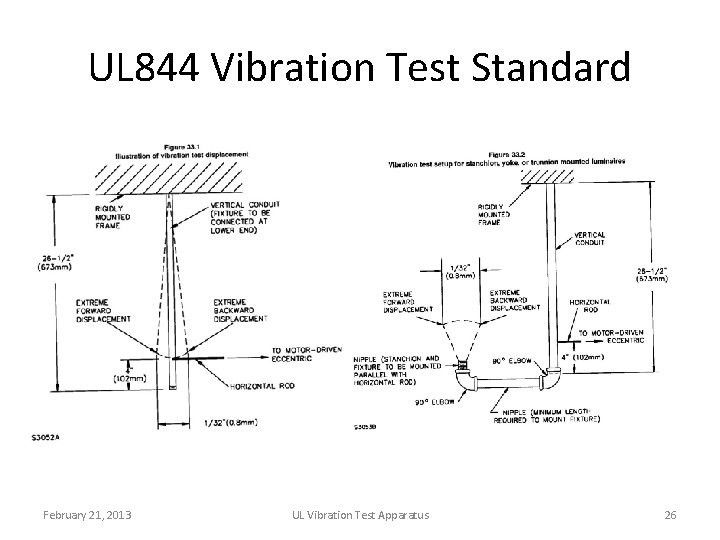
UL 844 Vibration Test Standard February 21, 2013 UL Vibration Test Apparatus 26
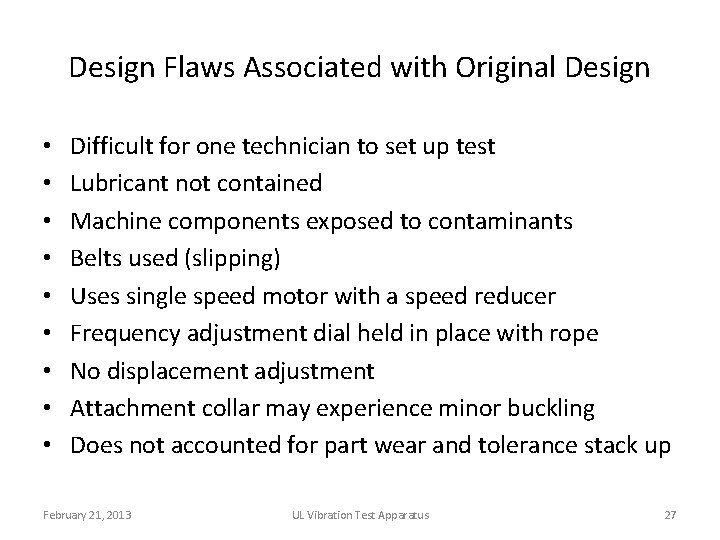
Design Flaws Associated with Original Design • • • Difficult for one technician to set up test Lubricant not contained Machine components exposed to contaminants Belts used (slipping) Uses single speed motor with a speed reducer Frequency adjustment dial held in place with rope No displacement adjustment Attachment collar may experience minor buckling Does not accounted for part wear and tolerance stack up February 21, 2013 UL Vibration Test Apparatus 27
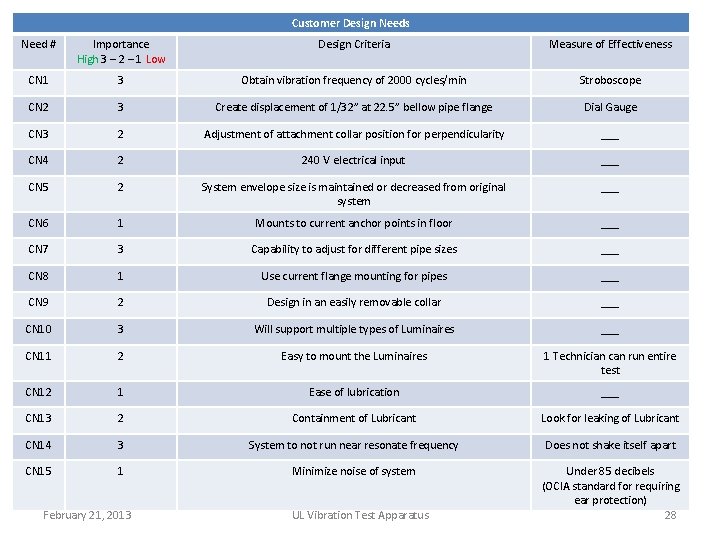
Customer Design Needs Need # Importance High 3 – 2 – 1 Low Design Criteria Measure of Effectiveness CN 1 3 Obtain vibration frequency of 2000 cycles/min Stroboscope CN 2 3 Create displacement of 1/32” at 22. 5” bellow pipe flange Dial Gauge CN 3 2 Adjustment of attachment collar position for perpendicularity ___ CN 4 2 240 V electrical input ___ CN 5 2 System envelope size is maintained or decreased from original system ___ CN 6 1 Mounts to current anchor points in floor ___ CN 7 3 Capability to adjust for different pipe sizes ___ CN 8 1 Use current flange mounting for pipes ___ CN 9 2 Design in an easily removable collar ___ CN 10 3 Will support multiple types of Luminaires ___ CN 11 2 Easy to mount the Luminaires 1 Technician can run entire test CN 12 1 Ease of lubrication ___ CN 13 2 Containment of Lubricant Look for leaking of Lubricant CN 14 3 System to not run near resonate frequency Does not shake itself apart CN 15 1 Minimize noise of system Under 85 decibels (OCIA standard for requiring ear protection) 28 February 21, 2013 UL Vibration Test Apparatus
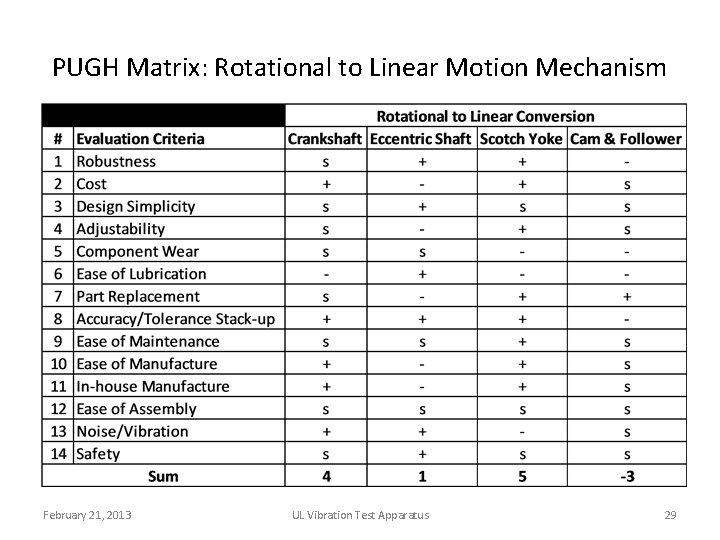
PUGH Matrix: Rotational to Linear Motion Mechanism February 21, 2013 UL Vibration Test Apparatus 29
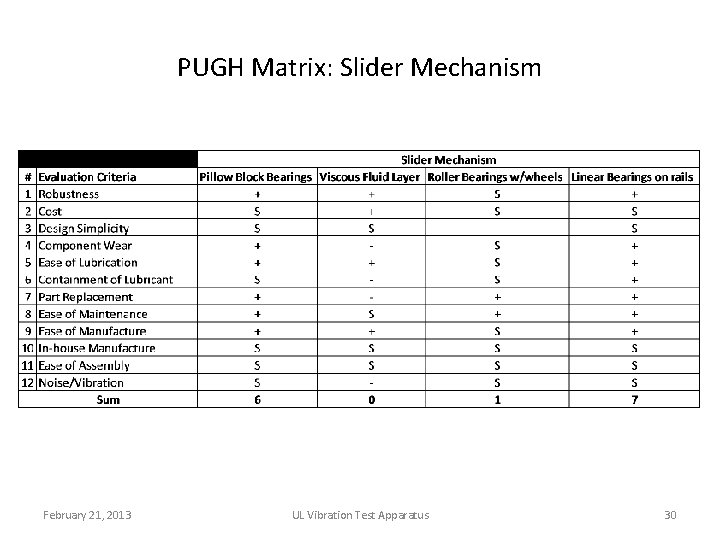
PUGH Matrix: Slider Mechanism February 21, 2013 UL Vibration Test Apparatus 30
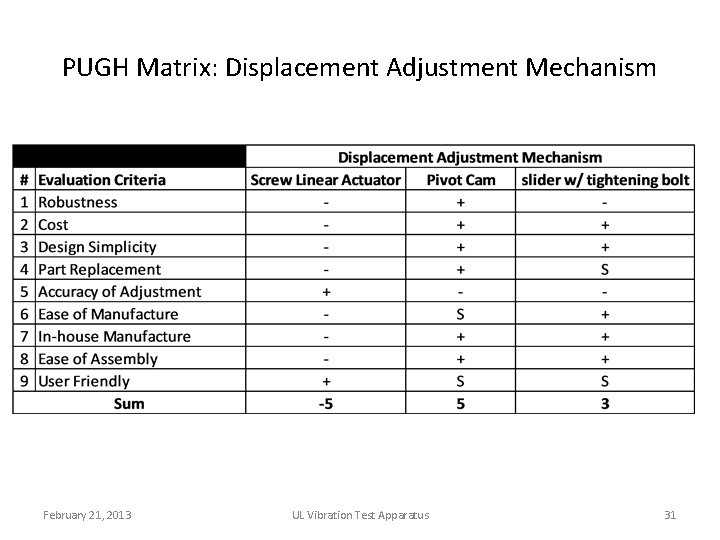
PUGH Matrix: Displacement Adjustment Mechanism February 21, 2013 UL Vibration Test Apparatus 31
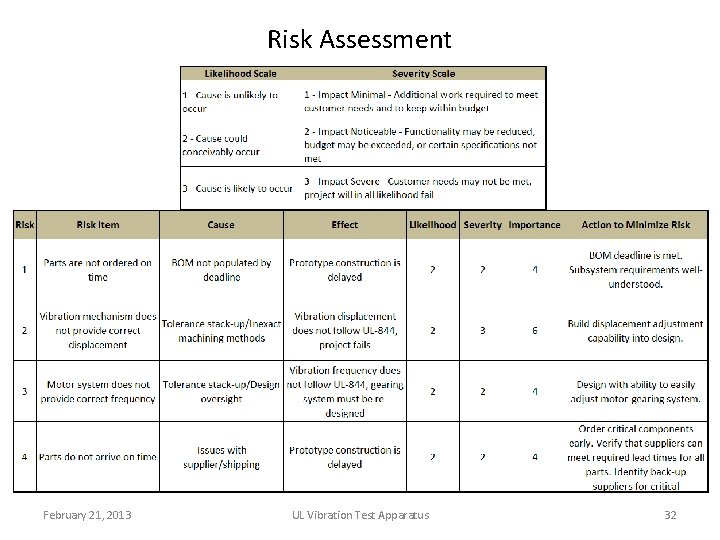
Risk Assessment February 21, 2013 UL Vibration Test Apparatus 32
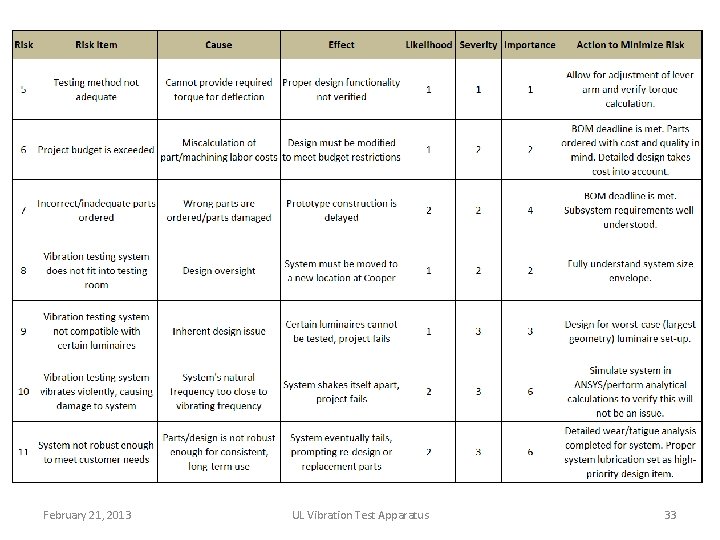
February 21, 2013 UL Vibration Test Apparatus 33
- Slides: 33