
Design Project Management Voice of the Customer Interviews
- Slides: 23
Design Project Management Voice of the Customer: Interviews and Observations Rochester Institute of Technology Mechanical Engineering Department Rochester, NY USA R. I. T Mechanical Engineering
Session Objectives • • Assign project teams Review best practices Plan and conduct mock interviews Work time to plan real interviews and observations • Report back (brief) R. I. T Mechanical Engineering
Session Objectives • • Assign project teams Review best practices Plan and conduct mock interviews Work time to plan real interviews and observations • Report back (brief) R. I. T Mechanical Engineering
Session Objectives • • Assign project teams Review best practices Plan and conduct mock interviews Work time to plan real interviews and observations • Report back (brief) R. I. T Mechanical Engineering
Why? • Why do we conduct interviews and observations? R. I. T Mechanical Engineering
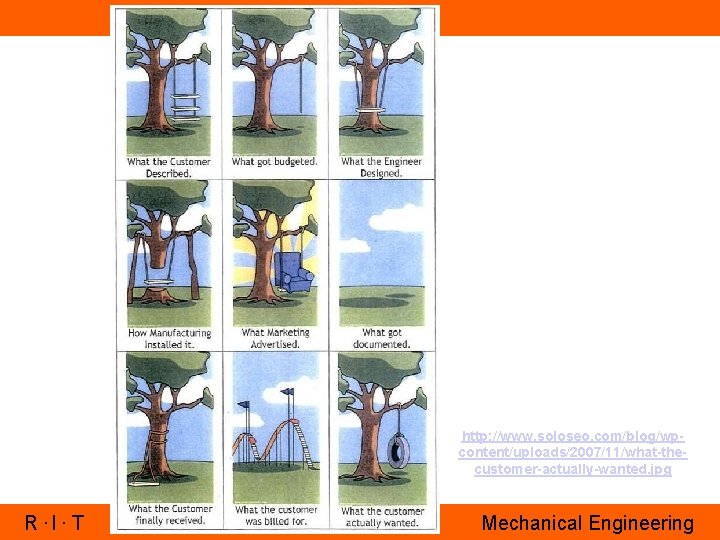
http: //www. soloseo. com/blog/wpcontent/uploads/2007/11/what-thecustomer-actually-wanted. jpg R. I. T Mechanical Engineering
Who to talk to? R. I. T Mechanical Engineering
What do you do with these people? • • Interview Written Survey Focus Groups (groups of customers together) Play acting (pretend you are the customer) Observe (shadow) Offer extreme examples What aspects of an existing product doesn’t meet their needs? R. I. T Mechanical Engineering
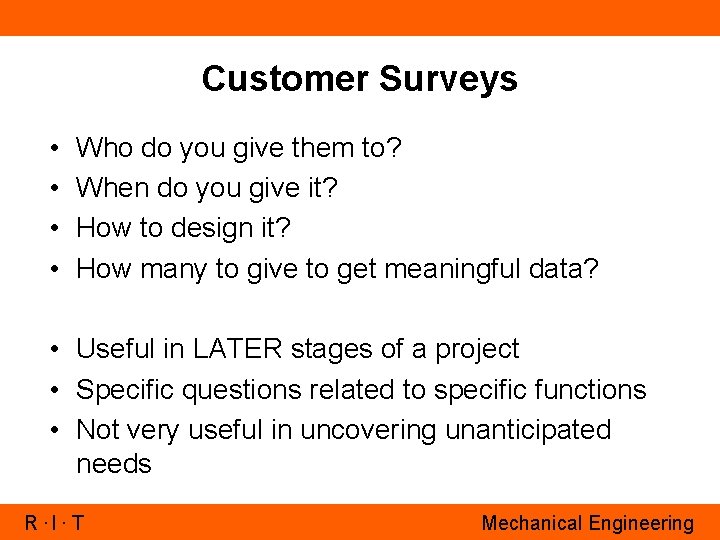
Customer Surveys • • Who do you give them to? When do you give it? How to design it? How many to give to get meaningful data? • Useful in LATER stages of a project • Specific questions related to specific functions • Not very useful in uncovering unanticipated needs R. I. T Mechanical Engineering
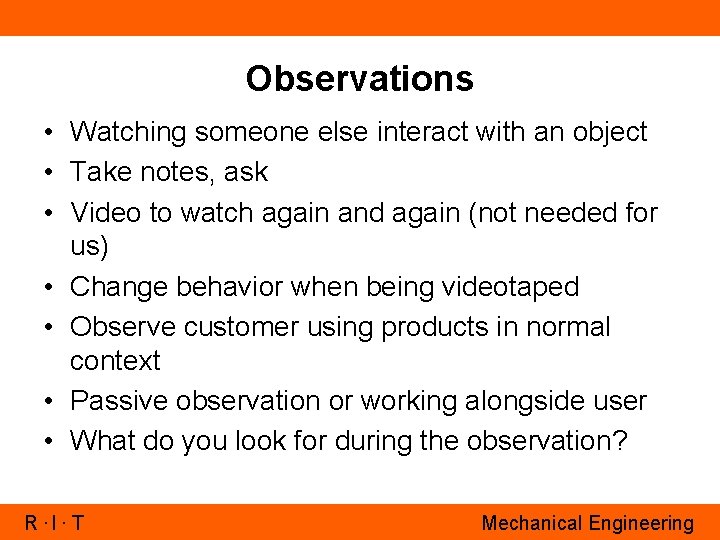
Observations • Watching someone else interact with an object • Take notes, ask • Video to watch again and again (not needed for us) • Change behavior when being videotaped • Observe customer using products in normal context • Passive observation or working alongside user • What do you look for during the observation? R. I. T Mechanical Engineering
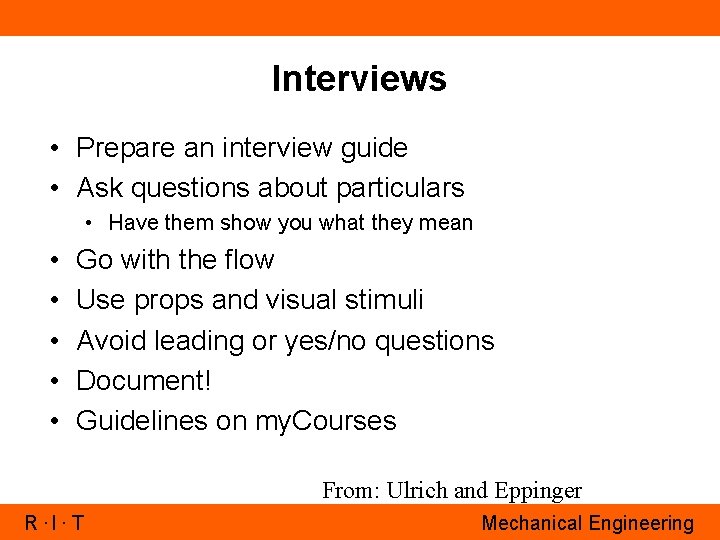
Interviews • Prepare an interview guide • Ask questions about particulars • Have them show you what they mean • • • Go with the flow Use props and visual stimuli Avoid leading or yes/no questions Document! Guidelines on my. Courses From: Ulrich and Eppinger R. I. T Mechanical Engineering
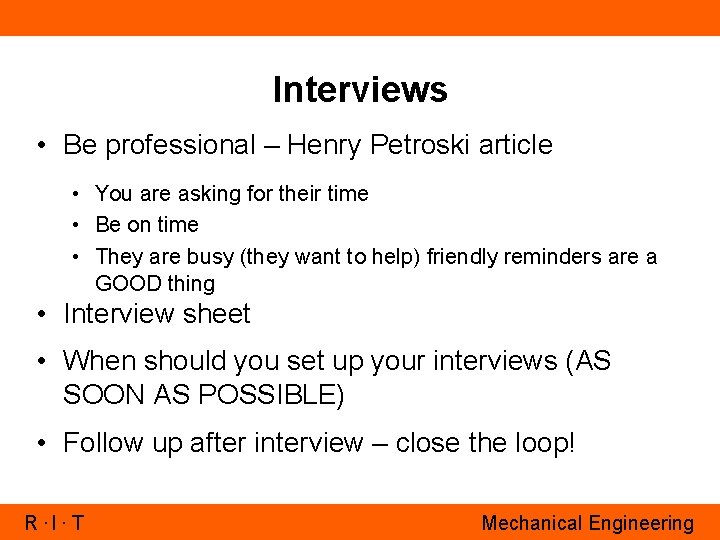
Interviews • Be professional – Henry Petroski article • You are asking for their time • Be on time • They are busy (they want to help) friendly reminders are a GOOD thing • Interview sheet • When should you set up your interviews (AS SOON AS POSSIBLE) • Follow up after interview – close the loop! R. I. T Mechanical Engineering
Interview Stakeholders • Consider why you want the stakeholder’s input • Start with a plan (questions you developed), but follow the lead of the stakeholder. • Don’t be afraid to ask, “Why? ” • Get clarification • Record, don’t interpret R. I. T Mechanical Engineering
The ART of eliciting customer needs data • When and why do you use this type of product? • Walk us through a typical session using the product. • What do you like about the existing products? • What do you dislike about the existing products? • What issues do you consider when purchasing the product? • What improvements would you like to make to the product? • From Ulrich and Eppinger R. I. T Mechanical Engineering
Communication • • Gestures Emotion Choice of language Body language, how do they hold a competitor’s product • Email • Video conferencing • Lack of communication R. I. T Mechanical Engineering
Session Objectives • • Assign project teams Review best practices Plan and conduct mock interviews Work time to plan real interviews and observations • Report back (brief) R. I. T Mechanical Engineering
Let’s try an interview… • The problem: design a revolutionary new Ankle. Foot Orthotic, designed to improve the lives of people with foot drop (inability to lift the toe while walking). • Who do you want to talk to? R. I. T Mechanical Engineering
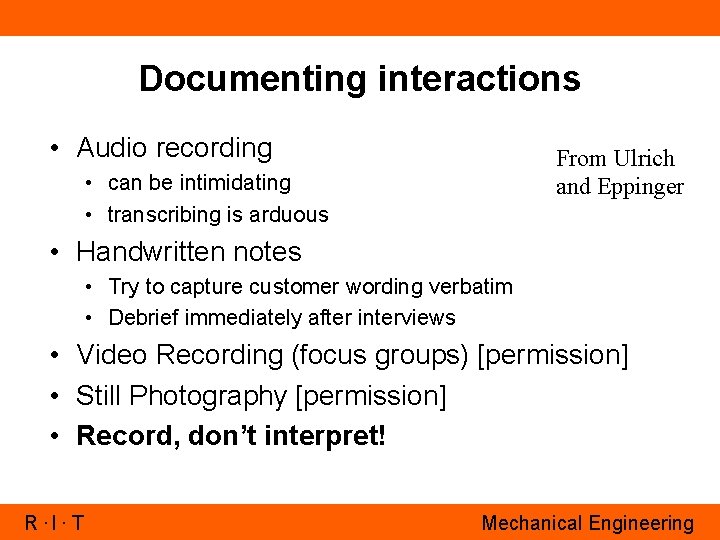
Documenting interactions • Audio recording From Ulrich and Eppinger • can be intimidating • transcribing is arduous • Handwritten notes • Try to capture customer wording verbatim • Debrief immediately after interviews • Video Recording (focus groups) [permission] • Still Photography [permission] • Record, don’t interpret! R. I. T Mechanical Engineering
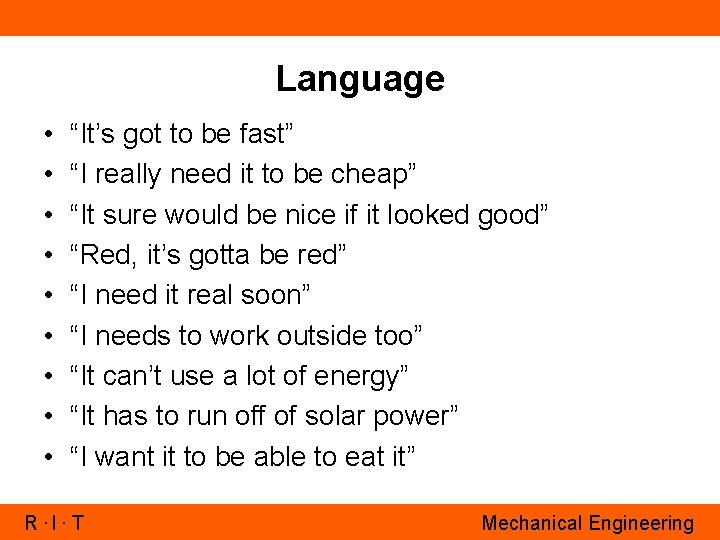
Language • • • “It’s got to be fast” “I really need it to be cheap” “It sure would be nice if it looked good” “Red, it’s gotta be red” “I need it real soon” “I needs to work outside too” “It can’t use a lot of energy” “It has to run off of solar power” “I want it to be able to eat it” R. I. T Mechanical Engineering
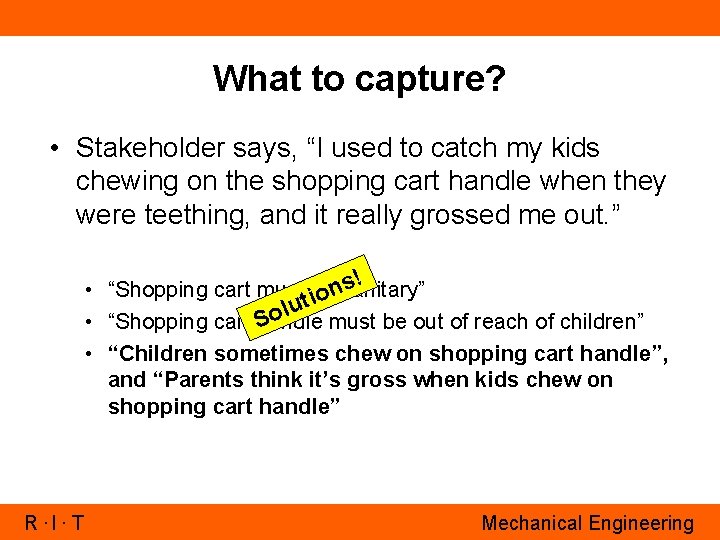
What to capture? • Stakeholder says, “I used to catch my kids chewing on the shopping cart handle when they were teething, and it really grossed me out. ” ! s n • “Shopping cart musttbe sanitary” o i u ol • “Shopping cart S handle must be out of reach of children” • “Children sometimes chew on shopping cart handle”, and “Parents think it’s gross when kids chew on shopping cart handle” R. I. T Mechanical Engineering
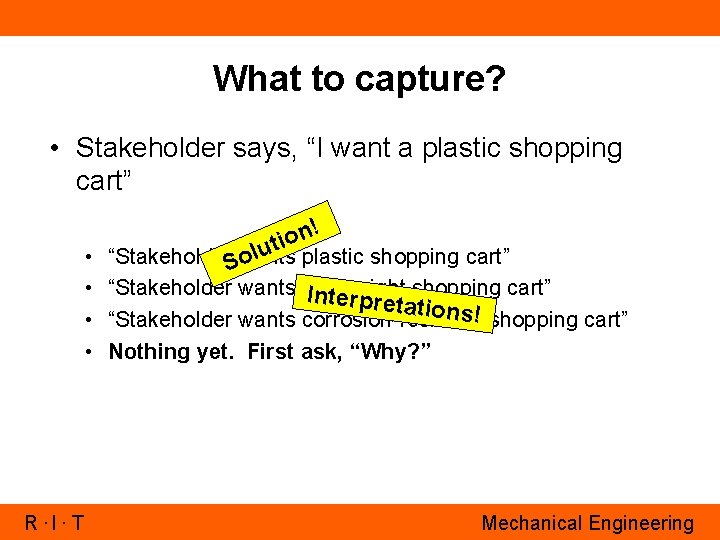
What to capture? • Stakeholder says, “I want a plastic shopping cart” • • R. I. T ! n o uti “Stakeholder. Swants plastic shopping cart” ol “Stakeholder wants lightweight Interpretashopping cart” tions! shopping cart” “Stakeholder wants corrosion-resistant Nothing yet. First ask, “Why? ” Mechanical Engineering
Session Objectives • • Assign project teams Review best practices Plan and conduct mock interviews Work time to plan real interviews and observations • Report back (brief) R. I. T Mechanical Engineering
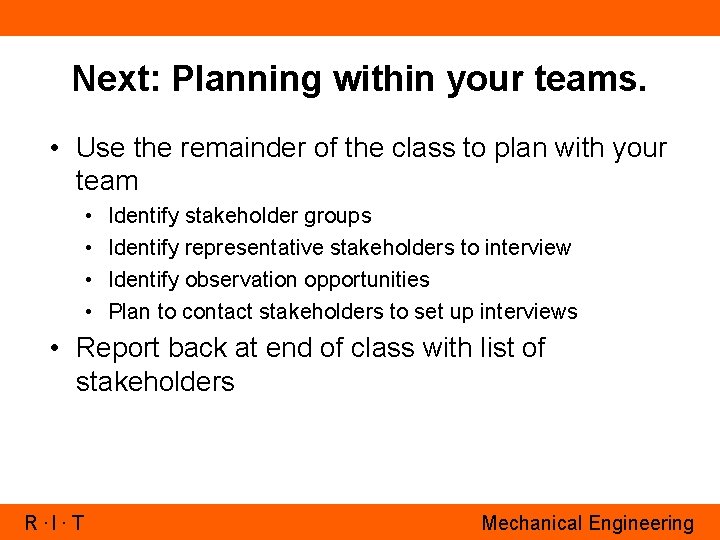
Next: Planning within your teams. • Use the remainder of the class to plan with your team • • Identify stakeholder groups Identify representative stakeholders to interview Identify observation opportunities Plan to contact stakeholders to set up interviews • Report back at end of class with list of stakeholders R. I. T Mechanical Engineering