
Design Project 1 Replacement of Vehicle Bridge over
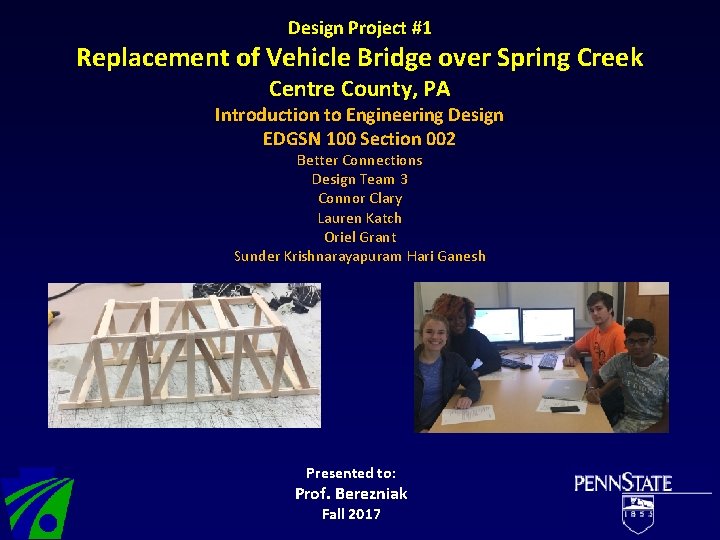
Design Project #1 Replacement of Vehicle Bridge over Spring Creek Centre County, PA Introduction to Engineering Design EDGSN 100 Section 002 Better Connections Design Team 3 Connor Clary Lauren Katch Oriel Grant Sunder Krishnarayapuram Hari Ganesh Presented to: Prof. Berezniak Fall 2017
Statement of the Problem • Spring Creek Pedestrian Bridge in College Township was destroyed by a 100 year flood • Rerouting traffic around the bridge has caused near by residential roads to be overflowed • The heavy traffic prevents emergency, first responders from quickly accessing the township
Project Objective • Pennsylvania Department of Transportation of (Penn. DOT) Engineering District 2 – 0 needs a bridge to be designed quickly to replace the broken bridge
Required Design Criteria • A Warren truss bridge and Howe truss bridge were desired • The bridges would have: • Standard abutments • No piers • . 23 medium strength concrete deck material • No cable anchorages • Hold a load of two AASHTO H 20 -44 trucks • Deck elevation of 20 meters • Deck span of 40 meters
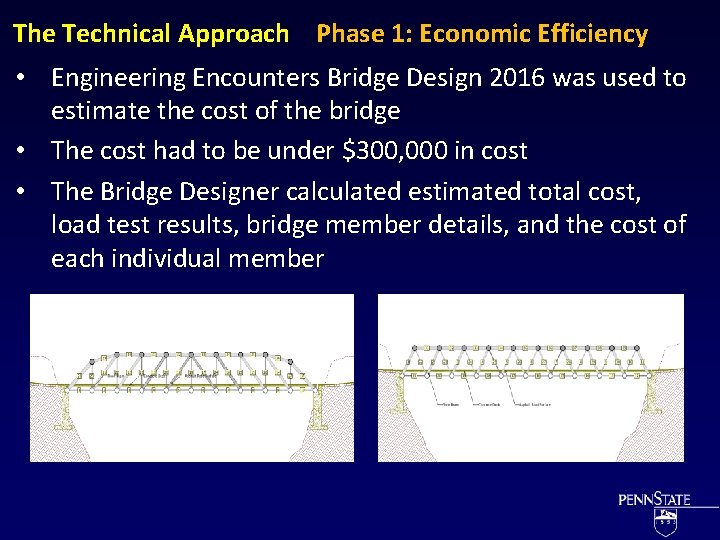
The Technical Approach Phase 1: Economic Efficiency • Engineering Encounters Bridge Design 2016 was used to estimate the cost of the bridge • The cost had to be under $300, 000 in cost • The Bridge Designer calculated estimated total cost, load test results, bridge member details, and the cost of each individual member
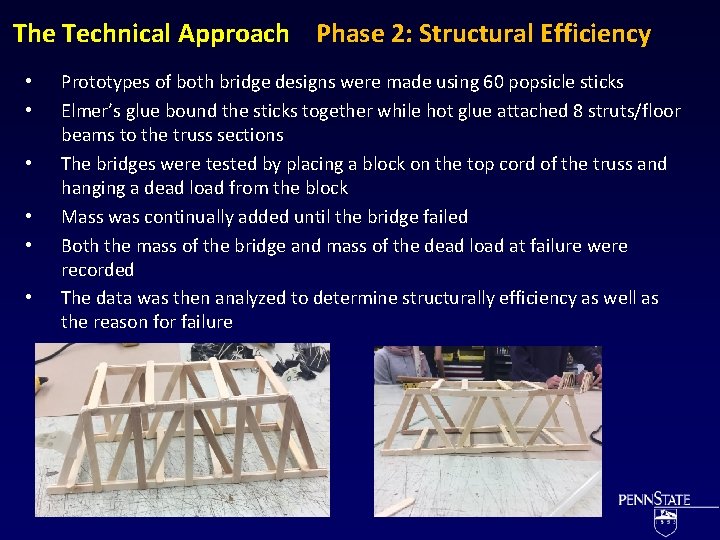
The Technical Approach Phase 2: Structural Efficiency • • • Prototypes of both bridge designs were made using 60 popsicle sticks Elmer’s glue bound the sticks together while hot glue attached 8 struts/floor beams to the truss sections The bridges were tested by placing a block on the top cord of the truss and hanging a dead load from the block Mass was continually added until the bridge failed Both the mass of the bridge and mass of the dead load at failure were recorded The data was then analyzed to determine structurally efficiency as well as the reason for failure
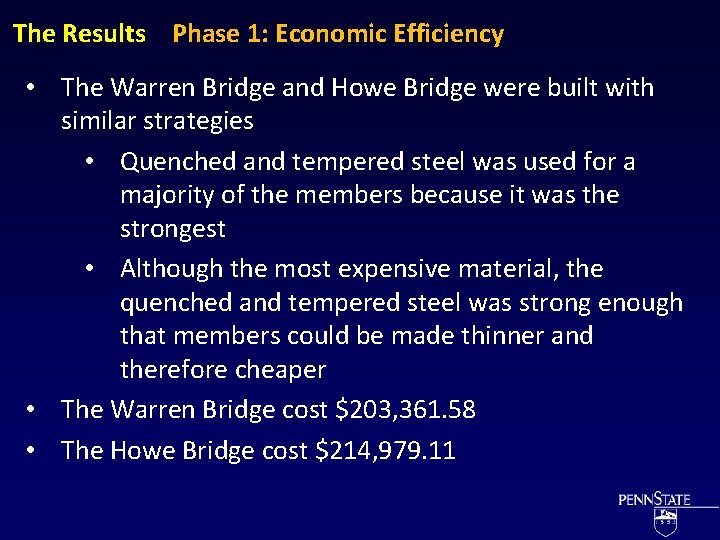
The Results Phase 1: Economic Efficiency • The Warren Bridge and Howe Bridge were built with similar strategies • Quenched and tempered steel was used for a majority of the members because it was the strongest • Although the most expensive material, the quenched and tempered steel was strong enough that members could be made thinner and therefore cheaper • The Warren Bridge cost $203, 361. 58 • The Howe Bridge cost $214, 979. 11
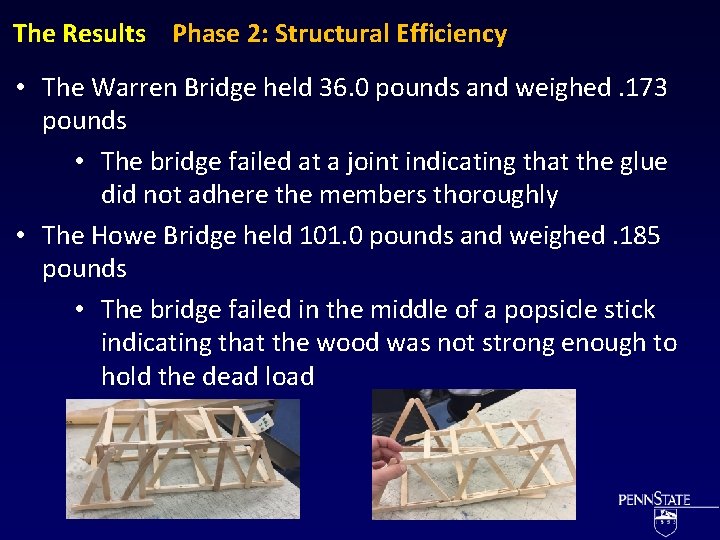
The Results Phase 2: Structural Efficiency • The Warren Bridge held 36. 0 pounds and weighed. 173 pounds • The bridge failed at a joint indicating that the glue did not adhere the members thoroughly • The Howe Bridge held 101. 0 pounds and weighed. 185 pounds • The bridge failed in the middle of a popsicle stick indicating that the wood was not strong enough to hold the dead load
The Best Solution The Howe Bridge was the best solution • Economic Efficiency: The Howe Bridge only cost $11, 617. 58 more than the Warren Bridge • Structural Efficiency: The Howe Bridge had a much higher structural efficiency of 546 compared to the Howe Bridge’s 208. • Design Efficiency: The Howe Bridge had a much lower number for DE at 394 ($/SE) compared to the Warren Bridge’s 978 (%/SE) • Constructability: The Howe Bridge had more expensive material costs and production cost, but a cheaper connections cost
Our Conclusions Goal: Construct a structurally and economically efficient bridge to replace the broken bridge Solution: • Met all design requirements (standard abutments, etc. ) • Price was underneath $300, 000 • Bridge held required load of 2 AASHTO H 20 -44 trucks Results: • Howe Bridge solution was economically efficient at $214, 979. 00 • Howe Bridge solution was structurally efficient with an SE of 546 and a design efficiency of 978 ($/SE) Importance: • Bridge can safely allow for emergency, first responders to access the township and prevent overflow traffic in residential areas
Our Recommendations • Before building the final bridge design, the terrain surrounding the bridge should be investigated • Ensure that the standard abutments are the best choice for the foundation • Create a timeline for the bridge’s construction • Create a budget for the bridge including material costs and labor costs
In Closing Thank you to Penn. DOT for sponsoring this project! • The design project provided powerful insight into the process of designing and problem solving
- Slides: 12