
Design of Ventricular Assist Device Basic Components of
Design of Ventricular Assist Device Basic Components of VAD 1. Blood pump 2. Controller 3. Power source Two Categories of VAD’s Pump 1. Pulsatile flow : rythmic propagation of blood flow 2. Continuous flow

Design of Ventricular Assist Device First Generation VADs Displacement blood pumps External control system triggers pumping by a pusher plate or diaphragm mechanism Pneumatic console used to drive pump, but now have been replaced by implantable electric system This mechanism provides pulsatile stroke volume But there’s problem with weight, size, driveline infection and thromboembolism. e. g. Abiomed BVS® 5000, Thoratec, Lion. Heart
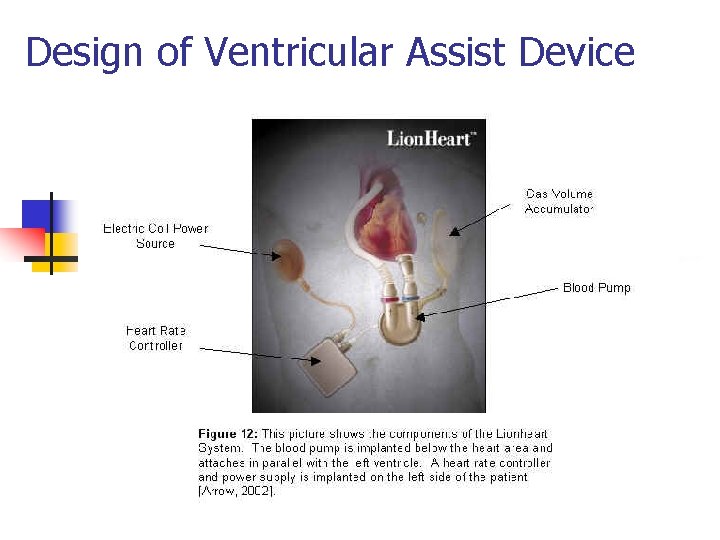
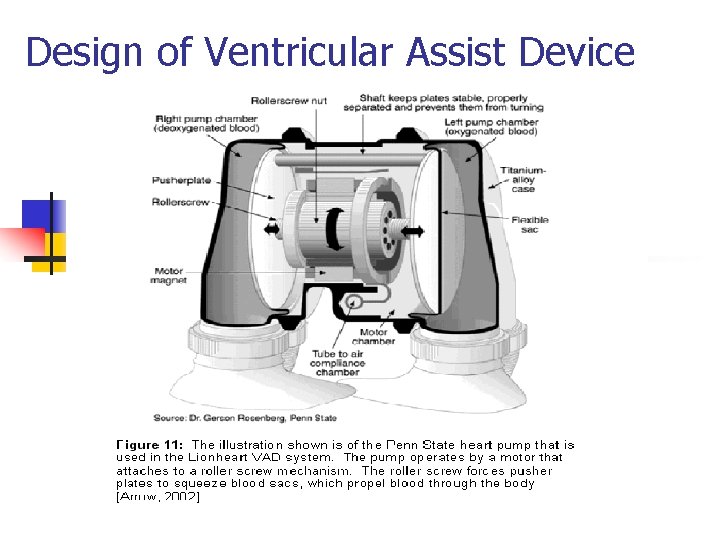
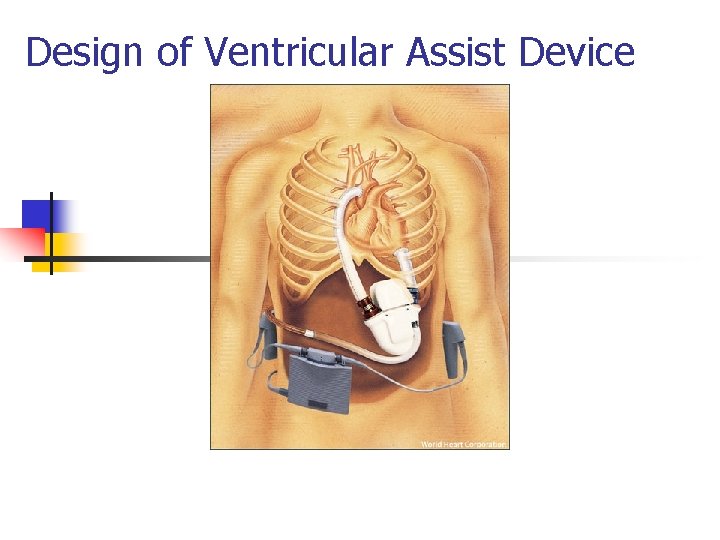
Design of Ventricular Assist Device Lion. Heart™ VAD - - Implantable Consist of internal components : blood pump, system controller, rechargeable batteries, compliance chamber, internal power coil Also there are external components : power pack, power transmitter, telemetry wand, charger, battery No percutaneous leads : reduction in risk of infection improved mobility enhanced quality of life Pump consist of : Titanium case with motor Seam-free polyurethane blood sac Pusher plate Unidirectional inlet/outlet mechanical heart valve
Design of Ventricular Assist Device
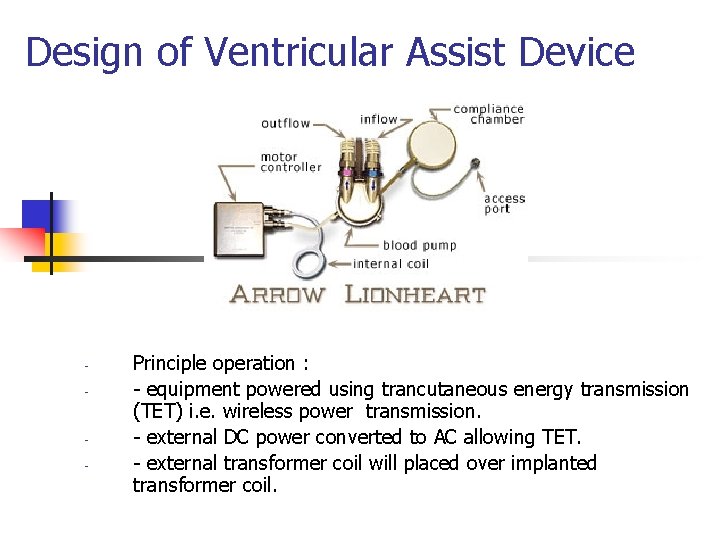
Design of Ventricular Assist Device - - Principle operation : - equipment powered using trancutaneous energy transmission (TET) i. e. wireless power transmission. - external DC power converted to AC allowing TET. - external transformer coil will placed over implanted transformer coil.
Design of Ventricular Assist Device
Design of Ventricular Assist Device - - - implanted power coil produce current to run the motor. - motor actuates roller screw and pusher plate. - motor will drive the roller screw mechanism. - linear motion of screw will results in linear motion of pusher plate. - pusher plate will compress blood sac. - compressed blood sac will eject blood from the pump. - when pusher plate releases, blood will fill the pump. - Lion. Heart capable to produce 3 -7 L/min of output. - controller housed in titanium case. - continuous monitoring of EDV using Hall Effect sensor for control system. - pump rate automatically adjusted to match the rate of blood filling the sac.
Design of Ventricular Assist Device - - - gas-filled compliance chamber ensure constant air pressure inside the pump. - otherwise it could cause fatigue to motor components. Novacor® LVA System - electromechanical vented VAD. - controller and battery located externally. - pump design is dual-plate pusher. - percutaneous lead connecting pump with external component. - the system can be operated in fixed-pulse rate, synchronous or automatic mode. - inflow conduit designed to reduce thromboembolic complications. - vibration damping in pump driving unit.
Design of Ventricular Assist Device
Design of Ventricular Assist Device Second Generation VADs Of rotary pump type i. e. axial flow impeller pumps and centrifugal/radial flow pump. Provide continuous, non-pulsatile flow. Electromagnetic mechanism consist of rotor and impeller blades Advantage of rotary pump over pulsatile flow : - small size - fewer moving part - elimination of compliance chamber or external vent tube - absence of valves - quiet operation - fewer infections and thromboembolic complications e. g De. Bakey VAD, Flow. Maker, Heart. Mate II
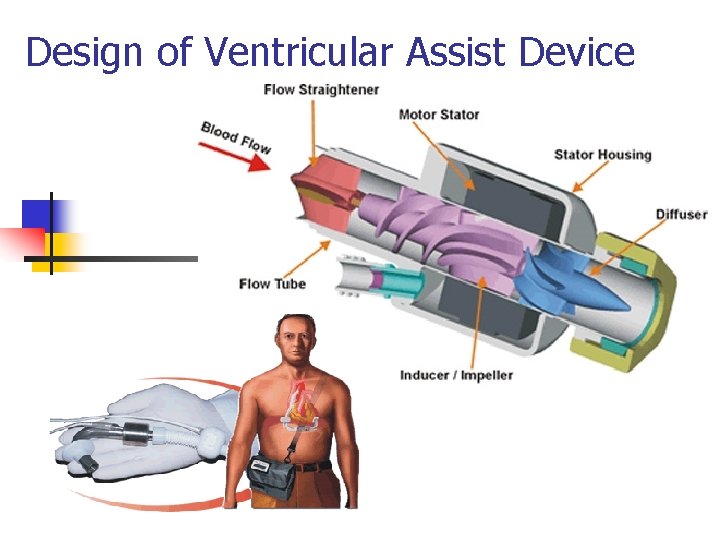
Design of Ventricular Assist Device De. Bakey VAD® - Axial flow blood pump. The pump composed of : - titanium pump housing - inlet cannula - rotating inducer impeller - stationary flow straightener - percutaneous cable assembly with controller connector Impeller has six blades rotated by electromagnetic force. Pump driven by DC motor stator contained in stator housing. Ultrasonic flow probe placed on outflow graft. Controller module has audible and visual alarms with LCD to display messages.
Design of Ventricular Assist Device
Design of Ventricular Assist Device Heart. Mate II - - - Axial flow blood pump. Consist of blood pump, percutaneous lead, external power source and system driver. The pump unit has blood immersed mechanical bearings. External power source connected by abdominal percutaneous electrical lead. Designed for thrombosis and haemolysis reduction using computational fluid dynamics and laser flow visualization. Smooth and textured design for blood contacting surfaces to eliminate thrombus at inlet and outlet stator. Manual or auto mode for rotation speed control. For auto mode, motor speed control based on characteristics of pump’s head pressure, pump flow and current consumption.

Design of Ventricular Assist Device
Design of Ventricular Assist Device Third Generation VADs Replacement of mechanical bearings of 2 nd generation by hydrodynamics bearing and/or full magnetic suspension pumps thus allow higher durability and reliability. In hydrodynamic bearing, rotor partially supported by a film of blood that counteract mechanical loads on pump rotor. Magnetic suspension(levitation) allow large clearances around impeller and permits optimised flow. Longer life expectancy (10 -15 yrs) since there is no friction effect at contact bearings. No contact between impeller and static part, thus it is a silent device. Sensor linked to magnetic bearing provide info on flow rate and pump performance. e. g. INCOR® LVAD, Micro. VAD, Magne. VAD, EVAHEART
Design of Ventricular Assist Device INCOR® LVAD - - - Axial flow blood pump. Free floating active magnetic bearing stabilize impeller in axial direction. Percutaneous driveline to controller and power pack. Integrated sensor system to measure pressure of head. Automatic anti-suction algorithm based on grade of pulsatility of blood flow across pump. Ventr. Assist LVAD Centrifugal flow pump. Contact-free hydrodynamicaly suspended impeller. Integrated rare earth magnet motor. Pump encased in biocompatible titanium alloy shell
Design of Ventricular Assist Device Classification of VADs 1. Pulsatile flow 2. Continuous flow (or rotary pump) : 3. - axial flow 4. - centrifugal flow 5. - magnetic bearing supported 6. - blood immersed bearing supported 7. - hybrid magnetic/blood bearings 8. Examples of VAD design will be shown :
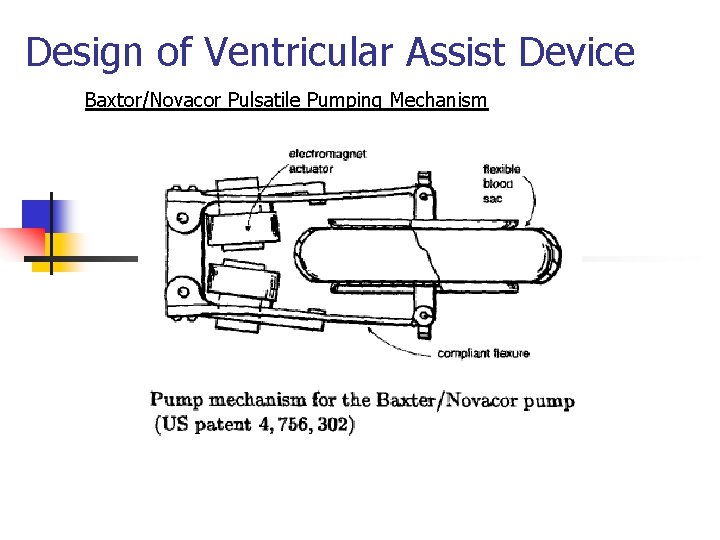
Design of Ventricular Assist Device Baxtor/Novacor Pulsatile Pumping Mechanism
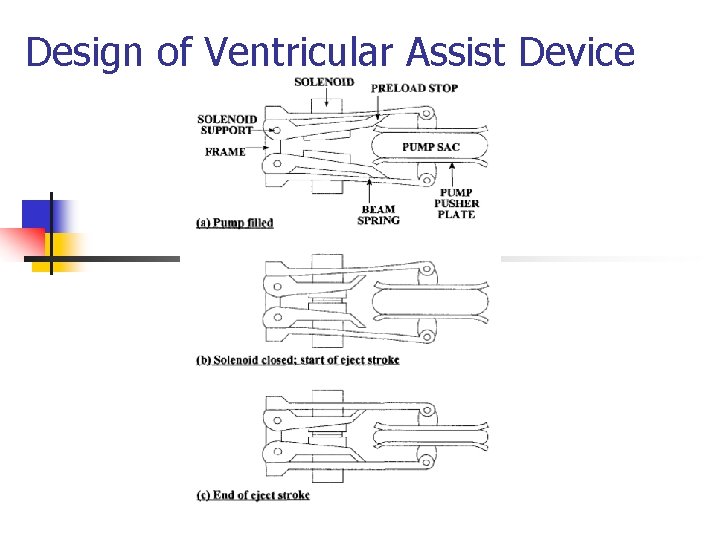
Design of Ventricular Assist Device - Electromagnetic actuator closes rapidly. - Stores energy by deforming a compliant flexure drives the pump. - Deformed flexure compresses the flexible blood sac to move the blood. Mechanism - Pump sac filled with blood and solenoid is unlatched. Solenoid closed rapidly at start of pump ejection. Beam spring defelected through pump pusher plates. Force exerted on surfaces of blood in pump sac.
Design of Ventricular Assist Device
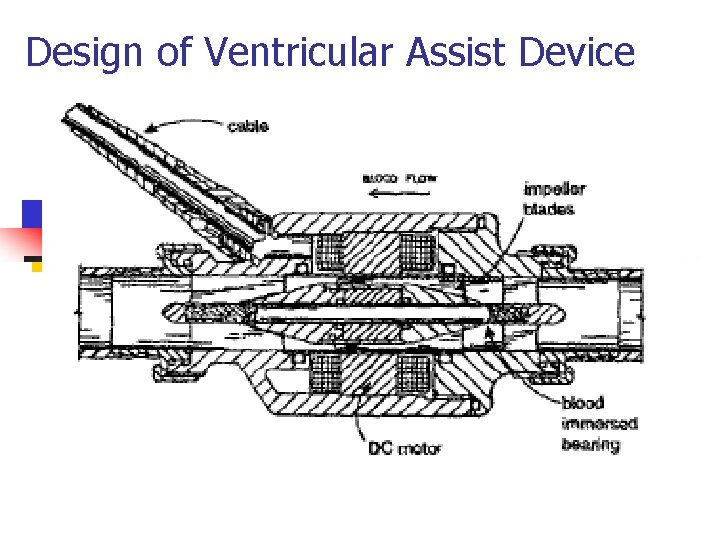
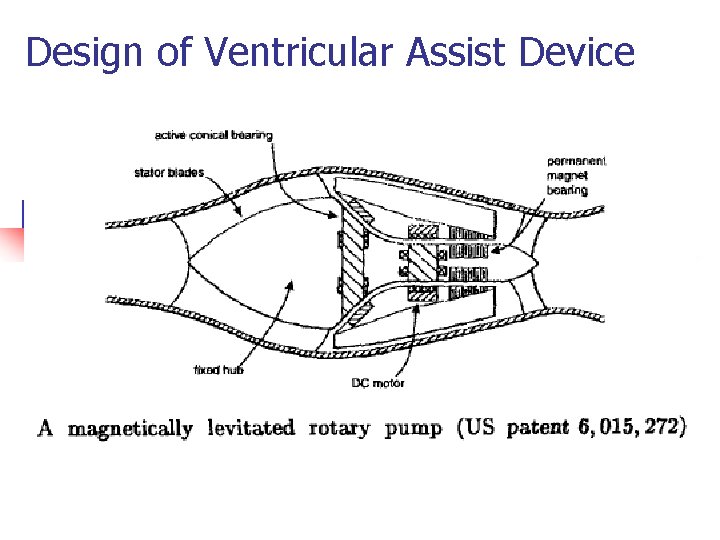
Design of Ventricular Assist Device Nimbus Rotary LVAD - With blood immersed bearing. - Such bearings has high shear rates* - Bearings also might cause blood damage. - Thrombus might be formed around the bearing. Magnetically Levitated Pump - Magnetic bearings with large gaps replace blood immersed bearing. - Impeller supported by passive permanent magnet toward inlet. - Active conical bearing support towards outlet of the pump. *gradient of velocity
Design of Ventricular Assist Device
Design of Ventricular Assist Device
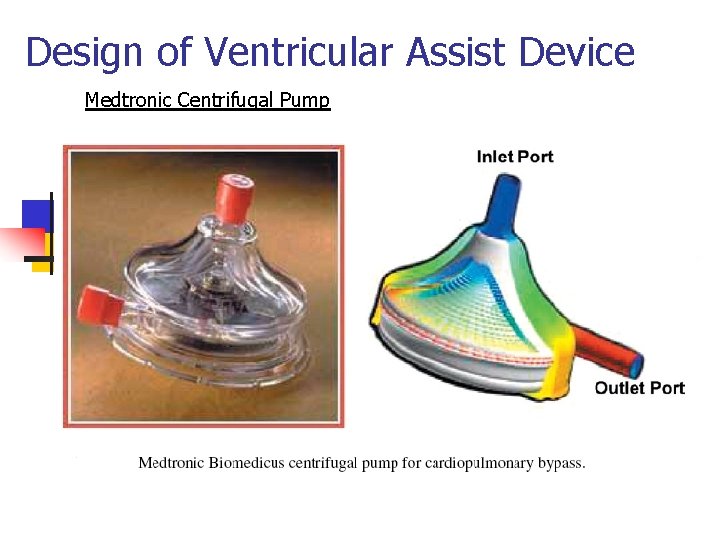
Design of Ventricular Assist Device Medtronic Centrifugal Pump
Design of Ventricular Assist Device - Impeller driven to rotate by external motor and power console. - Impeller’s rotation produces vortexing effect establishing suction in inlet cannula. - Blood enters the pump and ejected tangentially.
- Slides: 25