
Design of Vegetative Filtering SystemsOpen Channels and Filter



- Slides: 43
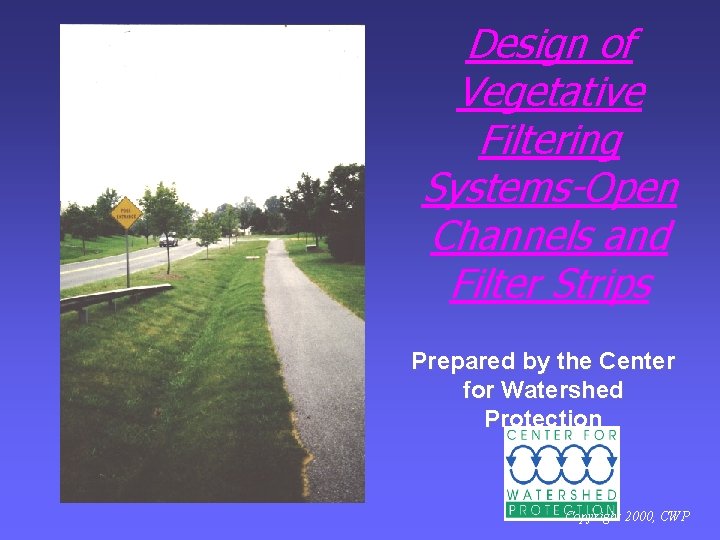
Design of Vegetative Filtering Systems-Open Channels and Filter Strips Prepared by the Center for Watershed Protection Copyright 2000, CWP
Vegetative Filtering Systems Four Design Variations • • Grass Channels Dry Swales Wet Swales Filter Strips Copyright 2000, CWP
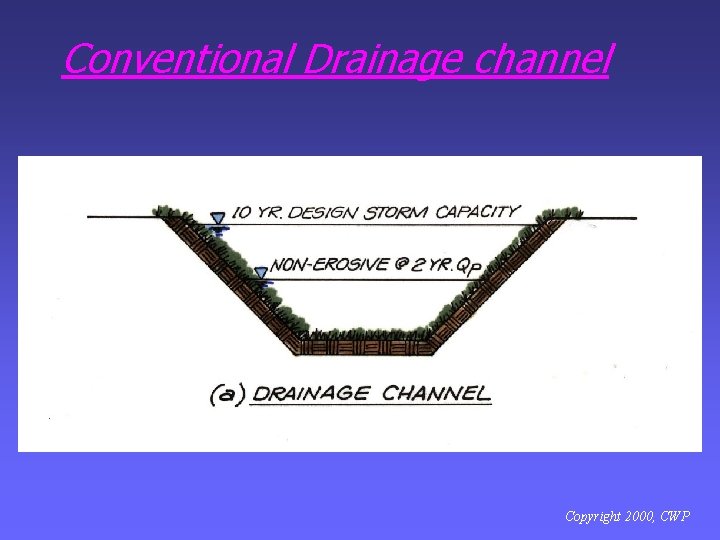
Conventional Drainage channel Copyright 2000, CWP
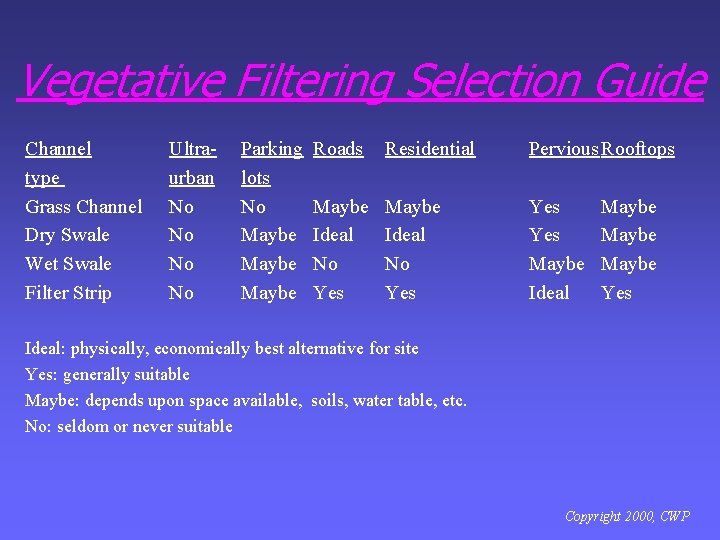
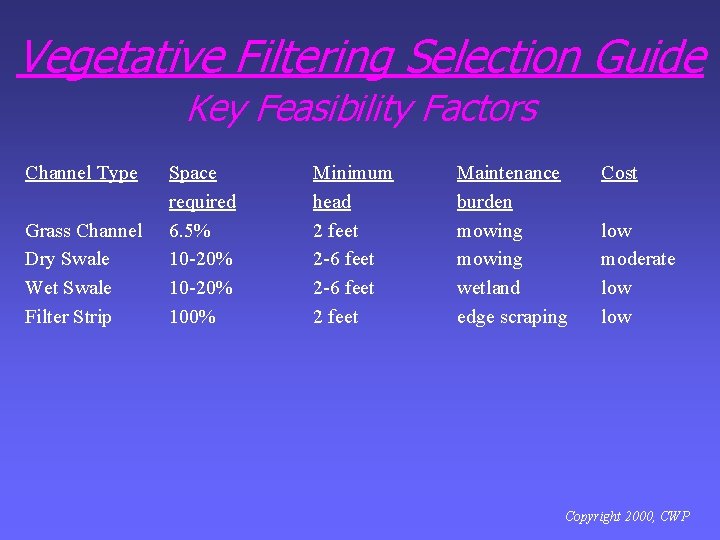
Vegetative Filtering Selection Guide Channel type Grass Channel Dry Swale Wet Swale Filter Strip Ultraurban No No Parking lots No Maybe Roads Residential Pervious Rooftops Maybe Ideal No Yes Yes Maybe Ideal Maybe Yes Ideal: physically, economically best alternative for site Yes: generally suitable Maybe: depends upon space available, soils, water table, etc. No: seldom or never suitable Copyright 2000, CWP
Vegetative Filtering Selection Guide Key Feasibility Factors Channel Type Grass Channel Dry Swale Wet Swale Filter Strip Space required 6. 5% 10 -20% 100% Minimum head 2 feet 2 -6 feet 2 feet Maintenance burden mowing wetland edge scraping Cost low moderate low Copyright 2000, CWP
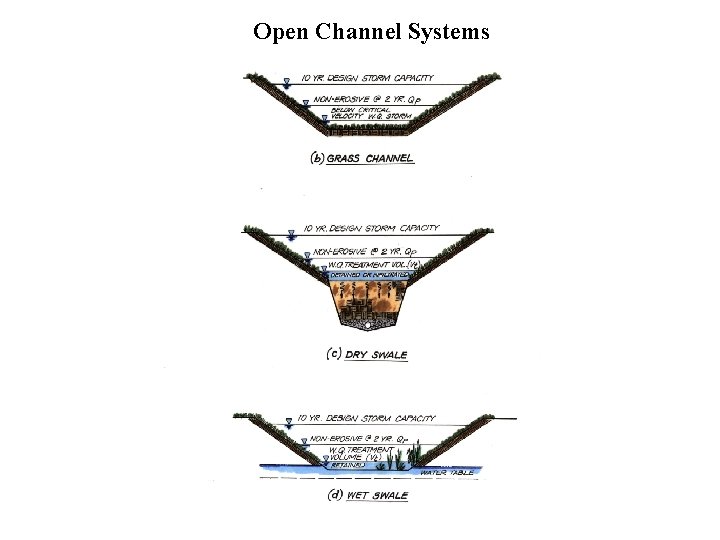
Open Channel Systems Copyright 2000, CWP
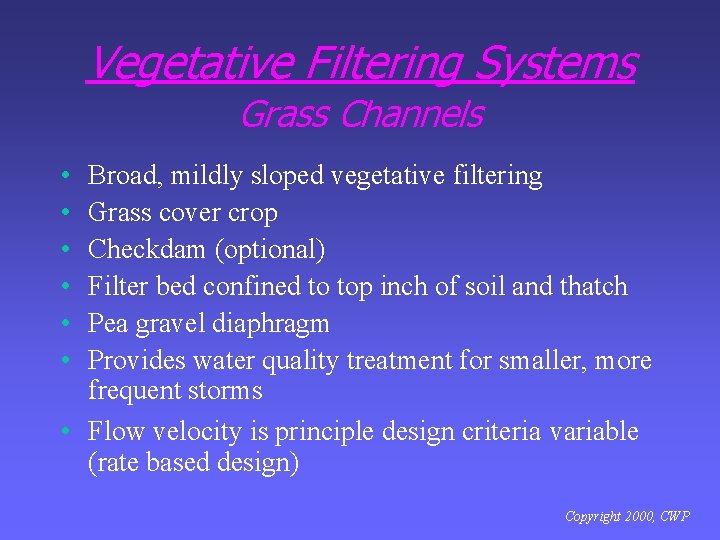
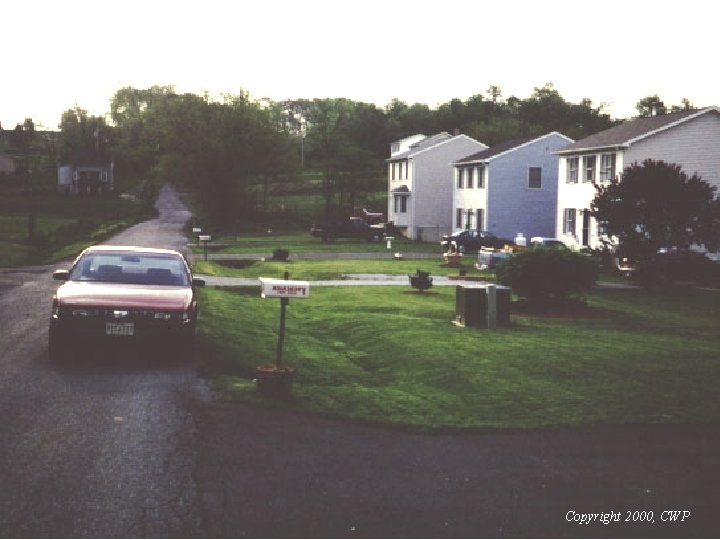
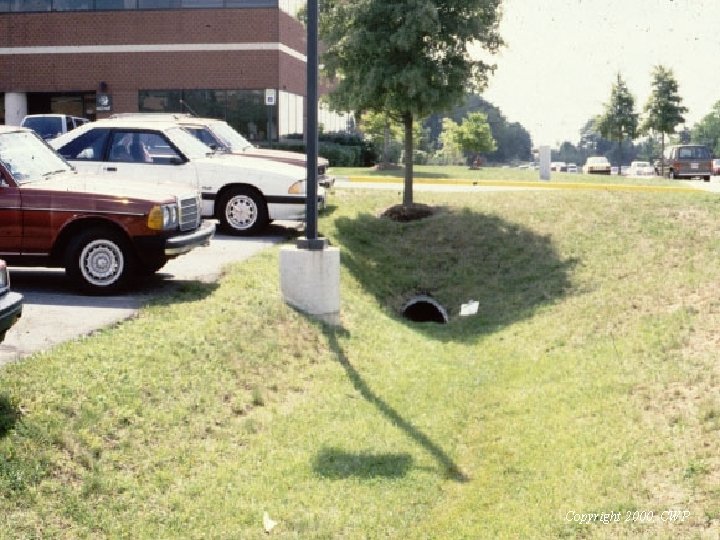
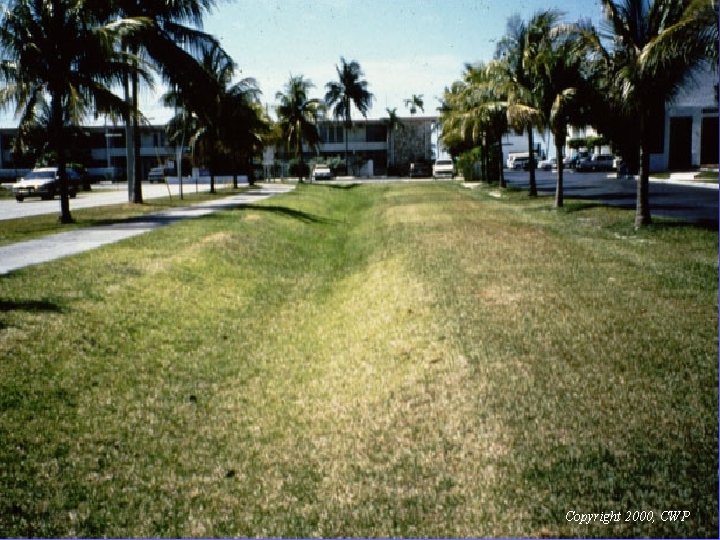
Vegetative Filtering Systems Grass Channels • • • Broad, mildly sloped vegetative filtering Grass cover crop Checkdam (optional) Filter bed confined to top inch of soil and thatch Pea gravel diaphragm Provides water quality treatment for smaller, more frequent storms • Flow velocity is principle design criteria variable (rate based design) Copyright 2000, CWP
Copyright 2000, CWP
Copyright 2000, CWP
Copyright 2000, CWP
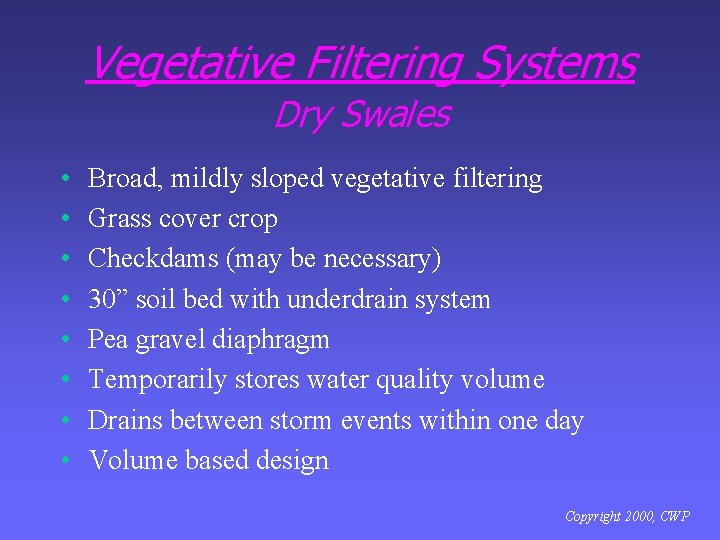
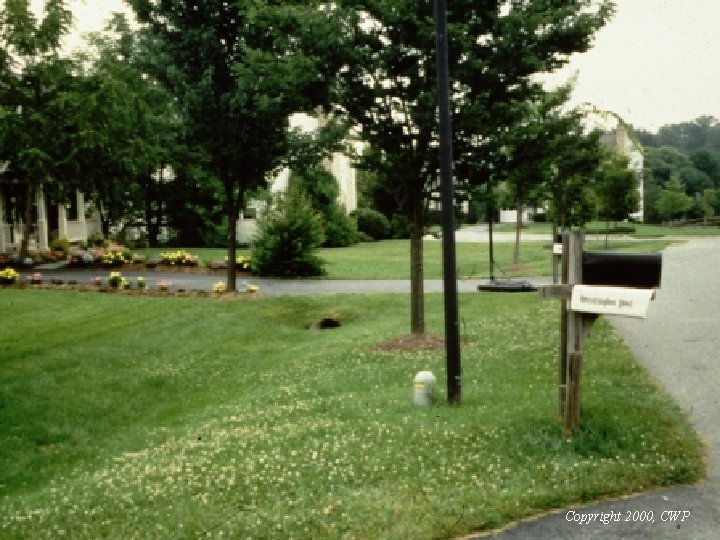
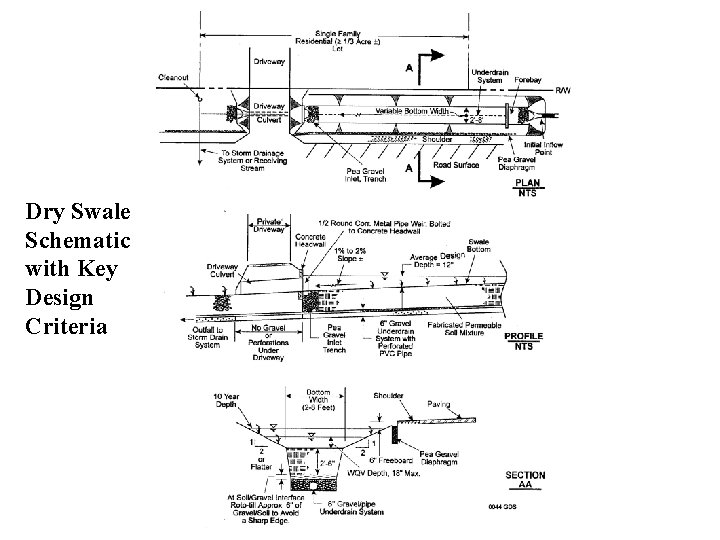
Vegetative Filtering Systems Dry Swales • • Broad, mildly sloped vegetative filtering Grass cover crop Checkdams (may be necessary) 30” soil bed with underdrain system Pea gravel diaphragm Temporarily stores water quality volume Drains between storm events within one day Volume based design Copyright 2000, CWP
Copyright 2000, CWP
Copyright 2000, CWP
Copyright 2000, CWP
Copyright 2000, CWP
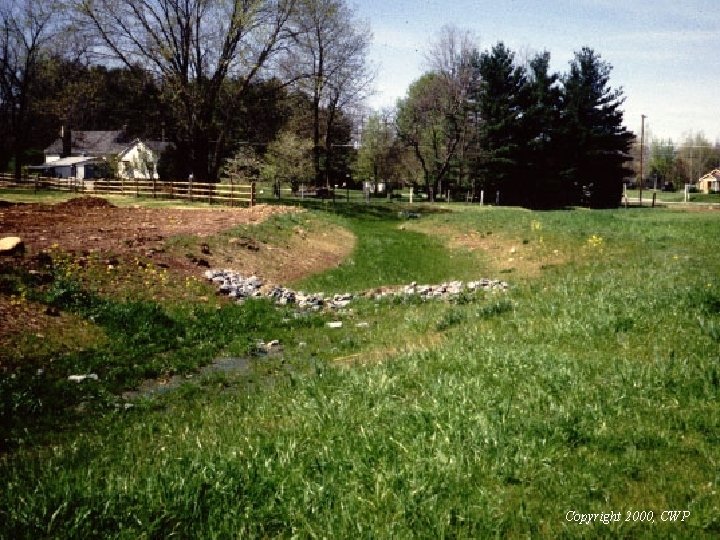
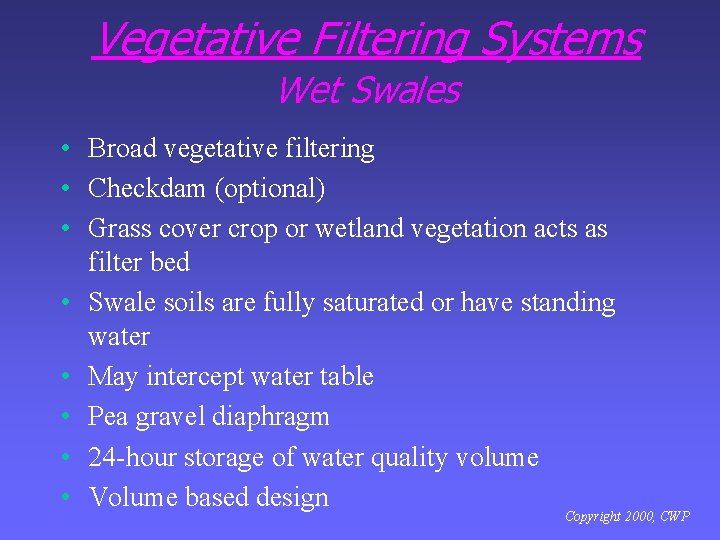
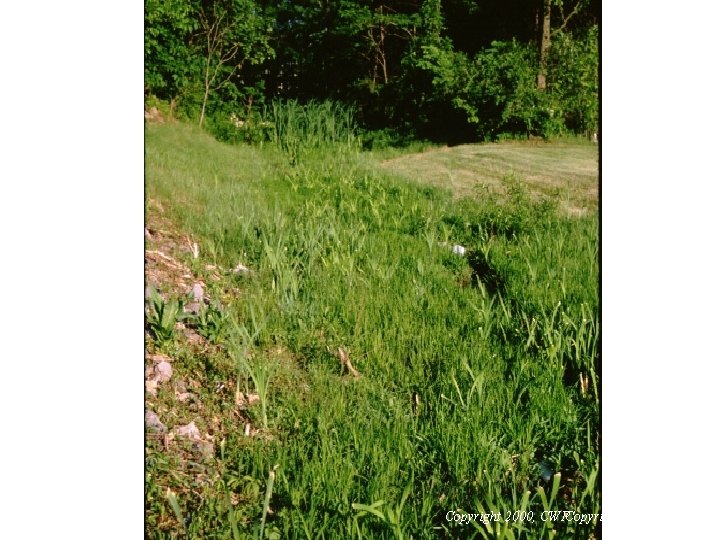
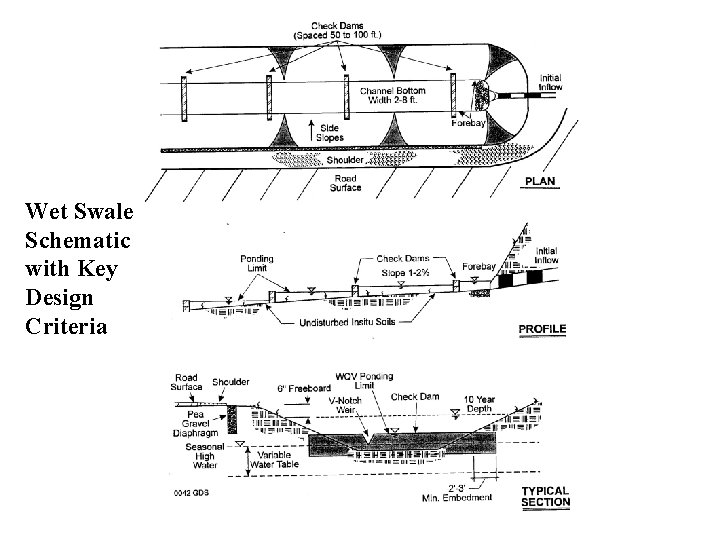
Vegetative Filtering Systems Wet Swales • Broad vegetative filtering • Checkdam (optional) • Grass cover crop or wetland vegetation acts as filter bed • Swale soils are fully saturated or have standing water • May intercept water table • Pea gravel diaphragm • 24 -hour storage of water quality volume • Volume based design Copyright 2000, CWP
Copyright 2000, CWP
Copyright 2000, CWP
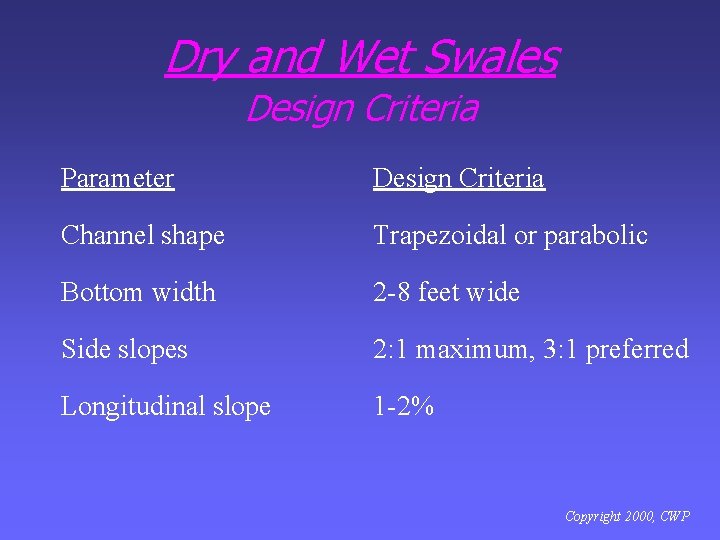
Dry and Wet Swales Design Criteria Parameter Design Criteria Channel shape Trapezoidal or parabolic Bottom width 2 -8 feet wide Side slopes 2: 1 maximum, 3: 1 preferred Longitudinal slope 1 -2% Copyright 2000, CWP
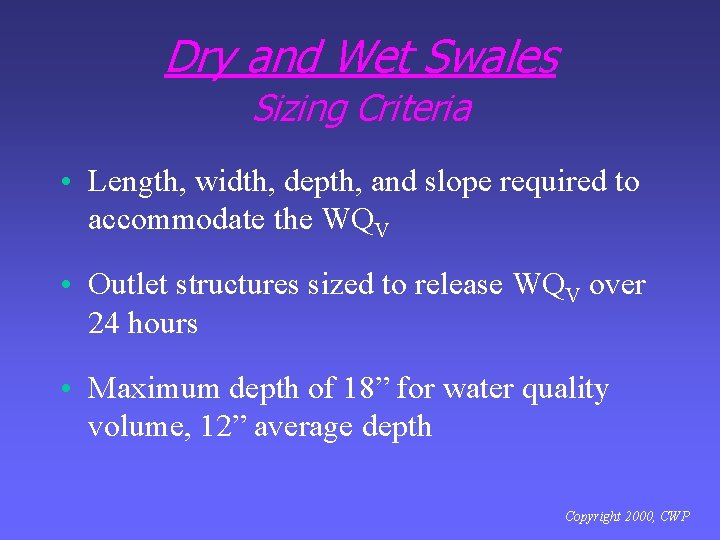
Dry and Wet Swales Sizing Criteria • Length, width, depth, and slope required to accommodate the WQV • Outlet structures sized to release WQV over 24 hours • Maximum depth of 18” for water quality volume, 12” average depth Copyright 2000, CWP
Dry Swale Schematic with Key Design Criteria Copyright 2000, CWP
Wet Swale Schematic with Key Design Criteria Copyright 2000, CWP
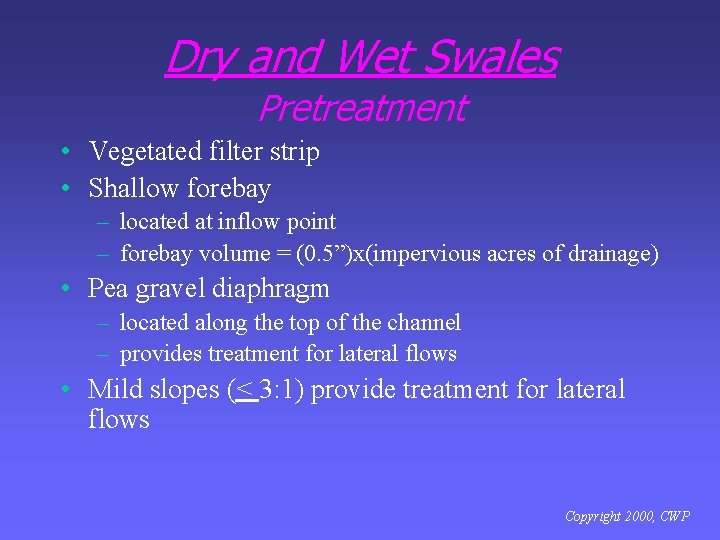
Dry and Wet Swales Pretreatment • Vegetated filter strip • Shallow forebay – located at inflow point – forebay volume = (0. 5”)x(impervious acres of drainage) • Pea gravel diaphragm – located along the top of the channel – provides treatment for lateral flows • Mild slopes (< 3: 1) provide treatment for lateral flows Copyright 2000, CWP
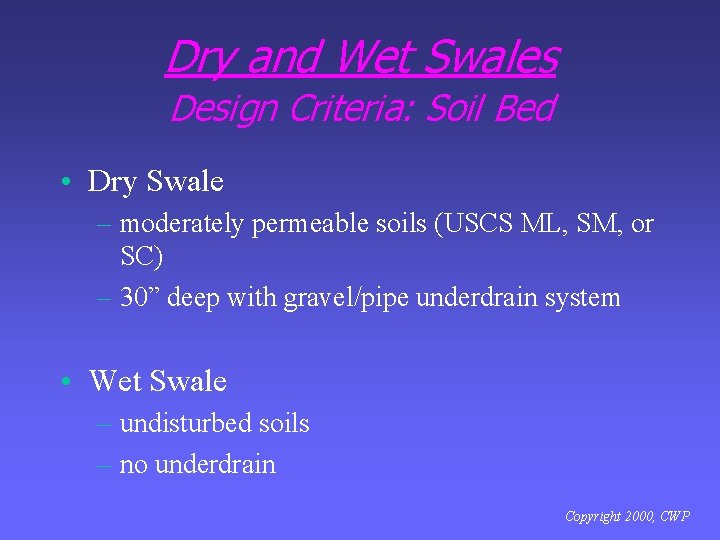
Dry and Wet Swales Design Criteria: Soil Bed • Dry Swale – moderately permeable soils (USCS ML, SM, or SC) – 30” deep with gravel/pipe underdrain system • Wet Swale – undisturbed soils – no underdrain Copyright 2000, CWP
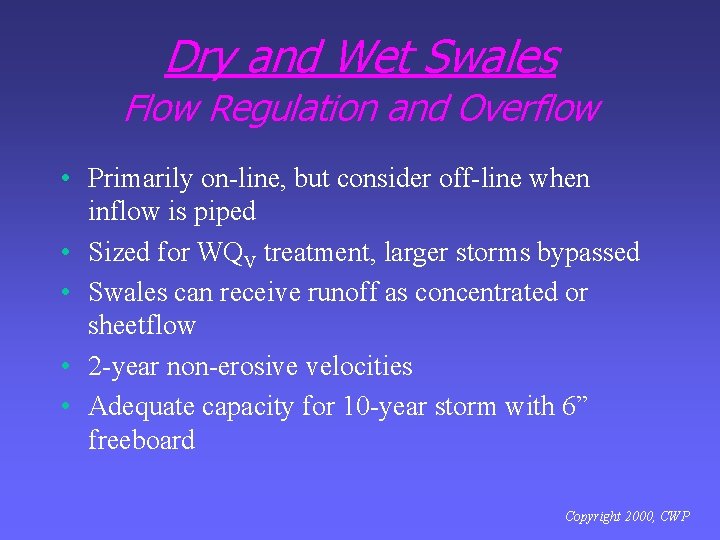
Dry and Wet Swales Flow Regulation and Overflow • Primarily on-line, but consider off-line when inflow is piped • Sized for WQV treatment, larger storms bypassed • Swales can receive runoff as concentrated or sheetflow • 2 -year non-erosive velocities • Adequate capacity for 10 -year storm with 6” freeboard Copyright 2000, CWP
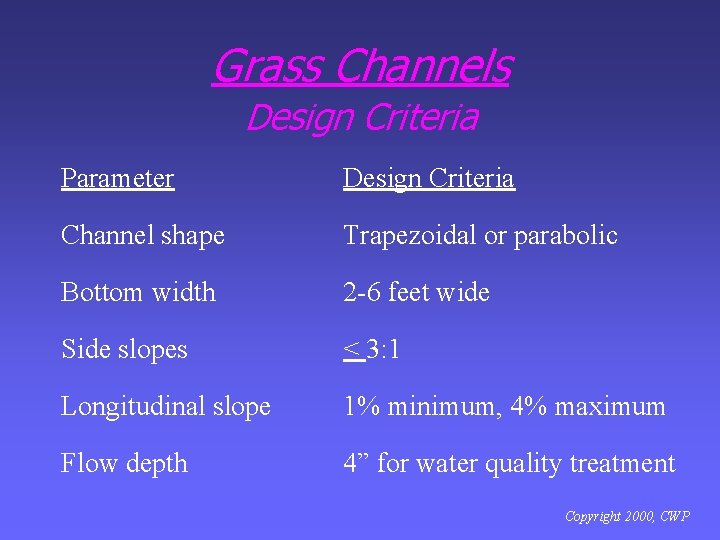
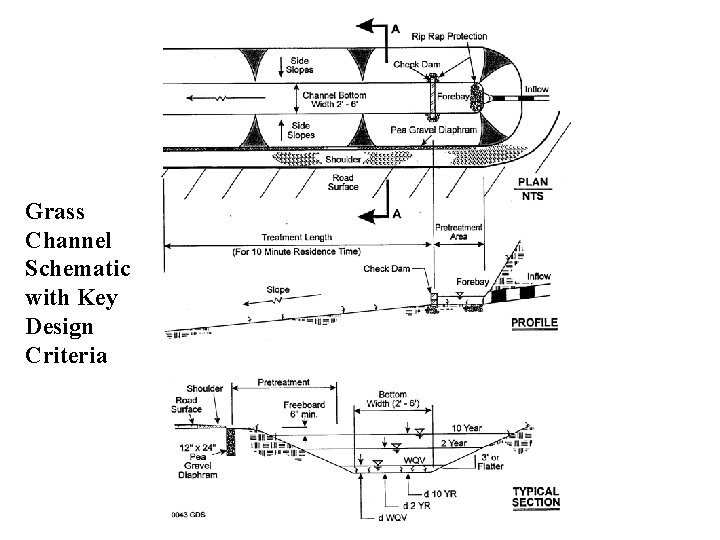
Grass Channels Design Criteria Parameter Design Criteria Channel shape Trapezoidal or parabolic Bottom width 2 -6 feet wide Side slopes < 3: 1 Longitudinal slope 1% minimum, 4% maximum Flow depth 4” for water quality treatment Copyright 2000, CWP
Grass Channel Schematic with Key Design Criteria Copyright 2000, CWP
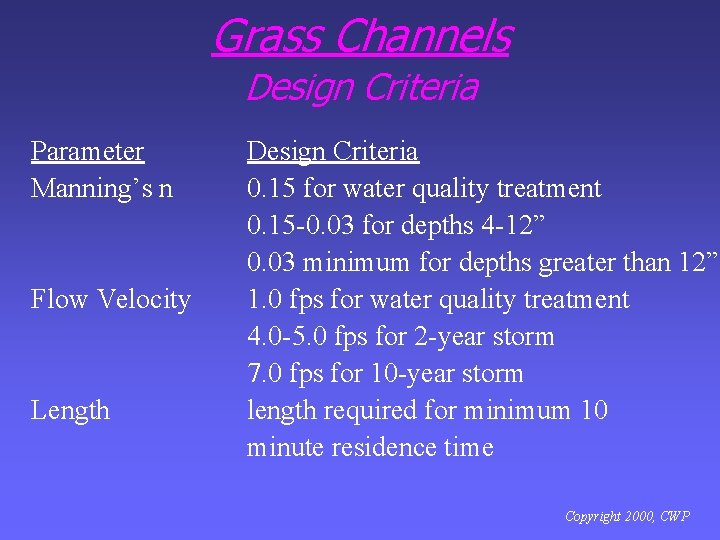
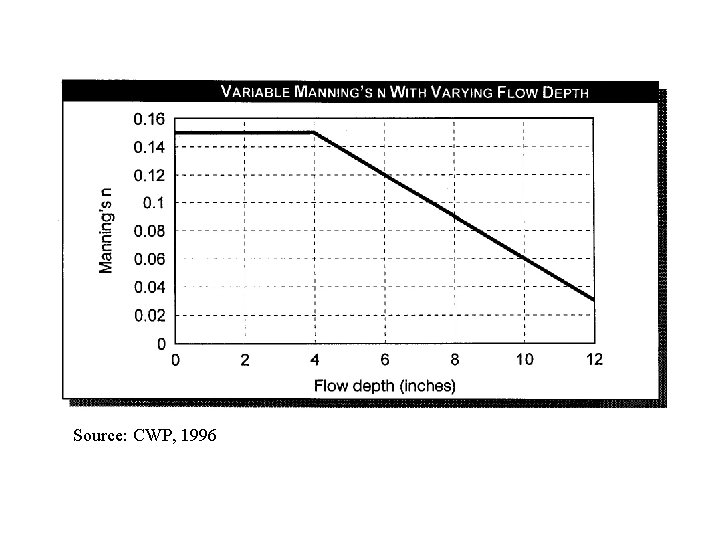
Grass Channels Design Criteria Parameter Manning’s n Flow Velocity Length Design Criteria 0. 15 for water quality treatment 0. 15 -0. 03 for depths 4 -12” 0. 03 minimum for depths greater than 12” 1. 0 fps for water quality treatment 4. 0 -5. 0 fps for 2 -year storm 7. 0 fps for 10 -year storm length required for minimum 10 minute residence time Copyright 2000, CWP
Source: CWP, 1996 Copyright 2000, CWP
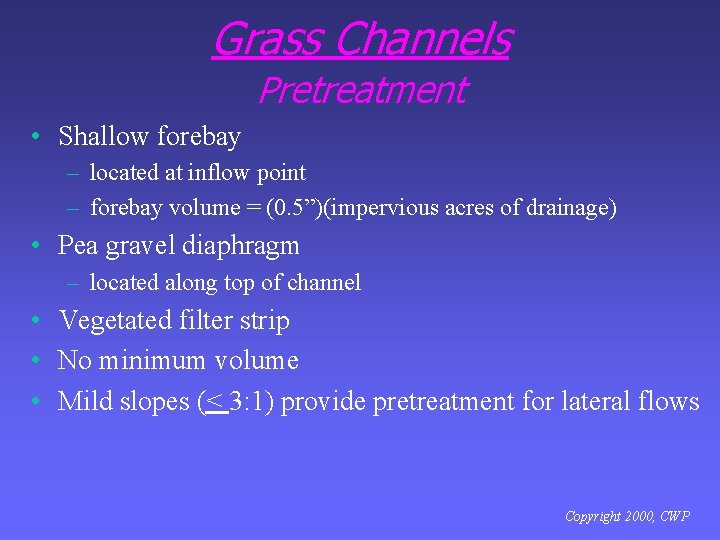
Grass Channels Pretreatment • Shallow forebay – located at inflow point – forebay volume = (0. 5”)(impervious acres of drainage) • Pea gravel diaphragm – located along top of channel • Vegetated filter strip • No minimum volume • Mild slopes (< 3: 1) provide pretreatment for lateral flows Copyright 2000, CWP
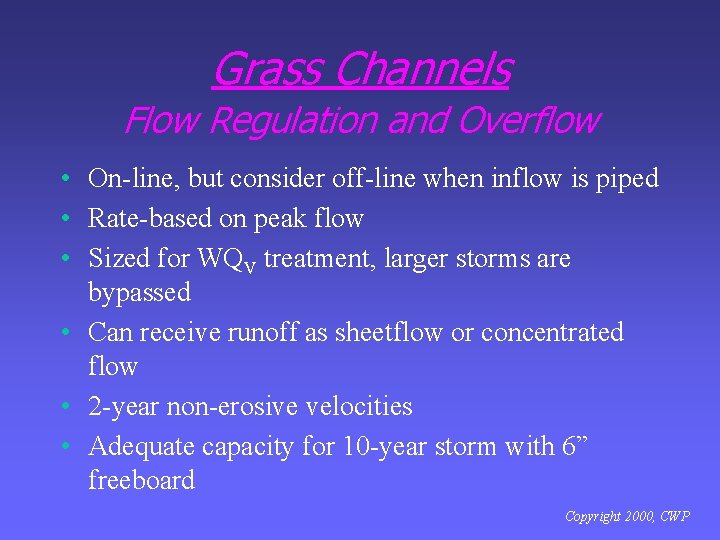
Grass Channels Flow Regulation and Overflow • On-line, but consider off-line when inflow is piped • Rate-based on peak flow • Sized for WQV treatment, larger storms are bypassed • Can receive runoff as sheetflow or concentrated flow • 2 -year non-erosive velocities • Adequate capacity for 10 -year storm with 6” freeboard Copyright 2000, CWP
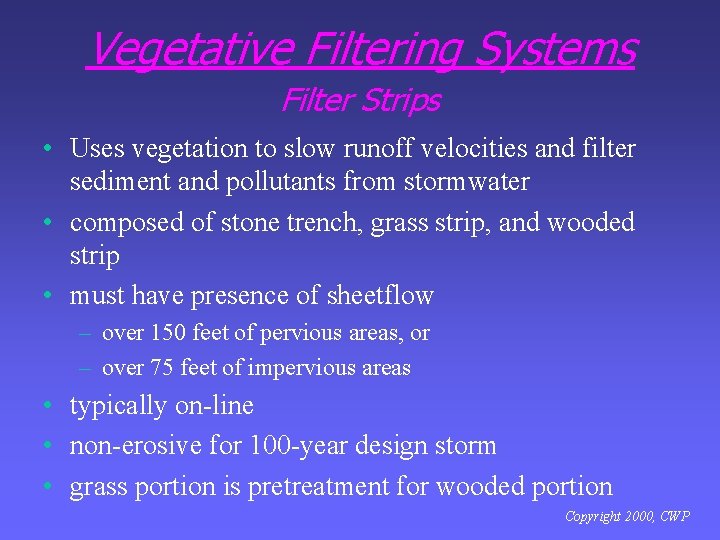
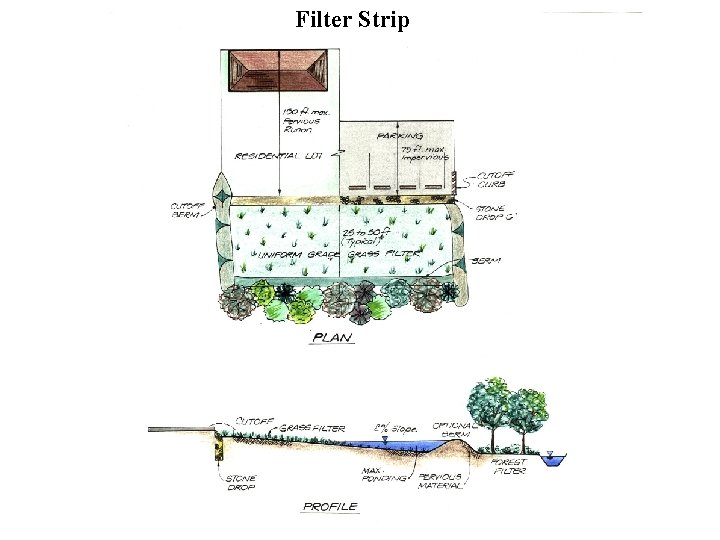
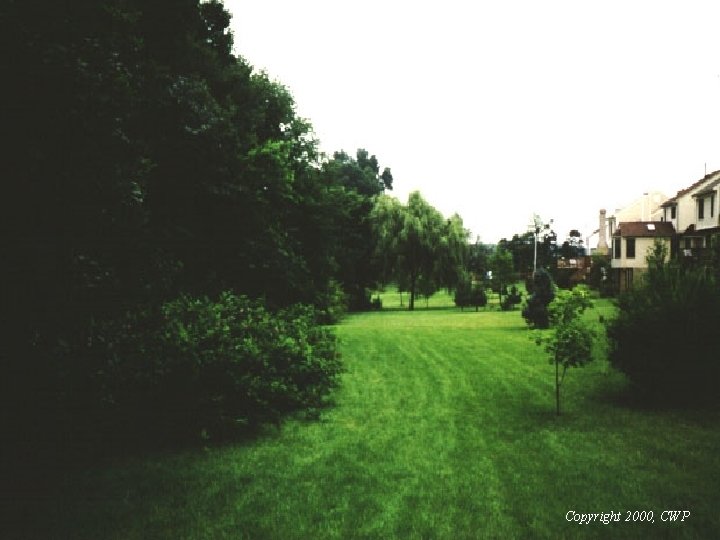
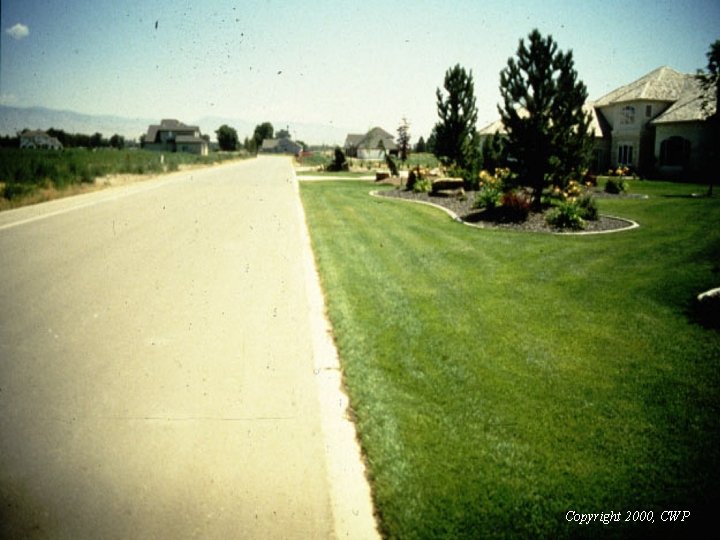
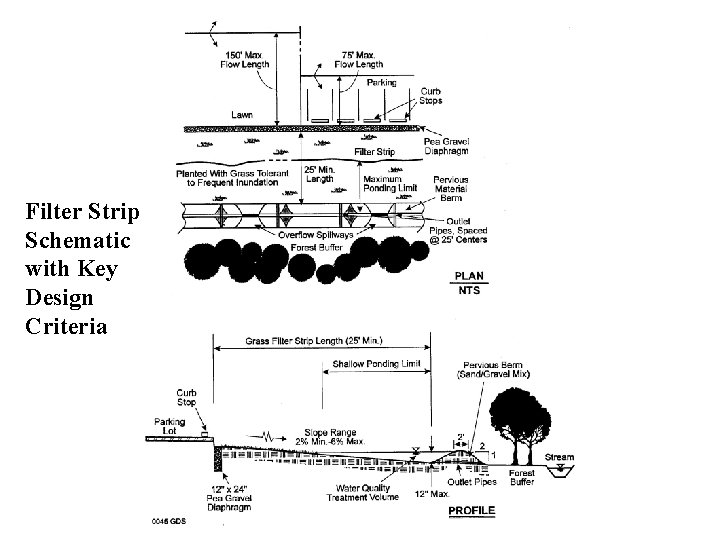
Vegetative Filtering Systems Filter Strips • Uses vegetation to slow runoff velocities and filter sediment and pollutants from stormwater • composed of stone trench, grass strip, and wooded strip • must have presence of sheetflow – over 150 feet of pervious areas, or – over 75 feet of impervious areas • typically on-line • non-erosive for 100 -year design storm • grass portion is pretreatment for wooded portion Copyright 2000, CWP
Filter Strip Copyright 2000, CWP
Copyright 2000, CWP
Copyright 2000, CWP
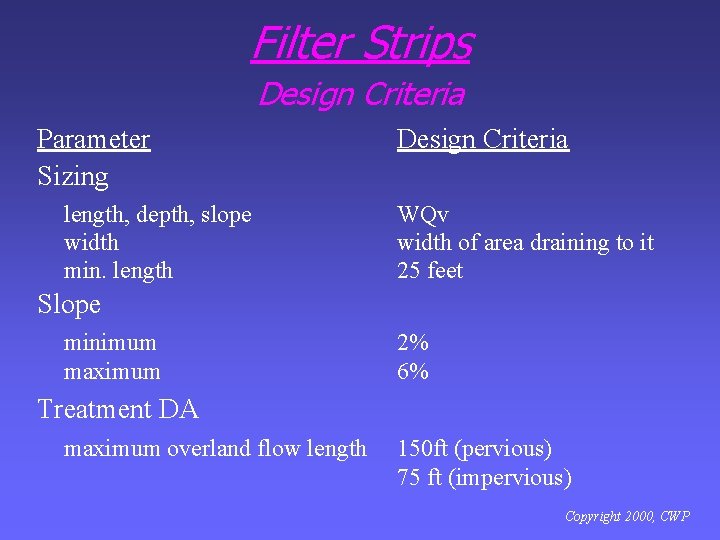
Filter Strips Design Criteria Parameter Sizing length, depth, slope width min. length Design Criteria WQv width of area draining to it 25 feet Slope minimum maximum 2% 6% Treatment DA maximum overland flow length 150 ft (pervious) 75 ft (impervious) Copyright 2000, CWP
Filter Strip Schematic with Key Design Criteria Copyright 2000, CWP
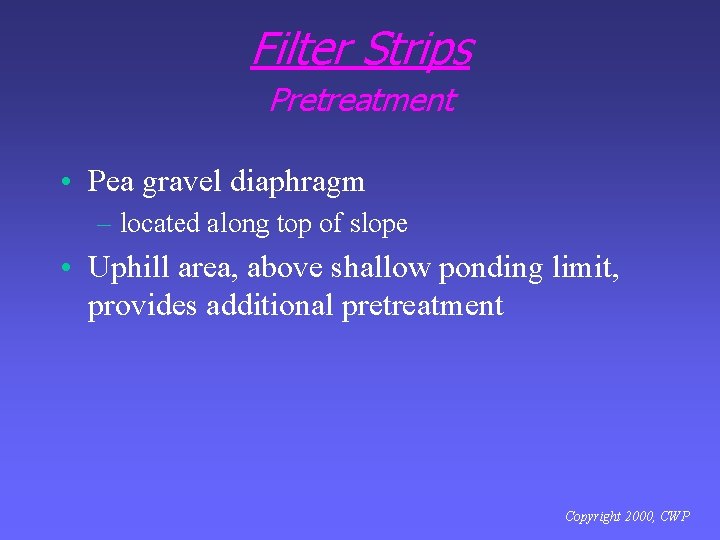
Filter Strips Pretreatment • Pea gravel diaphragm – located along top of slope • Uphill area, above shallow ponding limit, provides additional pretreatment Copyright 2000, CWP
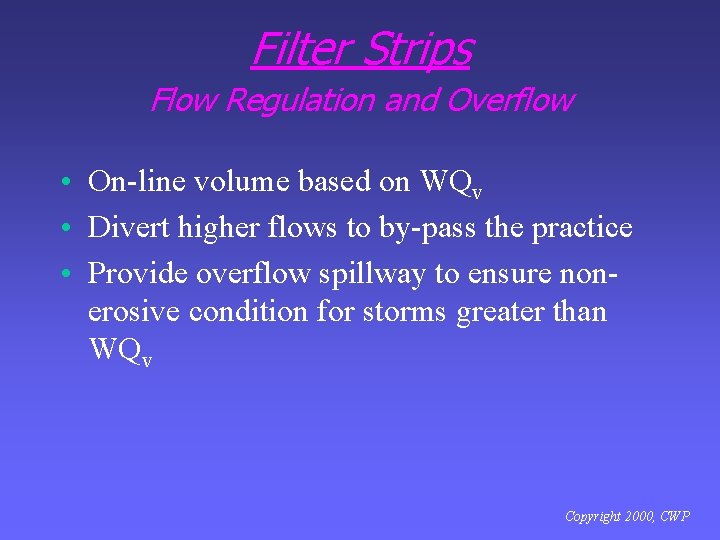
Filter Strips Flow Regulation and Overflow • On-line volume based on WQv • Divert higher flows to by-pass the practice • Provide overflow spillway to ensure nonerosive condition for storms greater than WQv Copyright 2000, CWP
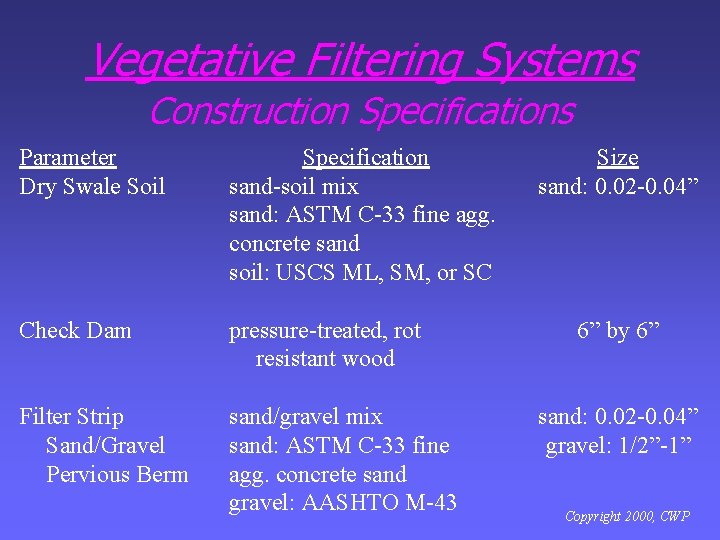
Vegetative Filtering Systems Construction Specifications Parameter Dry Swale Soil Specification sand-soil mix sand: ASTM C-33 fine agg. concrete sand soil: USCS ML, SM, or SC Check Dam pressure-treated, rot resistant wood Filter Strip Sand/Gravel Pervious Berm sand/gravel mix sand: ASTM C-33 fine agg. concrete sand gravel: AASHTO M-43 Size sand: 0. 02 -0. 04” 6” by 6” sand: 0. 02 -0. 04” gravel: 1/2”-1” Copyright 2000, CWP
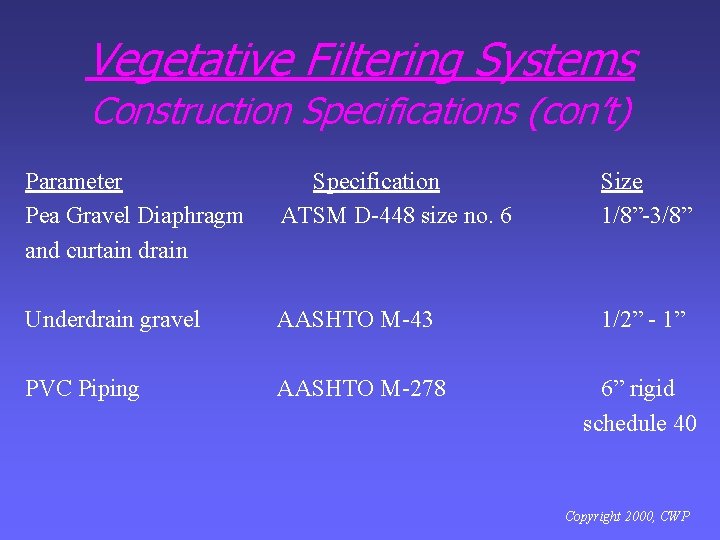
Vegetative Filtering Systems Construction Specifications (con’t) Parameter Pea Gravel Diaphragm and curtain drain Specification ATSM D-448 size no. 6 Size 1/8”-3/8” Underdrain gravel AASHTO M-43 1/2” - 1” PVC Piping AASHTO M-278 6” rigid schedule 40 Copyright 2000, CWP
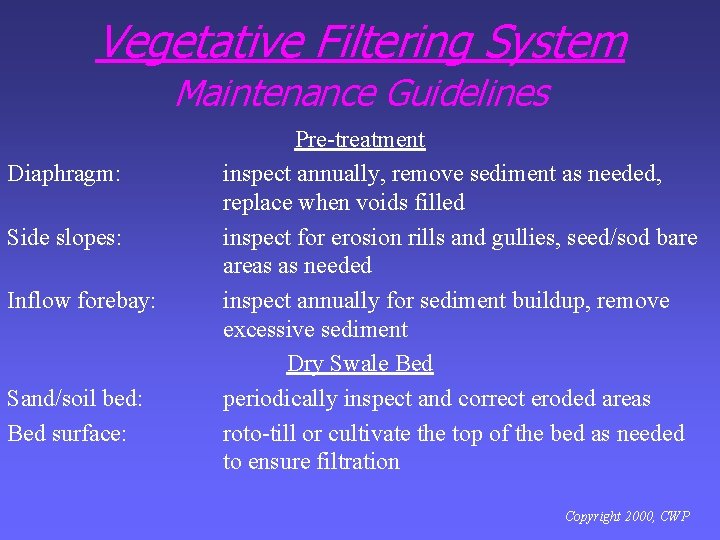
Vegetative Filtering System Maintenance Guidelines Diaphragm: Side slopes: Inflow forebay: Sand/soil bed: Bed surface: Pre-treatment inspect annually, remove sediment as needed, replace when voids filled inspect for erosion rills and gullies, seed/sod bare areas as needed inspect annually for sediment buildup, remove excessive sediment Dry Swale Bed periodically inspect and correct eroded areas roto-till or cultivate the top of the bed as needed to ensure filtration Copyright 2000, CWP
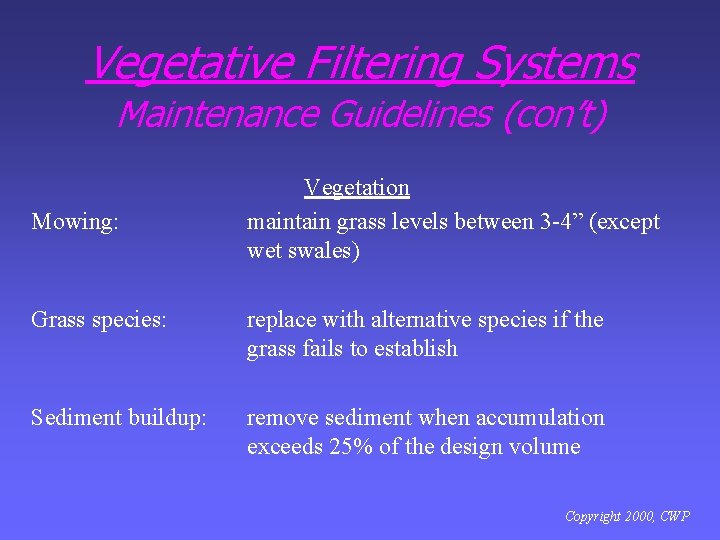
Vegetative Filtering Systems Maintenance Guidelines (con’t) Mowing: Vegetation maintain grass levels between 3 -4” (except wet swales) Grass species: replace with alternative species if the grass fails to establish Sediment buildup: remove sediment when accumulation exceeds 25% of the design volume Copyright 2000, CWP