
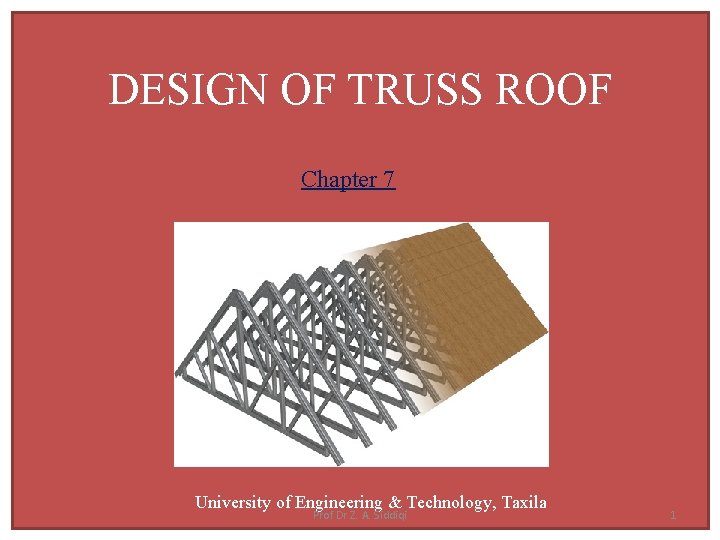
DESIGN OF TRUSS ROOF Chapter 7 University of




- Slides: 48
DESIGN OF TRUSS ROOF Chapter 7 University of Engineering & Technology, Taxila Prof Dr Z. A. Siddiqi 1
Purlin Design 1/5/2022 2
General Notes A. Allowable stress design (ASD) or load and resistance factor design (LRFD) may be used for the design of a purlin. However, only ASD method is explained here in detail. Service loads and reduced material strengths are involved in allowable stress design. 1/5/2022 3
eathing ed tatprovides the necessary lateral support to the purlin through Jbolts and the purlin behaves as a continuously braced beam. The design moment of a compact section with closely braced compression flange is Φb. Mn (LRFD) or Mn/Ωb. For single angles, Mn = 1. 5 My; for double angles, Mn = Fy. Zx ≤ 1. 6 Fy. Sx. 1/5/2022 4
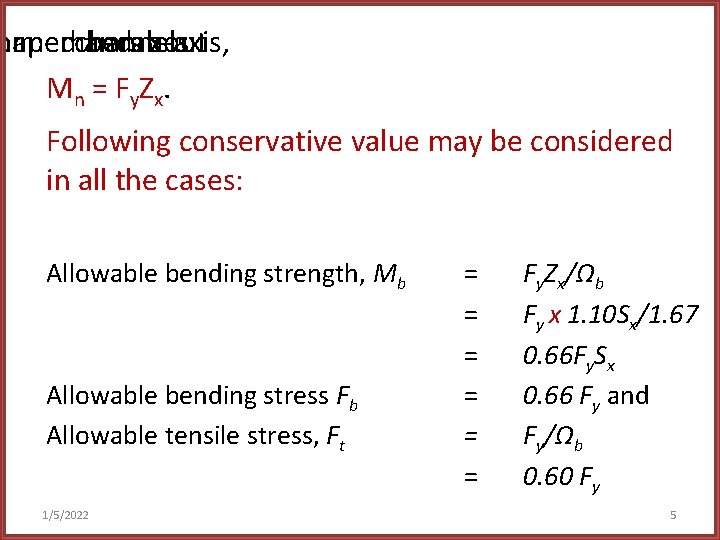
haped ormembers channels andabout x-axis, M n = F y Z x. Following conservative value may be considered in all the cases: Allowable bending strength, Mb Allowable bending stress Fb Allowable tensile stress, Ft 1/5/2022 = = = Fy. Zx/Ωb Fy х 1. 10 Sx/1. 67 0. 66 Fy. Sx 0. 66 Fy and Fy/Ωb 0. 60 Fy 5
B. The dead plus live load (D+L) combination is used because it is proved to be critical for purlin and roof sheet design. C. Dead load on purlin acts due to roofing, insulation and self-weight of the purlin. Insulation load is considered if it is directly attached or hanged from the sheet or the purlin. Approximately one third or half of the miscellaneous load may also be included. 1/5/2022 6
D. Depth of section should not be lesser than 1/27. 5 th of the purlin span to control deflections. d 1/5/2022 ≥ s/27. 5 7
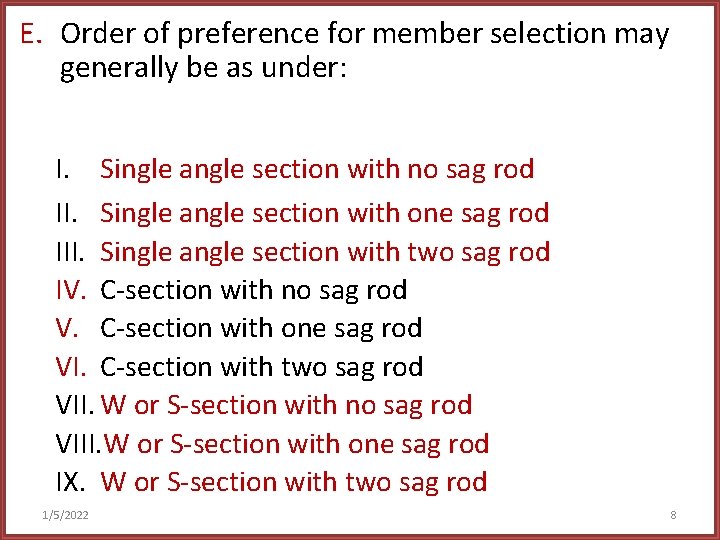
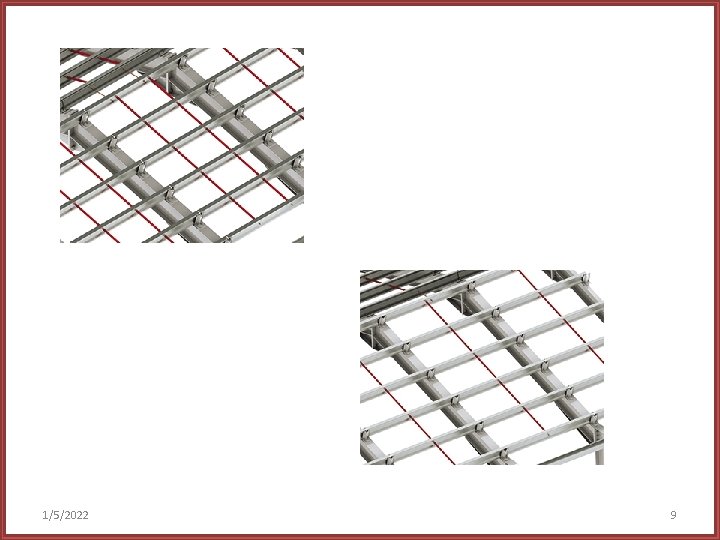
E. Order of preference for member selection may generally be as under: I. Single angle section with no sag rod II. Single angle section with one sag rod III. Single angle section with two sag rod IV. C-section with no sag rod V. C-section with one sag rod VI. C-section with two sag rod VII. W or S-section with no sag rod VIII. W or S-section with one sag rod IX. W or S-section with two sag rod 1/5/2022 8
1/5/2022 9
Z-section is behavior-wise the best section for a purlin. However as it is not a hot-rolled section and is to be made by cold bending. It may not be readily available. In case the section modulus required for the first option is much greater than 230 x 103 mm 3, the option of channel section may be selected directly. 1/5/2022 10
F. The width of angle section may not commonly exceed 102 mm. G. The roof load is converted into beam load per unit length by the formula given below: Load per unit length = load per unit area of roof x purlin spacing Note: if the panel length is excessive and it is difficult to design the roofing, purlins are also placed in between the panel points reducing the purlin spacing and span for the roof sheet. This induces bending moment in the top chord of the truss, which must be checked as a beam column for such cases. 1/5/2022 11
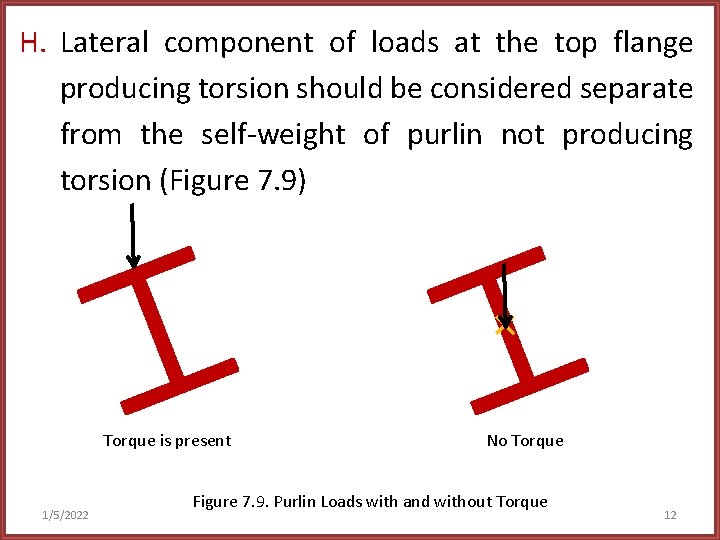
H. Lateral component of loads at the top flange producing torsion should be considered separate from the self-weight of purlin not producing torsion (Figure 7. 9) Torque is present 1/5/2022 No Torque Figure 7. 9. Purlin Loads with and without Torque 12
I. In place of using complicated formulas for torsion design, half strength in lateral direction (Sy/2 or Zy/2) is reserved for torsion and only the other half (Sy/2 or Zy/2) is used for lateral bending. No calculations for torsion are required afterwards. 1/5/2022 13
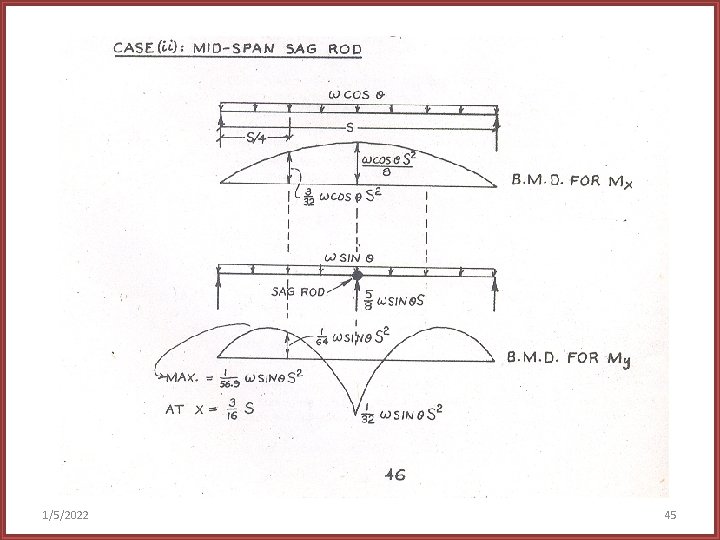
J. Purlin is assumed to be simply supported on trusses, both for x and y direction bending. The bending moments may be calculated by using the typical bending moment diagrams given in Design Aids. 1/5/2022 14
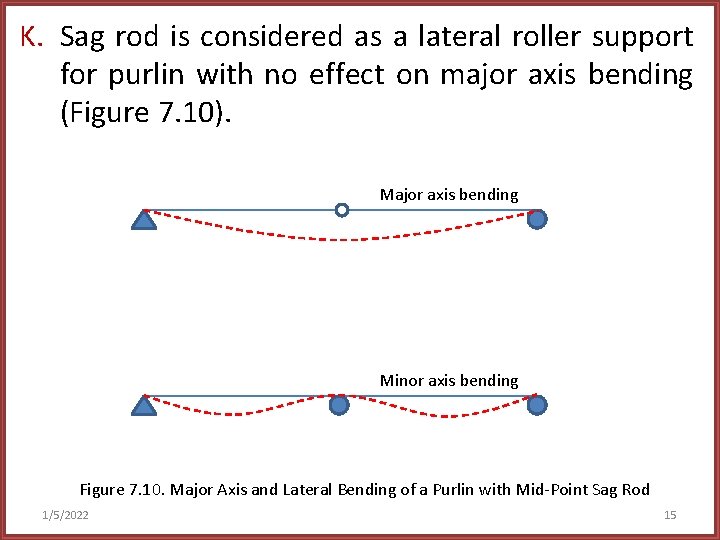
K. Sag rod is considered as a lateral roller support for purlin with no effect on major axis bending (Figure 7. 10). Major axis bending Minor axis bending Figure 7. 10. Major Axis and Lateral Bending of a Purlin with Mid-Point Sag Rod 1/5/2022 15
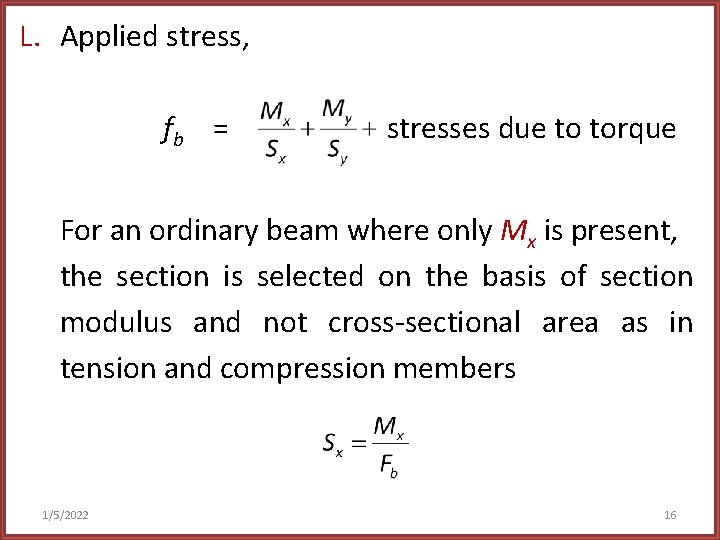
L. Applied stress, fb = stresses due to torque For an ordinary beam where only Mx is present, the section is selected on the basis of section modulus and not cross-sectional area as in tension and compression members 1/5/2022 16
However, in case of a purlin, two unknowns (Sx and Sy) occur in single equation. We cannot calculate Sx and Sy as such, making it necessary to use some simplifying assumption for the trial section. Once the trail section is selected, its stresses may easily be back checked to verify that they remain within the permissible range. The procedure given in the next section describes this procedure in detail. 1/5/2022 17
Procedure for Purlin Design 1/5/2022 18
1. w. D (N/m) = (load of roofing + insulation + part of miscellaneous loads) x purlin spacing + (purlin self weight) x prulin spacing The two terms are kept separate as one is producing torque while the other is not. 2. w. L (N/m) = live load (N/m 2) x purlin spacing 3. Again, self weight of the purlin is kept as a separate entity. 1/5/2022 19
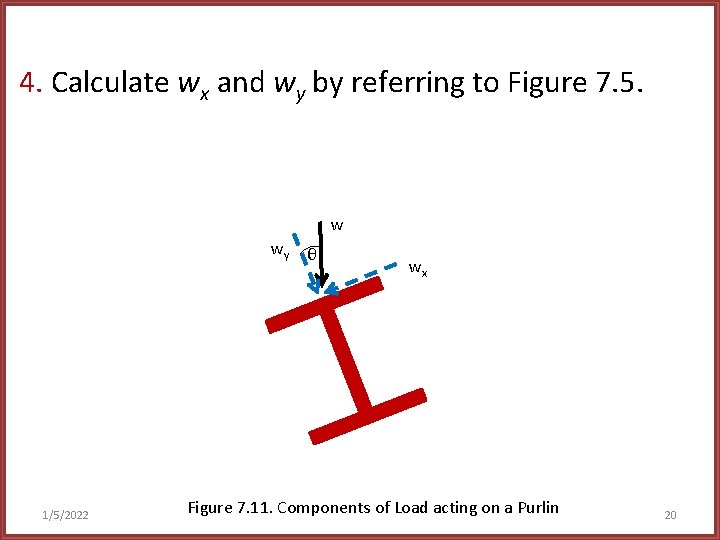
4. Calculate wx and wy by referring to Figure 7. 5. w wy θ 1/5/2022 wx Figure 7. 11. Components of Load acting on a Purlin 20
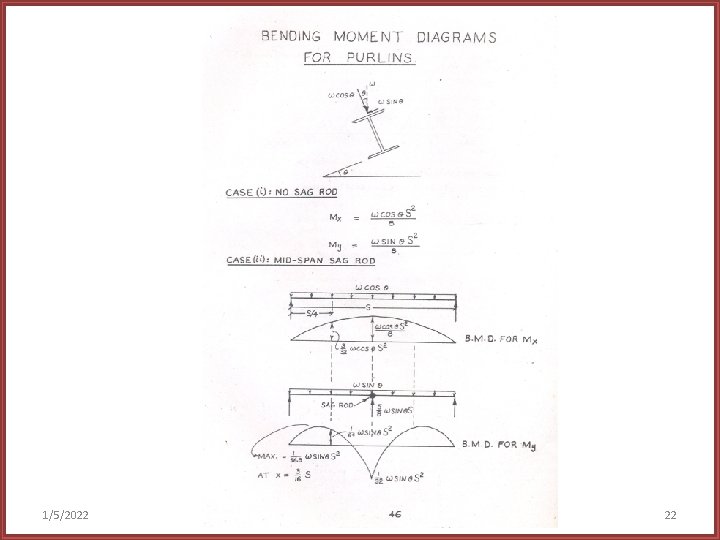
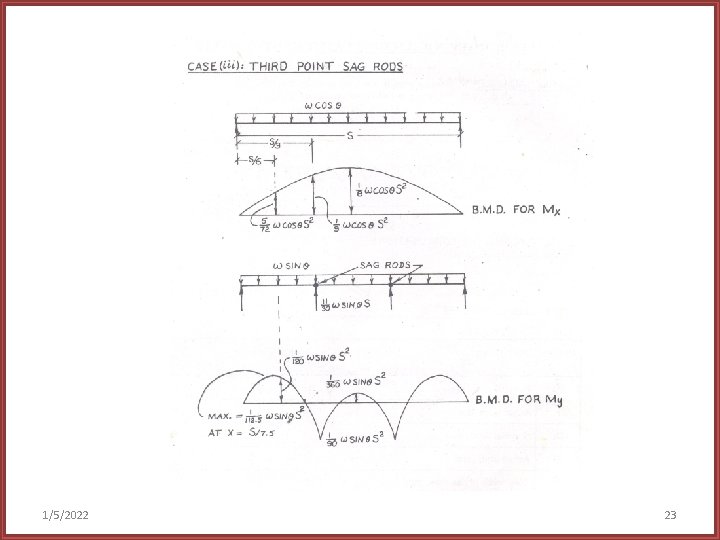
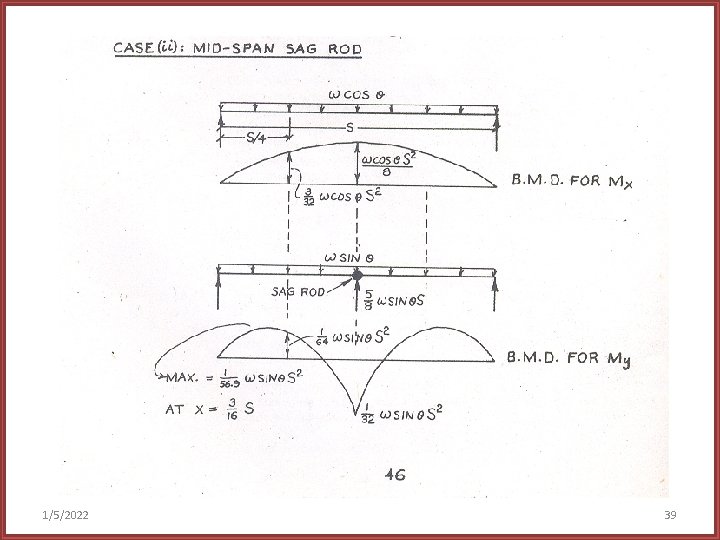
5. Calculate maximum values of Mx and My by using bending moment diagrams for the given sag rod case. Further, calculate My for loads producing torsion and loads not producing torsion separately. 1/5/2022 21
1/5/2022 22
1/5/2022 23
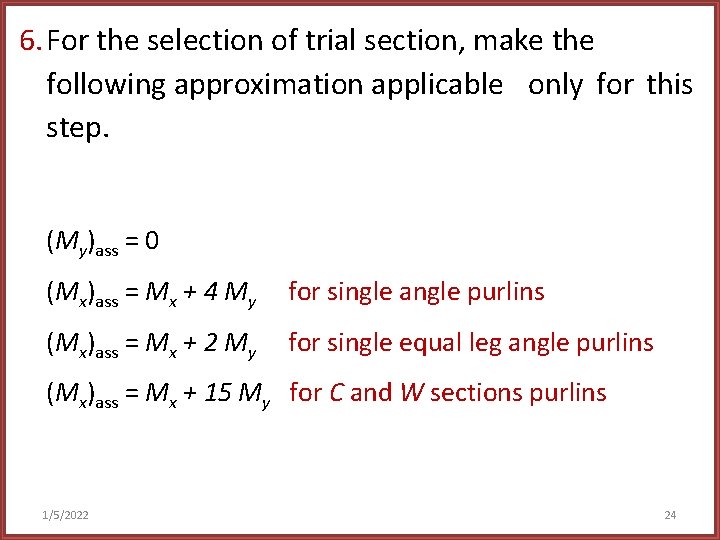
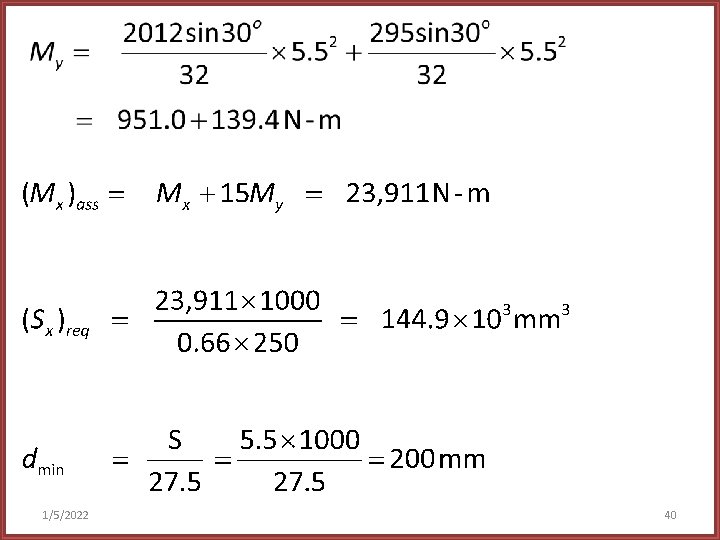
6. For the selection of trial section, make the following approximation applicable only for this step. (My)ass = 0 (Mx)ass = Mx + 4 My for single angle purlins (Mx)ass = Mx + 2 My for single equal leg angle purlins (Mx)ass = Mx + 15 My for C and W sections purlins 1/5/2022 24
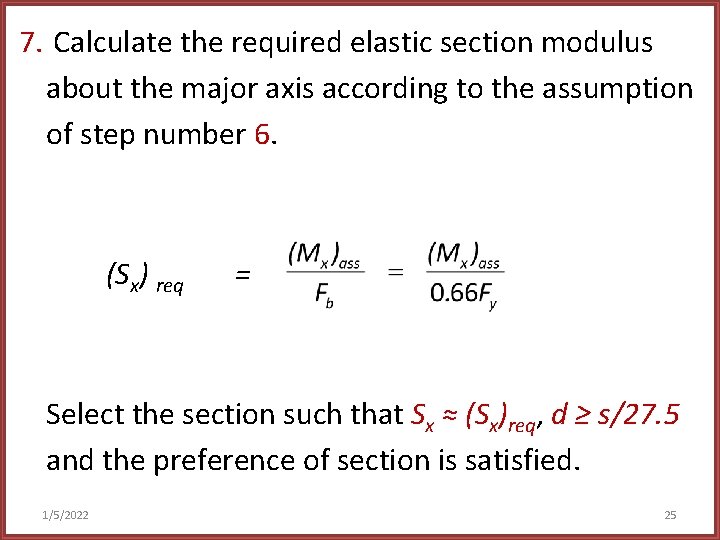
7. Calculate the required elastic section modulus about the major axis according to the assumption of step number 6. (Sx) req = Select the section such that Sx ≈ (Sx)req, d ≥ s/27. 5 and the preference of section is satisfied. 1/5/2022 25
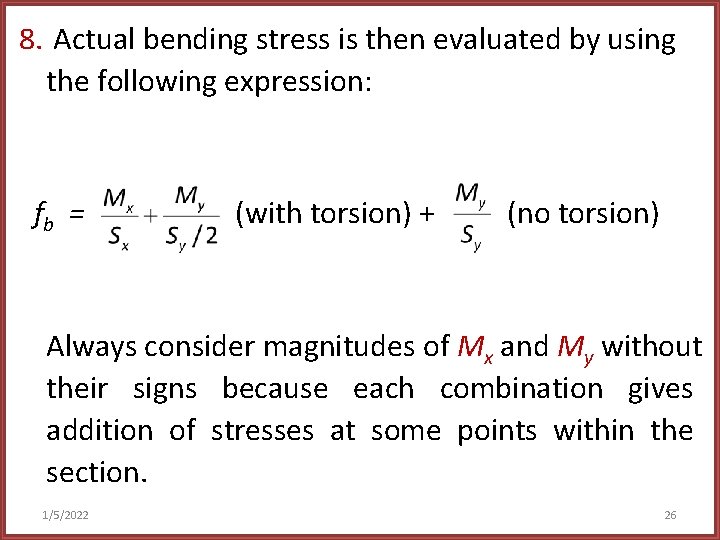
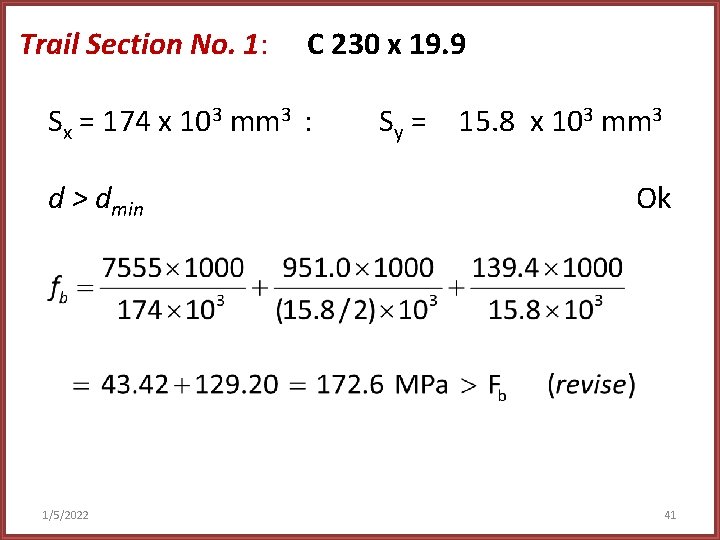
8. Actual bending stress is then evaluated by using the following expression: fb = (with torsion) + (no torsion) Always consider magnitudes of Mx and My without their signs because each combination gives addition of stresses at some points within the section. 1/5/2022 26
9. If the stress due to My is more than two times the stress due to Mx revise the section by a) increasing the sag rods b) selecting section with bigger Sy / Sx ratio However, if sag rods are limited due to construction difficulties, the first option is not employed. 1/5/2022 27
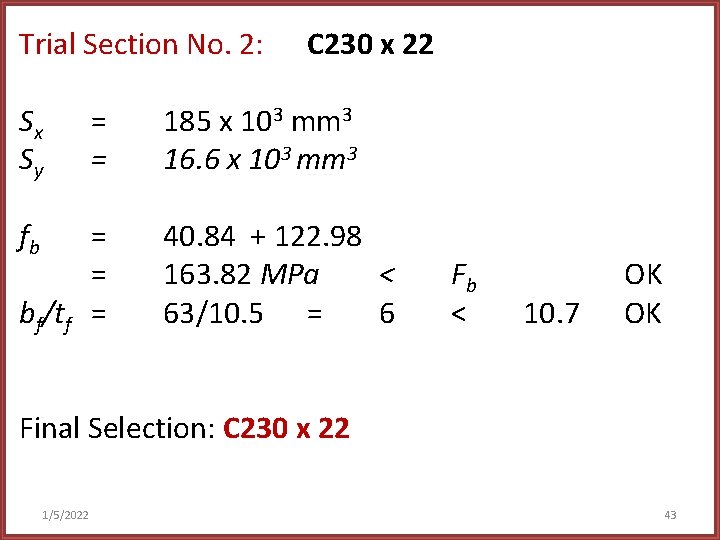
10. if fb ≤ F b Otherwise, revise the section. (OK) 11. Check b/t for angles, bf/tf for channels and bf/2 tf for W sections (called λ-value). λ ≤ λp (OK) otherwise, revise the section. 1/5/2022 28
For single angles, only shorter leg is in compression throughout and hence is to be used to check λ value. The value of λp for un-stiffened elements is 10. 8 and for stiffened elements is 31. 6 for A 36 steel. Any section meeting these requirements and continuously braced in lateral direction is called compact section. 1/5/2022 29
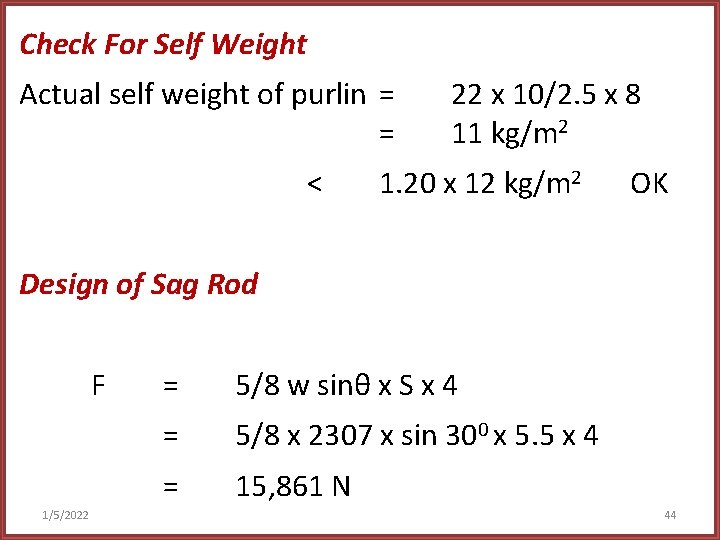
12. Check self-weight of the purlin: Actual self-weight of purlin = weight of purlin section(kg/m) x number of purlin / span of the truss Provided self-weight ≤ 1. 20 x assumed purlin weight. OK Otherwise, revise purlin self-weight and all the calculations. 1/5/2022 30
1/5/2022 31
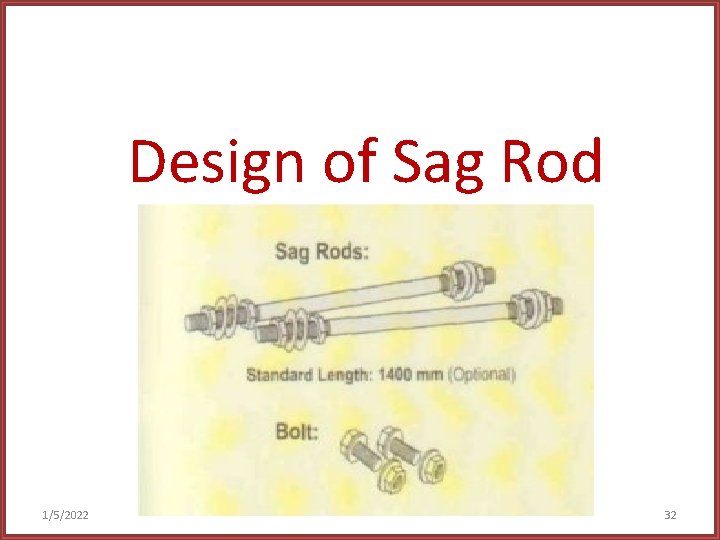
Design of Sag Rod 1/5/2022 32
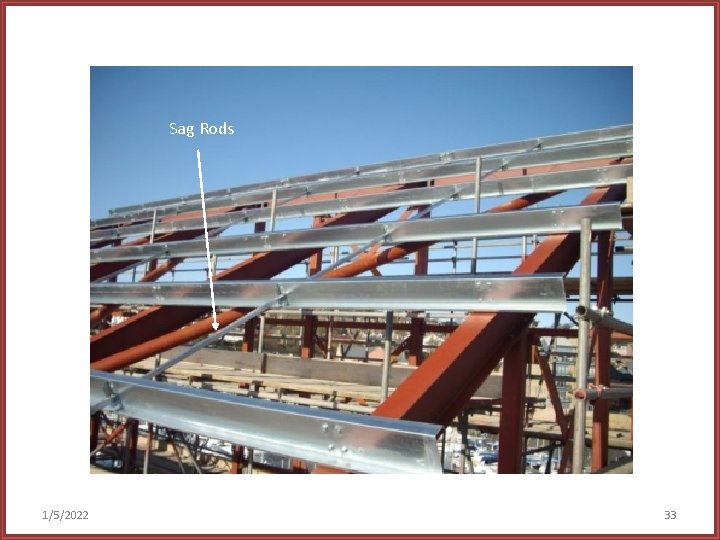
Sag Rods 1/5/2022 33
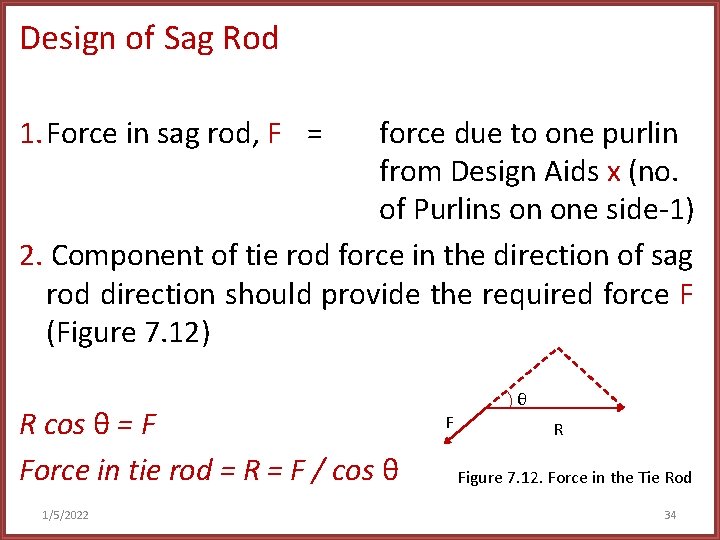
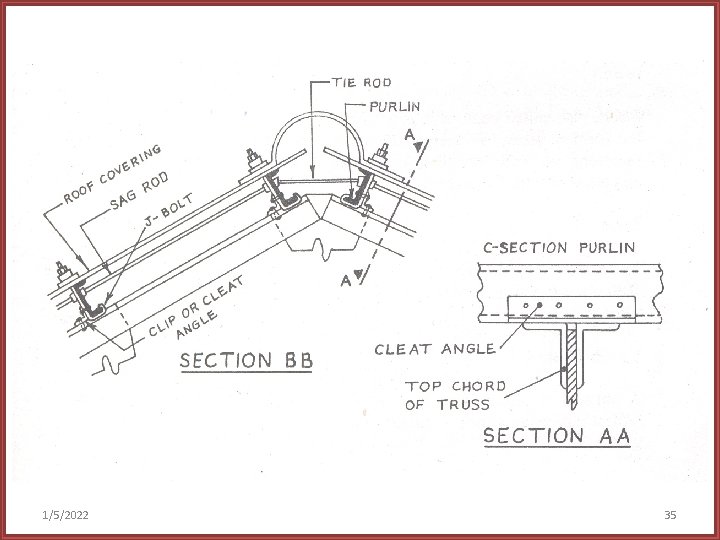
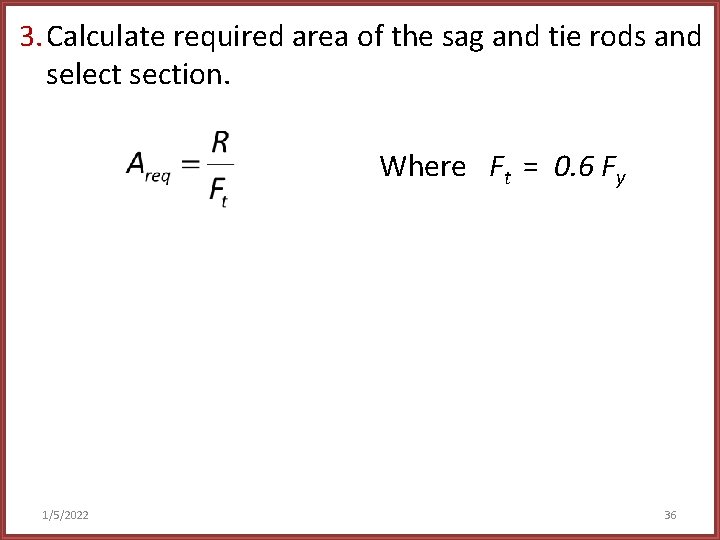
Design of Sag Rod 1. Force in sag rod, F = force due to one purlin from Design Aids x (no. of Purlins on one side-1) 2. Component of tie rod force in the direction of sag rod direction should provide the required force F (Figure 7. 12) R cos θ = F Force in tie rod = R = F / cos θ 1/5/2022 θ F R Figure 7. 12. Force in the Tie Rod 34
1/5/2022 35
3. Calculate required area of the sag and tie rods and select section. Where Ft = 0. 6 Fy 1/5/2022 36
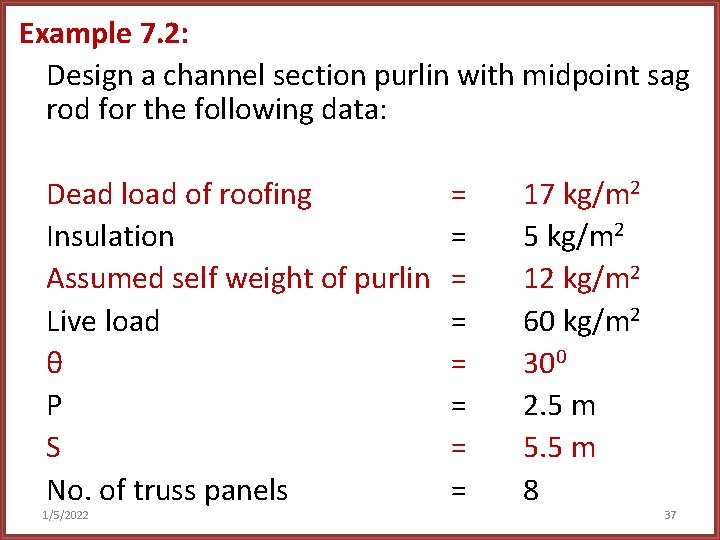
Example 7. 2: Design a channel section purlin with midpoint sag rod for the following data: Dead load of roofing Insulation Assumed self weight of purlin Live load θ P S No. of truss panels 1/5/2022 = = = = 17 kg/m 2 5 kg/m 2 12 kg/m 2 60 kg/m 2 300 2. 5 m 5. 5 m 8 37
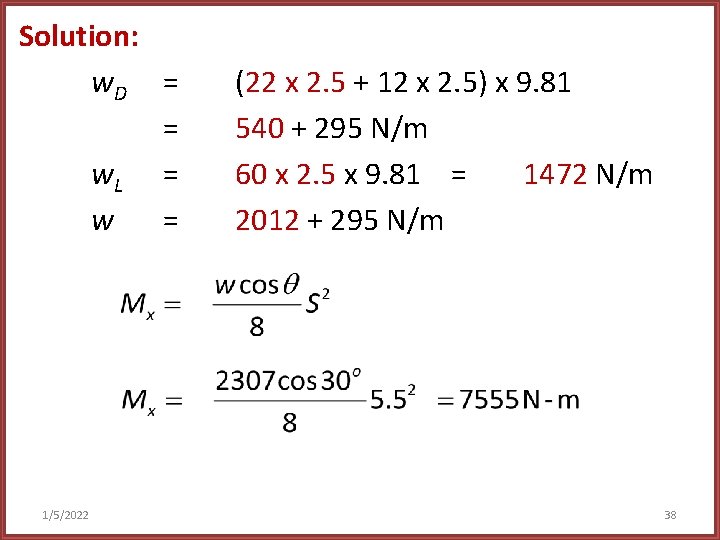
Solution: w. D = = w. L = w = 1/5/2022 (22 x 2. 5 + 12 x 2. 5) x 9. 81 540 + 295 N/m 60 x 2. 5 x 9. 81 = 1472 N/m 2012 + 295 N/m 38
1/5/2022 39
1/5/2022 40
Trail Section No. 1: C 230 x 19. 9 Sx = 174 x 103 mm 3 : d > dmin 1/5/2022 Sy = 15. 8 x 103 mm 3 Ok 41
Note: 1/5/2022 42
Trial Section No. 2: Sx Sy = = fb = = bf/tf = C 230 x 22 185 x 103 mm 3 16. 6 x 103 mm 3 40. 84 + 122. 98 163. 82 MPa < 63/10. 5 = 6 Fb < 10. 7 OK OK Final Selection: C 230 x 22 1/5/2022 43
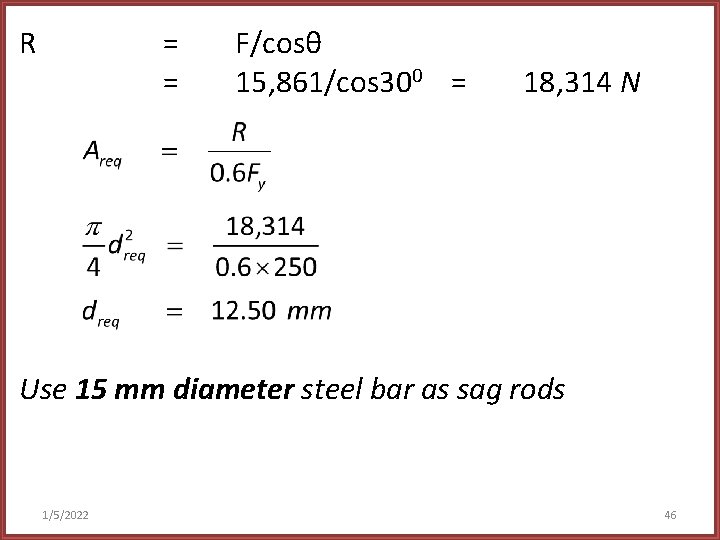
Check For Self Weight Actual self weight of purlin = = < 22 x 10/2. 5 x 8 11 kg/m 2 1. 20 x 12 kg/m 2 OK Design of Sag Rod F 1/5/2022 = 5/8 w sinθ x S x 4 = 5/8 x 2307 x sin 300 x 5. 5 x 4 = 15, 861 N 44
1/5/2022 45
R = = F/cosθ 15, 861/cos 300 = 18, 314 N Use 15 mm diameter steel bar as sag rods 1/5/2022 46
Note: The purlin, if place as in Figure 7. 13 (a), is better for the applied loads because the load resultant remains near the shear center. However, this arrangement may cause slipping of the roof sheets downwards by bending of the J-bolts. The arrangement shown in Figure 7. 13(b) is better in this aspect of behavior and construction. 1/5/2022 47
Assignment Design Purlin for your truss using your own data 1/5/2022 48