
Design of the Periodic Table Vocabulary n Group
Design of the Periodic Table
Vocabulary n. Group n. Family n. Period n. Metal n. Nonmetal n. Metalloid n. Valence Electrons
Objectives n Discuss importance of valence electrons n Discuss how families contain elements with similar properties. n Explain how properties of elements vary across a horizontal row, or period. n Compare the properties of metals, nonmetals, and metalloids.
Periodic Table Design
Group (Family) n. Columns (18) n. Have similar properties n. Li, Na, and K are all soft, white, shiny metals and are highly reactive n. Same number of valence electrons
Valence electrons are electrons in the outer most energy level (electron shell)
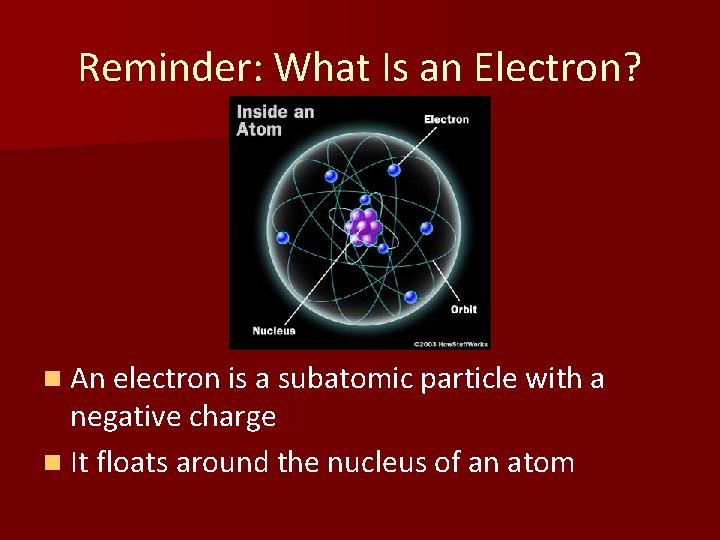
Reminder: What Is an Electron? n An electron is a subatomic particle with a negative charge n It floats around the nucleus of an atom
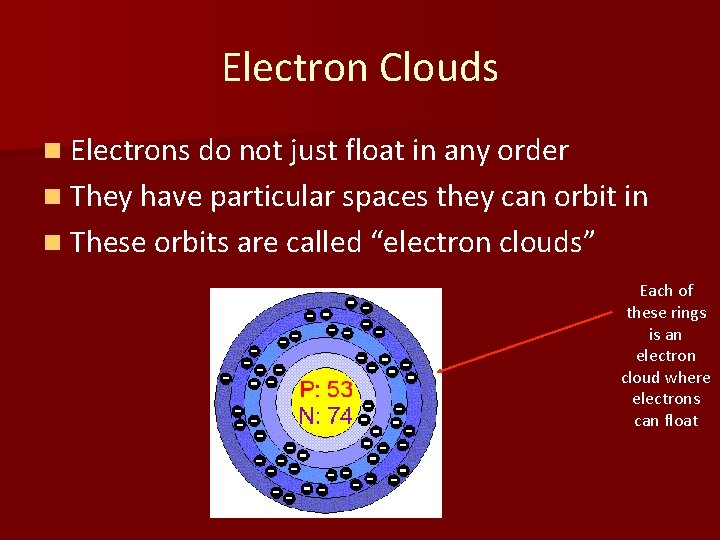
Electron Clouds n Electrons do not just float in any order n They have particular spaces they can orbit in n These orbits are called “electron clouds” Each of these rings is an electron cloud where electrons can float
How Many Electrons Can Fit In Each Cloud? n Electron clouds can only hold a certain amount of electrons n As you move further away from the nucleus, the clouds can hold more electrons n The most stable (“happiest”) atoms are the ones that have each of their electron clouds filled
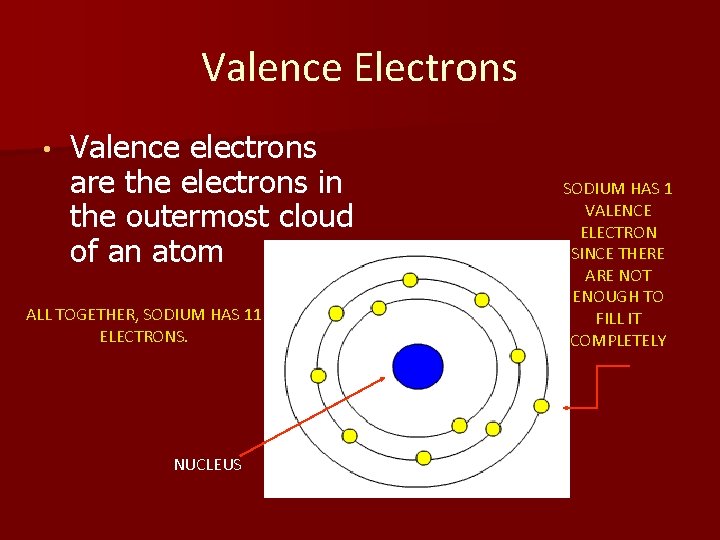
Valence Electrons • Valence electrons are the electrons in the outermost cloud of an atom ALL TOGETHER, SODIUM HAS 11 ELECTRONS. NUCLEUS SODIUM HAS 1 VALENCE ELECTRON SINCE THERE ARE NOT ENOUGH TO FILL IT COMPLETELY
What Happens If the Atoms Don’t Have Enough Electrons In the Clouds? Want to swap some electrons? n If the atom doesn’t have enough electrons in its clouds, then it is always going to be on the lookout for another atom to give it electrons!
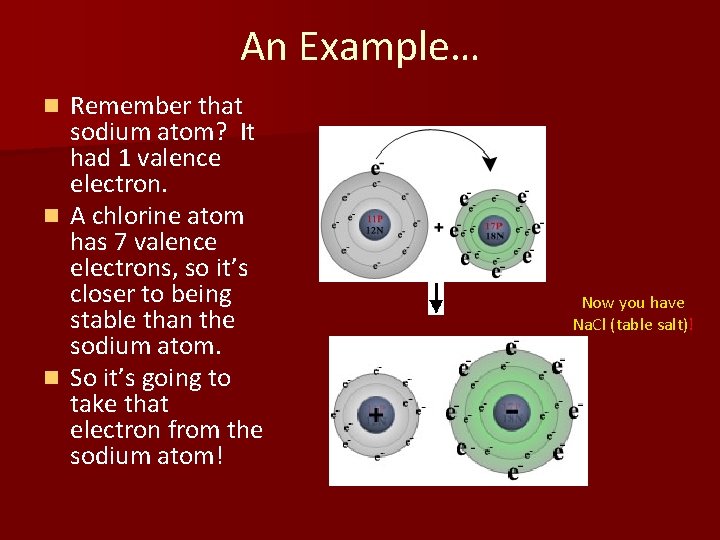
An Example… Remember that sodium atom? It had 1 valence electron. n A chlorine atom has 7 valence electrons, so it’s closer to being stable than the sodium atom. n So it’s going to take that electron from the sodium atom! n Now you have Na. Cl (table salt)!
Period n. Rows (7) n. Not alike in properties n. Rare-Earth Elements are part of row 6 & 7
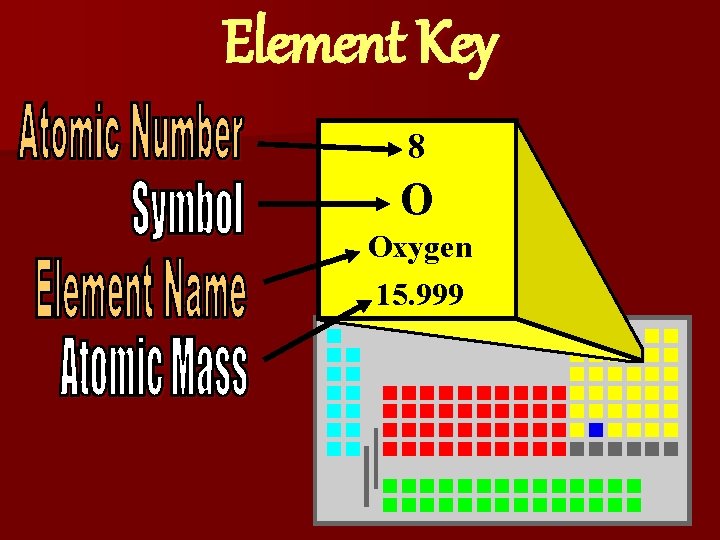
Element Key 8 O Oxygen 15. 999
Metals n. Elements left of the zigzag line are metals or metallike
Metals n. Physical Properties –Solids at 250 C –Luster (shine) –Conductors of heat and electricity –High Density –Fairly high melting point –Ductile (into wire) –Malleable (into thin sheets)
Metals n. Chemical Properties –Depends on the # of electrons in the outer most energy level. –Lose electrons when combine chemically – 1, 2, 3, or 4 electrons in outer energy level
Nonmetals n. Located to the right of the zigzag line.
Nonmetals n. Physical Properties –Most are gases at 25 o. C –Some are brittle solids. –No Luster, Dull –Not conductors of heat and electricity –Low densities –Low melting points
Nonmetals n. Chemical Properties –Depends on the # of electrons in the outer most energy level. –Gain electrons when combine chemically – 5, 6, 7, or 8 electrons in outer energy level
Metalloids n. Touching the zigzag line n. Have properties of both metals and nonmetals. n. Solids that can be shiny or dull.
Chemical Families
Alkali Metals ONE n____ valence electron n. Very Reactive n. Never found uncombined in nature (Na. Cl)
Alkaline Earth Metals TWO n____ valence electron n. Very Reactive n. Never found uncombined in nature (Ca. CO 3)
Boron Family three n______ electron valence n. Aluminum is the most abundant of all metal
Carbon Family FOUR n_____ valence electron n. Contains nonmetals, and metalloids n. Carbon forms more than 5 million compounds
Nitrogen Family FIVE n____ valence electron n. Nitrogen makes up 78% of the air
Oxygen Family SIX n___ valence electron n. Oxygen important in all life processes
Halogens SEVEN n______ valence electron n. Most active nonmetals n. Fluoride – strengthens teeth
Noble Gas EIGHT n______ valence electron n. FULL OUTER SHELL n. Unreactive n. Neon Lights
Transition Metals n. Found between Alkaline Earth and boron family ONE TWO n. Most have ___ or ____ valence electrons
Rare-Earth Metals n. Fits between alkaline earth and transition metals n. Bottom row is radioactive ______
- Slides: 32