
Design of the LORD Experiment and Perspectives of
- Slides: 36
Design of the LORD Experiment and Perspectives of Ultra-High Energy Particles Observation G. A. Gusev, V. A. Chechin, B. N. Lomonosov, N. G. Polukhina, and V. A. Ryabov. P. N. Lebedev Physical Institute, Russian Academy of Sciences Arena 2010 1
Outlook of Presentation o o Problems of ultrahigh-energy cosmic rays and neutrinos observation. LORD space experiment and design of apparatus The results of Monte Carlo simulation Conclusion Arena 2010 2
The Main Goal of the LORD Experiment The primary goal of the LORD experiment is the detection of ultrahigh-energy cosmic rays and neutrinos. An investigation of the nature and spectra of cosmic particles with energies E ≥ 1020 e. V (“ultra-high energies”, UHE) is one of the “hottest” problems of modern science. Information on these particles is important for solving fundamental problems of astrophysics and particle physics relating to cosmic ray sources and acceleration mechanisms, nature of dark matter, and spacetime structure. Arena 2010 3
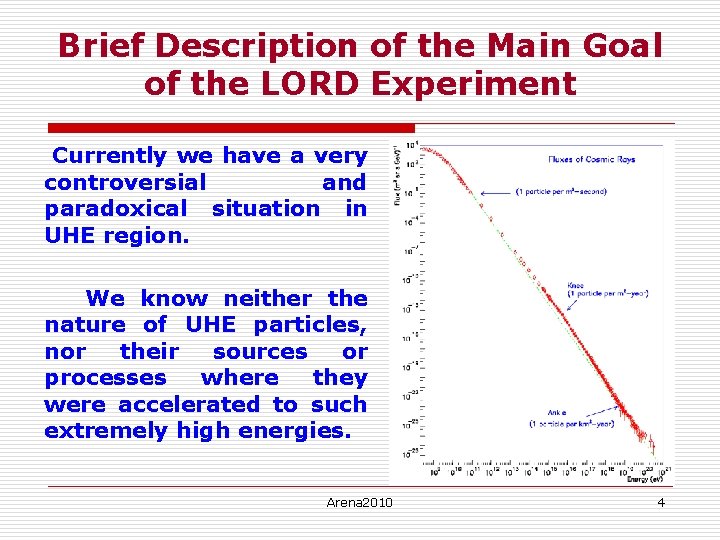
Brief Description of the Main Goal of the LORD Experiment Currently we have a very controversial and paradoxical situation in UHE region. We know neither the nature of UHE particles, nor their sources or processes where they were accelerated to such extremely high energies. Arena 2010 4
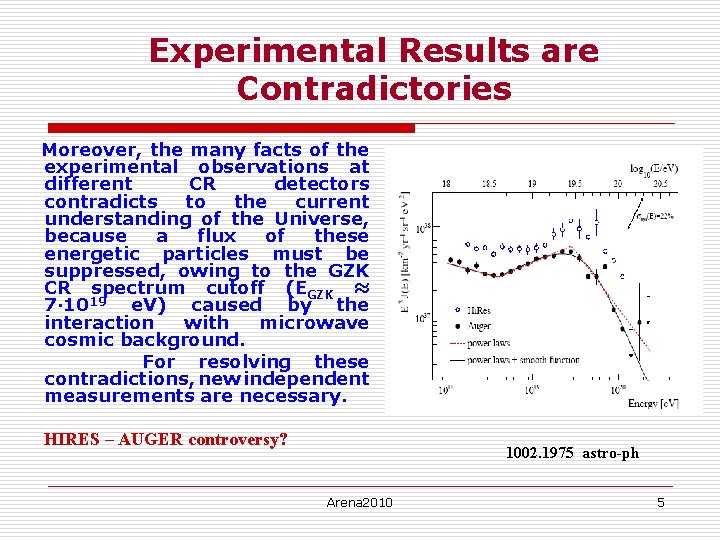
Experimental Results are Contradictories Moreover, the many facts of the experimental observations at different CR detectors contradicts to the current understanding of the Universe, because a flux of these energetic particles must be suppressed, owing to the GZK CR spectrum cutoff (EGZK ≈ 7∙ 1019 e. V) caused by the interaction with microwave cosmic background. For resolving these contradictions, new independent measurements are necessary. HIRES – AUGER controversy? 1002. 1975 astro-ph Arena 2010 5
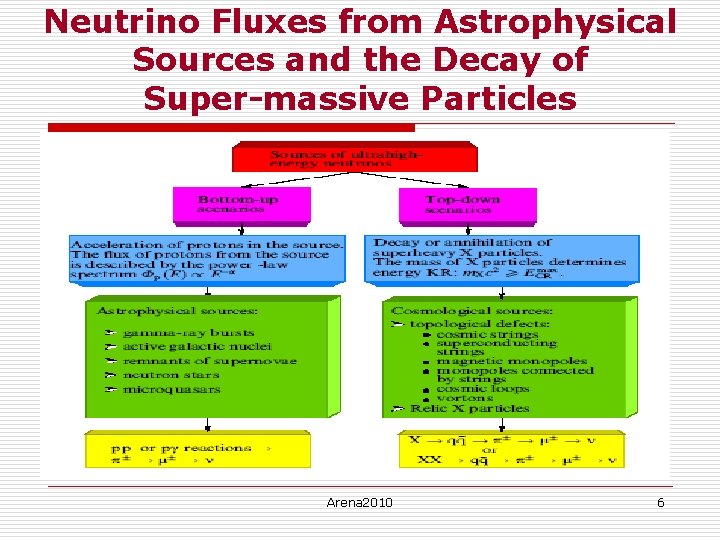
Neutrino Fluxes from Astrophysical Sources and the Decay of Super-massive Particles Arena 2010 6
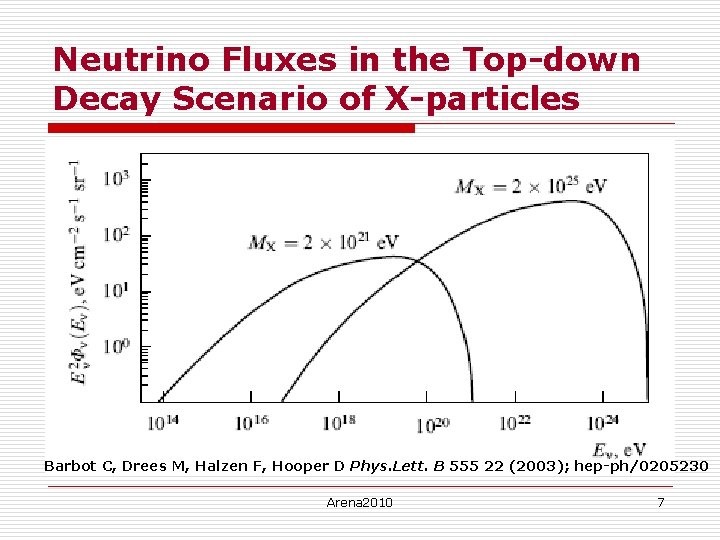
Neutrino Fluxes in the Top-down Decay Scenario of X-particles Barbot C, Drees M, Halzen F, Hooper D Phys. Lett. B 555 22 (2003); hep-ph/0205230 Arena 2010 7
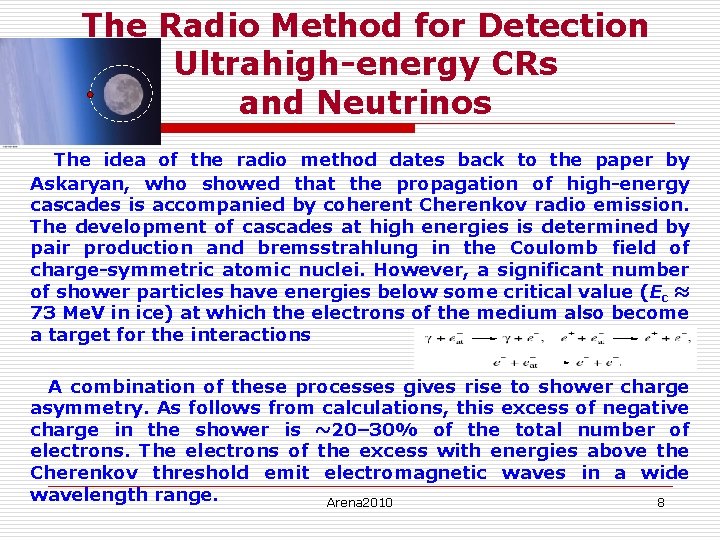
The Radio Method for Detection Ultrahigh-energy CRs and Neutrinos The idea of the radio method dates back to the paper by Askaryan, who showed that the propagation of high-energy cascades is accompanied by coherent Cherenkov radio emission. The development of cascades at high energies is determined by pair production and bremsstrahlung in the Coulomb field of charge-symmetric atomic nuclei. However, a significant number of shower particles have energies below some critical value (Ec ≈ 73 Me. V in ice) at which the electrons of the medium also become a target for the interactions A combination of these processes gives rise to shower charge asymmetry. As follows from calculations, this excess of negative charge in the shower is ~20– 30% of the total number of electrons. The electrons of the excess with energies above the Cherenkov threshold emit electromagnetic waves in a wide wavelength range. Arena 2010 8
The Radio Method for Detection Ultrahigh-energy CRs and Neutrinos The application of the radio method is especially appropriate at ultrahigh energies since the power of coherent radio signal increases as a square of the shower energy. The most important advantage of the radio method is the possibility to scan over huge volumes of radio-transparent media providing detection of rare ultrahigh-energy events with relatively high statistics. Arena 2010 9
The Radio Method for Detection Ultrahigh-energy CRs and Neutrinos Currently radio method is used as the basis for a number of experiments and projects on the ultrahigh-energy particle detection in such radiotransparent media as the atmosphere, salt domes and ice sheets of Antarctic and Greenland. Arena 2010 10
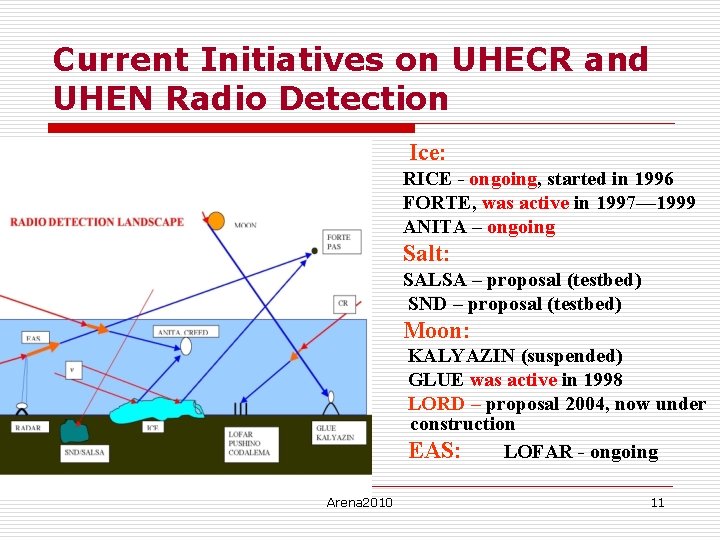
Current Initiatives on UHECR and UHEN Radio Detection Ice: RICE - ongoing, started in 1996 FORTE, was active in 1997— 1999 ANITA – ongoing Salt: SALSA – proposal (testbed) SND – proposal (testbed) Moon: KALYAZIN (suspended) GLUE was active in 1998 LORD – proposal 2004, now under construction EAS: LOFAR - ongoing Arena 2010 11
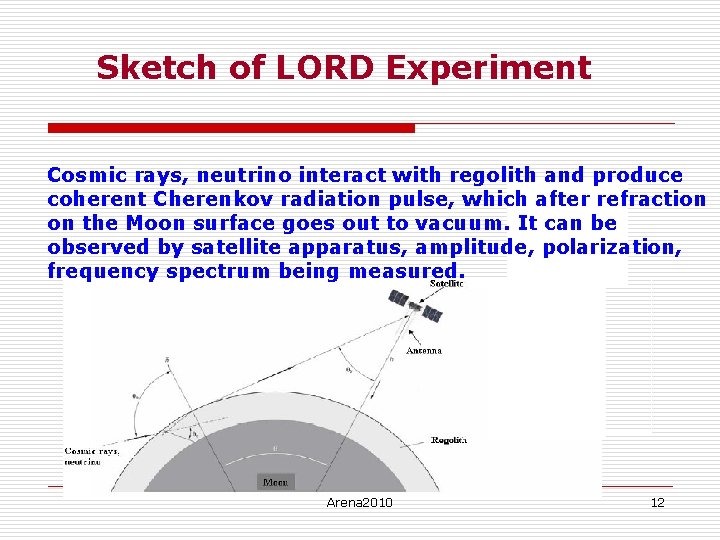
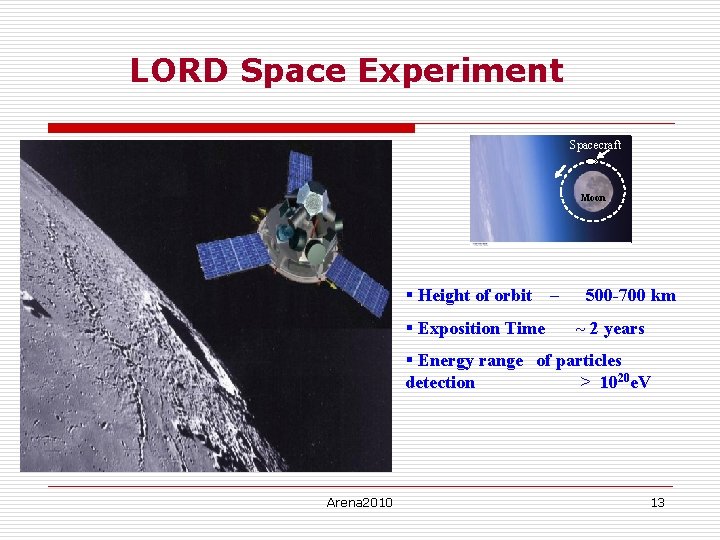
Sketch of LORD Experiment Cosmic rays, neutrino interact with regolith and produce coherent Cherenkov radiation pulse, which after refraction on the Moon surface goes out to vacuum. It can be observed by satellite apparatus, amplitude, polarization, frequency spectrum being measured. Arena 2010 12
LORD Space Experiment Spacecraft Moon § Height of orbit – § Exposition Time 500 -700 km ~ 2 years § Energy range of particles detection > 1020 e. V Arena 2010 13
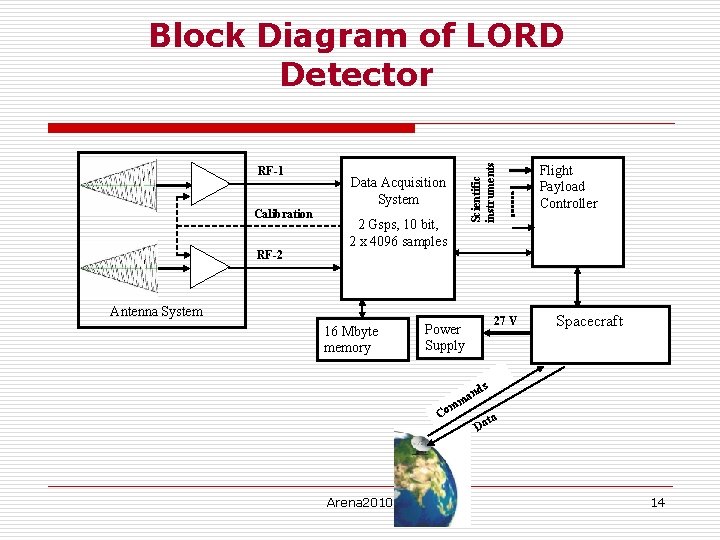
RF-1 Calibration RF-2 Scientific instruments Block Diagram of LORD Detector Data Acquisition System 2 Gsps, 10 bit, 2 x 4096 samples Antenna System 16 Mbyte memory 27 V Power Supply Flight Payload Controller Spacecraft ds n ma m Co Arena 2010 ta Da 14
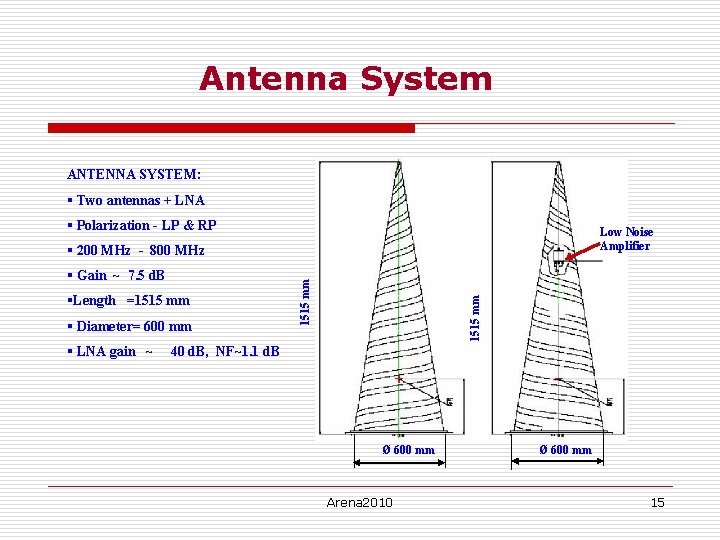
Antenna System ANTENNA SYSTEM: § Two antennas + LNA § Polarization - LP & RP § 200 MHz - 800 MHz § Diameter= 600 mm § LNA gain ~ 1515 mm §Length =1515 mm § Gain ~ 7. 5 d. B Low Noise Amplifier 40 d. B, NF~1. 1 d. B Ø 600 mm Arena 2010 Ø 600 mm 15
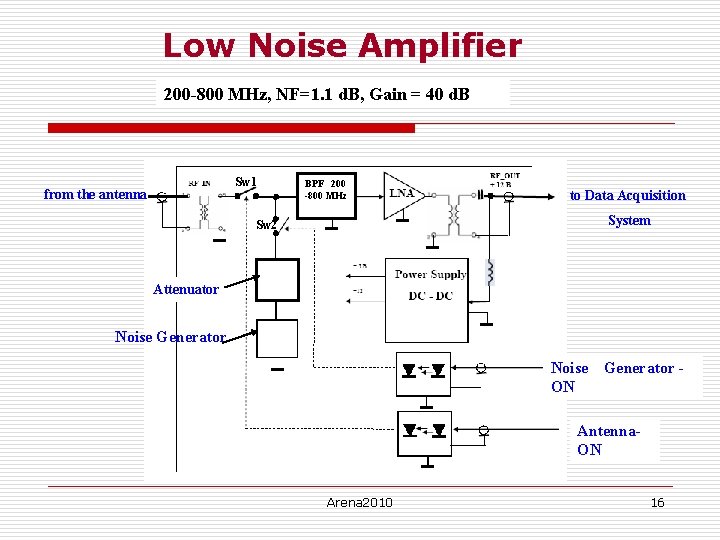
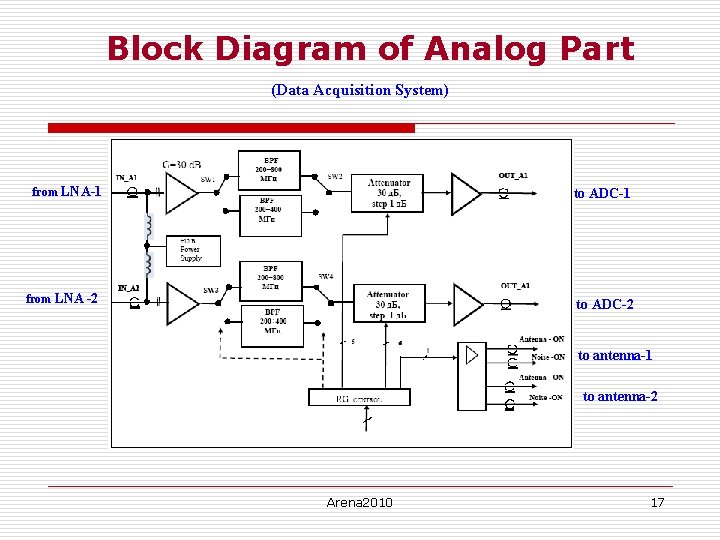
Low Noise Amplifier 200 -800 MHz, NF=1. 1 d. B, Gain = 40 d. B Sw 1 from the antenna BPF 200 -800 MHz to Data Acquisition System Sw 2 Attenuator Noise Generator Noise ON Generator - Antenna. ON Arena 2010 16
Block Diagram of Analog Part (Data Acquisition System) from LNA-1 to ADC-1 from LNA -2 to ADC-2 to antenna-1 to antenna-2 Arena 2010 17
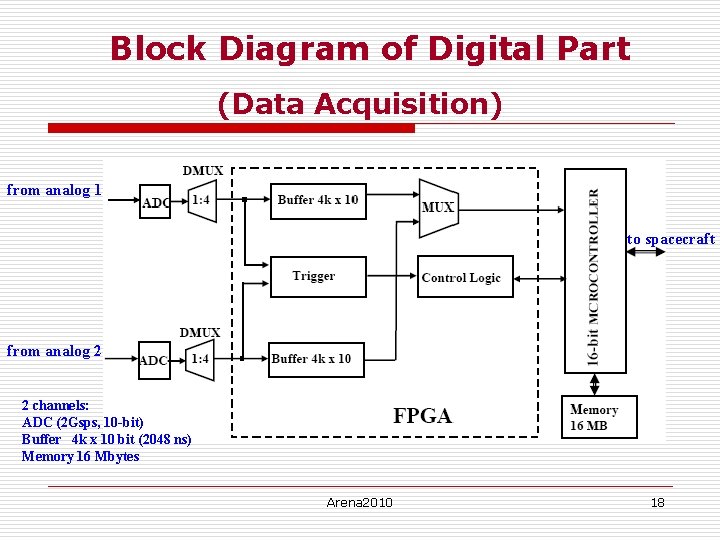
Block Diagram of Digital Part (Data Acquisition) from analog 1 to spacecraft from analog 2 2 channels: ADC (2 Gsps, 10 -bit) Buffer 4 k x 10 bit (2048 ns) Memory 16 Mbytes Arena 2010 18
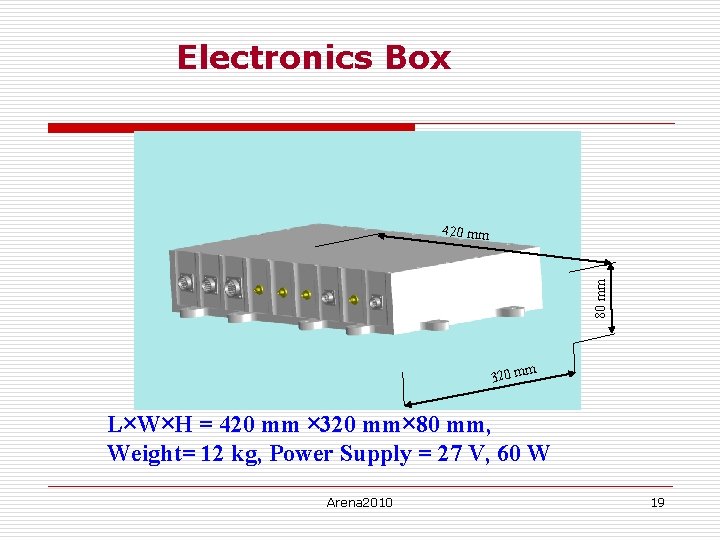
Electronics Box 80 mm 420 mm m 320 m L×W×H = 420 mm × 320 mm× 80 mm, Weight= 12 kg, Power Supply = 27 V, 60 W Arena 2010 19
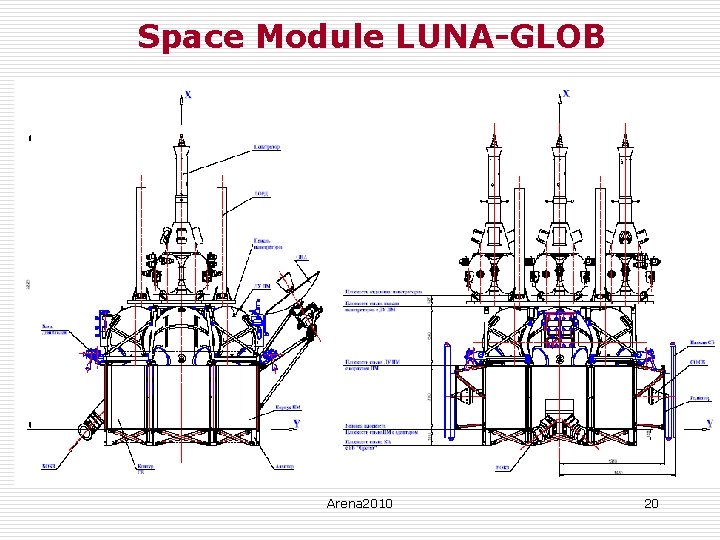
Space Module LUNA-GLOB Arena 2010 20
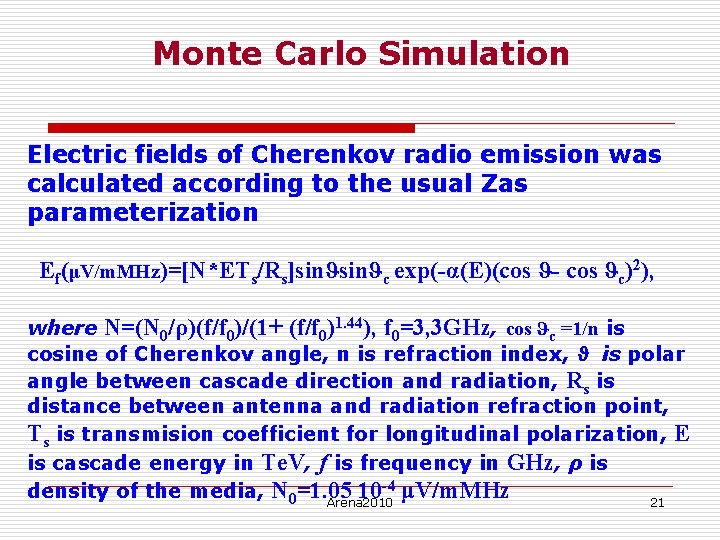
Monte Carlo Simulation Electric fields of Cherenkov radio emission was calculated according to the usual Zas parameterization Ef(μV/m. MHz)=[N*ETs/Rs]sinϑc exp(-α(E)(cos ϑ- cos ϑc)2), where N=(N 0/ρ)(f/f 0)/(1+ (f/f 0)1. 44), f 0=3, 3 GHz, cos ϑc =1/n is cosine of Cherenkov angle, n is refraction index, ϑ is polar angle between cascade direction and radiation, Rs is distance between antenna and radiation refraction point, Ts is transmision coefficient for longitudinal polarization, E is cascade energy in Te. V, f is frequency in GHz, ρ is -4 μV/m. MHz density of the media, N 0=1. 05 10 Arena 2010 21
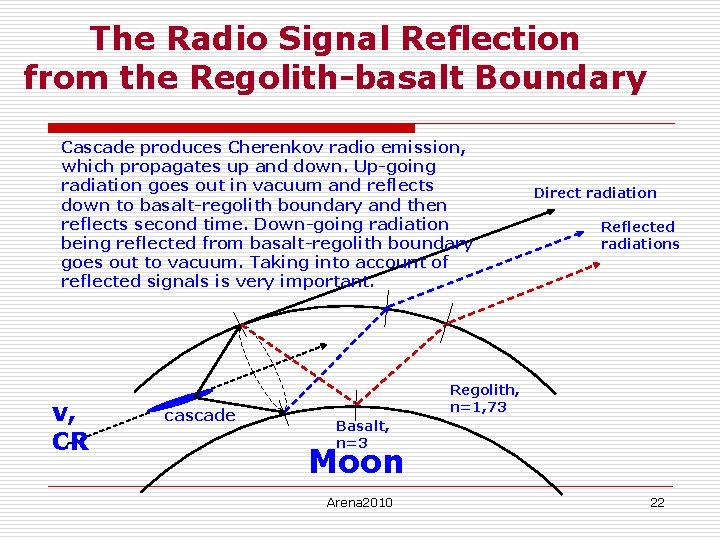
The Radio Signal Reflection from the Regolith-basalt Boundary Cascade produces Cherenkov radio emission, which propagates up and down. Up-going radiation goes out in vacuum and reflects down to basalt-regolith boundary and then reflects second time. Down-going radiation being reflected from basalt-regolith boundary goes out to vacuum. Taking into account of reflected signals is very important. ν, CR cascade Direct radiation Reflected radiations Regolith, n=1, 73 Basalt, n=3 Moon Arena 2010 22
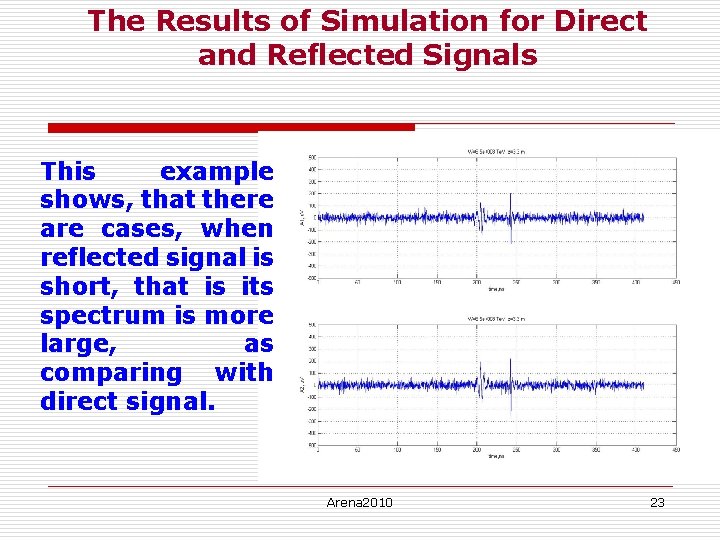
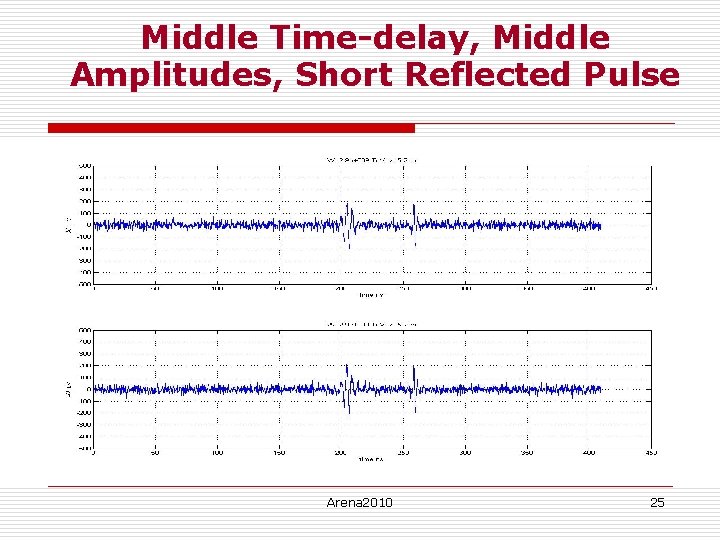
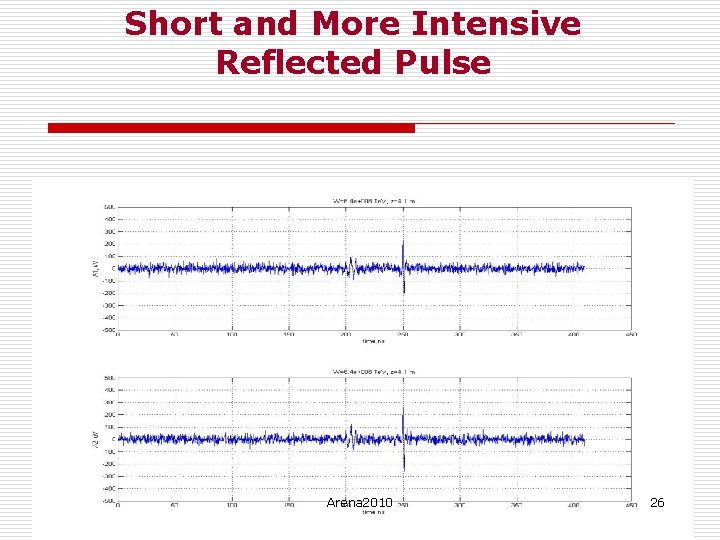
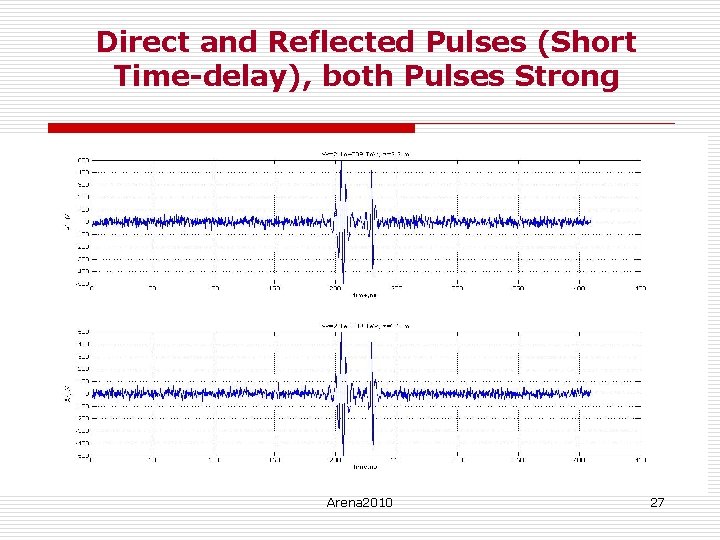
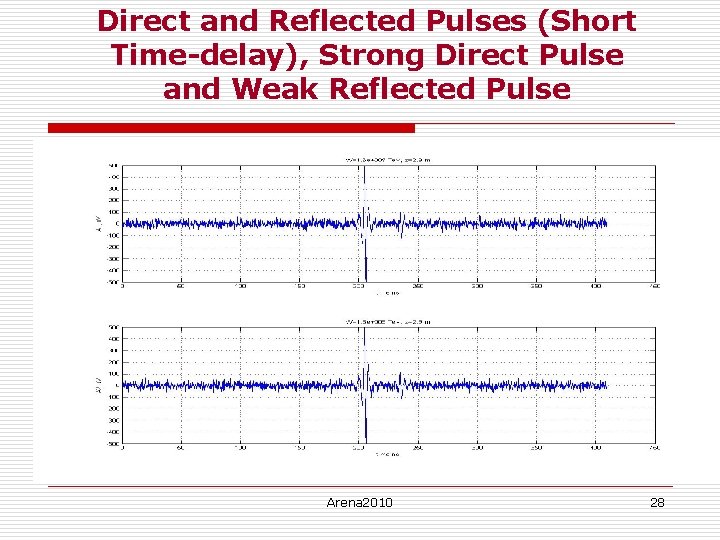
The Results of Simulation for Direct and Reflected Signals This example shows, that there are cases, when reflected signal is short, that is its spectrum is more large, as comparing with direct signal. Arena 2010 23
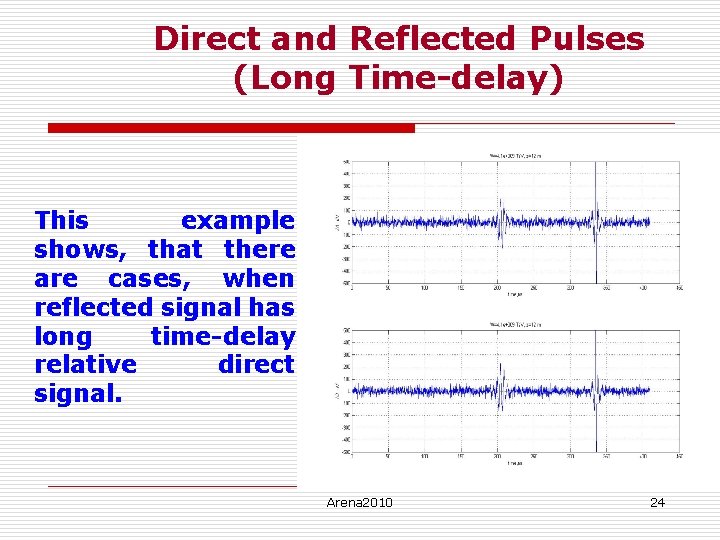
Direct and Reflected Pulses (Long Time-delay) This example shows, that there are cases, when reflected signal has long time-delay relative direct signal. Arena 2010 24
Middle Time-delay, Middle Amplitudes, Short Reflected Pulse Arena 2010 25
Short and More Intensive Reflected Pulse Arena 2010 26
Direct and Reflected Pulses (Short Time-delay), both Pulses Strong Arena 2010 27
Direct and Reflected Pulses (Short Time-delay), Strong Direct Pulse and Weak Reflected Pulse Arena 2010 28
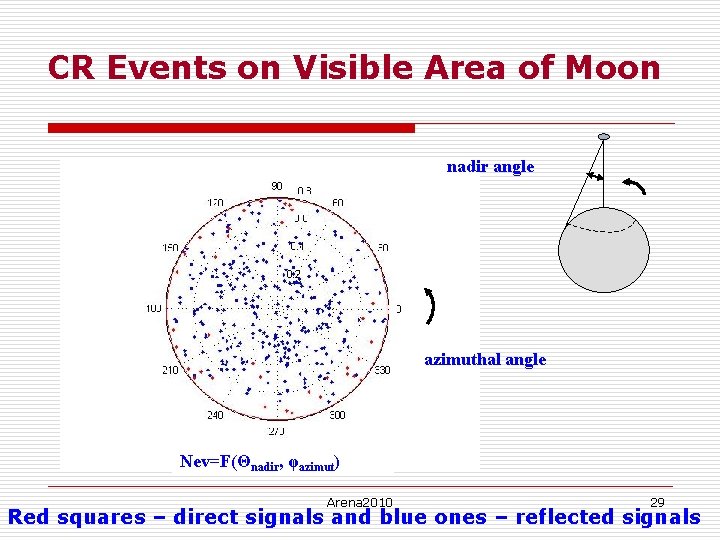
CR Events on Visible Area of Moon nadir angle azimuthal angle Νev=F(Θnadir, φazimut) Arena 2010 29 Red squares – direct signals and blue ones – reflected signals
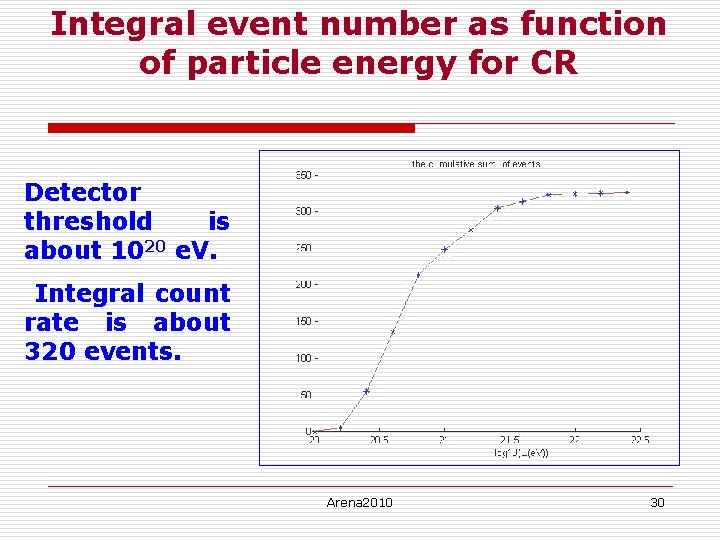
Integral event number as function of particle energy for CR Detector threshold is about 1020 e. V. Integral count rate is about 320 events. Arena 2010 30
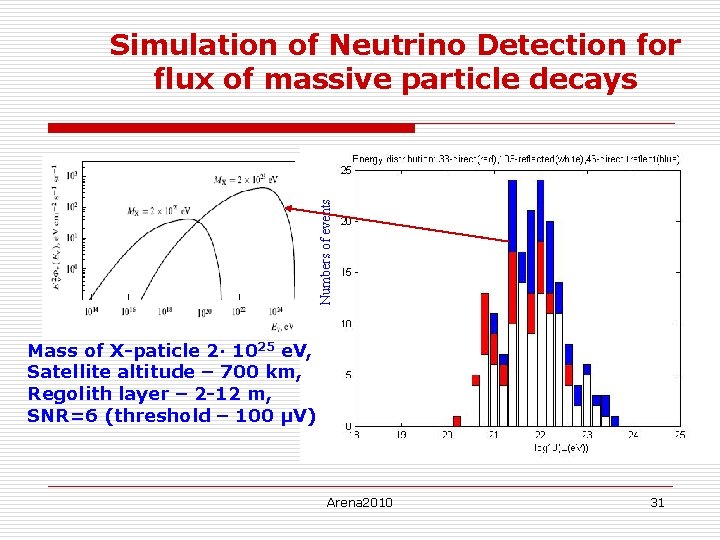
Numbers of events Simulation of Neutrino Detection for flux of massive particle decays Mass of X-paticle 2· 1025 e. V, Satellite altitude – 700 km, Regolith layer – 2 -12 m, SNR=6 (threshold – 100 μV) Arena 2010 31
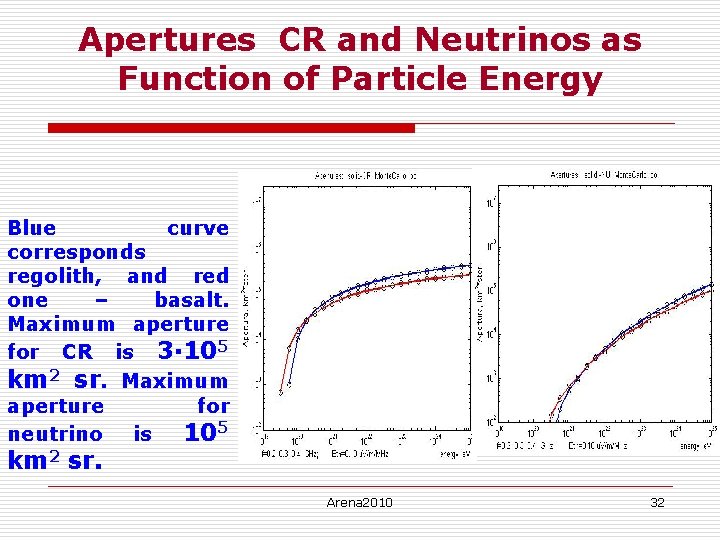
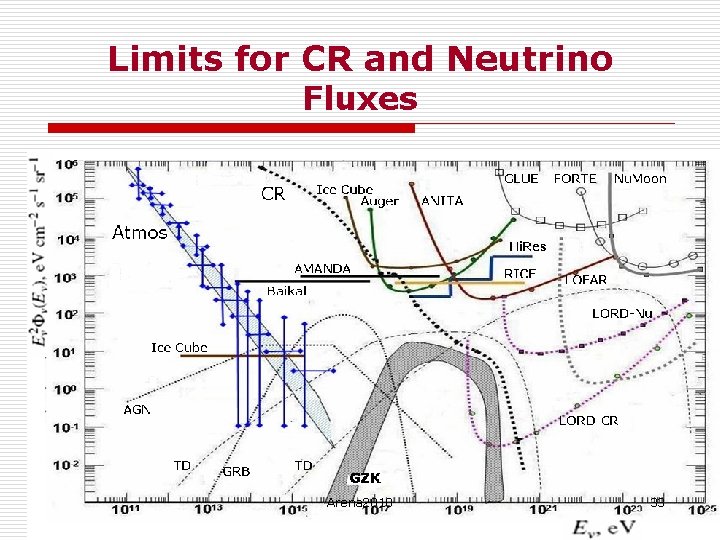
Apertures CR and Neutrinos as Function of Particle Energy Blue curve corresponds regolith, and red one – basalt. Maximum aperture for CR is 3· 105 km 2 sr. Maximum aperture for neutrino is 105 km 2 sr. Arena 2010 32
Limits for CR and Neutrino Fluxes Arena 2010 33
Conclusion o o o LORD is elaborated and now under construction. The additional contribution of reflected signal greatly enhances the scientific potential of experiments with the lunar orbital radio detector. LORD apertures for UHECR & UHEN detection are higher than in all ongoing experiments and for energy 1021 e. V are about 3· 105 km 2 sr for UHECR and 105 km 2 sr for UHEN The work is performed with partial support of grant RFBR 08 -02 -00515 and Arena 2010 34 Program of Russian Academy of Sciences “Neutrino Physics ”.
Expected “Luna-Globe” launch 2012 Arena 2010 35
Thank you for attention Arena 2010 36