
Design of the Baby IAXO superconducting detector magnet
Design of the Baby. IAXO superconducting detector magnet N. Bykovskiy, A. Dudarev, H. F. P. Silva, P. Borges de Sousa, and H. H. J. ten Kate Mon-Af-Or 5 -05 September 23, 2019
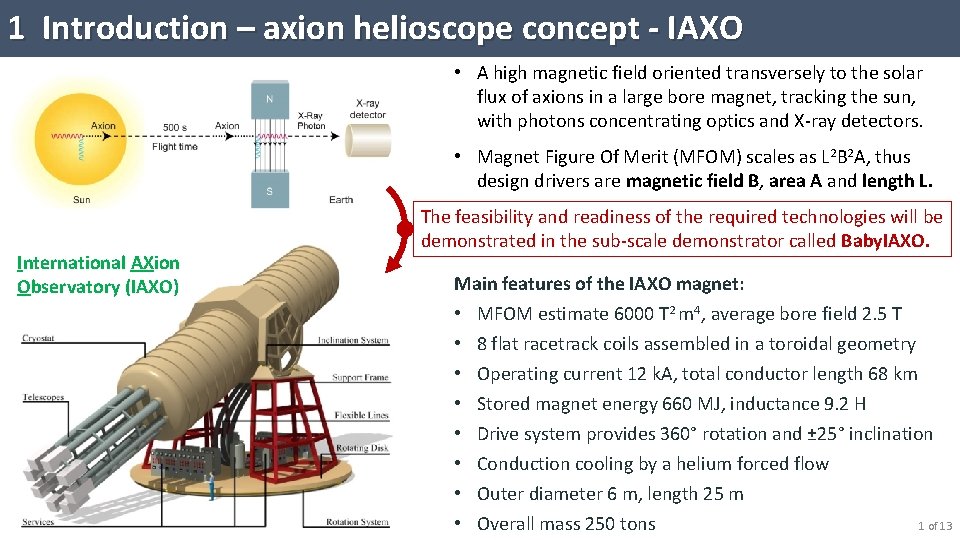
1 Introduction – axion helioscope concept - IAXO • A high magnetic field oriented transversely to the solar flux of axions in a large bore magnet, tracking the sun, with photons concentrating optics and X-ray detectors. • Magnet Figure Of Merit (MFOM) scales as L 2 B 2 A, thus design drivers are magnetic field B, area A and length L. International AXion Observatory (IAXO) The feasibility and readiness of the required technologies will be demonstrated in the sub-scale demonstrator called Baby. IAXO. Main features of the IAXO magnet: • • MFOM estimate 6000 T 2 m 4, average bore field 2. 5 T 8 flat racetrack coils assembled in a toroidal geometry Operating current 12 k. A, total conductor length 68 km Stored magnet energy 660 MJ, inductance 9. 2 H Drive system provides 360° rotation and ± 25° inclination Conduction cooling by a helium forced flow Outer diameter 6 m, length 25 m 1 of 13 Overall mass 250 tons
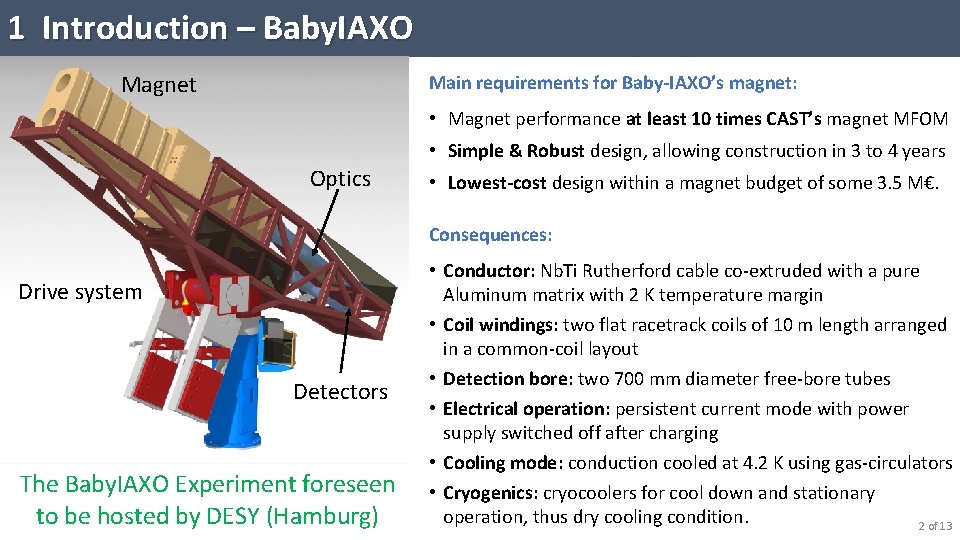
1 Introduction – Baby. IAXO Magnet Main requirements for Baby-IAXO’s magnet: • Magnet performance at least 10 times CAST’s magnet MFOM • Simple & Robust design, allowing construction in 3 to 4 years Optics • Lowest-cost design within a magnet budget of some 3. 5 M€. Consequences: Drive system Detectors The Baby. IAXO Experiment foreseen to be hosted by DESY (Hamburg) • Conductor: Nb. Ti Rutherford cable co-extruded with a pure Aluminum matrix with 2 K temperature margin • Coil windings: two flat racetrack coils of 10 m length arranged in a common-coil layout • Detection bore: two 700 mm diameter free-bore tubes • Electrical operation: persistent current mode with power supply switched off after charging • Cooling mode: conduction cooled at 4. 2 K using gas-circulators • Cryogenics: cryocoolers for cool down and stationary operation, thus dry cooling condition. 2 of 13
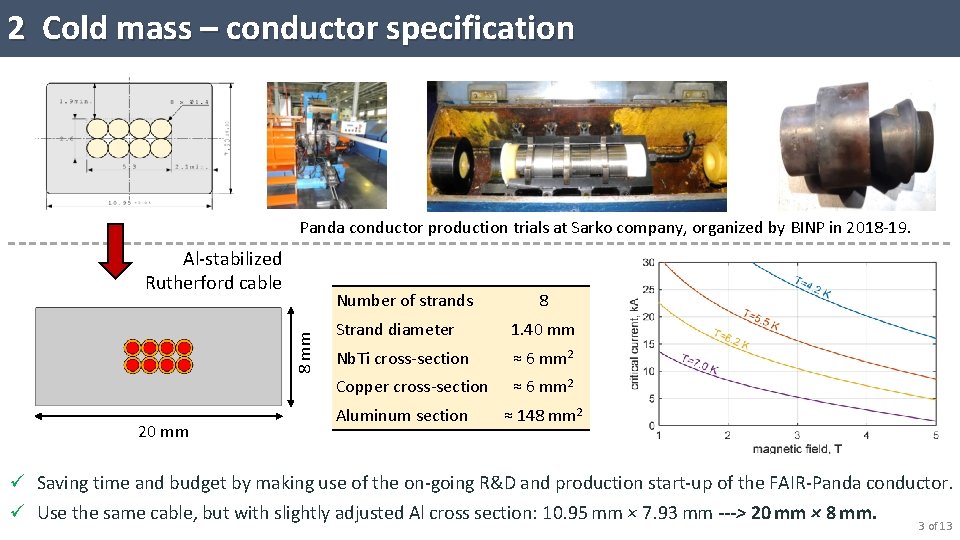
2 Cold mass – conductor specification Panda conductor production trials at Sarko company, organized by BINP in 2018 -19. Al-stabilized Rutherford cable 8 mm Number of strands 20 mm 8 Strand diameter 1. 40 mm Nb. Ti cross-section ≈ 6 mm 2 Copper cross-section ≈ 6 mm 2 Aluminum section ≈ 148 mm 2 ü Saving time and budget by making use of the on-going R&D and production start-up of the FAIR-Panda conductor. ü Use the same cable, but with slightly adjusted Al cross section: 10. 95 mm × 7. 93 mm ---> 20 mm × 8 mm. 3 of 13
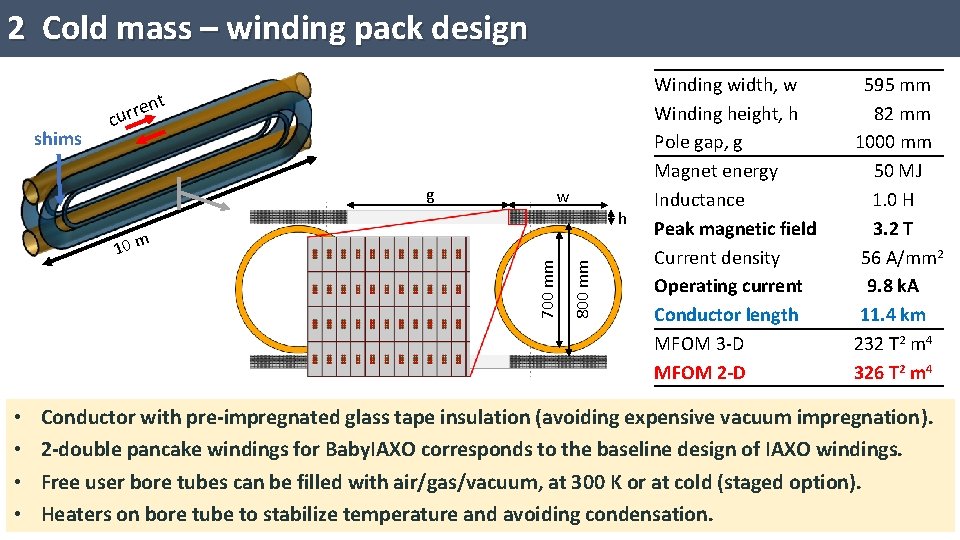
2 Cold mass – winding pack design t 10 m • • w h 800 mm g 700 mm shims en r r u c Winding width, w Winding height, h Pole gap, g Magnet energy Inductance Peak magnetic field Current density Operating current Conductor length MFOM 3 -D MFOM 2 -D 595 mm 82 mm 1000 mm 50 MJ 1. 0 H 3. 2 T 56 A/mm 2 9. 8 k. A 11. 4 km 232 T 2 m 4 326 T 2 m 4 Conductor with pre-impregnated glass tape insulation (avoiding expensive vacuum impregnation). 2 -double pancake windings for Baby. IAXO corresponds to the baseline design of IAXO windings. Free user bore tubes can be filled with air/gas/vacuum, at 300 K or at cold (staged option). Heaters on bore tube to stabilize temperature and avoiding condensation. 4 of 13
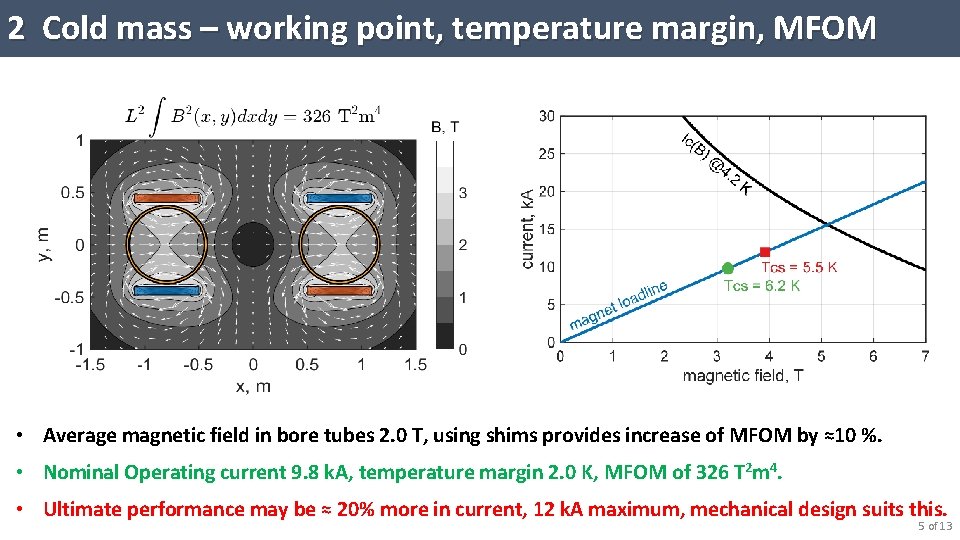
2 Cold mass – working point, temperature margin, MFOM • Average magnetic field in bore tubes 2. 0 T, using shims provides increase of MFOM by ≈10 %. • Nominal Operating current 9. 8 k. A, temperature margin 2. 0 K, MFOM of 326 T 2 m 4. • Ultimate performance may be ≈ 20% more in current, 12 k. A maximum, mechanical design suits this. 5 of 13
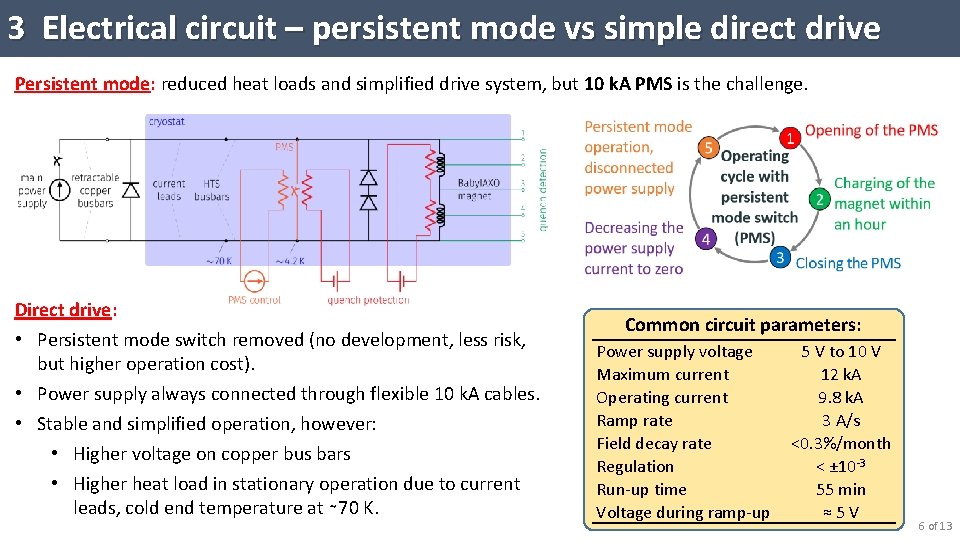
3 Electrical circuit – persistent mode vs simple direct drive Persistent mode: reduced heat loads and simplified drive system, but 10 k. A PMS is the challenge. Direct drive: • Persistent mode switch removed (no development, less risk, but higher operation cost). • Power supply always connected through flexible 10 k. A cables. • Stable and simplified operation, however: • Higher voltage on copper bus bars • Higher heat load in stationary operation due to current leads, cold end temperature at ∼ 70 K. Common circuit parameters: Power supply voltage Maximum current Operating current Ramp rate Field decay rate Regulation Run-up time Voltage during ramp-up 5 V to 10 V 12 k. A 9. 8 k. A 3 A/s <0. 3%/month < ± 10 -3 55 min ≈ 5 V 6 of 13
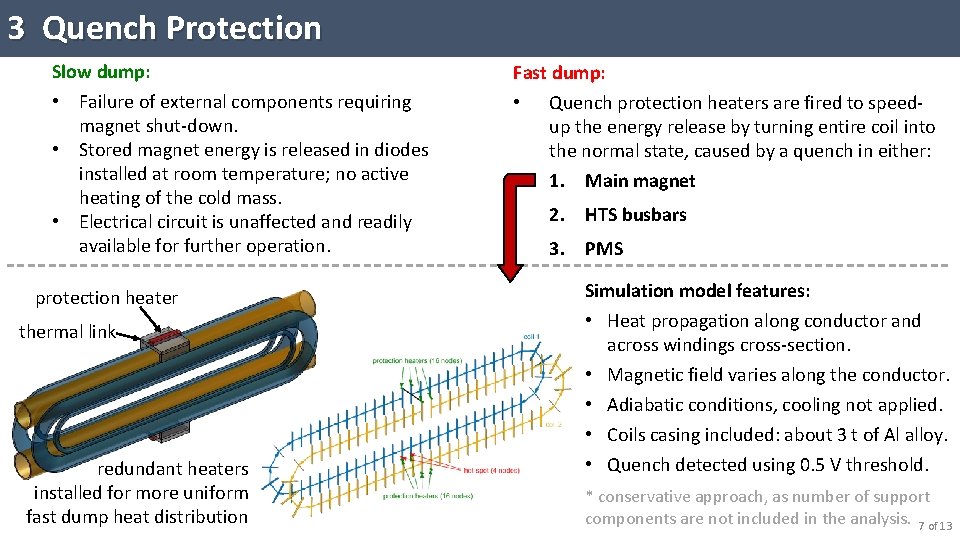
3 Quench Protection Slow dump: Fast dump: • Failure of external components requiring magnet shut-down. • Stored magnet energy is released in diodes installed at room temperature; no active heating of the cold mass. • Electrical circuit is unaffected and readily available for further operation. • protection heater thermal link redundant heaters installed for more uniform fast dump heat distribution Quench protection heaters are fired to speedup the energy release by turning entire coil into the normal state, caused by a quench in either: 1. Main magnet 2. HTS busbars 3. PMS Simulation model features: • Heat propagation along conductor and across windings cross-section. • Magnetic field varies along the conductor. • Adiabatic conditions, cooling not applied. • Coils casing included: about 3 t of Al alloy. • Quench detected using 0. 5 V threshold. * conservative approach, as number of support components are not included in the analysis. 7 of 13
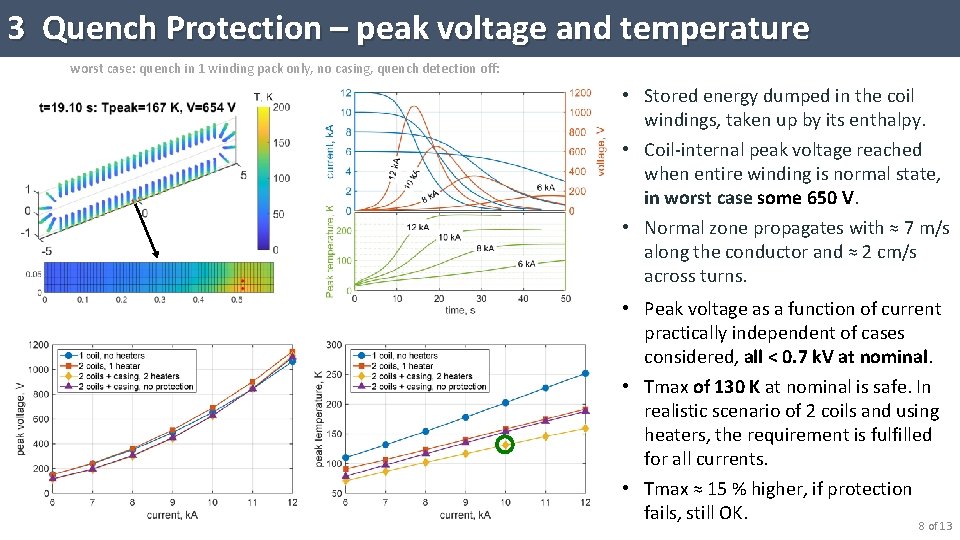
3 Quench Protection – peak voltage and temperature worst case: quench in 1 winding pack only, no casing, quench detection off: • Stored energy dumped in the coil windings, taken up by its enthalpy. • Coil-internal peak voltage reached when entire winding is normal state, in worst case some 650 V. • Normal zone propagates with ≈ 7 m/s along the conductor and ≈ 2 cm/s across turns. • Peak voltage as a function of current practically independent of cases considered, all < 0. 7 k. V at nominal. • Tmax of 130 K at nominal is safe. In realistic scenario of 2 coils and using heaters, the requirement is fulfilled for all currents. • Tmax ≈ 15 % higher, if protection fails, still OK. 8 of 13
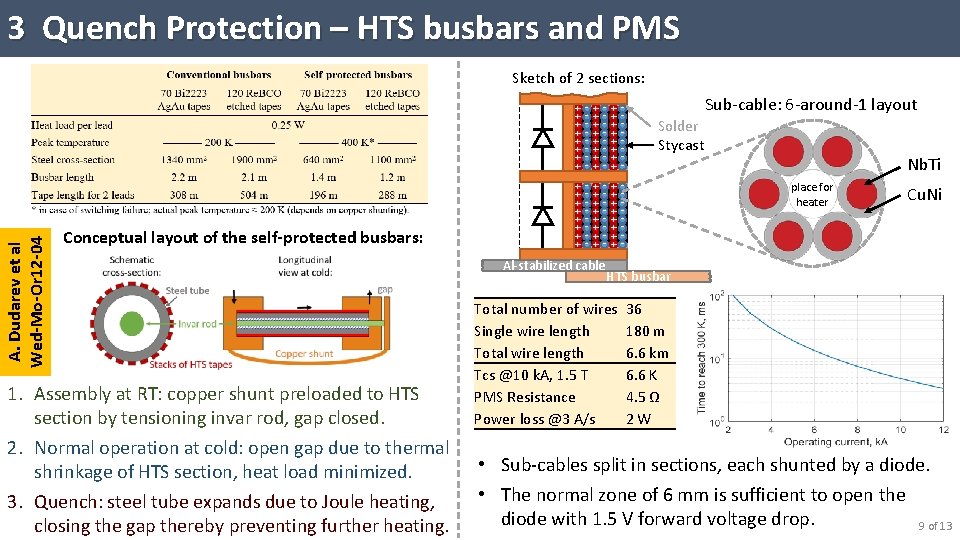
3 Quench Protection – HTS busbars and PMS A. Dudarev et al Wed-Mo-Or 12 -04 Sketch of 2 sections: Conceptual layout of the self-protected busbars: 1. Assembly at RT: copper shunt preloaded to HTS section by tensioning invar rod, gap closed. 2. Normal operation at cold: open gap due to thermal shrinkage of HTS section, heat load minimized. 3. Quench: steel tube expands due to Joule heating, closing the gap thereby preventing further heating. + + + + + + + + - + + + + - Al-stabilized cable Sub-cable: 6 -around-1 layout Solder Stycast Nb. Ti place for heater Cu. Ni HTS busbar Total number of wires Single wire length Total wire length Tcs @10 k. A, 1. 5 T PMS Resistance Power loss @3 A/s 36 180 m 6. 6 km 6. 6 K 4. 5 Ω 2 W • Sub-cables split in sections, each shunted by a diode. • The normal zone of 6 mm is sufficient to open the diode with 1. 5 V forward voltage drop. 9 of 13
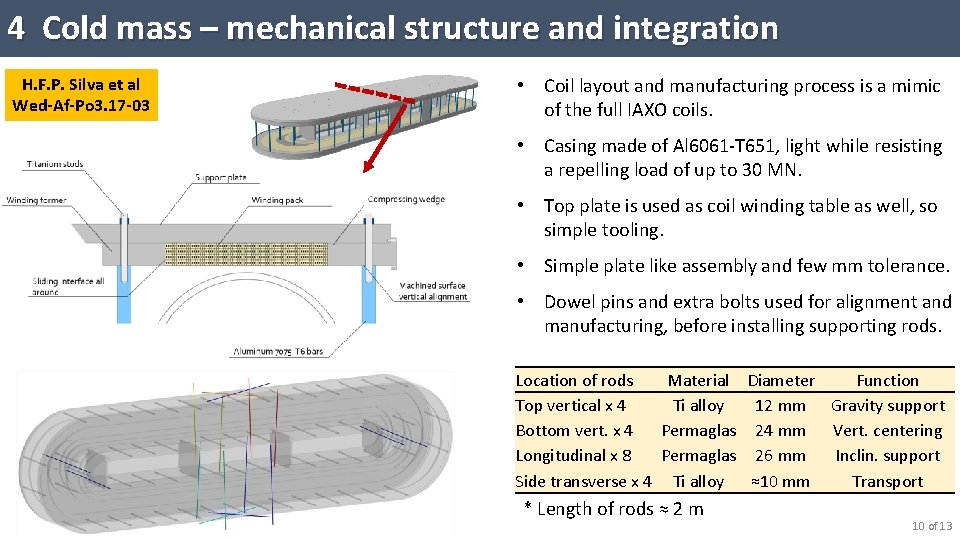
4 Cold mass – mechanical structure and integration H. F. P. Silva et al Wed-Af-Po 3. 17 -03 • Coil layout and manufacturing process is a mimic of the full IAXO coils. • Casing made of Al 6061 -T 651, light while resisting a repelling load of up to 30 MN. • Top plate is used as coil winding table as well, so simple tooling. • Simple plate like assembly and few mm tolerance. • Dowel pins and extra bolts used for alignment and manufacturing, before installing supporting rods. Location of rods Material Diameter Function Top vertical x 4 Ti alloy 12 mm Gravity support Bottom vert. x 4 Permaglas 24 mm Vert. centering Longitudinal x 8 Permaglas 26 mm Inclin. support Side transverse x 4 Ti alloy ≈10 mm Transport * Length of rods ≈ 2 m 10 of 13
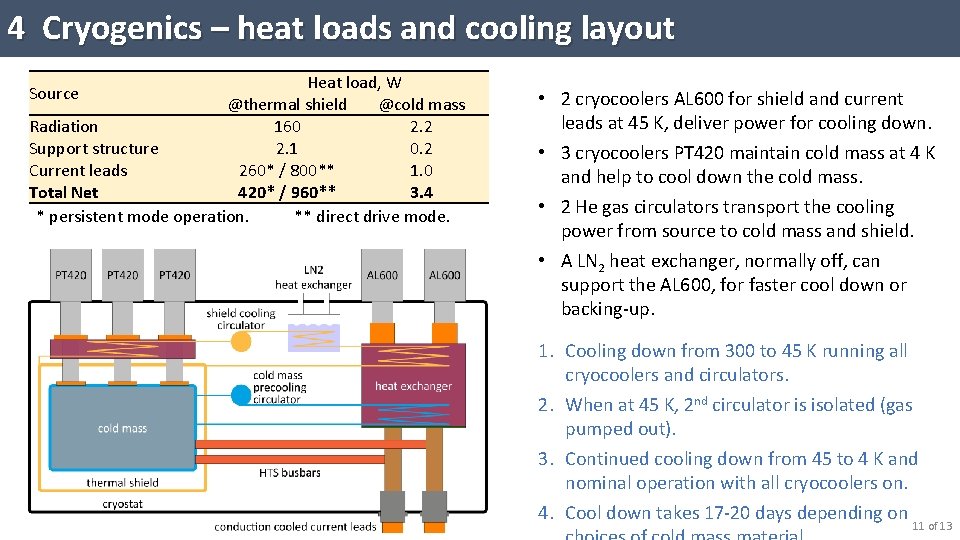
4 Cryogenics – heat loads and cooling layout Heat load, W @thermal shield @cold mass Radiation 160 2. 2 Support structure 2. 1 0. 2 Current leads 260* / 800** 1. 0 Total Net 420* / 960** 3. 4 * persistent mode operation. ** direct drive mode. Source • 2 cryocoolers AL 600 for shield and current leads at 45 K, deliver power for cooling down. • 3 cryocoolers PT 420 maintain cold mass at 4 K and help to cool down the cold mass. • 2 He gas circulators transport the cooling power from source to cold mass and shield. • A LN 2 heat exchanger, normally off, can support the AL 600, for faster cool down or backing-up. 1. Cooling down from 300 to 45 K running all cryocoolers and circulators. 2. When at 45 K, 2 nd circulator is isolated (gas pumped out). 3. Continued cooling down from 45 to 4 K and nominal operation with all cryocoolers on. 4. Cool down takes 17 -20 days depending on 11 of 13
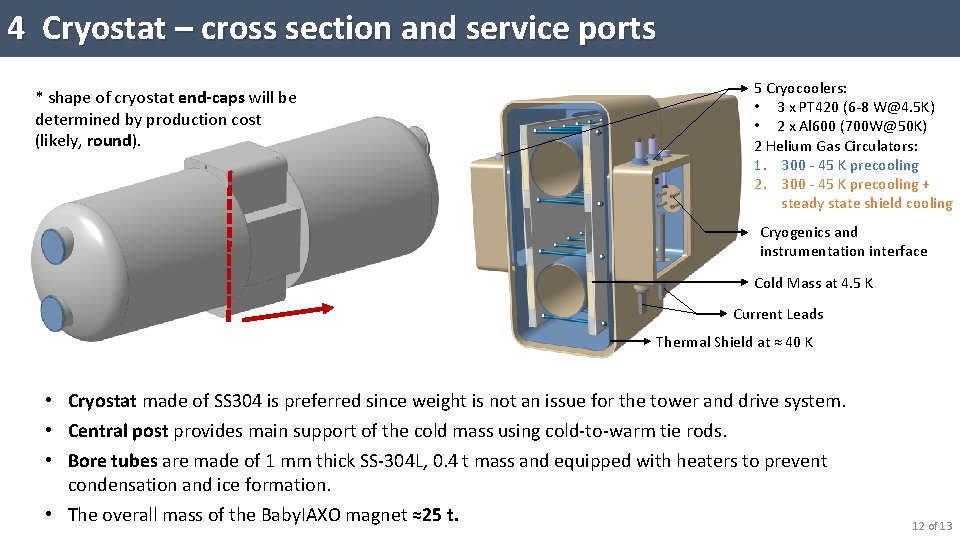
4 Cryostat – cross section and service ports * shape of cryostat end-caps will be determined by production cost (likely, round). 5 Cryocoolers: • 3 x PT 420 (6 -8 W@4. 5 K) • 2 x Al 600 (700 W@50 K) 2 Helium Gas Circulators: 1. 300 - 45 K precooling 2. 300 - 45 K precooling + steady state shield cooling Cryogenics and instrumentation interface Cold Mass at 4. 5 K Current Leads Thermal Shield at ≈ 40 K • Cryostat made of SS 304 is preferred since weight is not an issue for the tower and drive system. • Central post provides main support of the cold mass using cold-to-warm tie rods. • Bore tubes are made of 1 mm thick SS-304 L, 0. 4 t mass and equipped with heaters to prevent condensation and ice formation. • The overall mass of the Baby. IAXO magnet ≈25 t. 12 of 13
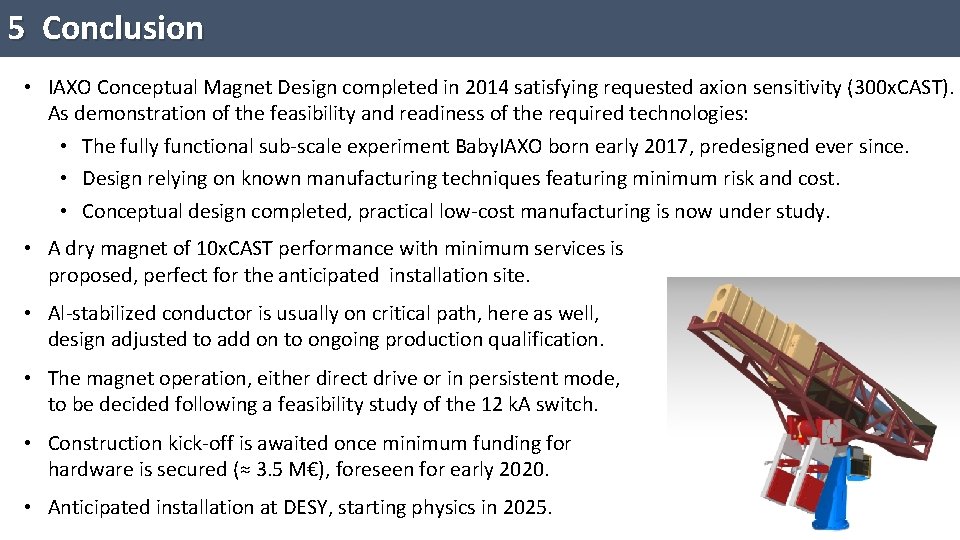
5 Conclusion • IAXO Conceptual Magnet Design completed in 2014 satisfying requested axion sensitivity (300 x. CAST). As demonstration of the feasibility and readiness of the required technologies: • The fully functional sub-scale experiment Baby. IAXO born early 2017, predesigned ever since. • Design relying on known manufacturing techniques featuring minimum risk and cost. • Conceptual design completed, practical low-cost manufacturing is now under study. • A dry magnet of 10 x. CAST performance with minimum services is proposed, perfect for the anticipated installation site. • Al-stabilized conductor is usually on critical path, here as well, design adjusted to add on to ongoing production qualification. • The magnet operation, either direct drive or in persistent mode, to be decided following a feasibility study of the 12 k. A switch. • Construction kick-off is awaited once minimum funding for hardware is secured (≈ 3. 5 M€), foreseen for early 2020. • Anticipated installation at DESY, starting physics in 2025. 13 of 13
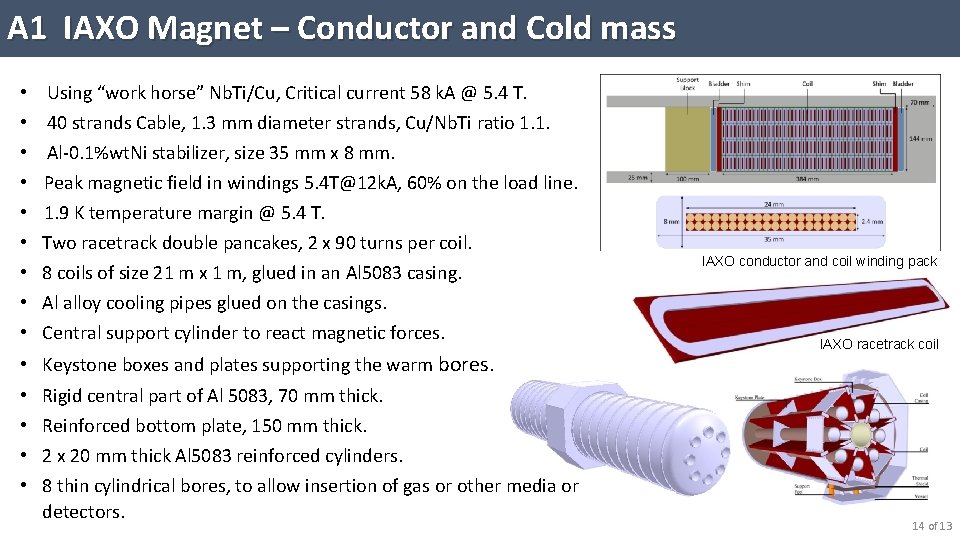
A 1 IAXO Magnet – Conductor and Cold mass • • • • Using “work horse” Nb. Ti/Cu, Critical current 58 k. A @ 5. 4 T. 40 strands Cable, 1. 3 mm diameter strands, Cu/Nb. Ti ratio 1. 1. Al-0. 1%wt. Ni stabilizer, size 35 mm x 8 mm. Peak magnetic field in windings 5. 4 T@12 k. A, 60% on the load line. 1. 9 K temperature margin @ 5. 4 T. Two racetrack double pancakes, 2 x 90 turns per coil. 8 coils of size 21 m x 1 m, glued in an Al 5083 casing. Al alloy cooling pipes glued on the casings. Central support cylinder to react magnetic forces. Keystone boxes and plates supporting the warm bores. Rigid central part of Al 5083, 70 mm thick. Reinforced bottom plate, 150 mm thick. 2 x 20 mm thick Al 5083 reinforced cylinders. 8 thin cylindrical bores, to allow insertion of gas or other media or detectors. IAXO conductor and coil winding pack IAXO racetrack coil 14 of 13
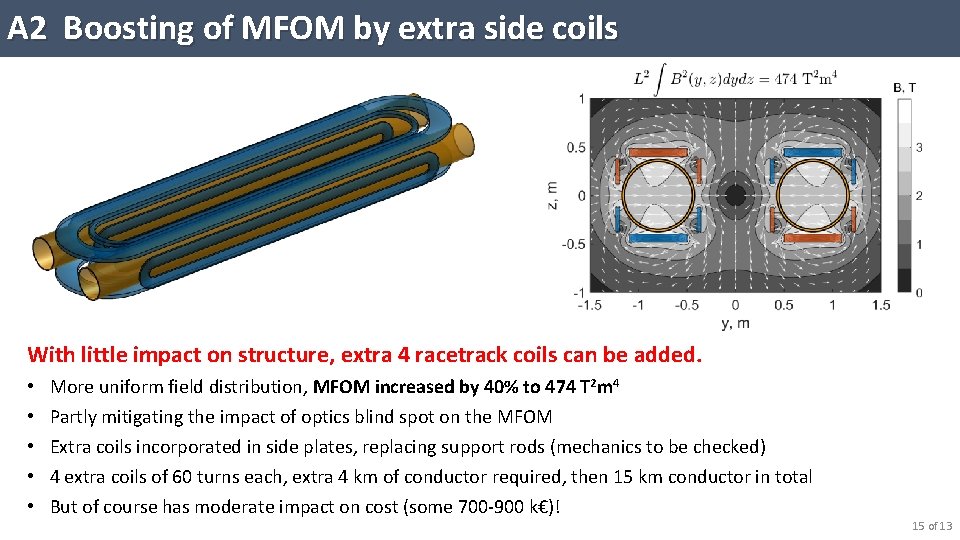
A 2 Boosting of MFOM by extra side coils With little impact on structure, extra 4 racetrack coils can be added. • • • More uniform field distribution, MFOM increased by 40% to 474 T 2 m 4 Partly mitigating the impact of optics blind spot on the MFOM Extra coils incorporated in side plates, replacing support rods (mechanics to be checked) 4 extra coils of 60 turns each, extra 4 km of conductor required, then 15 km conductor in total But of course has moderate impact on cost (some 700 -900 k€)! 15 of 13
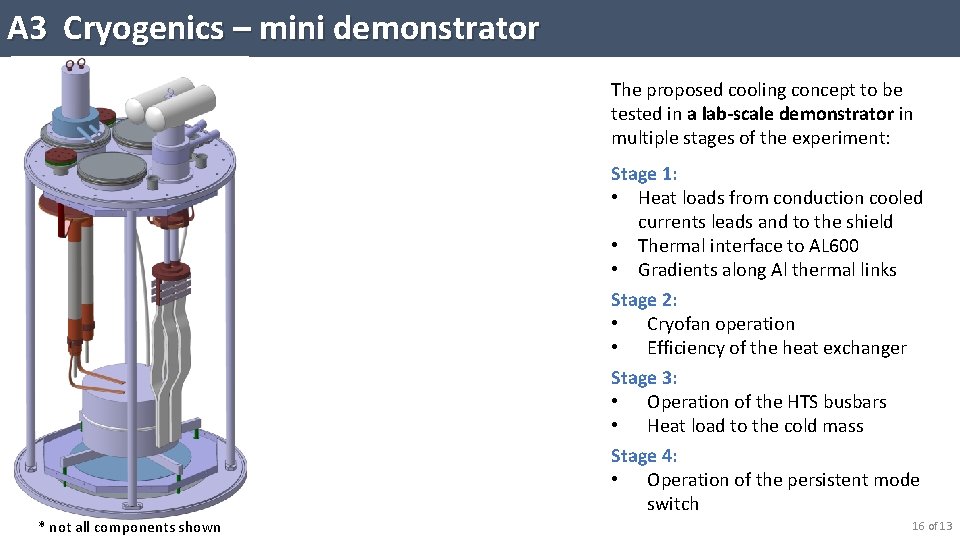
A 3 Cryogenics – mini demonstrator The proposed cooling concept to be tested in a lab-scale demonstrator in multiple stages of the experiment: Stage 1: • Heat loads from conduction cooled currents leads and to the shield • Thermal interface to AL 600 • Gradients along Al thermal links Stage 2: • Cryofan operation • Efficiency of the heat exchanger Stage 3: • Operation of the HTS busbars • Heat load to the cold mass Stage 4: • Operation of the persistent mode switch * not all components shown 16 of 13
- Slides: 17