
Design of Survey Questionnares By Dr Ravindra Pratap
Design of Survey Questionnares By Dr. Ravindra Pratap Gupta
ISSUED IN PUBLIC INTEREST Advisable “All material in slides need not be understood. Use your current working environment and experience to relate to situations. Errors and omissions regrettable. Subject to corrections on Being brought to notice”
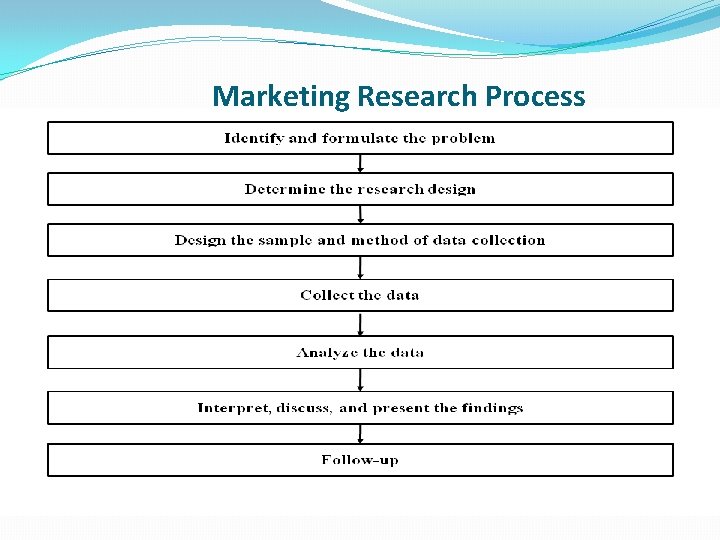
Marketing Research Process
What is a Questionnaire? � A method of data collection where a formal set of questions are arranged sequentially to collect information. � An instrument (form) to � Collect answers to questions � Collect factual data -gathers information or measures � This method can be used for exploratory, descriptive or experimental studies
The Basic Categories of Information to be Sought: 1. Attributes: � Refer to personal or demographic characteristics. � Some of the most frequently requested attributes are age, sex, marital status, education, occupation, income, etc. 2. Attitude: � Questions are evaluative and reflect the respondent’s views about the desirability of something. 3. Beliefs: � Are assessments of what a person thinks is true or false. � These questions are designed to elicit people’s perceptions of past, present, or future reality. 4. Behaviours: � Questions elicit people’s beliefs about their behaviour, and may be concerned with what they have done in the past, what they are currently doing, or what they plan to do in the future ( eg smoking ).
Advantages of Questionnaires � Can reach a large number of people relatively easily and economically � Provide quantifiable answers � Relatively easy to analyse
Disadvantages of Questionnaires � Provides only limited insight into problem � Limited response allowed by questions � Maybe not the right questions are asked � Varying response � Misunderstanding/misinterpretation � Need to get it right first time � Hard to chase after missing data
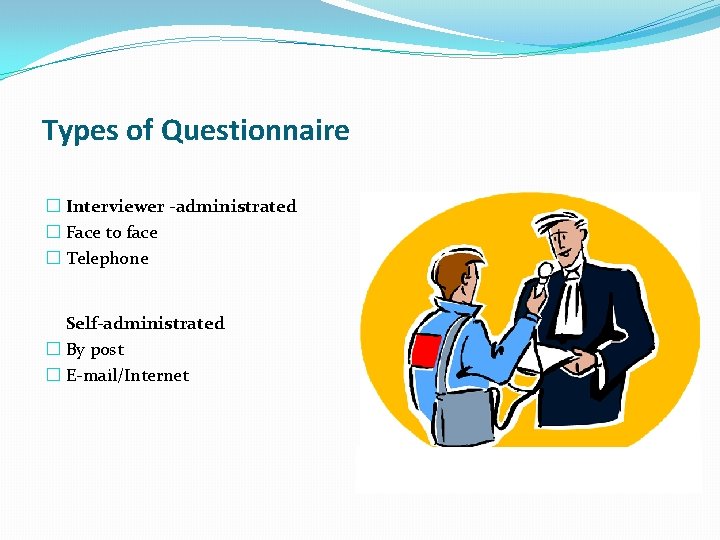
Types of Questionnaire � Interviewer -administrated � Face to face � Telephone Self-administrated � By post � E-mail/Internet
Interviewer-administered Questionnaire � Advantages: � Quick answers � Clarification of ambiguity � Seeks responses with better precision � Disadvantages: � Interviewer bias � Needs more resources � Only short questionnaires possible Especially on telephone � Difficult for sensitive issues �
Self-administered questionnaire � Advantages: � Cheap and easy to administer � Preserves confidentiality � Completed at respondent's convenience � No influence by interviewer � Disadvantages: � Low response rate � Questions can be misunderstood � No control by interviewer � Time and resouces loss
Questionnaire Design § Questionnaire design is a systematic process in which the researcher contemplates various question formats considers a number of factors characterizing the survey at hand ultimately words the various questions very carefully, and organizes the questionnaire’s layout.
Design a questionnaire: Most of market research’s factual information becomes the requirement for planning and implementing strategies. Thus the investigator should have a clear idea about what, why, where and how to collect information and this requires thorough knowledge of main facets of making a questionnaire. Considerations for constructing a questionnaire thus include • • Type of data Cost Time Effort Degree of accuracy
A Well defined Questionnaire Purpose � Gives accurate and relevant information to your research question � Minimises potential sources of bias � Will more likely be completed Keep ⇒ As simple and focused as possible
What Makes A Well Designed Questionnaire? � Good appearance ® easy on the eye � Short and simple � Relevant and logical ⇒ High response rate ⇒ Easy data summarisation and analysis
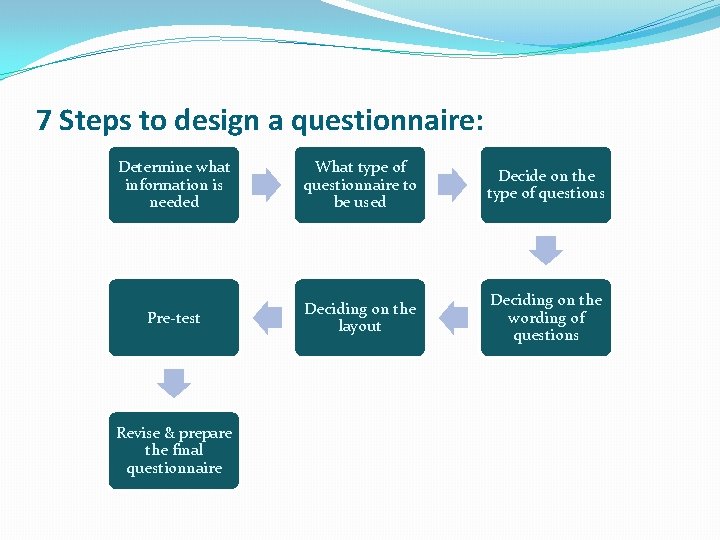
7 Steps to design a questionnaire: Determine what information is needed What type of questionnaire to be used Decide on the type of questions Pre-test Deciding on the layout Deciding on the wording of questions Revise & prepare the final questionnaire
Step-1: Determine what information is needed � The purpose is to � Explore what work has been done on the same or similar problems in the past � What factors have not yet been examined � How the present questionnaire can be build on what has already been discovered � What are things that are required to know from the respondent in order to meet the study objectives � At this stage information required and scope of the research should be cleared.
Example � Memory of events depends on � Importance of events and � Whether it is necessary for the respondents to remember � Suppose a gifting solutions company wants to study the preferred festive or special occasions anniversary/ birthday gift choice to determine what such gift it can design to give to its top customers. � It can collect information on ones easily remembered over years than others that have faded memories accordingly can work out the questionnaire
Step-2: What type of questionnaire to be used � Structured and Non-disguised � Structured and Disguised � Non-structured and Non-disguised
Structured and Non-disguised Questionnaire � Questions are structured so as to obtain the facts. The interviewer will ask the questions strictly in accordance with the prearranged order. � The purpose of the questionnaire is known to the respondent � Easy to administer coding, tabulating is easy. � Example: What are the Strengths of soap A in comparison with soap B � � � Cost is less Lasts Longer Better Fragrance Produces more lather Available in more convenient sizes � The researcher wants the respondent to choose one of the five options given above. The respondents have no difficulty in answering , because it is structured, the frame of reference is obvious. � Questions are provided with exactly the same wording and same order to all respondents. The reason for standardizing the question is to ensure that all respondents reply the same question � Inappropriate when the researcher wants to probe deeper. � Widely used in market research.
Structured and Disguised � This type of questionnaire is used to know the peoples attitude when an undisguised question produces a bias. � In a disguised type the respondent is not informed of the purpose of the questionnaire. Here the purpose is to hide “what is expected from the respondent? ” � In this type of questionnaire what comes out is “ “what does the respondent know” rather than what he feels. � Administering the questionnaire and post administration work is simple i. e. coding and tabulating etc is easy. � Example 1: � What is the current status of the “Office of Profit” Bill ? � In the Lok Sabha for approval. � Approved by the Lok Sabha and pending in the Rajya Sabha. � Passed by both the Houses, pending the Presidential approval. � The bill is being passed by the President. � Example 2: “What do you think about the Babri Masjid demolition? ” � Depending upon which answer the respondent chooses, his knowledge on the subject is classified. � Least used in market research
Non-structured and Disguised � The main objective is to conceal the topic of inquiry by using a disguised stimulus. � Though the stimulus is standardized by the researcher, the respondent is allowed to answer in an unstructured manner. � This is difficult to analyse, code etc. � The assumption made here is that individual's reaction is an indication of respondent’s basic perception. � Projective techniques are examples of non-structured disguised technique. � The techniques involve the use of a vague stimulus, which an individual is asked to expand or describe or build a story. � Three common types under this category are � Word association � Sentence completion � Story telling � This type of questionnaire is very commonly used for focus group interviews.
Non-structured and Non-disguised � Here the purpose of the study is clear but the responses to the question are open-ended. � The initial part of the question is consistent. After presenting the initial question, the interview becomes very unstructured as the interviewer probes more deeply. Subsequent answers by the respondents determines the direction the interviewer takes next. � The question asked by the interviewer varies from person to person. This method is called the depth interview. � Example � “How do you feel about the Cyber Law currently in practice and its need for further modification? ” � “Tell me something about your experience in this hospital? ” � The major advantage of this method is the freedom permitted to the interviewer. . This type of interviewing is extremely helpful in exploratory studies. � Major disadvantage is it takes time and the respondent may not cooperate. Other disadvantage is the coding of open ended questions may pose a challenge. � Not a very frequently used method
Step-3: Decide on the type of questions � Open ended questions � Dichotomous question � Close ended questions
Open-ended Questions: � These are questions where respondents are free to answer in their own words example “what factor do you consider while buying a suit “? � If multiple choices are given , it could be colour, price, style, brand , etc. , but some responds may mention attributes which may not occur to researcher. � Open ended questions are useful in exploratory research, where all possible alternatives are explored. � The greatest disadvantage of open ended questions is that the researcher has to note down the answer of the respondents verbatim. Therefore, there is a likelihood of the researcher failing to record some information. � Another problem with open ended question is that the responder may not use the same frame of reference. � Example : � “what is the most attractive attribute in a job? ” � Ans: The respondent may get "basic pay “ but interviewer may think that the respondent is talking about “total pay including dearness allowance and incentive”. � Since both of them refer to pay, it is impossible to separate two different frames.
Dichotomous Question: � These questions have only answers , yes or no , true or false , use or do not use � Do you use toothpaste? Yes…. . no……. . � There is no third answer. � However sometimes , there can be a third answer “do you like to watch movies ? ” � Ans : neither like nor dislike. � Dichotomous questions are most convenient and easy to answer. � A major disadvantage of dichotomous question is that it limits the respondent’s response. This may lead to measurement error.
Close-ended questions are structured questions � There are two basic formats in this type � 1. Make one or more choices among the alternatives � 2. Rate the alternatives � Choice among alternatives � Which of the following word or phrases best describes the kind of person you feel would be most likely to use this product, based on what you have seen in the commercial? � Young……. . Old……. . � Single…………. Married ……… � Modern……old fashioned……. .
![� Rating scale � I] Please tell us your overall reaction to this commercial?](http://slidetodoc.com/presentation_image_h2/5b311d39726c483dc50700d3c4036685/image-27.jpg "� Rating scale � I] Please tell us your overall reaction to this commercial?")
� Rating scale � I] Please tell us your overall reaction to this commercial? � 1] a great commercial , would like to see again � 2] just so-so , like other commercials � 3] another bad commercial � 4] pretty good commercial � Ii] based on what you saw in the commercial , how interested do you feel, you would be buying the products ? � 1] definitely � 2] probably I would buy � 3 ] I may or may not buy � 4] probably I would not buy � 5] definitely I would not buy
� Closed ended questionnaires are easy to answer. it requires less effort on the part of the interviewer. � Tabulation and analysis is easier. There are fewer errors, since the same questions are asked to everyone � The time taken to respond is lesser. We can compare the answer of one respondent to another respondent. � One basic criticism of close ended questionnaires is that middle alternatives are not included in this , such as “don’t know “. this will force the respondents to choose among the given alternative.
Step-4: Decide on the wording of questions � Wordings of particular questions could have a large impact on how the respondent interprets them, even a small shift in the wording could alter the respondents answer � Example 1 : Don’t you think that Brazil played poorly in the FIFA Cup ? The answer will be yes. many of them , who do not have any idea about the game , will also most likely say yes. � If the question is worded in a slightly different manner , the response will be different. � Example 2: Do you think that brazil played poorly in the FIFA Cup? This is a straightforward question. the answer could be yes , no or don’t know depending on the knowledge the respondents have about the game.
� Change of just one word, can generate different responses by respondents � Example 3: “Do you think anything should be done to make it easier for the people to pay their electric bill, phone bill, water bill under one roof ? � Example 4: “Don’t you think anything should be done to make it easier for the people to pay their electric bill , phone bill, water bill under one roof ? � Guidelines towards the use of correct wording: � Is the vocabulary simple and familiar to the respondents? � Example : Instead of using the word ‘reasonably’, ‘usually’ , ’ generally’ , on the whole. � Example : How often do you go to a movie ? often, may be once a week, once a month, once in two months or even more.
Avoid double barrelled questions � There are question in which the respondent can agree with one part of the question but not with the other or cannot answer without making a particular assumption. � Example 1: Do you feel the firms today are employee-oriented and customer –oriented ? � There are two separate issues here. . . [Yes or no] � Example 2 : “Are you happy with the price and quality of branded shampoos? ” [ yes or no]
� Avoid leading and loading questions � leading questions: � A leading question is the one that suggest answer to the respondent � The question itself will influence the answer, when respondent give the idea that the data is being collected by a company. the respondents have the tendency to answer positively. � Example 1 : How do you like the programme on Radio Mirchi ? the answer is likely to be yes � The unbiased way of asking is “which is your favourite FM radio station. The answer could be any of the four station namely � 1 Radio City 2 Mirchy 3 Rainbow 4 Radio-One � Example 2 ; Do you think that offshore drilling for oil is environmentally unsound. the most probable response is yes. � The same question can be modified to eliminate the leading factor. � What is your feeling about the environmental impact of offshore drilling for oil? give choices as follows : � 1] Offshore drilling is environmentally sound. � 2] Offshore drilling is environmentally unsound � 3] no opinion
� Loaded questions : A leading question is also known as a loaded question. � In a loaded question, special emphasis is given to a word or a phrase, which acts as a lead to respondent. � Example : � “Do you own a Kelvinator refrigerator “. � A better question would be “what brand of refrigerator do you own ? � “ Don’t you think the civic body is incompetent “. � Here the word incompetent is loaded.
Avoid implicit assumptions � An implicit opinion is one which is not expressed in the options. Consider the following two questions � Would you like to have a job if available? � Would you prefer to have a job, or do you prefer to do just domestic work � Even though we may say that these questions look similar, they vary widely. � The difference is that question 2 makes explicit the alternative implied in question 1.
Split ballot technique � This is a procedure used wherein � The question is split into two halves and � Different sequencing of questions is administered to each half. � There are occasions when a single version of question is not derived the correct answer and the choice is not obvious to respondent. � Example: “why do you use ayurvedic soap”? � One respondent might say “ayurvedic soap is better for skin care”. � Other might say “because the dermatologist has recommended. � The third respondent “the family tradition for using”. � As can be seen, different reference frames are used. The question may be balanced and rephrased.
Complex questions � In which of the following do you like to park your liquid funds � Debenture � Preferential shares � Equity linked M. F. � I. P. O. � Fixed deposit � If this question is posed to the general public, they may not know the meaning of liquid funds? � Most of the respondents will guess and tick one of them
Are the questions too long? � Generally as a thumb rule , it is advisable to keep the number of words in a question not exceeding 20. � The question given below is too long for the respondent to comprehend, leave alone answer � Examples : � Do you accept that the people whom you know , and associate yourself have been receiving ESI AND P. F benefits from the government accept a reduction in those benefits , with a view to cut down government expenditure, to provide more resources for infrastructural development? � yes……… no……………… can’t say………………
Participation at the expense of accuracy � Sometimes the respondent may not have the information that is needed by the researcher. � Example 1: the husband is asked a question “how much does your family spend on groceries in a week “? � Unless the respondent does the grocery shopping himself, he will not know how much has been spent. � In a situation like this, it will be helpful to ask a ‘filtered question’. � An example of a filtered question can be, “who buys the groceries in your family”?
Step-5: Deciding on the layout Sequence � Some guidelines for sequencing the questionnaires are as follows: � Divide the questionnaire into 3 parts � 1] basic information 2] classification 3] identification information. � Basic Information of reasons for carrying a survey etc � Items such as age, sex, income, education, etc. . , are questioned in the classification section. � The identification part involves body of questionnaire. Always move from general to specific question to the topic. � Layout � How the questionnaire looks or appears. � Example : clear instructions , gap between questions, answers and spaces are part of layout.
Use funnel approach � Funnel sequencing gets the name from its shape, starting with broad questions and progressively narrowing down the scope. � Move from general to specific examples � 1 How do you think this country is getting along in its relations with other countries ? � 2 How do you think we are doing in our relations with US? � 3 Do you think we ought to be dealing with us? � 4 If yes what should be done differently � 5 Some say that we are weak on the nuclear deal with US, while some say we are ok. What do you feel? � The first question introduces the general subject. � In the next question, a specific country is mentioned. � The third and fourth questions are asked to seek views. � The fifth question is to seek a specific opinion.
Step-6: Pre-test � Pre-testing of questionnaire is done to detect any flaws that might be present. � For example the word used by the researcher must convey the same meaning to the respondents. Are instructions clear ? � One of the fine conditions for pre testing is that the sample chosen for pre testing should be similar to the respondents who are ultimately going to participate. � Just because a few chosen respondents fill in all the questions going does not mean that the questionnaire is sound. � How many questions to be asked? � The questionnaire should not be too long as the response will be poor. � There is no rule to decide this. However the researcher should consider that if he were the respondent , how would he react to a lengthy questionnaire to a few known people to seek their opinion
Step-7: Revise & prepare final questionnaire � Final questionnaire may be prepared after pre testing the questionnaire with the small group of respondents. � Questionnaire should be revised for the following � To correct the spellings. � To place the questions in proper order to avoid the contextual bias. � To remove the words which are not familiar to respondents. � To add or remove question arise in the process of pre test, if any. � To purge the words with double meaning , etc.
Questionnaire content � Goal of the questions is to obtain the required information. � A well laid out questionnaire must have a sensible sequence of questions. � Neutral question at the beginning to build rapport. � Effective opening questions should be simple. � Sequence leading general subjects at the beginning and the more particular later on. � Questions on image, purchasing behavior and classification should all be arranged together. �Questions and responses should be clear and easy to read.
Questionnaire objective This questionnaire is a complete tool through which not only the high school students even their parents could understand what their children are thinking about their career plans.
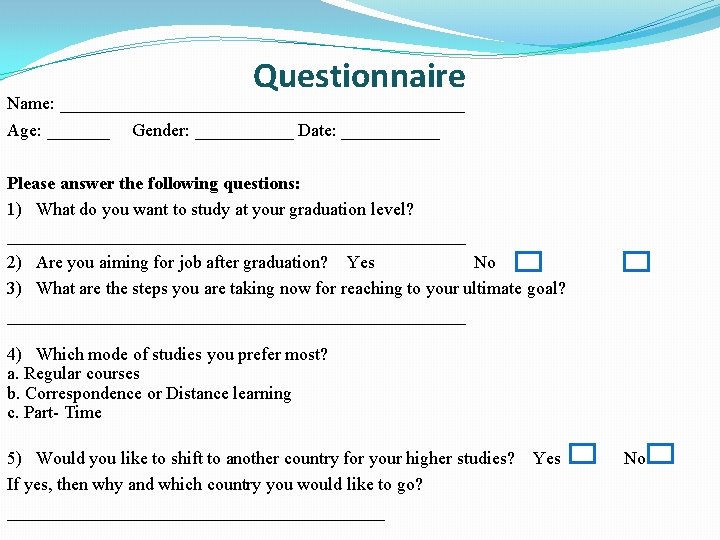
Questionnaire Name: _______________________ Age: _______ Gender: ______ Date: ______ Please answer the following questions: 1) What do you want to study at your graduation level? __________________________ 2) Are you aiming for job after graduation? Yes No 3) What are the steps you are taking now for reaching to your ultimate goal? __________________________ 4) Which mode of studies you prefer most? a. Regular courses b. Correspondence or Distance learning c. Part- Time 5) Would you like to shift to another country for your higher studies? If yes, then why and which country you would like to go? _____________________ Yes No
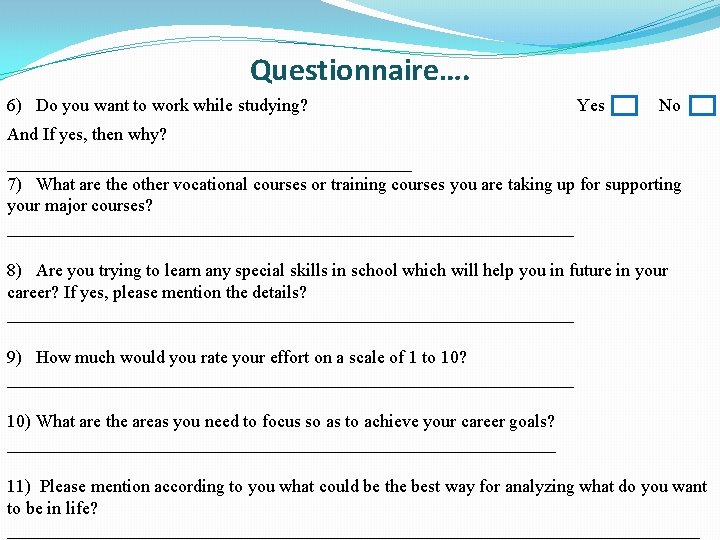
Questionnaire…. 6) Do you want to work while studying? Yes No And If yes, then why? _______________________ 7) What are the other vocational courses or training courses you are taking up for supporting your major courses? ________________________________ 8) Are you trying to learn any special skills in school which will help you in future in your career? If yes, please mention the details? ________________________________ 9) How much would you rate your effort on a scale of 1 to 10? ________________________________ 10) What are the areas you need to focus so as to achieve your career goals? _______________________________ 11) Please mention according to you what could be the best way for analyzing what do you want to be in life? _______________________________________
Question �Discuss 7 Steps to design a questionnaire?
Thanks
- Slides: 48