
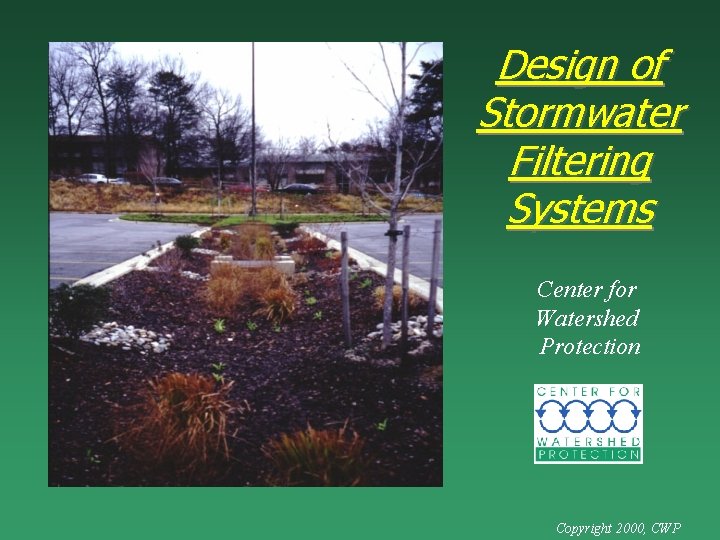
Design of Stormwater Filtering Systems Center for Watershed



![Sand Filter bed Sizing Criteria • Darcy’s Law – Af =WQV*(df)/[k*(hf + df)(tf)] where:](https://slidetodoc.com/presentation_image_h2/89b4d1b0dc72f77a8402426f28b331e2/image-32.jpg "Sand Filter bed Sizing Criteria • Darcy’s Law – Af =WQV*(df)/[k*(hf + df)(tf)] where:")
- Slides: 52
Design of Stormwater Filtering Systems Center for Watershed Protection Copyright 2000, CWP
Filtering Systems Six Design Variations • • • Surface sand filter Perimeter sand filter Organic sand filter Underground sand filter Pocket sand filter Bioretention Copyright 2000, CWP
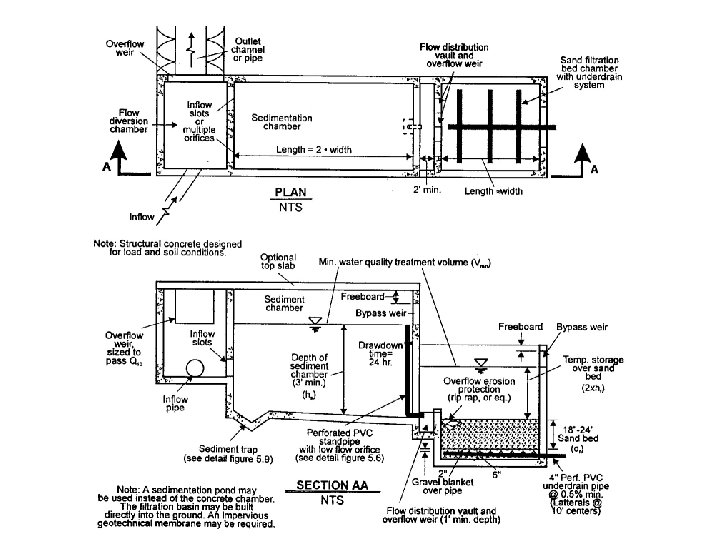
Filter System Design Components • Flow Regulation – Diversion of only water quality volume to facility • Pretreatment – Trapping of coarse sediments to extend design life • Filter Bed and Filter Media – Primary treatment component of facility • Outflow/Overflow – Safe conveyance of all storms through facility Copyright 2000, CWP
Copyright 2000, CWP
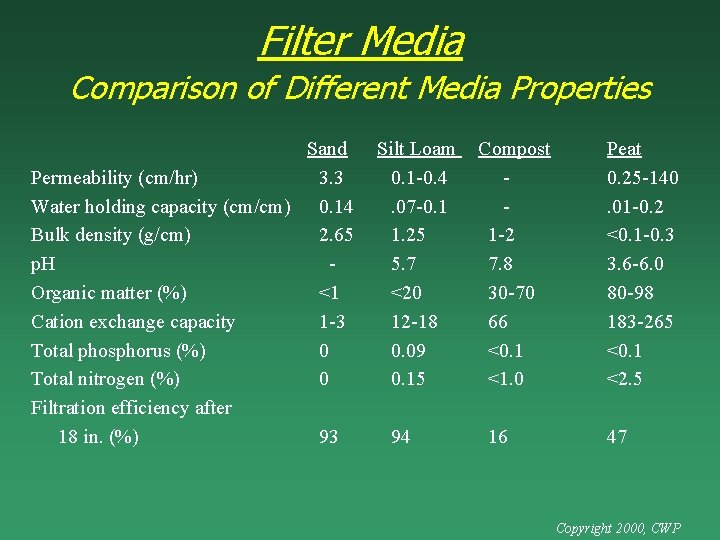
Filter Media Comparison of Different Media Properties Sand Permeability (cm/hr) 3. 3 Water holding capacity (cm/cm) 0. 14 Bulk density (g/cm) 2. 65 p. H Organic matter (%) <1 Cation exchange capacity 1 -3 Total phosphorus (%) 0 Total nitrogen (%) 0 Filtration efficiency after 18 in. (%) 93 Silt Loam 0. 1 -0. 4. 07 -0. 1 1. 25 5. 7 <20 12 -18 0. 09 0. 15 94 Compost 1 -2 7. 8 30 -70 66 <0. 1 <1. 0 16 Peat 0. 25 -140. 01 -0. 2 <0. 1 -0. 3 3. 6 -6. 0 80 -98 183 -265 <0. 1 <2. 5 47 Copyright 2000, CWP
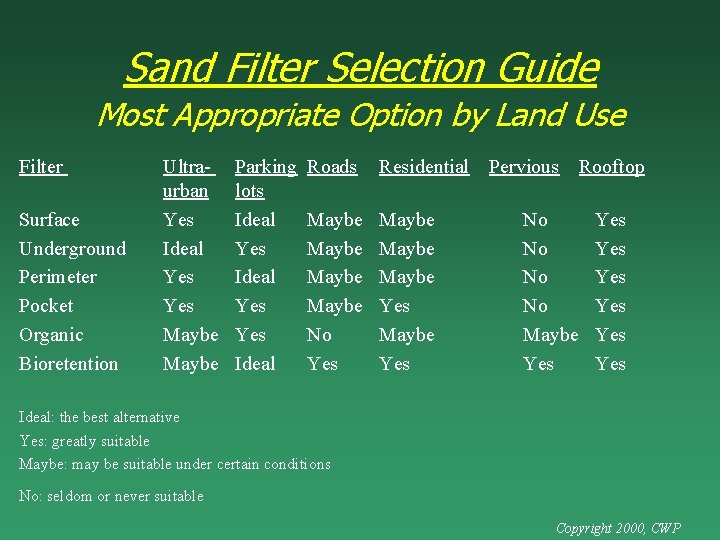
Sand Filter Selection Guide Most Appropriate Option by Land Use Filter Surface Underground Perimeter Pocket Organic Bioretention Ultraurban Yes Ideal Yes Maybe Parking lots Ideal Yes Yes Ideal Roads Residential Maybe No Yes Maybe Yes Pervious No No Maybe Yes Rooftop Yes Yes Yes Ideal: the best alternative Yes: greatly suitable Maybe: may be suitable under certain conditions No: seldom or never suitable Copyright 2000, CWP
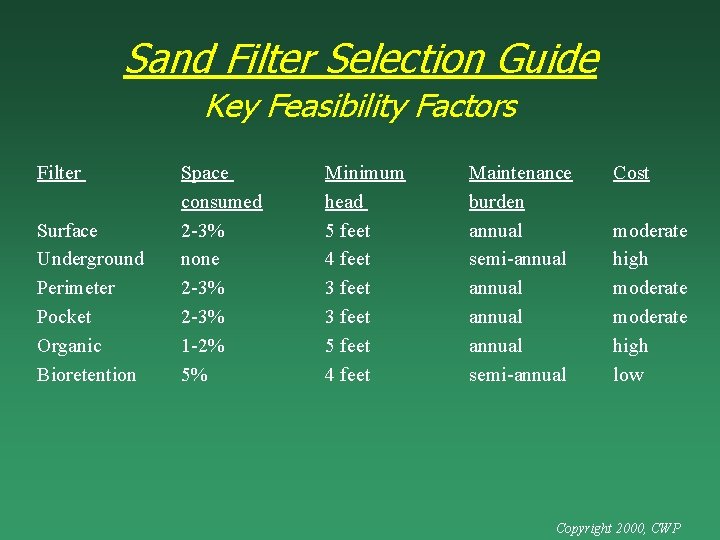
Sand Filter Selection Guide Key Feasibility Factors Filter Surface Underground Perimeter Pocket Organic Bioretention Space consumed 2 -3% none 2 -3% 1 -2% 5% Minimum head 5 feet 4 feet 3 feet 5 feet 4 feet Maintenance burden annual semi-annual Cost moderate high low Copyright 2000, CWP
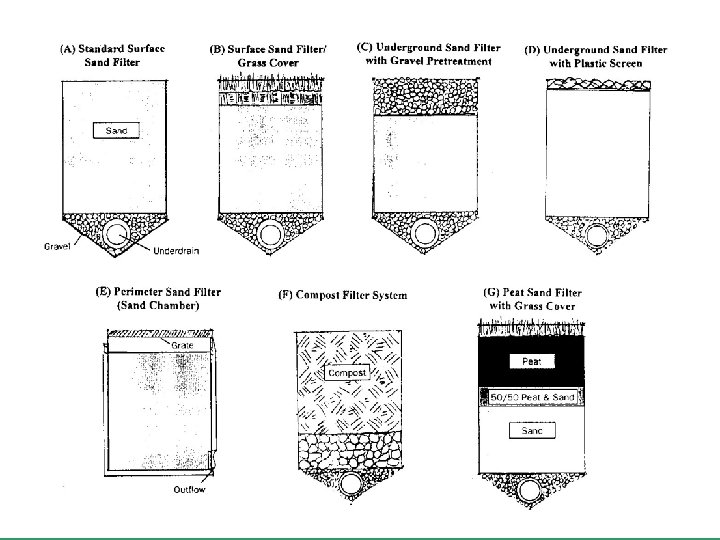
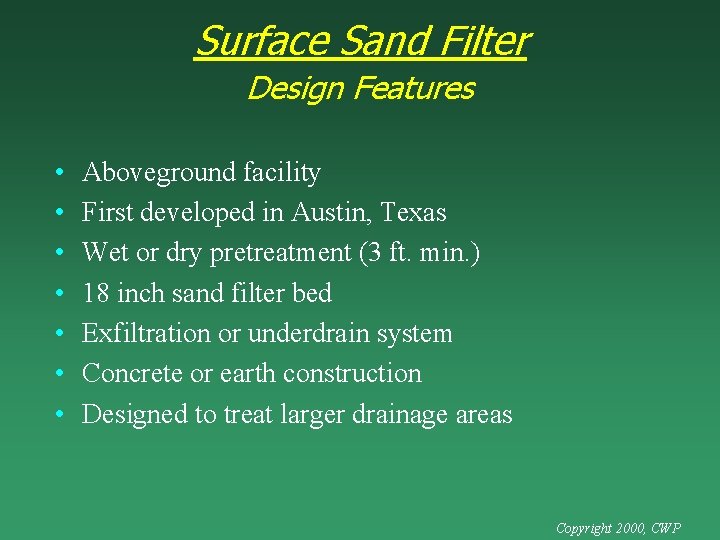
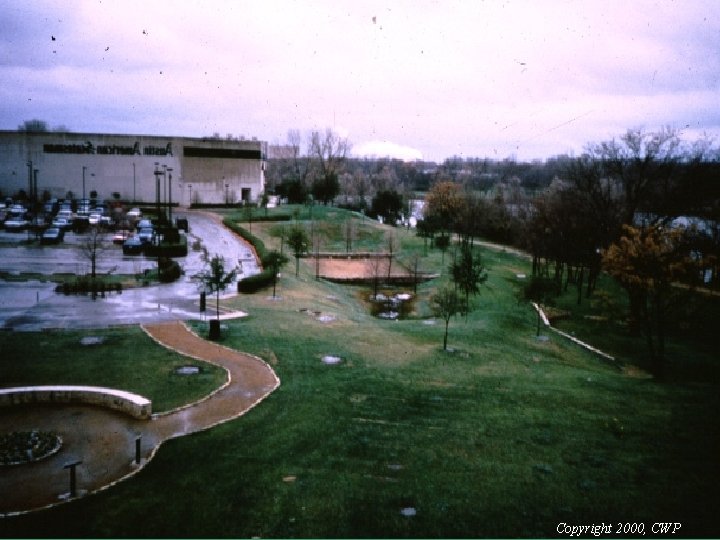
Surface Sand Filter Design Features • • Aboveground facility First developed in Austin, Texas Wet or dry pretreatment (3 ft. min. ) 18 inch sand filter bed Exfiltration or underdrain system Concrete or earth construction Designed to treat larger drainage areas Copyright 2000, CWP
Copyright 2000, CWP
Copyright 2000, CWP
Copyright 2000, CWP
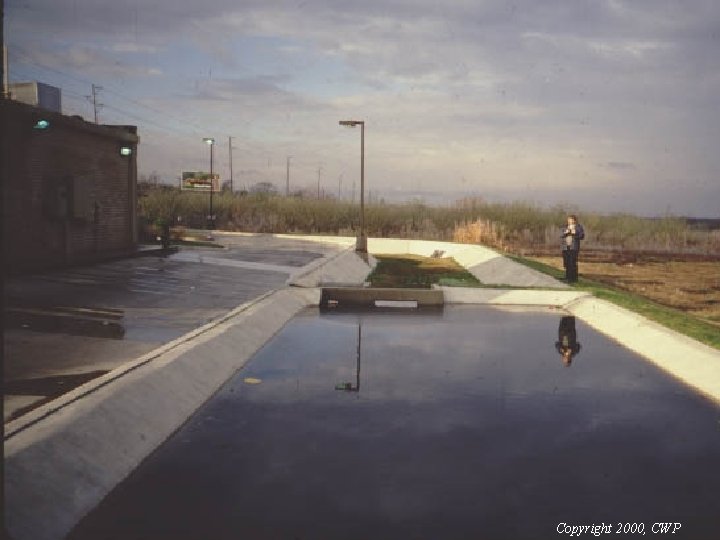
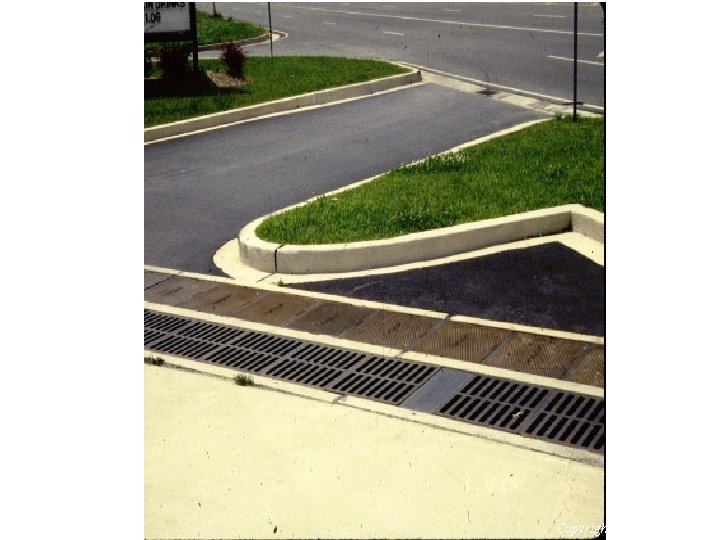
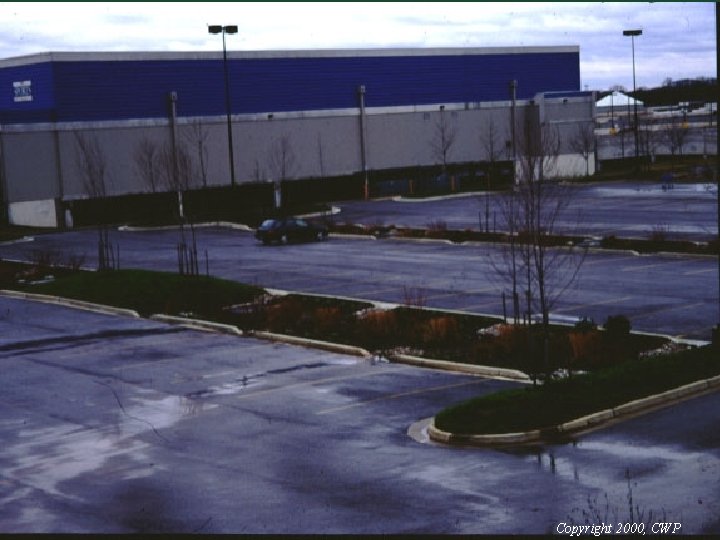
Perimeter Sand Filter Design Features • • Located at the perimeter of parking lots Developed originally in Delaware Two parallel trench chambers Two foot wet pool pretreatment 18 inch sand filter bed Underdrain system Ideal for small, highly impervious areas Ideal for flat areas with relatively low available head. Copyright 2000, CWP
Copyright 2000, CWP
Copyright 2000, CWP
Copyright 2000, CWP
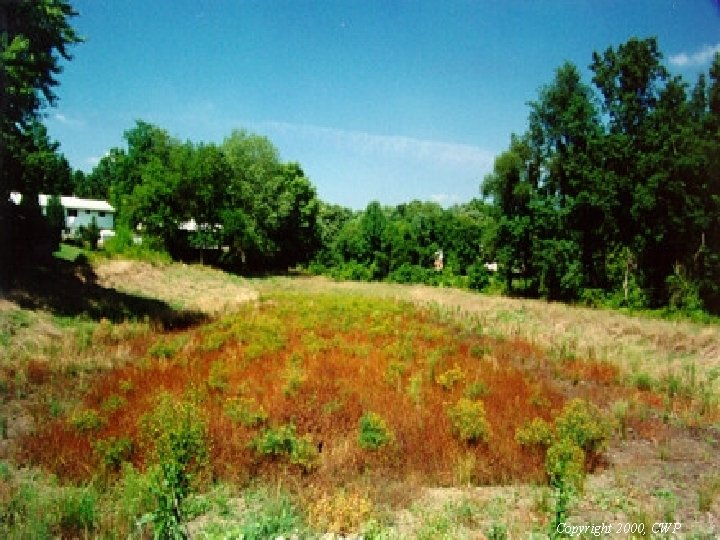
Organic Filter Design Features • • • Aboveground filter system Organic medium replaces or augments sand Peat & leaf compost, two most common media 24 inch peat/sand filter bed 18 inch compost filter bed (proprietary system: CSF Treatment Systems, Inc. ) • Exfiltration or underdrain system • Cover crop desirable for peat/sand system Copyright 2000, CWP
Peat Sand Filters • Peat Qualities: – High cation exchange capacity – High C: N: P ratio (microbial) – High organic matter content (80 -98%) – Moderately decomposed, fibric or hemic (reedsedge) – Stays in place Copyright 2000, CWP
Copyright 2000, CWP
Copyright 2000, CWP
Copyright 2000, CWP
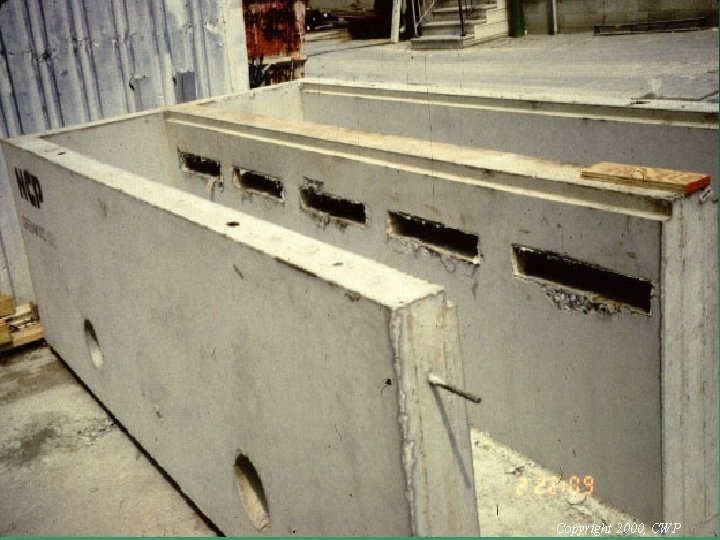
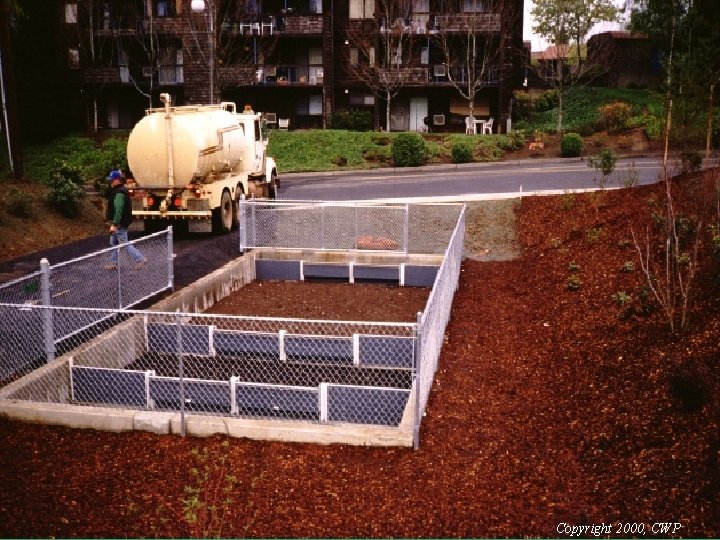
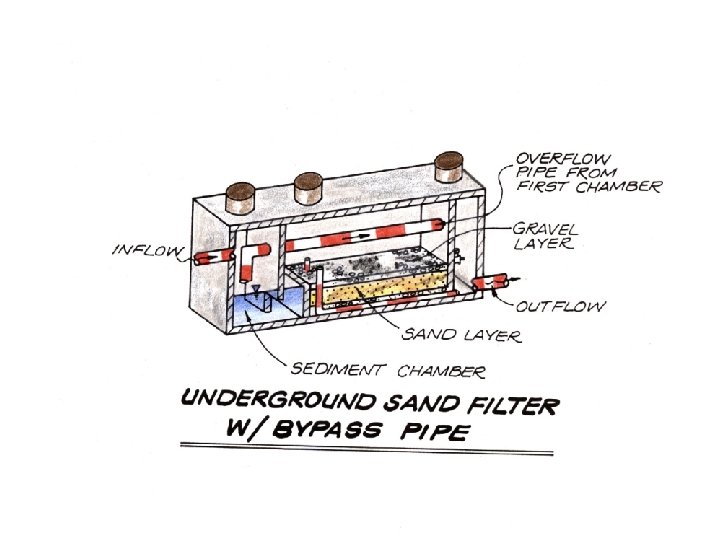
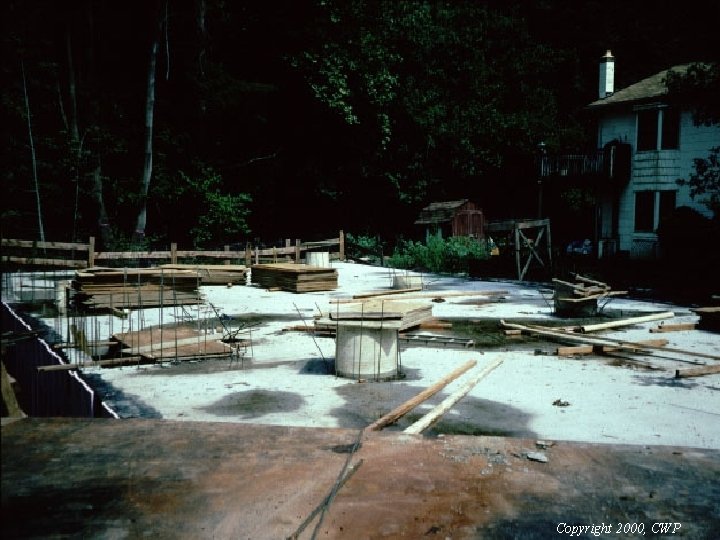
Underground Sand Filter Design Features • • • Below-ground facility Developed in District of Columbia Three foot wet pool pretreatment 24 inch sand filter bed Underdrain system Confined space considerations Copyright 2000, CWP
Copyright 2000, CWP
Copyright 2000, CWP
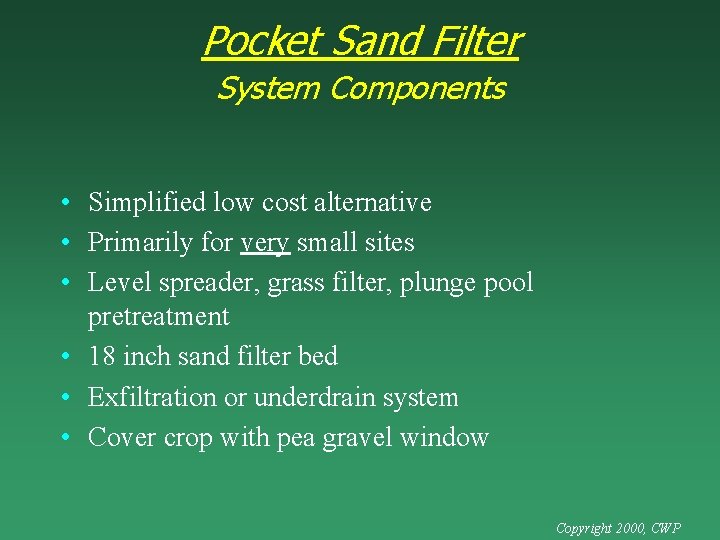
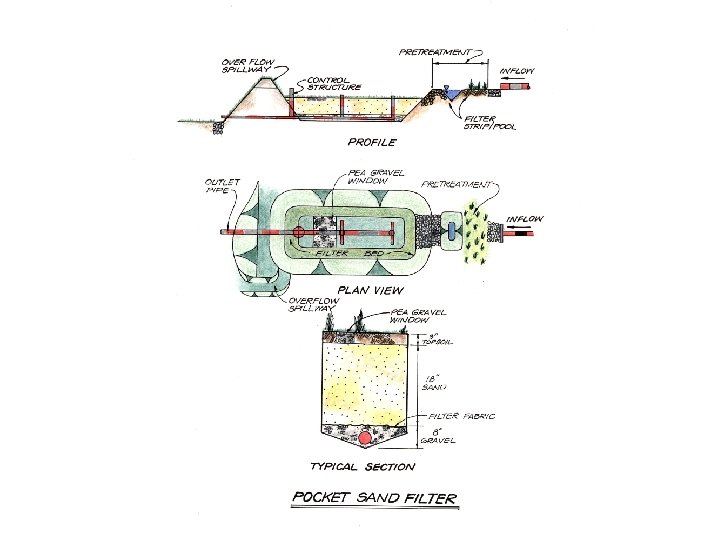
Pocket Sand Filter System Components • Simplified low cost alternative • Primarily for very small sites • Level spreader, grass filter, plunge pool pretreatment • 18 inch sand filter bed • Exfiltration or underdrain system • Cover crop with pea gravel window Copyright 2000, CWP
Copyright 2000, CWP
Copyright 2000, CWP
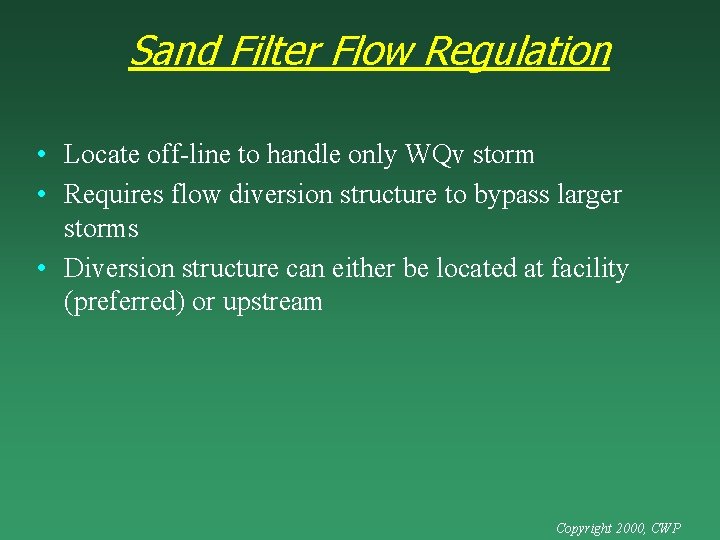
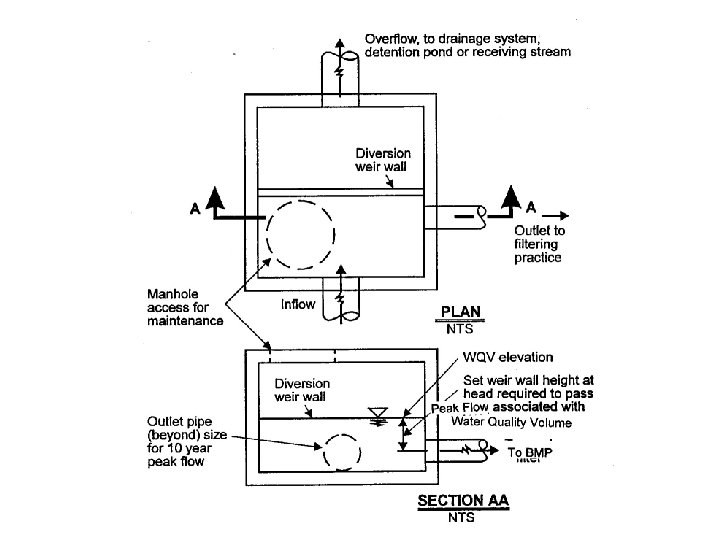
Sand Filter Flow Regulation • Locate off-line to handle only WQv storm • Requires flow diversion structure to bypass larger storms • Diversion structure can either be located at facility (preferred) or upstream Copyright 2000, CWP
Copyright 2000, CWP
Copyright 2000, CWP
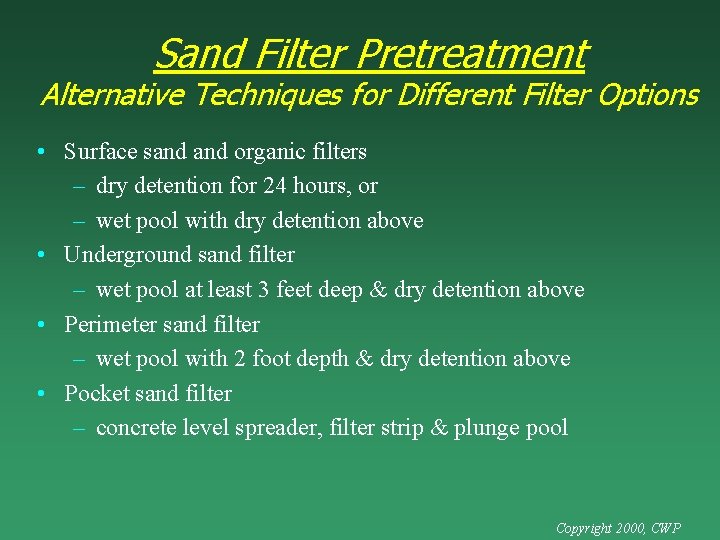
Sand Filter Pretreatment Alternative Techniques for Different Filter Options • Surface sand organic filters – dry detention for 24 hours, or – wet pool with dry detention above • Underground sand filter – wet pool at least 3 feet deep & dry detention above • Perimeter sand filter – wet pool with 2 foot depth & dry detention above • Pocket sand filter – concrete level spreader, filter strip & plunge pool Copyright 2000, CWP
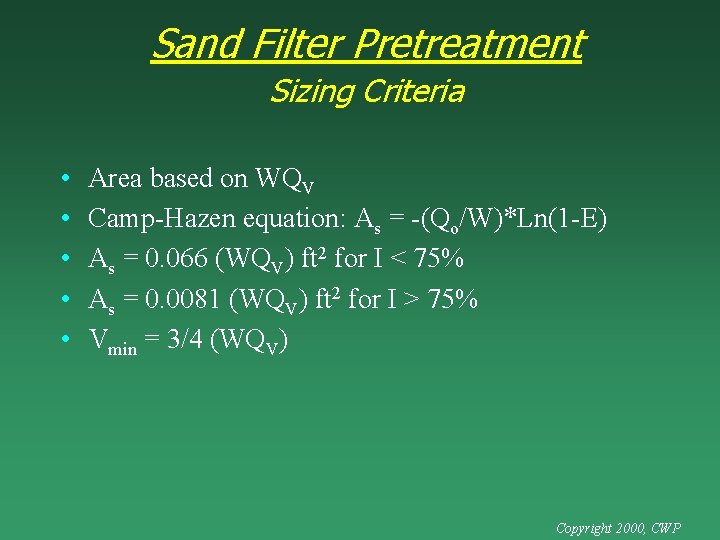
Sand Filter Pretreatment Sizing Criteria • • • Area based on WQV Camp-Hazen equation: As = -(Qo/W)*Ln(1 -E) As = 0. 066 (WQV) ft 2 for I < 75% As = 0. 0081 (WQV) ft 2 for I > 75% Vmin = 3/4 (WQV) Copyright 2000, CWP
Sand Filter bed Sizing Criteria • Darcy’s Law – Af =WQV*(df)/[k*(hf + df)(tf)] where: • Af = surface area of filter (ft 2) • WQV = treatment volume (ft 3) • df = filter bed depth (ft) - can vary depending on the site conditions but should not be more 24" (18" is the standard) • k = coefficient of permeability (ft/day) • hf = average head above filter bed (ft) - varies depending on the site conditions, but should not exceed 6 feet • tf = time to filter through bed (days) - A value of 40 hours is recommended Copyright 2000, CWP
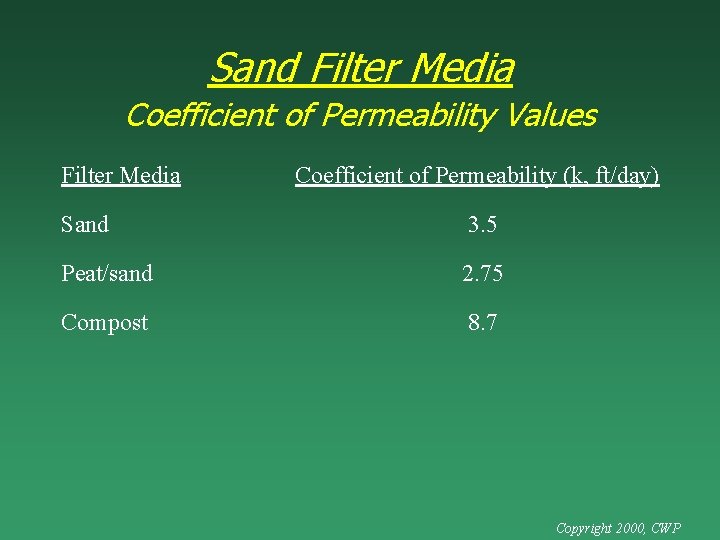
Sand Filter Media Coefficient of Permeability Values Filter Media Coefficient of Permeability (k, ft/day) Sand 3. 5 Peat/sand 2. 75 Compost 8. 7 Copyright 2000, CWP
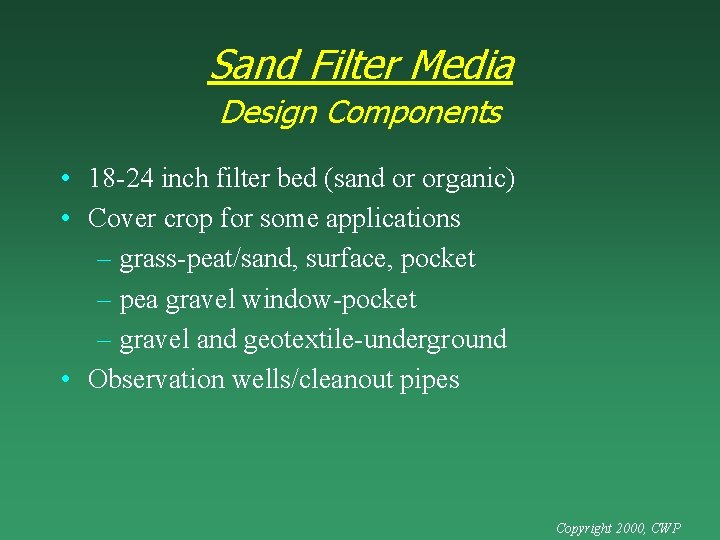
Sand Filter Media Design Components • 18 -24 inch filter bed (sand or organic) • Cover crop for some applications – grass-peat/sand, surface, pocket – pea gravel window-pocket – gravel and geotextile-underground • Observation wells/cleanout pipes Copyright 2000, CWP
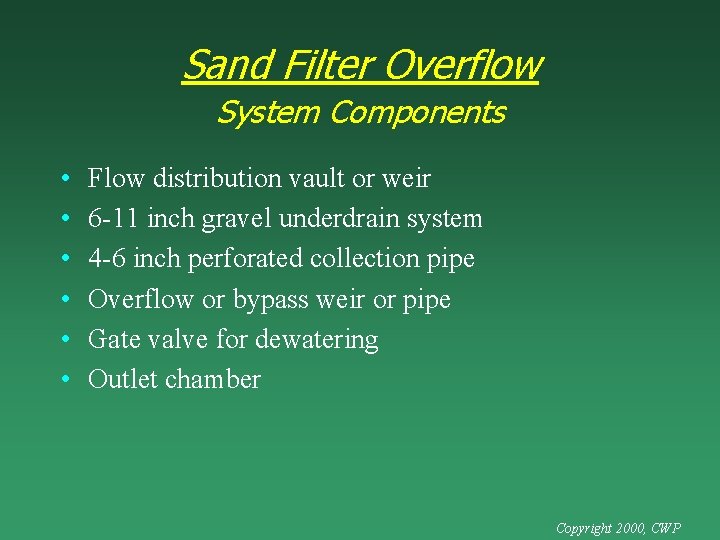
Sand Filter Overflow System Components • • • Flow distribution vault or weir 6 -11 inch gravel underdrain system 4 -6 inch perforated collection pipe Overflow or bypass weir or pipe Gate valve for dewatering Outlet chamber Copyright 2000, CWP
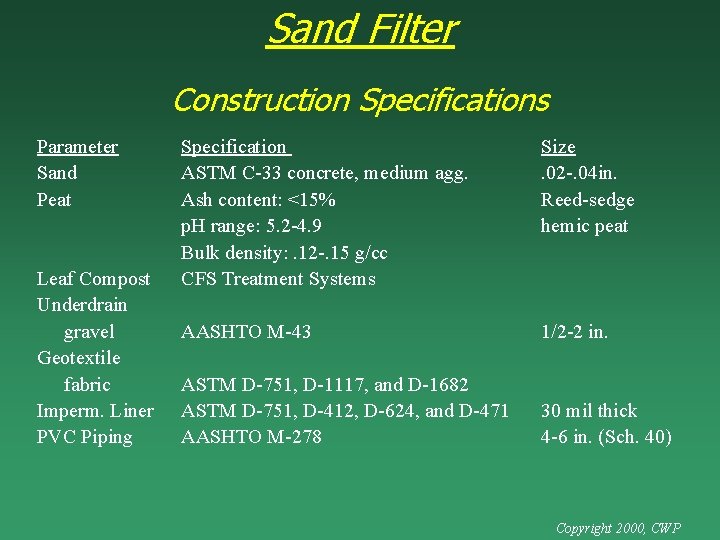
Sand Filter Construction Specifications Parameter Sand Peat Leaf Compost Underdrain gravel Geotextile fabric Imperm. Liner PVC Piping Specification ASTM C-33 concrete, medium agg. Ash content: <15% p. H range: 5. 2 -4. 9 Bulk density: . 12 -. 15 g/cc CFS Treatment Systems Size. 02 -. 04 in. Reed-sedge hemic peat AASHTO M-43 1/2 -2 in. ASTM D-751, D-1117, and D-1682 ASTM D-751, D-412, D-624, and D-471 AASHTO M-278 30 mil thick 4 -6 in. (Sch. 40) Copyright 2000, CWP
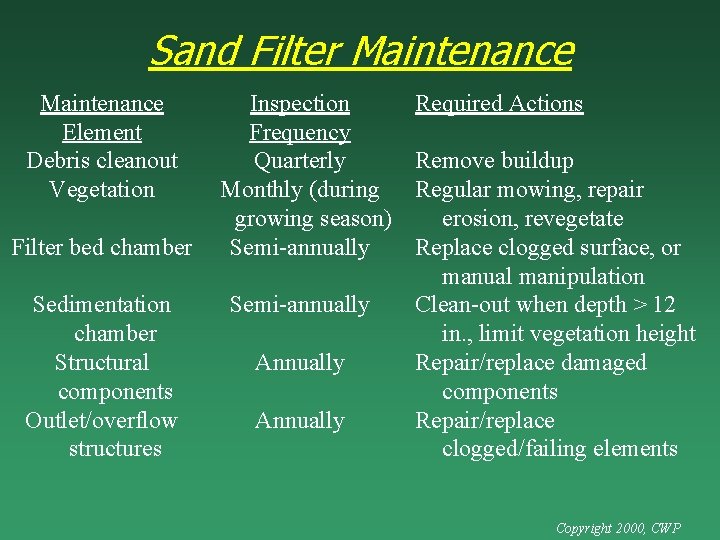
Sand Filter Maintenance Element Debris cleanout Vegetation Filter bed chamber Sedimentation chamber Structural components Outlet/overflow structures Inspection Frequency Quarterly Monthly (during growing season) Semi-annually Annually Required Actions Remove buildup Regular mowing, repair erosion, revegetate Replace clogged surface, or manual manipulation Clean-out when depth > 12 in. , limit vegetation height Repair/replace damaged components Repair/replace clogged/failing elements Copyright 2000, CWP
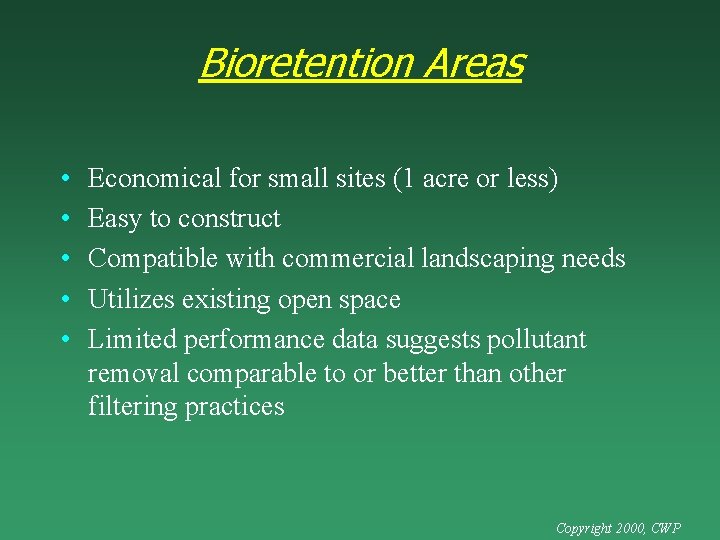
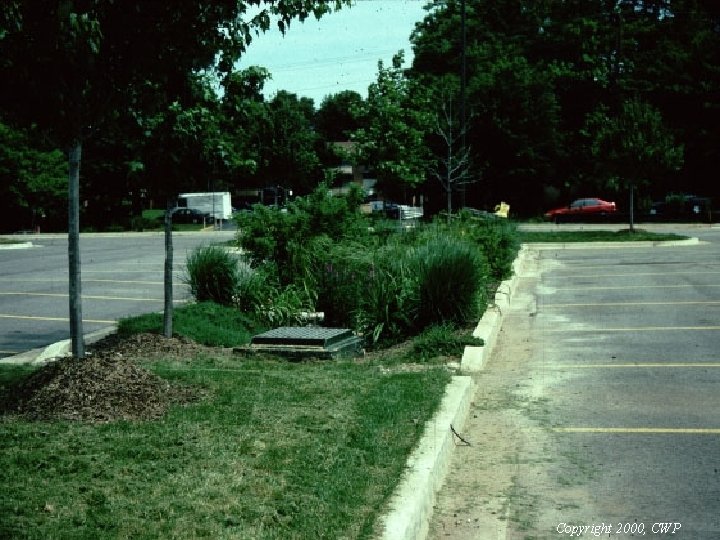
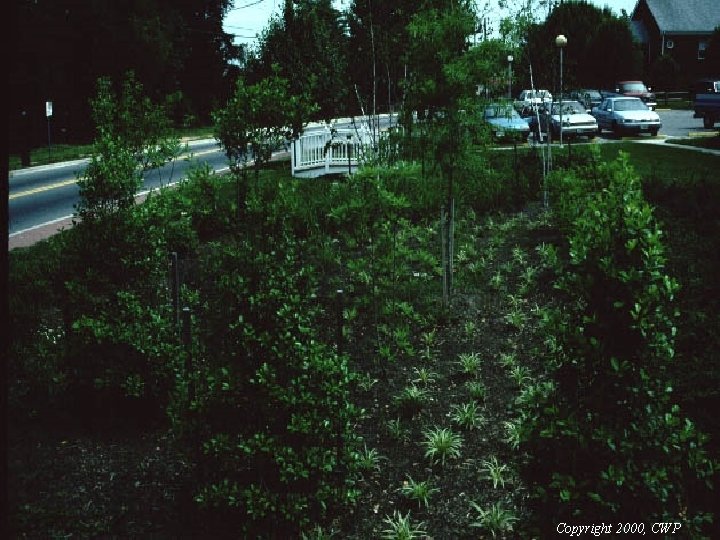
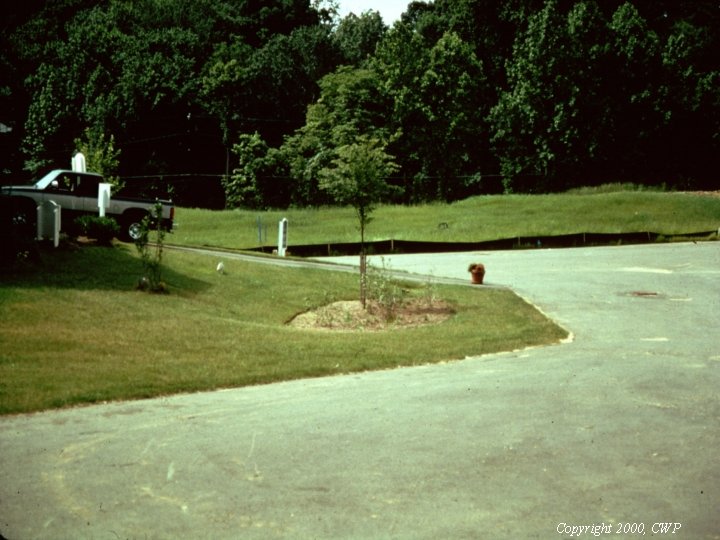
Bioretention Areas • • • Economical for small sites (1 acre or less) Easy to construct Compatible with commercial landscaping needs Utilizes existing open space Limited performance data suggests pollutant removal comparable to or better than other filtering practices Copyright 2000, CWP
Copyright 2000, CWP
Copyright 2000, CWP
Copyright 2000, CWP
Copyright 2000, CWP
Copyright 2000, CWP
Copyright 2000, CWP
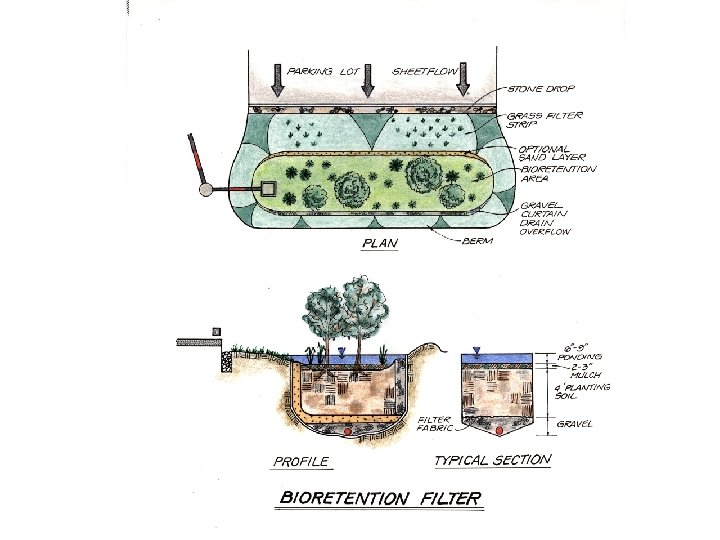
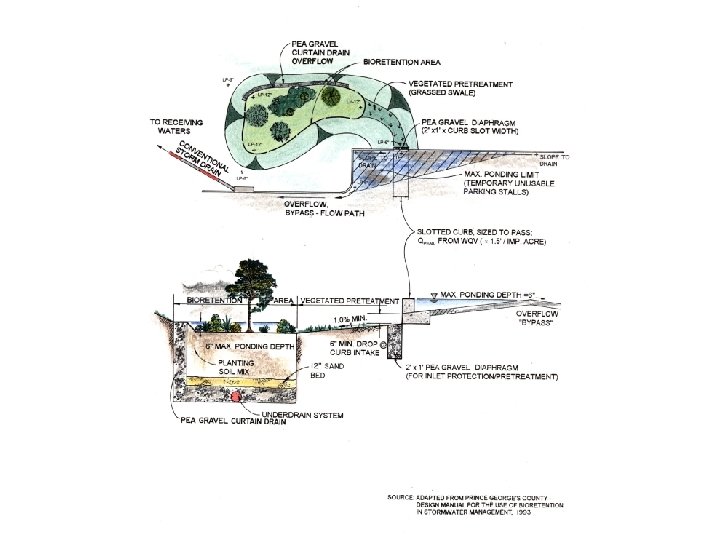
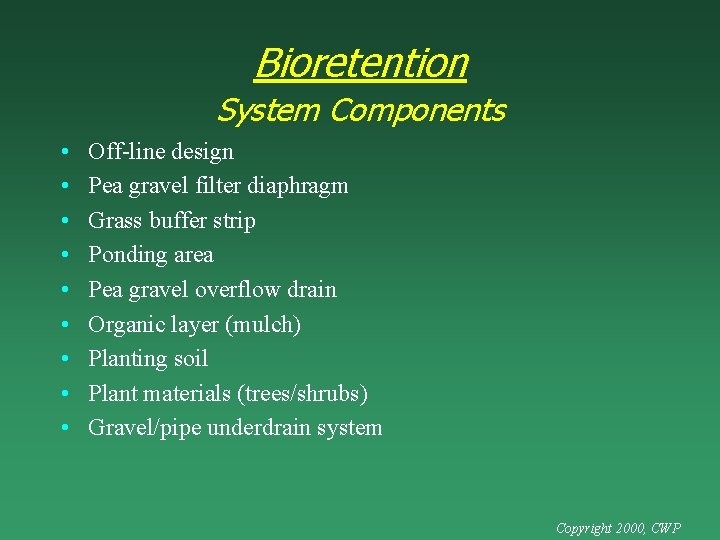
Bioretention System Components • • • Off-line design Pea gravel filter diaphragm Grass buffer strip Ponding area Pea gravel overflow drain Organic layer (mulch) Planting soil Plant materials (trees/shrubs) Gravel/pipe underdrain system Copyright 2000, CWP
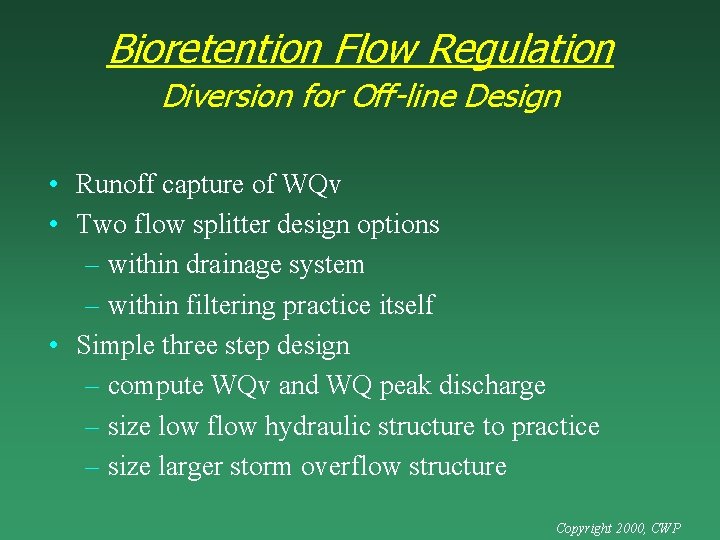
Bioretention Flow Regulation Diversion for Off-line Design • Runoff capture of WQv • Two flow splitter design options – within drainage system – within filtering practice itself • Simple three step design – compute WQv and WQ peak discharge – size low flow hydraulic structure to practice – size larger storm overflow structure Copyright 2000, CWP
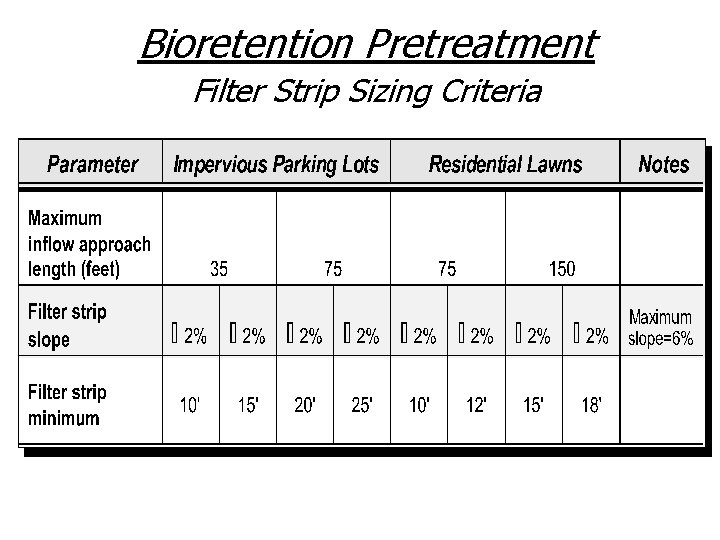
Bioretention Pretreatment Filter Strip Sizing Criteria Copyright 2000, CWP
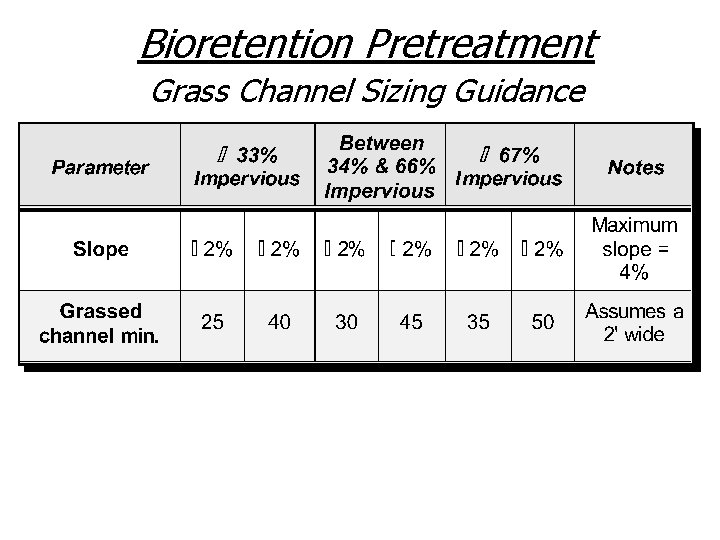
Bioretention Pretreatment Grass Channel Sizing Guidance Copyright 2000, CWP
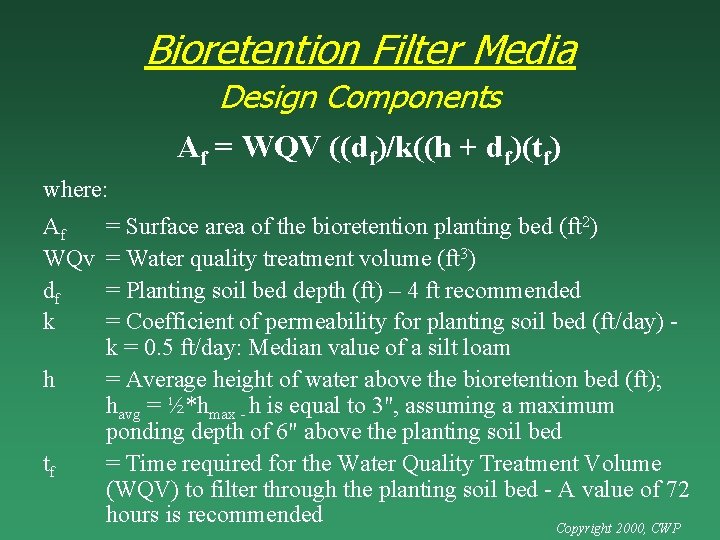
Bioretention Filter Media Design Components Af = WQV ((df)/k((h + df)(tf) where: Af WQv df k h tf = Surface area of the bioretention planting bed (ft 2) = Water quality treatment volume (ft 3) = Planting soil bed depth (ft) – 4 ft recommended = Coefficient of permeability for planting soil bed (ft/day) k = 0. 5 ft/day: Median value of a silt loam = Average height of water above the bioretention bed (ft); havg = ½*hmax - h is equal to 3", assuming a maximum ponding depth of 6" above the planting soil bed = Time required for the Water Quality Treatment Volume (WQV) to filter through the planting soil bed - A value of 72 hours is recommended Copyright 2000, CWP
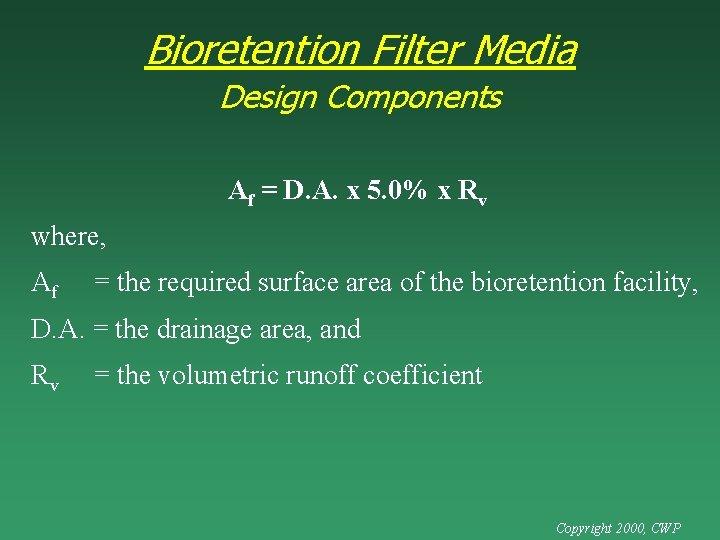
Bioretention Filter Media Design Components Af = D. A. x 5. 0% x Rv where, Af = the required surface area of the bioretention facility, D. A. = the drainage area, and Rv = the volumetric runoff coefficient Copyright 2000, CWP
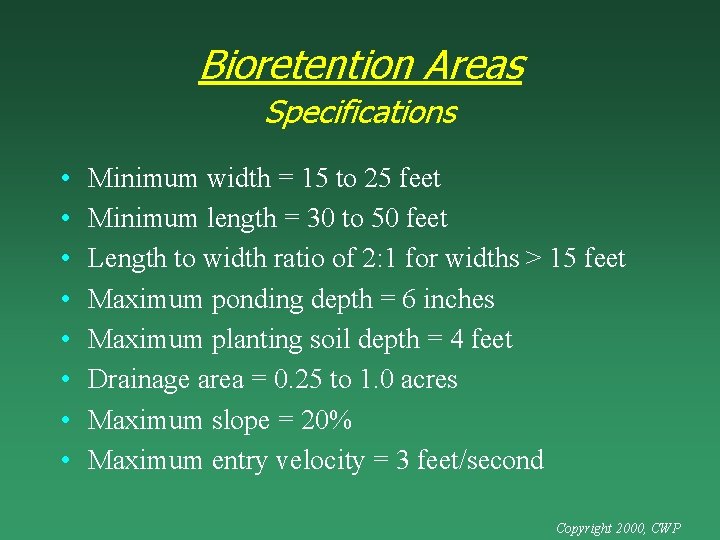
Bioretention Areas Specifications • • Minimum width = 15 to 25 feet Minimum length = 30 to 50 feet Length to width ratio of 2: 1 for widths > 15 feet Maximum ponding depth = 6 inches Maximum planting soil depth = 4 feet Drainage area = 0. 25 to 1. 0 acres Maximum slope = 20% Maximum entry velocity = 3 feet/second Copyright 2000, CWP
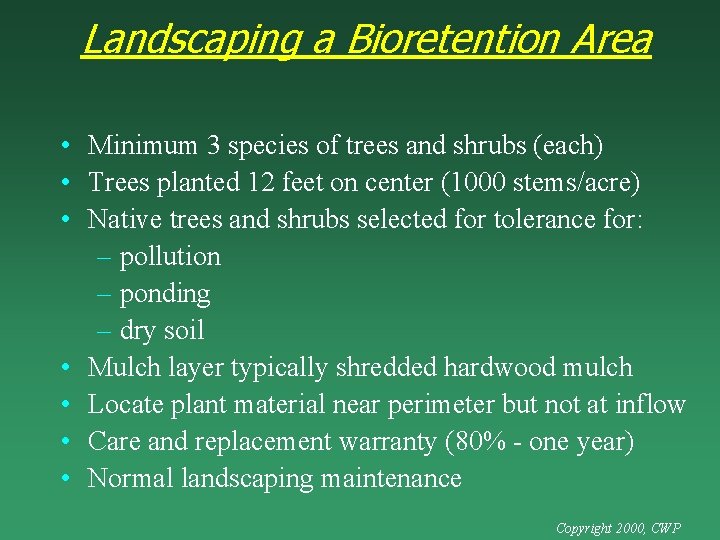
Landscaping a Bioretention Area • Minimum 3 species of trees and shrubs (each) • Trees planted 12 feet on center (1000 stems/acre) • Native trees and shrubs selected for tolerance for: – pollution – ponding – dry soil • Mulch layer typically shredded hardwood mulch • Locate plant material near perimeter but not at inflow • Care and replacement warranty (80% - one year) • Normal landscaping maintenance Copyright 2000, CWP