
Design of Stable Channels CH4 RiprapLined Channels Providing
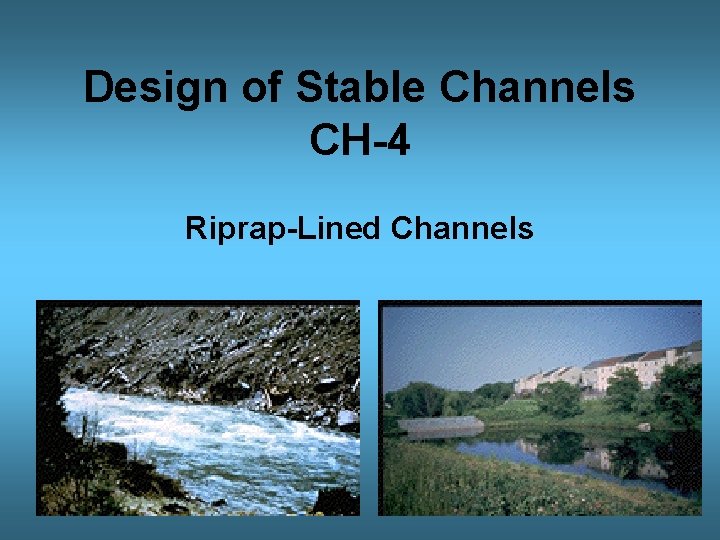
Design of Stable Channels CH-4 Riprap-Lined Channels
Providing Channel Protection • In cases where vegetation is not suitable, riprap is often used to stabilize channels… – Riprap = rough, angular rocks of varying size • Place riprap on surfaces that are well compacted and stable – Toe protection for channel bank riprap • Design of riprap… – Select rock size large enough so that the force attempting to overturn the rocks is less than the gravitational force acting on the rocks

Providing Channel Protection • Gradation of riprap: – Select particle size distribution such that voids between the larger particles are filled with smaller particles – Suggested gradation by Simons and Senturk (1977, 1992): Size % Finer 0. 2 d 50 0 0. 5 d 50 20% d 50 50% 2 d 50 100%
Sloping Bed • Design procedures: – Federal Highway Administration (FHA) – SCS Procedure – CSU Procedure
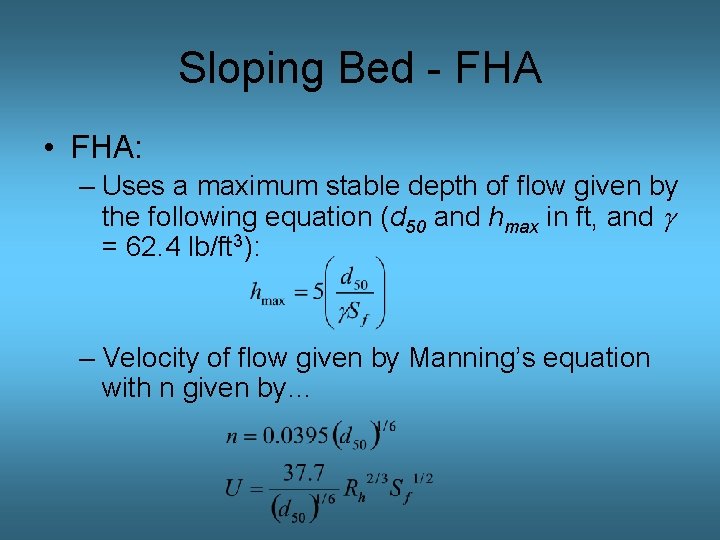
Sloping Bed - FHA • FHA: – Uses a maximum stable depth of flow given by the following equation (d 50 and hmax in ft, and g = 62. 4 lb/ft 3): – Velocity of flow given by Manning’s equation with n given by…

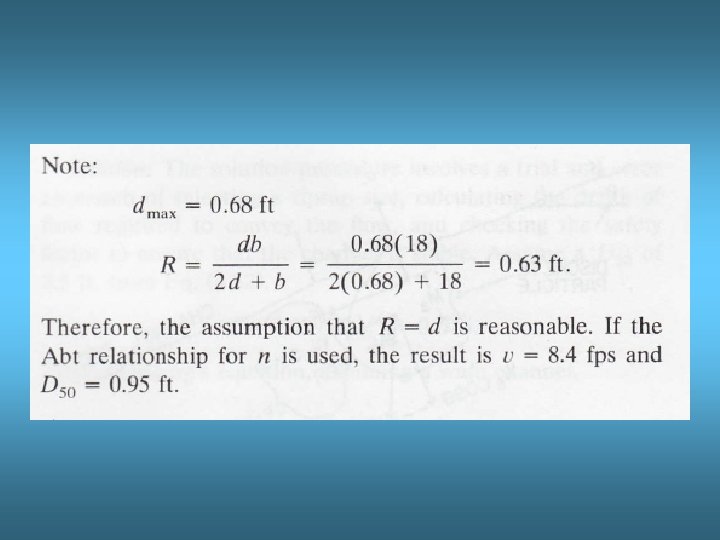
Example- 4. 15 Determine the d 50 riprap size required to convey 115 cfs down a 10% slope in a rectangular channel 18 ft wide. Riprap is for the bottom and use the FHA procedure.

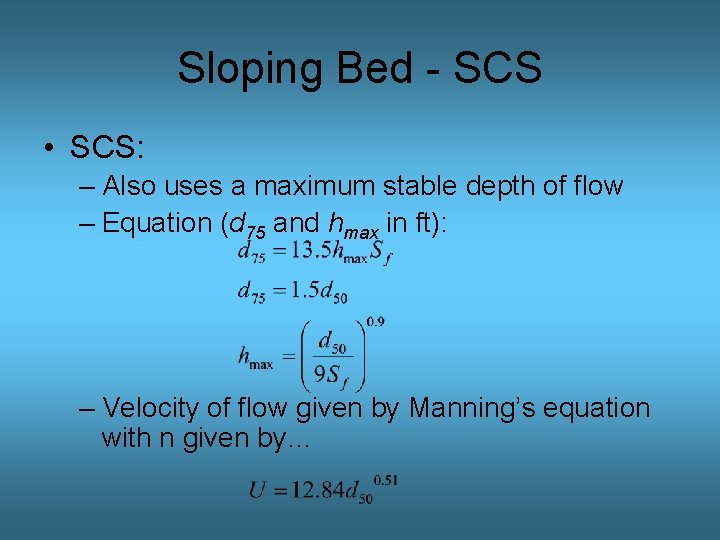
Sloping Bed - SCS • SCS: – Also uses a maximum stable depth of flow – Equation (d 75 and hmax in ft): – Velocity of flow given by Manning’s equation with n given by…
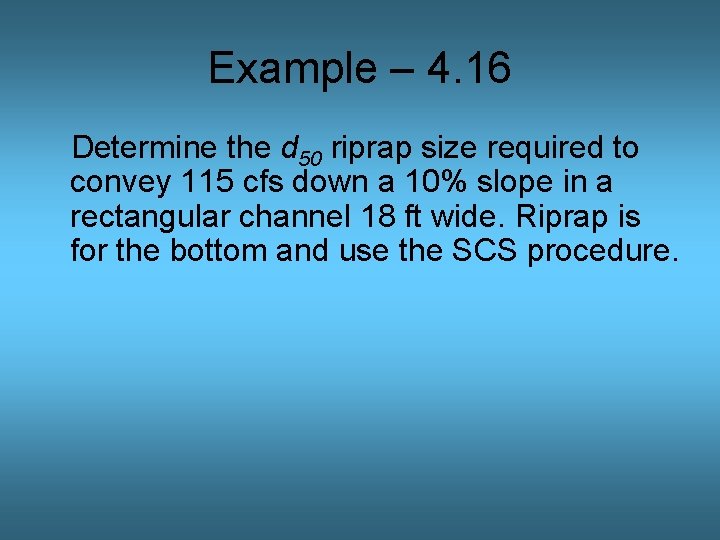
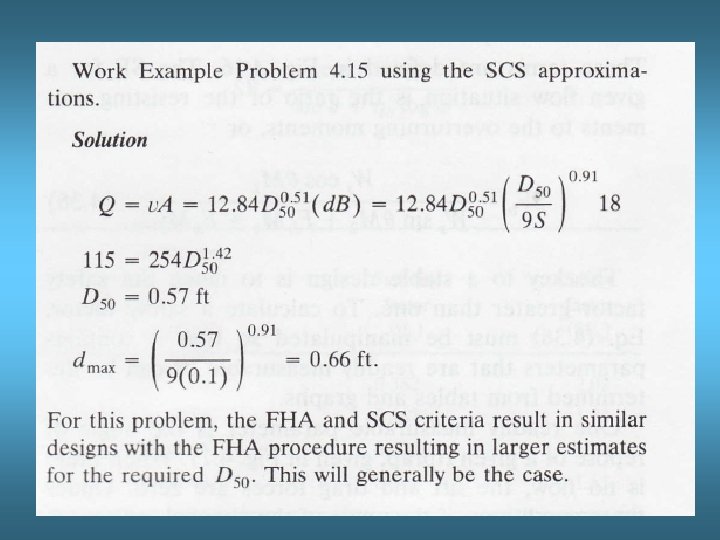
Example – 4. 16 Determine the d 50 riprap size required to convey 115 cfs down a 10% slope in a rectangular channel 18 ft wide. Riprap is for the bottom and use the SCS procedure.
Sloping Bed - CSU • CSU Procedure (Simons and Senturk, 1977, 1992): – Safety Factor (SF) concept • SF = ratio of resisting forces (moments) to driving forces (moments) • SF = 1 (Point of incipient motion) • Recommend SF > 1. 5 to account for variability in particle sizes
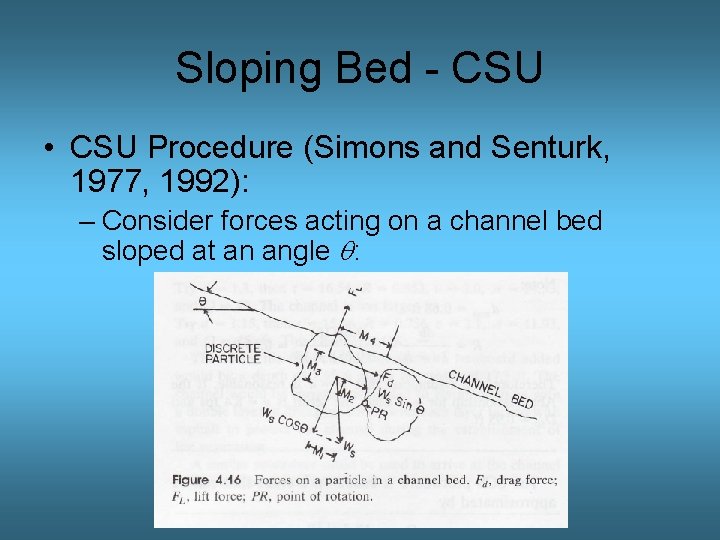
Sloping Bed - CSU • CSU Procedure (Simons and Senturk, 1977, 1992): – Consider forces acting on a channel bed sloped at an angle q:
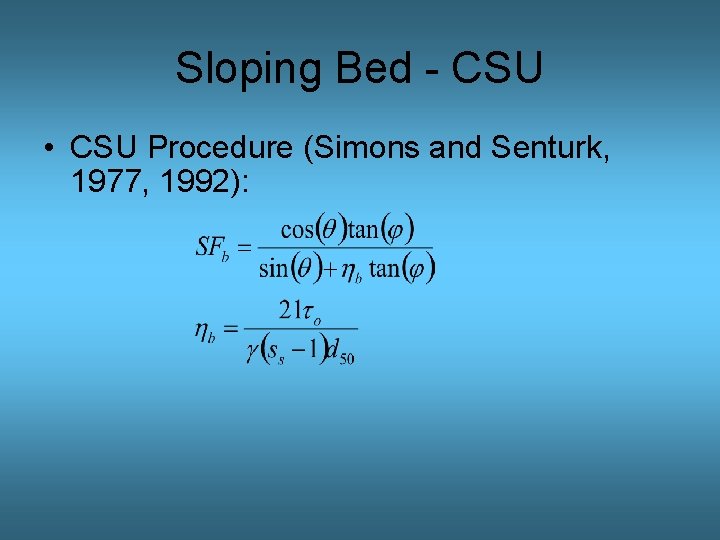
Sloping Bed - CSU • CSU Procedure (Simons and Senturk, 1977, 1992):
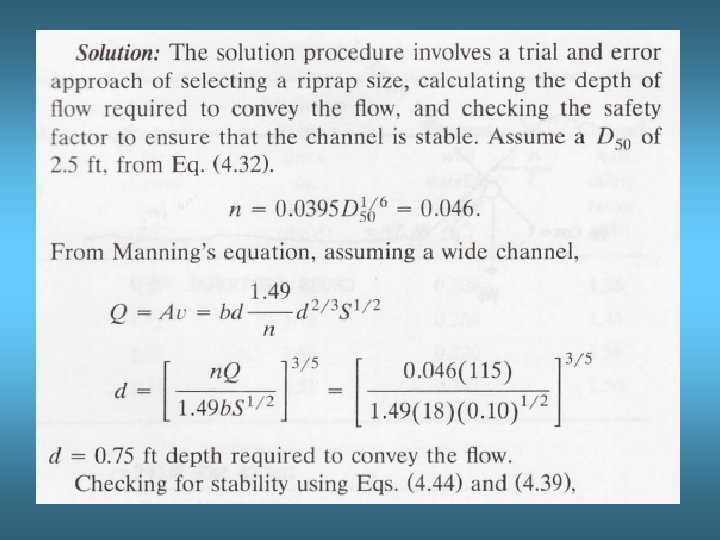
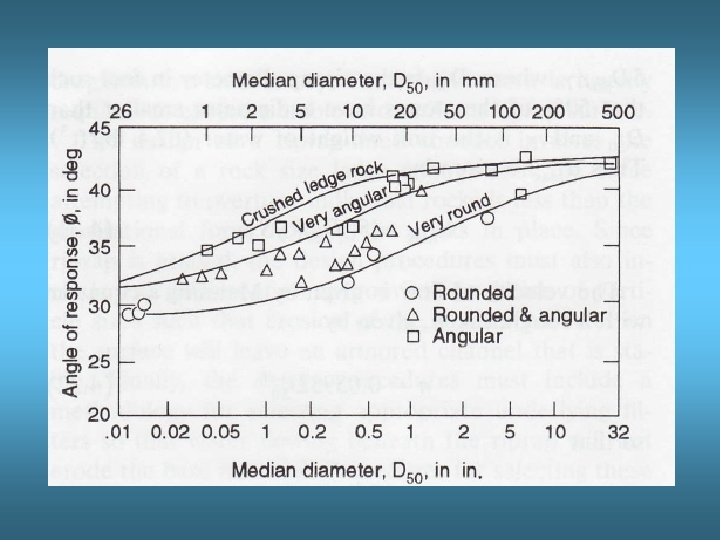
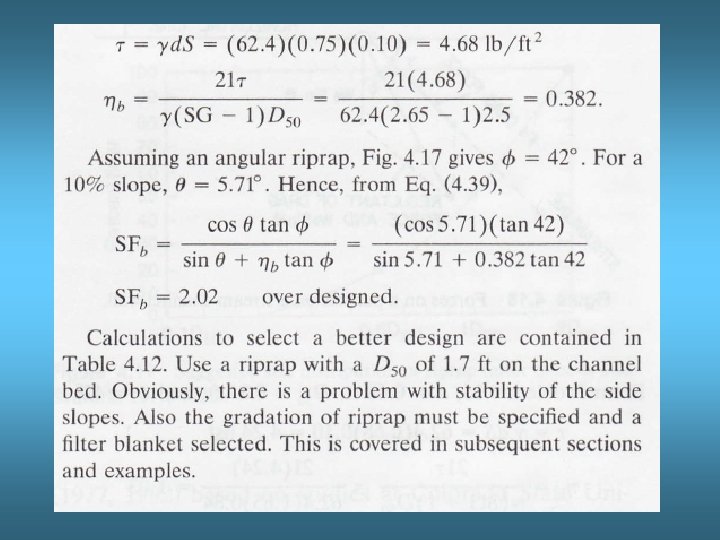
Example – 4. 17 Determine the d 50 riprap size required to convey 115 cfs down a 10% slope in a rectangular channel 18 ft wide. Riprap is for the bottom (neglect stability problems associated with the side slopes). Assume a specific gravity of sediment of 2. 65 with j = 42 o. Design for a safety factor of 1. 5.
Channel Bank Stability • CSU Procedure - Stevens and Simons (1971) and Simons and Senturk (1977, 1992): – Difference from bed is that drag forces are not aligned with the down slope gravitational forces – Equations assume that the ratio of lift to drag forces is 0. 5

Channel Bank Stability
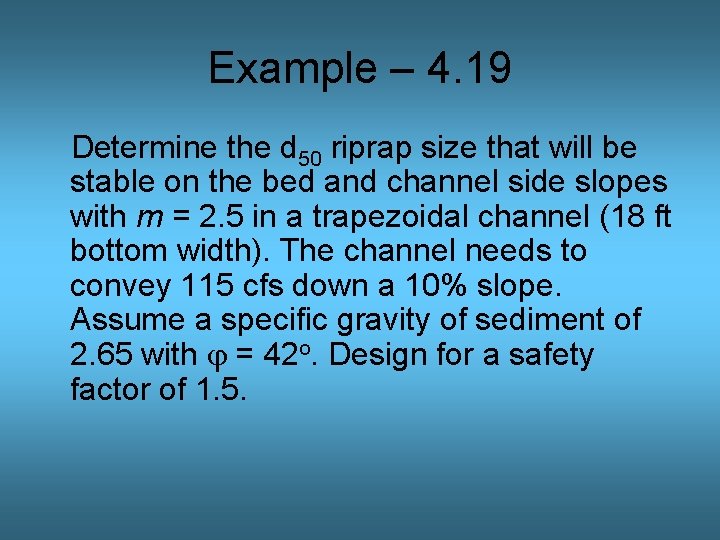
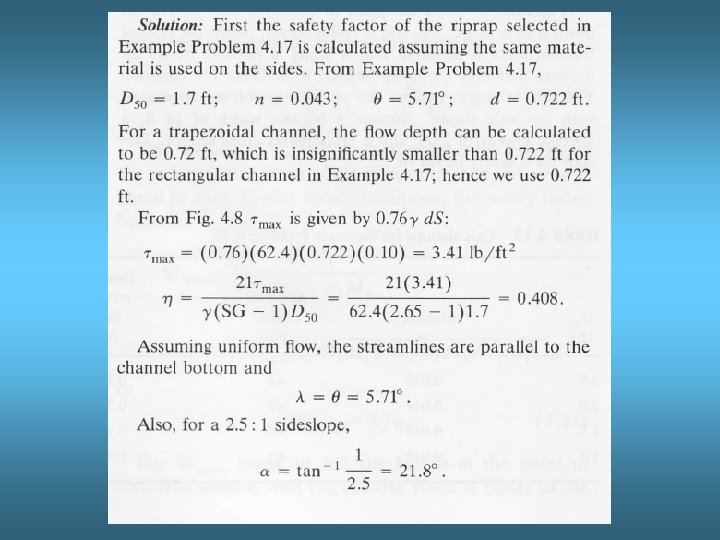
Example – 4. 19 Determine the d 50 riprap size that will be stable on the bed and channel side slopes with m = 2. 5 in a trapezoidal channel (18 ft bottom width). The channel needs to convey 115 cfs down a 10% slope. Assume a specific gravity of sediment of 2. 65 with j = 42 o. Design for a safety factor of 1. 5.
- Slides: 22