
Design of Qband gilbert cell down conversion mixer
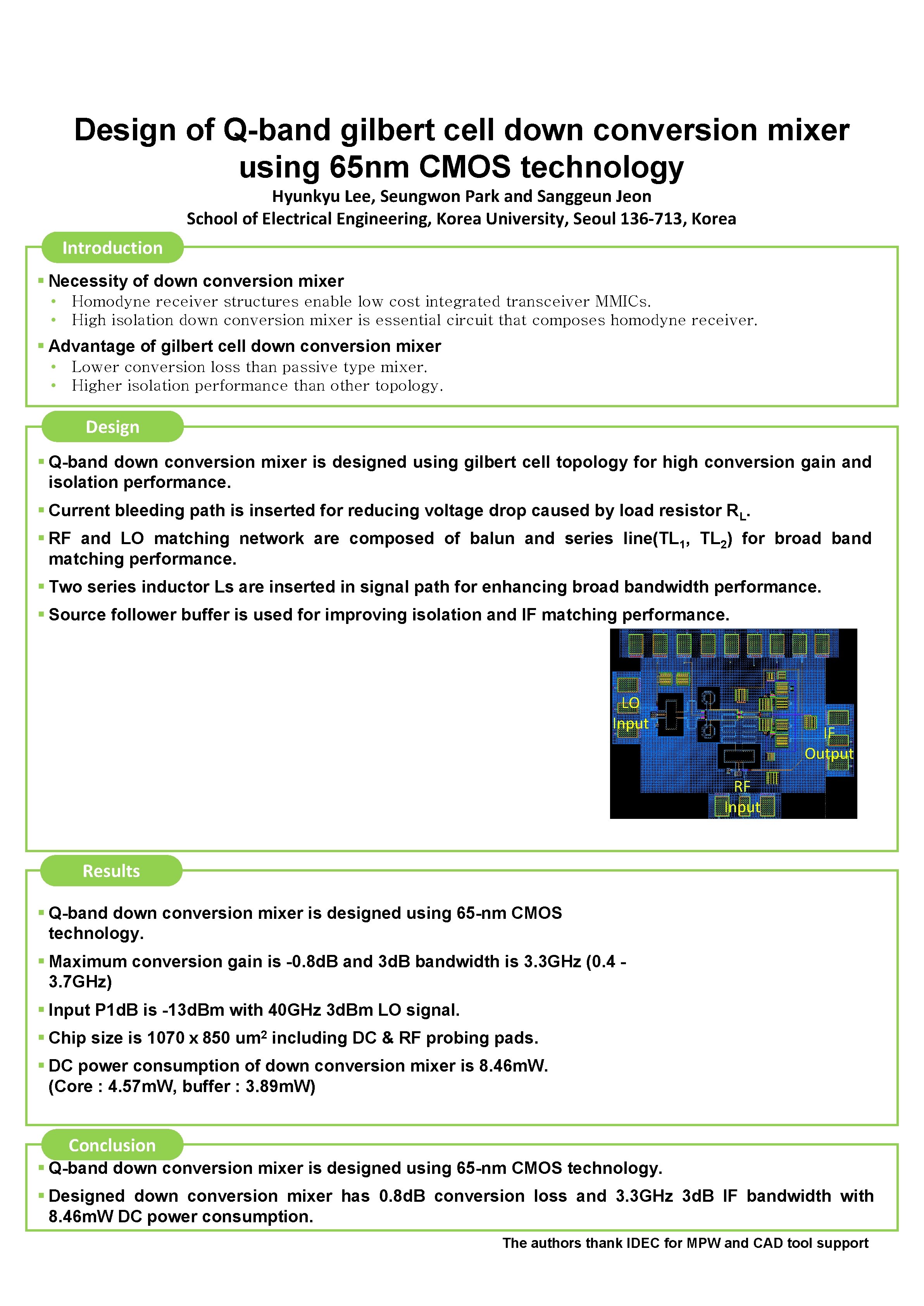
Design of Q-band gilbert cell down conversion mixer using 65 nm CMOS technology Hyunkyu Lee, Seungwon Park and Sanggeun Jeon School of Electrical Engineering, Korea University, Seoul 136 -713, Korea Introduction § Necessity of down conversion mixer • Homodyne receiver structures enable low cost integrated transceiver MMICs. • High isolation down conversion mixer is essential circuit that composes homodyne receiver. § Advantage of gilbert cell down conversion mixer • Lower conversion loss than passive type mixer. • Higher isolation performance than other topology. Design § Q-band down conversion mixer is designed using gilbert cell topology for high conversion gain and isolation performance. § Current bleeding path is inserted for reducing voltage drop caused by load resistor R L. § RF and LO matching network are composed of balun and series line(TL 1, TL 2) for broad band matching performance. § Two series inductor Ls are inserted in signal path for enhancing broad bandwidth performance. § Source follower buffer is used for improving isolation and IF matching performance. LO Input IF Output RF Input Results § Q-band down conversion mixer is designed using 65 -nm CMOS technology. § Maximum conversion gain is -0. 8 d. B and 3 d. B bandwidth is 3. 3 GHz (0. 4 3. 7 GHz) § Input P 1 d. B is -13 d. Bm with 40 GHz 3 d. Bm LO signal. § Chip size is 1070ⅹ 850 um 2 including DC & RF probing pads. § DC power consumption of down conversion mixer is 8. 46 m. W. (Core : 4. 57 m. W, buffer : 3. 89 m. W) Conclusion § Q-band down conversion mixer is designed using 65 -nm CMOS technology. § Designed down conversion mixer has 0. 8 d. B conversion loss and 3. 3 GHz 3 d. B IF bandwidth with 8. 46 m. W DC power consumption. The authors thank IDEC for MPW and CAD tool support
- Slides: 1