
Design of Photonic Metamaterial Electromagnetic Concentrator Operating in
- Slides: 1
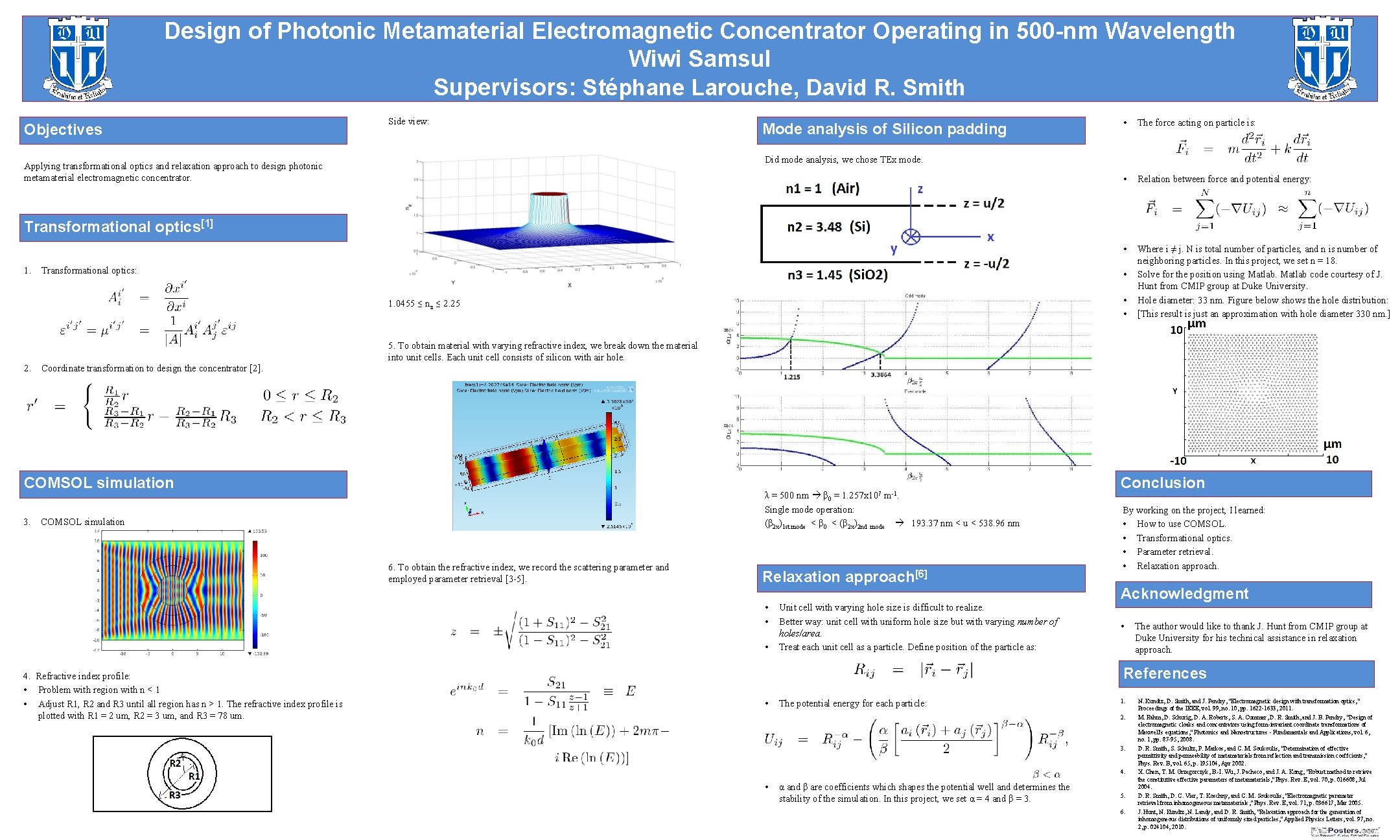
Design of Photonic Metamaterial Electromagnetic Concentrator Operating in 500 -nm Wavelength Wiwi Samsul Supervisors: Stéphane Larouche, David R. Smith Objectives Side view: Mode analysis of Silicon padding • The force acting on particle is: • Relation between force and potential energy: • Where i ≠ j. N is total number of particles, and n is number of neighboring particles. In this project, we set n = 18. Solve for the position using Matlab code courtesy of J. Hunt from CMIP group at Duke University. Hole diameter: 33 nm. Figure below shows the hole distribution: [This result is just an approximation with hole diameter 330 nm. ] Did mode analysis, we chose TEx mode. Applying transformational optics and relaxation approach to design photonic metamaterial electromagnetic concentrator. Transformational optics[1] 1. Transformational optics: • • • 1. 0455 ≤ nz ≤ 2. 25 5. To obtain material with varying refractive index, we break down the material into unit cells. Each unit cell consists of silicon with air hole. 2. Coordinate transformation to design the concentrator [2]. COMSOL simulation λ = 500 nm β 0 = Single mode operation: (β 2 x)1 st mode < β 0 < (β 2 x)2 nd 1. 257 x 107 3. COMSOL simulation 6. To obtain the refractive index, we record the scattering parameter and employed parameter retrieval [3 -5]. mode 193. 37 nm < u < 538. 96 nm Relaxation approach[6] • • • 4. Refractive index profile: • Problem with region with n < 1 • Adjust R 1, R 2 and R 3 until all region has n > 1. The refractive index profile is plotted with R 1 = 2 um, R 2 = 3 um, and R 3 = 78 um. m-1. Unit cell with varying hole size is difficult to realize. Better way: unit cell with uniform hole size but with varying number of holes/area. Treat each unit cell as a particle. Define position of the particle as: Conclusion By working on the project, I learned: • How to use COMSOL. • Transformational optics. • Parameter retrieval. • Relaxation approach. Acknowledgment • The author would like to thank J. Hunt from CMIP group at Duke University for his technical assistance in relaxation approach. References • The potential energy for each particle: 1. 2. 3. 4. • α and β are coefficients which shapes the potential well and determines the stability of the simulation. In this project, we set α = 4 and β = 3. 5. 6. N. Kundtz, D. Smith, and J. Pendry, "Electromagnetic design with transformation optics, " Proceedings of the IEEE, vol. 99, no. 10, pp. 1622 -1633, 2011. M. Rahm, D. Schurig, D. A. Roberts, S. A. Cummer, D. R. Smith, and J. B. Pendry, "Design of electromagnetic cloaks and concentrators using form-invariant coordinate transformations of Maxwell's equations, " Photonics and Nanostructures - Fundamentals and Applications, vol. 6, no. 1, pp. 87 -95, 2008. D. R. Smith, S. Schultz, P. Markos, and C. M. Soukoulis, "Determination of effective permittivity and permeability of metamaterials from reflection and transmission coeffcients, " Phys. Rev. B, vol. 65, p. 195104, Apr 2002. X. Chen, T. M. Grzegorczyk, B. -I. Wu, J. Pacheco, and J. A. Kong, "Robust method to retrieve the constitutive effective parameters of metamaterials, " Phys. Rev. E, vol. 70, p. 016608, Jul 2004. D. R. Smith, D. C. Vier, T. Koschny, and C. M. Soukoulis, "Electromagnetic parameter retrieval from inhomogeneous metamaterials, " Phys. Rev. E, vol. 71, p. 036617, Mar 2005. J. Hunt, N. Kundtz, N. Landy, and D. R. Smith, "Relaxation approach for the generation of inhomogeneous distributions of uniformly sized particles, " Applied Physics Letters, vol. 97, no. 2, p. 024104, 2010.