
Design of periodicmove sprinkler systems Design of continuous
- Slides: 65
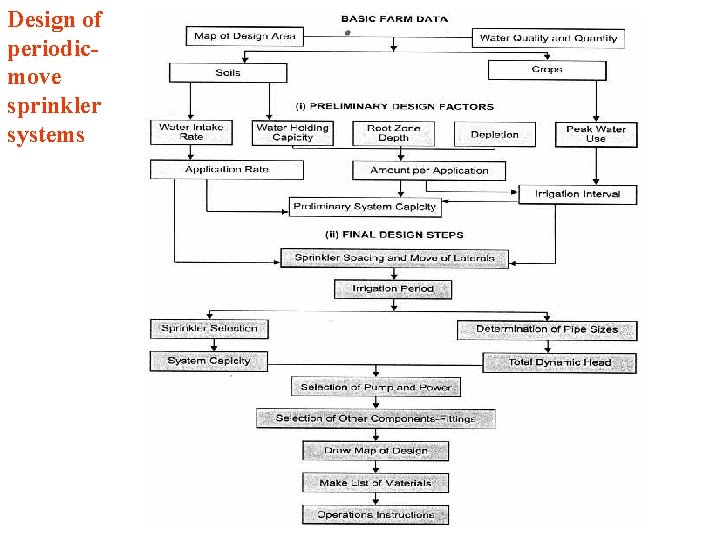
Design of periodicmove sprinkler systems
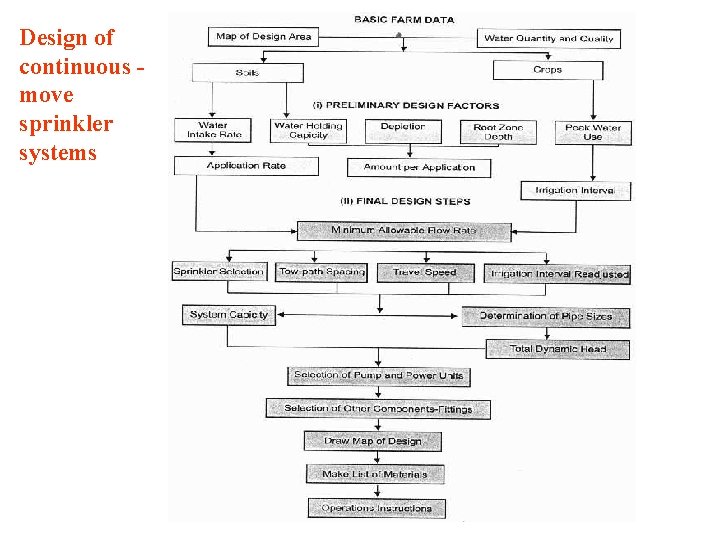
Design of continuous move sprinkler systems
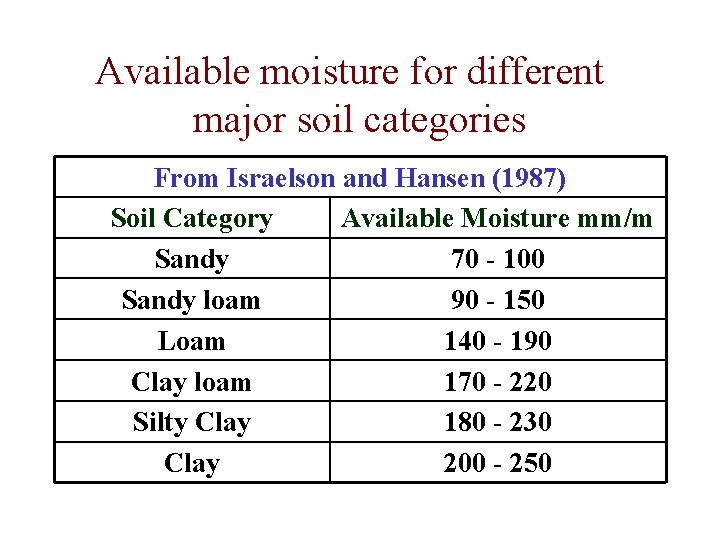
Available moisture for different major soil categories From Israelson and Hansen (1987) Soil Category Available Moisture mm/m Sandy 70 - 100 Sandy loam 90 - 150 Loam 140 - 190 Clay loam 170 - 220 Silty Clay 180 - 230 Clay 200 - 250
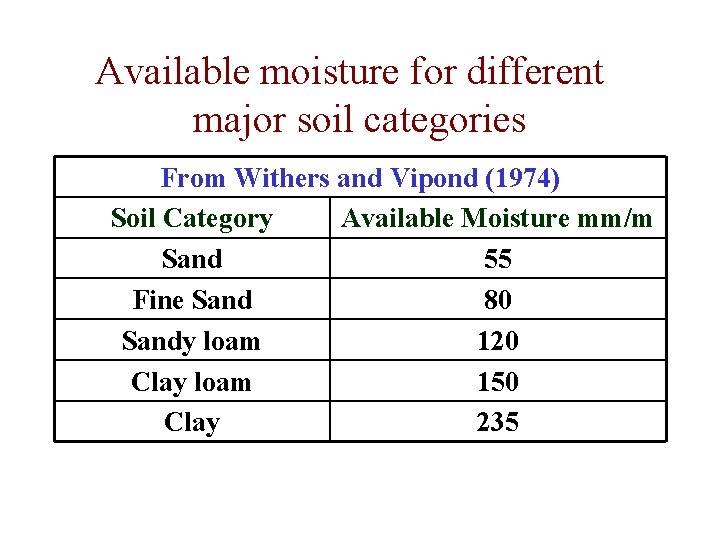
Available moisture for different major soil categories From Withers and Vipond (1974) Soil Category Available Moisture mm/m Sand 55 Fine Sand 80 Sandy loam 120 Clay loam 150 Clay 235
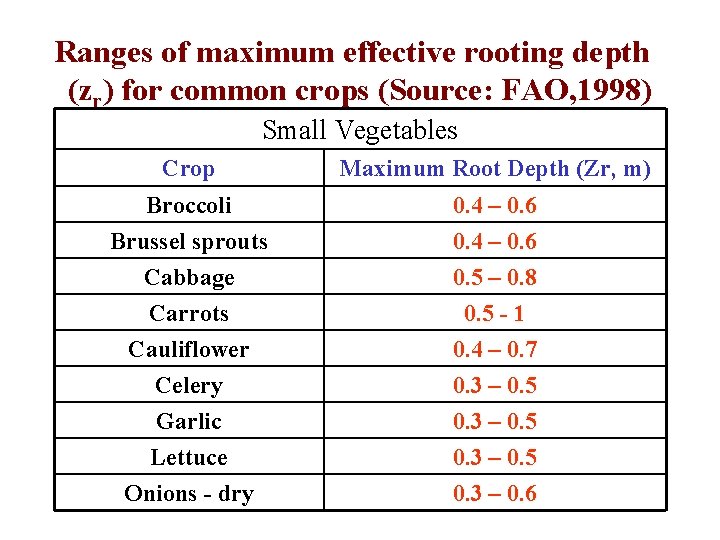
Ranges of maximum effective rooting depth (zr) for common crops (Source: FAO, 1998) Small Vegetables Crop Maximum Root Depth (Zr, m) Broccoli Brussel sprouts 0. 4 – 0. 6 Cabbage Carrots Cauliflower Celery Garlic Lettuce Onions - dry 0. 5 – 0. 8 0. 5 - 1 0. 4 – 0. 7 0. 3 – 0. 5 0. 3 – 0. 6
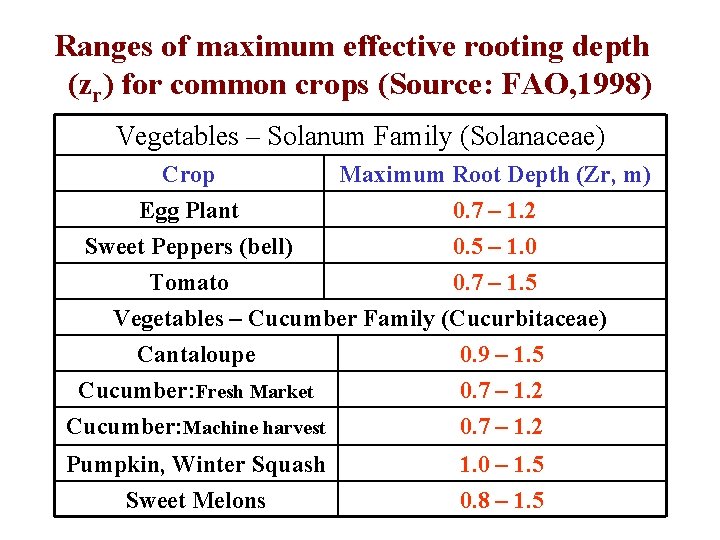
Ranges of maximum effective rooting depth (zr) for common crops (Source: FAO, 1998) Vegetables – Solanum Family (Solanaceae) Crop Egg Plant Sweet Peppers (bell) Maximum Root Depth (Zr, m) 0. 7 – 1. 2 0. 5 – 1. 0 Tomato 0. 7 – 1. 5 Vegetables – Cucumber Family (Cucurbitaceae) Cantaloupe 0. 9 – 1. 5 Cucumber: Fresh Market 0. 7 – 1. 2 Cucumber: Machine harvest 0. 7 – 1. 2 Pumpkin, Winter Squash Sweet Melons 1. 0 – 1. 5 0. 8 – 1. 5
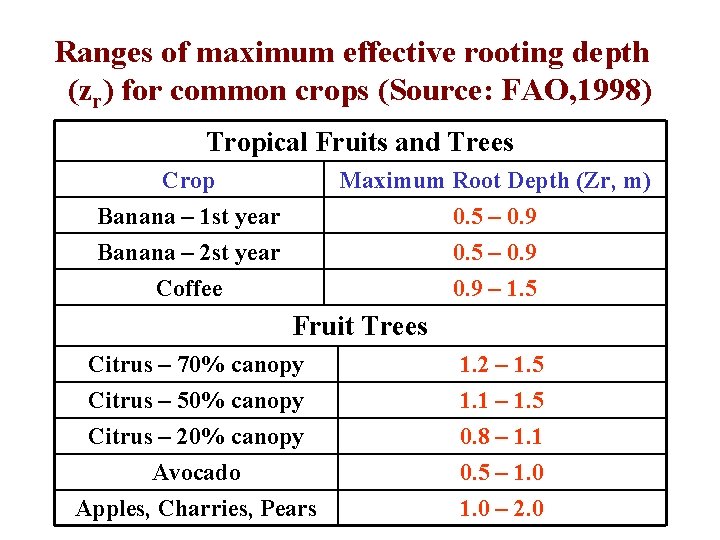
Ranges of maximum effective rooting depth (zr) for common crops (Source: FAO, 1998) Tropical Fruits and Trees Crop Banana – 1 st year Banana – 2 st year Maximum Root Depth (Zr, m) 0. 5 – 0. 9 Coffee 0. 9 – 1. 5 Fruit Trees Citrus – 70% canopy Citrus – 50% canopy Citrus – 20% canopy Avocado Apples, Charries, Pears 1. 2 – 1. 5 1. 1 – 1. 5 0. 8 – 1. 1 0. 5 – 1. 0 – 2. 0
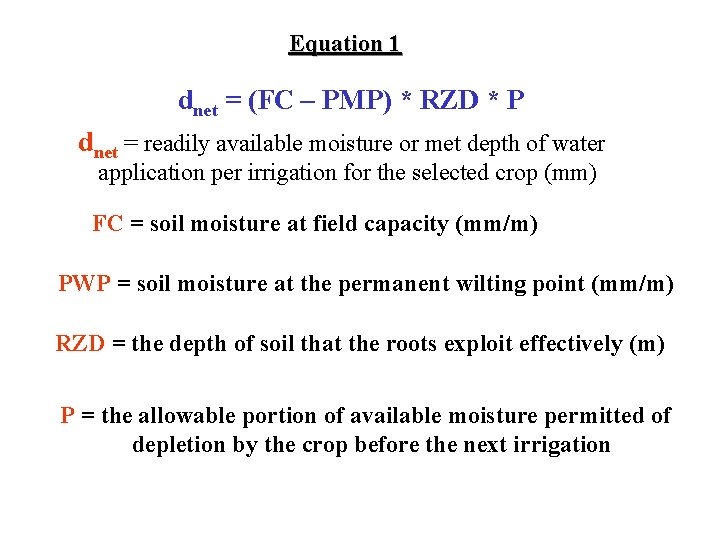
Equation 1 dnet = (FC – PMP) * RZD * P dnet = readily available moisture or met depth of water application per irrigation for the selected crop (mm) FC = soil moisture at field capacity (mm/m) PWP = soil moisture at the permanent wilting point (mm/m) RZD = the depth of soil that the roots exploit effectively (m) P = the allowable portion of available moisture permitted of depletion by the crop before the next irrigation
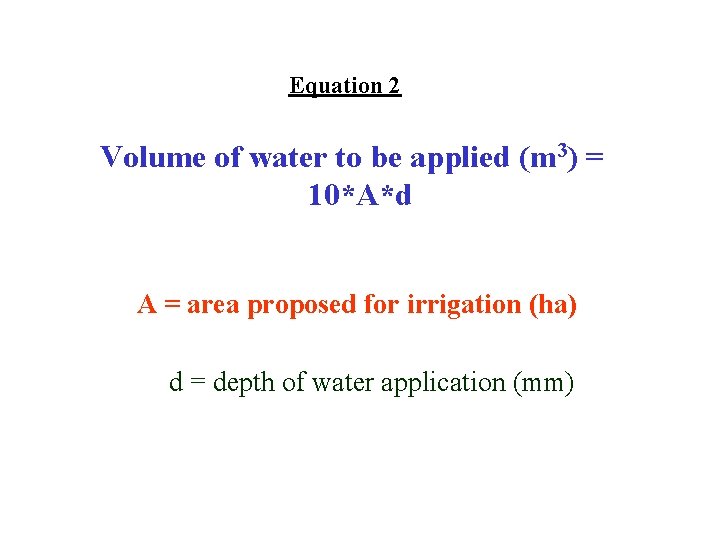
Equation 2 Volume of water to be applied (m 3) = 10*A*d A = area proposed for irrigation (ha) d = depth of water application (mm)
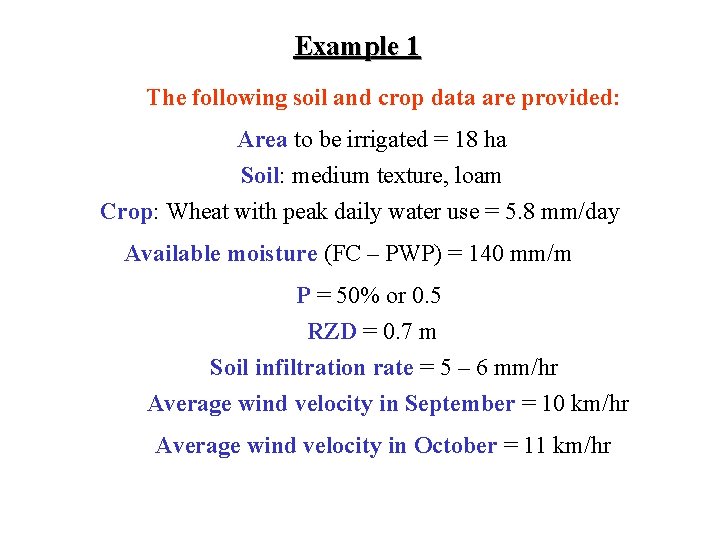
Example 1 The following soil and crop data are provided: Area to be irrigated = 18 ha Soil: medium texture, loam Crop: Wheat with peak daily water use = 5. 8 mm/day Available moisture (FC – PWP) = 140 mm/m P = 50% or 0. 5 RZD = 0. 7 m Soil infiltration rate = 5 – 6 mm/hr Average wind velocity in September = 10 km/hr Average wind velocity in October = 11 km/hr
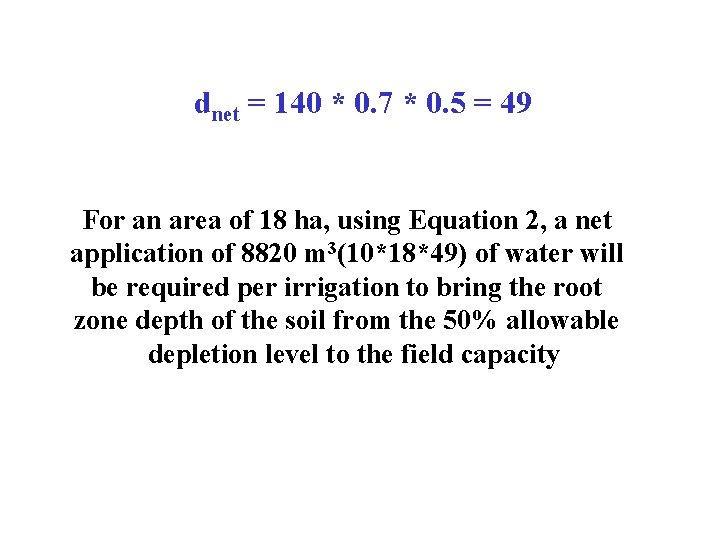
dnet = 140 * 0. 7 * 0. 5 = 49 For an area of 18 ha, using Equation 2, a net application of 8820 m 3(10*18*49) of water will be required per irrigation to bring the root zone depth of the soil from the 50% allowable depletion level to the field capacity
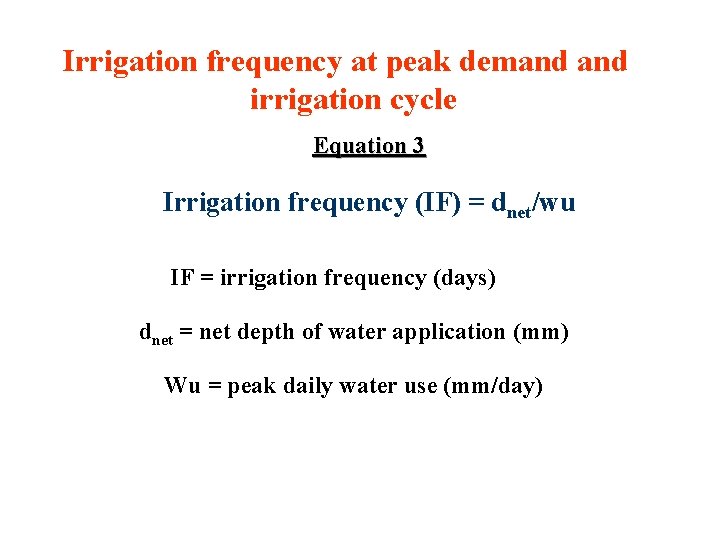
Irrigation frequency at peak demand irrigation cycle Equation 3 Irrigation frequency (IF) = dnet/wu IF = irrigation frequency (days) dnet = net depth of water application (mm) Wu = peak daily water use (mm/day)
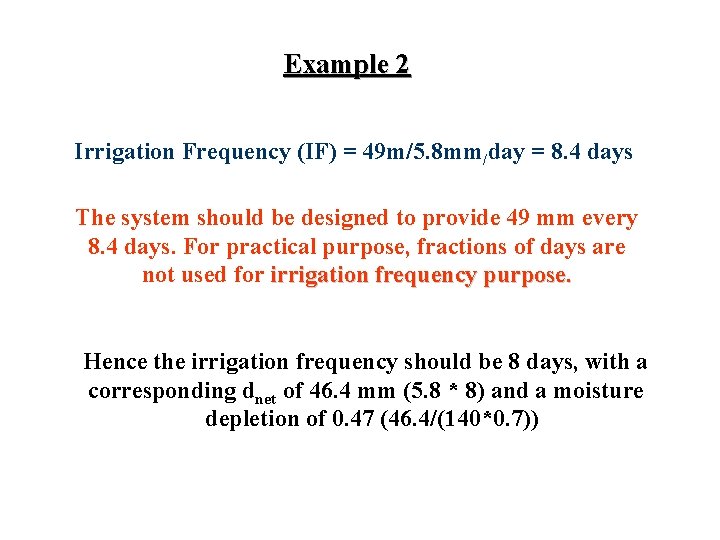
Example 2 Irrigation Frequency (IF) = 49 m/5. 8 mm/day = 8. 4 days The system should be designed to provide 49 mm every 8. 4 days. For practical purpose, fractions of days are not used for irrigation frequency purpose. Hence the irrigation frequency should be 8 days, with a corresponding dnet of 46. 4 mm (5. 8 * 8) and a moisture depletion of 0. 47 (46. 4/(140*0. 7))
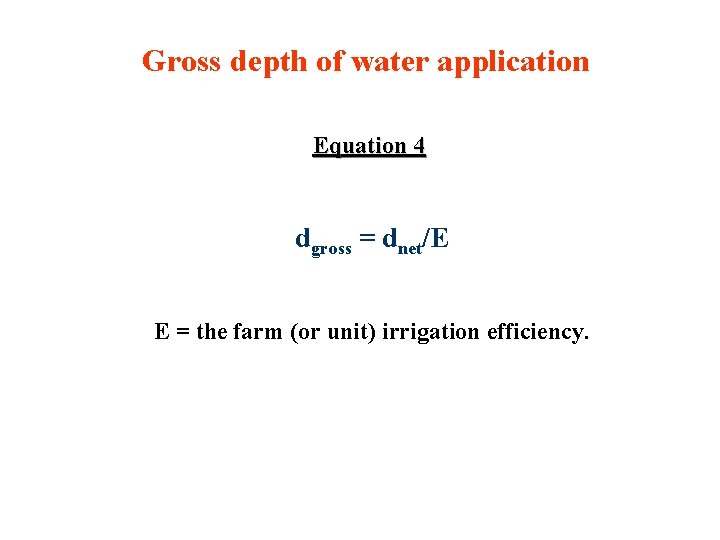
Gross depth of water application Equation 4 dgross = dnet/E E = the farm (or unit) irrigation efficiency.
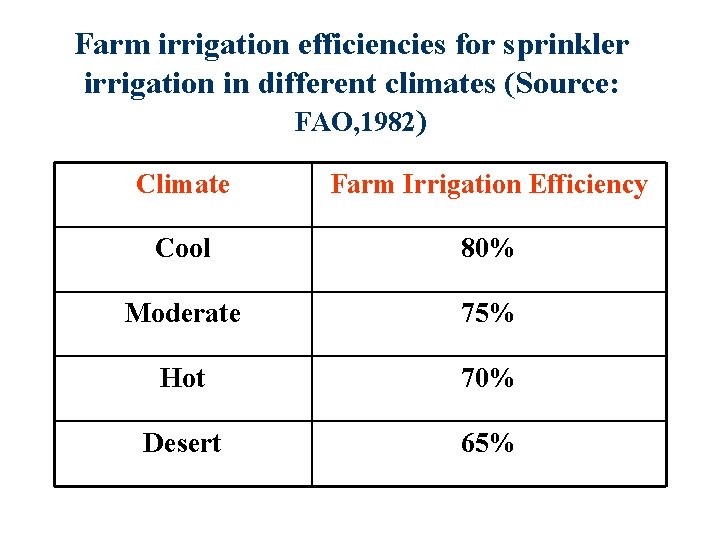
Farm irrigation efficiencies for sprinkler irrigation in different climates (Source: FAO, 1982) Climate Farm Irrigation Efficiency Cool 80% Moderate 75% Hot 70% Desert 65%
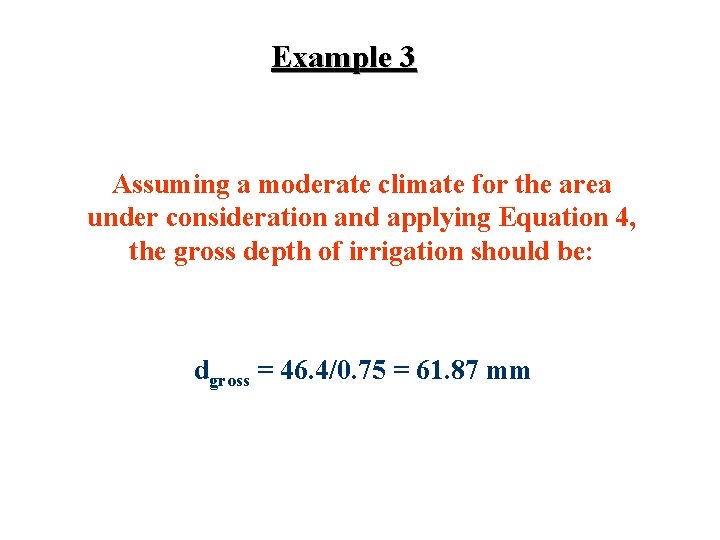
Example 3 Assuming a moderate climate for the area under consideration and applying Equation 4, the gross depth of irrigation should be: dgross = 46. 4/0. 75 = 61. 87 mm
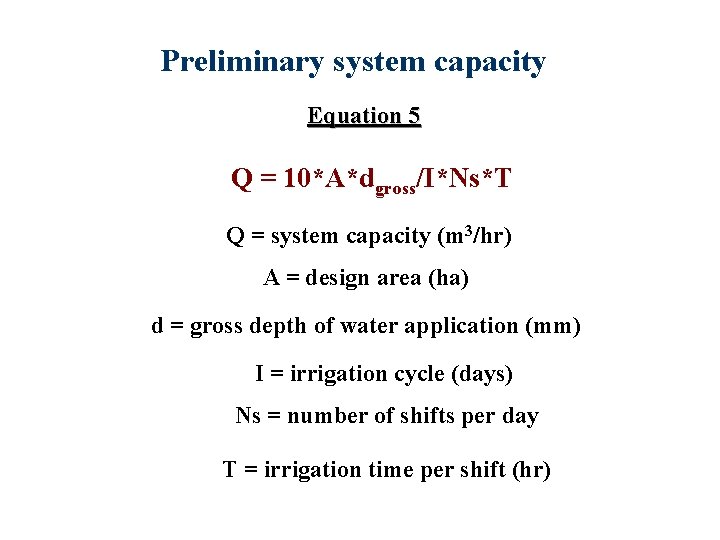
Preliminary system capacity Equation 5 Q = 10*A*dgross/I*Ns*T Q = system capacity (m 3/hr) A = design area (ha) d = gross depth of water application (mm) I = irrigation cycle (days) Ns = number of shifts per day T = irrigation time per shift (hr)
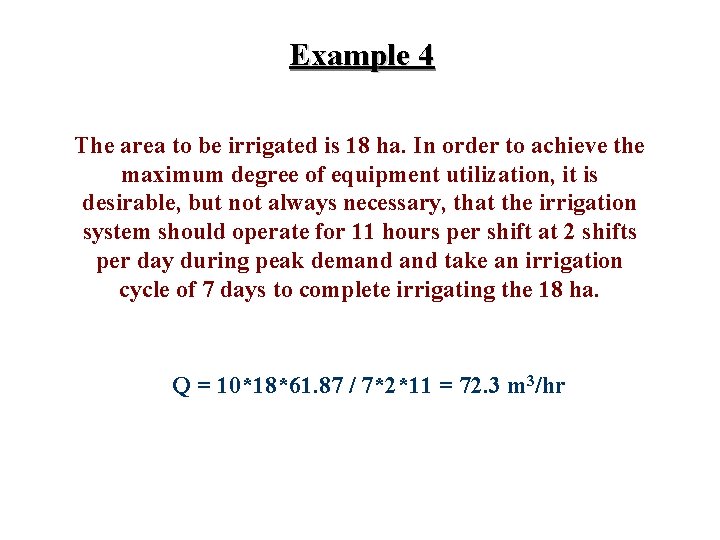
Example 4 The area to be irrigated is 18 ha. In order to achieve the maximum degree of equipment utilization, it is desirable, but not always necessary, that the irrigation system should operate for 11 hours per shift at 2 shifts per day during peak demand take an irrigation cycle of 7 days to complete irrigating the 18 ha. Q = 10*18*61. 87 / 7*2*11 = 72. 3 m 3/hr
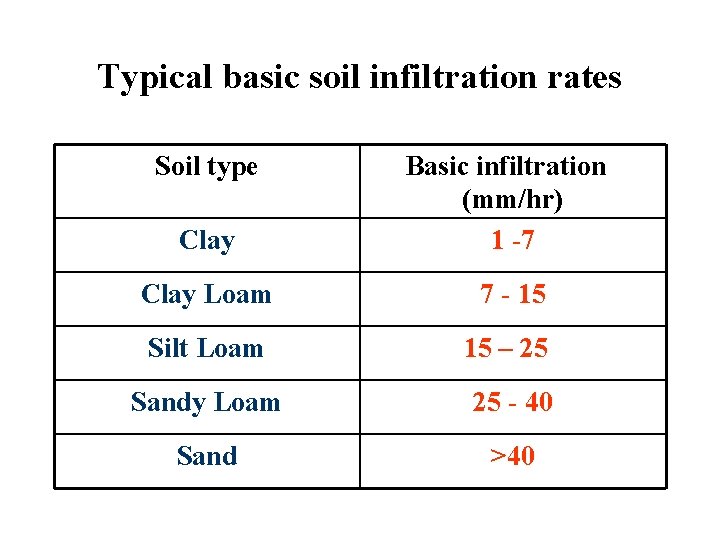
Typical basic soil infiltration rates Soil type Clay Basic infiltration (mm/hr) 1 -7 Clay Loam 7 - 15 Silt Loam 15 – 25 Sandy Loam 25 - 40 Sand >40
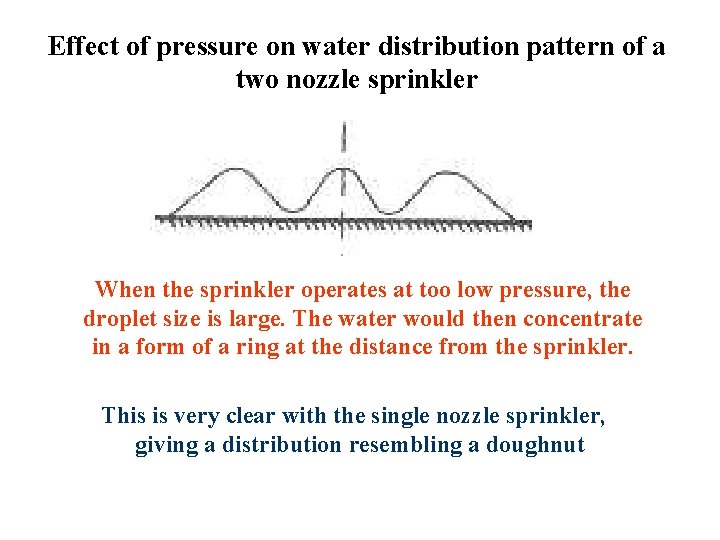
Effect of pressure on water distribution pattern of a two nozzle sprinkler When the sprinkler operates at too low pressure, the droplet size is large. The water would then concentrate in a form of a ring at the distance from the sprinkler. This is very clear with the single nozzle sprinkler, giving a distribution resembling a doughnut
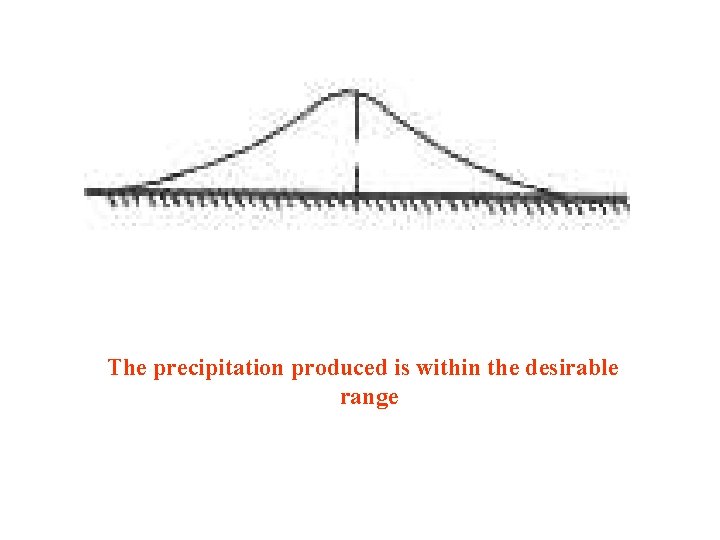
The precipitation produced is within the desirable range
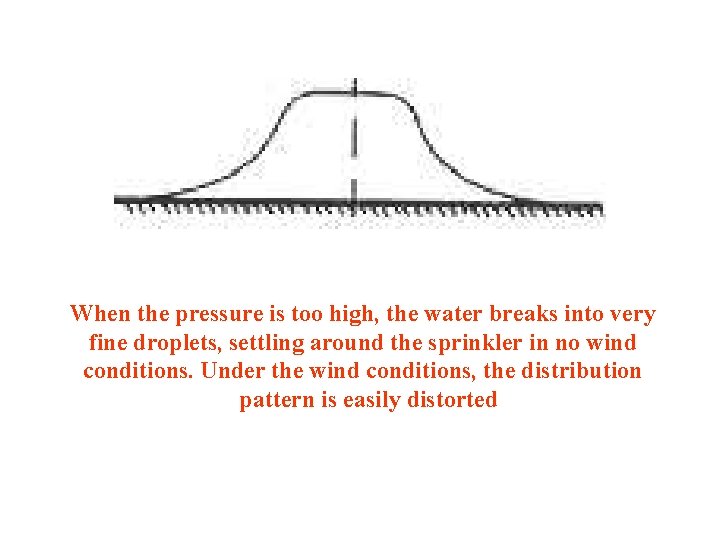
When the pressure is too high, the water breaks into very fine droplets, settling around the sprinkler in no wind conditions. Under the wind conditions, the distribution pattern is easily distorted
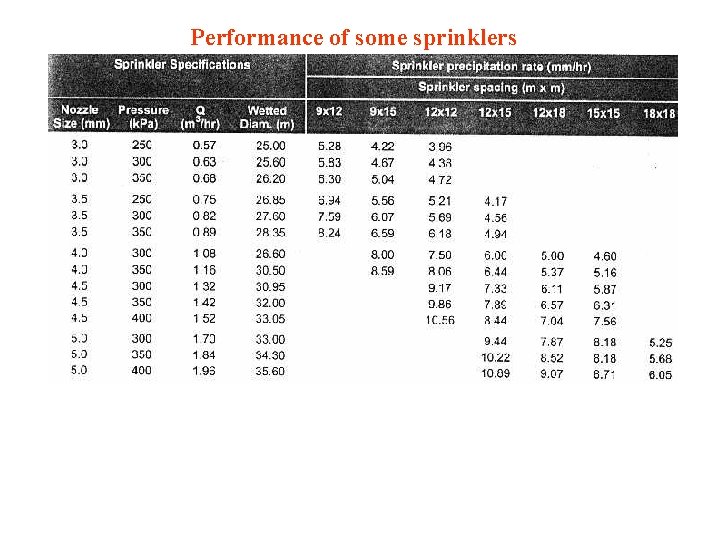
Performance of some sprinklers
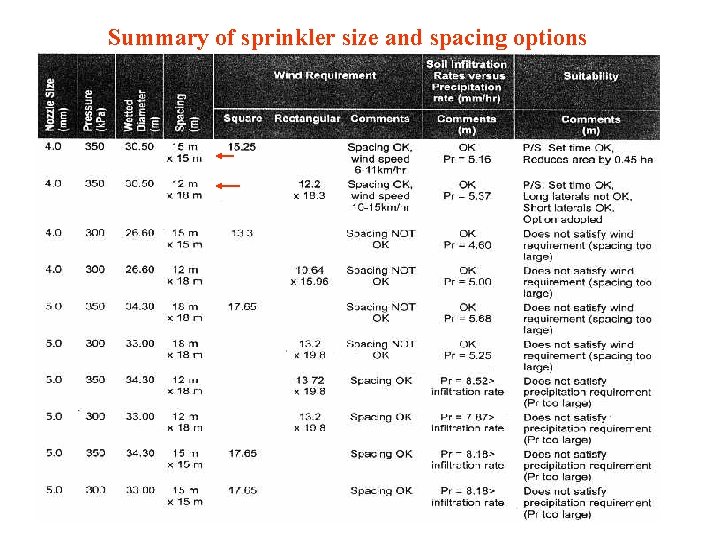
Nozzle size indicate the diameter of the orifice of the nozzle. Pressure is the sprinkler operating pressure at the nozzle. Discharge indicates the volume of water per unit time that the nozzle provides at a given pressure Wetted diameter shows the diameter of the circular area wetted by the sprinkler when operating at a given pressure and no wind The sprinkler spacing shows the pattern in which the sprinklers are laid onto the irrigated area. A 12 m*18 m spacing means that sprinklers are spaced at 12 m along the sprinkler lateral line and 18 m between sprinkler lines.
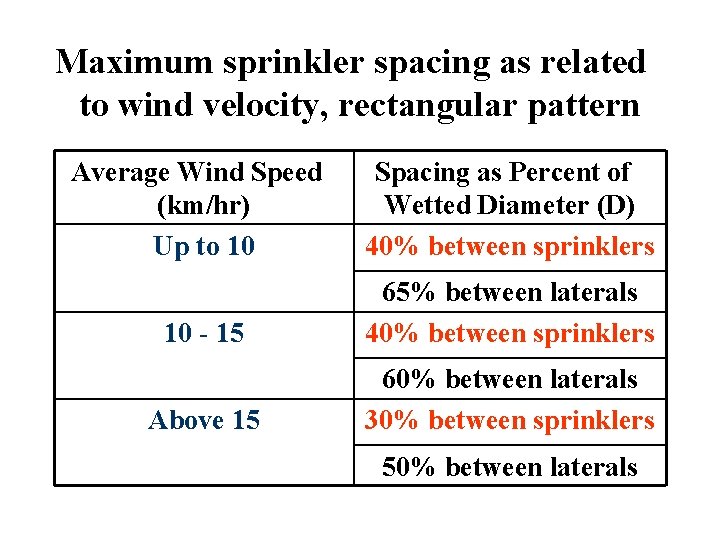
Maximum sprinkler spacing as related to wind velocity, rectangular pattern Average Wind Speed (km/hr) Up to 10 Spacing as Percent of Wetted Diameter (D) 40% between sprinklers 10 - 15 65% between laterals 40% between sprinklers Above 15 60% between laterals 30% between sprinklers 50% between laterals
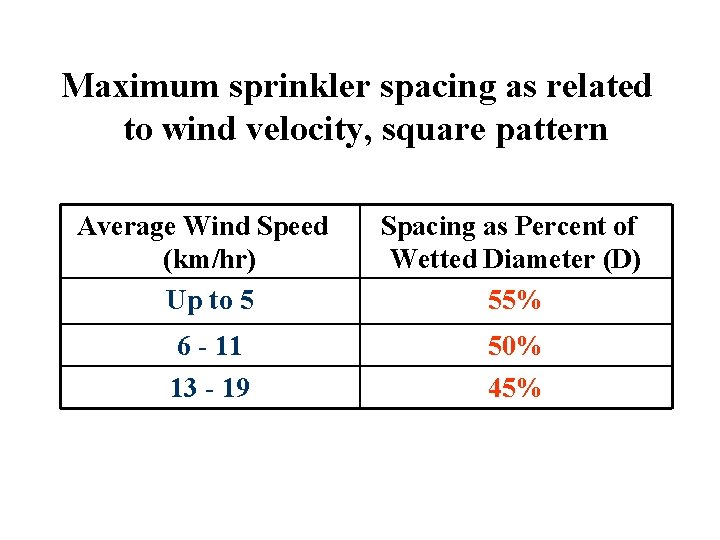
Maximum sprinkler spacing as related to wind velocity, square pattern Average Wind Speed (km/hr) Up to 5 Spacing as Percent of Wetted Diameter (D) 55% 6 - 11 13 - 19 50% 45%
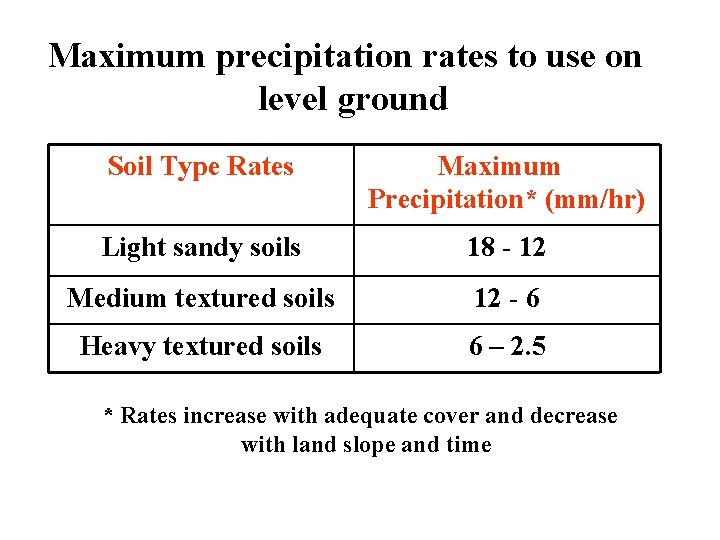
Maximum precipitation rates to use on level ground Soil Type Rates Maximum Precipitation* (mm/hr) Light sandy soils 18 - 12 Medium textured soils 12 - 6 Heavy textured soils 6 – 2. 5 * Rates increase with adequate cover and decrease with land slope and time
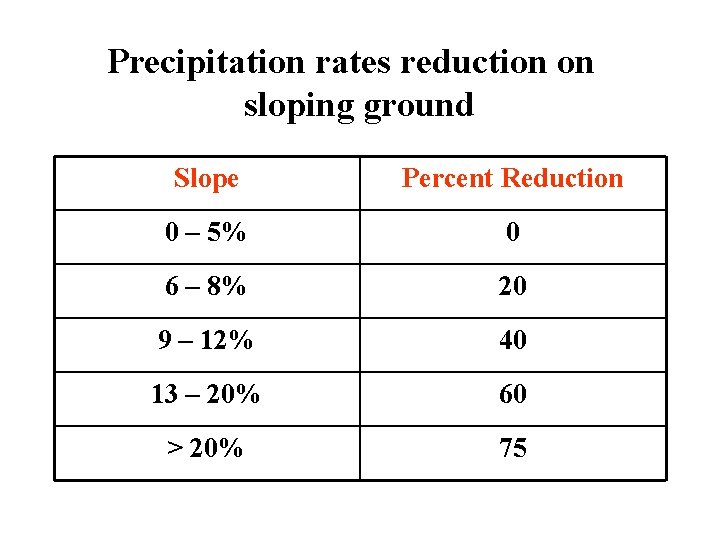
Precipitation rates reduction on sloping ground Slope Percent Reduction 0 – 5% 0 6 – 8% 20 9 – 12% 40 13 – 20% 60 > 20% 75
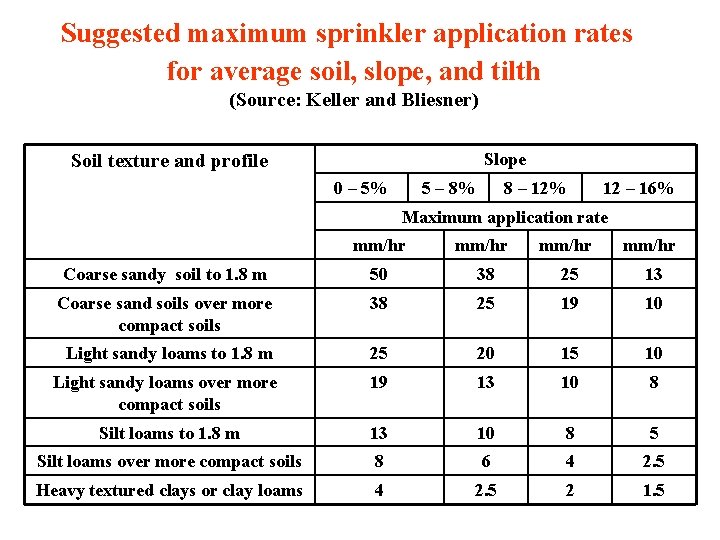
Suggested maximum sprinkler application rates for average soil, slope, and tilth (Source: Keller and Bliesner) Slope Soil texture and profile 0 – 5% 5 – 8% 8 – 12% 12 – 16% Maximum application rate mm/hr Coarse sandy soil to 1. 8 m 50 38 25 13 Coarse sand soils over more compact soils 38 25 19 10 Light sandy loams to 1. 8 m 25 20 15 10 Light sandy loams over more compact soils 19 13 10 8 Silt loams to 1. 8 m 13 10 8 5 Silt loams over more compact soils 8 6 4 2. 5 Heavy textured clays or clay loams 4 2. 5 2 1. 5
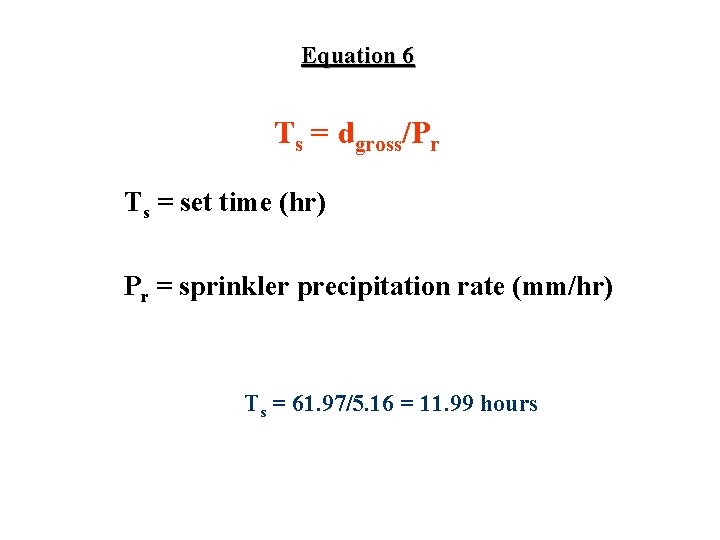
Equation 6 Ts = dgross/Pr Ts = set time (hr) Pr = sprinkler precipitation rate (mm/hr) Ts = 61. 97/5. 16 = 11. 99 hours
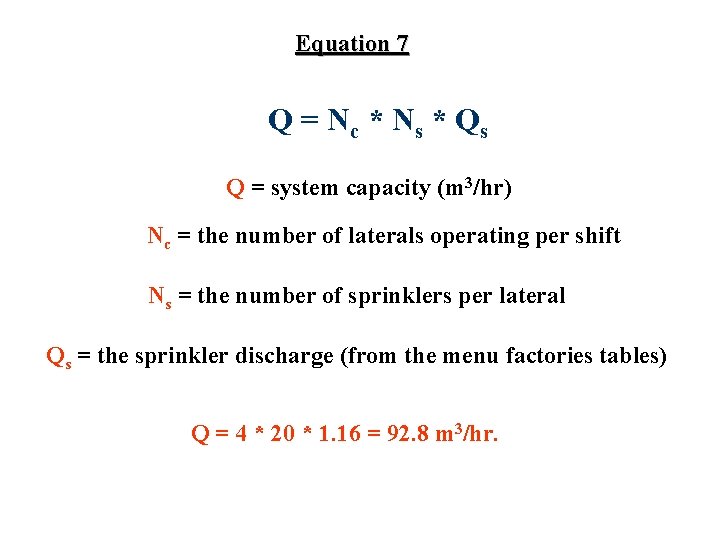
Equation 7 Q = Nc * Ns * Q s Q = system capacity (m 3/hr) Nc = the number of laterals operating per shift Ns = the number of sprinklers per lateral Qs = the sprinkler discharge (from the menu factories tables) Q = 4 * 20 * 1. 16 = 92. 8 m 3/hr.
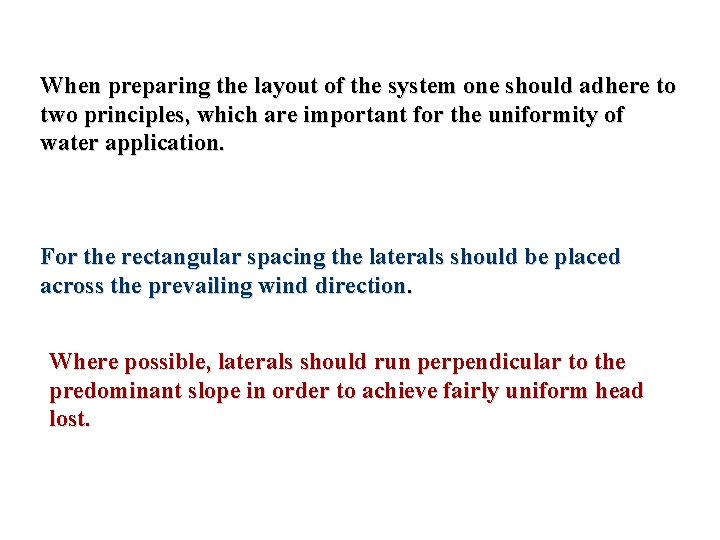
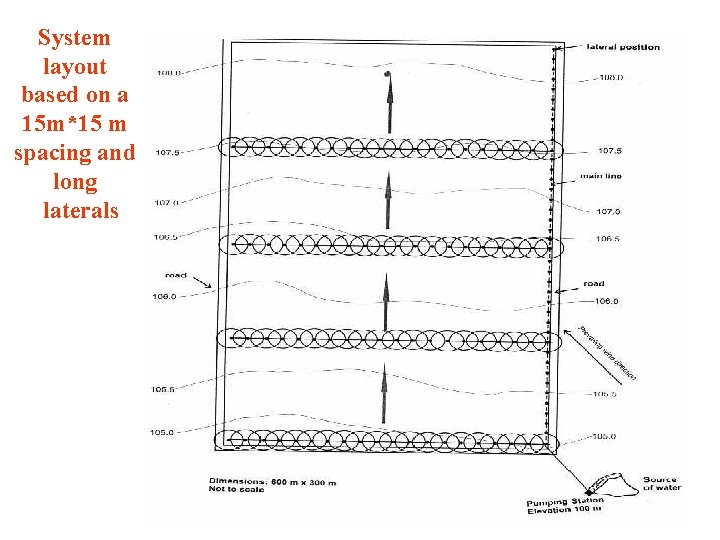
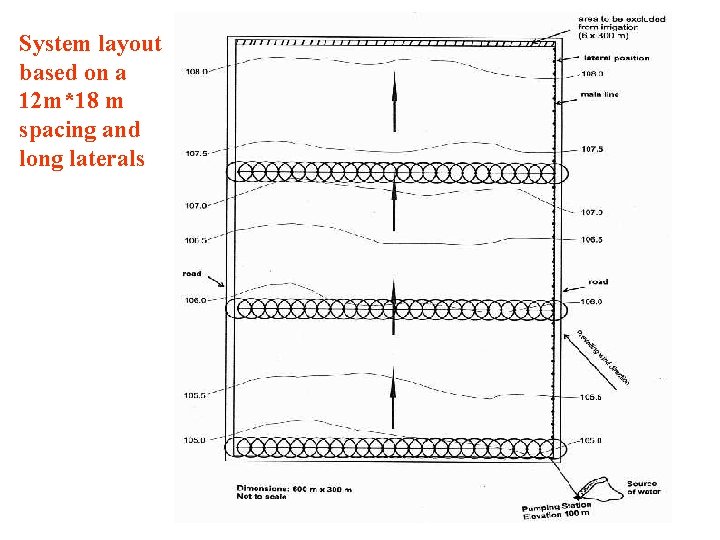
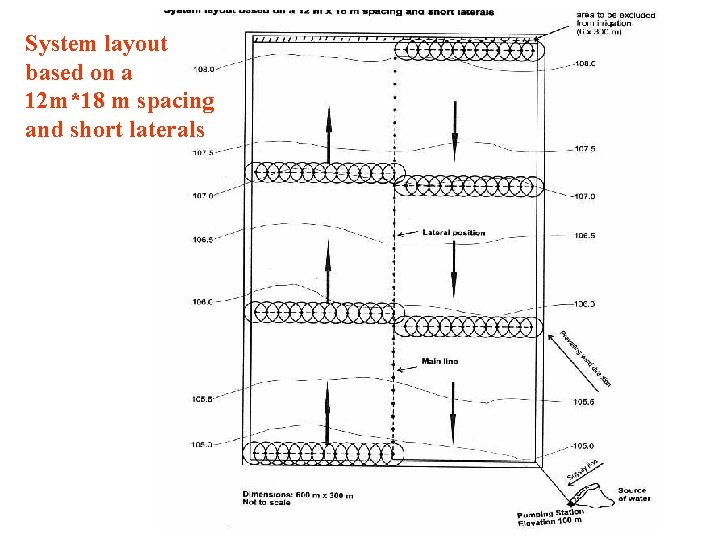
When preparing the layout of the system one should adhere to two principles, which are important for the uniformity of water application. For the rectangular spacing the laterals should be placed across the prevailing wind direction. Where possible, laterals should run perpendicular to the predominant slope in order to achieve fairly uniform head lost.
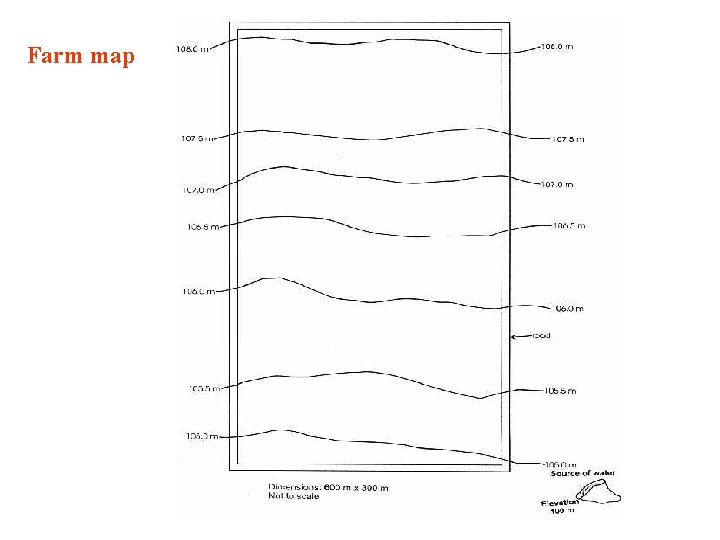
Farm map
System layout based on a 15 m*15 m spacing and long laterals
System layout based on a 12 m*18 m spacing and long laterals
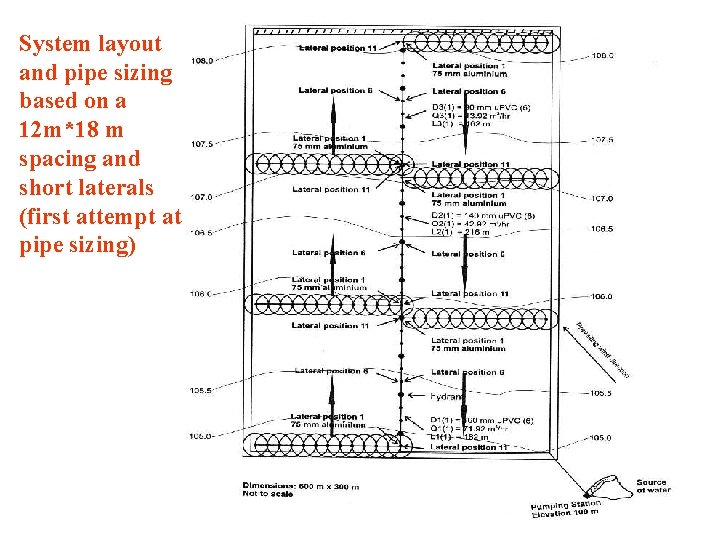
System layout based on a 12 m*18 m spacing and short laterals
Summary of sprinkler size and spacing options
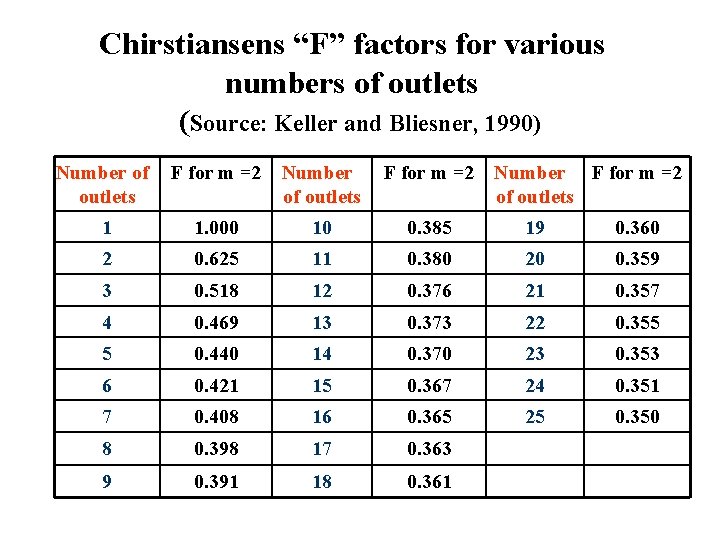
Chirstiansens “F” factors for various numbers of outlets (Source: Keller and Bliesner, 1990) Number of outlets F for m =2 Number F for m =2 of outlets 1 1. 000 10 0. 385 19 0. 360 2 0. 625 11 0. 380 20 0. 359 3 0. 518 12 0. 376 21 0. 357 4 0. 469 13 0. 373 22 0. 355 5 0. 440 14 0. 370 23 0. 353 6 0. 421 15 0. 367 24 0. 351 7 0. 408 16 0. 365 25 0. 350 8 0. 398 17 0. 363 9 0. 391 18 0. 361
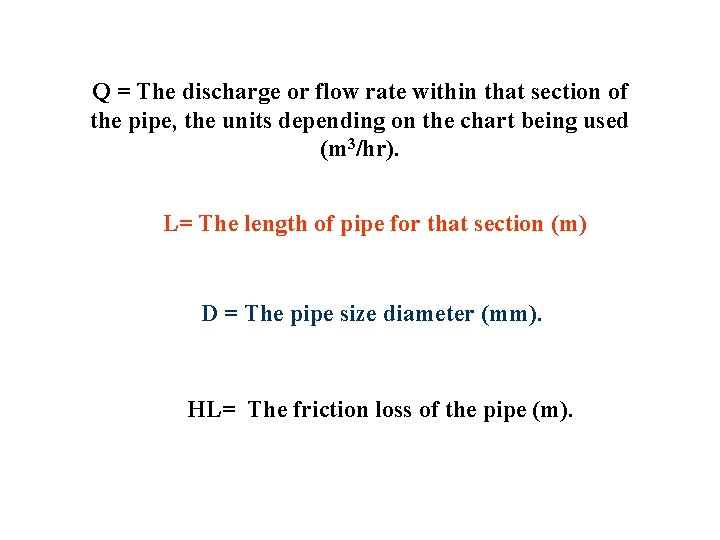
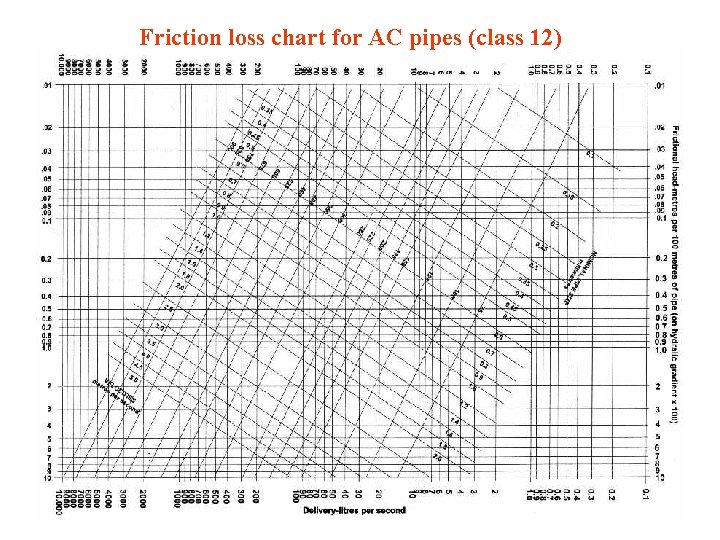
Q = The discharge or flow rate within that section of the pipe, the units depending on the chart being used (m 3/hr). L= The length of pipe for that section (m) D = The pipe size diameter (mm). HL= The friction loss of the pipe (m).
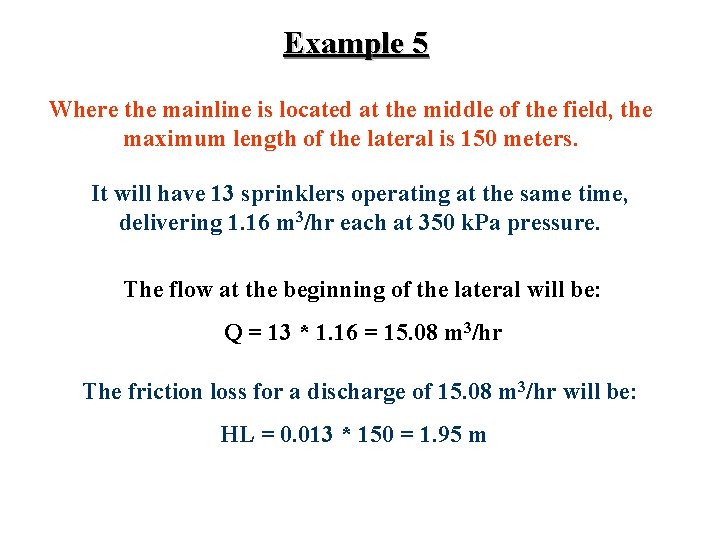
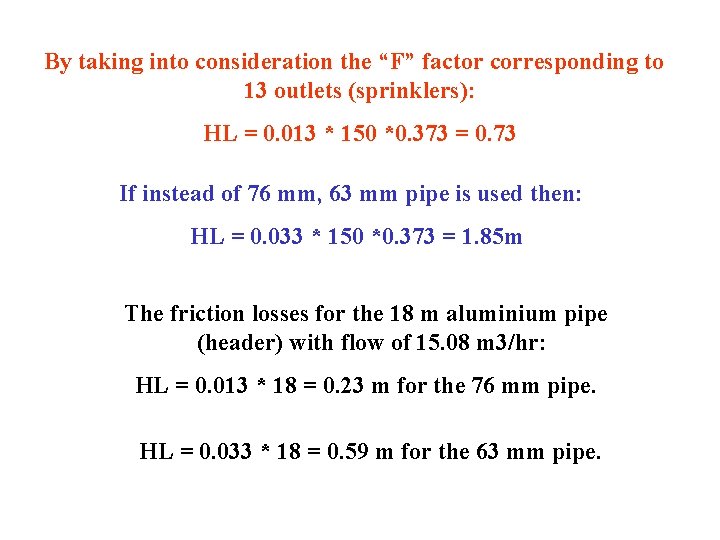
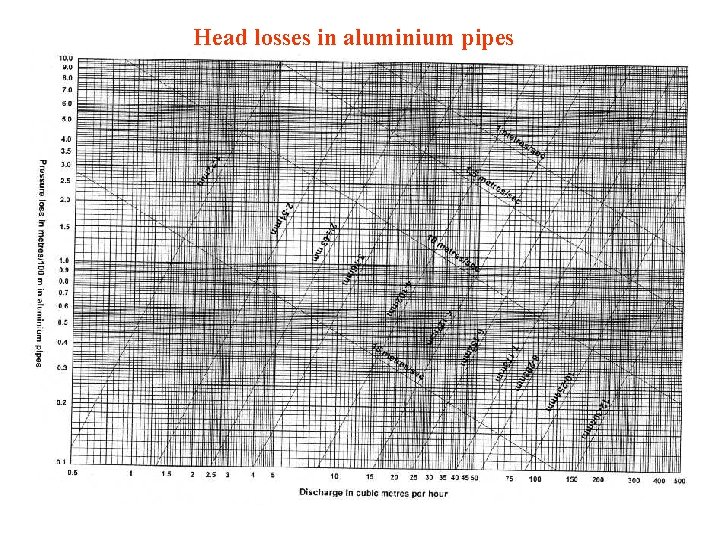
Example 5 Where the mainline is located at the middle of the field, the maximum length of the lateral is 150 meters. It will have 13 sprinklers operating at the same time, delivering 1. 16 m 3/hr each at 350 k. Pa pressure. The flow at the beginning of the lateral will be: Q = 13 * 1. 16 = 15. 08 m 3/hr The friction loss for a discharge of 15. 08 m 3/hr will be: HL = 0. 013 * 150 = 1. 95 m
By taking into consideration the “F” factor corresponding to 13 outlets (sprinklers): HL = 0. 013 * 150 *0. 373 = 0. 73 If instead of 76 mm, 63 mm pipe is used then: HL = 0. 033 * 150 *0. 373 = 1. 85 m The friction losses for the 18 m aluminium pipe (header) with flow of 15. 08 m 3/hr: HL = 0. 013 * 18 = 0. 23 m for the 76 mm pipe. HL = 0. 033 * 18 = 0. 59 m for the 63 mm pipe.
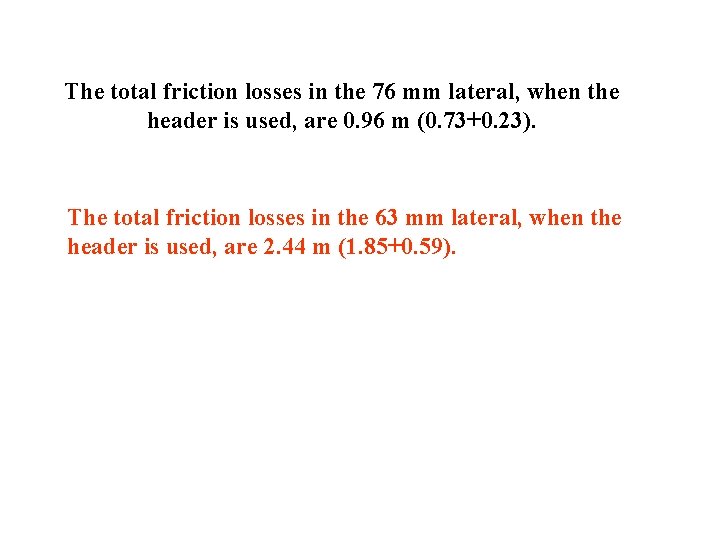
The total friction losses in the 76 mm lateral, when the header is used, are 0. 96 m (0. 73+0. 23). The total friction losses in the 63 mm lateral, when the header is used, are 2. 44 m (1. 85+0. 59).
Head losses in aluminium pipes
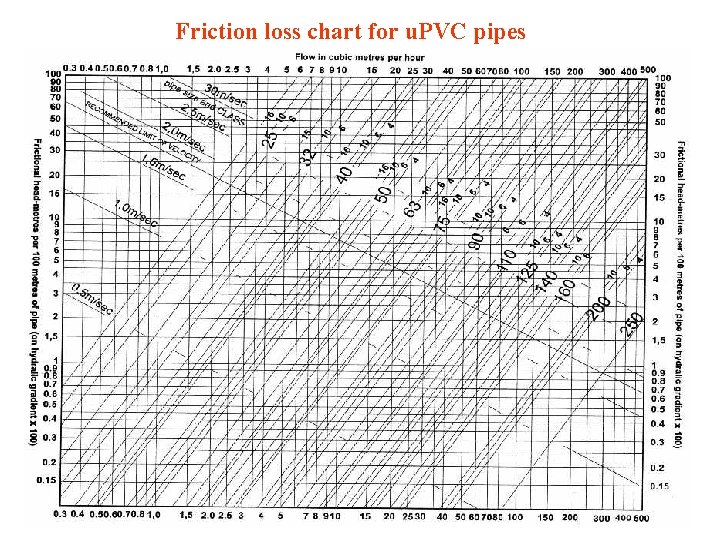
Friction loss chart for u. PVC pipes
Friction loss chart for AC pipes (class 12)
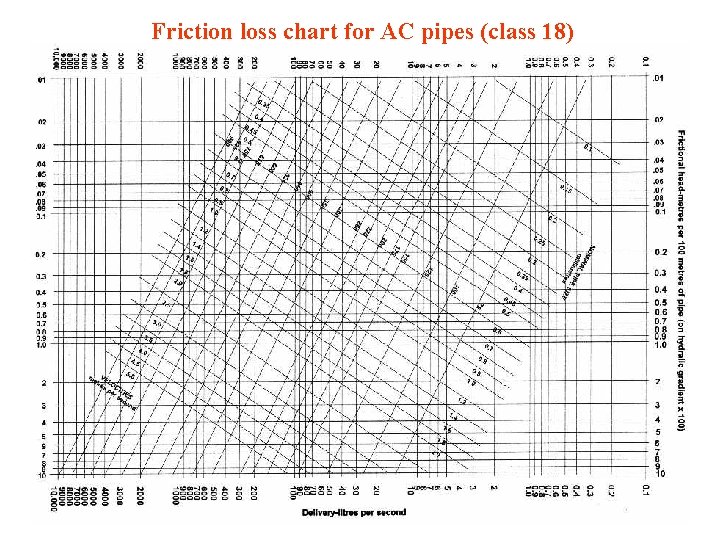
Friction loss chart for AC pipes (class 18)
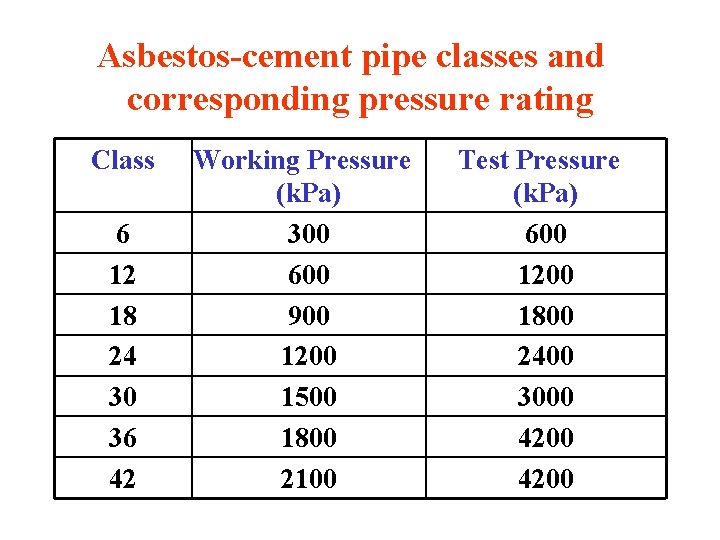
Asbestos-cement pipe classes and corresponding pressure rating Class 6 12 18 24 30 36 42 Working Pressure (k. Pa) 300 600 900 1200 1500 1800 2100 Test Pressure (k. Pa) 600 1200 1800 2400 3000 4200
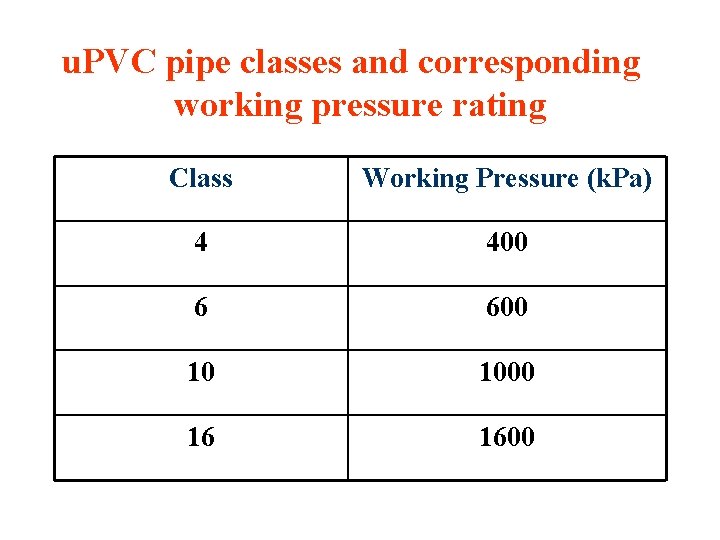
u. PVC pipe classes and corresponding working pressure rating Class Working Pressure (k. Pa) 4 400 6 600 10 1000 16 1600
System layout and pipe sizing based on a 12 m*18 m spacing and short laterals (first attempt at pipe sizing)
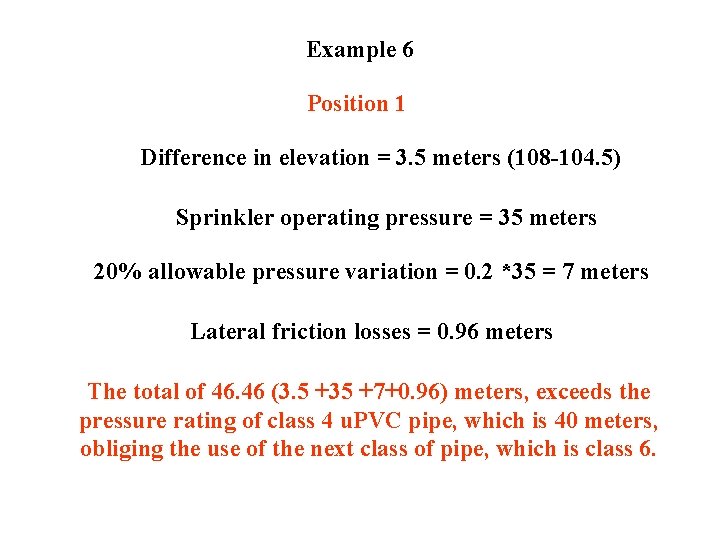
Example 6 Position 1 Difference in elevation = 3. 5 meters (108 -104. 5) Sprinkler operating pressure = 35 meters 20% allowable pressure variation = 0. 2 *35 = 7 meters Lateral friction losses = 0. 96 meters The total of 46. 46 (3. 5 +35 +7+0. 96) meters, exceeds the pressure rating of class 4 u. PVC pipe, which is 40 meters, obliging the use of the next class of pipe, which is class 6.
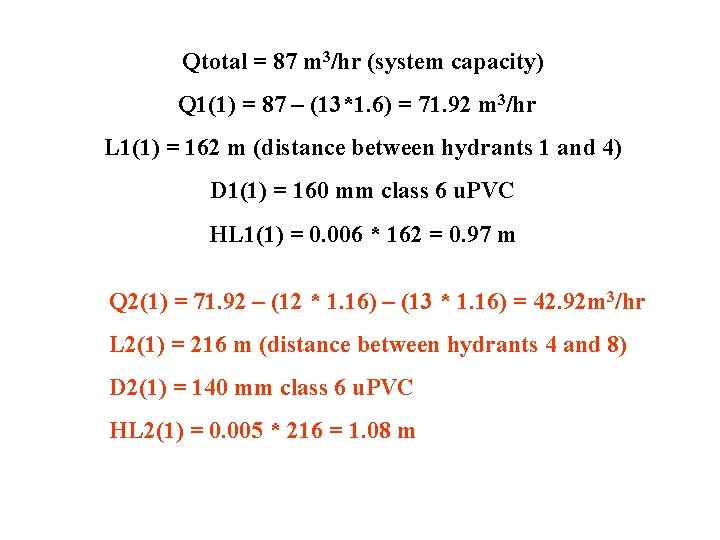
Qtotal = 87 m 3/hr (system capacity) Q 1(1) = 87 – (13*1. 6) = 71. 92 m 3/hr L 1(1) = 162 m (distance between hydrants 1 and 4) D 1(1) = 160 mm class 6 u. PVC HL 1(1) = 0. 006 * 162 = 0. 97 m Q 2(1) = 71. 92 – (12 * 1. 16) – (13 * 1. 16) = 42. 92 m 3/hr L 2(1) = 216 m (distance between hydrants 4 and 8) D 2(1) = 140 mm class 6 u. PVC HL 2(1) = 0. 005 * 216 = 1. 08 m
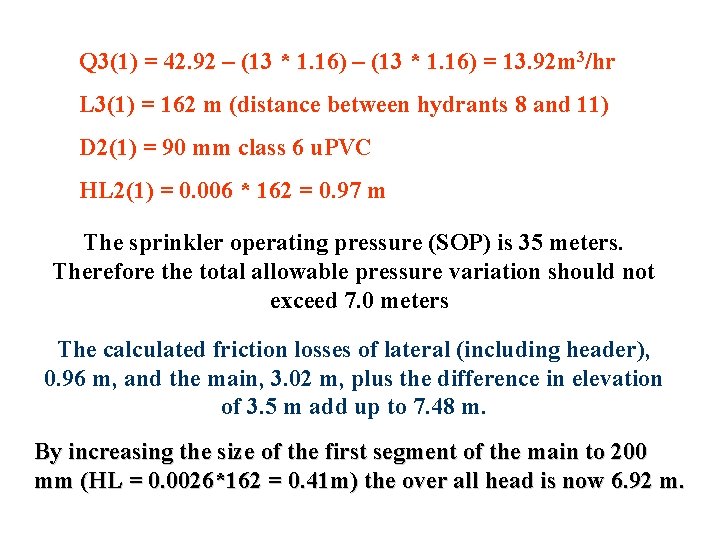
Q 3(1) = 42. 92 – (13 * 1. 16) = 13. 92 m 3/hr L 3(1) = 162 m (distance between hydrants 8 and 11) D 2(1) = 90 mm class 6 u. PVC HL 2(1) = 0. 006 * 162 = 0. 97 m The sprinkler operating pressure (SOP) is 35 meters. Therefore the total allowable pressure variation should not exceed 7. 0 meters The calculated friction losses of lateral (including header), 0. 96 m, and the main, 3. 02 m, plus the difference in elevation of 3. 5 m add up to 7. 48 m. By increasing the size of the first segment of the main to 200 mm (HL = 0. 0026*162 = 0. 41 m) the over all head is now 6. 92 m.
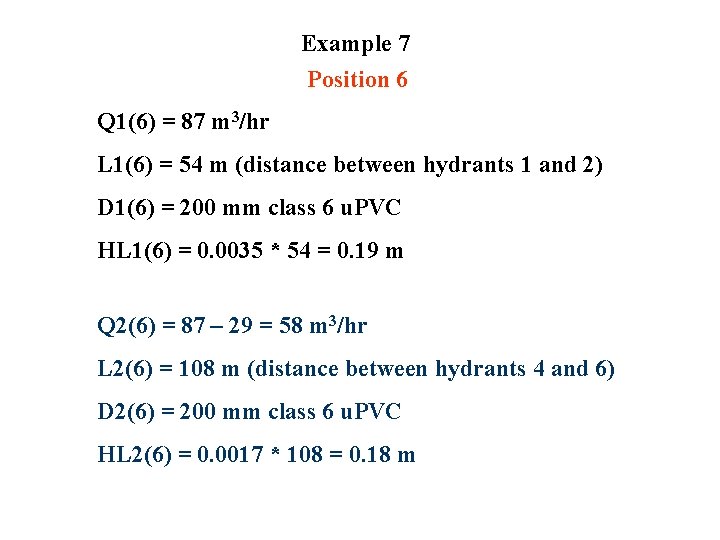
Example 7 Position 6 Q 1(6) = 87 m 3/hr L 1(6) = 54 m (distance between hydrants 1 and 2) D 1(6) = 200 mm class 6 u. PVC HL 1(6) = 0. 0035 * 54 = 0. 19 m Q 2(6) = 87 – 29 = 58 m 3/hr L 2(6) = 108 m (distance between hydrants 4 and 6) D 2(6) = 200 mm class 6 u. PVC HL 2(6) = 0. 0017 * 108 = 0. 18 m
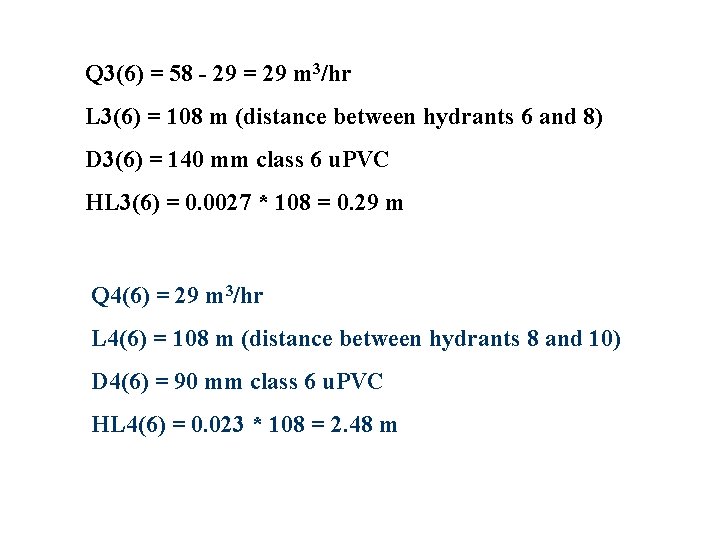
Q 3(6) = 58 - 29 = 29 m 3/hr L 3(6) = 108 m (distance between hydrants 6 and 8) D 3(6) = 140 mm class 6 u. PVC HL 3(6) = 0. 0027 * 108 = 0. 29 m Q 4(6) = 29 m 3/hr L 4(6) = 108 m (distance between hydrants 8 and 10) D 4(6) = 90 mm class 6 u. PVC HL 4(6) = 0. 023 * 108 = 2. 48 m
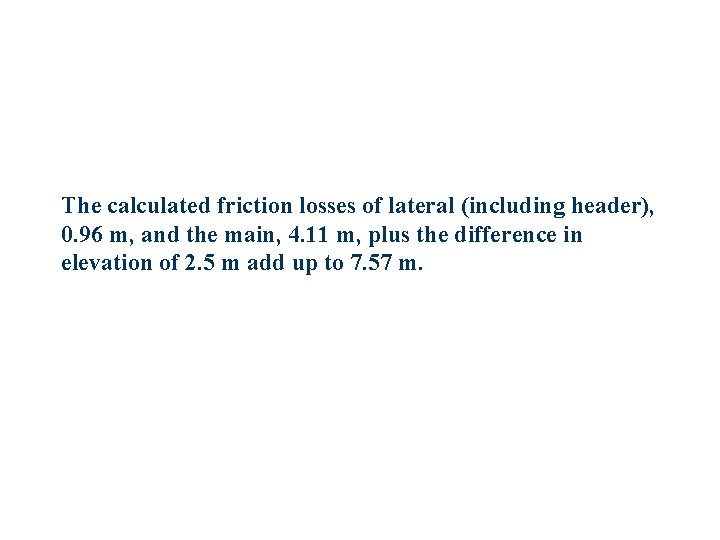
The calculated friction losses of lateral (including header), 0. 96 m, and the main, 4. 11 m, plus the difference in elevation of 2. 5 m add up to 7. 57 m.
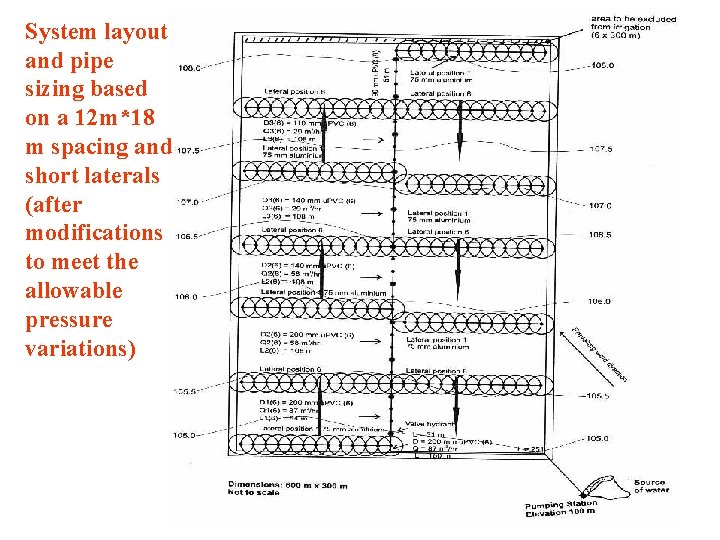
System layout and pipe sizing based on a 12 m*18 m spacing and short laterals (after modifications to meet the allowable pressure variations)
Total head requirements Pump suction lift The friction losses in the supply line. The friction losses in the main, lateral and fittings, the riser, the sprinkler operating pressure and the difference in elevation.
The suction lift is the difference in elevation between the water level and the eye of the pump impeller plus the head losses in the suction pipe. The head losses of the suction pipe comprise the frictional losses of the pipe, fittings and the velocity head.
The velocity head is equal to: V 2/2 g V = water velocity (m/s) g = acceleration due to gravity (9. 81 m/s 2) Keller and Bliesner recommend that for centrifugal pumps the diameter of the suction pipe should be selected such that the water velocity v < 3. 3 m/s in order to ensure good pump performance
The water level is at 99 m, the difference in elevation between the water and the eye of the impeller (located at 100 m) is 1 m. Maximum velocity head is 0. 56 m, the suction lift is 1. 56 m (1 + 0. 56) The difference in elevation is the difference between the ground level of the sprinkler, located at the highest point, and the eye of the pump impeller 108 – 100 = 8 m
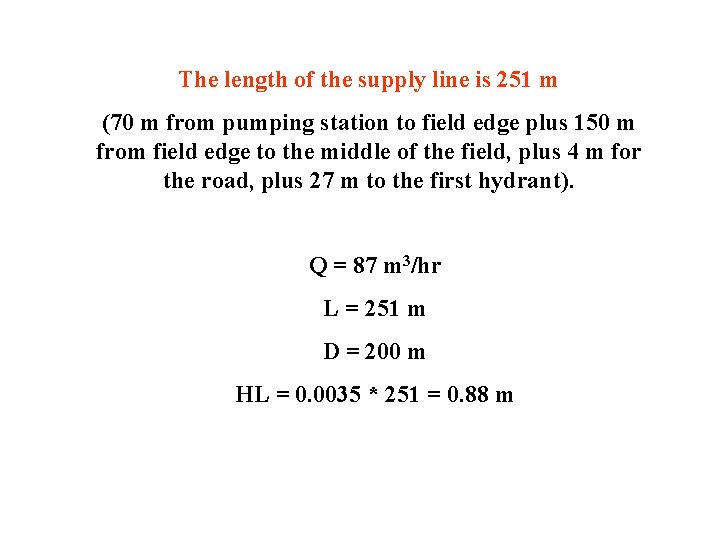
The length of the supply line is 251 m (70 m from pumping station to field edge plus 150 m from field edge to the middle of the field, plus 4 m for the road, plus 27 m to the first hydrant). Q = 87 m 3/hr L = 251 m D = 200 m HL = 0. 0035 * 251 = 0. 88 m
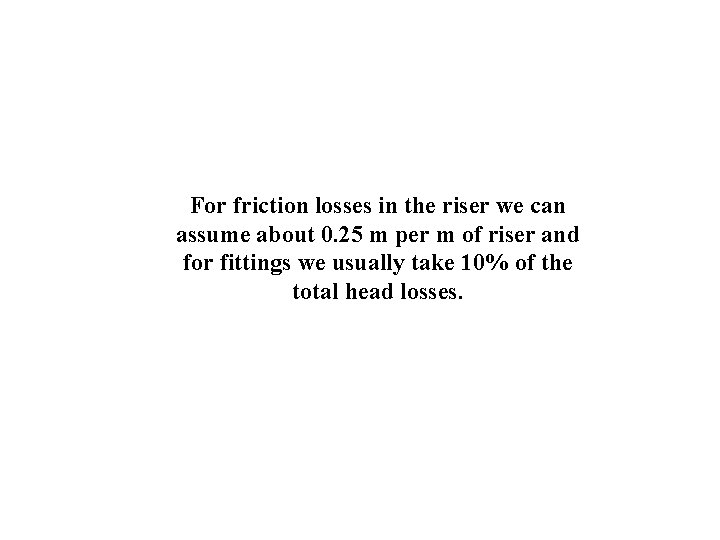
For friction losses in the riser we can assume about 0. 25 m per m of riser and for fittings we usually take 10% of the total head losses.
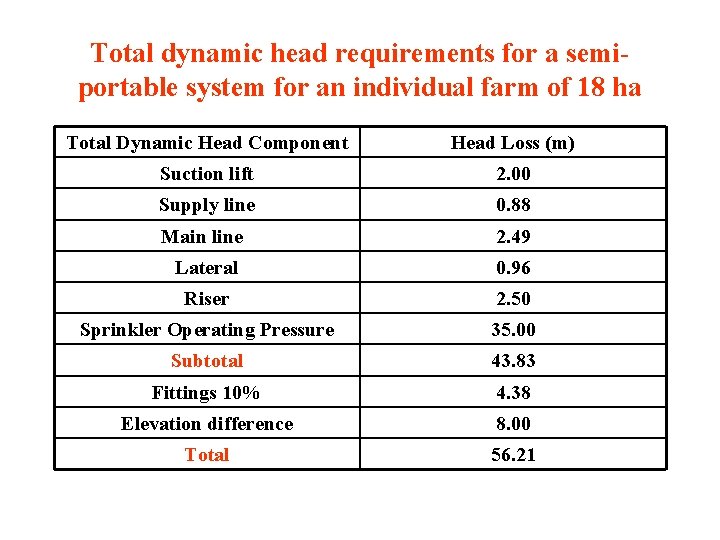
Total dynamic head requirements for a semiportable system for an individual farm of 18 ha Total Dynamic Head Component Head Loss (m) Suction lift 2. 00 Supply line 0. 88 Main line 2. 49 Lateral 0. 96 Riser 2. 50 Sprinkler Operating Pressure 35. 00 Subtotal 43. 83 Fittings 10% 4. 38 Elevation difference 8. 00 Total 56. 21
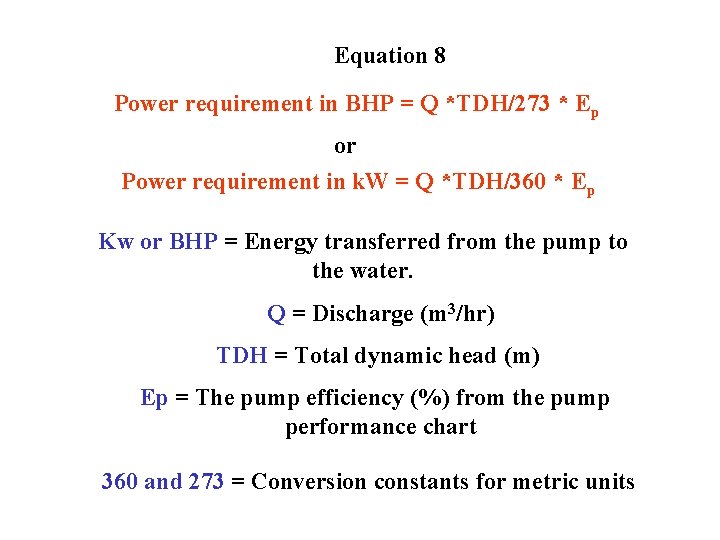
Equation 8 Power requirement in BHP = Q *TDH/273 * Ep or Power requirement in k. W = Q *TDH/360 * Ep Kw or BHP = Energy transferred from the pump to the water. Q = Discharge (m 3/hr) TDH = Total dynamic head (m) Ep = The pump efficiency (%) from the pump performance chart 360 and 273 = Conversion constants for metric units
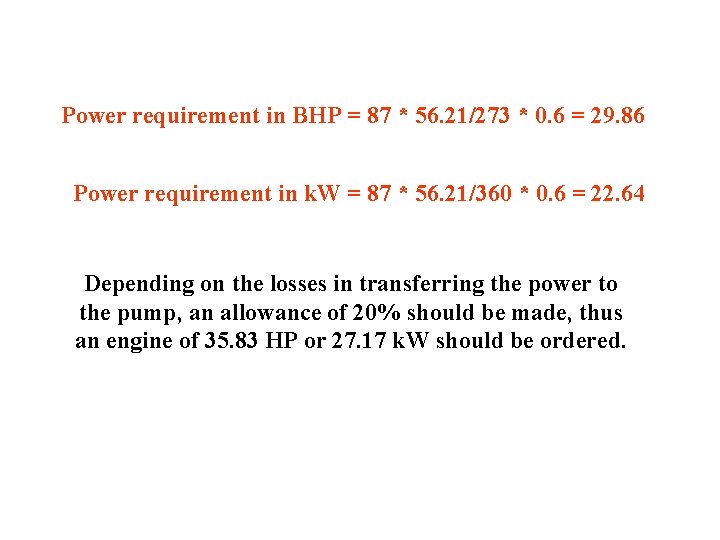
Power requirement in BHP = 87 * 56. 21/273 * 0. 6 = 29. 86 Power requirement in k. W = 87 * 56. 21/360 * 0. 6 = 22. 64 Depending on the losses in transferring the power to the pump, an allowance of 20% should be made, thus an engine of 35. 83 HP or 27. 17 k. W should be ordered.