
DESIGN OF NORTHERN ELECTRICAL TRANSMISSION NETWORK IN WEST

- Slides: 48
DESIGN OF NORTHERN ELECTRICAL TRANSMISSION NETWORK IN WEST BANK By Rabei Hendyeh Hamza Hinnawi Mohammed Burghal Supervised by: Dr. Maher Khmmash
Introduction � Our project is to design transmission network in the Northern West Bank, we will use high voltage such as 161 k. V which is taken directly from IEC. So that we can skip some of huge transformers in the network which are very costly. � We have 2 connection points, Sara and Al. Jalamah which is swing bus, with 135 MW capacity for each one. So our project is to make the best configuration technically and economically to perform our network.
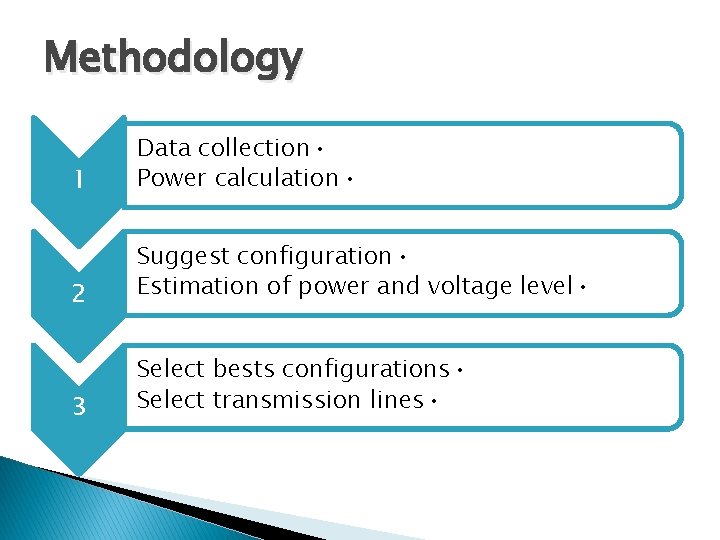
Methodology 1 Data collection • Power calculation • 2 Suggest configuration • Estimation of power and voltage level • 3 Select bests configurations • Select transmission lines •
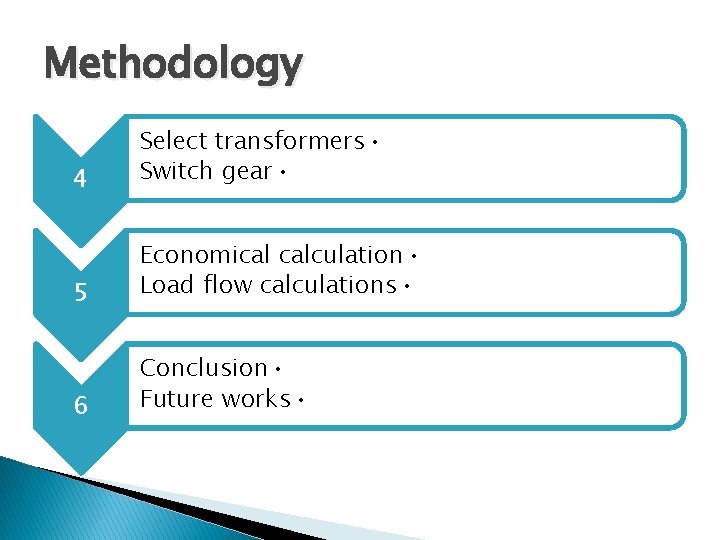
Methodology 4 Select transformers • Switch gear • 5 Economical calculation • Load flow calculations • 6 Conclusion • Future works •
Current situation � The cities of west bank is fed by several small connection points from IEC side distributed around main cities at 33 kv or fed directly from Israel at 161 kv like Tulqarem and Qalqilya or fed form near settlements for more than 125 SPS feeding 130 MVA especially for villages. � Tulqarem and Qalqilya regions have 22 KV systems, and the Northern electrical systems are operated at 33 KV.
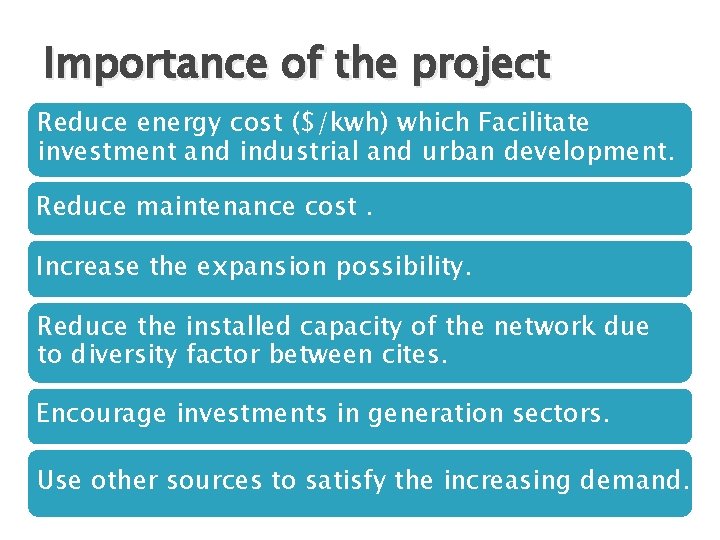
Importance of the project Reduce energy cost ($/kwh) which Facilitate investment and industrial and urban development. Reduce maintenance cost. Increase the expansion possibility. Reduce the installed capacity of the network due to diversity factor between cites. Encourage investments in generation sectors. Use other sources to satisfy the increasing demand.
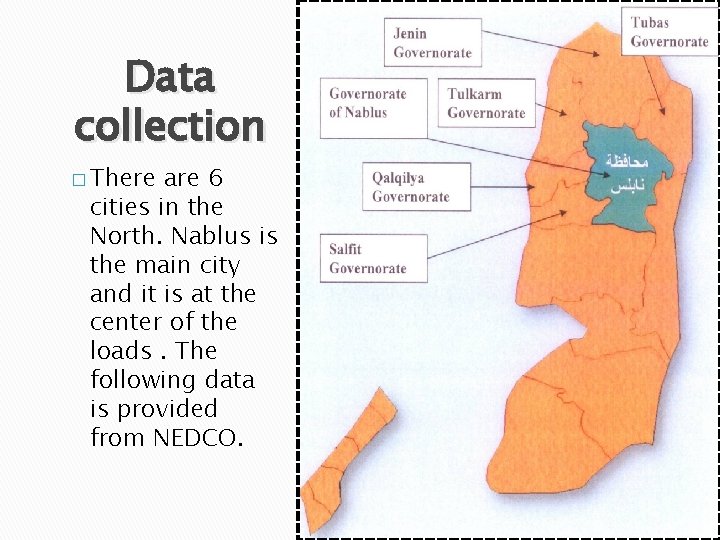
Data collection � There are 6 cities in the North. Nablus is the main city and it is at the center of the loads. The following data is provided from NEDCO.
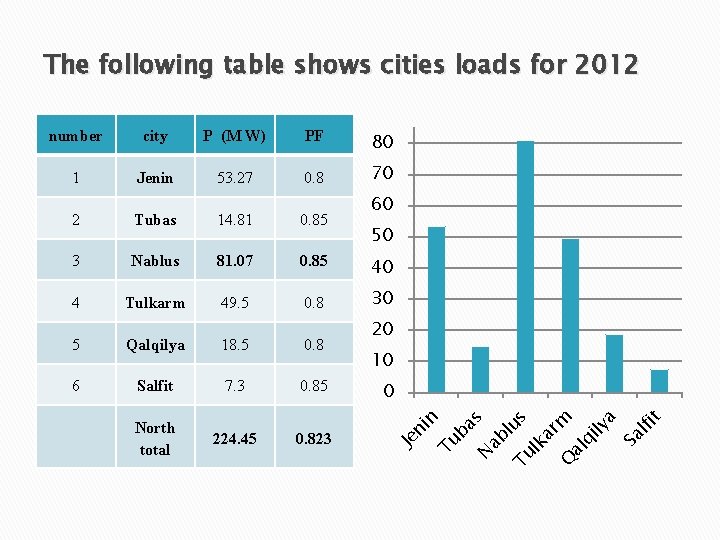
The following table shows cities loads for 2012 number city P (M W) PF 80 1 Jenin 53. 27 0. 8 70 60 2 Tubas 14. 81 0. 85 3 Nablus 81. 07 0. 85 40 4 Tulkarm 49. 5 0. 8 30 North total 224. 45 0. 823 0 l Tu us lk ar m Q al qi ly a Sa lfi t 0. 85 ab 7. 3 s Salfit N 6 10 ba 0. 8 Tu 18. 5 ni n Qalqilya 20 Je 5 50
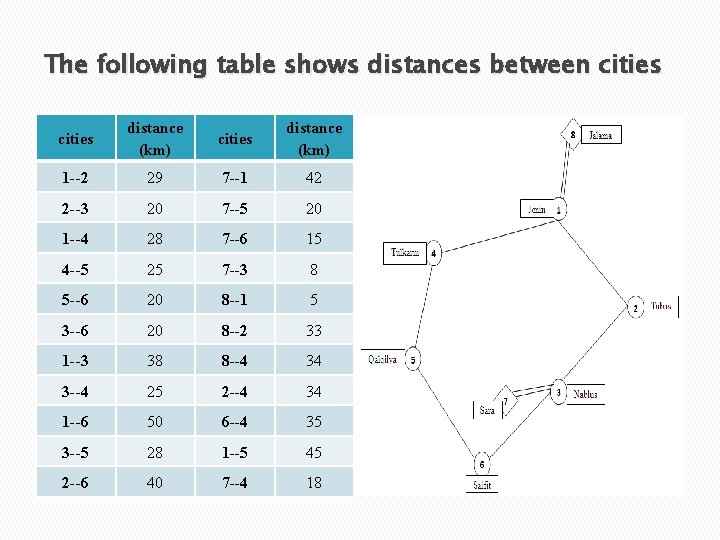
The following table shows distances between cities distance (km) 1 --2 29 7 --1 42 2 --3 20 7 --5 20 1 --4 28 7 --6 15 4 --5 25 7 --3 8 5 --6 20 8 --1 5 3 --6 20 8 --2 33 1 --3 38 8 --4 34 3 --4 25 2 --4 34 1 --6 50 6 --4 35 3 --5 28 1 --5 45 2 --6 40 7 --4 18
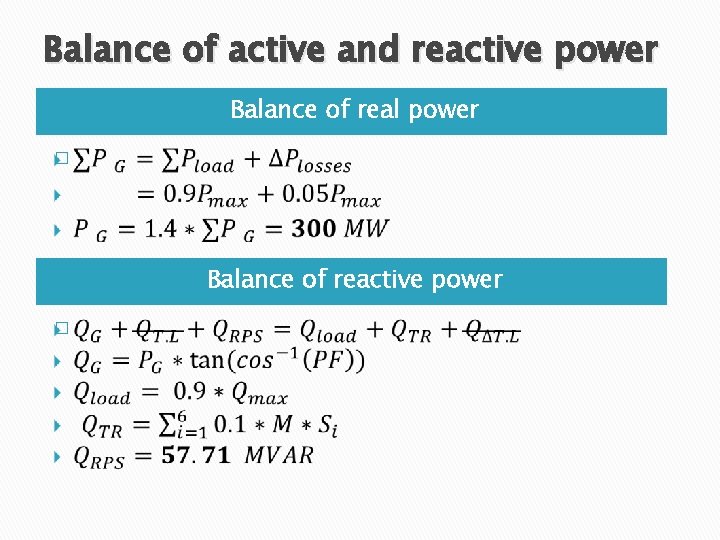
Balance of active and reactive power Balance of real power � Balance of reactive power �
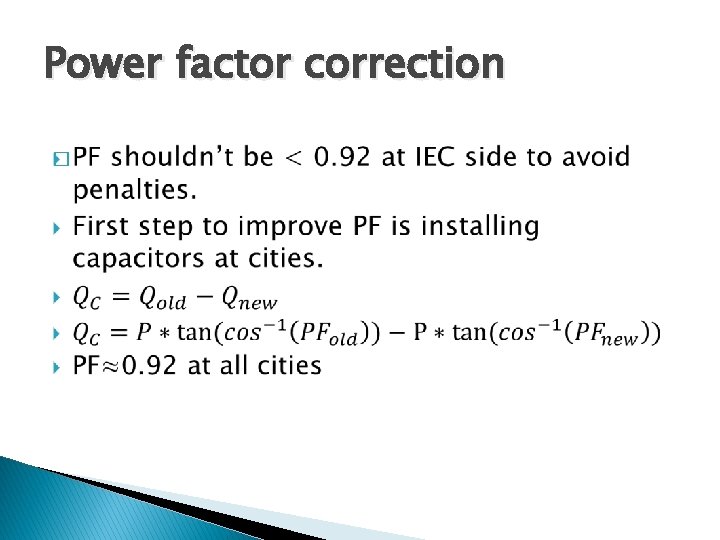
Power factor correction �
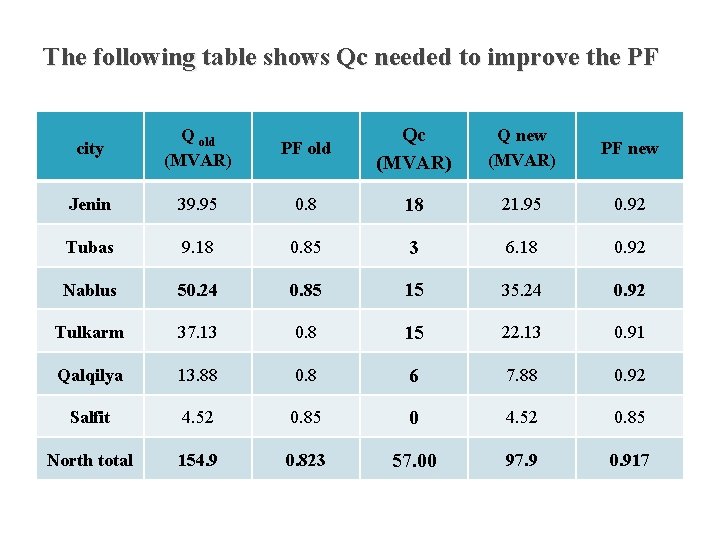
The following table shows Qc needed to improve the PF city Q old (MVAR) PF old Qc (MVAR) Q new (MVAR) PF new Jenin 39. 95 0. 8 18 21. 95 0. 92 Tubas 9. 18 0. 85 3 6. 18 0. 92 Nablus 50. 24 0. 85 15 35. 24 0. 92 Tulkarm 37. 13 0. 8 15 22. 13 0. 91 Qalqilya 13. 88 0. 8 6 7. 88 0. 92 Salfit 4. 52 0. 85 0 4. 52 0. 85 North total 154. 9 0. 823 57. 00 97. 9 0. 917
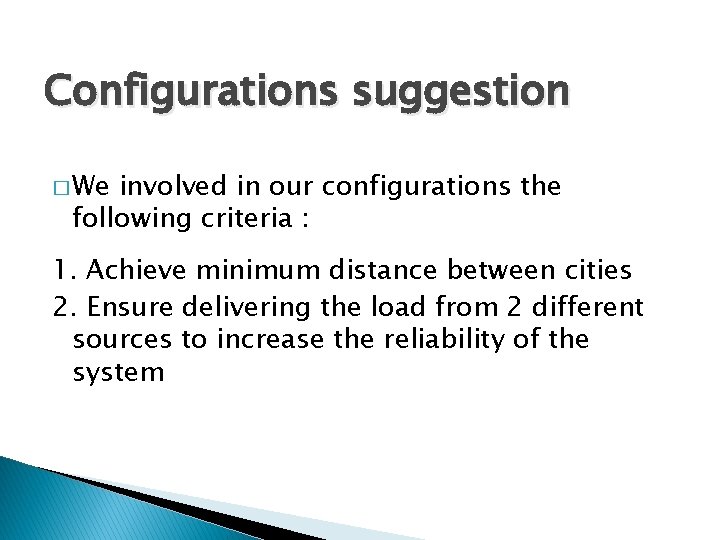
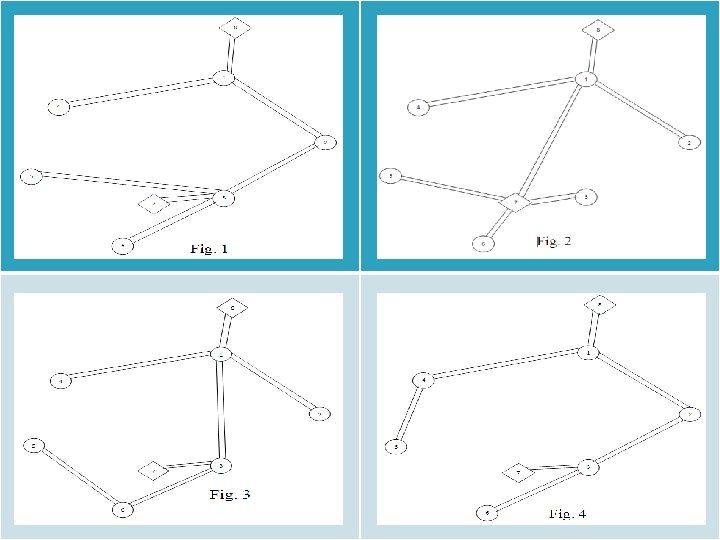
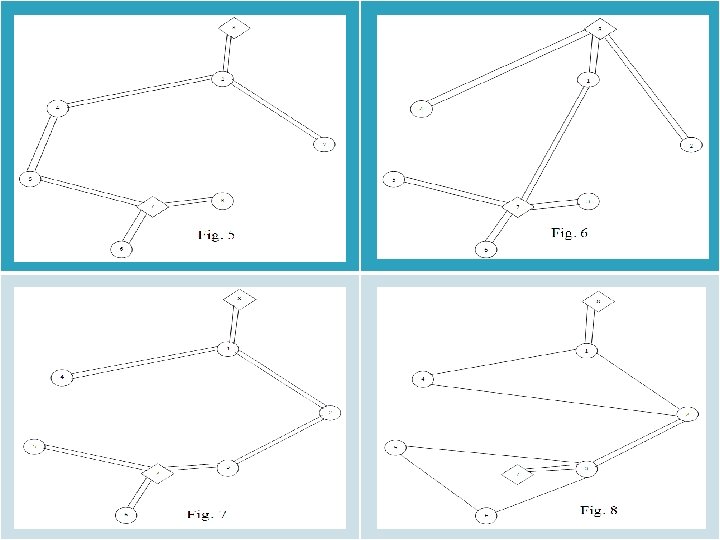
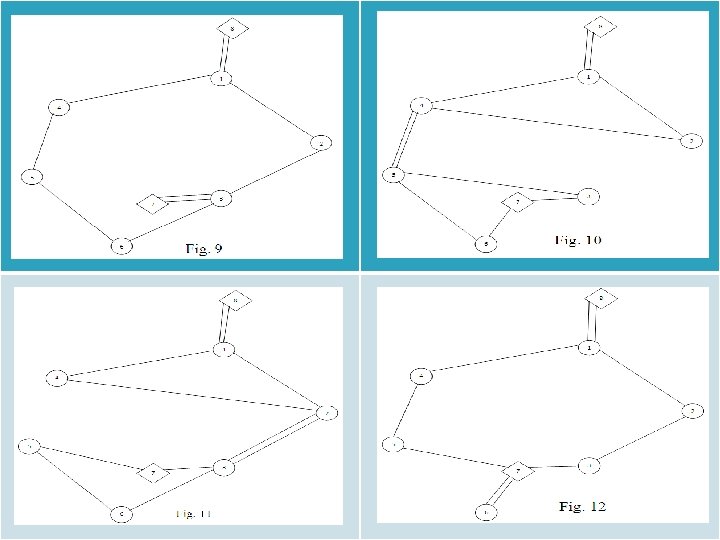
Configurations suggestion � We involved in our configurations the following criteria : 1. Achieve minimum distance between cities 2. Ensure delivering the load from 2 different sources to increase the reliability of the system
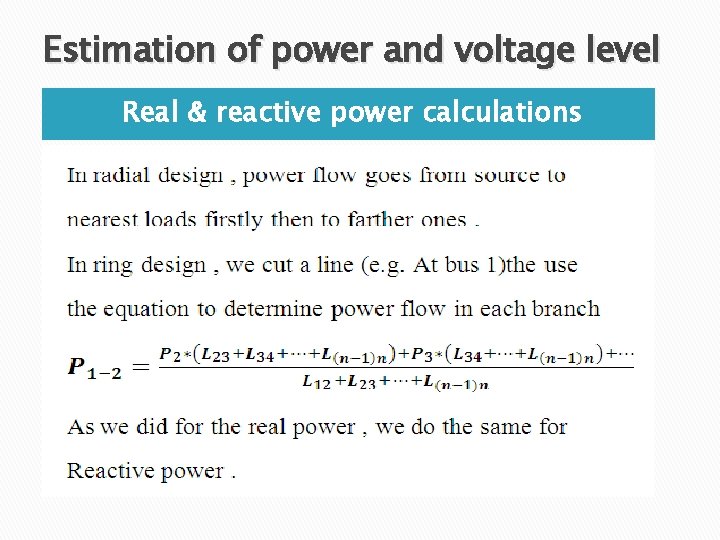
Estimation of power and voltage level Real & reactive power calculations
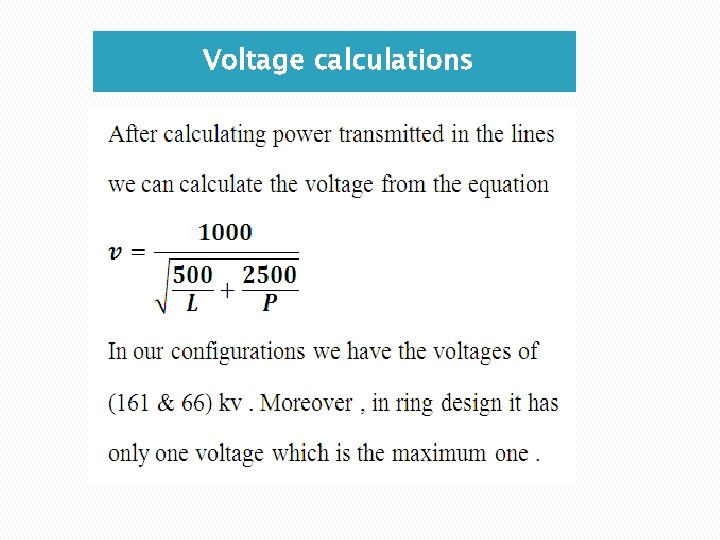
Voltage calculations
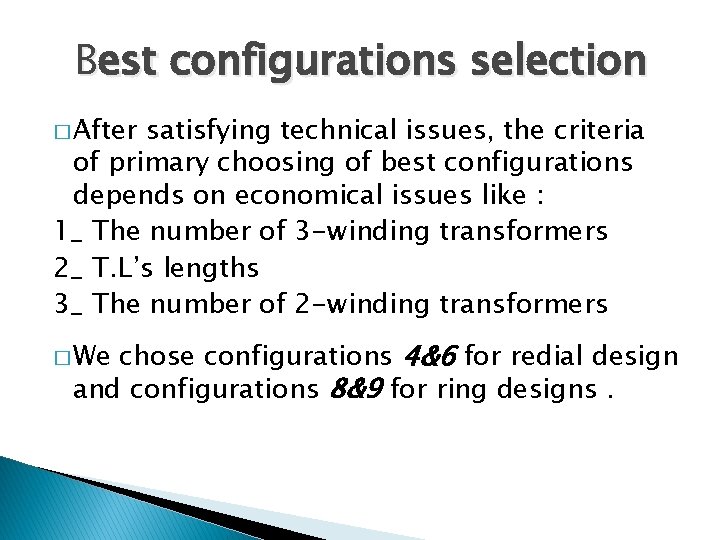
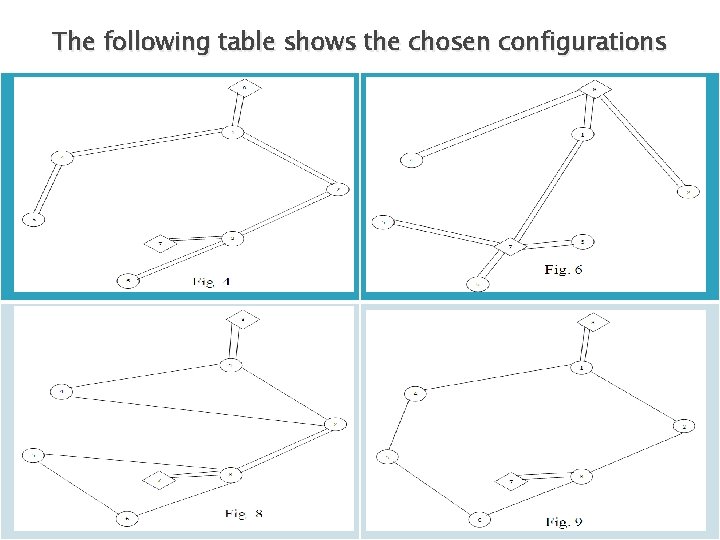
Best configurations selection � After satisfying technical issues, the criteria of primary choosing of best configurations depends on economical issues like : 1_ The number of 3 -winding transformers 2_ T. L’s lengths 3_ The number of 2 -winding transformers chose configurations 4&6 for redial design and configurations 8&9 for ring designs. � We
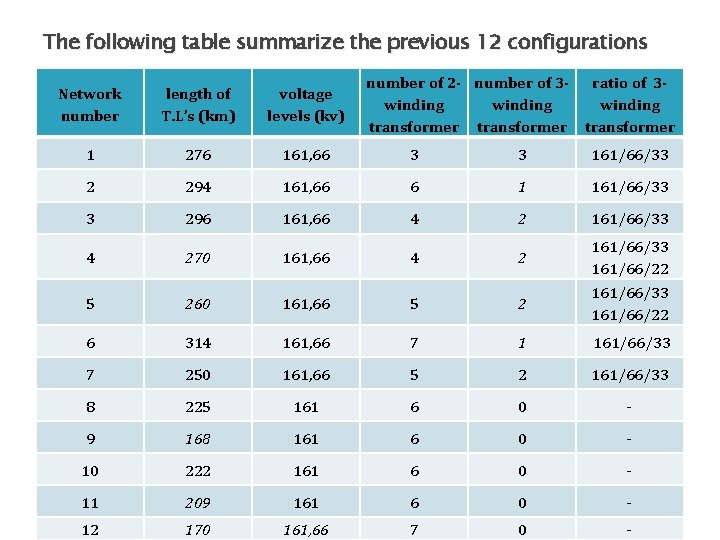
The following table summarize the previous 12 configurations number of 2 - number of 3 - ratio of 3 winding transformer Network number length of T. L’s (km) voltage levels (kv) 1 276 161, 66 3 3 161/66/33 2 294 161, 66 6 1 161/66/33 3 296 161, 66 4 2 161/66/33 4 270 161, 66 4 2 5 260 161, 66 5 2 6 314 161, 66 7 1 161/66/33 7 250 161, 66 5 2 161/66/33 8 225 161 6 0 - 9 168 161 6 0 - 10 222 161 6 0 - 11 209 161 6 0 - 12 170 161, 66 7 0 - 161/66/33 161/66/22
The following table shows the chosen configurations
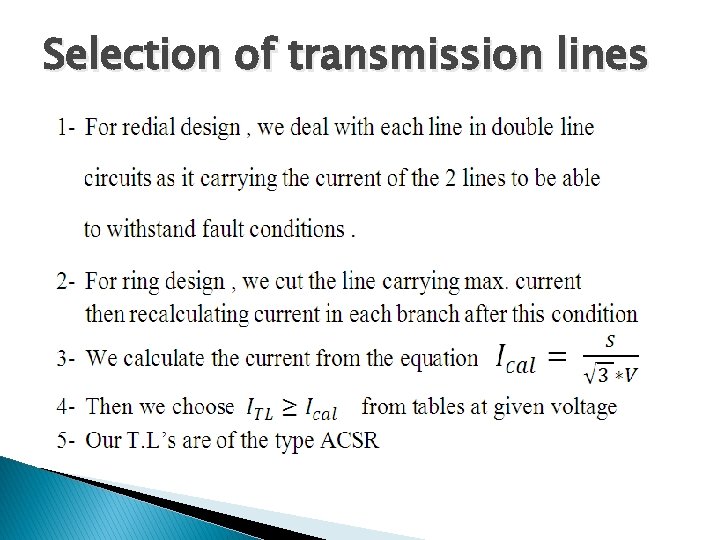
Selection of transmission lines
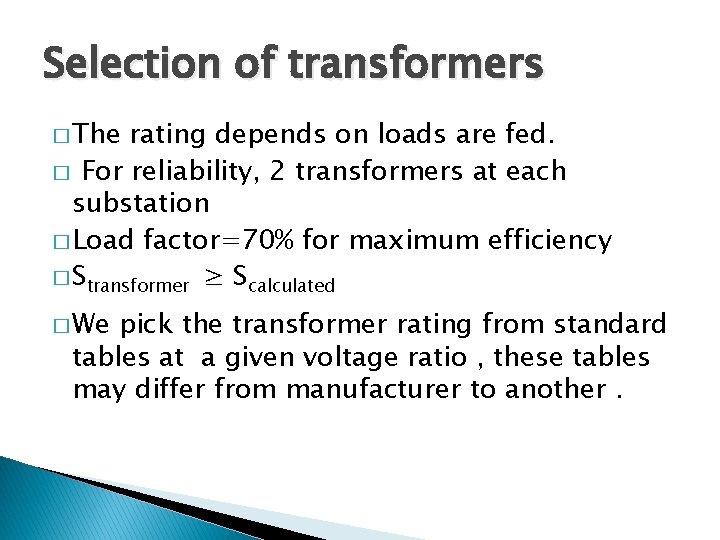
Selection of transformers � The rating depends on loads are fed. � For reliability, 2 transformers at each substation � Load factor=70% for maximum efficiency � Stransformer ≥ Scalculated � We pick the transformer rating from standard tables at a given voltage ratio , these tables may differ from manufacturer to another.
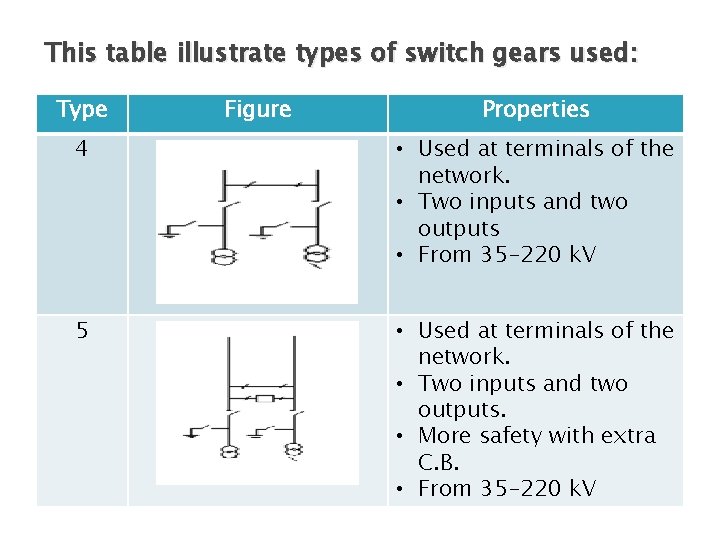
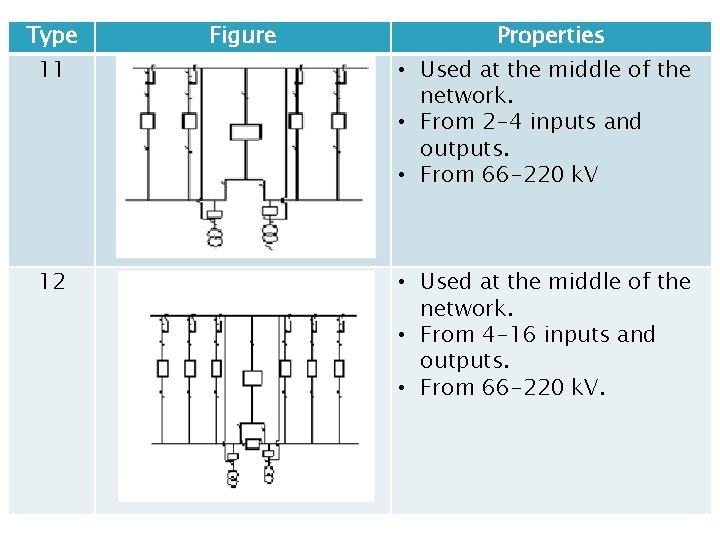
Selection of switch gears � Switch gear is an important device which contains bus-bars, transformers, measuring and protection devices. � Selection depends on 1. Voltage level 2. Number of lines 3. Location of substation 4. Possibility of expansion � All switch gears are outdoor ones.
This table illustrate types of switch gears used: Type Figure Properties 4 • Used at terminals of the network. • Two inputs and two outputs • From 35 -220 k. V 5 • Used at terminals of the network. • Two inputs and two outputs. • More safety with extra C. B. • From 35 -220 k. V
Type 11 12 Figure Properties • Used at the middle of the network. • From 2 -4 inputs and outputs. • From 66 -220 k. V • Used at the middle of the network. • From 4 -16 inputs and outputs. • From 66 -220 k. V.
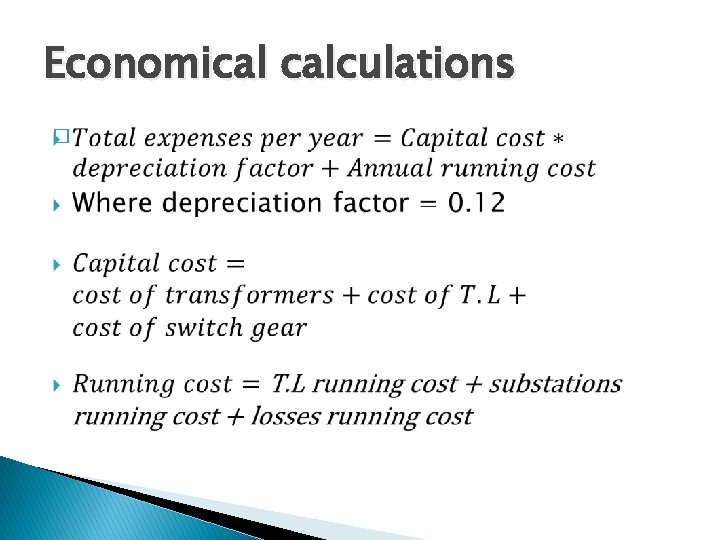
Economical calculations �
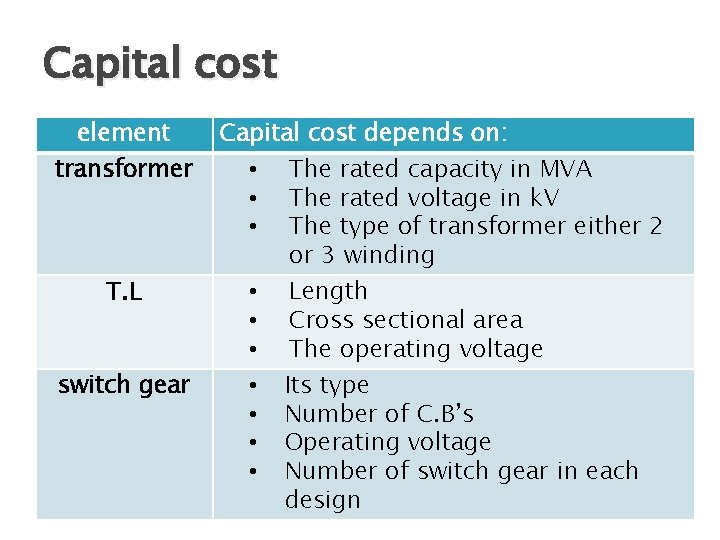
Capital cost element transformer T. L switch gear Capital cost depends on: • The rated capacity in MVA • The rated voltage in k. V • The type of transformer either 2 or 3 winding • • Length Cross sectional area The operating voltage Its type Number of C. B’s Operating voltage Number of switch gear in each design
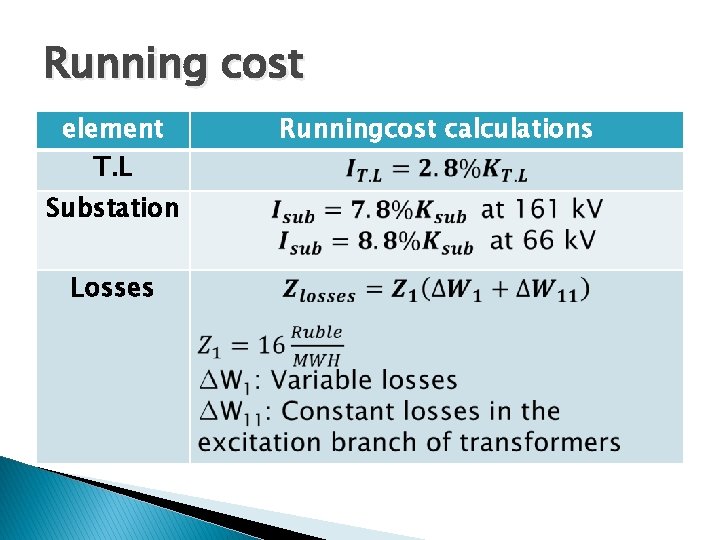
Running cost element T. L Substation Losses Runningcost calculations
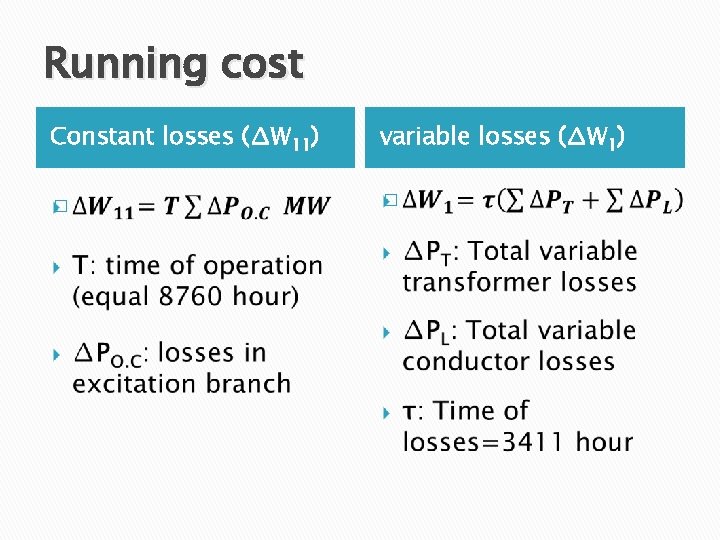
Running cost Constant losses (∆W 11) variable losses (∆W 1) � �
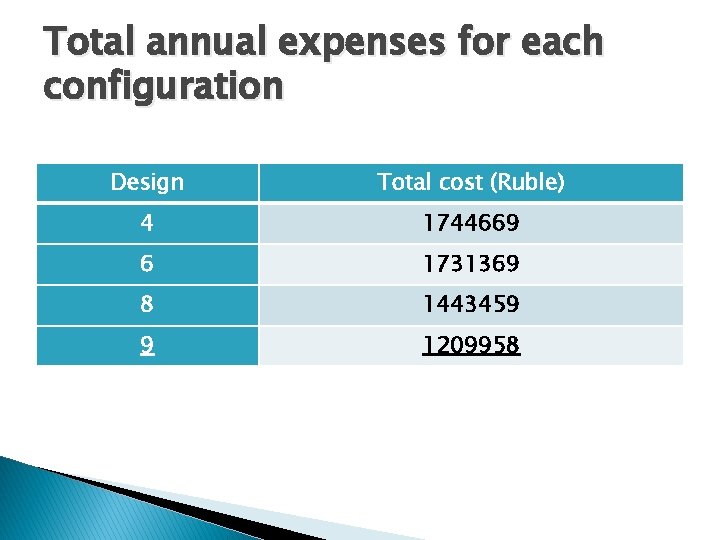
Total annual expenses for each configuration Design Total cost (Ruble) 4 1744669 6 1731369 8 1443459 9 1209958
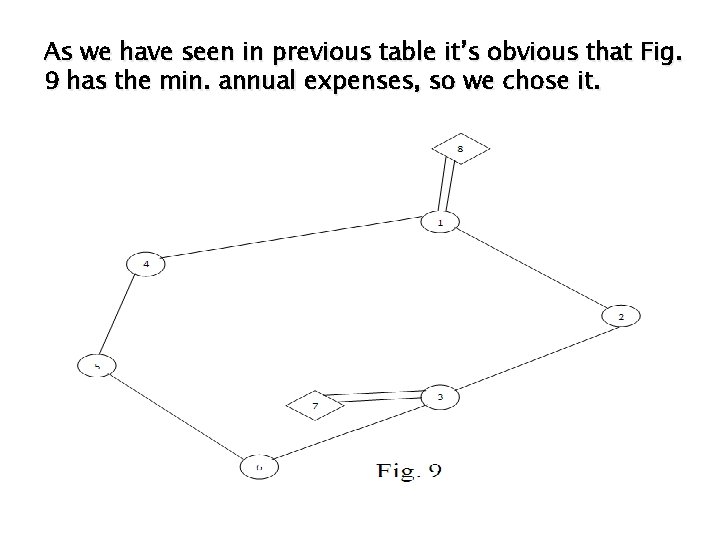
As we have seen in previous table it’s obvious that Fig. 9 has the min. annual expenses, so we chose it.
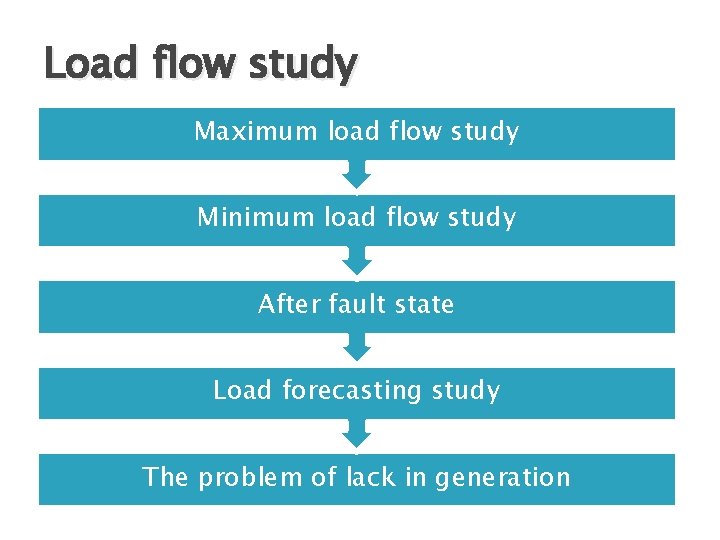
Load flow study Maximum load flow study Minimum load flow study After fault state Load forecasting study The problem of lack in generation
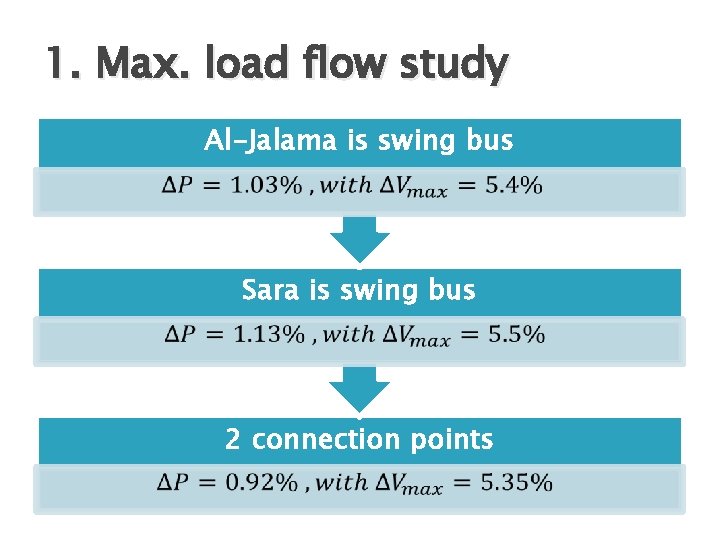
1. Max. load flow study Al-Jalama is swing bus Sara is swing bus 2 connection points
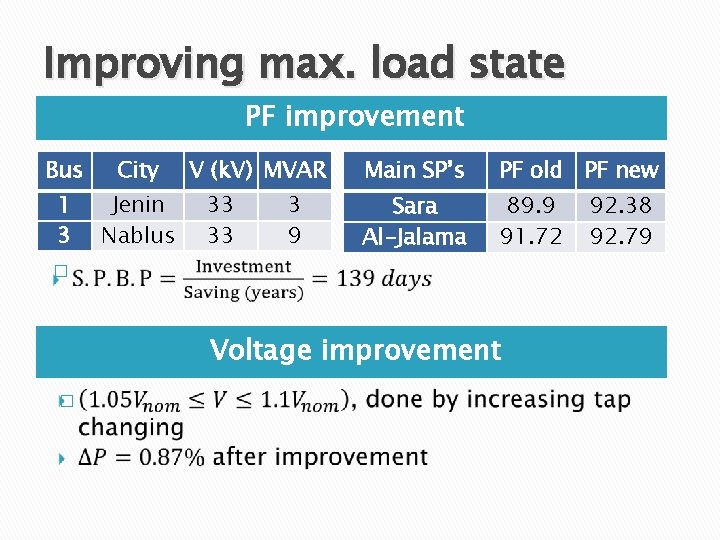
Improving max. load state PF improvement Bus City 1 3 Jenin Nablus � V (k. V) MVAR 33 33 3 9 Main SP’s PF old PF new Sara Al-Jalama 89. 9 91. 72 Voltage improvement � 92. 38 92. 79
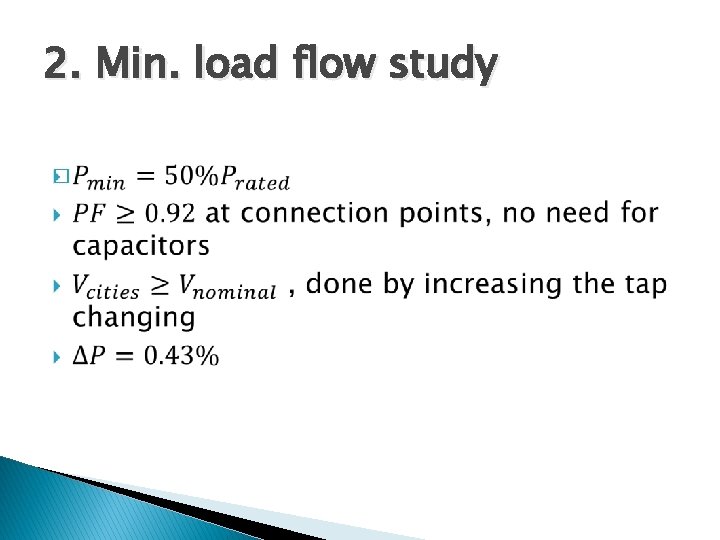
2. Min. load flow study �
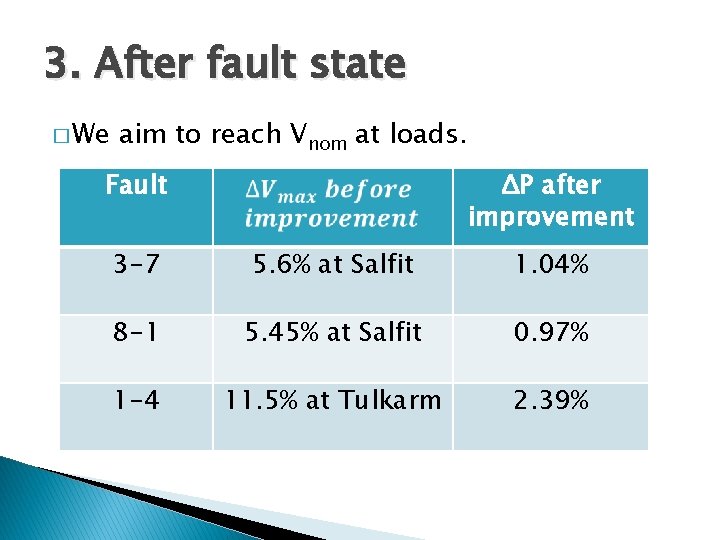
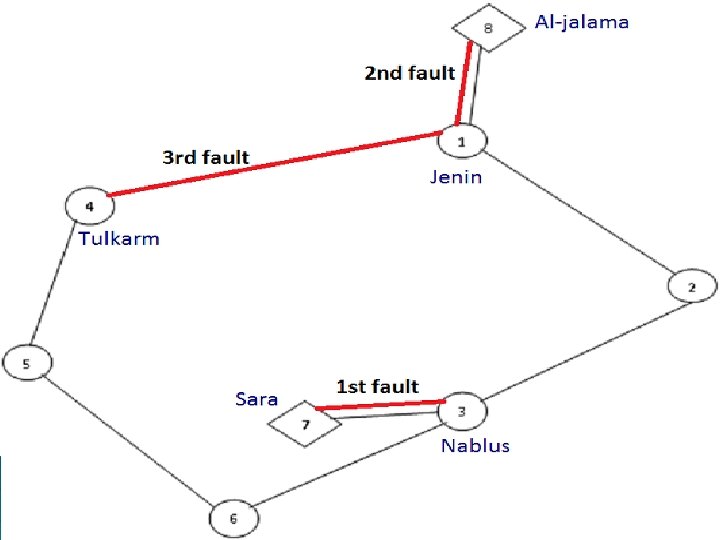
3. After fault state � We aim to reach Vnom at loads. Fault ΔP after improvement 3 -7 5. 6% at Salfit 1. 04% 8 -1 5. 45% at Salfit 0. 97% 1 -4 11. 5% at Tulkarm 2. 39%
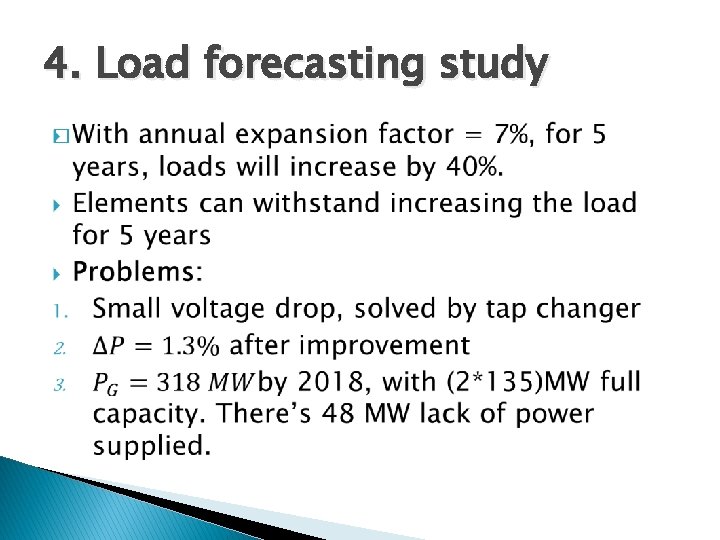
4. Load forecasting study �
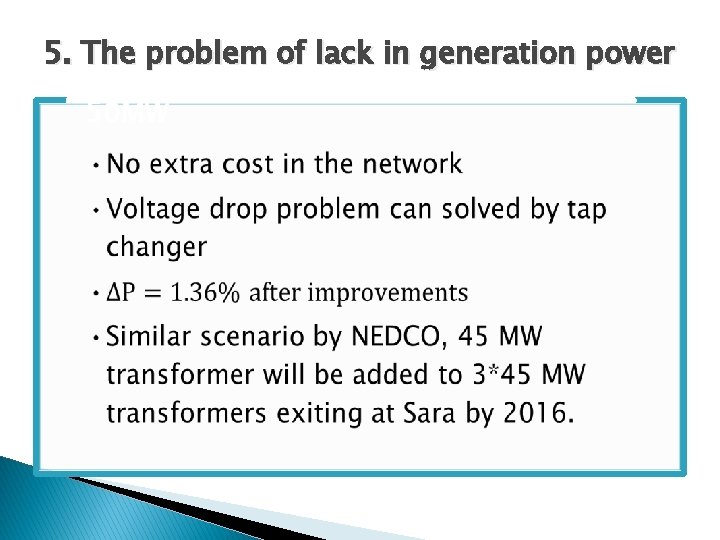
5. The problem of lack in generation power Scenario I: Sara increased by 50 MW • •
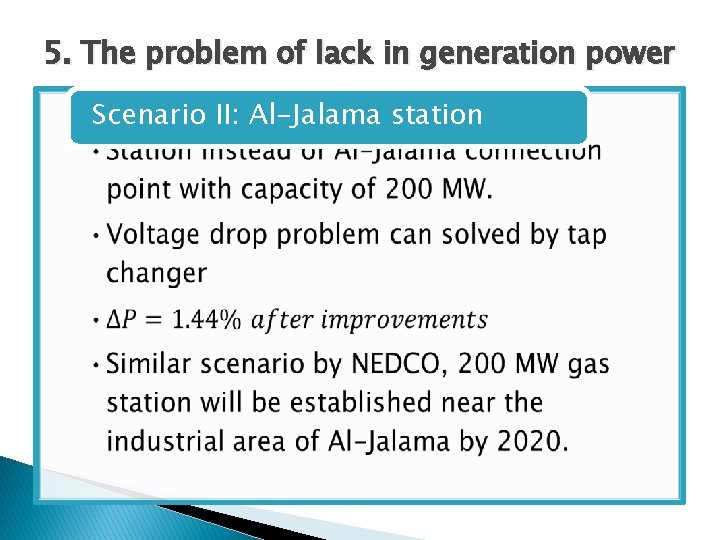
5. The problem of lack in generation power Scenario II: Al-Jalama station • •
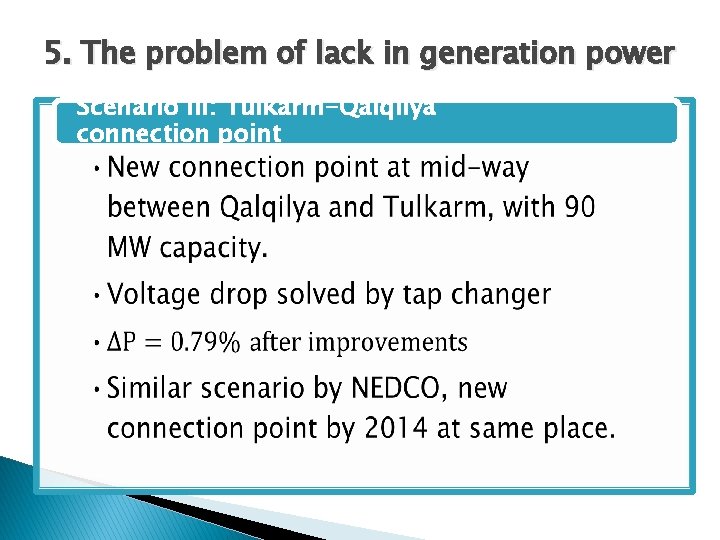
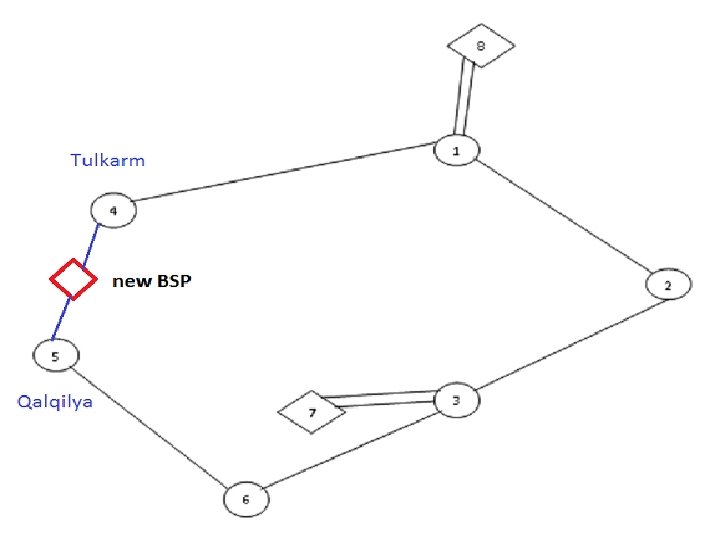
5. The problem of lack in generation power Scenario III: Tulkarm-Qalqilya connection point • •
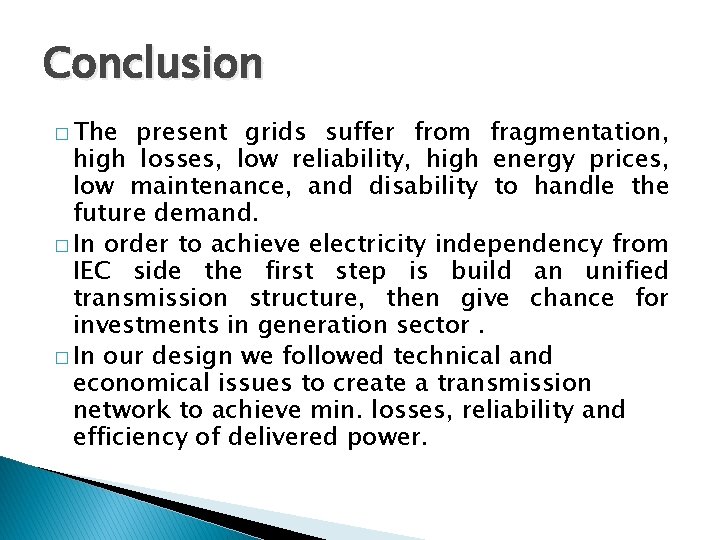
Conclusion � The present grids suffer from fragmentation, high losses, low reliability, high energy prices, low maintenance, and disability to handle the future demand. � In order to achieve electricity independency from IEC side the first step is build an unified transmission structure, then give chance for investments in generation sector. � In our design we followed technical and economical issues to create a transmission network to achieve min. losses, reliability and efficiency of delivered power.
Conclusion � Technical issues like voltage level, PF are satisfied. Moreover losses ≤ 1%. � Age of network is 5 years. To cover supply gap; best scenario to create new connection point between Tulkarm-Qalqilya by 2016. � Al-Jalama station can be replaced by its connection point by 2020.
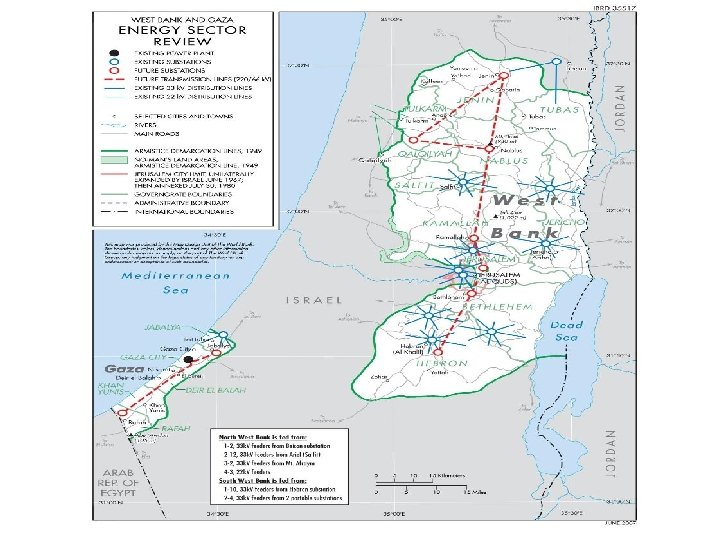
Future work � Protection system can be done � A connection to the transmission networks of middle and south of West Bank can be done, to create a uniform transmission system for whole West Bank. This connection can easily be done at Salfit substation or Sarra substation.