
Design of Magnetic Circuit CORE PRESENTED BY PROF
Design of Magnetic Circuit (CORE) PRESENTED BY PROF. VG PATEL
TRANSFORMER ENCYCLOPAEDIA DESIGN OF MAGNETIC CIRCUIT INTRODUCTION TO TRANSFORMER Transformer is a device which • Transfers the electric power from one circuit to another • It does so without a change of frequency • It accomplishes by electromagnetic induction • Where the two electric circuits are in mutual inductive influence of each other. Basically the transformer consists of Magnetic Circuit (core), Electric Circuit (winding), Dielectric Circuit (Insulation) and Cooling circuit. Monday, June 14, 2021 PROF. V. G. PATEL 2
TRANSFORMER ENCYCLOPAEDIA DESIGN OF MAGNETIC CIRCUIT INTRODUCTION TO MAGNETIC CIRCUIT The magnetic circuit is one of the most important active parts of the transformer. It consists of laminated iron core and carries flux linked to windings. Energy is transferred from one electrical circuit to another through the magnetic field carried by the core. The iron core provides a low reluctance path to the flux thereby reducing magnetizing current. In early days of transformer manufacturing, inferior grades of laminated steels were used with inherent high losses and magnetizing volt-amperes. Later on it was found that the addition of silicon content of about 4 to 5% improves the performance of core. Because of this there is a drastically reduction in eddy loss of core as well as helps to reduce its aging effect. Monday, June 14, 2021 PROF. V. G. PATEL 3
TRANSFORMER ENCYCLOPAEDIA DESIGN OF MAGNETIC CIRCUIT Important stages of core material development are: 1. HRGO : non - oriented, Hot rolled grain oriented. 2. CRGO : Cold rolled grain oriented 3. Hi-B : Laser Scribed Laminations with lower thickness are manufactured to take advantage of lower eddy losses. Currently the lowest thickness available is 0. 23 mm and the popular thickness range is 0. 23 mm to 0. 35 mm. Inorganic coating, generally of glass film and phosphate layer having thickness of 0. 002 to 0. 003 mm is provided on both the surfaces of laminations. Monday, June 14, 2021 PROF. V. G. PATEL 4
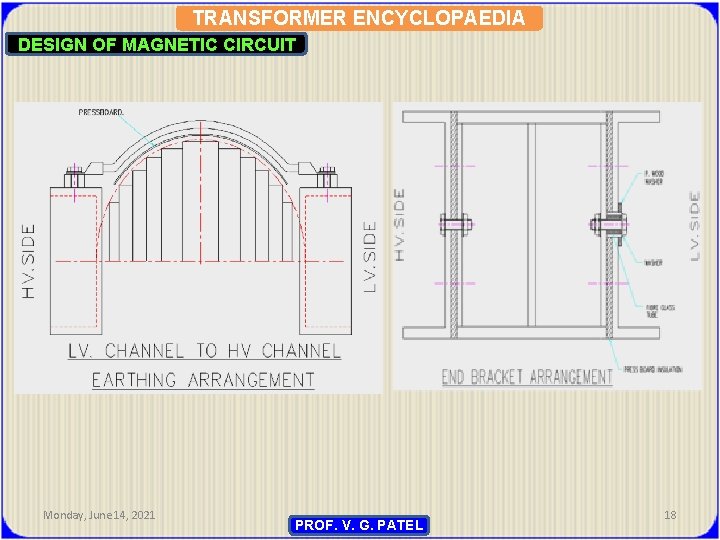
TRANSFORMER ENCYCLOPAEDIA DESIGN OF MAGNETIC CIRCUIT EARTHING OF MAGNETIC CIRCUIT The core is in the vicinity of high voltage windings, it is grounded to drain out the statically induced voltages. If the core is sectionalized by the ducts for cooling purpose, than individual section shall be grounded. The magnetic circuit shall be earthed to the clamping structure at one point only through a link placed in an accessible position beneath an inspection opening in the tank cover. The connection to the link shall be on the same side of the core as the main earth connection. Monday, June 14, 2021 PROF. V. G. PATEL 5
TRANSFORMER ENCYCLOPAEDIA DESIGN OF MAGNETIC CIRCUIT SINGLE POINT EARTHING REDUCES STRAY LOSSES CONSIDERABLY. The idea is to: (1) Inter connect all metal parts used in the assembly of core electrically to prevent floating of metal parts. (2) Prevent flow of circulating current between metal parts on HV and LV sides of the core. (3) Prevent flow of leakage current from core to tank through many imperfect contacts the core makes at the bottom and also at the top in the case of cover mounted transformers. (4) Make a perfect earth connection from the core lamination to the frame and the frame to the tank. 6 Monday, June 14, 2021 PROF. V. G. PATEL

TRANSFORMER ENCYCLOPAEDIA DESIGN OF MAGNETIC CIRCUIT (1) FLOAT PREVENTION (a) Frame to flitch plates: 0. 25 * 30 copper plate of 100 mm length is bent in U shape and inserted between the frame and flitch plate after removing paint from both the frame and flitch plate where the copper piece makes contact. This has to be done at 12 locations, 6 at top and 6 at the bottom. Monday, June 14, 2021 PROF. V. G. PATEL 7
TRANSFORMER ENCYCLOPAEDIA DESIGN OF MAGNETIC CIRCUIT (b) Frame to core base: Copper strip size is the same. Remove paint and polish when the strip touches the frame and the base. This is required at ends of the base. In case the length of core base is extended for locking purpose, the strips can be inserted from the sides. (c) Core bolts to frame: Do not use insulation at one end. As a standard practice, it is HV side. Remove paint from frame at the area where the clamping nut touches the frame. Monday, June 14, 2021 PROF. V. G. PATEL 8
TRANSFORMER ENCYCLOPAEDIA DESIGN OF MAGNETIC CIRCUIT (d) Metal straps to frame: In the case metal straps are used for clamping yokes instead of core bolts, remove insulation from HV side end as in the case of core bolts. (e) Pins to core frame: Remove paint suitably so that pins and locking plates make contact with frame. (f) Yoke end clamps / end clamping bolts: Make contact to frame on HV side by removing paint. Monday, June 14, 2021 PROF. V. G. PATEL 9
TRANSFORMER ENCYCLOPAEDIA DESIGN OF MAGNETIC CIRCUIT 2. PREVENTION OFCIRCULATING CURRENTS There should not be any electrical contact between the top frames on HV and LV sides. For this, use insulation bushes on LV side for all fasteners used for clamping the top yoke. Discontinuity may be ascertained using continuity tester between the fasteners and the frame. Monday, June 14, 2021 PROF. V. G. PATEL 10
TRANSFORMER ENCYCLOPAEDIA DESIGN OF MAGNETIC CIRCUIT 3. PREVENTION OF LEAKAGE CURRENTS The active part rests at the base of the tank and side ways movement is prevented by stoppers. Insulation pad is placed at the base. But the stoppers are not insulated. So leakage current can flow from the base to tank through the stoppers. It is difficult to insulate the stoppers. So the use of insulated pins as stoppers is recommended. The pins will have a shape as shown in the sketch. There shall be four pins the pins will engage in holes provided at the ends two outer base. Pin holes will have a shape as indicated in the sketch. Monday, June 14, 2021 PROF. V. G. PATEL 11
TRANSFORMER ENCYCLOPAEDIA DESIGN OF MAGNETIC CIRCUIT 3. PREVENTION OF LEAKAGE CURRENTS While fixing the position of pins on the bottom plate clearance of active part from sides on HV and LV side will have to be considered. There are two ways of doing it. One is to keep pins equidistant from the longitudinal centre line of the tank and give more length to the base on HV side. The other is to keep length of base same on HV and LV sides and shift the HV side pins closer to the centre line so as to get more clearance on H. V side. Another- leakage point is from top frame to the cover through the cover fixing bracket in the case of top cover mounted transformers. All fixing bolts shall be provided with insulation bushes both on HV and LV sides. Monday, June 14, 2021 PROF. V. G. PATEL 12
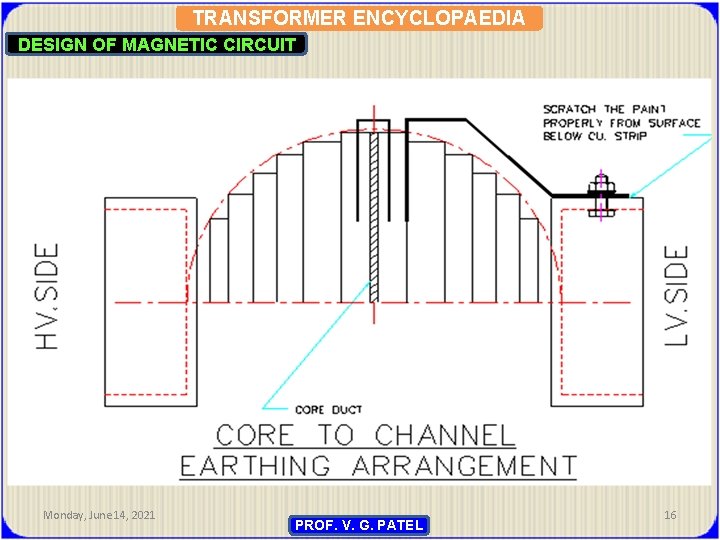
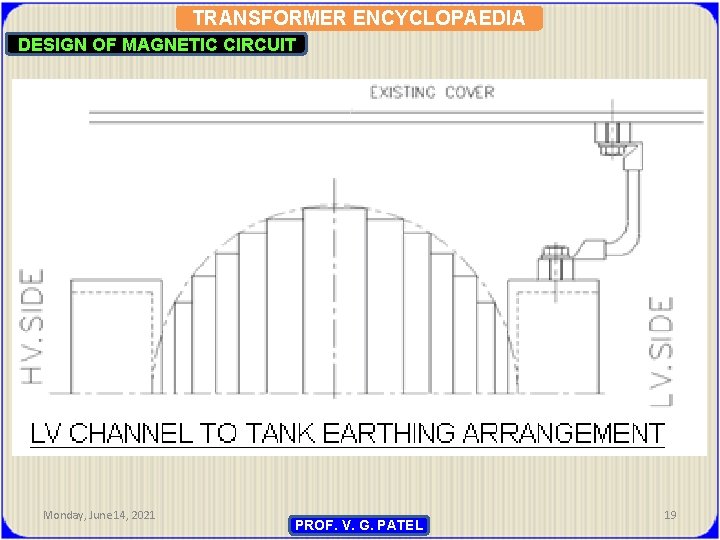
TRANSFORMER ENCYCLOPAEDIA DESIGN OF MAGNETIC CIRCUIT 4. PERFECT EARTHING OF CORE (a) Copper strip of 0. 25 x 30 x 100 mm size shall be inserted bridging the oil ducts and stack insulation of lamination. (b) Lamination to frame part earthing: Normally an earthing boss is welded on the LV side top frame on its left hand side end. Earthing of lamination is done using a cupper strip of 0. 25 * 30 * 100 size between the last step lamination and the earthing boss on the LV side. In the case of very long cores more than one earth strip is used as shown in the sketch. Monday, June 14, 2021 PROF. V. G. PATEL 13
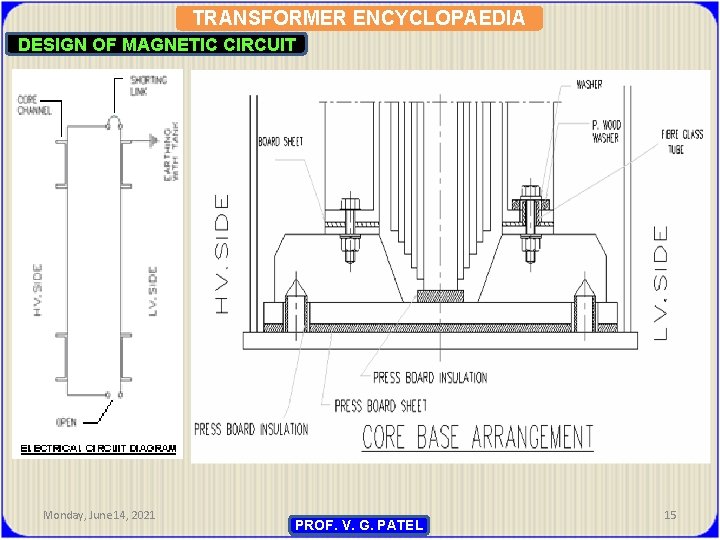
TRANSFORMER ENCYCLOPAEDIA DESIGN OF MAGNETIC CIRCUIT 4. PERFECT EARTHING OF CORE (c) Frame to tank earthing: A flexible lead having a minimum cross sectional area of 80 mm is used for earth connection between frame and tank. If customer specifies, this connection is given through an 11 kv bushing mounted on the tank cover. Some customers want separate earthing bushings for laminations and frames. They are shorted externally and earthed. Insulation resistance measure-ment between these two bushings gives insulation resistance of core bolts. Monday, June 14, 2021 PROF. V. G. PATEL 14
TRANSFORMER ENCYCLOPAEDIA DESIGN OF MAGNETIC CIRCUIT Monday, June 14, 2021 PROF. V. G. PATEL 15
TRANSFORMER ENCYCLOPAEDIA DESIGN OF MAGNETIC CIRCUIT Monday, June 14, 2021 PROF. V. G. PATEL 16
TRANSFORMER ENCYCLOPAEDIA DESIGN OF MAGNETIC CIRCUIT Monday, June 14, 2021 PROF. V. G. PATEL 17
TRANSFORMER ENCYCLOPAEDIA DESIGN OF MAGNETIC CIRCUIT Monday, June 14, 2021 PROF. V. G. PATEL 18
TRANSFORMER ENCYCLOPAEDIA DESIGN OF MAGNETIC CIRCUIT Monday, June 14, 2021 PROF. V. G. PATEL 19
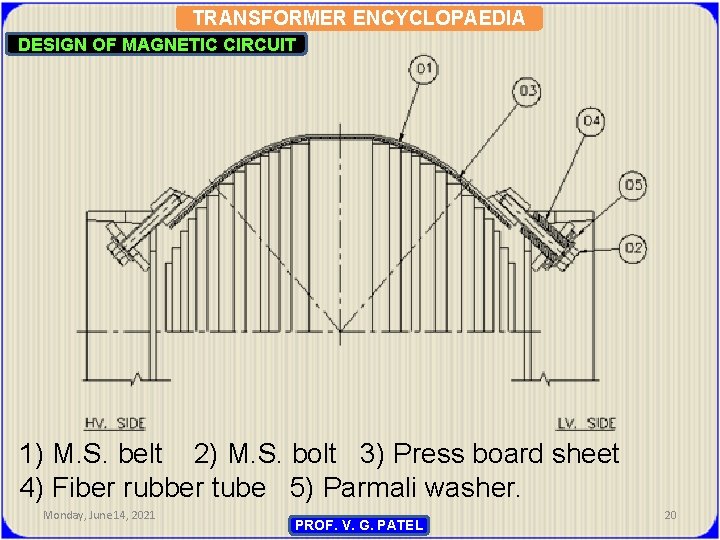
TRANSFORMER ENCYCLOPAEDIA DESIGN OF MAGNETIC CIRCUIT 1) M. S. belt 2) M. S. bolt 3) Press board sheet 4) Fiber rubber tube 5) Parmali washer. Monday, June 14, 2021 PROF. V. G. PATEL 20
TRANSFORMER ENCYCLOPAEDIA DESIGN OF MAGNETIC CIRCUIT Magnetic field (Electromagnetic field): Very large amount of energy can be transformed by this field from one voltage level to another voltage level. ----Voltage & current are active element. ----Current is the resultant of voltage. v. Resistance – physical property. v. Inductance – magnetic circuit property. v. Capacitance – dielectric property. v. Faraday – invented electromagnetic induction. Monday, June 14, 2021 PROF. V. G. PATEL 21
TRANSFORMER ENCYCLOPAEDIA DESIGN OF MAGNETIC CIRCUIT 1. material 2. standard for the material – (international & national) 3. properties 4. construction 5. design 6. testing International standards – AISI: 1983 (American iron and steel institute) Standard of core is divided into 2 parts: (1) for core material (2) for testing. Monday, June 14, 2021 PROF. V. G. PATEL 22
TRANSFORMER ENCYCLOPAEDIA DESIGN OF MAGNETIC CIRCUIT • IEC – 404 – 8. 7 (1988) • BS – British std. – 6404 PART 8 (1988) • JIS – Japanese C 2553 (1986) • Din 46400 – 3. 04 (1989) • ASTM 876 part 8. 7 (American standards for testing of material) • IS 3024 (1996) • IS 649 (1997) - Methods of testing of steels Monday, June 14, 2021 PROF. V. G. PATEL 23
TRANSFORMER ENCYCLOPAEDIA DESIGN OF MAGNETIC CIRCUIT In India, we do not have manufacturing plant for CRGO. Core material is imported from 1. AMCO - USA (merged with AK steel 0 2. A. K. Steel - USA 3. Nippon steel - Japan 4. Kawasaki steel - Japan (Japanese steel is considered as one of the best material in the world). 5. Pohang steel - Korea (POSKO) 6. AST - Italy 7. Orbsteel - UK 8. Ugigne steel - France 9. Thysunkrapp - Germany For core material ----- Amod-Vardhman Stampings, etc. Monday, June 14, 2021 PROF. V. G. PATEL 24
TRANSFORMER ENCYCLOPAEDIA DESIGN OF MAGNETIC CIRCUIT Core material in form of 914 mm width coil - 2 to 3 tons Rolls. Fabrication plants are available in Mumbai, Baroda, Silvasa, Ahmedabad, etc. 1. Slit - using cutting blade (width) 2. Mitring - to required length 3. Deburring - to remove projection at the cutting edge Desired properties of core material 1. higher flux density 2. lower specific loss 3. lower magnetizing current 4. workability (slitting, cutting, etc) Monday, June 14, 2021 PROF. V. G. PATEL 25
TRANSFORMER ENCYCLOPAEDIA DESIGN OF MAGNETIC CIRCUIT V/t = 4. 44 B A f volts = et A= deciding factor for cost (size and weight) = et/4. 44 B f If B is increased, A will reduce. Core material is having saturation flux density = Bsat = 2. 03 Tesla Allowed(max) = 1. 9 Tesla Operating(max) = 1. 7 Tesla 2. 6 to 3 % Silicon is added (by weight). Specific loss: Watt/Kg means - 1 kg of material, how much loss it will produce? Specific loss is a function of flux density. Monday, June 14, 2021 PROF. V. G. PATEL 26
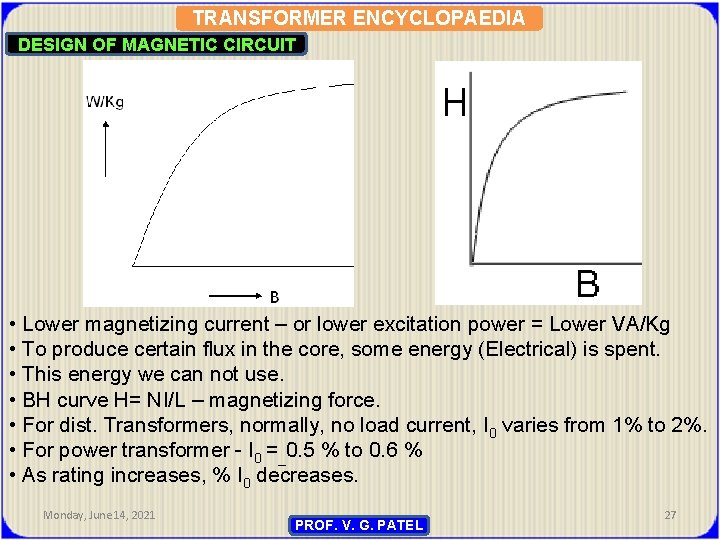
TRANSFORMER ENCYCLOPAEDIA DESIGN OF MAGNETIC CIRCUIT • Lower magnetizing current – or lower excitation power = Lower VA/Kg • To produce certain flux in the core, some energy (Electrical) is spent. • This energy we can not use. • BH curve H= NI/L – magnetizing force. • For dist. Transformers, normally, no load current, I 0 varies from 1% to 2%. • For power transformer - I 0 =_0. 5 % to 0. 6 % • As rating increases, % I 0 decreases. Monday, June 14, 2021 PROF. V. G. PATEL 27
TRANSFORMER ENCYCLOPAEDIA DESIGN OF MAGNETIC CIRCUIT Material – CRGO silicon steel Magnetic material – Grain orientation • Basic physical property is density. • For CRGO steel, density – 7. 65 grm/cm³. • Resistivity of the material decides W/kg. • Thickness of material (present day material) = 0. 23 to 0. 35 mm thick. • When t increases, losses increase. • Eddy current loss, Peddy (Bft)2 • 1 Watt/Kg at 0. 35 mm • At 0. 23 mm, it is (0. 23/0. 35)² X 1 Watts = 0. 439 Watts (for comparison purpose) • Lower specific loss and lower I 0 by lower thickness of stamping. Monday, June 14, 2021 PROF. V. G. PATEL 28
TRANSFORMER ENCYCLOPAEDIA DESIGN OF MAGNETIC CIRCUIT EDDY CURRENT When flux is produced in the core, some emfs are induced in the core. This emf will circulate current in the close path of core, which depends upon the resistance of the core path and is known as eddy current. Induced eddy currents circulate within the core, causing resistive heating. Silicon is added to the steel to help in controlling eddy currents. Adding silicon also has the advantage of stopping aging of the electrical steel that was a problem years ago. Monday, June 14, 2021 PROF. V. G. PATEL 29
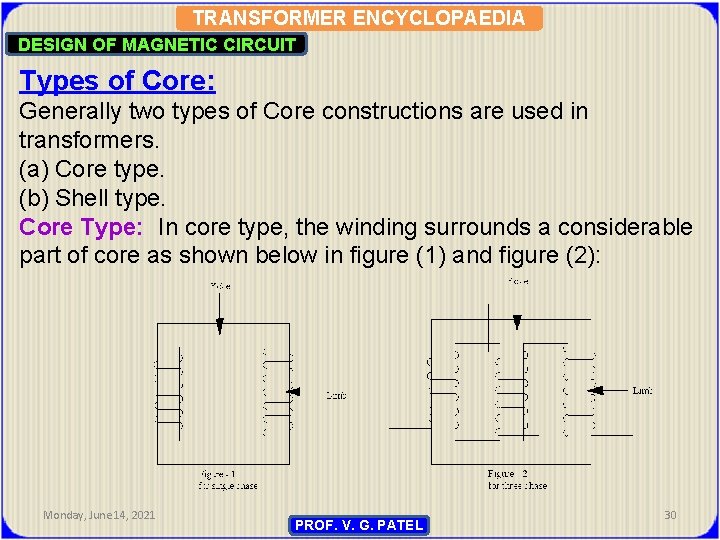
TRANSFORMER ENCYCLOPAEDIA DESIGN OF MAGNETIC CIRCUIT Types of Core: Generally two types of Core constructions are used in transformers. (a) Core type. (b) Shell type. Core Type: In core type, the winding surrounds a considerable part of core as shown below in figure (1) and figure (2): Monday, June 14, 2021 PROF. V. G. PATEL 30
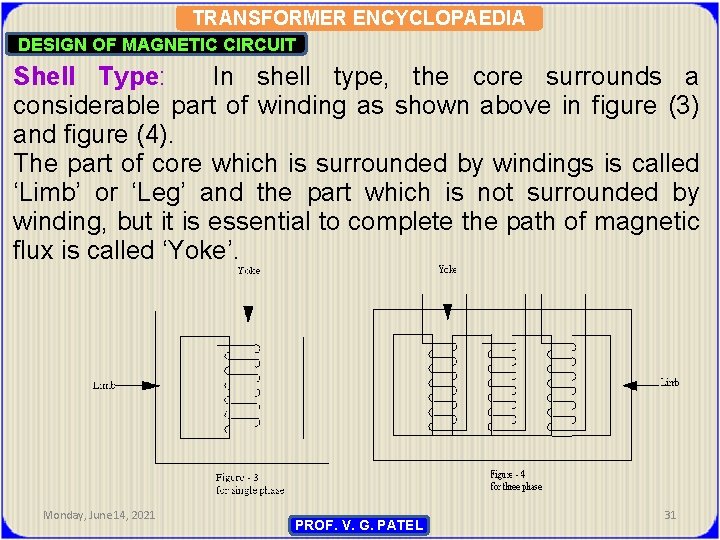
TRANSFORMER ENCYCLOPAEDIA DESIGN OF MAGNETIC CIRCUIT Shell Type: In shell type, the core surrounds a considerable part of winding as shown above in figure (3) and figure (4). The part of core which is surrounded by windings is called ‘Limb’ or ‘Leg’ and the part which is not surrounded by winding, but it is essential to complete the path of magnetic flux is called ‘Yoke’. Monday, June 14, 2021 PROF. V. G. PATEL 31
TRANSFORMER ENCYCLOPAEDIA DESIGN OF MAGNETIC CIRCUIT Advantages of Core type Construction are: • Construction is Simpler • Cooling is better • Repair is easy Advantages of Shell type Construction are: • Use of sandwich construction of L. V. and H. V. winding to get very low impedance. It is not easily possible in core type construction. Monday, June 14, 2021 PROF. V. G. PATEL 32
TRANSFORMER ENCYCLOPAEDIA DESIGN OF MAGNETIC CIRCUIT Monday, June 14, 2021 PROF. V. G. PATEL 33
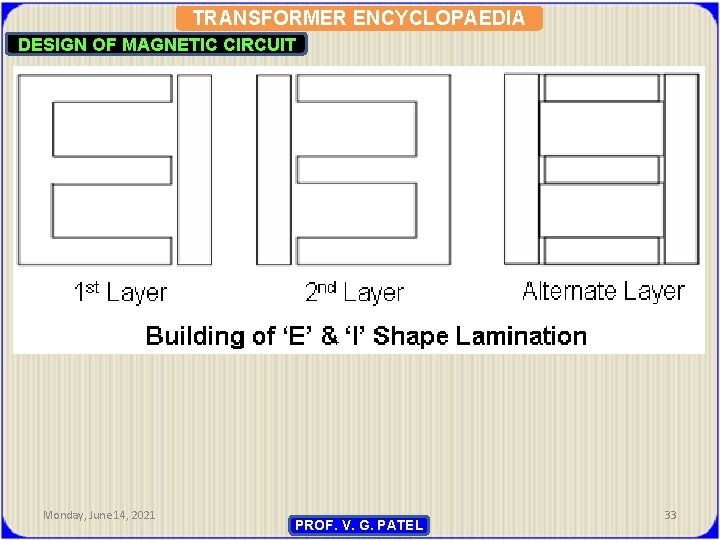
TRANSFORMER ENCYCLOPAEDIA DESIGN OF MAGNETIC CIRCUIT This type of core is generally called as Square or Rectangular core generally used in small transformers. To avoid high reluctance at the joints, the laminations are butted or non-mitred joint against each other and the alternate layers are stacked differently to eliminate these joints. The overlap angle of non-mitred joint is 90 degree and it is quite simple arrangement for manufacturing but the loss in corner joints is more. Hence non-mitred joints are used in small transformers. Monday, June 14, 2021 PROF. V. G. PATEL 34
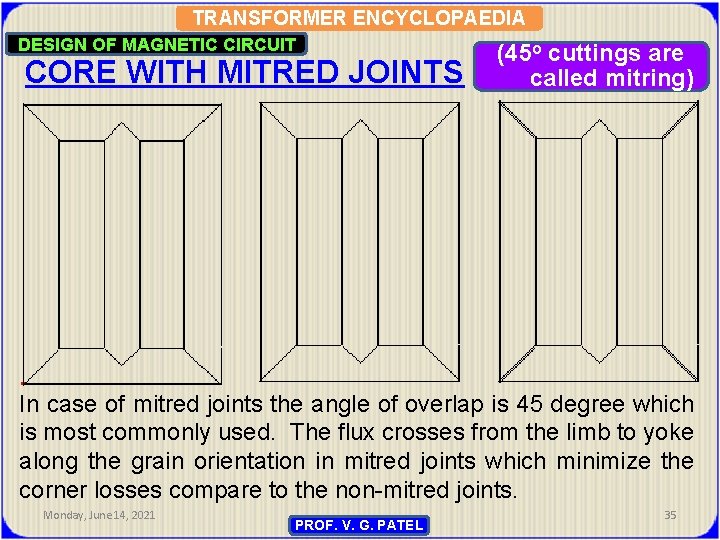
TRANSFORMER ENCYCLOPAEDIA DESIGN OF MAGNETIC CIRCUIT CORE WITH MITRED JOINTS (45 o cuttings are called mitring) In case of mitred joints the angle of overlap is 45 degree which is most commonly used. The flux crosses from the limb to yoke along the grain orientation in mitred joints which minimize the corner losses compare to the non-mitred joints. Monday, June 14, 2021 PROF. V. G. PATEL 35
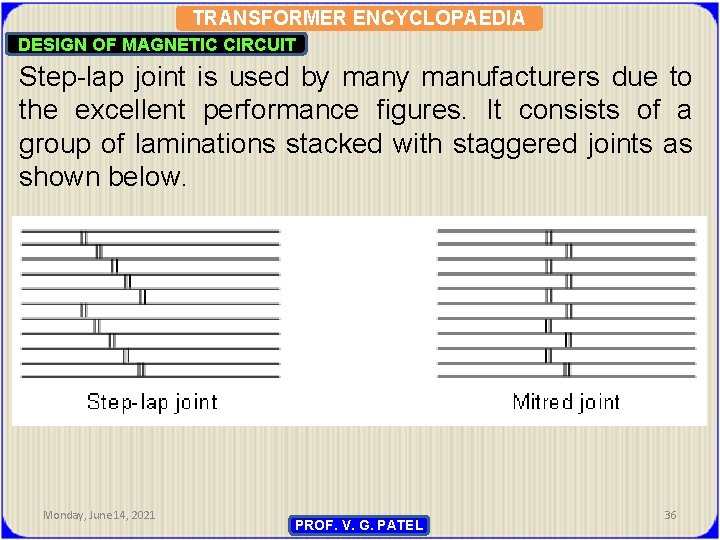
TRANSFORMER ENCYCLOPAEDIA DESIGN OF MAGNETIC CIRCUIT Step-lap joint is used by manufacturers due to the excellent performance figures. It consists of a group of laminations stacked with staggered joints as shown below. Monday, June 14, 2021 PROF. V. G. PATEL 36
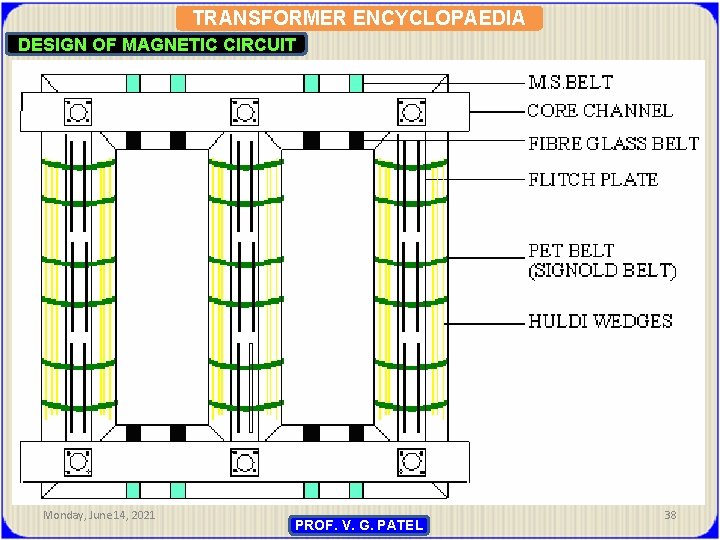
TRANSFORMER ENCYCLOPAEDIA DESIGN OF MAGNETIC CIRCUIT Core Construction: The corners of the core are of mitred-joint construction. At the joint every two laminations of leg and yoke are lapped. The mitred joint construction cuts corner losses substantially by reducing the cross-grain flow of flux in the joint regions. The core shall be clamp from the yoke which is made of heavy structural steel and the two clamps on both sides of a yoke are connected rigidly by tie plates which hold the yoke laminations tightly together, making the use of core yoke bolts unnecessarily. To hold the leg or limbs of core, fibre glass taps is used as shown in below figure: Monday, June 14, 2021 PROF. V. G. PATEL 37
TRANSFORMER ENCYCLOPAEDIA DESIGN OF MAGNETIC CIRCUIT Monday, June 14, 2021 PROF. V. G. PATEL 38
TRANSFORMER ENCYCLOPAEDIA DESIGN OF MAGNETIC CIRCUIT STACKING FACTOR OR LAMINATION FACTOR Monday, June 14, 2021 PROF. V. G. PATEL 39
TRANSFORMER ENCYCLOPAEDIA DESIGN OF MAGNETIC CIRCUIT The density of silicon steel is 7. 5 g/cc for Si < 2%, and 7. 7 g/cc for Si > 2%. It was found that steel containing more than 1% Si was not subject to the phenomenon of "ageing" in which the coercive force (and so the hysteresis loss) increased as much as 100% with time, when the iron operated at temperatures above 1500 F (as is often the case) or was subject to mechanical actions. All transformer cores for power frequencies, and parts of rotating machinery subject to alternating fields, are now made of silicon steel, for this and the other reasons mentioned. Monday, June 14, 2021 PROF. V. G. PATEL 40
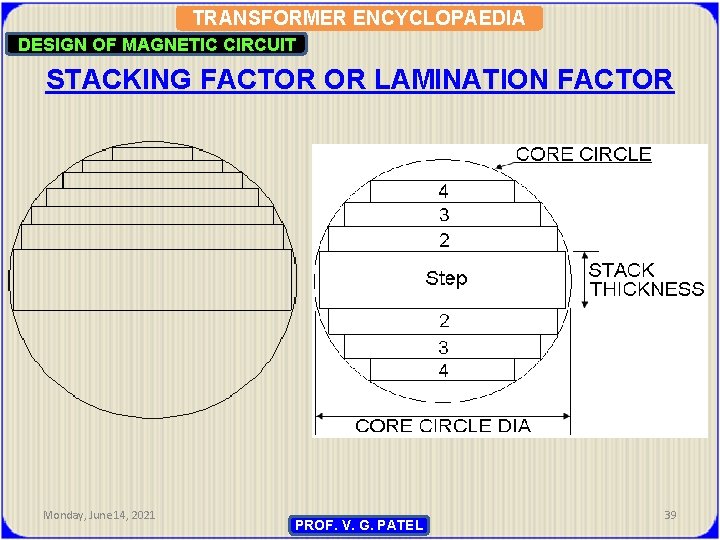
TRANSFORMER ENCYCLOPAEDIA DESIGN OF MAGNETIC CIRCUIT Core loss = Weight of core x (W/Kg) x Handling factor. • In distribution transformer handling factor = 1. 2 to 1. 3 • In power transformer handling factor = 1. 1 to 1. 2 Stacking factor or lamination factor = 0. 97 Insulation occupies certain space. 3 to 7 microns - thickness of insulation Handling factor = (Specific loss of build up core) / (specific loss of original material) Space factor = (Net area of steps) / (Area of Core Circle) Monday, June 14, 2021 PROF. V. G. PATEL 41
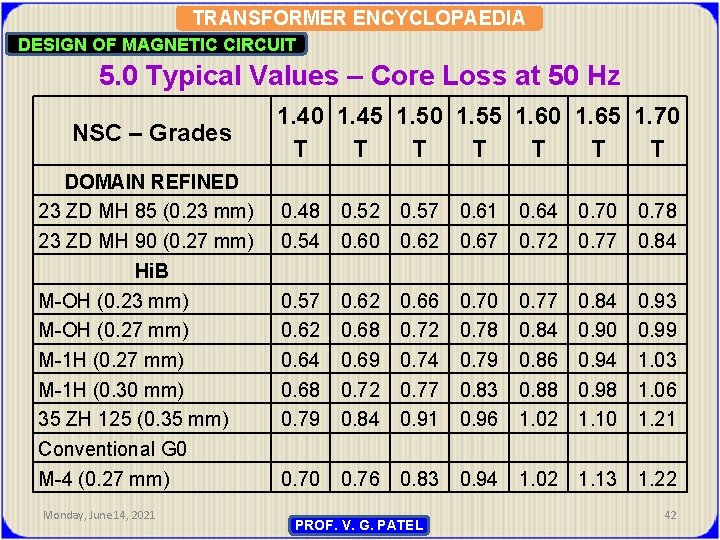
TRANSFORMER ENCYCLOPAEDIA DESIGN OF MAGNETIC CIRCUIT 5. 0 Typical Values – Core Loss at 50 Hz NSC – Grades DOMAIN REFINED 23 ZD MH 85 (0. 23 mm) 23 ZD MH 90 (0. 27 mm) Hi. B M-OH (0. 23 mm) M-OH (0. 27 mm) M-1 H (0. 30 mm) 35 ZH 125 (0. 35 mm) Conventional G 0 M-4 (0. 27 mm) Monday, June 14, 2021 1. 40 1. 45 1. 50 1. 55 1. 60 1. 65 1. 70 T T T T 0. 48 0. 54 0. 52 0. 60 0. 57 0. 62 0. 61 0. 67 0. 64 0. 72 0. 70 0. 77 0. 78 0. 84 0. 57 0. 62 0. 64 0. 68 0. 79 0. 62 0. 68 0. 69 0. 72 0. 84 0. 66 0. 72 0. 74 0. 77 0. 91 0. 70 0. 78 0. 79 0. 83 0. 96 0. 77 0. 84 0. 86 0. 88 1. 02 0. 84 0. 90 0. 94 0. 98 1. 10 0. 93 0. 99 1. 03 1. 06 1. 21 0. 70 0. 76 0. 83 0. 94 1. 02 1. 13 1. 22 PROF. V. G. PATEL 42
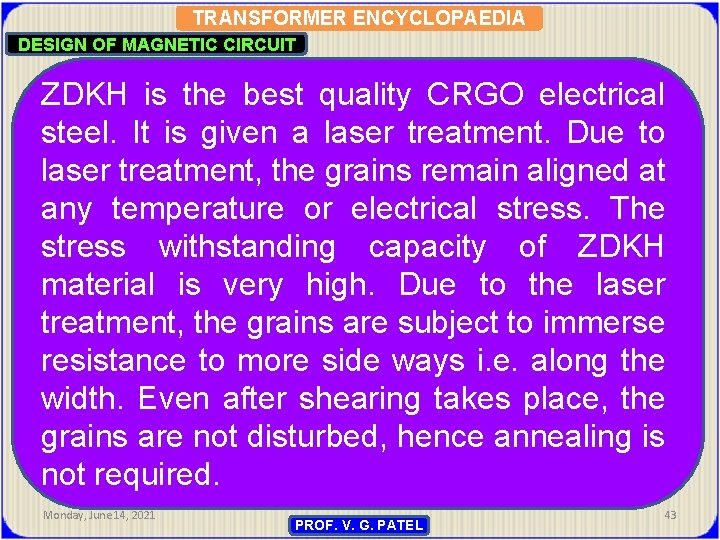
TRANSFORMER ENCYCLOPAEDIA DESIGN OF MAGNETIC CIRCUIT ZDKH is the best quality CRGO electrical steel. It is given a laser treatment. Due to laser treatment, the grains remain aligned at any temperature or electrical stress. The stress withstanding capacity of ZDKH material is very high. Due to the laser treatment, the grains are subject to immerse resistance to more side ways i. e. along the width. Even after shearing takes place, the grains are not disturbed, hence annealing is not required. Monday, June 14, 2021 PROF. V. G. PATEL 43
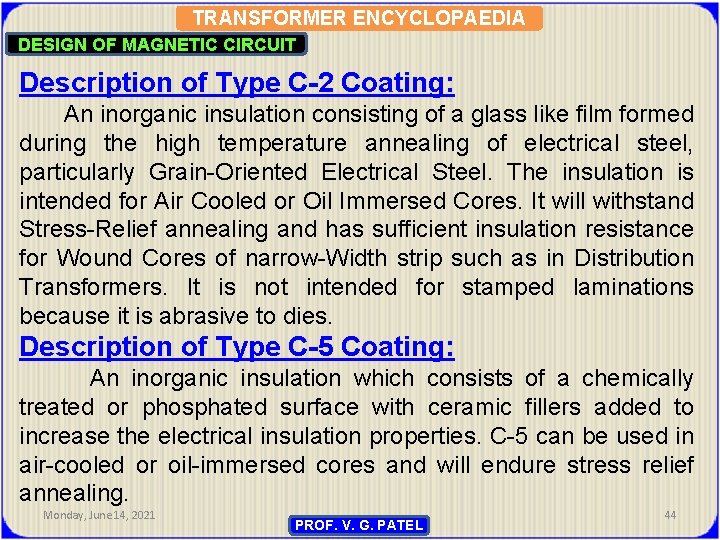
TRANSFORMER ENCYCLOPAEDIA DESIGN OF MAGNETIC CIRCUIT Description of Type C-2 Coating: An inorganic insulation consisting of a glass like film formed during the high temperature annealing of electrical steel, particularly Grain-Oriented Electrical Steel. The insulation is intended for Air Cooled or Oil Immersed Cores. It will withstand Stress-Relief annealing and has sufficient insulation resistance for Wound Cores of narrow-Width strip such as in Distribution Transformers. It is not intended for stamped laminations because it is abrasive to dies. Description of Type C-5 Coating: An inorganic insulation which consists of a chemically treated or phosphated surface with ceramic fillers added to increase the electrical insulation properties. C-5 can be used in air-cooled or oil-immersed cores and will endure stress relief annealing. Monday, June 14, 2021 PROF. V. G. PATEL 44
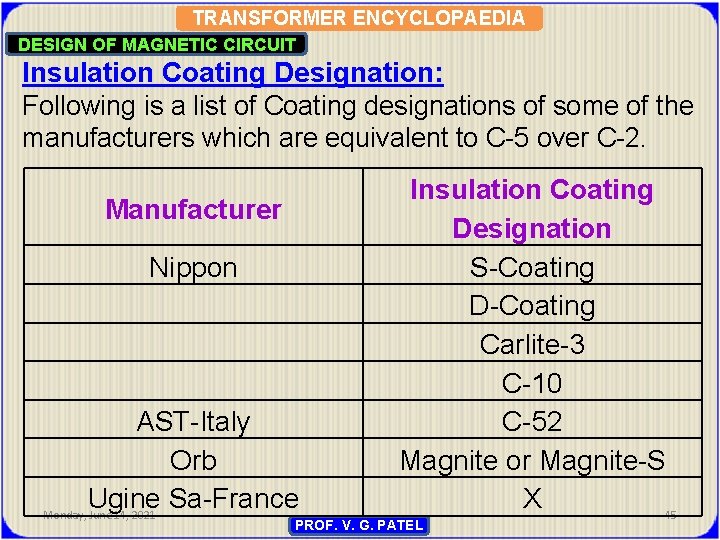
TRANSFORMER ENCYCLOPAEDIA DESIGN OF MAGNETIC CIRCUIT Insulation Coating Designation: Following is a list of Coating designations of some of the manufacturers which are equivalent to C-5 over C-2. Manufacturer Nippon AST-Italy Orb Ugine Sa-France Monday, June 14, 2021 Insulation Coating Designation S-Coating D-Coating Carlite-3 C-10 C-52 Magnite or Magnite-S X 45 PROF. V. G. PATEL

TRANSFORMER ENCYCLOPAEDIA OPEN FORUM Monday, June 14, 2021 46
TRANSFORMER ENCYCLOPAEDIA THANQ Monday, June 14, 2021 47
- Slides: 47