
Design of LowPressure Membrane Filtration Systems and New
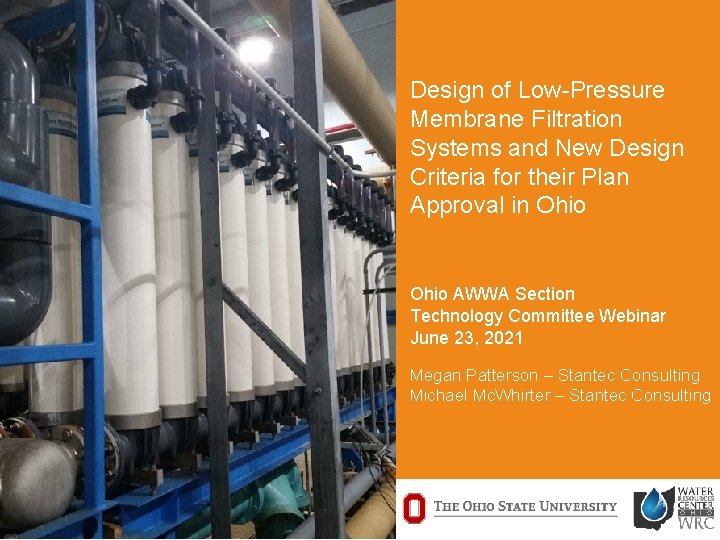
Design of Low-Pressure Membrane Filtration Systems and New Design Criteria for their Plan Approval in Ohio AWWA Section Technology Committee Webinar June 23, 2021 Megan Patterson – Stantec Consulting Michael Mc. Whirter – Stantec Consulting
Previously on. . . The OAWWA Technology Committee Webinar Series: • Discussed Ten State Standards use in Ohio and “emerging” vs. conventional technologies. • Referenced future work, including Low-Pressure Membrane Filtration Design Criteria Today: • Design criteria development process for Low-Pressure Membrane Filtration Design Criteria • Example low-pressure membrane design scenario
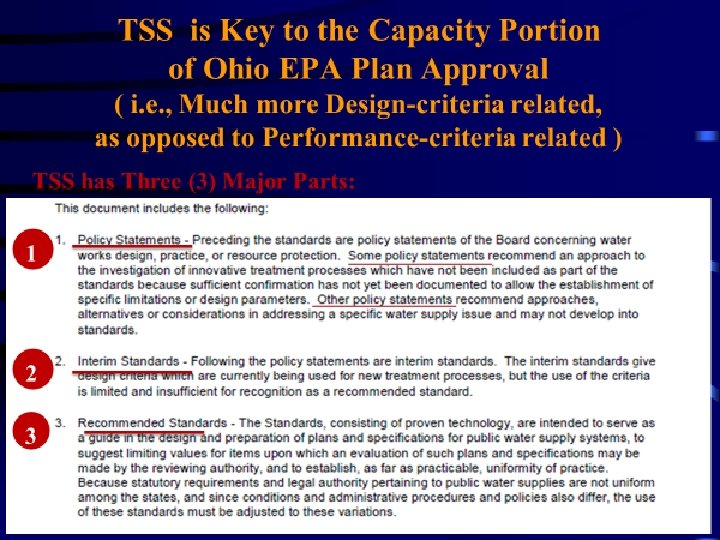
TSS is Key to the Capacity Portion of Ohio EPA Plan Approval ( i. e. , Much more Design-criteria related, as opposed to Performance-criteria related ) TSS has Three (3) Major Parts: 1 2 3
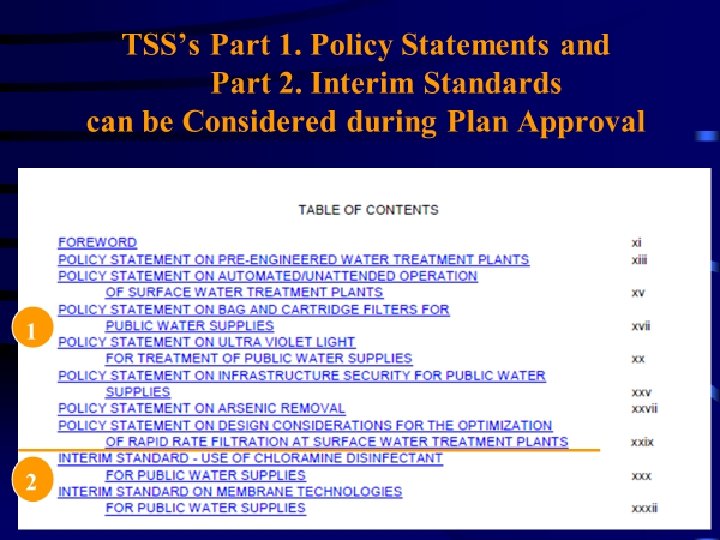
TSS’s Part 1. Policy Statements and Part 2. Interim Standards can be Considered during Plan Approval 1 2
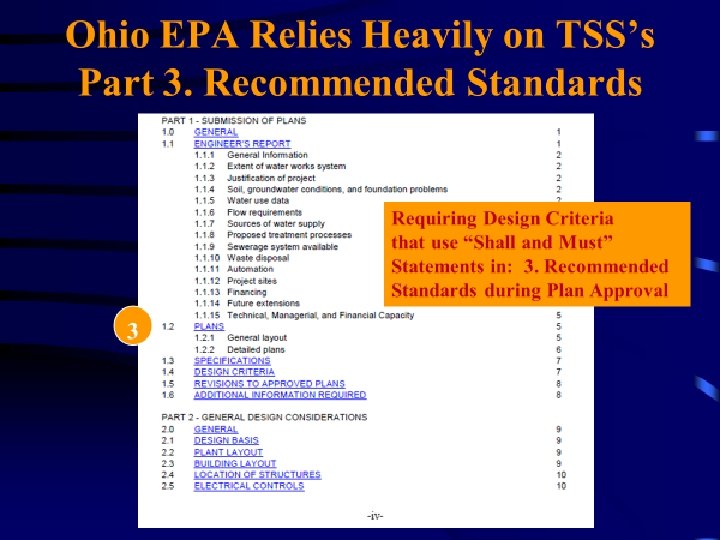
Ohio EPA Relies Heavily on TSS’s Part 3. Recommended Standards 3 Requiring Design Criteria that use “Shall and Must” Statements in: 3. Recommended Standards during Plan Approval
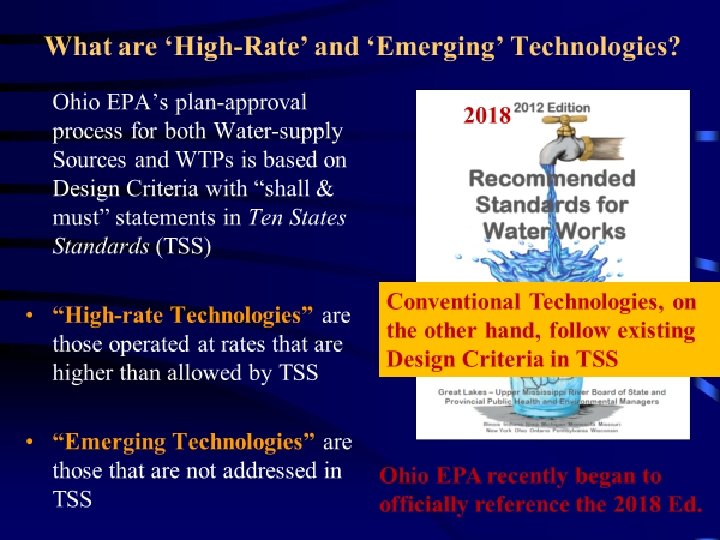
What are ‘High-Rate’ and ‘Emerging’ Technologies? Ohio EPA’s plan-approval process for both Water-supply Sources and WTPs is based on Design Criteria with “shall & must” statements in Ten States Standards (TSS) “High-rate Technologies” are those operated at rates that are higher than allowed by TSS “Emerging Technologies” are those that are not addressed in TSS 2018 Conventional Technologies, on the other hand, follow existing Design Criteria in TSS Ohio EPA recently began to officially reference the 2018 Ed.
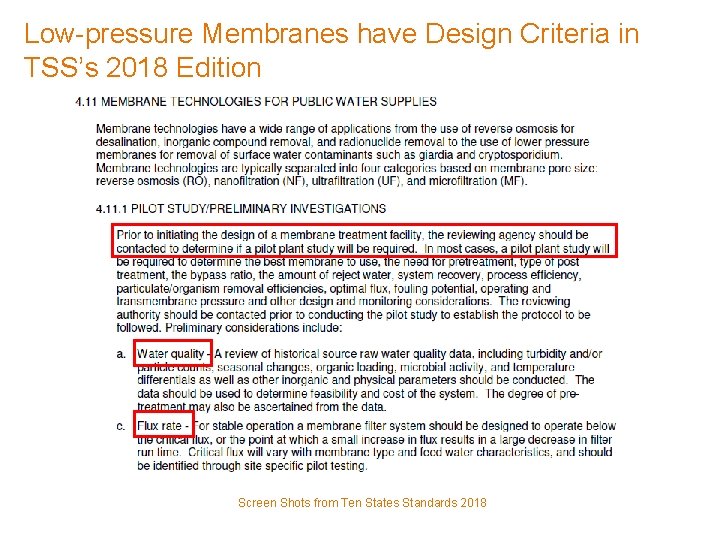
Low-pressure Membranes have Design Criteria in TSS’s 2018 Edition Screen Shots from Ten States Standards 2018
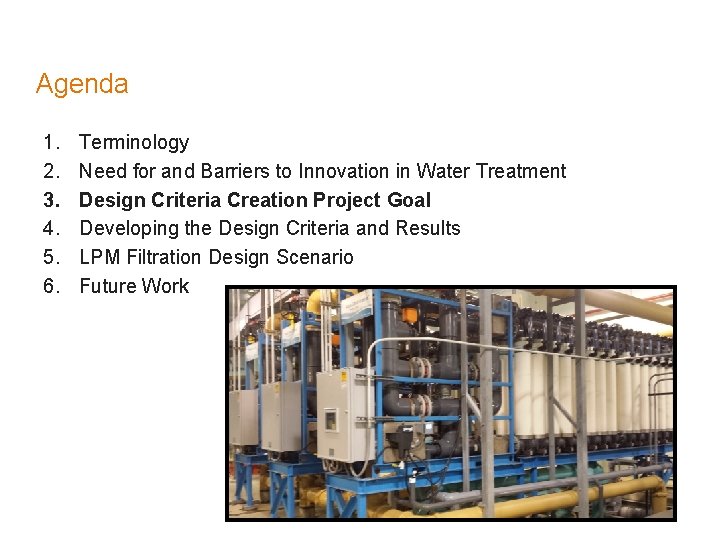
Agenda 1. 2. 3. 4. 5. 6. Terminology Need for and Barriers to Innovation in Water Treatment Design Criteria Creation Project Goal Developing the Design Criteria and Results LPM Filtration Design Scenario Future Work
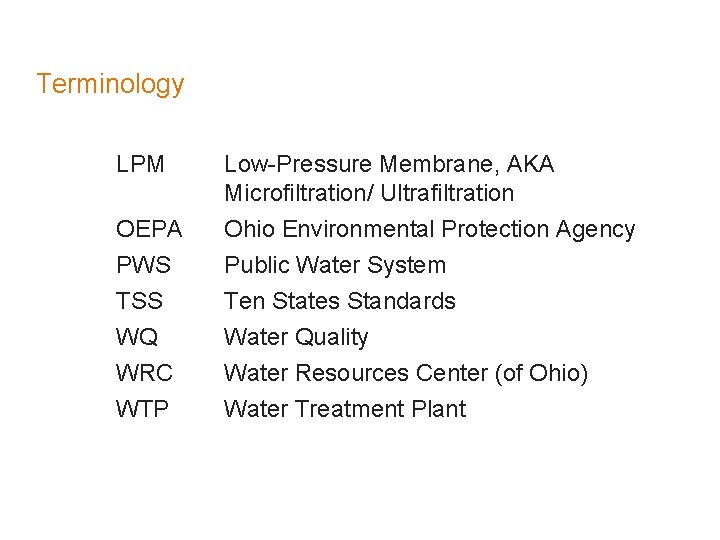
Terminology LPM Low-Pressure Membrane, AKA Microfiltration/ Ultrafiltration OEPA PWS TSS WQ WRC WTP Ohio Environmental Protection Agency Public Water System Ten States Standards Water Quality Water Resources Center (of Ohio) Water Treatment Plant

Nationwide Discussion to Enable Innovation in Water Treatment Benefits of innovation: Improved finished water quality Improved public health outcomes Reduced costs More sustainable treatment alternatives Barriers
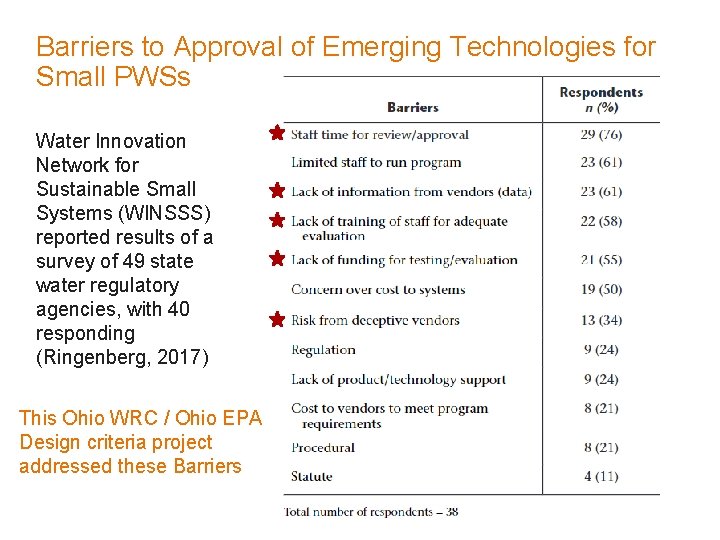
Barriers to Approval of Emerging Technologies for Small PWSs Water Innovation Network for Sustainable Small Systems (WINSSS) reported results of a survey of 49 state water regulatory agencies, with 40 responding (Ringenberg, 2017) This Ohio WRC / Ohio EPA Design criteria project addressed these Barriers
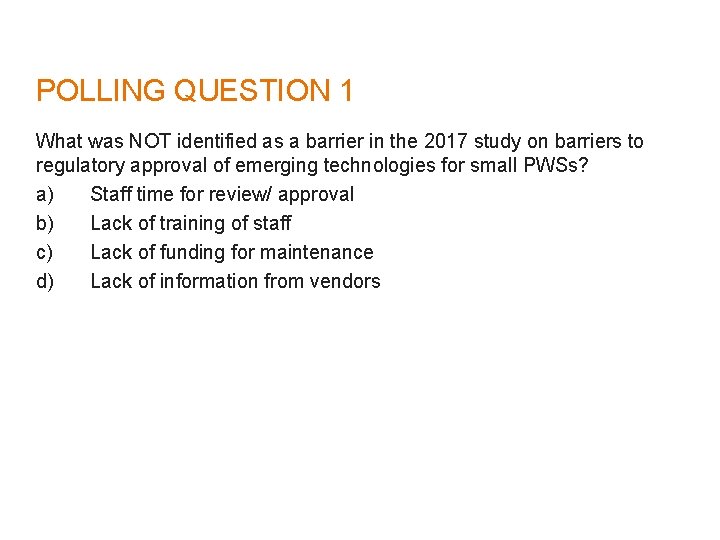
POLLING QUESTION 1 What was NOT identified as a barrier in the 2017 study on barriers to regulatory approval of emerging technologies for small PWSs? a) Staff time for review/ approval b) Lack of training of staff c) Lack of funding for maintenance d) Lack of information from vendors
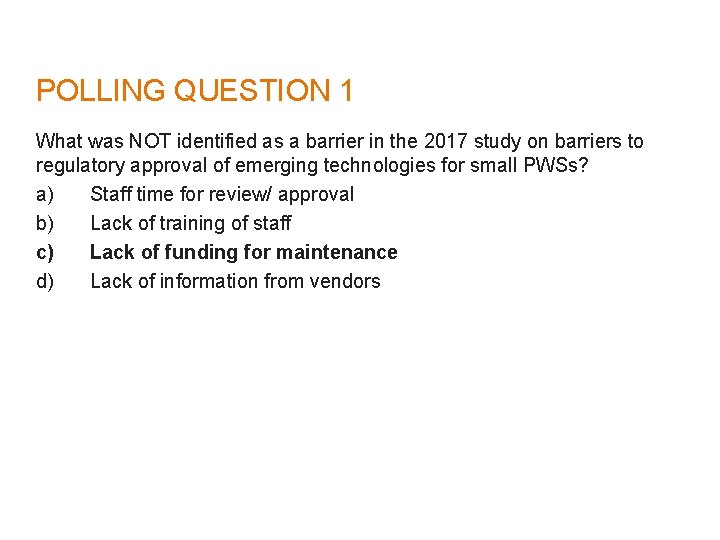
POLLING QUESTION 1 What was NOT identified as a barrier in the 2017 study on barriers to regulatory approval of emerging technologies for small PWSs? a) Staff time for review/ approval b) Lack of training of staff c) Lack of funding for maintenance d) Lack of information from vendors
Agenda 1. 2. 3. 4. 5. 6. Terminology Need for and Barriers to Innovation in Water Treatment Design Criteria Creation Project Goal Developing the Design Criteria and Results LPM Filtration Design Scenario Future Work
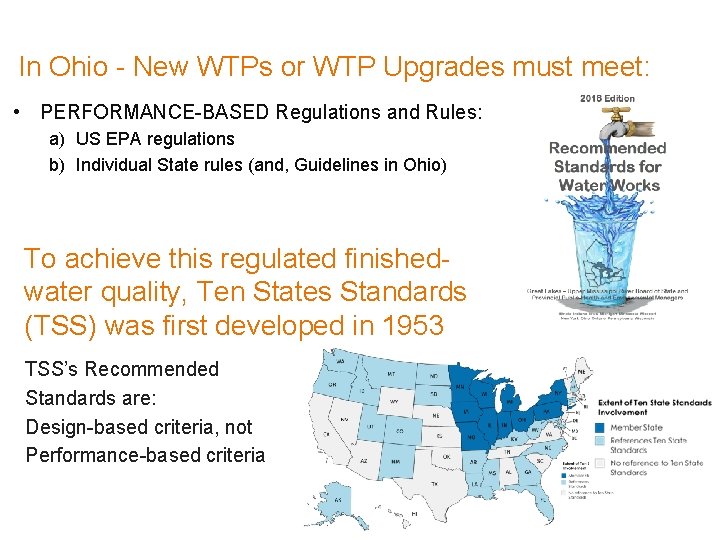
In Ohio - New WTPs or WTP Upgrades must meet: • PERFORMANCE-BASED Regulations and Rules: a) US EPA regulations b) Individual State rules (and, Guidelines in Ohio) To achieve this regulated finishedwater quality, Ten States Standards (TSS) was first developed in 1953 TSS’s Recommended Standards are: Design-based criteria, not Performance-based criteria
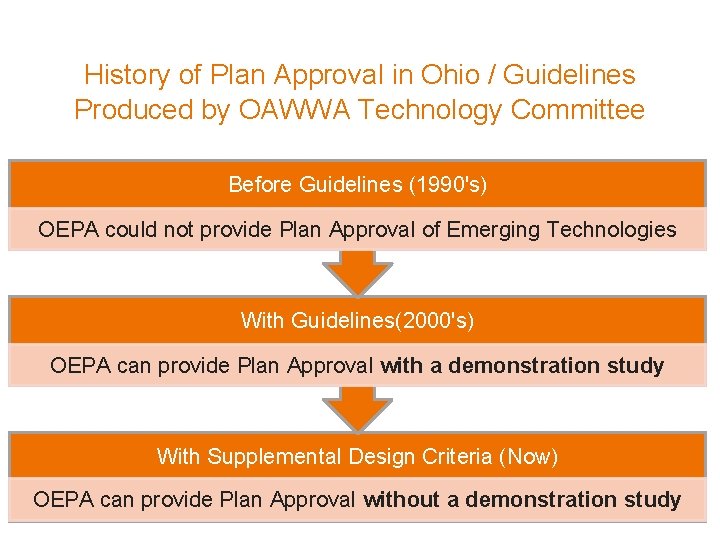
History of Plan Approval in Ohio / Guidelines Produced by OAWWA Technology Committee Before Guidelines (1990's) OEPA could not provide Plan Approval of Emerging Technologies With Guidelines(2000's) OEPA can provide Plan Approval with a demonstration study With Supplemental Design Criteria (Now) OEPA can provide Plan Approval without a demonstration study
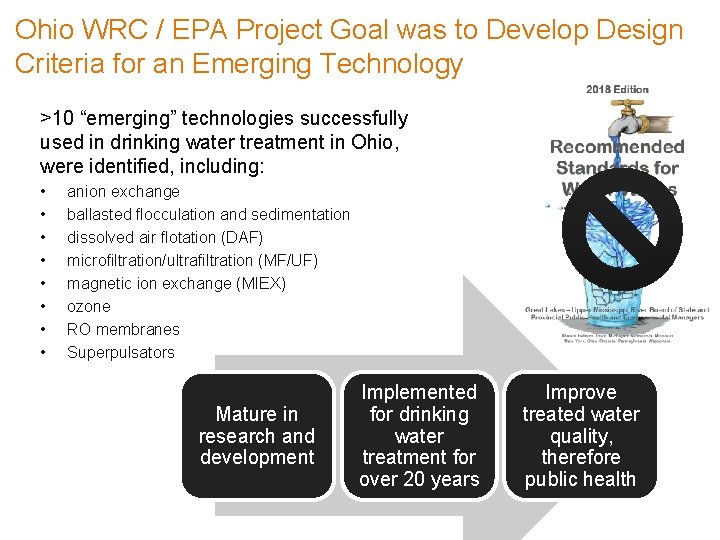
Ohio WRC / EPA Project Goal was to Develop Design Criteria for an Emerging Technology >10 “emerging” technologies successfully used in drinking water treatment in Ohio, were identified, including: • • anion exchange ballasted flocculation and sedimentation dissolved air flotation (DAF) microfiltration/ultrafiltration (MF/UF) magnetic ion exchange (MIEX) ozone RO membranes Superpulsators Mature in research and development Implemented for drinking water treatment for over 20 years Improve treated water quality, therefore public health
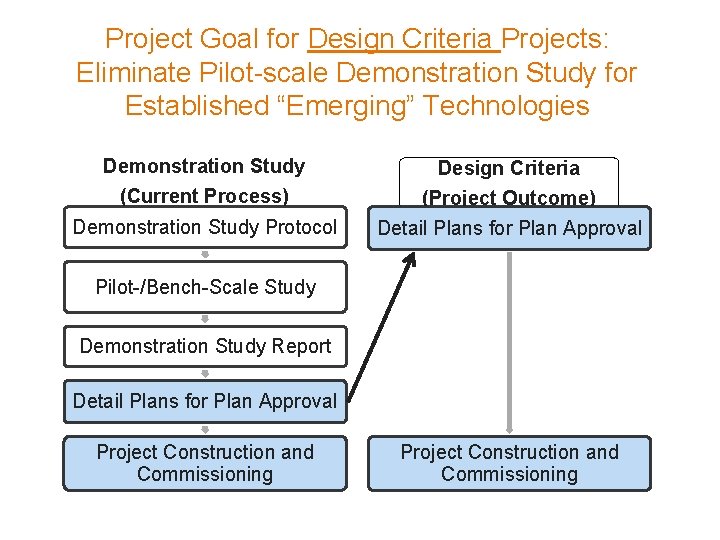
Project Goal for Design Criteria Projects: Eliminate Pilot-scale Demonstration Study for Established “Emerging” Technologies Demonstration Study (Current Process) Design Criteria (Project Outcome) Demonstration Study Protocol Detail Plans for Plan Approval Pilot-/Bench-Scale Study Demonstration Study Report Detail Plans for Plan Approval Project Construction and Commissioning
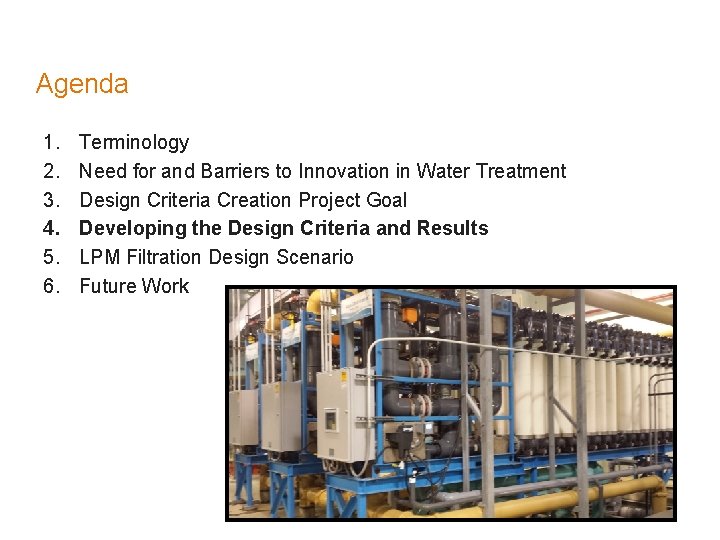
Agenda 1. 2. 3. 4. 5. 6. Terminology Need for and Barriers to Innovation in Water Treatment Design Criteria Creation Project Goal Developing the Design Criteria and Results LPM Filtration Design Scenario Future Work
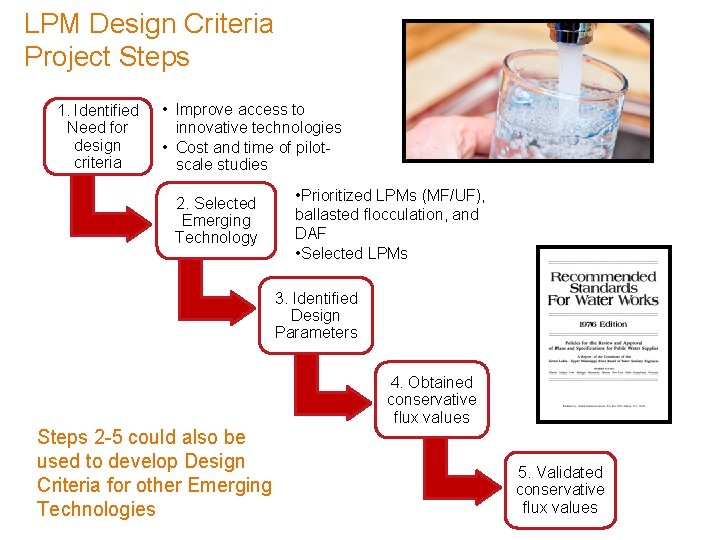
LPM Design Criteria Project Steps 1. Identified Need for design criteria • Improve access to innovative technologies • Cost and time of pilotscale studies 2. Selected Emerging Technology • Prioritized LPMs (MF/UF), cdc. gov ballasted flocculation, and DAF • Selected LPMs 3. Identified Design Parameters Steps 2 -5 could also be used to develop Design Criteria for other Emerging Technologies 4. Obtained conservative flux values 5. Validated conservative flux values
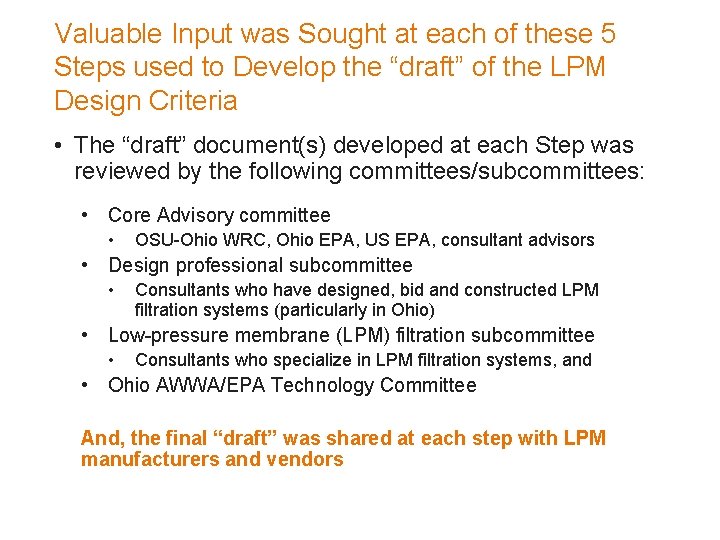
Valuable Input was Sought at each of these 5 Steps used to Develop the “draft” of the LPM Design Criteria • The “draft” document(s) developed at each Step was reviewed by the following committees/subcommittees: • Core Advisory committee • OSU-Ohio WRC, Ohio EPA, US EPA, consultant advisors • Design professional subcommittee • Consultants who have designed, bid and constructed LPM filtration systems (particularly in Ohio) • Low-pressure membrane (LPM) filtration subcommittee • Consultants who specialize in LPM filtration systems, and • Ohio AWWA/EPA Technology Committee And, the final “draft” was shared at each step with LPM manufacturers and vendors
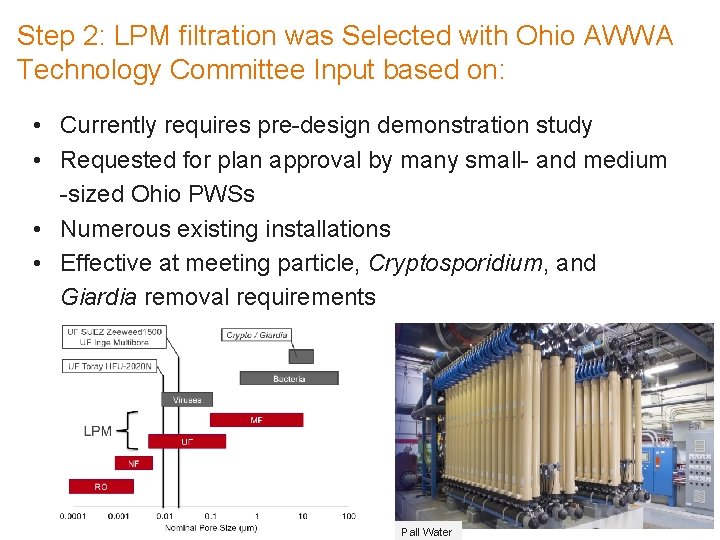
Step 2: LPM filtration was Selected with Ohio AWWA Technology Committee Input based on: • Currently requires pre-design demonstration study • Requested for plan approval by many small- and medium -sized Ohio PWSs • Numerous existing installations • Effective at meeting particle, Cryptosporidium, and Giardia removal requirements Pall Water
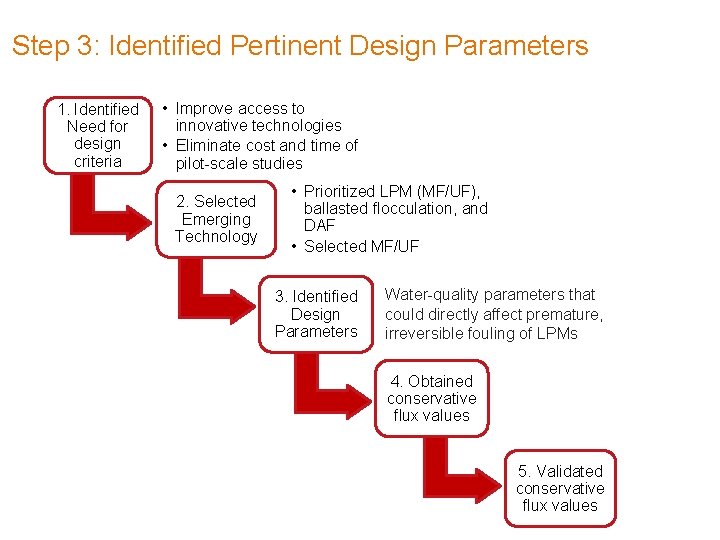
Step 3: Identified Pertinent Design Parameters 1. Identified Need for design criteria • Improve access to innovative technologies • Eliminate cost and time of pilot-scale studies 2. Selected Emerging Technology • Prioritized LPM (MF/UF), ballasted flocculation, and DAF • Selected MF/UF 3. Identified Design Parameters Water-quality parameters that could directly affect premature, irreversible fouling of LPMs 4. Obtained conservative flux values 5. Validated conservative flux values
POLLING QUESTION 2 How many years are typical for a low-pressure membrane unit design life? a) 0 -5 years b) 5 -10 years c) 10 -20 years d) 20 -50 years
POLLING QUESTION 2 How many years are typical for a low-pressure membrane unit design life? a) 0 -5 years b) 5 -10 years c) 10 -20 years d) 20 -50 years
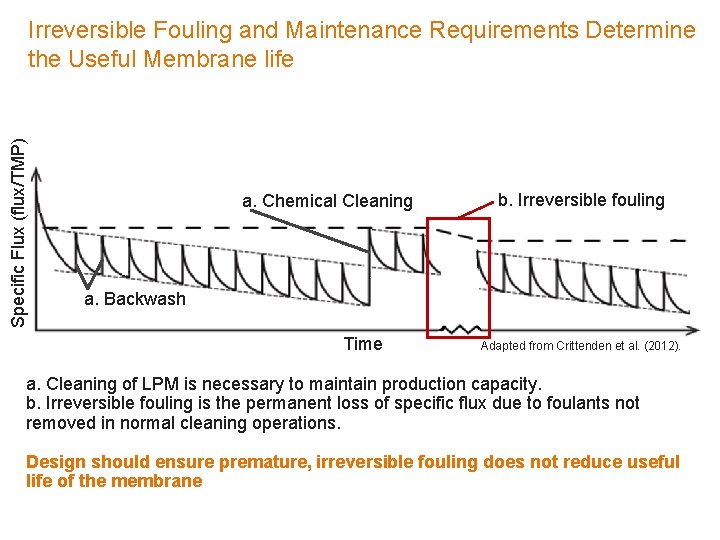
Specific Flux (flux/TMP) Irreversible Fouling and Maintenance Requirements Determine the Useful Membrane life a. Chemical Cleaning b. Irreversible fouling a. Backwash Time Adapted from Crittenden et al. (2012). a. Cleaning of LPM is necessary to maintain production capacity. b. Irreversible fouling is the permanent loss of specific flux due to foulants not removed in normal cleaning operations. Design should ensure premature, irreversible fouling does not reduce useful life of the membrane
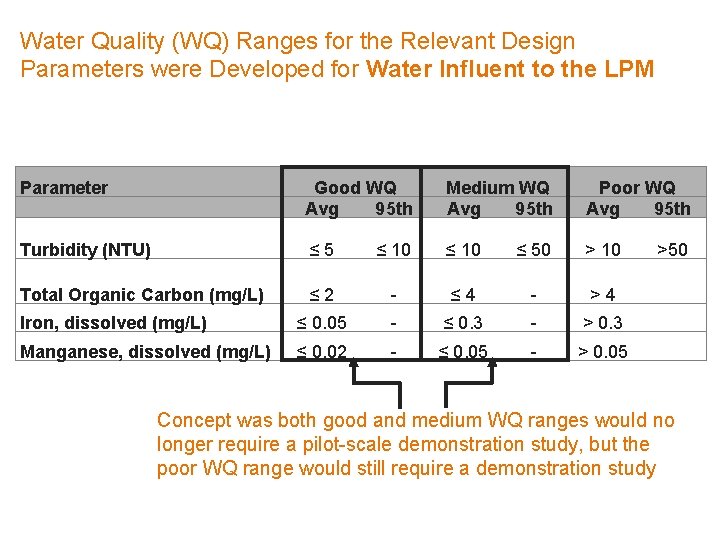
Water Quality (WQ) Ranges for the Relevant Design Parameters were Developed for Water Influent to the LPM Parameter Good WQ Avg 95 th Medium WQ Avg 95 th Poor WQ Avg 95 th Turbidity (NTU) ≤ 5 ≤ 10 ≤ 50 > 10 Total Organic Carbon (mg/L) ≤ 2 - ≤ 4 - >4 Iron, dissolved (mg/L) ≤ 0. 05 - ≤ 0. 3 - > 0. 3 Manganese, dissolved (mg/L) ≤ 0. 02 - ≤ 0. 05 - > 0. 05 >50 Concept was both good and medium WQ ranges would no longer require a pilot-scale demonstration study, but the poor WQ range would still require a demonstration study
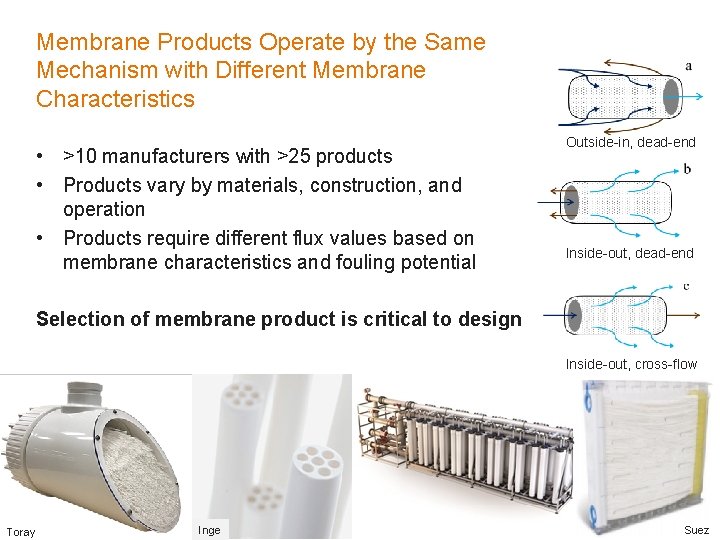
Membrane Products Operate by the Same Mechanism with Different Membrane Characteristics • >10 manufacturers with >25 products • Products vary by materials, construction, and operation • Products require different flux values based on membrane characteristics and fouling potential Outside-in, dead-end Inside-out, dead-end Selection of membrane product is critical to design Inside-out, cross-flow Toray Inge Suez
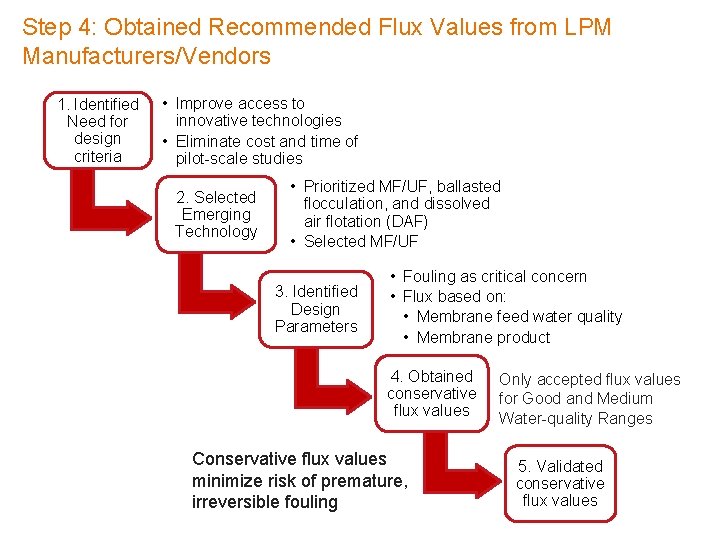
Step 4: Obtained Recommended Flux Values from LPM Manufacturers/Vendors 1. Identified Need for design criteria • Improve access to innovative technologies • Eliminate cost and time of pilot-scale studies 2. Selected Emerging Technology • Prioritized MF/UF, ballasted flocculation, and dissolved air flotation (DAF) • Selected MF/UF 3. Identified Design Parameters • Fouling as critical concern • Flux based on: • Membrane feed water quality • Membrane product 4. Obtained conservative flux values Conservative flux values minimize risk of premature, irreversible fouling Only accepted flux values for Good and Medium Water-quality Ranges 5. Validated conservative flux values
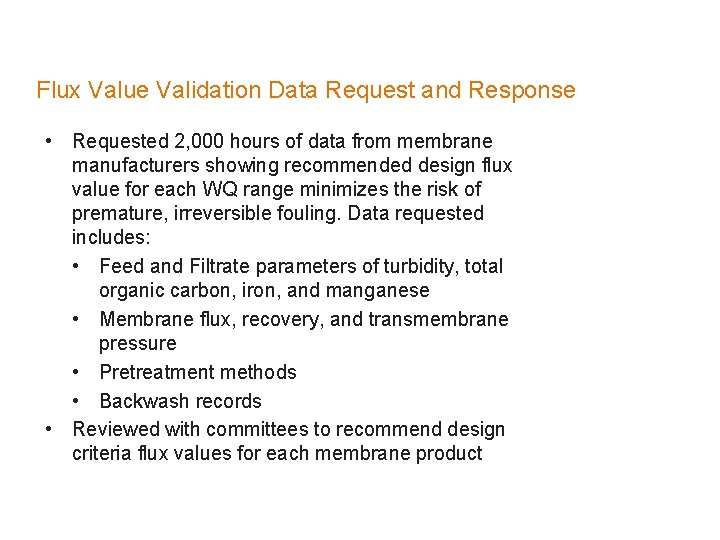
Flux Value Validation Data Request and Response • Requested 2, 000 hours of data from membrane manufacturers showing recommended design flux value for each WQ range minimizes the risk of premature, irreversible fouling. Data requested includes: • Feed and Filtrate parameters of turbidity, total organic carbon, iron, and manganese • Membrane flux, recovery, and transmembrane pressure • Pretreatment methods • Backwash records • Reviewed with committees to recommend design criteria flux values for each membrane product
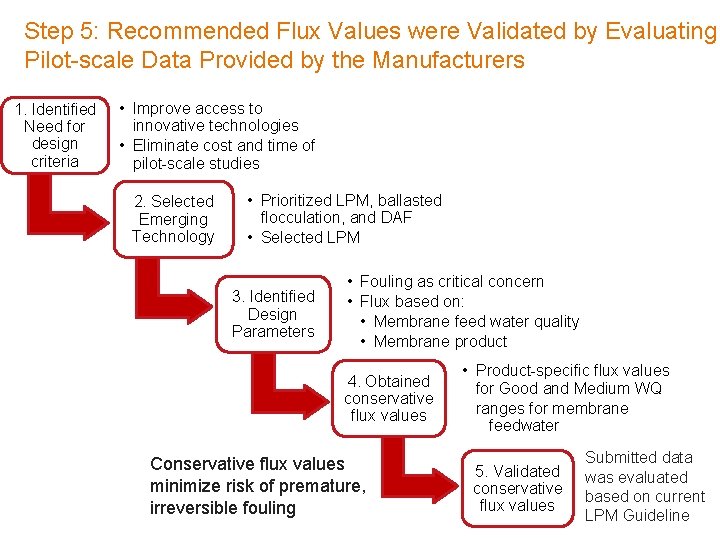
Step 5: Recommended Flux Values were Validated by Evaluating Pilot-scale Data Provided by the Manufacturers 1. Identified Need for design criteria • Improve access to innovative technologies • Eliminate cost and time of pilot-scale studies 2. Selected Emerging Technology • Prioritized LPM, ballasted flocculation, and DAF • Selected LPM 3. Identified Design Parameters • Fouling as critical concern • Flux based on: • Membrane feed water quality • Membrane product 4. Obtained conservative flux values Conservative flux values minimize risk of premature, irreversible fouling • Product-specific flux values for Good and Medium WQ ranges for membrane feedwater 5. Validated conservative flux values data • Submitted Existing studies was evaluated to show flux based on current recovery after cleaning LPM Guideline
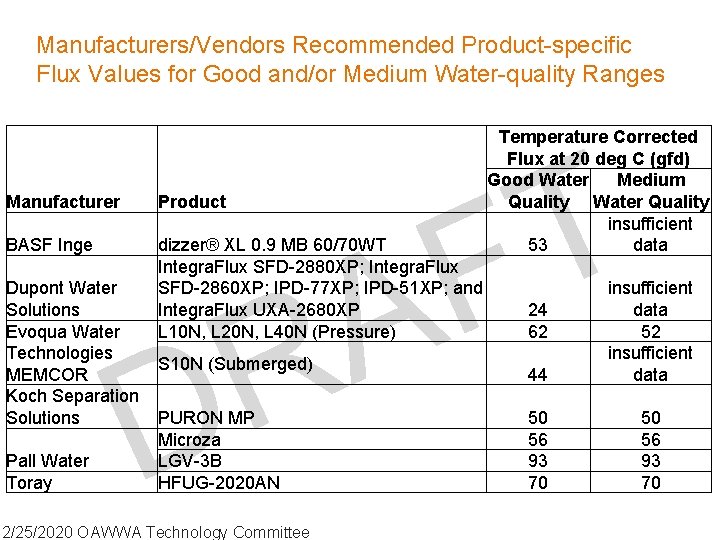
Manufacturers/Vendors Recommended Product-specific Flux Values for Good and/or Medium Water-quality Ranges Manufacturer BASF Inge T F A R D Dupont Water Solutions Evoqua Water Technologies MEMCOR Koch Separation Solutions Pall Water Toray Temperature Corrected Flux at 20 deg C (gfd) Good Water Medium Quality Water Quality insufficient 53 data Product dizzer® XL 0. 9 MB 60/70 WT Integra. Flux SFD-2880 XP; Integra. Flux SFD-2860 XP; IPD-77 XP; IPD-51 XP; and Integra. Flux UXA-2680 XP L 10 N, L 20 N, L 40 N (Pressure) S 10 N (Submerged) PURON MP Microza LGV-3 B HFUG-2020 AN 2/25/2020 OAWWA Technology Committee 44 insufficient data 52 insufficient data 50 56 93 70 24 62
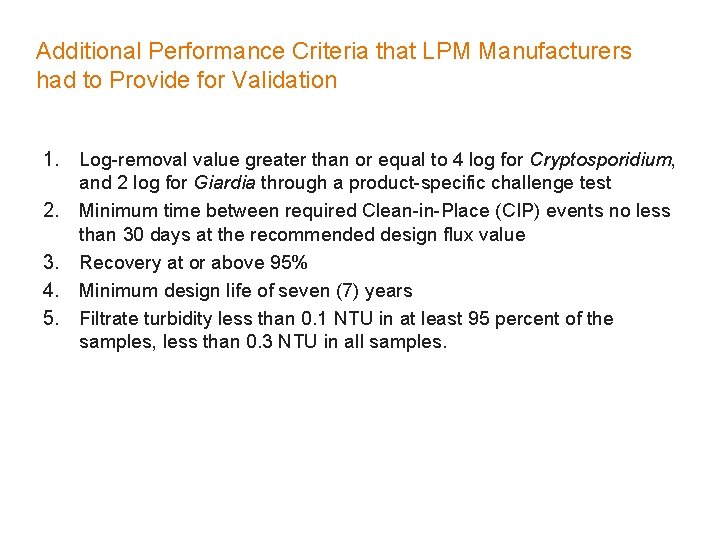
Additional Performance Criteria that LPM Manufacturers had to Provide for Validation 1. Log-removal value greater than or equal to 4 log for Cryptosporidium, and 2 log for Giardia through a product-specific challenge test 2. Minimum time between required Clean-in-Place (CIP) events no less than 30 days at the recommended design flux value 3. Recovery at or above 95% 4. Minimum design life of seven (7) years 5. Filtrate turbidity less than 0. 1 NTU in at least 95 percent of the samples, less than 0. 3 NTU in all samples.
Membrane Data Validation Subcommittee was formed to review validation data for LPM products • It is anticipated that more manufacturers will provide flux validation data as they have it available or when LPM projects are implemented by Ohio PWSs • The Membrane Data Validation Subcommittee’s primary objective is to continue efforts to update Ohio EPA’s LPM Filtration design criteria by establishing design criteria flux values for LPMs as new validation data is provided by manufacturers for existing, new, or improved products.
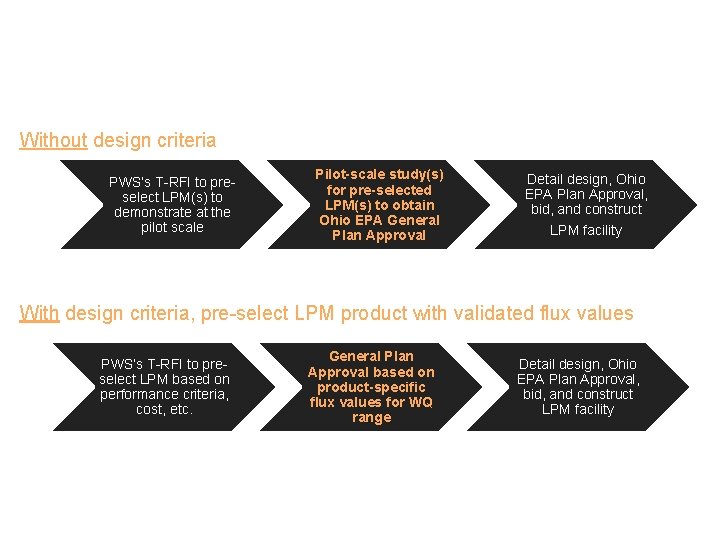
Without design criteria PWS’s T-RFI to preselect LPM(s) to demonstrate at the pilot scale Pilot-scale study(s) for pre-selected LPM(s) to obtain Ohio EPA General Plan Approval Detail design, Ohio EPA Plan Approval, bid, and construct LPM facility With design criteria, pre-select LPM product with validated flux values PWS’s T-RFI to preselect LPM based on performance criteria, cost, etc. General Plan Approval based on product-specific flux values for WQ range Detail design, Ohio EPA Plan Approval, bid, and construct LPM facility
Advisory Committees • • Core Advisory Committee Design Engineer Subcommittee Membrane Expert Subcommittee Manufacturers and Vendors
Agenda 1. 2. 3. 4. 5. 6. Terminology Need for and Barriers to Innovation in Water Treatment Design Criteria Creation Project Goal Developing the Design Criteria and Results LPM Filtration Design Scenario Future Work
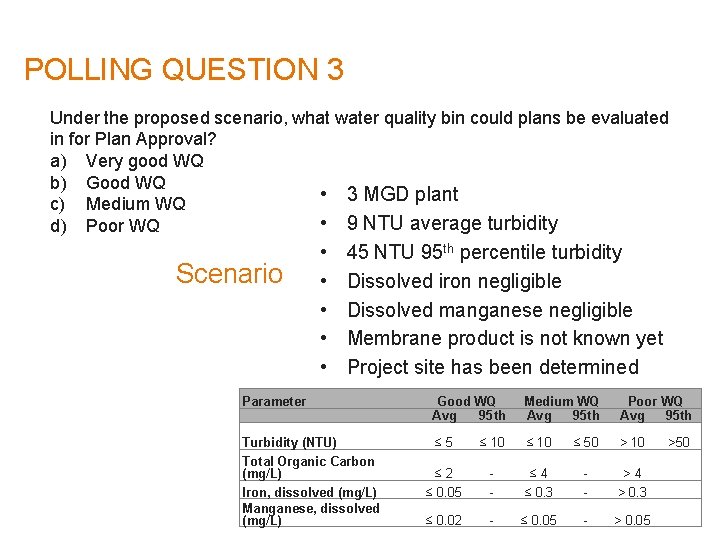
POLLING QUESTION 3 Under the proposed scenario, what water quality bin could plans be evaluated in for Plan Approval? a) Very good WQ b) Good WQ • 3 MGD plant c) Medium WQ • 9 NTU average turbidity d) Poor WQ Scenario • • • 45 NTU 95 th percentile turbidity Dissolved iron negligible Dissolved manganese negligible Membrane product is not known yet Project site has been determined Parameter Good WQ Avg 95 th Medium WQ Avg 95 th Poor WQ Avg 95 th Turbidity (NTU) Total Organic Carbon (mg/L) Iron, dissolved (mg/L) Manganese, dissolved (mg/L) ≤ 5 ≤ 10 ≤ 50 > 10 ≤ 2 ≤ 0. 05 - ≤ 4 ≤ 0. 3 - >4 > 0. 3 ≤ 0. 02 - ≤ 0. 05 - > 0. 05 >50
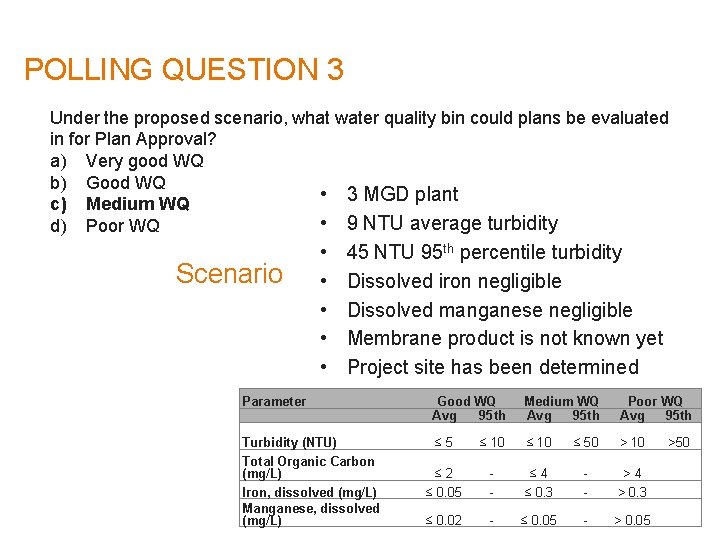
POLLING QUESTION 3 Under the proposed scenario, what water quality bin could plans be evaluated in for Plan Approval? a) Very good WQ b) Good WQ • 3 MGD plant c) Medium WQ • 9 NTU average turbidity d) Poor WQ Scenario • • • 45 NTU 95 th percentile turbidity Dissolved iron negligible Dissolved manganese negligible Membrane product is not known yet Project site has been determined Parameter Good WQ Avg 95 th Medium WQ Avg 95 th Poor WQ Avg 95 th Turbidity (NTU) Total Organic Carbon (mg/L) Iron, dissolved (mg/L) Manganese, dissolved (mg/L) ≤ 5 ≤ 10 ≤ 50 > 10 ≤ 2 ≤ 0. 05 - ≤ 4 ≤ 0. 3 - >4 > 0. 3 ≤ 0. 02 - ≤ 0. 05 - > 0. 05 >50
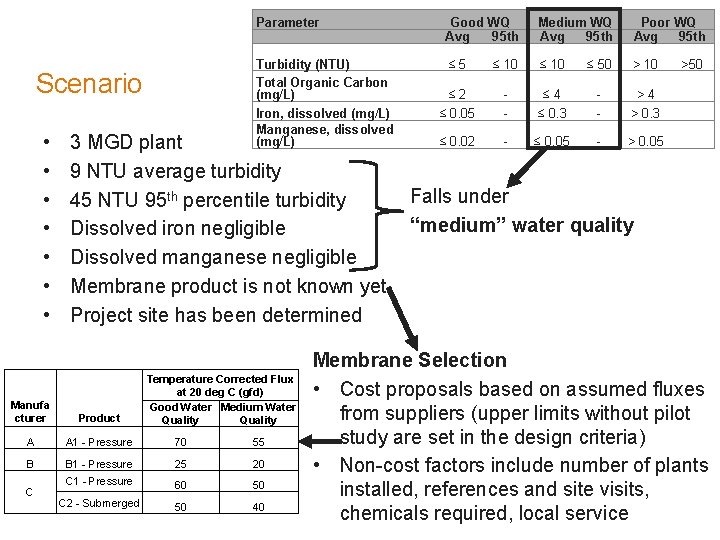
Scenario • • Parameter Good WQ Avg 95 th Medium WQ Avg 95 th Poor WQ Avg 95 th Turbidity (NTU) Total Organic Carbon (mg/L) Iron, dissolved (mg/L) Manganese, dissolved (mg/L) ≤ 5 ≤ 10 ≤ 50 > 10 ≤ 2 ≤ 0. 05 - ≤ 4 ≤ 0. 3 - >4 > 0. 3 ≤ 0. 02 - ≤ 0. 05 - > 0. 05 3 MGD plant 9 NTU average turbidity 45 NTU 95 th percentile turbidity Dissolved iron negligible Dissolved manganese negligible Membrane product is not known yet Project site has been determined Temperature Corrected Flux at 20 deg C (gfd) Good Water Medium Water Quality Manufa cturer Product A A 1 - Pressure 70 55 B B 1 - Pressure 25 20 C 1 - Pressure 60 50 C 2 - Submerged 50 40 C >50 Falls under “medium” water quality Membrane Selection • Cost proposals based on assumed fluxes from suppliers (upper limits without pilot study are set in the design criteria) • Non-cost factors include number of plants installed, references and site visits, chemicals required, local service
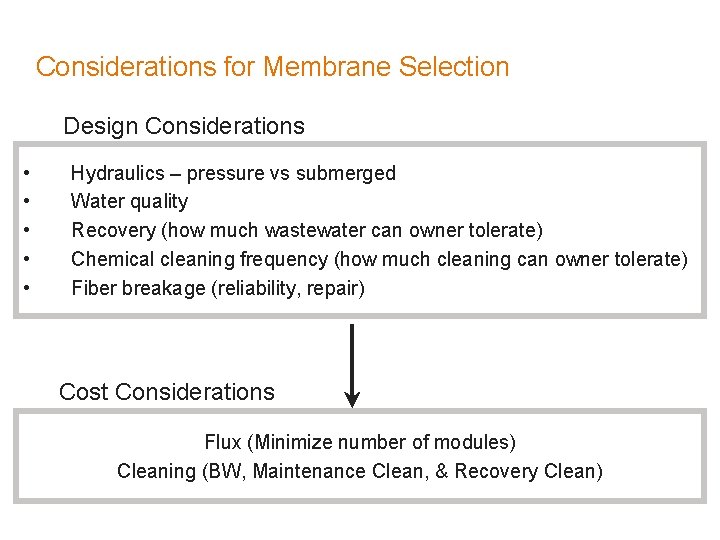
Considerations for Membrane Selection Design Considerations • • • Hydraulics – pressure vs submerged Water quality Recovery (how much wastewater can owner tolerate) Chemical cleaning frequency (how much cleaning can owner tolerate) Fiber breakage (reliability, repair) Cost Considerations Flux (Minimize number of modules) Cleaning (BW, Maintenance Clean, & Recovery Clean)
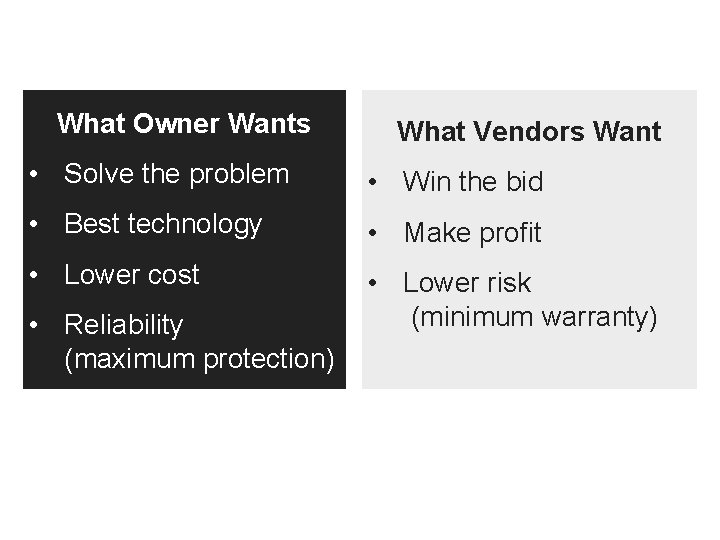
What Owner Wants What Vendors Want • Solve the problem • Win the bid • Best technology • Make profit • Lower cost • Lower risk (minimum warranty) • Reliability (maximum protection)
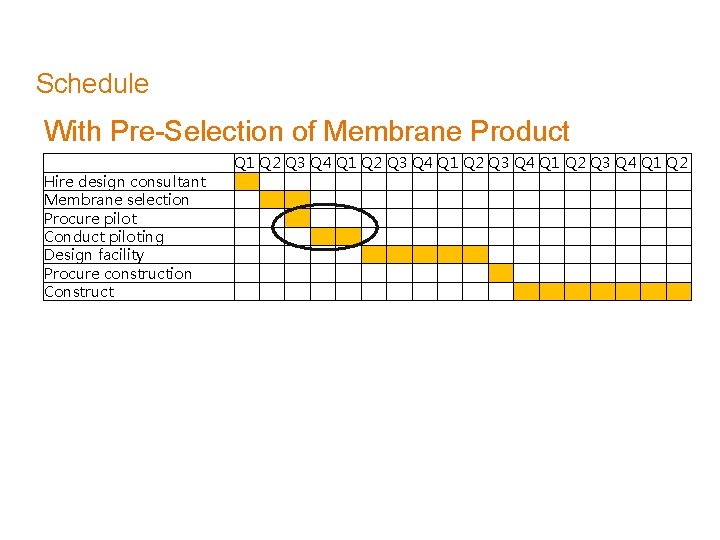
Schedule With Pre-Selection of Membrane Product Hire design consultant Membrane selection Procure pilot Conduct piloting Design facility Procure construction Construct Q 1 Q 2 Q 3 Q 4 Q 1 Q 2
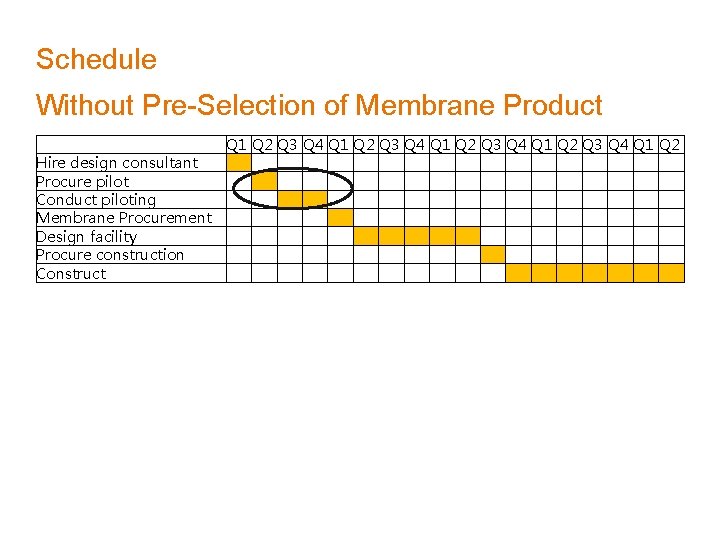
Schedule Without Pre-Selection of Membrane Product Hire design consultant Procure pilot Conduct piloting Membrane Procurement Design facility Procure construction Construct Q 1 Q 2 Q 3 Q 4 Q 1 Q 2
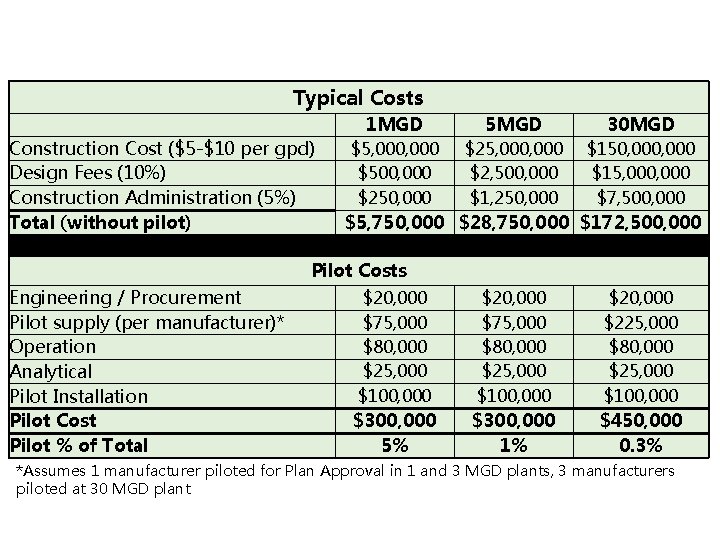
Typical Costs Construction Cost ($5 -$10 per gpd) Design Fees (10%) Construction Administration (5%) Total (without pilot) 1 MGD 5 MGD 30 MGD $5, 000 $500, 000 $25, 000 $2, 500, 000 $1, 250, 000 $150, 000 $15, 000 $7, 500, 000 $5, 750, 000 $28, 750, 000 $172, 500, 000 Pilot Costs Engineering / Procurement Pilot supply (per manufacturer)* Operation Analytical Pilot Installation Pilot Cost Pilot % of Total $20, 000 $75, 000 $80, 000 $25, 000 $100, 000 $20, 000 $225, 000 $80, 000 $25, 000 $100, 000 $300, 000 5% $300, 000 1% $450, 000 0. 3% *Assumes 1 manufacturer piloted for Plan Approval in 1 and 3 MGD plants, 3 manufacturers piloted at 30 MGD plant
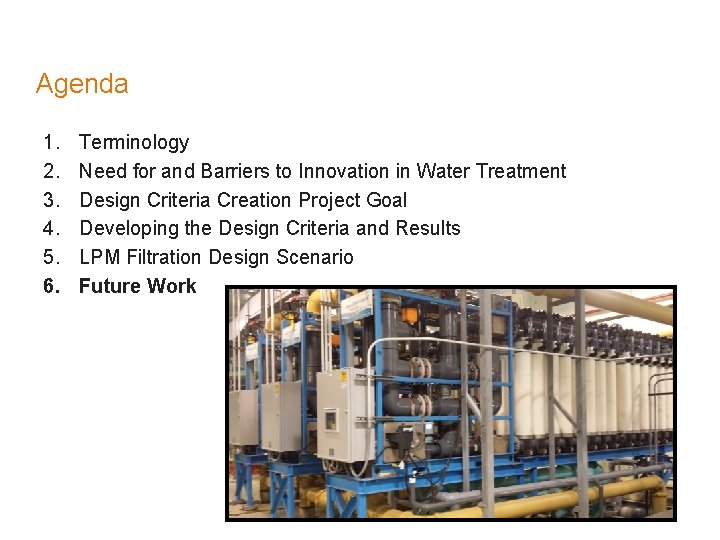
Agenda 1. 2. 3. 4. 5. 6. Terminology Need for and Barriers to Innovation in Water Treatment Design Criteria Creation Project Goal Developing the Design Criteria and Results LPM Filtration Design Scenario Future Work
Future Work - Need for a document to provide ranges of percent removal for unit-treatment processes preceding membrane: 1. Design criteria is based on water quality influent to the membrane. • • 2. A PWS may not have that direct water quality data. To obtain data influent to the membrane for a WTP will have to: • Perform bench- or pilot-scale study(s) – defeats the purpose of having a design std in place, OR • Rely on a Simultaneous Compliance document that provides ranges for percent removals of parameters for unit-treatment processes that would precede the membrane Such a Simultaneous Compliance document may assist when coming to agreement on points of conflict that arise when reviewing General Plans that a PWS submits prior to starting detail design of a WTP project of some kind A subcommittee has been formed to create a Simultaneous Compliance document to address these and other concerns
POLLING QUESTION 4 – Future Work The next design criteria is already in development. What emerging technology would YOU like the Ohio AWWA Technology Committee to evaluate next? a) Ozonation with biologically active filtration for HABs/DBPs/T&O/disinfection b) Dissolved air flotation for turbidity and algae (HABs) c) Granular activated carbon (GAC) for PFAS removal and RSSCT Guidelines d) Tank or inline aeration and mixing for disinfection byproducts (DBPs) e) Proprietary filter media for inorganics (arsenic/iron/manganese)
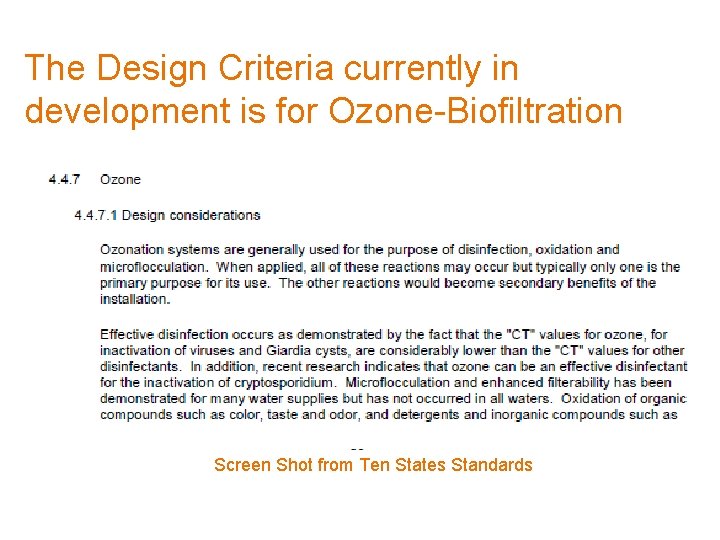
The Design Criteria currently in development is for Ozone-Biofiltration Screen Shot from Ten States Standards
Next time on the OAWWA Technology Committee Webinar series September 29, 2021—Lead Service Line Replacement Guidance November/December—Ohio EPA DDAGW Regulatory Update Check OAWWA. org for details and registration
Presenter E-mails -Megan. Patterson@Stantec. com Thank you -Michael. Mc. Whirter@Stantec. com LPM Design Criteria Project Team Dr. Linda Weavers 1, 2 Dr. Zuzana Bohrerova 1, 2 Dr. Tim Wolfe 3 Megan Patterson 2, 3 1 The Ohio Water Resources Center Department of Civil, Environmental, and Geodetic Engineering 3 Stantec Consulting Services, Inc. 2 OSU
Future Work - The Simultaneous Compliance Document (SCD) would likely be Used. . . 1. During Central office review of a General Plan for a significant capital improvement project for a “new, upgraded, or expanded” water treatment plant (WTP) which the PWS/ consultant team intends to develop detail plans and specifications, and 2. During Central office review of a “new” WTP that intends to use lowpressure membranes (or other Design Standards that might be developed based on water quality influent to the unit-treatment) for the Agency to approve pre-treatment processes prior to the membranes without a pilotscale demonstration study (i. e. the Draft Design Criteria had to be developed based on water quality influent to the membranes and new WTP projects likely only have source-water quality data available). 3. This document would include unit-treatment processes for which there are no Design Criteria in the Ten States Standards. Information for each process would include preliminary design criteria and a range of percent removals expected for contaminants the process is being installed to address.
- Slides: 52