
Design of Infrared WavelengthSelective Microbolometers Using Planar Multimode

Design of Infrared Wavelength-Selective Microbolometers Using Planar Multimode Detectors Dean P. Neikirk and Sangwook Han Microelectronics Research Center Department of Electrical and Computer Engineering The University of Texas at Austin, TX 78712 USA SPIE’s Microtechnologies for the New Millennium 15 -18 May 2003 Hotel Meliá Sevilla, Spain Proceedings of SPIE Vol. #5836 : Smart Sensors, Actuators, and MEMS SESSION 16, Room: Arenal I Wed. May 18, 12. 00 to 13. 00: Infrared Sensors 12. 20 -12. 35: Design of infrared wavelength-selective microbolometers using planar multimode detectors, D. P. Neikirk, S. Han, Univ. of Texas/Austin (USA) [5836 -60] link to pdf of proceedings paper. Microtechnologies for the New Millennium 2005 Microelectronics Research Center, The University of Texas at Austin

Conventional microbolometer infrared focal plane detectors Mirror layer thin conductor (absorber) Gap • • in an ideal device, the absorber should provide total absorption of the incoming radiation and convert the electromagnetic radiation into heat to “match” an absorber to free space requires incident resistive sheet – absorber: e. g. , a thin conductor with sheet resistance 377 ohms – mirror placed (odd integer)·l/4 behind absorbing layer – essentially a Fabry-Perot cavity – this is sometimes referred to as “space cloth” d mirror Fabry-Perot Microbolometer Array http: //lep 694. gsfc. nasa. gov/code 693/tdw 03/proceedings/docs/session_2/Ngo. pdf Microtechnologies for the New Millennium 2005 2 Microelectronics Research Center, The University of Texas at Austin

Spectral response of Fabry-Perot microbolometers • is it possible to build “multi-color” IR F-P microbolometer focal plane arrays? – the primary “design variable” is the distance to the mirror LWIR 377 W 1 coupling efficiency 0. 8 2 mm gap mirror 2. 5 mm gap 0. 6 the bandwidth of conventional Fabry-Perot microbolometers is too wide to allow easy “color” discrimination in the LWIR wavelength band 0. 4 3 mm gap 0. 2 0 4 6 8 10 12 14 wavelength (microns) Microtechnologies for the New Millennium 2005 3 Microelectronics Research Center, The University of Texas at Austin
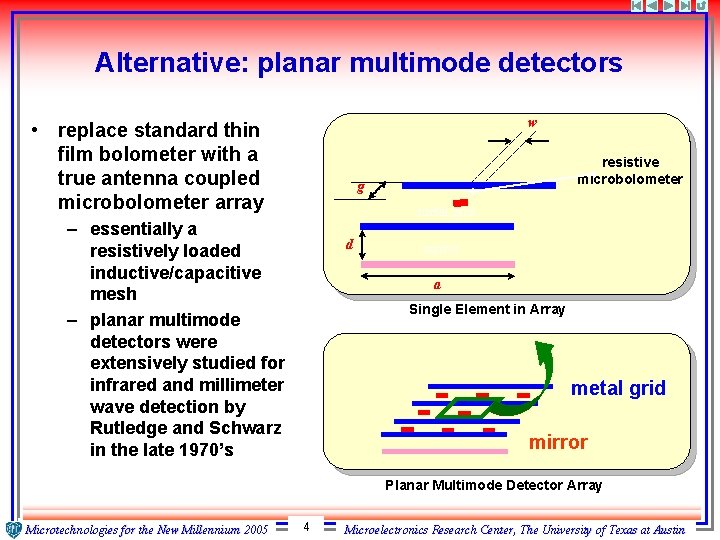
Alternative: planar multimode detectors w • replace standard thin film bolometer with a true antenna coupled microbolometer array resistive microbolometer g metal grid – essentially a resistively loaded inductive/capacitive mesh – planar multimode detectors were extensively studied for infrared and millimeter wave detection by Rutledge and Schwarz in the late 1970’s d mirror a Single Element in Array metal grid mirror Planar Multimode Detector Array Microtechnologies for the New Millennium 2005 4 Microelectronics Research Center, The University of Texas at Austin
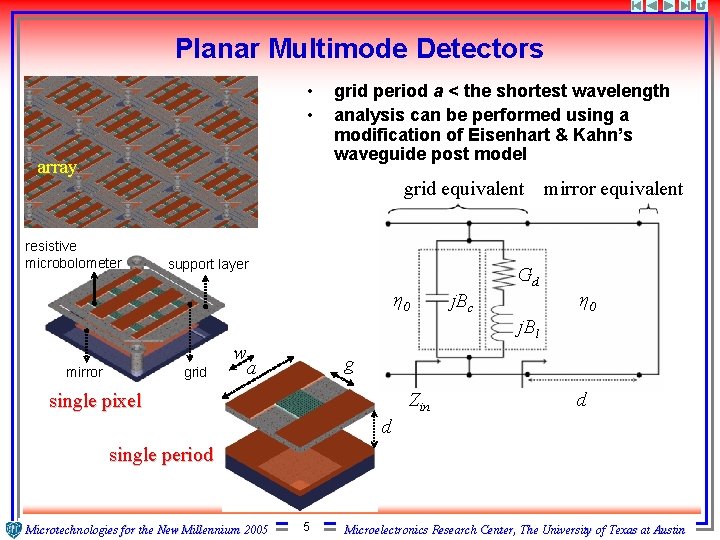
Planar Multimode Detectors • • array grid period a < the shortest wavelength analysis can be performed using a modification of Eisenhart & Kahn’s waveguide post model grid equivalent mirror equivalent resistive microbolometer support layer η 0 j. Bc Gd η 0 j. Bl w mirror grid g a Zin single pixel d d single period Microtechnologies for the New Millennium 2005 5 Microelectronics Research Center, The University of Texas at Austin
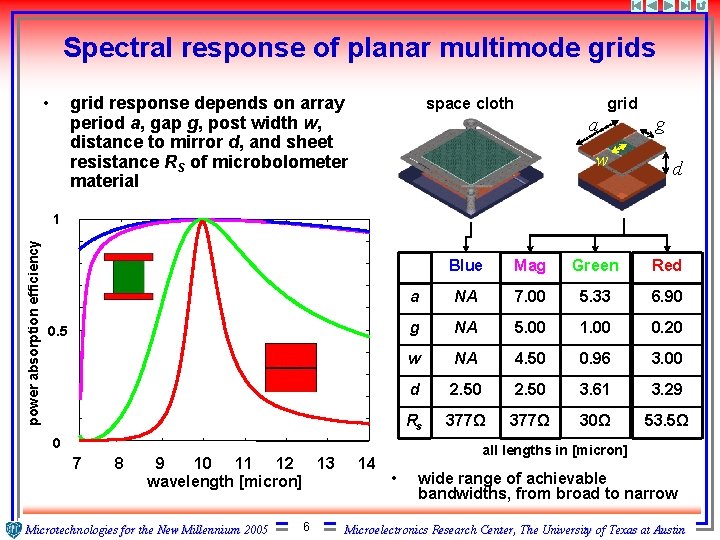
Spectral response of planar multimode grids • grid response depends on array period a, gap g, post width w, distance to mirror d, and sheet resistance RS of microbolometer material grid space cloth a w g d power absorption efficiency 1 * * 0. 5 0 7 8 9 10 11 12 13 wavelength [micron] Microtechnologies for the New Millennium 2005 6 14 Blue Mag Green Red a NA 7. 00 5. 33 6. 90 g NA 5. 00 1. 00 0. 20 w NA 4. 50 0. 96 3. 00 d 2. 50 3. 61 3. 29 Rs 377Ω 30Ω 53. 5Ω all lengths in [micron] • wide range of achievable bandwidths, from broad to narrow Microelectronics Research Center, The University of Texas at Austin

Methods of to achieve varied wavelength selectivity • for fixed grid dimensions, vary the distance between the array and the mirror – three “color” array using three different mirror distances • for fixed grid dimensions, use an actuator to vary the distance between the array and the mirror mechanical actuation Microtechnologies for the New Millennium 2005 7 Microelectronics Research Center, The University of Texas at Austin

Wavelength selectivity varied by changing distance d to the mirror a=6. 90μm g=0. 20μm d=0μm w=3. 00μm Rs=53. 5Ω d=6μm d=3. 29μm wavelength in [μm] power absorption efficiency 14 13 12 11 10 9 8 7 0 1 2 4 3 d in [μm] 5 6 • Microtechnologies for the New Millennium 2005 8 narrow spectral response allows greater “color” sensitivity Microelectronics Research Center, The University of Texas at Austin
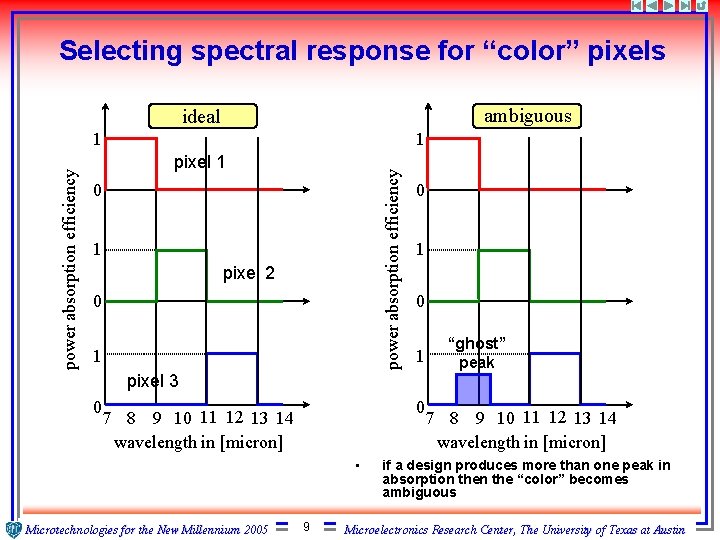
Selecting spectral response for “color” pixels ambiguous ideal 1 pixel 1 power absorption efficiency 1 0 1 pixel 2 0 1 pixel 3 1 0 1 “ghost” peak 0 7 8 9 10 11 12 13 14 wavelength in [micron] • Microtechnologies for the New Millennium 2005 0 9 if a design produces more than one peak in absorption the “color” becomes ambiguous Microelectronics Research Center, The University of Texas at Austin
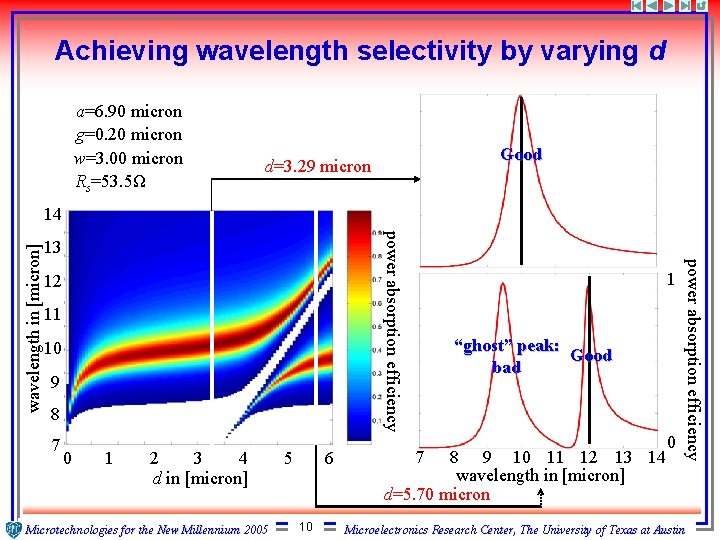
Achieving wavelength selectivity by varying d a=6. 90 micron g=0. 20 micron w=3. 00 micron Rs=53. 5Ω Good d=3. 29 micron 13 12 11 10 9 8 7 0 1 2 4 3 d in [micron] Microtechnologies for the New Millennium 2005 5 6 10 1 “ghost” peak: Good bad 7 8 9 10 11 12 13 14 wavelength in [micron] d=5. 70 micron 0 power absorption efficiency wavelength in [micron] 14 Microelectronics Research Center, The University of Texas at Austin
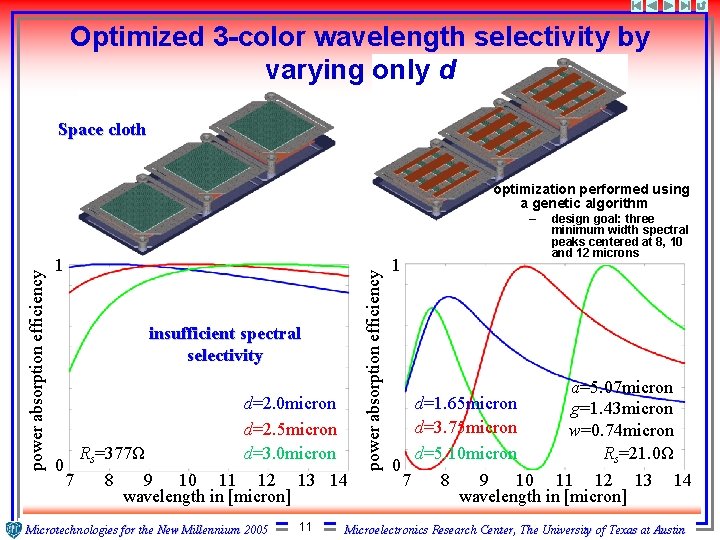
Optimized 3 -color wavelength selectivity by varying only d Space cloth optimization performed using a genetic algorithm 1 insufficient spectral selectivity 0 Rs=377Ω 7 8 d=2. 0 micron d=2. 5 micron d=3. 0 micron 9 10 11 12 13 14 wavelength in [micron] Microtechnologies for the New Millennium 2005 11 power absorption efficiency – 1 0 d=1. 65 micron d=3. 75 micron d=5. 10 micron 7 8 design goal: three minimum width spectral peaks centered at 8, 10 and 12 microns a=5. 07 micron g=1. 43 micron w=0. 74 micron Rs=21. 0Ω 9 10 11 12 13 wavelength in [micron] 14 Microelectronics Research Center, The University of Texas at Austin
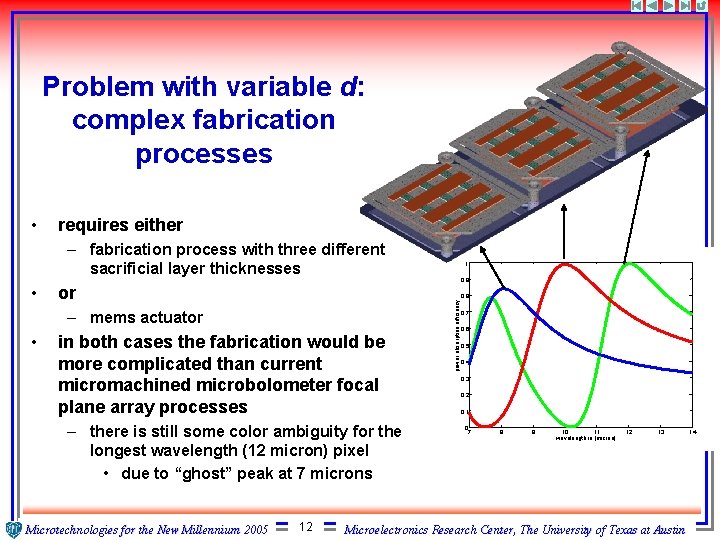
Problem with variable d: complex fabrication processes • requires either – fabrication process with three different sacrificial layer thicknesses or 0. 8 – mems actuator • in both cases the fabrication would be more complicated than current micromachined microbolometer focal plane array processes – there is still some color ambiguity for the longest wavelength (12 micron) pixel • due to “ghost” peak at 7 microns Microtechnologies for the New Millennium 2005 0. 9 12 power absorption efficiency • 1 0. 7 0. 6 0. 5 0. 4 0. 3 0. 2 0. 1 0 7 8 9 10 11 wavelength in [micron] 12 13 Microelectronics Research Center, The University of Texas at Austin 14

Wavelength selectivity by varying lithographicallydrawn parameters • potentially simpler process if the sacrificial layer is held fixed for all pixels – sheet resistance of bolometer material also held constant (same material for all pixels) – vary ONLY the lithographically drawn features of the grid • array period a, gap width g, and post width w Microtechnologies for the New Millennium 2005 13 w a g d Microelectronics Research Center, The University of Texas at Austin
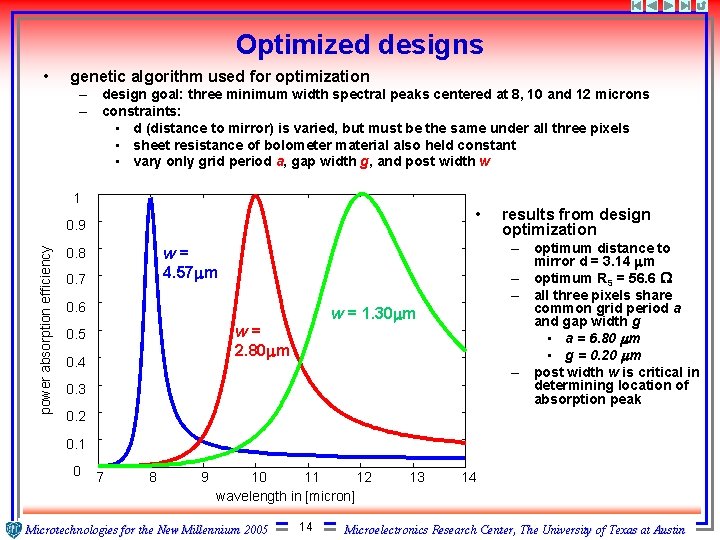
Optimized designs • genetic algorithm used for optimization – design goal: three minimum width spectral peaks centered at 8, 10 and 12 microns – constraints: • d (distance to mirror) is varied, but must be the same under all three pixels • sheet resistance of bolometer material also held constant • vary only grid period a, gap width g, and post width w 1 • power absorption efficiency 0. 9 – optimum distance to mirror d = 3. 14 mm – optimum RS = 56. 6 W – all three pixels share common grid period a and gap width g • a = 6. 80 mm • g = 0. 20 mm – post width w is critical in determining location of absorption peak w= 4. 57 mm 0. 8 0. 7 0. 6 w = 1. 30 mm w= 2. 80 mm 0. 5 0. 4 results from design optimization 0. 3 0. 2 0. 1 0 7 8 9 10 11 12 wavelength in [micron] Microtechnologies for the New Millennium 2005 14 13 14 Microelectronics Research Center, The University of Texas at Austin
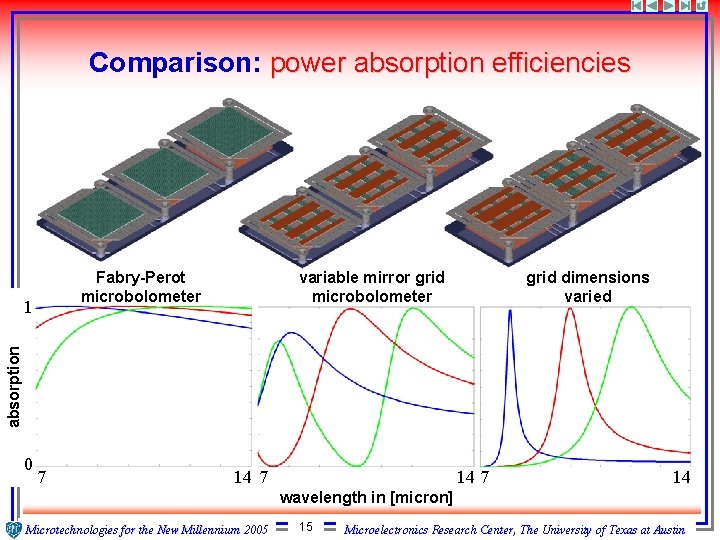
Comparison: power absorption efficiencies Fabry-Perot microbolometer grid dimensions varied absorption 1 variable mirror grid microbolometer 0 7 14 wavelength in [micron] Microtechnologies for the New Millennium 2005 15 Microelectronics Research Center, The University of Texas at Austin
IR wavelength-selective focal plane arrays • planar multimode detectors exhibit widely tunable spectral response – can tune for much narrower spectral response than conventional Fabry-Perot microbolometers • tuning of wavelength response can be achieved using several methods – for fixed grid dimensions distance to tuning mirror can be used • multiple sacrificial layer thicknesses • mechanical actuation • a wavelength-selective three pixel design, each pixel using different lithographically drawn dimensions with constant mirror separation, shows excellent narrow band response • through the use of planar multimode detectors color vision in the long wavelength band should be achievable Microtechnologies for the New Millennium 2005 16 Microelectronics Research Center, The University of Texas at Austin
- Slides: 16