
DESIGN OF HOISTING MECHANISM PRITI S VAIRAGI MECHANICAL
- Slides: 7
DESIGN OF HOISTING MECHANISM PRITI S VAIRAGI MECHANICAL ENGINEER
INTRODUCTION TO CRANES For lifting and conveying material within the unit of an industry, an overhead crane or a bridge crane is used. An overhead crane consists of snatch block, trolley travelling mechanism and cross travel mechanism to cover an entire area of unit. A hoist of a crane, travels along the bridge. An overhead cranes are used for either manufacturing or maintenance applications. These cranes are either Human operated or remote operated cranes.
APPLICATIONS: In manufacturing plants at every process the material is handled by crane till finished product leaves a factory. For pouring Raw materials into a furnace, for rolling hot metal to specific thickness, for tempering, annealing and for storing purpose an overhead crane is used. For lifting finished product and loading in truck or train an overhead crane is used. Many industries including automobile uses an overhead crane to handle the steel, raw material and finished product in the factory. Small cranes, such as jib cranes handle lighter loads in a work area, such as CNC mill or saw.
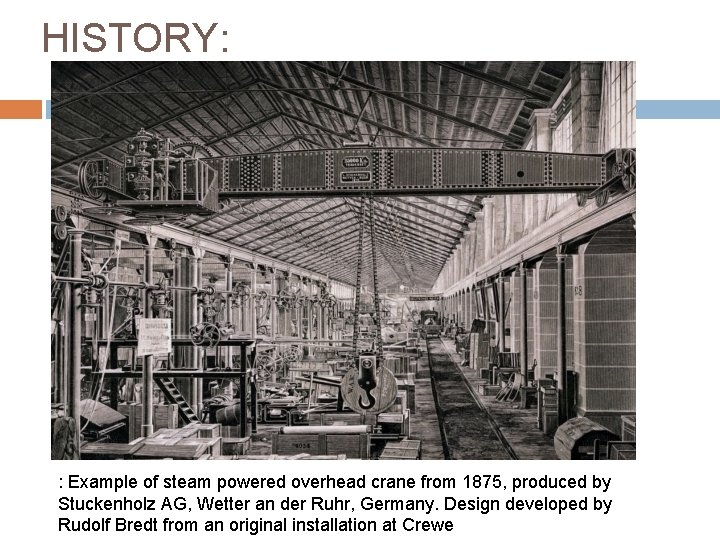
HISTORY: : Example of steam powered overhead crane from 1875, produced by Stuckenholz AG, Wetter an der Ruhr, Germany. Design developed by Rudolf Bredt from an original installation at Crewe
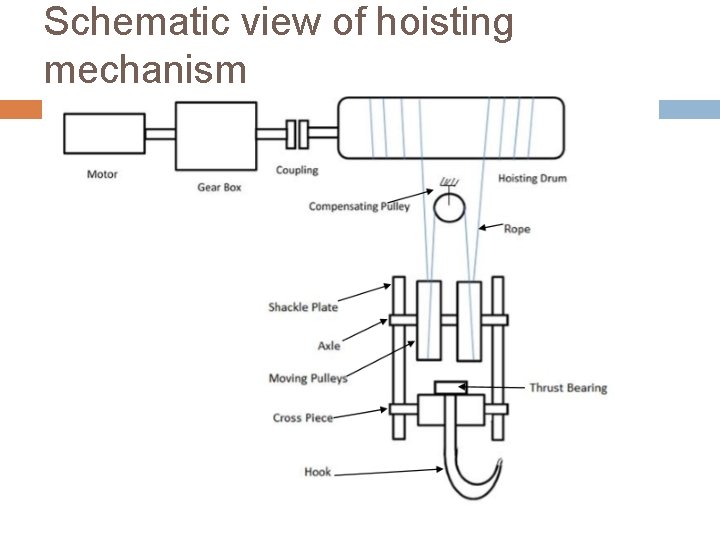
INTRODUCTION: Hoisting is the process of lifting and lowering some material or load or person from lower position to higher position with the help of some device or mechanism. A hoisting device is used for lifting or lowering a load by means of a drum or lift-wheel with the help of rope or chain. It may be manually operated, electrically or pneumatically driven and may use chain, fibre or wire rope as its lifting medium. Examples: Elevators, crane etc. The hoisting part of the EOT crane consists of the following parts, 1. Hoist motor, 2. Gear box, 3. Drum, 4. Pulleys, 5. Wire rope, 6. Hook
Schematic view of hoisting mechanism
Type of Hoisting Mechanisms a. Hoisting Machines: Hand Trolley Hoists, Portable power-operated hoists, travelling power-operated hoists, Winches, Crane Trolleys b. Cranes : Stationary Rotary Cranes, Cranes travelling on guide rails, Trackless Cranes, Bridge type Cranes, Cable Cranes c. Elevators : Portable air-operated hoists, Manually Propelled Stackers, Vertical skip elevators, Mast-type elevators, Funiculars.