
Design of fixed broadband beamforme robust against gain

Design of fixed broadband beamforme robust against gain and phase deviations Simon Doclo, Marc Moonen Katholieke Universiteit Leuven Dept. of Electrical Engineering, ESAT-SISTA Kasteelpark Arenberg 10, B-3001 Leuven, Belgium {simon. doclo, marc. moonen}@esat. kuleuven. ac. be Tel: +32 -16 -321899, Fax: +32 -16 -321970} May 15, 2003
Overview • Robust multi-microphone signal enhancement • Beamforming basics � Broadband beamformer design procedures � Filter-and-sum beamforming • Cost functions � Weighted least-squares � Non-linear cost function � Eigenfilter-based • Robust broadband beamforming � Robustness against gain/phase/position errors � Mean cost function � Maximum cost function • Simulations 2
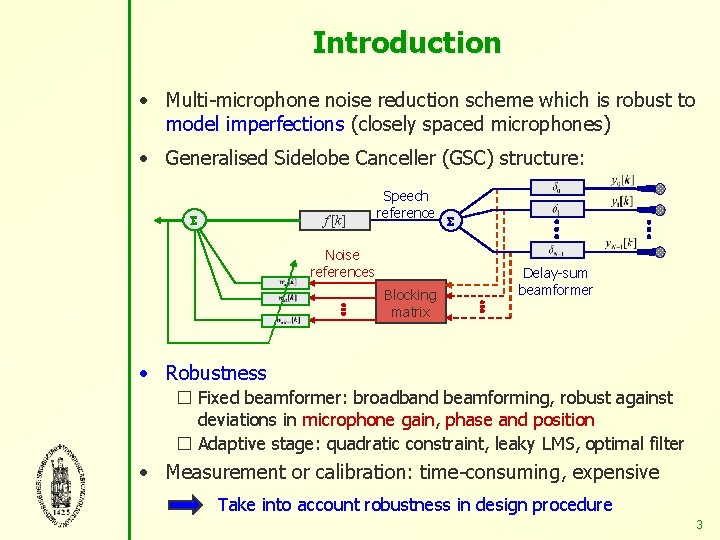
Introduction • Multi-microphone noise reduction scheme which is robust to model imperfections (closely spaced microphones) • Generalised Sidelobe Canceller (GSC) structure: S f [k] Speech reference Noise references Blocking matrix S Delay-sum beamformer • Robustness � Fixed beamformer: broadband beamforming, robust against deviations in microphone gain, phase and position � Adaptive stage: quadratic constraint, leaky LMS, optimal filter • Measurement or calibration: time-consuming, expensive Take into account robustness in design procedure 3

Beamforming basics • Microphone array configuration: N microphones, distance dn • Goal: compute FIR filters wn[k] such that beamformer provides desired (fixed) frequency and spatial discrimination Spatial directivity pattern: Design of broadband beamformer with arbitrary desired directivity pattern for a given arbitrary microphone array configuration, using FIR filter-and-sum structure 4
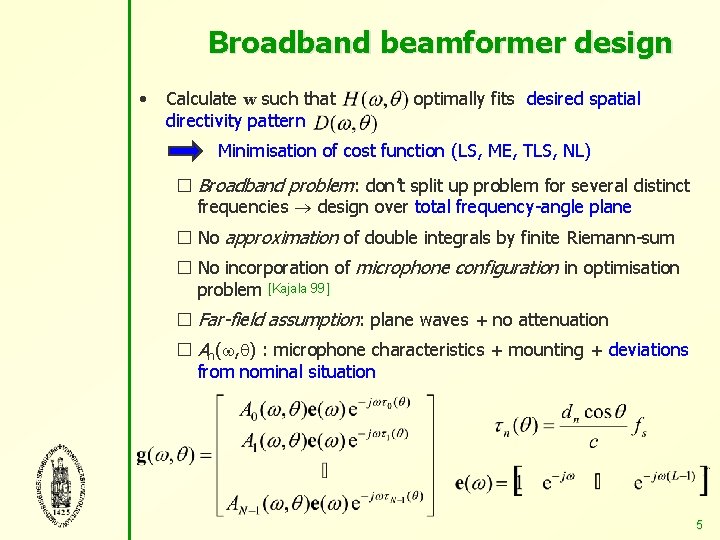
Broadband beamformer design • Calculate w such that directivity pattern optimally fits desired spatial Minimisation of cost function (LS, ME, TLS, NL) � Broadband problem: don’t split up problem for several distinct frequencies design over total frequency-angle plane � No approximation of double integrals by finite Riemann-sum � No incorporation of microphone configuration in optimisation problem [Kajala 99] � Far-field assumption: plane waves + no attenuation � An( , ) : microphone characteristics + mounting + deviations from nominal situation 5
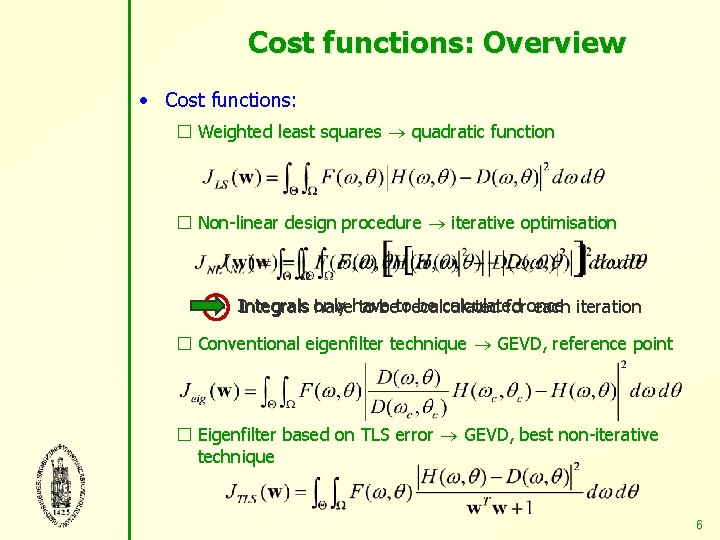
Cost functions: Overview • Cost functions: � Weighted least squares quadratic function � Non-linear design procedure iterative optimisation Integrals only be calculated have to betorecalculated foronce each iteration � Conventional eigenfilter technique GEVD, reference point � Eigenfilter based on TLS error GEVD, best non-iterative technique 6

Robust broadband beamforming • Small deviations from assumed characteristics (gain/phase/position) may lead to large deviations in spatial directivity pattern • In practice microphone characteristics are never exactly known Take into account stochastic deviations in design • Instead of measuring/calibrating or limiting WNG, take all feasible charateristics into account and minimise: � Mean cost function using probability as weights – Requires probability density functions – Gain: higher-order moments, phase: knowledge about complete pdf � Maximum cost function for all feasible characteristics – Minimax criterion, optimise for worst-case scenario – (dense) grid of characteristics high complexity 7
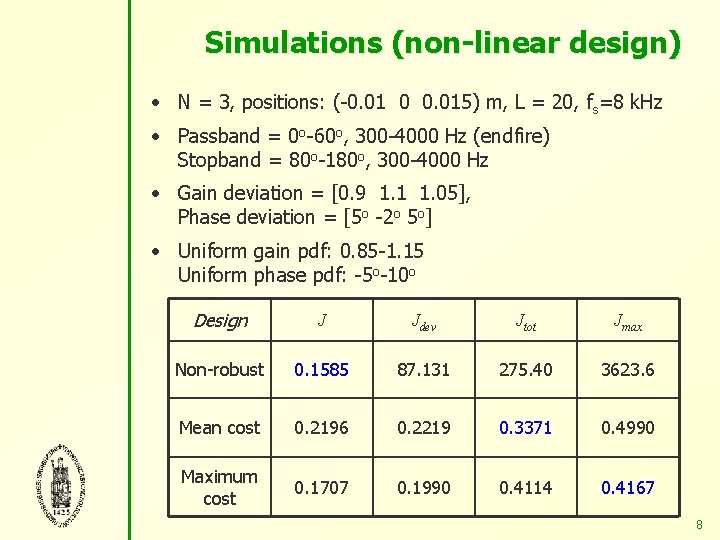
Simulations (non-linear design) • N = 3, positions: (-0. 01 0 0. 015) m, L = 20, f s=8 k. Hz • Passband = 0 o-60 o, 300 -4000 Hz (endfire) Stopband = 80 o-180 o, 300 -4000 Hz • Gain deviation = [0. 9 1. 1 1. 05], Phase deviation = [5 o -2 o 5 o] • Uniform gain pdf: 0. 85 -1. 15 Uniform phase pdf: -5 o-10 o Design J Jdev Jtot Jmax Non-robust 0. 1585 87. 131 275. 40 3623. 6 Mean cost 0. 2196 0. 2219 0. 3371 0. 4990 Maximum cost 0. 1707 0. 1990 0. 4114 0. 4167 8
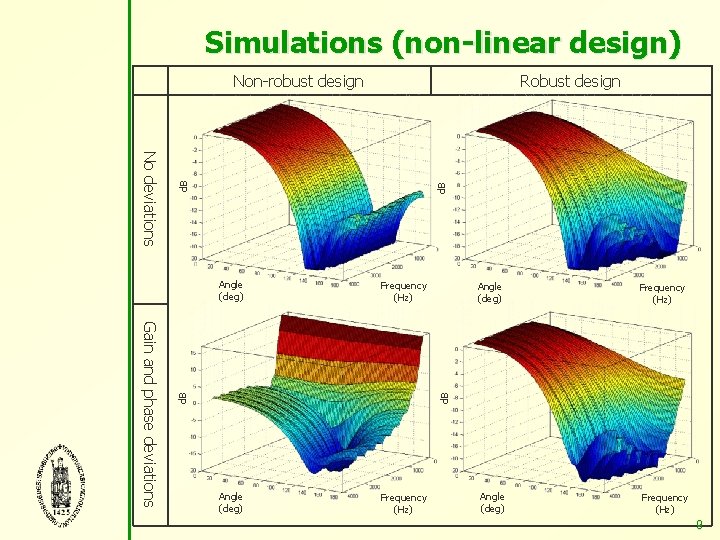
Simulations (non-linear design) Robust design d. B Frequency (Hz) Angle (deg) Frequency (Hz) d. B Gain and phase deviations Angle (deg) d. B No deviations d. B Non-robust design 9
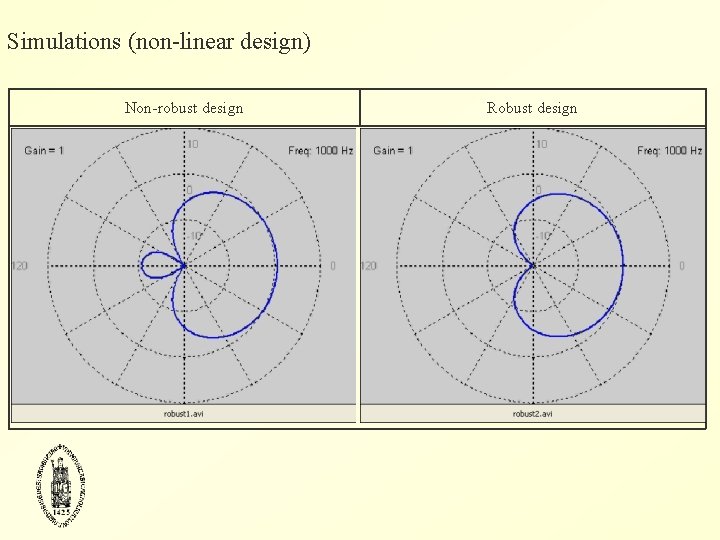
Simulations (non-linear design) Non-robust design Robust design
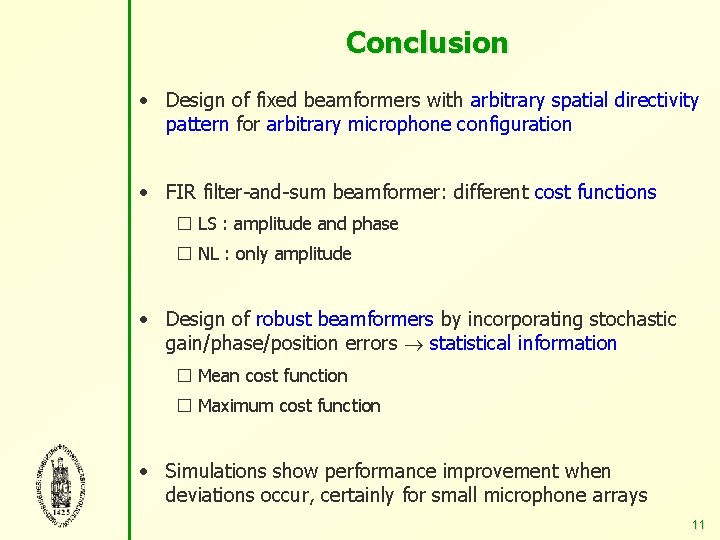
Conclusion • Design of fixed beamformers with arbitrary spatial directivity pattern for arbitrary microphone configuration • FIR filter-and-sum beamformer: different cost functions � LS : amplitude and phase � NL : only amplitude • Design of robust beamformers by incorporating stochastic gain/phase/position errors statistical information � Mean cost function � Maximum cost function • Simulations show performance improvement when deviations occur, certainly for small microphone arrays 11
- Slides: 11