
Design of experiment application in biology 2012 Petr
Design of experiment, application in biology 2012 Petr Císař
Points of presentation • Motivation • Design of experiment • Introduction • Main steps • Advantages • Application in biology • Process • Method • Results Faculty of fisheries and protection of waters
Motivation • Experiment is one of the basic method of human understanding • Experiment is a scientific method used for testing of hypothesis or existing theories • It is a bridge between theory and reality • Why the students do not use sophisticated methods of experiment realization and analysis? • How to design the experiment? • How to analyze the experiment? Faculty of fisheries and protection of waters
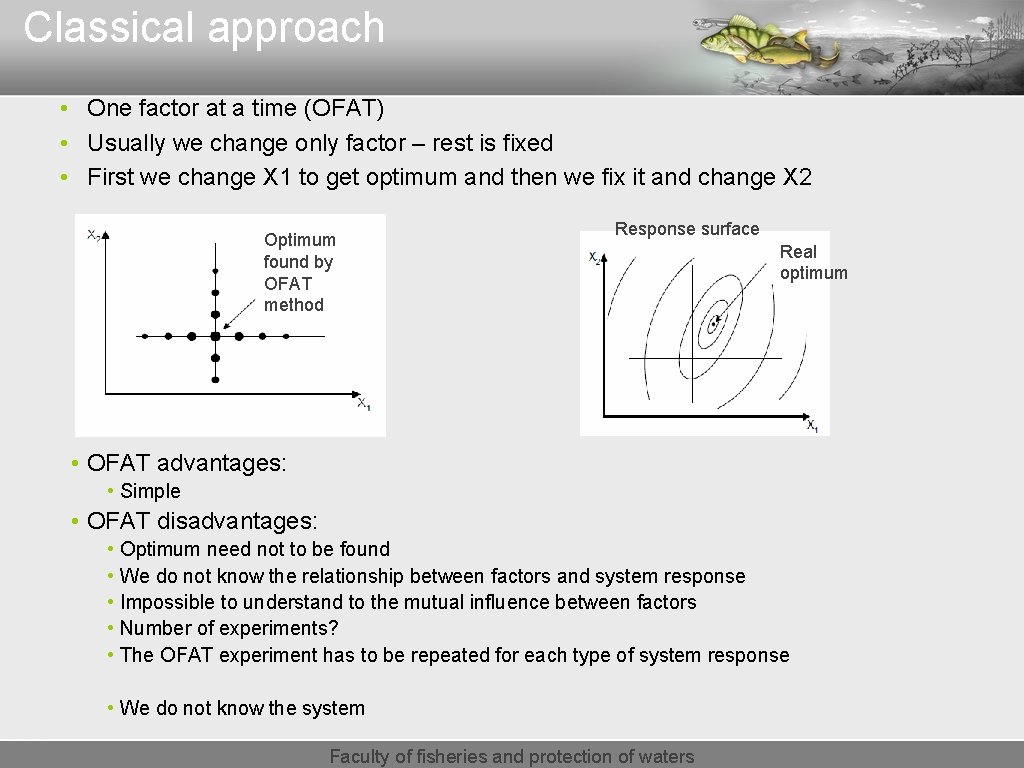
Classical approach • One factor at a time (OFAT) • Usually we change only factor – rest is fixed • First we change X 1 to get optimum and then we fix it and change X 2 Optimum found by OFAT method Response surface Real optimum • OFAT advantages: • Simple • OFAT disadvantages: • Optimum need not to be found • We do not know the relationship between factors and system response • Impossible to understand to the mutual influence between factors • Number of experiments? • The OFAT experiment has to be repeated for each type of system response • We do not know the system Faculty of fisheries and protection of waters
Motivation • • Is it possible to do it better? Measure everything under all conditions. NO Create optimal design of experiment and use statistics to understand to it • Design of experiment (DOE). Faculty of fisheries and protection of waters
Design of experiment DOE – Design Of Experiment • Set of tools for: • Creation of experimental design • Experiment realization • Experiment analysis • with optimal number of experiments • Part of Six Sigma methodologies • Industry standard for process improvement • Used in industry since 1986 • Planed experiment: active change of the process – controlled change of system factors • Outputs: • • • Minimal number of measurements List of important factors The level of influence of controlled and uncontrolled factors to the system response Interactions between factors Mathematical model of the system Faculty of fisheries and protection of waters
DOE - Main steps Experiment design Experiment analysis • • • Identify variables of the system Identify factors Select design Define the levels of factors Randomize the order of measurements Realize measurements and record the results • Analyze data • Evaluate the results • Verify results Faculty of fisheries and protection of waters
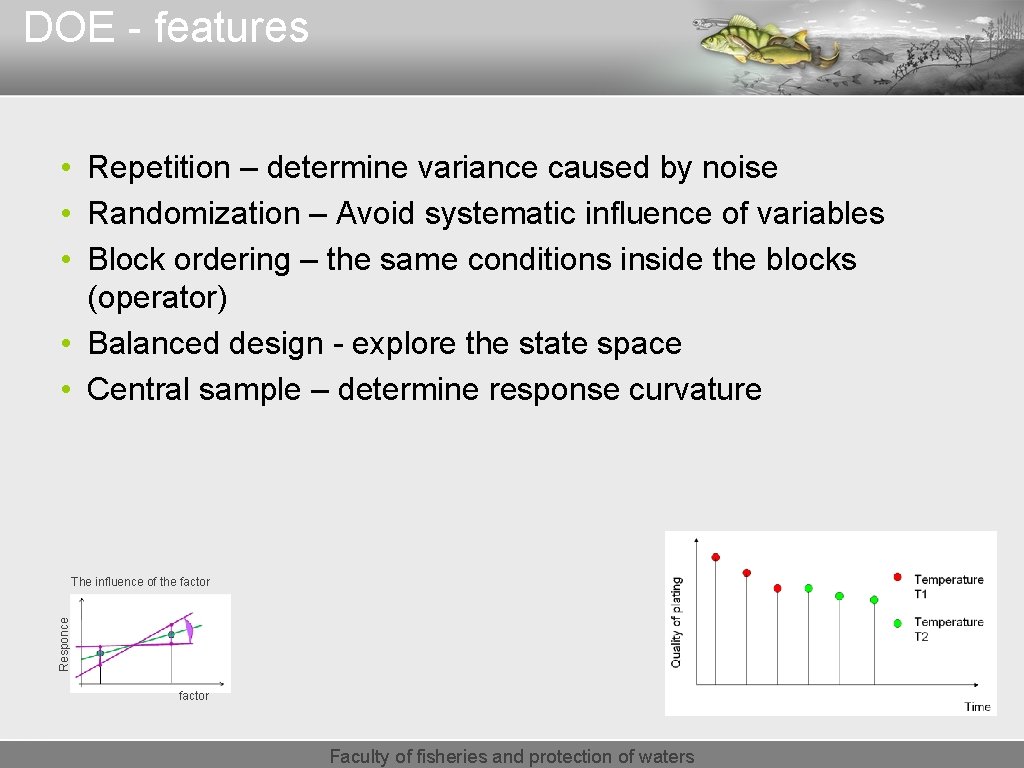
DOE - features • Repetition – determine variance caused by noise • Randomization – Avoid systematic influence of variables • Block ordering – the same conditions inside the blocks (operator) • Balanced design - explore the state space • Central sample – determine response curvature Responce The influence of the factor Faculty of fisheries and protection of waters
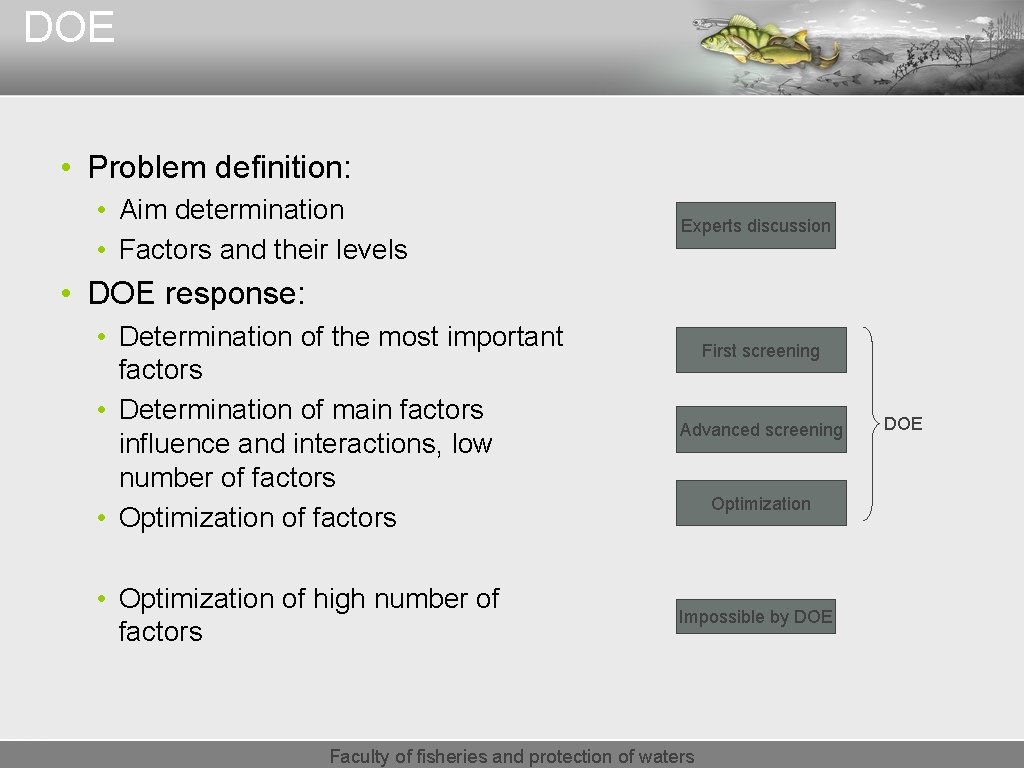
DOE • Problem definition: • Aim determination • Factors and their levels Experts discussion • DOE response: • Determination of the most important factors • Determination of main factors influence and interactions, low number of factors • Optimization of factors Advanced screening • Optimization of high number of factors Impossible by DOE First screening Optimization Faculty of fisheries and protection of waters DOE
DOE – Statistical method • The math behind DOE is relatively simple • The students can learn the math by examples • Tools: • ANOVA – Analysis Of Variance – explore the sources of variance in the system – influence of the factors • Regression model – determine mathematical description of the system • Optimization methods - optimization using the mathematical model of system • Everything can be show as pretty pictures • We have to understand what is behind !!! Faculty of fisheries and protection of waters
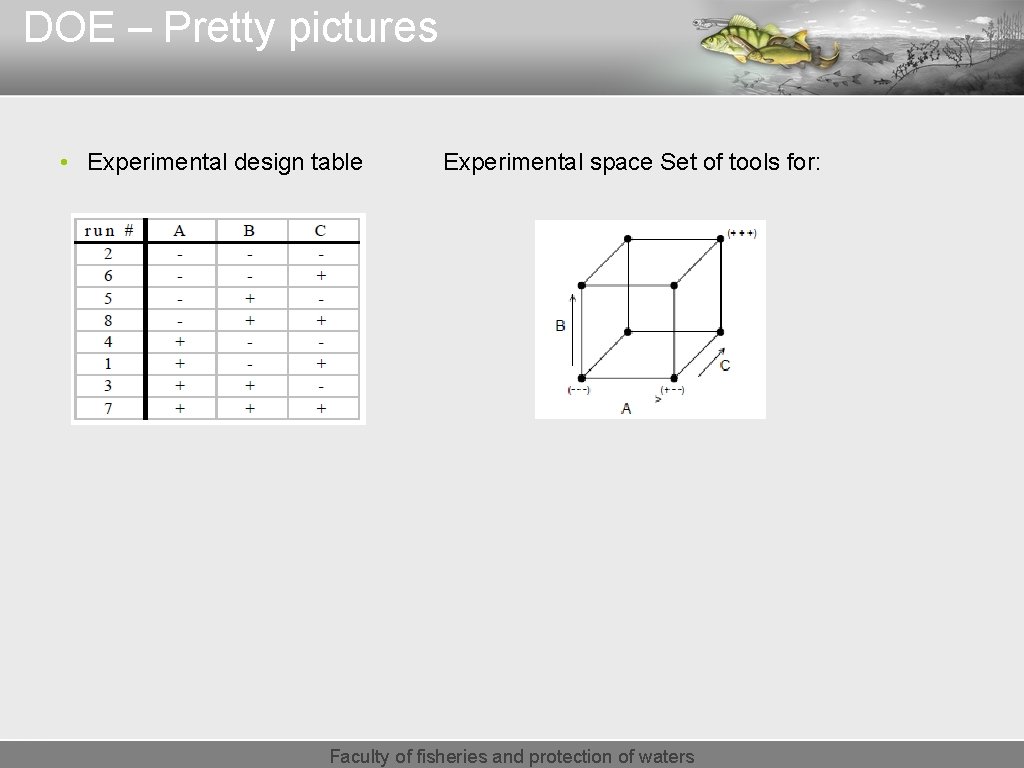
DOE – Pretty pictures • Experimental design table Experimental space Set of tools for: Faculty of fisheries and protection of waters
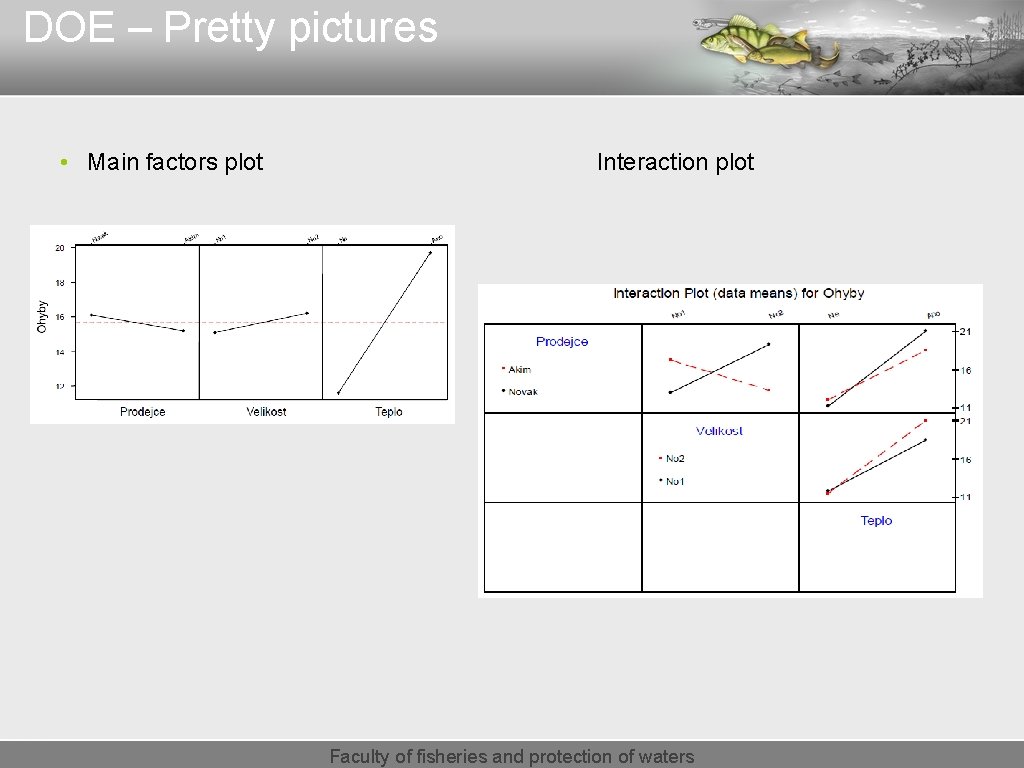
DOE – Pretty pictures • Main factors plot Interaction plot Faculty of fisheries and protection of waters
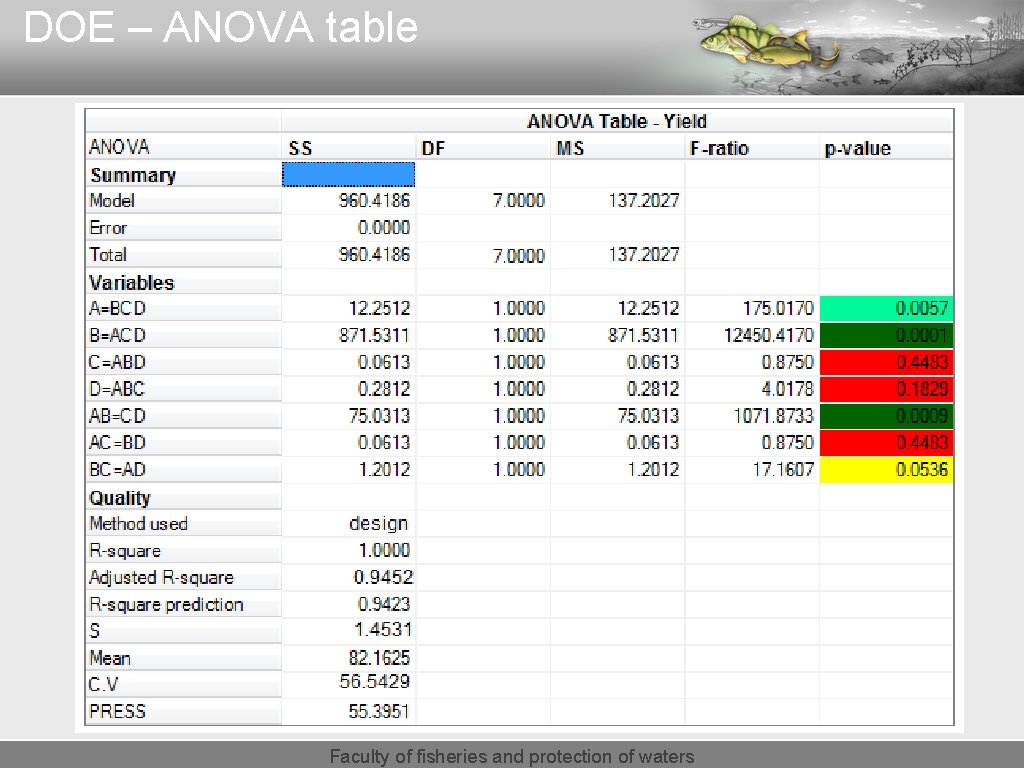
DOE – ANOVA table Faculty of fisheries and protection of waters
Application in biology • Biological experiments: • Typical task: optimization of cultivation conditions • • High level of noise Impossible to know all influencing factors High number of factors Difficult to set experimental conditions to defined values Outliers – unpredictable results Time consuming experiments Repeatability of experiment by other experts Faculty of fisheries and protection of waters
Maximization of protein amount • Aim • to optimize production of fusion protein to obtain the highest amount of protein • optimized protein: • fusion protein (FP) - maltose binding protein (MBP) and parathyroid hormone (1 -34) (PTH) • Procedure 1. choose variable parameters and methods for measurement 2. create procedure for analysis of amount of fusion protein 3. use DOE for planning and analysis of experiments 4. locate optimum cultivation conditions 5. verify optimum by additionally experiments Authors: Martina Tesařová, Petr Císař, Zuzana Antošová, Oksana Degtjarik, Jost Ludwig and Dalibor Štys Faculty of fisheries and protection of waters

Maximization of protein amount • Process • Growth of bacteria under cultivation conditions • Extraction of the amount of the protein – expensive • Factors and methods – based on expert knowledge • Four factors : • temperature 25; 37; 42 °C • starting OD 0. 1; 0. 2 • RPM of shaker 150; 200 • time of harvest 1; 3; 6; 12; 24; 48 h Faculty of fisheries and protection of waters
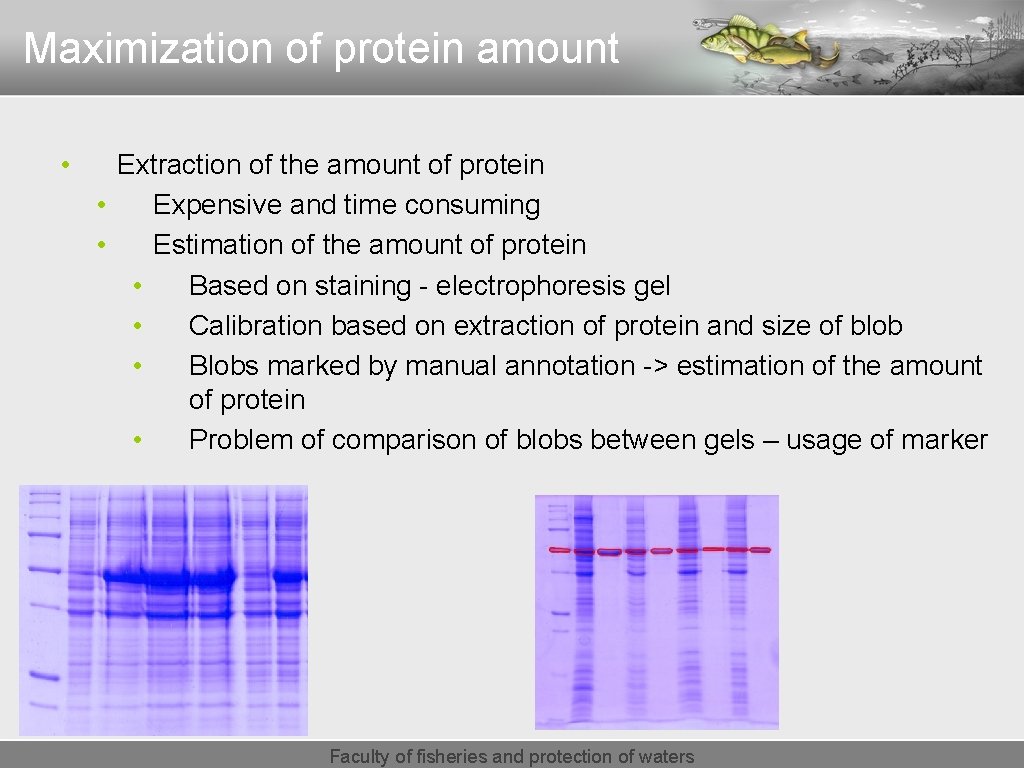
Maximization of protein amount • Extraction of the amount of protein • Expensive and time consuming • Estimation of the amount of protein • Based on staining - electrophoresis gel • Calibration based on extraction of protein and size of blob • Blobs marked by manual annotation -> estimation of the amount of protein • Problem of comparison of blobs between gels – usage of marker Faculty of fisheries and protection of waters
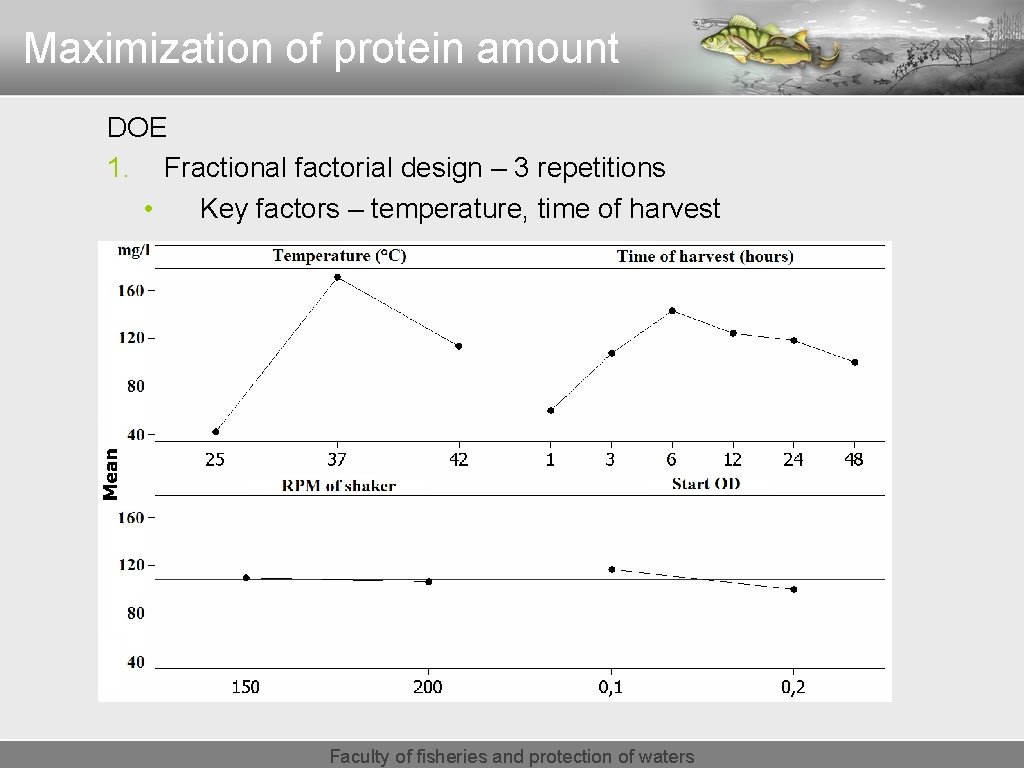
Maximization of protein amount DOE 1. Fractional factorial design – 3 repetitions • Key factors – temperature, time of harvest Faculty of fisheries and protection of waters
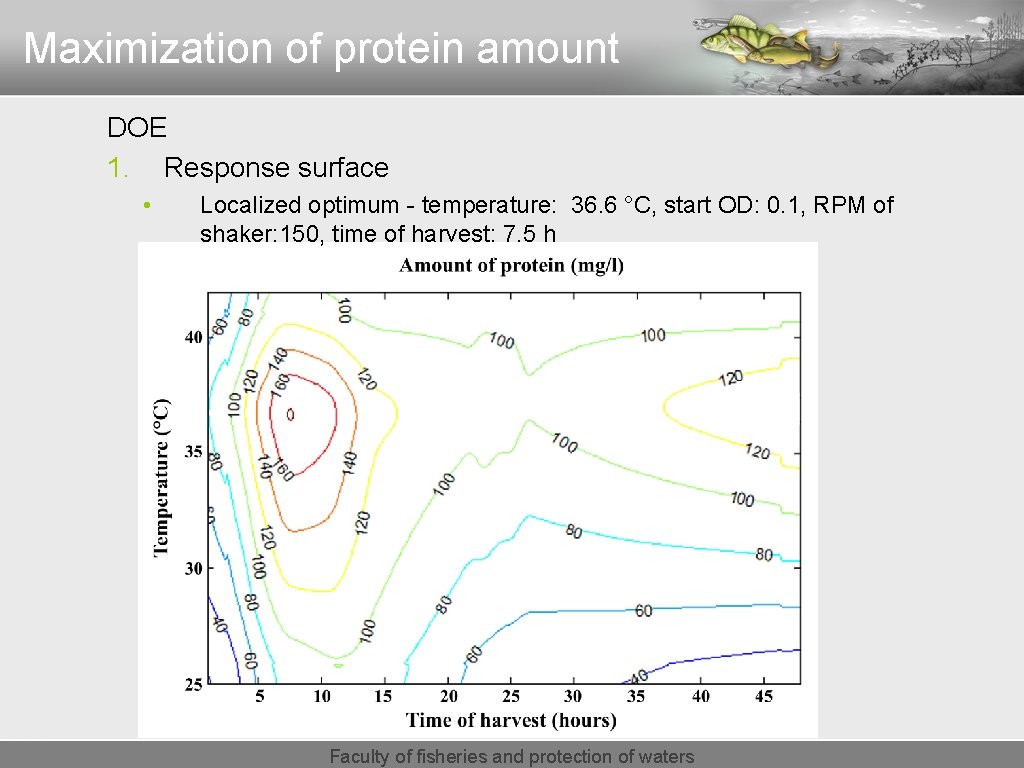
Maximization of protein amount DOE 1. Response surface • Localized optimum - temperature: 36. 6 °C, start OD: 0. 1, RPM of shaker: 150, time of harvest: 7. 5 h Faculty of fisheries and protection of waters
Conclusion DOE • Optimization of amount of protein • Results • • • 93% of the data are covered by the model – biological system Two key factors found: temperature and time of harvest Level of significance – 5% Localized optimum - temperature: 36. 6 °C, start OD: 0. 1, RPM of shaker: 150, time of harvest: 7. 5 h Optimum verified by 18 testing experiments DOE was successfully used for the optimization of biological experiment Faculty of fisheries and protection of waters
- Slides: 20