
Design of Engineering Experiments Part 6 Blocking Confounding
Design of Engineering Experiments Part 6 – Blocking & Confounding in the 2 k • Text reference, Chapter 7 • Blocking is a technique for dealing with controllable nuisance variables • Two cases are considered – Replicated designs – Unreplicated designs DOX 6 E Montgomery 1
Blocking a Replicated Design • This is the same scenario discussed previously (Chapter 5, Section 5 -6) • If there are n replicates of the design, then each replicate is a block • Each replicate is run in one of the blocks (time periods, batches of raw material, etc. ) • Runs within the block are randomized DOX 6 E Montgomery 2
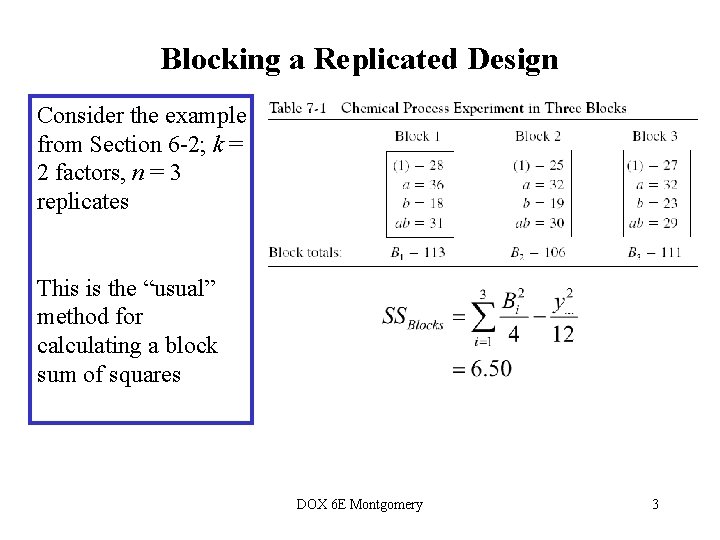
Blocking a Replicated Design Consider the example from Section 6 -2; k = 2 factors, n = 3 replicates This is the “usual” method for calculating a block sum of squares DOX 6 E Montgomery 3
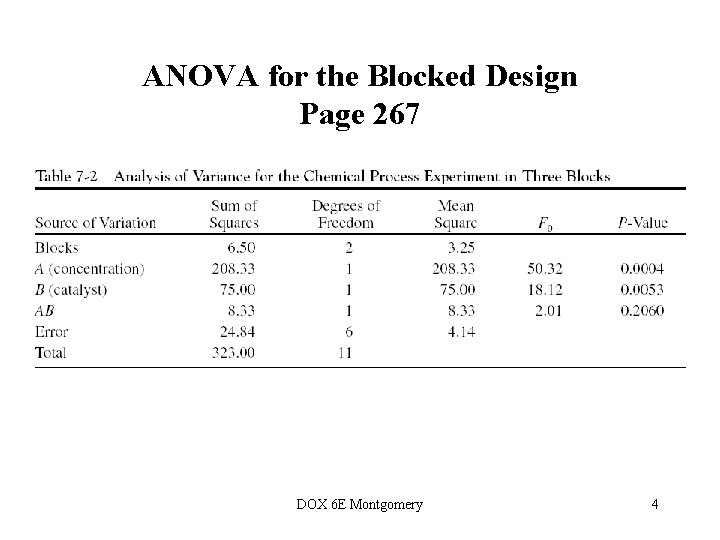
ANOVA for the Blocked Design Page 267 DOX 6 E Montgomery 4
Confounding in Blocks • Now consider the unreplicated case • Clearly the previous discussion does not apply, since there is only one replicate • To illustrate, consider the situation of Example 6 -2, Page 228 • This is a 24, n = 1 replicate DOX 6 E Montgomery 5
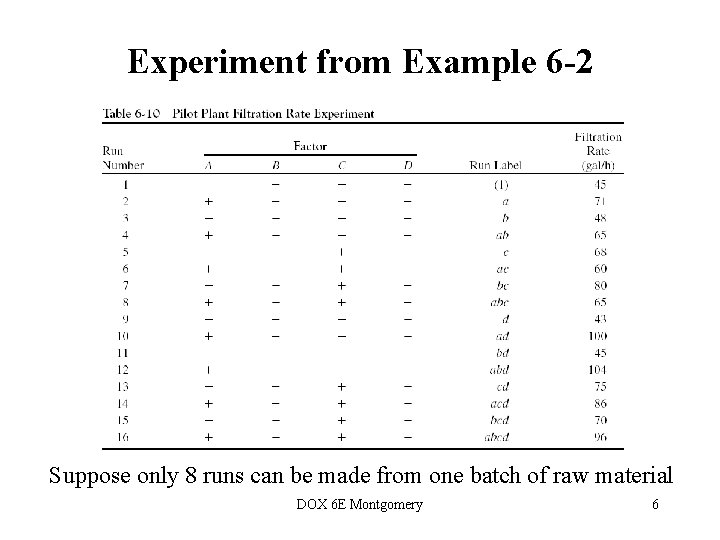
Experiment from Example 6 -2 Suppose only 8 runs can be made from one batch of raw material DOX 6 E Montgomery 6
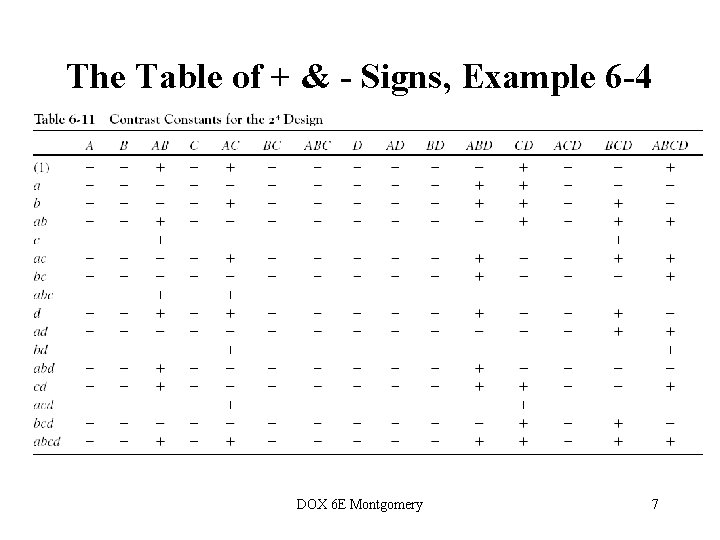
The Table of + & - Signs, Example 6 -4 DOX 6 E Montgomery 7
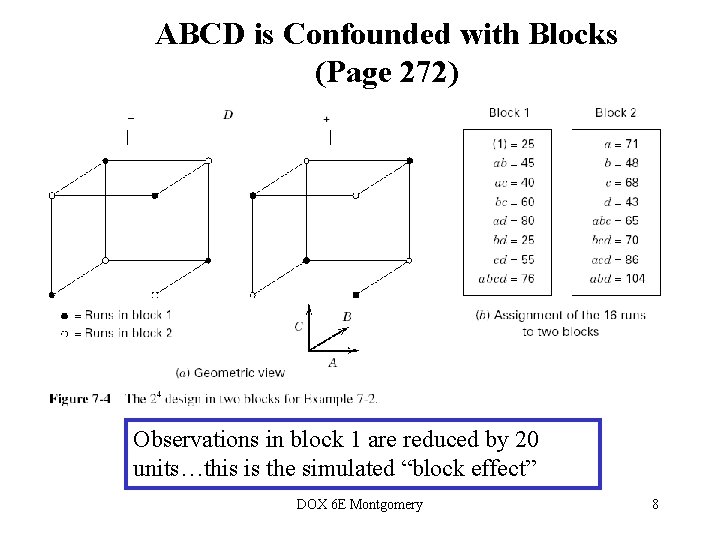
ABCD is Confounded with Blocks (Page 272) Observations in block 1 are reduced by 20 units…this is the simulated “block effect” DOX 6 E Montgomery 8
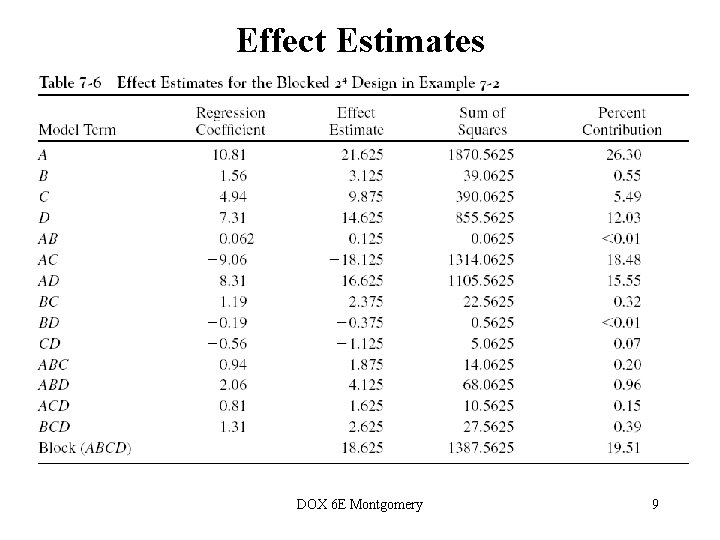
Effect Estimates DOX 6 E Montgomery 9
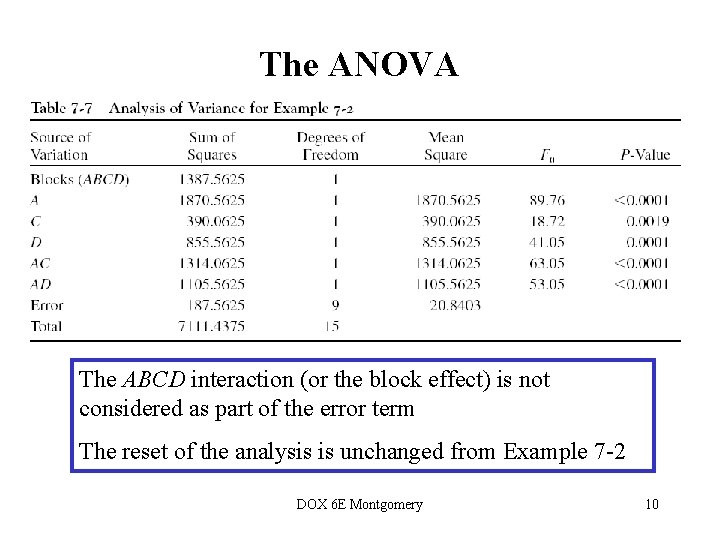
The ANOVA The ABCD interaction (or the block effect) is not considered as part of the error term The reset of the analysis is unchanged from Example 7 -2 DOX 6 E Montgomery 10
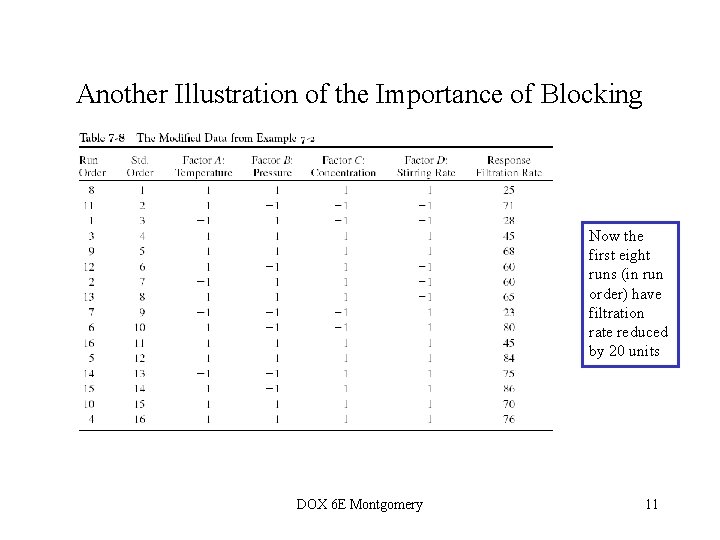
Another Illustration of the Importance of Blocking Now the first eight runs (in run order) have filtration rate reduced by 20 units DOX 6 E Montgomery 11
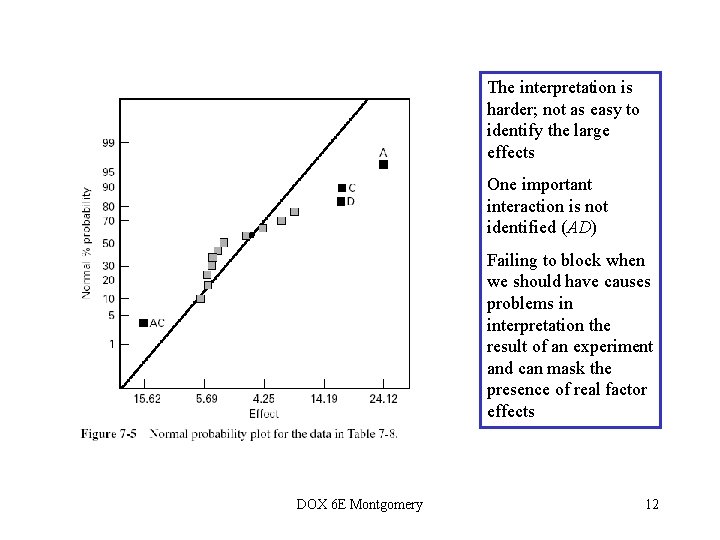
The interpretation is harder; not as easy to identify the large effects One important interaction is not identified (AD) Failing to block when we should have causes problems in interpretation the result of an experiment and can mask the presence of real factor effects DOX 6 E Montgomery 12
Confounding in Blocks • More than two blocks (page 275) – The two-level factorial can be confounded in 2, 4, 8, … (2 p, p > 1) blocks – For four blocks, select two effects to confound, automatically confounding a third effect – See example, page 275 – Choice of confounding schemes non-trivial; see Table 7 -9, page 277 • Partial confounding (page 278) DOX 6 E Montgomery 13
General Advice About Blocking • When in doubt, block • Block out the nuisance variables you know about, randomize as much as possible and rely on randomization to help balance out unknown nuisance effects • Measure the nuisance factors you know about but can’t control (ANCOVA) • It may be a good idea to conduct the experiment in blocks even if there isn't an obvious nuisance factor, just to protect against the loss of data or situations where the complete experiment can’t be finished DOX 6 E Montgomery 14
- Slides: 14