
Design of Digital Circuits Lecture 21 Graphics Processing
![Automatic Code Vectorization for (i=0; i < N; i++) C[i] = A[i] + B[i];](https://slidetodoc.com/presentation_image_h/2621365818b5cfc76574c388ddf70351/image-13.jpg "Automatic Code Vectorization for (i=0; i < N; i++) C[i] = A[i] + B[i];")
![for (i=0; i < N; i++) C[i] = A[i] + B[i]; Prog. Model 1:](https://slidetodoc.com/presentation_image_h/2621365818b5cfc76574c388ddf70351/image-29.jpg "for (i=0; i < N; i++) C[i] = A[i] + B[i]; Prog. Model 1:")
![for (i=0; i < N; i++) C[i] = A[i] + B[i]; Prog. Model 2:](https://slidetodoc.com/presentation_image_h/2621365818b5cfc76574c388ddf70351/image-30.jpg "for (i=0; i < N; i++) C[i] = A[i] + B[i]; Prog. Model 2:")
![for (i=0; i < N; i++) C[i] = A[i] + B[i]; Prog. Model 3:](https://slidetodoc.com/presentation_image_h/2621365818b5cfc76574c388ddf70351/image-31.jpg "for (i=0; i < N; i++) C[i] = A[i] + B[i]; Prog. Model 3:")
![for (i=0; i < N; i++) C[i] = A[i] + B[i]; Prog. Model 3:](https://slidetodoc.com/presentation_image_h/2621365818b5cfc76574c388ddf70351/image-32.jpg "for (i=0; i < N; i++) C[i] = A[i] + B[i]; Prog. Model 3:")
![Fine-Grained Multithreading of Warps n n n for (i=0; i < N; i++) C[i]](https://slidetodoc.com/presentation_image_h/2621365818b5cfc76574c388ddf70351/image-37.jpg "Fine-Grained Multithreading of Warps n n n for (i=0; i < N; i++) C[i]")
![Warp Execution (Recall the Slide) 32 -thread warp executing ADD A[tid], B[tid] C[tid] Execution](https://slidetodoc.com/presentation_image_h/2621365818b5cfc76574c388ddf70351/image-41.jpg "Warp Execution (Recall the Slide) 32 -thread warp executing ADD A[tid], B[tid] C[tid] Execution")
- Slides: 73
Design of Digital Circuits Lecture 21: Graphics Processing Units Dr. Juan Gómez Luna Prof. Onur Mutlu ETH Zurich Spring 2019 10 May 2019
We Are Almost Done With This… n Single-cycle Microarchitectures n Multi-cycle and Microprogrammed Microarchitectures n Pipelining n Issues in Pipelining: Control & Data Dependence Handling, State Maintenance and Recovery, … n Out-of-Order Execution n Other Execution Paradigms 2
Approaches to (Instruction-Level) Concurrency n Pipelining n n n n Out-of-order execution Dataflow (at the ISA level) Superscalar Execution VLIW Fine-Grained Multithreading Systolic Arrays Decoupled Access Execute SIMD Processing (Vector and array processors, GPUs) 3
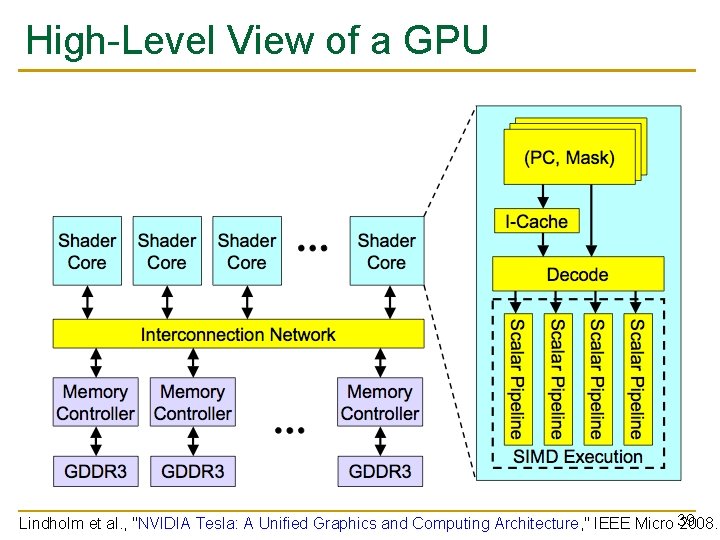
Readings for this Week n Required n n Lindholm et al. , "NVIDIA Tesla: A Unified Graphics and Computing Architecture, " IEEE Micro 2008. Recommended q Peleg and Weiser, “MMX Technology Extension to the Intel Architecture, ” IEEE Micro 1996. 4
SIMD Processing: Exploiting Regular (Data) Parallelism
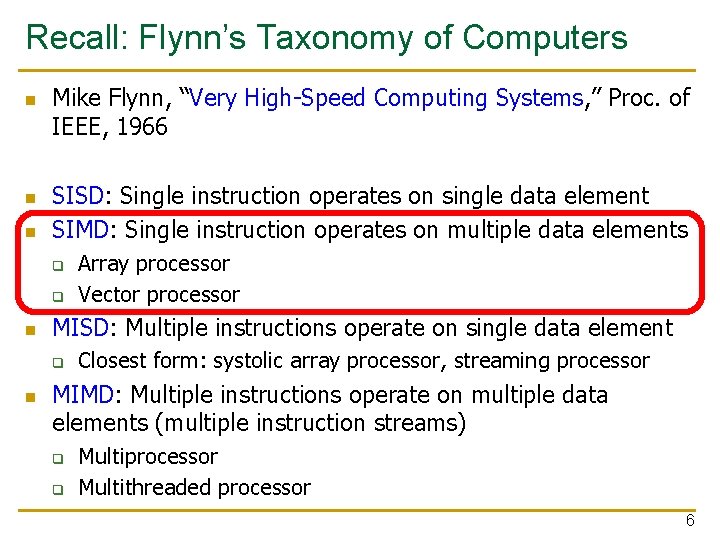
Recall: Flynn’s Taxonomy of Computers n n n Mike Flynn, “Very High-Speed Computing Systems, ” Proc. of IEEE, 1966 SISD: Single instruction operates on single data element SIMD: Single instruction operates on multiple data elements q q n MISD: Multiple instructions operate on single data element q n Array processor Vector processor Closest form: systolic array processor, streaming processor MIMD: Multiple instructions operate on multiple data elements (multiple instruction streams) q q Multiprocessor Multithreaded processor 6
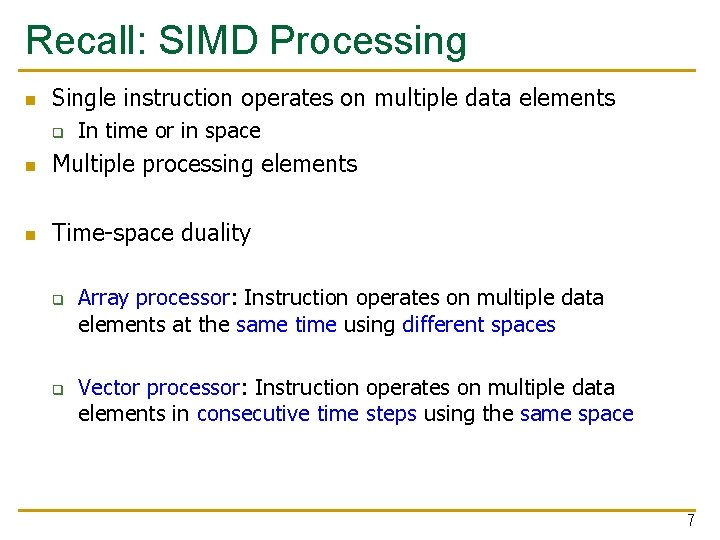
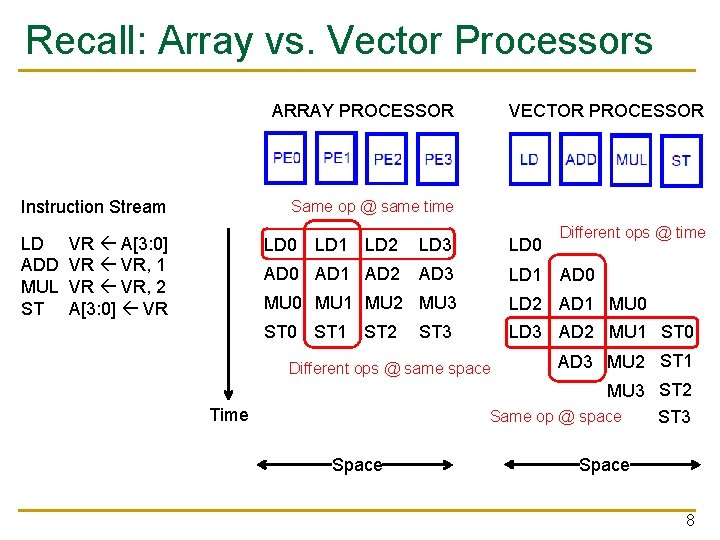
Recall: SIMD Processing n Single instruction operates on multiple data elements q In time or in space n Multiple processing elements n Time-space duality q q Array processor: Instruction operates on multiple data elements at the same time using different spaces Vector processor: Instruction operates on multiple data elements in consecutive time steps using the same space 7
Recall: Array vs. Vector Processors ARRAY PROCESSOR Instruction Stream LD ADD MUL ST VECTOR PROCESSOR Same op @ same time VR A[3: 0] VR VR, 1 VR VR, 2 A[3: 0] VR Different ops @ time LD 0 LD 1 LD 2 LD 3 LD 0 AD 1 AD 2 AD 3 LD 1 AD 0 MU 1 MU 2 MU 3 LD 2 AD 1 MU 0 ST 1 ST 2 LD 3 AD 2 MU 1 ST 0 ST 3 Different ops @ same space AD 3 MU 2 ST 1 MU 3 ST 2 Same op @ space ST 3 Time Space 8
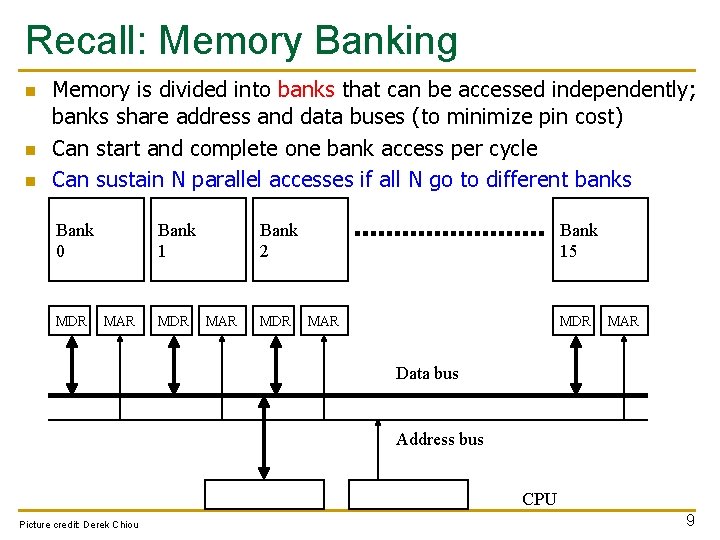
Recall: Memory Banking n n n Memory is divided into banks that can be accessed independently; banks share address and data buses (to minimize pin cost) Can start and complete one bank access per cycle Can sustain N parallel accesses if all N go to different banks Bank 0 MDR Bank 1 MAR MDR Bank 2 MAR MDR Bank 15 MAR MDR MAR Data bus Address bus CPU Picture credit: Derek Chiou 9
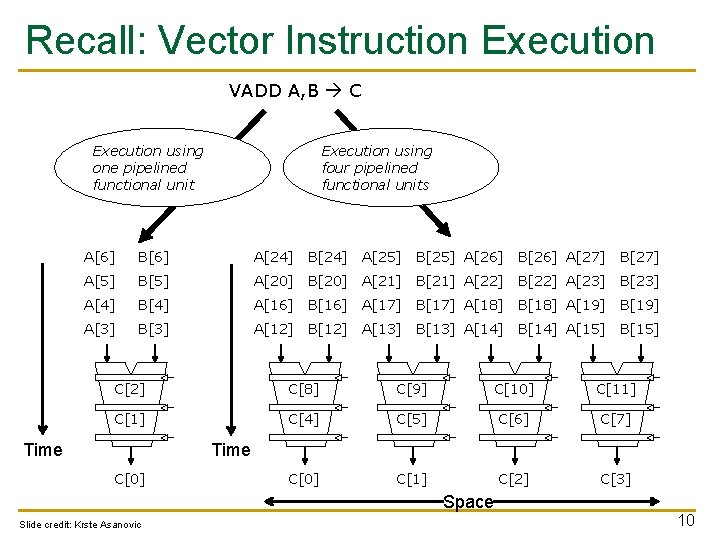
Recall: Vector Instruction Execution VADD A, B C Execution using one pipelined functional unit Execution using four pipelined functional units A[6] B[6] A[24] B[24] A[25] B[25] A[26] B[26] A[27] B[27] A[5] B[5] A[20] B[20] A[21] B[21] A[22] B[22] A[23] B[23] A[4] B[4] A[16] B[16] A[17] B[17] A[18] B[18] A[19] B[19] A[3] B[3] A[12] B[12] A[13] B[13] A[14] B[14] A[15] B[15] C[2] C[8] C[9] C[10] C[11] C[4] C[5] C[6] C[7] C[0] C[1] C[2] C[3] Time C[0] Space Slide credit: Krste Asanovic 10
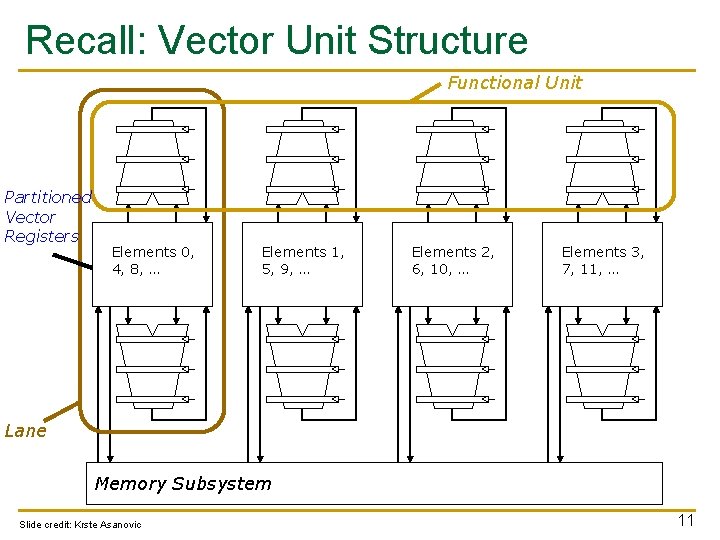
Recall: Vector Unit Structure Functional Unit Partitioned Vector Registers Elements 0, 4, 8, … Elements 1, 5, 9, … Elements 2, 6, 10, … Elements 3, 7, 11, … Lane Memory Subsystem Slide credit: Krste Asanovic 11
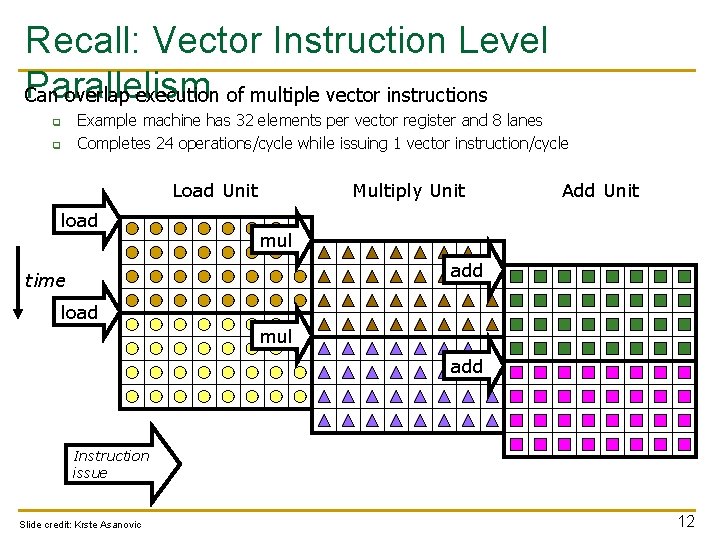
Recall: Vector Instruction Level Parallelism Can overlap execution of multiple vector instructions q q Example machine has 32 elements per vector register and 8 lanes Completes 24 operations/cycle while issuing 1 vector instruction/cycle Load Unit load Multiply Unit Add Unit mul add time load mul add Instruction issue Slide credit: Krste Asanovic 12
Automatic Code Vectorization for (i=0; i < N; i++) C[i] = A[i] + B[i]; Vectorized Code Scalar Sequential Code load Time Iter. 1 add store load Iter. 2 add store load Iter. 1 load add store Iter. 2 Vector Instruction Vectorization is a compile-time reordering of operation sequencing requires extensive loop dependence analysis Slide credit: Krste Asanovic 13
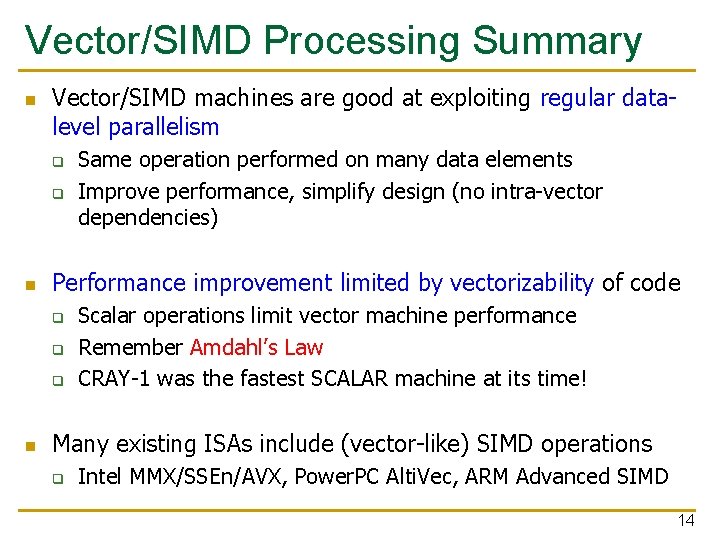
Vector/SIMD Processing Summary n Vector/SIMD machines are good at exploiting regular datalevel parallelism q q n Performance improvement limited by vectorizability of code q q q n Same operation performed on many data elements Improve performance, simplify design (no intra-vector dependencies) Scalar operations limit vector machine performance Remember Amdahl’s Law CRAY-1 was the fastest SCALAR machine at its time! Many existing ISAs include (vector-like) SIMD operations q Intel MMX/SSEn/AVX, Power. PC Alti. Vec, ARM Advanced SIMD 14
SIMD Operations in Modern ISAs
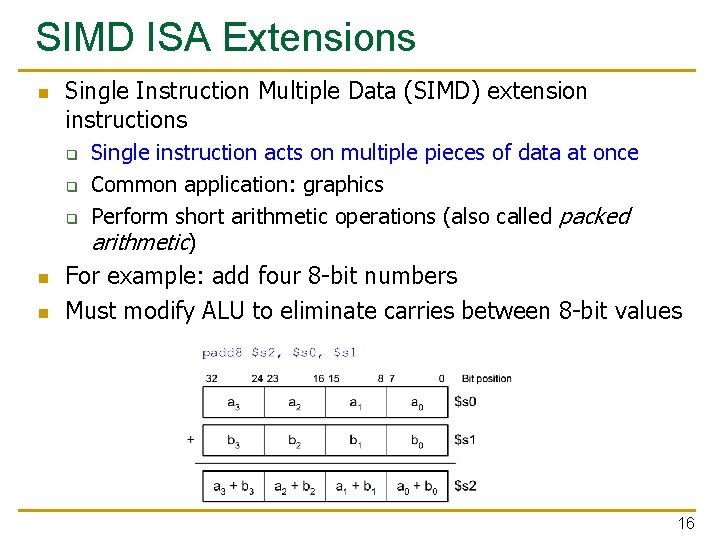
SIMD ISA Extensions n Single Instruction Multiple Data (SIMD) extension instructions q q q n n Single instruction acts on multiple pieces of data at once Common application: graphics Perform short arithmetic operations (also called packed arithmetic) For example: add four 8 -bit numbers Must modify ALU to eliminate carries between 8 -bit values 16
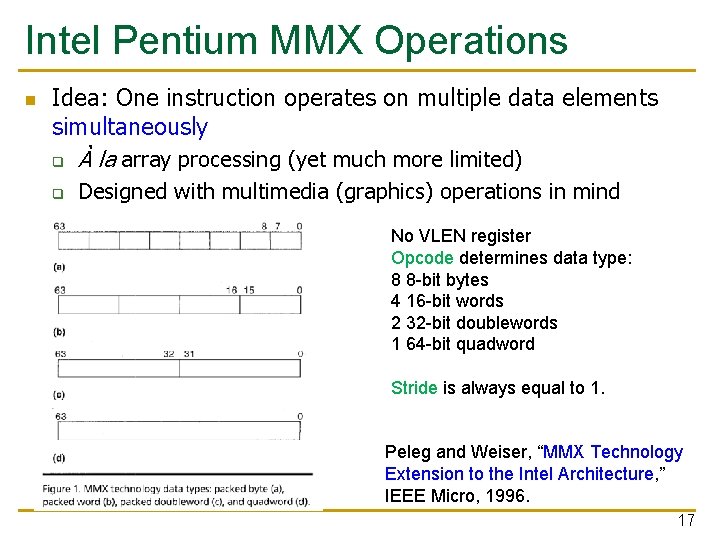
Intel Pentium MMX Operations n Idea: One instruction operates on multiple data elements simultaneously q À la array processing (yet much more limited) q Designed with multimedia (graphics) operations in mind No VLEN register Opcode determines data type: 8 8 -bit bytes 4 16 -bit words 2 32 -bit doublewords 1 64 -bit quadword Stride is always equal to 1. Peleg and Weiser, “MMX Technology Extension to the Intel Architecture, ” IEEE Micro, 1996. 17
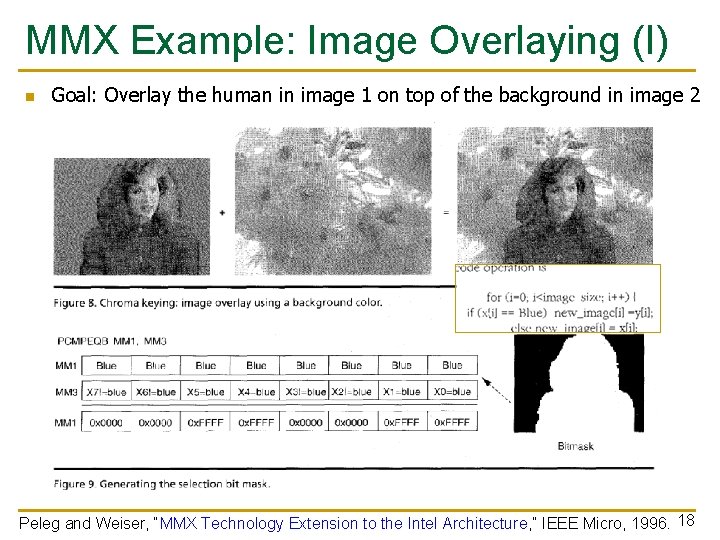
MMX Example: Image Overlaying (I) n Goal: Overlay the human in image 1 on top of the background in image 2 Peleg and Weiser, “MMX Technology Extension to the Intel Architecture, ” IEEE Micro, 1996. 18
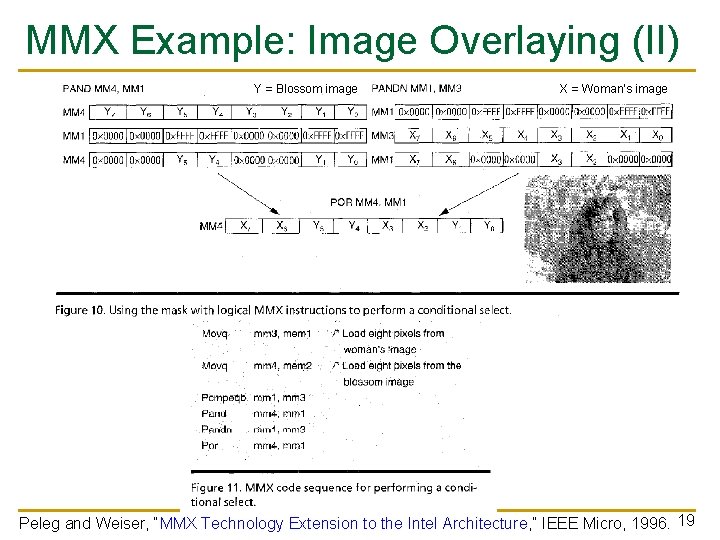
MMX Example: Image Overlaying (II) Y = Blossom image X = Woman’s image Peleg and Weiser, “MMX Technology Extension to the Intel Architecture, ” IEEE Micro, 1996. 19
Fine-Grained Multithreading 20
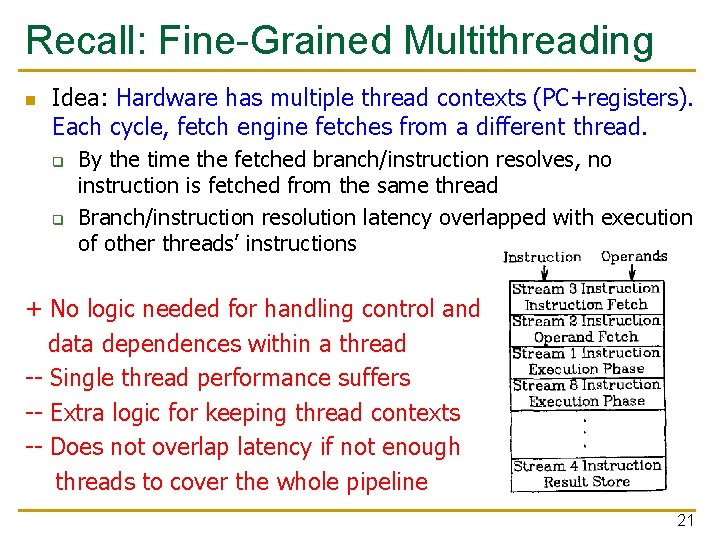
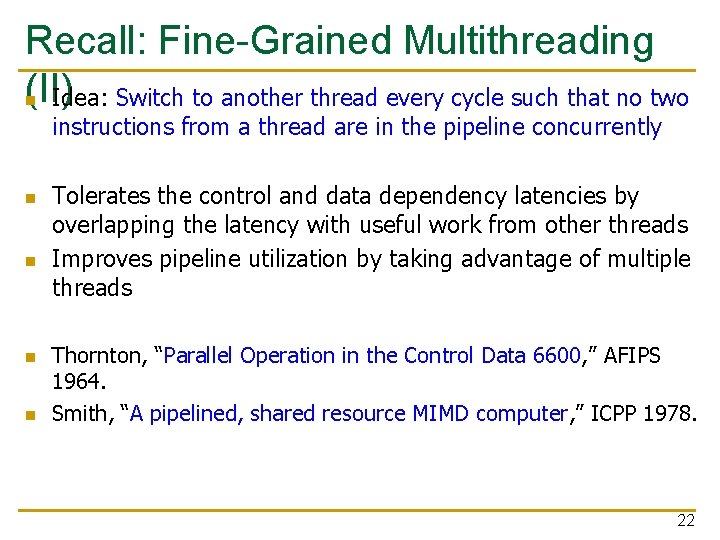
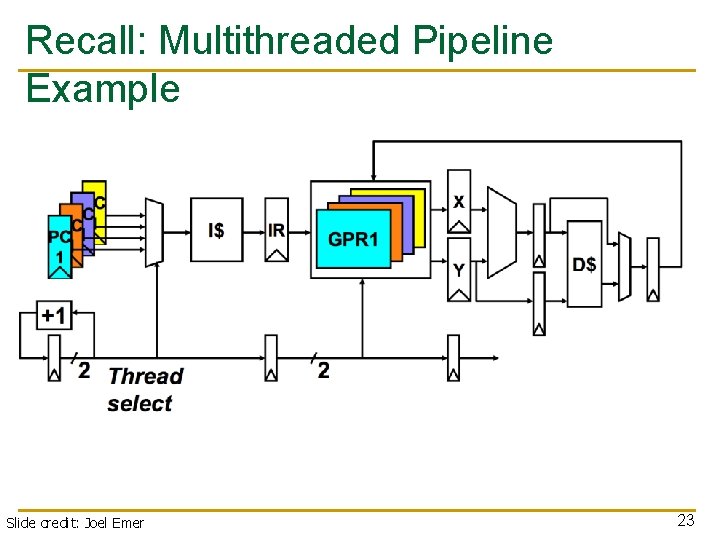
Recall: Fine-Grained Multithreading n Idea: Hardware has multiple thread contexts (PC+registers). Each cycle, fetch engine fetches from a different thread. q q By the time the fetched branch/instruction resolves, no instruction is fetched from the same thread Branch/instruction resolution latency overlapped with execution of other threads’ instructions + No logic needed for handling control and data dependences within a thread -- Single thread performance suffers -- Extra logic for keeping thread contexts -- Does not overlap latency if not enough threads to cover the whole pipeline 21
Recall: Fine-Grained Multithreading (II) n Idea: Switch to another thread every cycle such that no two instructions from a thread are in the pipeline concurrently n n Tolerates the control and data dependency latencies by overlapping the latency with useful work from other threads Improves pipeline utilization by taking advantage of multiple threads Thornton, “Parallel Operation in the Control Data 6600, ” AFIPS 1964. Smith, “A pipelined, shared resource MIMD computer, ” ICPP 1978. 22
Recall: Multithreaded Pipeline Example Slide credit: Joel Emer 23
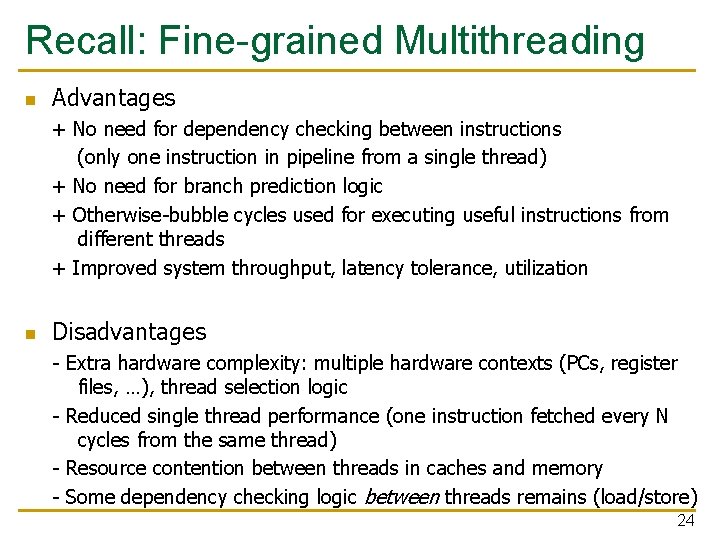
Recall: Fine-grained Multithreading n Advantages + No need for dependency checking between instructions (only one instruction in pipeline from a single thread) + No need for branch prediction logic + Otherwise-bubble cycles used for executing useful instructions from different threads + Improved system throughput, latency tolerance, utilization n Disadvantages - Extra hardware complexity: multiple hardware contexts (PCs, register files, …), thread selection logic - Reduced single thread performance (one instruction fetched every N cycles from the same thread) - Resource contention between threads in caches and memory - Some dependency checking logic between threads remains (load/store) 24
GPUs (Graphics Processing Units)
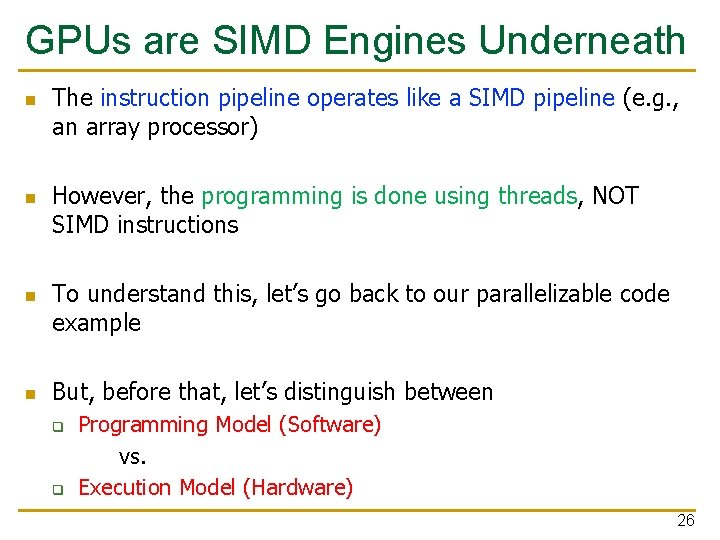
GPUs are SIMD Engines Underneath n n The instruction pipeline operates like a SIMD pipeline (e. g. , an array processor) However, the programming is done using threads, NOT SIMD instructions To understand this, let’s go back to our parallelizable code example But, before that, let’s distinguish between q q Programming Model (Software) vs. Execution Model (Hardware) 26
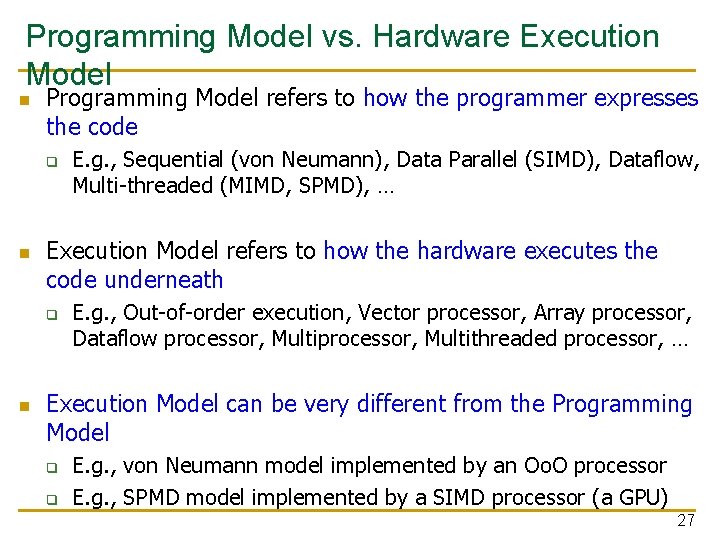
Programming Model vs. Hardware Execution Model n Programming Model refers to how the programmer expresses the code q n Execution Model refers to how the hardware executes the code underneath q n E. g. , Sequential (von Neumann), Data Parallel (SIMD), Dataflow, Multi-threaded (MIMD, SPMD), … E. g. , Out-of-order execution, Vector processor, Array processor, Dataflow processor, Multithreaded processor, … Execution Model can be very different from the Programming Model q q E. g. , von Neumann model implemented by an Oo. O processor E. g. , SPMD model implemented by a SIMD processor (a GPU) 27
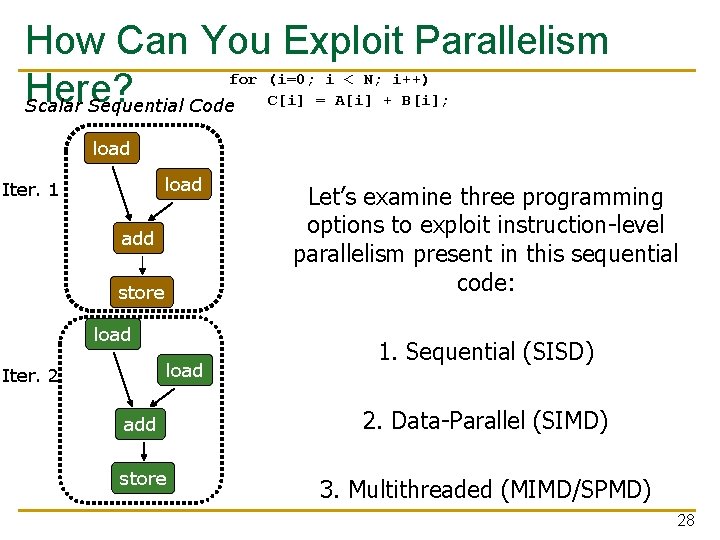
How Can You Exploit Parallelism Here? Scalar Sequential Code for (i=0; i < N; i++) C[i] = A[i] + B[i]; load Iter. 1 add store load Iter. 2 Let’s examine three programming options to exploit instruction-level parallelism present in this sequential code: 1. Sequential (SISD) add 2. Data-Parallel (SIMD) store 3. Multithreaded (MIMD/SPMD) 28
for (i=0; i < N; i++) C[i] = A[i] + B[i]; Prog. Model 1: Sequential (SISD) Scalar Sequential Code n load Iter. 1 n n Can be executed on a: Pipelined processor Out-of-order execution processor add q store q load Iter. 2 add store q n Independent instructions executed when ready Different iterations are present in the instruction window and can execute in parallel in multiple functional units In other words, the loop is dynamically unrolled by the hardware Superscalar or VLIW processor q Can fetch and execute multiple instructions per cycle 29
for (i=0; i < N; i++) C[i] = A[i] + B[i]; Prog. Model 2: Data Parallel (SIMD) Vector Instruction Scalar Sequential Code load load Iter. 1 load Vectorized Code VLD A V 1 VLD B V 2 add add VADD store VST load Iter. 2 1 add store load V 1 + V 2 V 3 C Iter. Realization: Each iteration is independent 2 Idea: Programmer or compiler generates a SIMD instruction to execute the same instruction from all iterations across different data Best executed by a SIMD processor (vector, array) 30
for (i=0; i < N; i++) C[i] = A[i] + B[i]; Prog. Model 3: Multithreaded Scalar Sequential Code load load Iter. 1 load add add store load Iter. 2 1 add store load Iter. Realization: Each iteration is independent 2 Idea: Programmer or compiler generates a thread to execute each iteration. Each thread does the same thing (but on different data) Can be executed on a MIMD machine 31
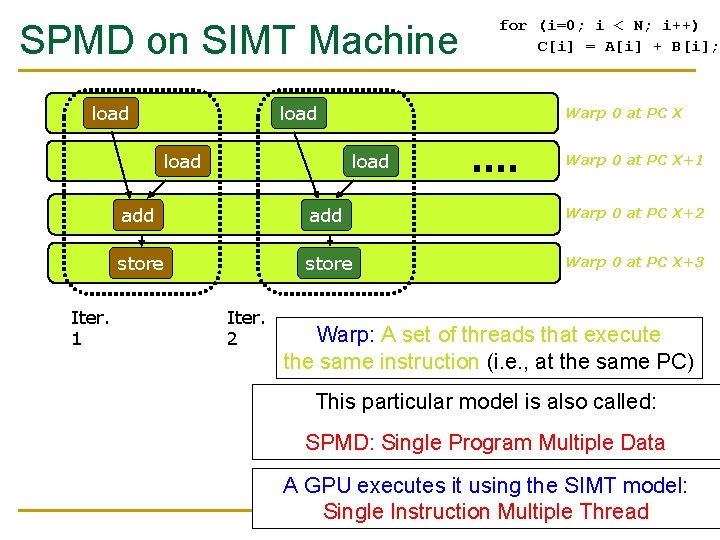
for (i=0; i < N; i++) C[i] = A[i] + B[i]; Prog. Model 3: Multithreaded load Iter. 1 load add store Iter. Realization: Each iteration is independent 2 Idea: This Programmer compiler generates a thread particularormodel is also called: to execute each iteration. Each thread does the SPMD: Single Multiple Data same thing (but on Program different data) be on machine Can be executed on a a SIMT SIMD machine Can be executed on a MIMD machine Single Instruction Multiple Thread 32
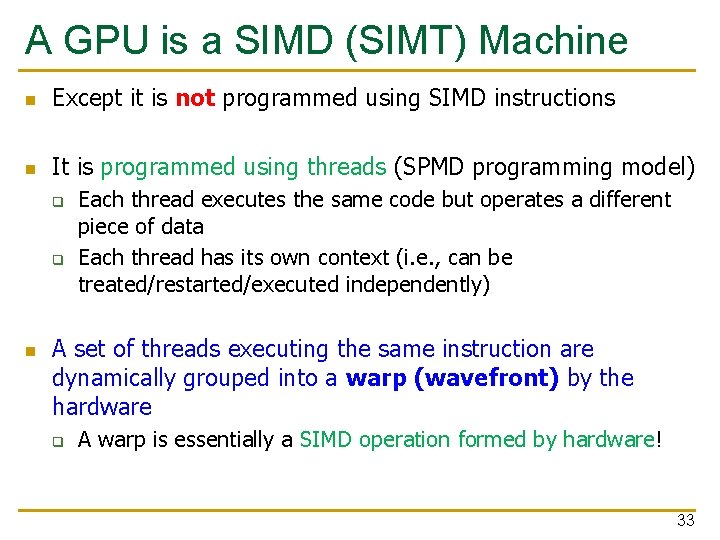
A GPU is a SIMD (SIMT) Machine n Except it is not programmed using SIMD instructions n It is programmed using threads (SPMD programming model) q q n Each thread executes the same code but operates a different piece of data Each thread has its own context (i. e. , can be treated/restarted/executed independently) A set of threads executing the same instruction are dynamically grouped into a warp (wavefront) by the hardware q A warp is essentially a SIMD operation formed by hardware! 33
SPMD on SIMT Machine load Warp 0 at PC X load Iter. 1 for (i=0; i < N; i++) C[i] = A[i] + B[i]; load Warp 0 at PC X+1 add Warp 0 at PC X+2 store Warp 0 at PC X+3 Iter. 2 Warp: A set of threads that execute Realization: Each iteration is independent the same instruction (i. e. , at the same PC) Idea: This Programmer compiler generates a thread particularormodel is also called: to execute each iteration. Each thread does the SPMD: Multiple Data same thing Single (but on Program different data) A GPU executes the SIMT model: Can be executed on a SIMD machine Can be executed onitausing MIMD machine Single Instruction Multiple Thread 34
Graphics Processing Units SIMD not Exposed to Programmer (SIMT)
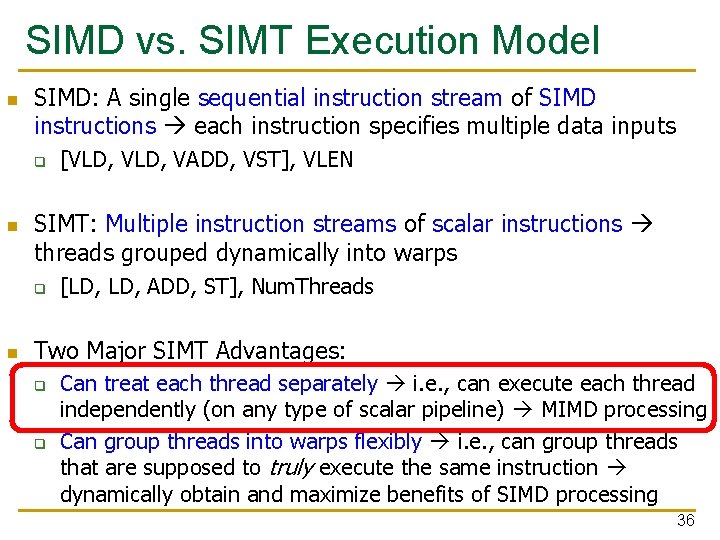
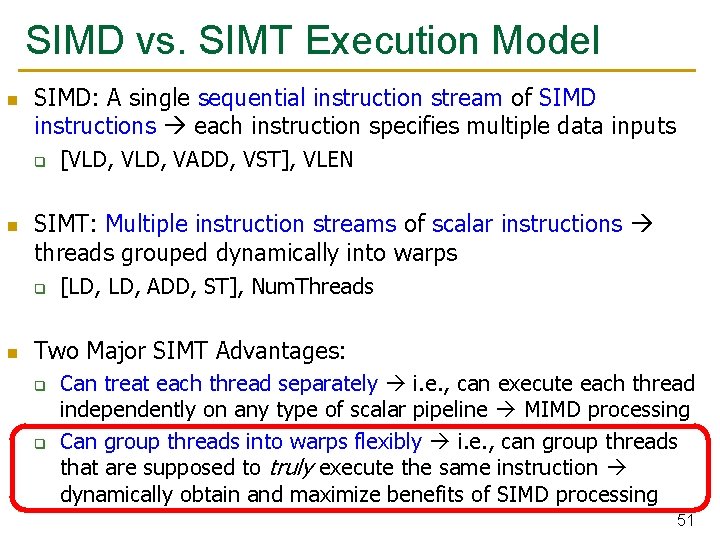
SIMD vs. SIMT Execution Model n SIMD: A single sequential instruction stream of SIMD instructions each instruction specifies multiple data inputs q n SIMT: Multiple instruction streams of scalar instructions threads grouped dynamically into warps q n [VLD, VADD, VST], VLEN [LD, ADD, ST], Num. Threads Two Major SIMT Advantages: q q Can treat each thread separately i. e. , can execute each thread independently (on any type of scalar pipeline) MIMD processing Can group threads into warps flexibly i. e. , can group threads that are supposed to truly execute the same instruction dynamically obtain and maximize benefits of SIMD processing 36
Fine-Grained Multithreading of Warps n n n for (i=0; i < N; i++) C[i] = A[i] + B[i]; Assume a warp consists of 32 threads If you have 32 K iterations, and 1 iteration/thread 1 K warps Warps can be interleaved on the same pipeline Fine grained multithreading of warps load add store Iter. 1 33 20*32 + 1 0 at PC X Warp 1 Warp 20 at PC X+2 Iter. 2 34 20*32 +2 37
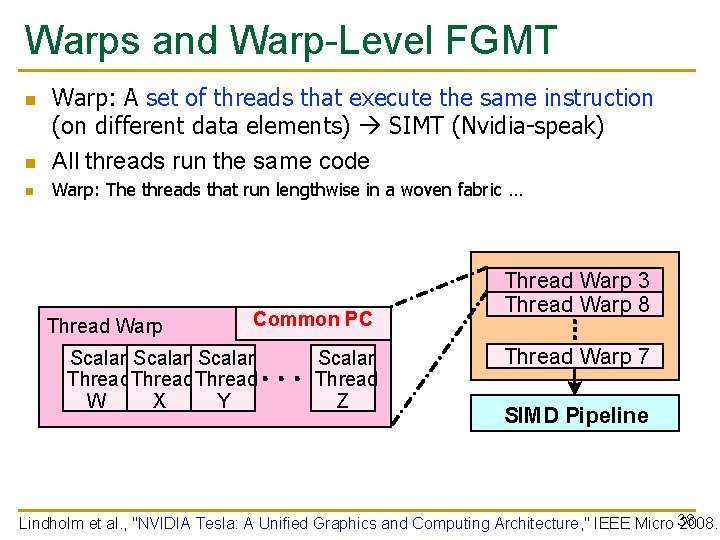
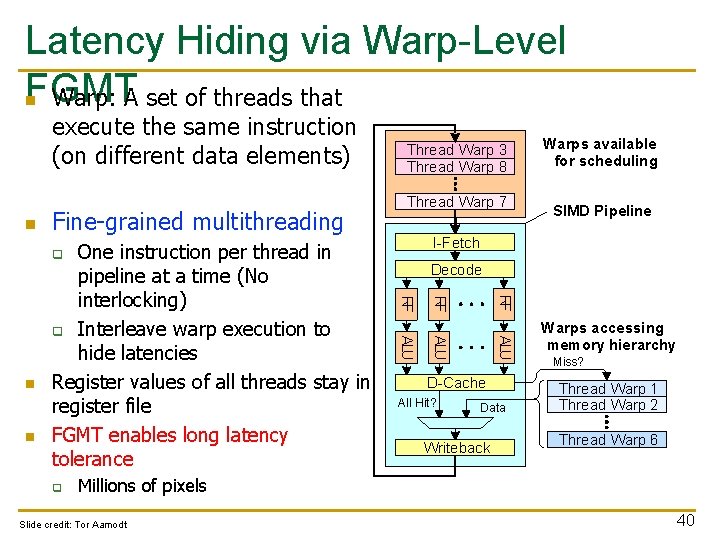
Warps and Warp-Level FGMT n Warp: A set of threads that execute the same instruction (on different data elements) SIMT (Nvidia-speak) All threads run the same code n Warp: The threads that run lengthwise in a woven fabric … n Thread Warp Common PC Scalar Thread W X Y Scalar Thread Z Thread Warp 3 Thread Warp 8 Thread Warp 7 SIMD Pipeline Lindholm et al. , "NVIDIA Tesla: A Unified Graphics and Computing Architecture, " IEEE Micro 38 2008.
High-Level View of a GPU Lindholm et al. , "NVIDIA Tesla: A Unified Graphics and Computing Architecture, " IEEE Micro 39 2008.
Latency Hiding via Warp-Level FGMT n Warp: A set of threads that execute the same instruction (on different data elements) n Fine-grained multithreading Thread Warp 7 RF ALU q ALU n SIMD Pipeline Decode RF n Warps available for scheduling I-Fetch q RF One instruction per thread in pipeline at a time (No interlocking) q Interleave warp execution to hide latencies Register values of all threads stay in register file FGMT enables long latency tolerance Thread Warp 3 Thread Warp 8 D-Cache All Hit? Data Writeback Warps accessing memory hierarchy Miss? Thread Warp 1 Thread Warp 2 Thread Warp 6 Millions of pixels Slide credit: Tor Aamodt 40
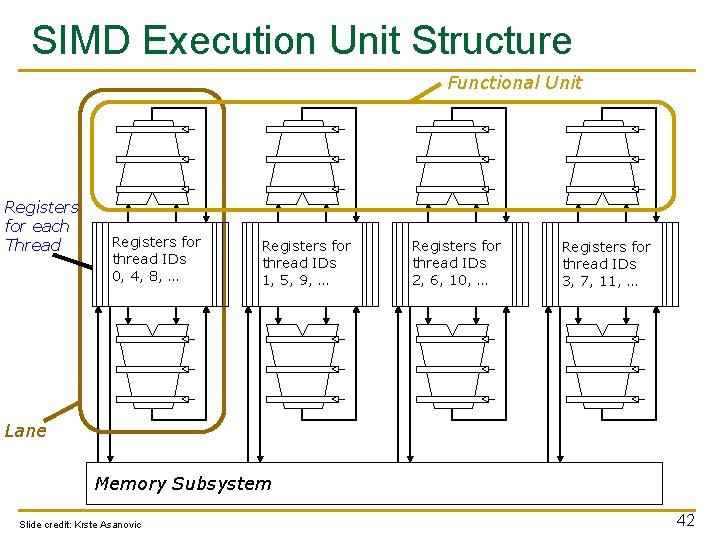
Warp Execution (Recall the Slide) 32 -thread warp executing ADD A[tid], B[tid] C[tid] Execution using one pipelined functional unit Execution using four pipelined functional units A[6] B[6] A[24] B[24] A[25] B[25] A[26] B[26] A[27] B[27] A[5] B[5] A[20] B[20] A[21] B[21] A[22] B[22] A[23] B[23] A[4] B[4] A[16] B[16] A[17] B[17] A[18] B[18] A[19] B[19] A[3] B[3] A[12] B[12] A[13] B[13] A[14] B[14] A[15] B[15] C[2] C[8] C[9] C[10] C[11] C[4] C[5] C[6] C[7] C[0] C[1] C[2] C[3] Time C[0] Space Slide credit: Krste Asanovic 41
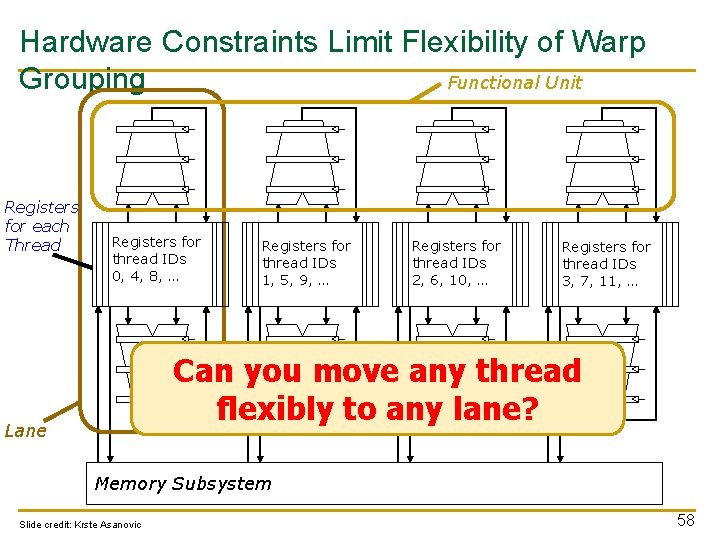
SIMD Execution Unit Structure Functional Unit Registers for each Thread Registers for thread IDs 0, 4, 8, … Registers for thread IDs 1, 5, 9, … Registers for thread IDs 2, 6, 10, … Registers for thread IDs 3, 7, 11, … Lane Memory Subsystem Slide credit: Krste Asanovic 42
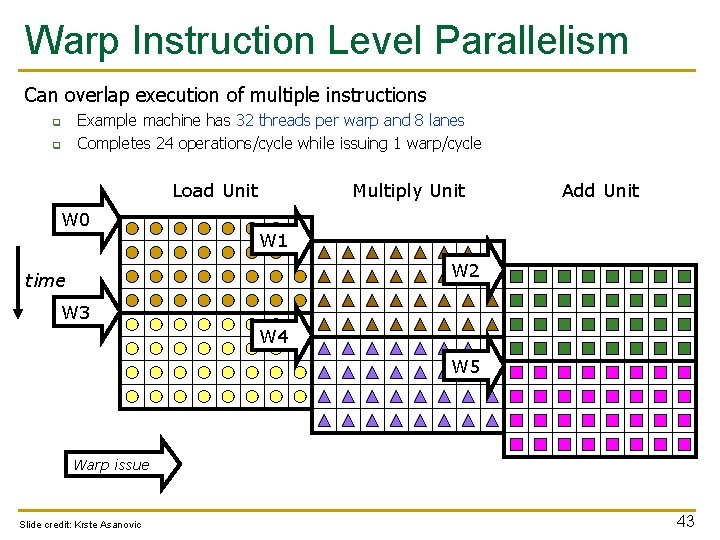
Warp Instruction Level Parallelism Can overlap execution of multiple instructions q q Example machine has 32 threads per warp and 8 lanes Completes 24 operations/cycle while issuing 1 warp/cycle Load Unit W 0 Multiply Unit Add Unit W 1 W 2 time W 3 W 4 W 5 Warp issue Slide credit: Krste Asanovic 43
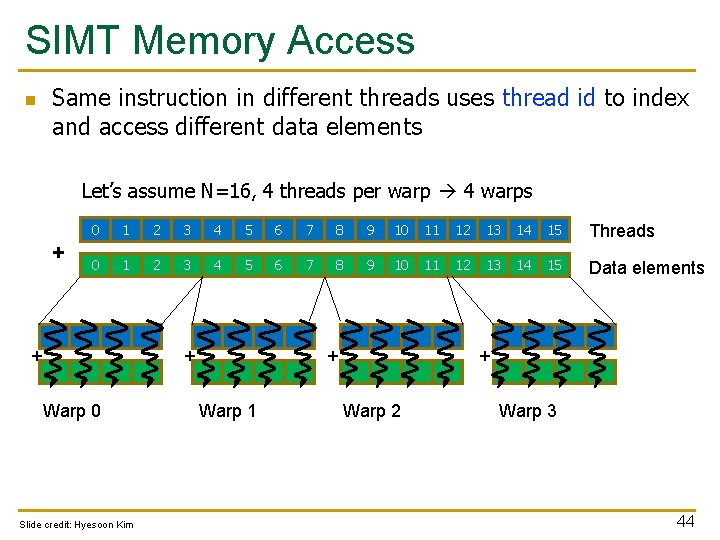
SIMT Memory Access Same instruction in different threads uses thread id to index and access different data elements n Let’s assume N=16, 4 threads per warp 4 warps + 0 1 2 3 4 5 6 7 8 9 10 11 12 13 14 15 Threads 0 1 2 3 4 5 6 7 8 9 10 11 12 13 14 15 Data elements + Warp 0 Slide credit: Hyesoon Kim + + Warp 1 + Warp 2 Warp 3 44
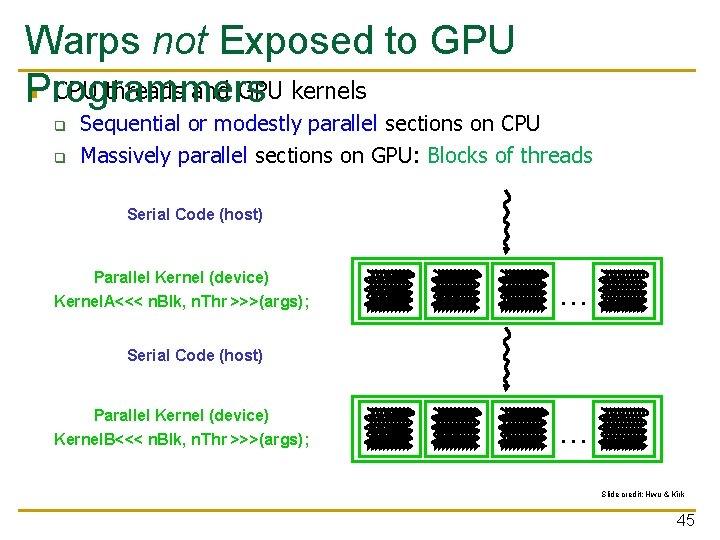
Warps not Exposed to GPU n CPU threads and GPU kernels Programmers q q Sequential or modestly parallel sections on CPU Massively parallel sections on GPU: Blocks of threads Serial Code (host) Parallel Kernel (device) Kernel. A<<< n. Blk, n. Thr >>>(args); . . . Serial Code (host) Parallel Kernel (device) Kernel. B<<< n. Blk, n. Thr >>>(args); . . . Slide credit: Hwu & Kirk 45
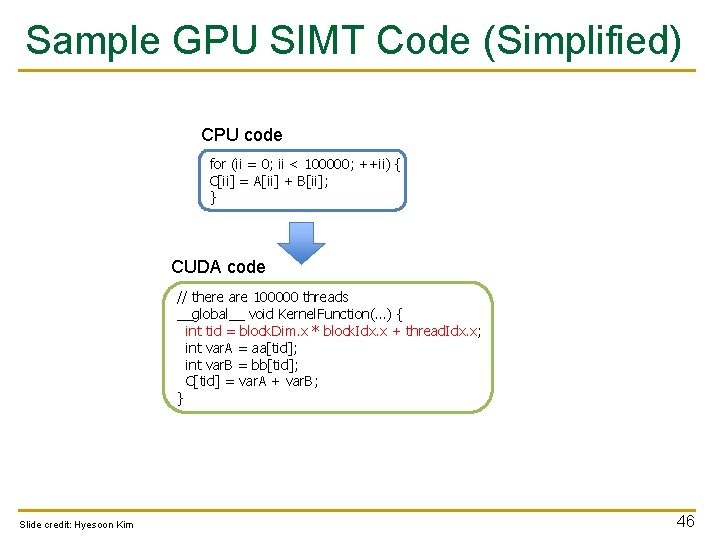
Sample GPU SIMT Code (Simplified) CPU code for (ii = 0; ii < 100000; ++ii) { C[ii] = A[ii] + B[ii]; } CUDA code // there are 100000 threads __global__ void Kernel. Function(…) { int tid = block. Dim. x * block. Idx. x + thread. Idx. x; int var. A = aa[tid]; int var. B = bb[tid]; C[tid] = var. A + var. B; } Slide credit: Hyesoon Kim 46
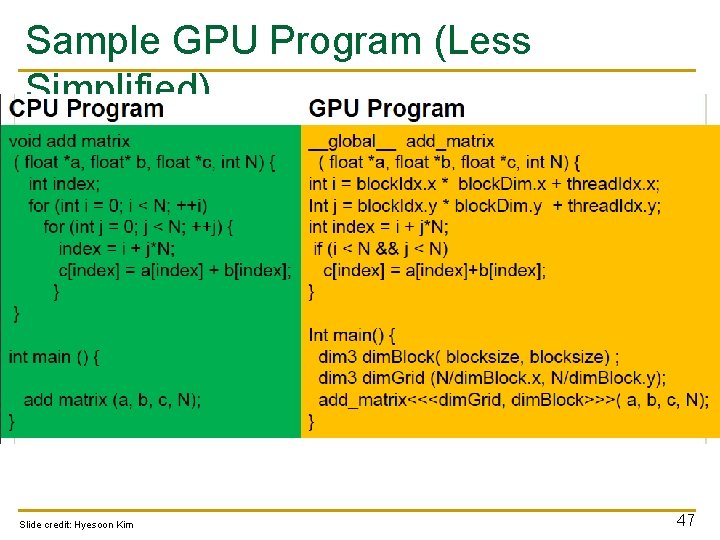
Sample GPU Program (Less Simplified) Slide credit: Hyesoon Kim 47
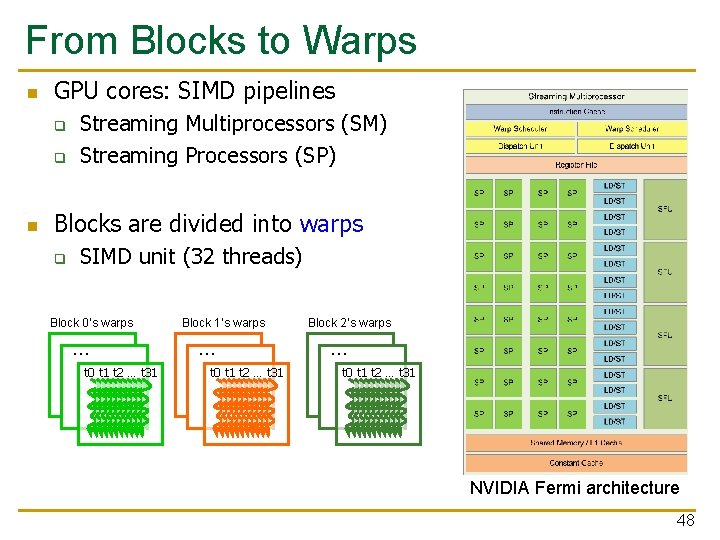
From Blocks to Warps n GPU cores: SIMD pipelines q q n Streaming Multiprocessors (SM) Streaming Processors (SP) Blocks are divided into warps q SIMD unit (32 threads) Block 0’s warps … Block 1’s warps … t 0 t 1 t 2 … t 31 … Block 2’s warps … t 0 t 1 t 2 … t 31 … NVIDIA Fermi architecture 48
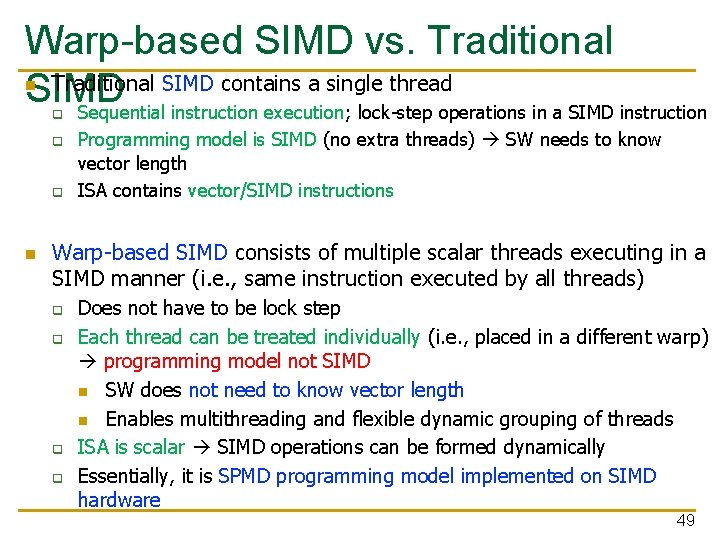
Warp-based SIMD vs. Traditional SIMD contains a single thread SIMD Sequential instruction execution; lock-step operations in a SIMD instruction n q q q n Programming model is SIMD (no extra threads) SW needs to know vector length ISA contains vector/SIMD instructions Warp-based SIMD consists of multiple scalar threads executing in a SIMD manner (i. e. , same instruction executed by all threads) q q Does not have to be lock step Each thread can be treated individually (i. e. , placed in a different warp) programming model not SIMD n SW does not need to know vector length n Enables multithreading and flexible dynamic grouping of threads ISA is scalar SIMD operations can be formed dynamically Essentially, it is SPMD programming model implemented on SIMD hardware 49
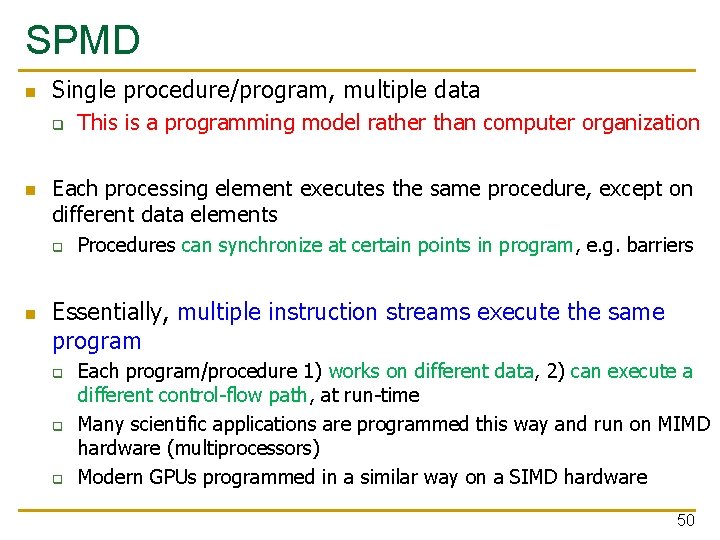
SPMD n Single procedure/program, multiple data q n Each processing element executes the same procedure, except on different data elements q n This is a programming model rather than computer organization Procedures can synchronize at certain points in program, e. g. barriers Essentially, multiple instruction streams execute the same program q q q Each program/procedure 1) works on different data, 2) can execute a different control-flow path, at run-time Many scientific applications are programmed this way and run on MIMD hardware (multiprocessors) Modern GPUs programmed in a similar way on a SIMD hardware 50
SIMD vs. SIMT Execution Model n SIMD: A single sequential instruction stream of SIMD instructions each instruction specifies multiple data inputs q n SIMT: Multiple instruction streams of scalar instructions threads grouped dynamically into warps q n [VLD, VADD, VST], VLEN [LD, ADD, ST], Num. Threads Two Major SIMT Advantages: q q Can treat each thread separately i. e. , can execute each thread independently on any type of scalar pipeline MIMD processing Can group threads into warps flexibly i. e. , can group threads that are supposed to truly execute the same instruction dynamically obtain and maximize benefits of SIMD processing 51
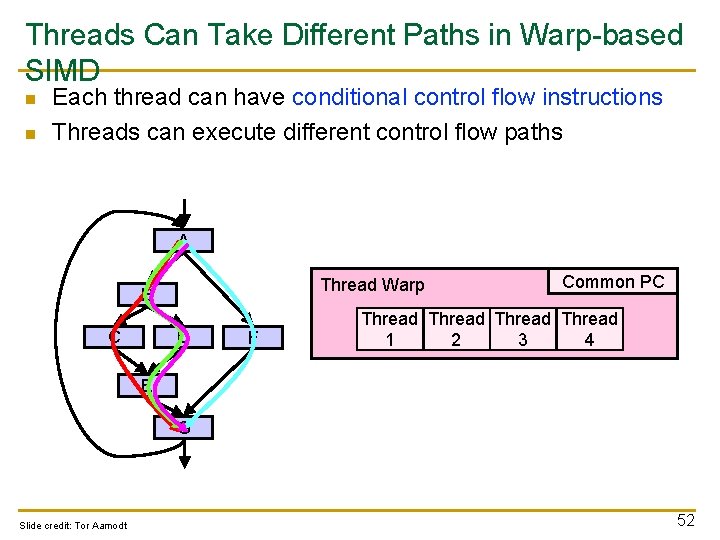
Threads Can Take Different Paths in Warp-based SIMD n n Each thread can have conditional control flow instructions Threads can execute different control flow paths A Thread Warp B C D F Common PC Thread 1 2 3 4 E G Slide credit: Tor Aamodt 52
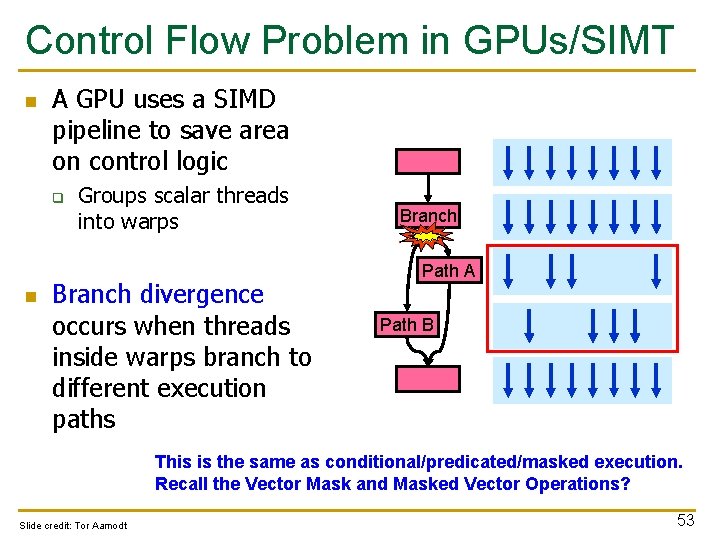
Control Flow Problem in GPUs/SIMT n A GPU uses a SIMD pipeline to save area on control logic q n Groups scalar threads into warps Branch divergence occurs when threads inside warps branch to different execution paths Branch Path A Path B This is the same as conditional/predicated/masked execution. Recall the Vector Mask and Masked Vector Operations? Slide credit: Tor Aamodt 53
Remember: Each Thread Is n Independent Two Major SIMT Advantages: q q n n Can treat each thread separately i. e. , can execute each thread independently on any type of scalar pipeline MIMD processing Can group threads into warps flexibly i. e. , can group threads that are supposed to truly execute the same instruction dynamically obtain and maximize benefits of SIMD processing If we have many threads We can find individual threads that are at the same PC And, group them together into a single warp dynamically This reduces “divergence” improves SIMD utilization q SIMD utilization: fraction of SIMD lanes executing a useful operation (i. e. , executing an active thread) 54
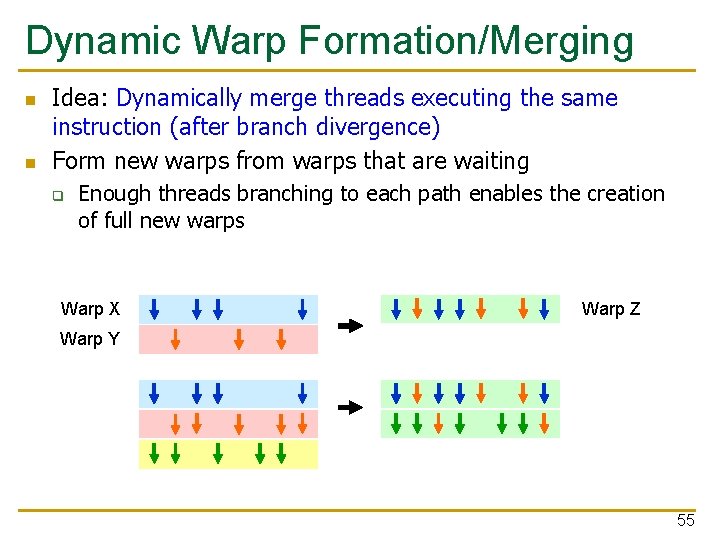
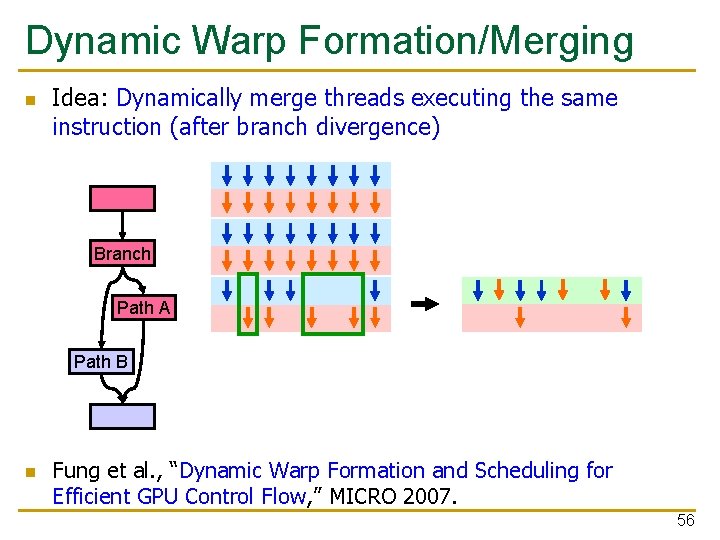
Dynamic Warp Formation/Merging n n Idea: Dynamically merge threads executing the same instruction (after branch divergence) Form new warps from warps that are waiting q Enough threads branching to each path enables the creation of full new warps Warp X Warp Z Warp Y 55
Dynamic Warp Formation/Merging n Idea: Dynamically merge threads executing the same instruction (after branch divergence) Branch Path A Path B n Fung et al. , “Dynamic Warp Formation and Scheduling for Efficient GPU Control Flow, ” MICRO 2007. 56
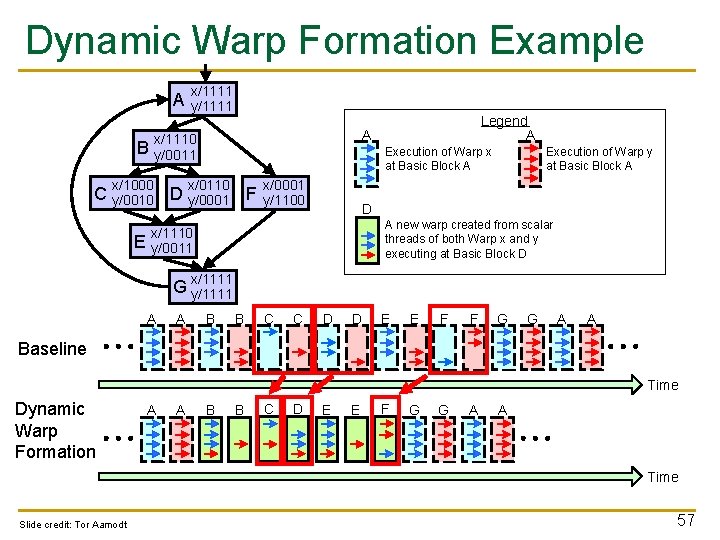
Dynamic Warp Formation Example A x/1111 y/1111 A x/1110 y/0011 B x/1000 Execution of Warp x at Basic Block A x/0110 C y/0010 D y/0001 F E Legend A x/0001 y/1100 Execution of Warp y at Basic Block A D A new warp created from scalar threads of both Warp x and y executing at Basic Block D x/1110 y/0011 x/1111 G y/1111 A A B B C C D D E E F F G G A A Baseline Time Dynamic Warp Formation A A B B C D E E F G G A A Time Slide credit: Tor Aamodt 57
Hardware Constraints Limit Flexibility of Warp Functional Unit Grouping Registers for each Thread Registers for thread IDs 0, 4, 8, … Registers for thread IDs 1, 5, 9, … Registers for thread IDs 2, 6, 10, … Registers for thread IDs 3, 7, 11, … Can you move any thread flexibly to any lane? Lane Memory Subsystem Slide credit: Krste Asanovic 58
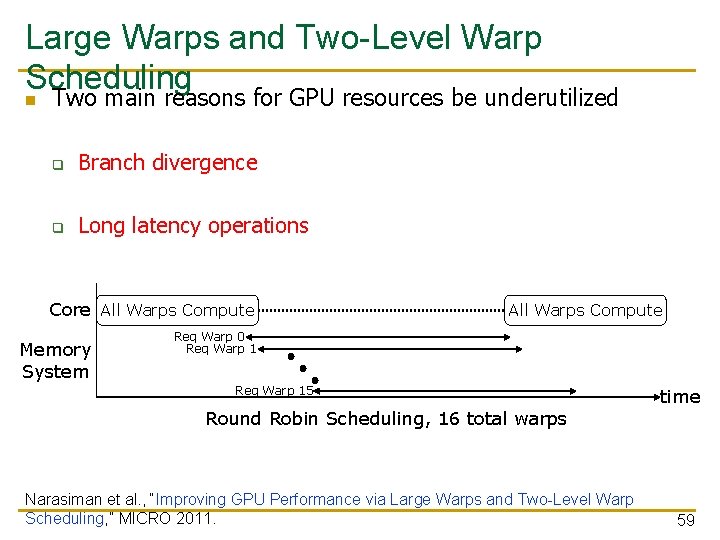
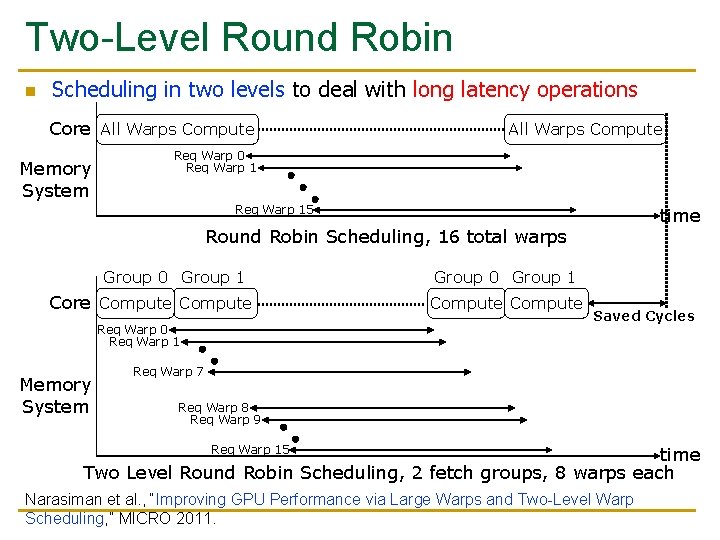
Large Warps and Two-Level Warp Scheduling n Two main reasons for GPU resources be underutilized q Branch divergence q Long latency operations Core All Warps Compute Memory System All Warps Compute Req Warp 0 Req Warp 15 Round Robin Scheduling, 16 total warps Narasiman et al. , “Improving GPU Performance via Large Warps and Two-Level Warp Scheduling, ” MICRO 2011. time 59
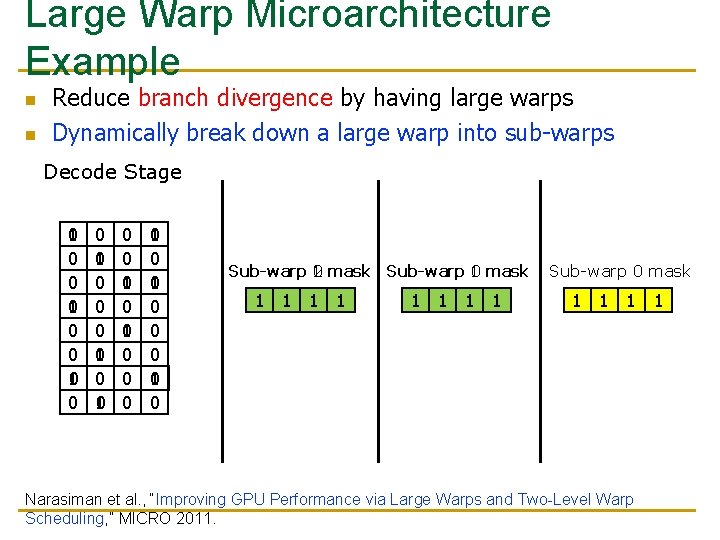
Large Warp Microarchitecture Example n n Reduce branch divergence by having large warps Dynamically break down a large warp into sub-warps Decode Stage 0 1 0 0 0 0 1 0 0 1 0 0 Sub-warp 1 0 mask Sub-warp 1 2 0 mask 1 1 0 1 1 1 Sub-warp 0 mask 1 1 Narasiman et al. , “Improving GPU Performance via Large Warps and Two-Level Warp Scheduling, ” MICRO 2011.
Two-Level Round Robin n Scheduling in two levels to deal with long latency operations Core All Warps Compute Memory System All Warps Compute Req Warp 0 Req Warp 15 time Round Robin Scheduling, 16 total warps Group 0 Group 1 Core Compute Req Warp 0 Req Warp 1 Memory System Group 0 Group 1 Compute Saved Cycles Req Warp 7 Req Warp 8 Req Warp 9 Req Warp 15 time Two Level Round Robin Scheduling, 2 fetch groups, 8 warps each Narasiman et al. , “Improving GPU Performance via Large Warps and Two-Level Warp Scheduling, ” MICRO 2011.
An Example GPU
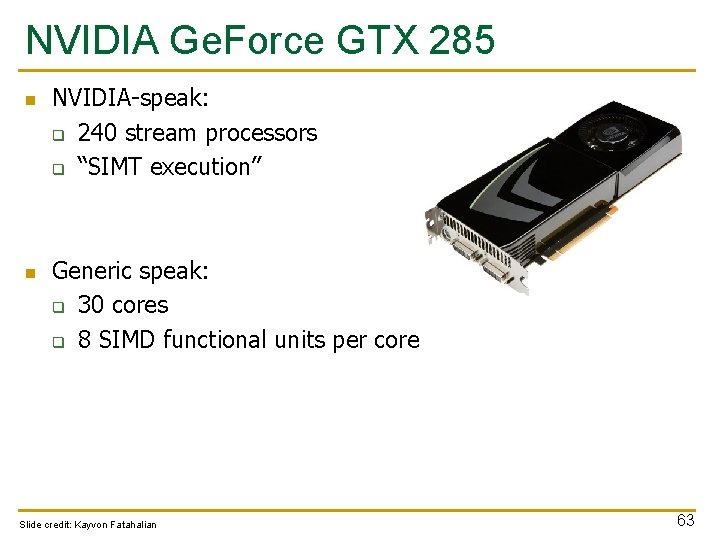
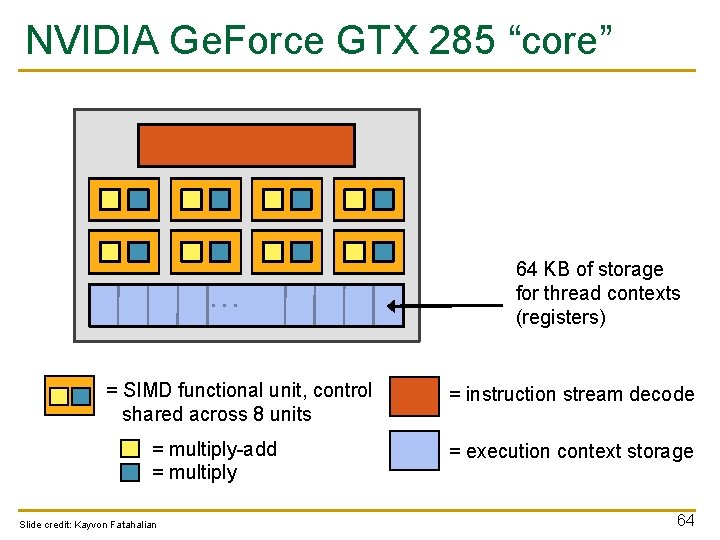
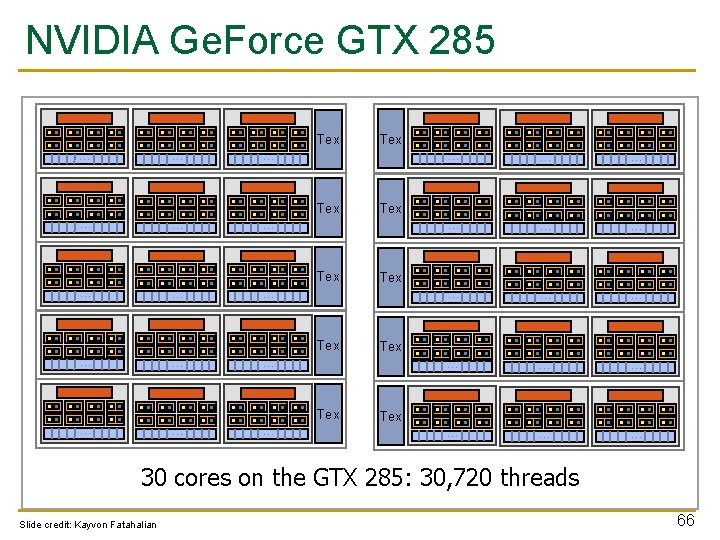
NVIDIA Ge. Force GTX 285 n n NVIDIA-speak: q 240 stream processors q “SIMT execution” Generic speak: q 30 cores q 8 SIMD functional units per core Slide credit: Kayvon Fatahalian 63
NVIDIA Ge. Force GTX 285 “core” … = SIMD functional unit, control shared across 8 units = multiply-add = multiply Slide credit: Kayvon Fatahalian 64 KB of storage for thread contexts (registers) = instruction stream decode = execution context storage 64
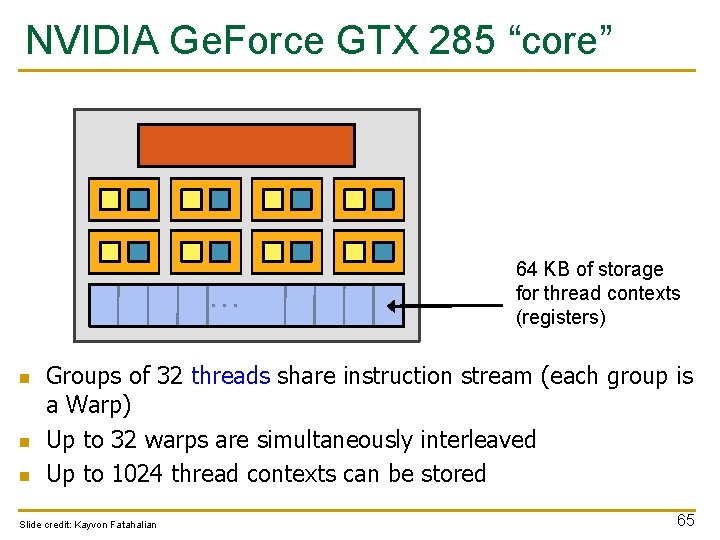
NVIDIA Ge. Force GTX 285 “core” … n n n 64 KB of storage for thread contexts (registers) Groups of 32 threads share instruction stream (each group is a Warp) Up to 32 warps are simultaneously interleaved Up to 1024 thread contexts can be stored Slide credit: Kayvon Fatahalian 65
NVIDIA Ge. Force GTX 285 Tex … … … … … … Tex … Tex … Tex 30 cores on the GTX 285: 30, 720 threads Slide credit: Kayvon Fatahalian 66
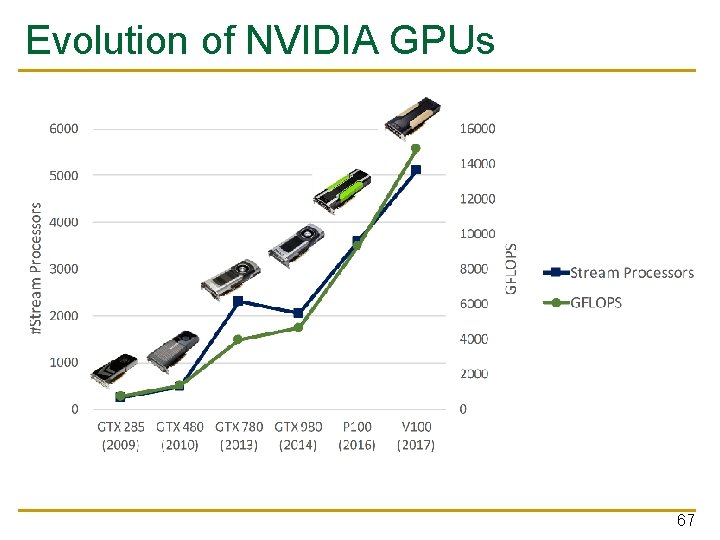
Evolution of NVIDIA GPUs 67
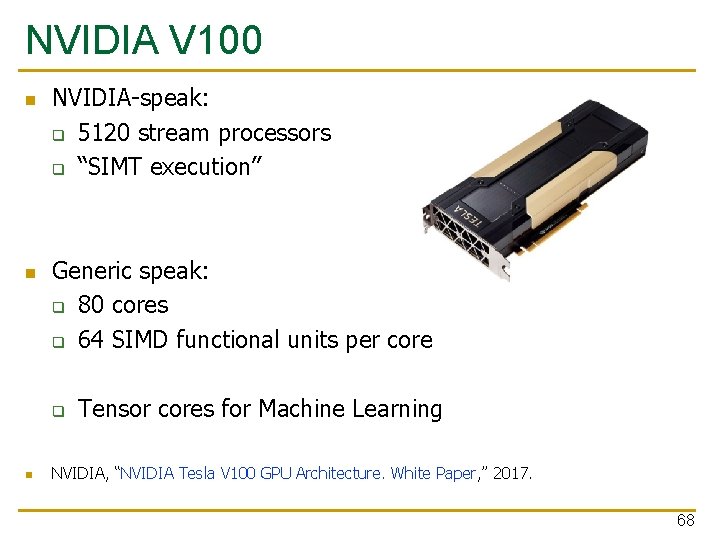
NVIDIA V 100 n n NVIDIA-speak: q 5120 stream processors q “SIMT execution” Generic speak: q 80 cores q 64 SIMD functional units per core q n Tensor cores for Machine Learning NVIDIA, “NVIDIA Tesla V 100 GPU Architecture. White Paper, ” 2017. 68
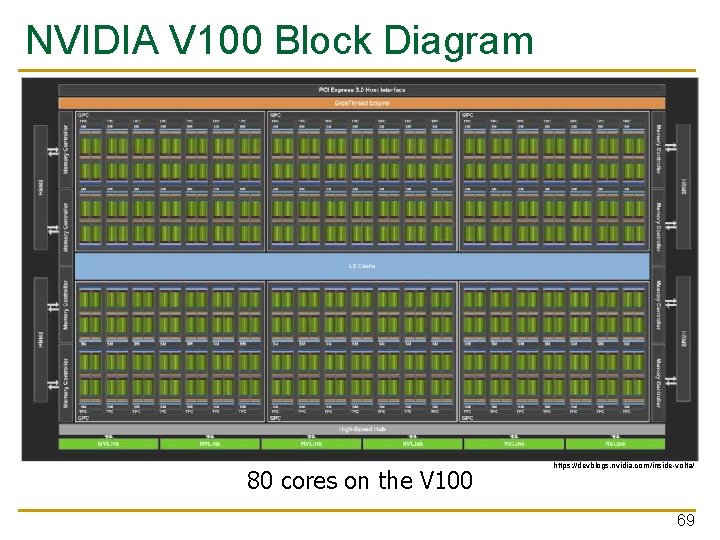
NVIDIA V 100 Block Diagram 80 cores on the V 100 https: //devblogs. nvidia. com/inside-volta/ 69
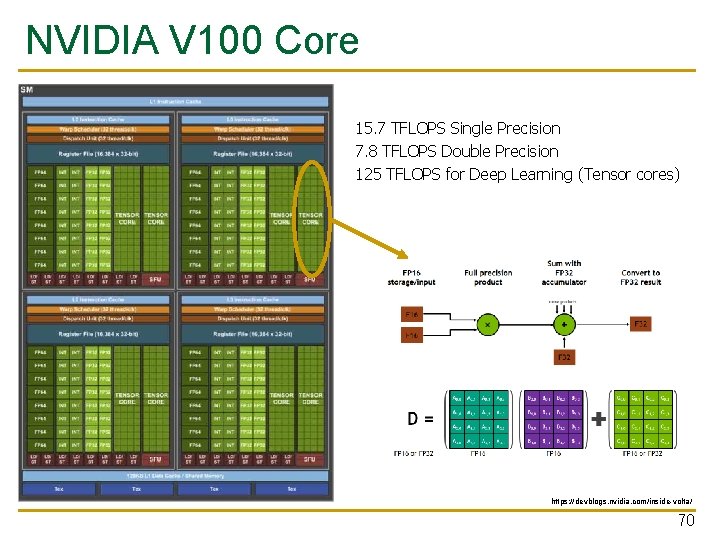
NVIDIA V 100 Core 15. 7 TFLOPS Single Precision 7. 8 TFLOPS Double Precision 125 TFLOPS for Deep Learning (Tensor cores) https: //devblogs. nvidia. com/inside-volta/ 70
Food for Thought n n Compare and contrast GPUs vs Systolic Arrays q Which one is better for machine learning? q Which one is better for image/vision processing? q What types of parallelism each one exploits? q What are the tradeoffs? If you are interested in such questions and more… q q Bachelor’s Seminar in Computer Architecture (HS 2019, FS 2020) Computer Architecture Master’s Course (HS 2019) 71
Design of Digital Circuits Lecture 21: Graphics Processing Units Dr. Juan Gómez Luna Prof. Onur Mutlu ETH Zurich Spring 2019 10 May 2019
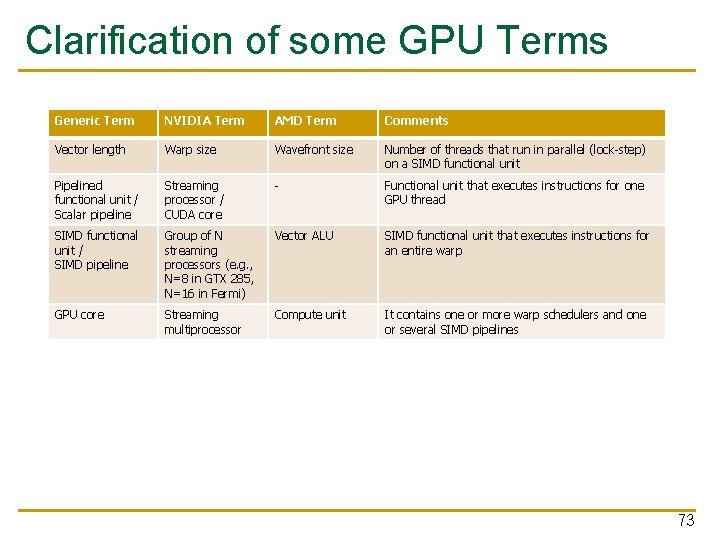
Clarification of some GPU Terms Generic Term NVIDIA Term AMD Term Comments Vector length Warp size Wavefront size Number of threads that run in parallel (lock-step) on a SIMD functional unit Pipelined functional unit / Scalar pipeline Streaming processor / CUDA core - Functional unit that executes instructions for one GPU thread SIMD functional unit / SIMD pipeline Group of N streaming processors (e. g. , N=8 in GTX 285, N=16 in Fermi) Vector ALU SIMD functional unit that executes instructions for an entire warp GPU core Streaming multiprocessor Compute unit It contains one or more warp schedulers and one or several SIMD pipelines 73