
Design of Digital Circuits Lecture 18 Branch Prediction

Design of Digital Circuits Lecture 18: Branch Prediction Prof. Onur Mutlu ETH Zurich Spring 2018 3 May 2018

Agenda for Today & Next Few Lectures n Single-cycle Microarchitectures n Multi-cycle and Microprogrammed Microarchitectures n Pipelining n Issues in Pipelining: Control & Data Dependence Handling, State Maintenance and Recovery, … n Out-of-Order Execution n Other Execution Paradigms 2

Reminder: Optional Homeworks n Posted online q 3 Optional Homeworks n Optional n Good for your learning n https: //safari. ethz. ch/digitaltechnik/spring 2018/doku. php? id =homeworks 3

Readings for Today n Smith and Sohi, “The Microarchitecture of Superscalar Processors, ” Proceedings of the IEEE, 1995 q q q More advanced pipelining Interrupt and exception handling Out-of-order and superscalar execution concepts n H&H Chapters 7. 8 and 7. 9 n Optional: q q Kessler, “The Alpha 21264 Microprocessor, ” IEEE Micro 1999. Mc. Farling, “Combining Branch Predictors, ” DEC WRL Technical Report, 1993. 4
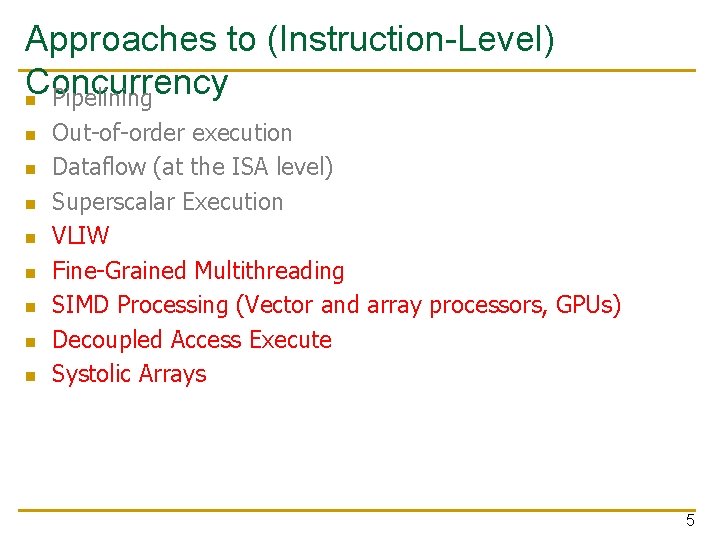
Approaches to (Instruction-Level) Concurrency n Pipelining n n n n Out-of-order execution Dataflow (at the ISA level) Superscalar Execution VLIW Fine-Grained Multithreading SIMD Processing (Vector and array processors, GPUs) Decoupled Access Execute Systolic Arrays 5
Control Dependence Handling 6
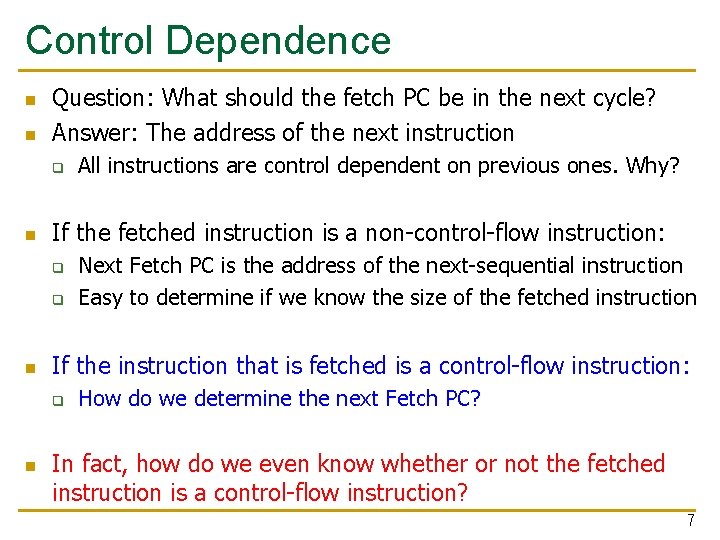
Control Dependence n n Question: What should the fetch PC be in the next cycle? Answer: The address of the next instruction q n If the fetched instruction is a non-control-flow instruction: q q n Next Fetch PC is the address of the next-sequential instruction Easy to determine if we know the size of the fetched instruction If the instruction that is fetched is a control-flow instruction: q n All instructions are control dependent on previous ones. Why? How do we determine the next Fetch PC? In fact, how do we even know whether or not the fetched instruction is a control-flow instruction? 7
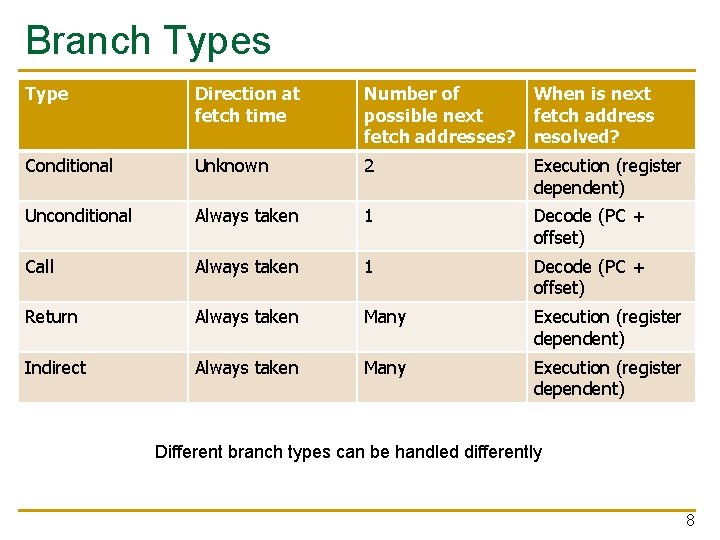
Branch Types Type Direction at fetch time Number of When is next possible next fetch addresses? resolved? Conditional Unknown 2 Execution (register dependent) Unconditional Always taken 1 Decode (PC + offset) Call Always taken 1 Decode (PC + offset) Return Always taken Many Execution (register dependent) Indirect Always taken Many Execution (register dependent) Different branch types can be handled differently 8
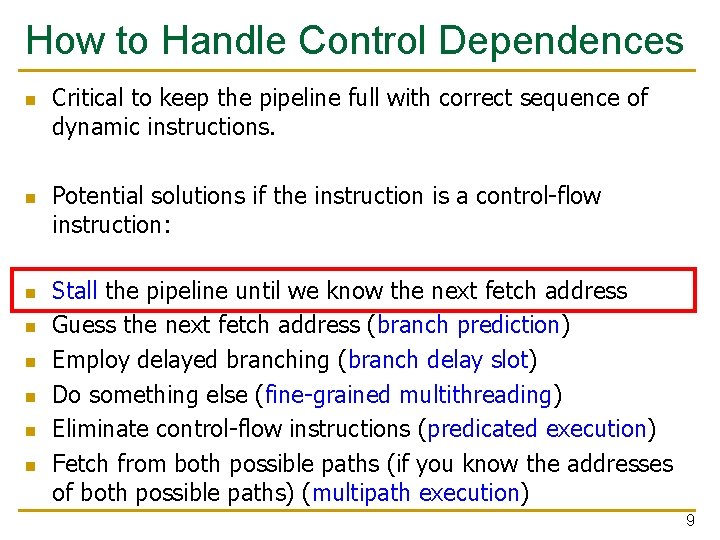
How to Handle Control Dependences n n n n Critical to keep the pipeline full with correct sequence of dynamic instructions. Potential solutions if the instruction is a control-flow instruction: Stall the pipeline until we know the next fetch address Guess the next fetch address (branch prediction) Employ delayed branching (branch delay slot) Do something else (fine-grained multithreading) Eliminate control-flow instructions (predicated execution) Fetch from both possible paths (if you know the addresses of both possible paths) (multipath execution) 9
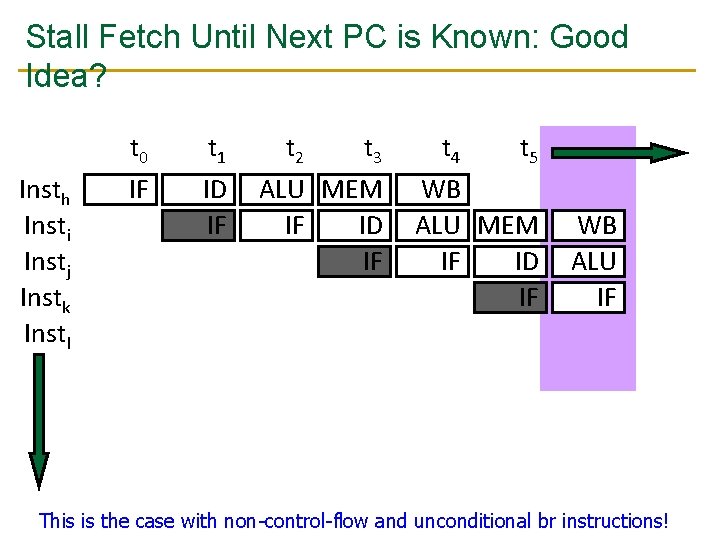
Stall Fetch Until Next PC is Known: Good Idea? Insth Insti Instj Instk Instl t 0 IF t 1 ID IF t 2 t 3 ALU MEM IF ID IF t 4 t 5 WB ALU MEM IF ID IF WB ALU IF This is the case with non-control-flow and unconditional br instructions! 10
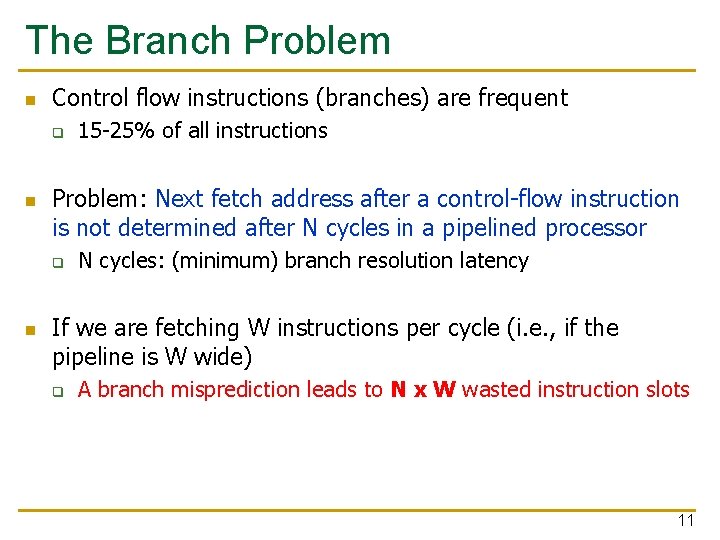
The Branch Problem n Control flow instructions (branches) are frequent q n Problem: Next fetch address after a control-flow instruction is not determined after N cycles in a pipelined processor q n 15 -25% of all instructions N cycles: (minimum) branch resolution latency If we are fetching W instructions per cycle (i. e. , if the pipeline is W wide) q A branch misprediction leads to N x W wasted instruction slots 11
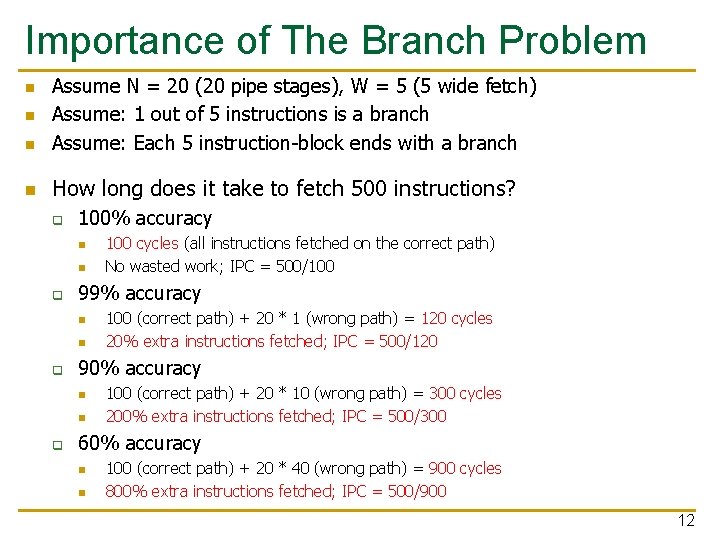
Importance of The Branch Problem n Assume N = 20 (20 pipe stages), W = 5 (5 wide fetch) Assume: 1 out of 5 instructions is a branch Assume: Each 5 instruction-block ends with a branch n How long does it take to fetch 500 instructions? n n q 100% accuracy n n q 99% accuracy n n q 100 (correct path) + 20 * 1 (wrong path) = 120 cycles 20% extra instructions fetched; IPC = 500/120 90% accuracy n n q 100 cycles (all instructions fetched on the correct path) No wasted work; IPC = 500/100 (correct path) + 20 * 10 (wrong path) = 300 cycles 200% extra instructions fetched; IPC = 500/300 60% accuracy n n 100 (correct path) + 20 * 40 (wrong path) = 900 cycles 800% extra instructions fetched; IPC = 500/900 12
Branch Prediction 13
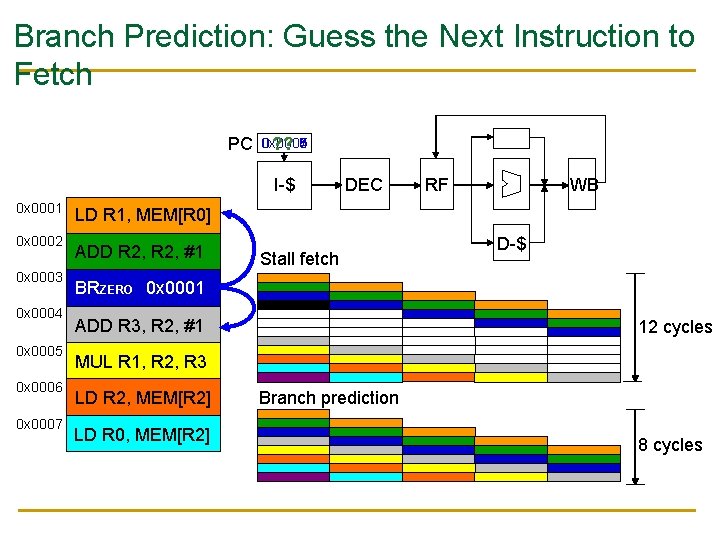
Branch Prediction: Guess the Next Instruction to Fetch PC 0 x 0006 0 x 0008 0 x 0007 0 x 0005 0 x 0004 ? ? I-$ 0 x 0001 0 x 0002 0 x 0003 0 x 0004 0 x 0005 0 x 0006 0 x 0007 DEC RF WB LD R 1, MEM[R 0] ADD R 2, #1 Stall fetch D-$ BRZERO 0 x 0001 ADD R 3, R 2, #1 12 cycles MUL R 1, R 2, R 3 LD R 2, MEM[R 2] LD R 0, MEM[R 2] Branch prediction 8 cycles
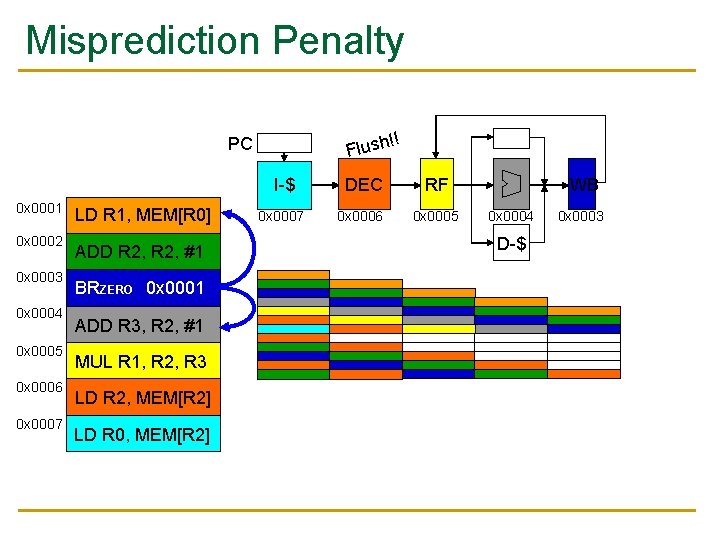
Misprediction Penalty !! Flush PC 0 x 0001 0 x 0002 0 x 0003 0 x 0004 0 x 0005 0 x 0006 0 x 0007 LD R 1, MEM[R 0] ADD R 2, #1 BRZERO 0 x 0001 ADD R 3, R 2, #1 MUL R 1, R 2, R 3 LD R 2, MEM[R 2] LD R 0, MEM[R 2] I-$ DEC RF 0 x 0007 0 x 0006 0 x 0005 WB 0 x 0004 D-$ 0 x 0003
Simplest: Always Guess Next. PC = PC + 4 predict the next sequential instruction is the next n Always n instruction to be executed This is a form of next fetch address prediction (and branch prediction) n How can you make this more effective? n Idea: Maximize the chances that the next sequential instruction is the next instruction to be executed q Software: Lay out the control flow graph such that the “likely next instruction” is on the not-taken path of a branch n q Profile guided code positioning Pettis & Hansen, PLDI 1990. Hardware: ? ? ? (how can you do this in hardware…) n Cache traces of executed instructions Trace cache 16
Guessing Next. PC = PC + 4 n n n How else can you make this more effective? Idea: Get rid of control flow instructions (or minimize their occurrence) How? 1. Get rid of unnecessary control flow instructions combine predicates (predicate combining) 2. Convert control dependences into data dependences predicated execution 17
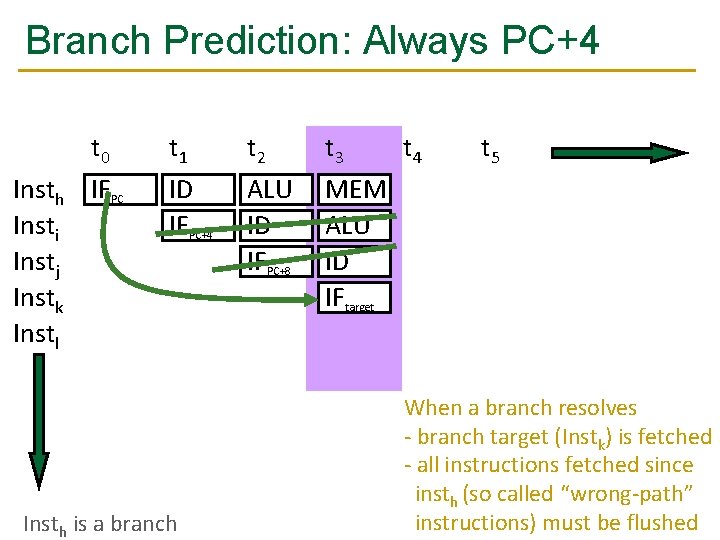
Branch Prediction: Always PC+4 Insth Insti Instj Instk Instl t 0 IFPC t 1 ID IFPC+4 Insth is a branch t 2 ALU ID IFPC+8 t 3 t 4 MEM ALU ID IFtarget t 5 Insth branch condition and target evaluated in ALU When a branch resolves - branch target (Instk) is fetched - all instructions fetched since insth (so called “wrong-path” 18 instructions) must be flushed
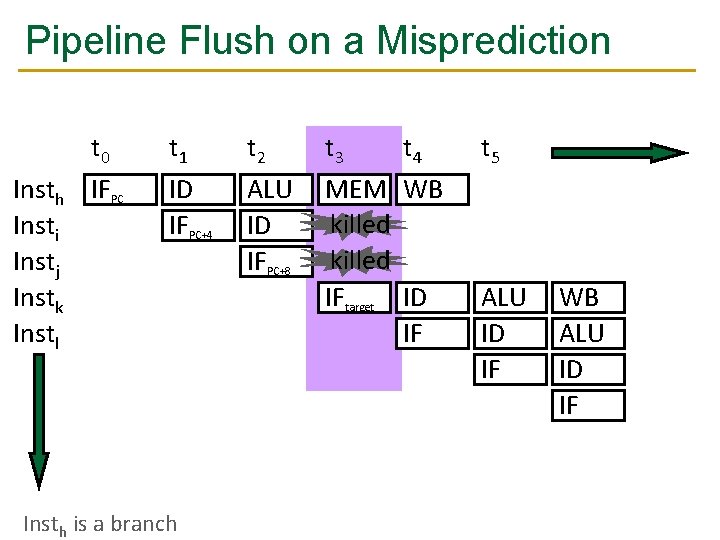
Pipeline Flush on a Misprediction Insth Insti Instj Instk Instl t 0 IFPC t 1 ID IFPC+4 Insth is a branch t 2 ALU ID IFPC+8 t 3 t 4 MEM WB killed IFtarget ID IF t 5 ALU ID IF WB ALU ID IF 19
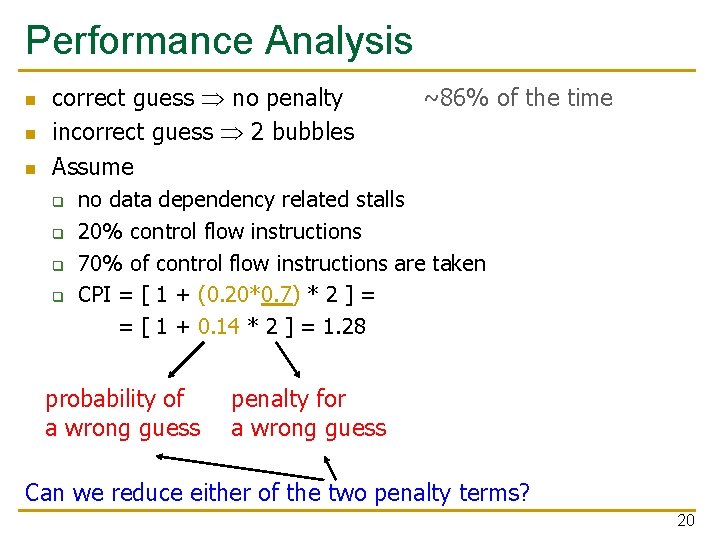
Performance Analysis n n n correct guess no penalty incorrect guess 2 bubbles Assume q q ~86% of the time no data dependency related stalls 20% control flow instructions 70% of control flow instructions are taken CPI = [ 1 + (0. 20*0. 7) * 2 ] = = [ 1 + 0. 14 * 2 ] = 1. 28 probability of a wrong guess penalty for a wrong guess Can we reduce either of the two penalty terms? 20
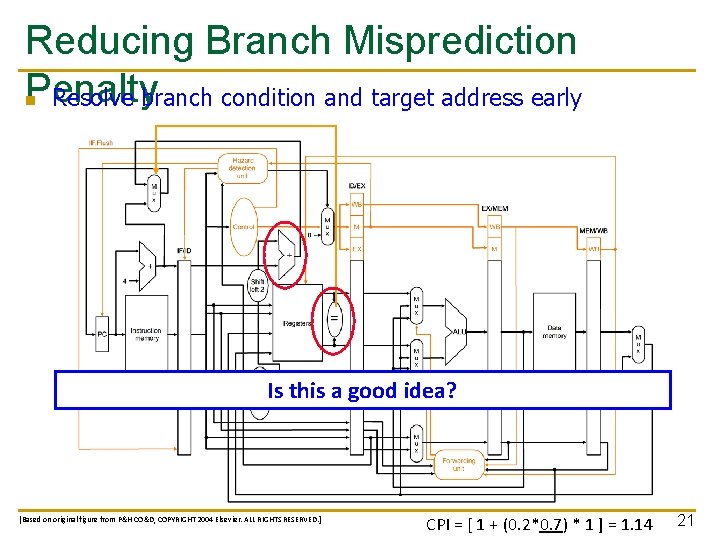
Reducing Branch Misprediction Penalty n Resolve branch condition and target address early Is this a good idea? [Based on original figure from P&H CO&D, COPYRIGHT 2004 Elsevier. ALL RIGHTS RESERVED. ] CPI = [ 1 + (0. 2*0. 7) * 1 ] = 1. 14 21
Branch Prediction (A Bit More n Idea: Predict the next fetch address (to be used in the next Enhanced) cycle) n Requires three things to be predicted at fetch stage: q q q n Whether the fetched instruction is a branch (Conditional) branch direction Branch target address (if taken) Observation: Target address remains the same for a conditional direct branch across dynamic instances q q Idea: Store the target address from previous instance and access it with the PC Called Branch Target Buffer (BTB) or Branch Target Address Cache 22
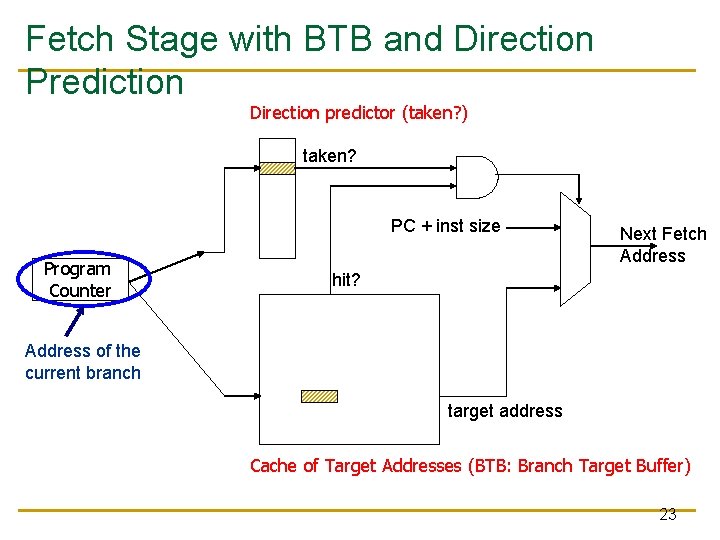
Fetch Stage with BTB and Direction Prediction Direction predictor (taken? ) taken? PC + inst size Program Counter Next Fetch Address hit? Address of the current branch target address Cache of Target Addresses (BTB: Branch Target Buffer) 23
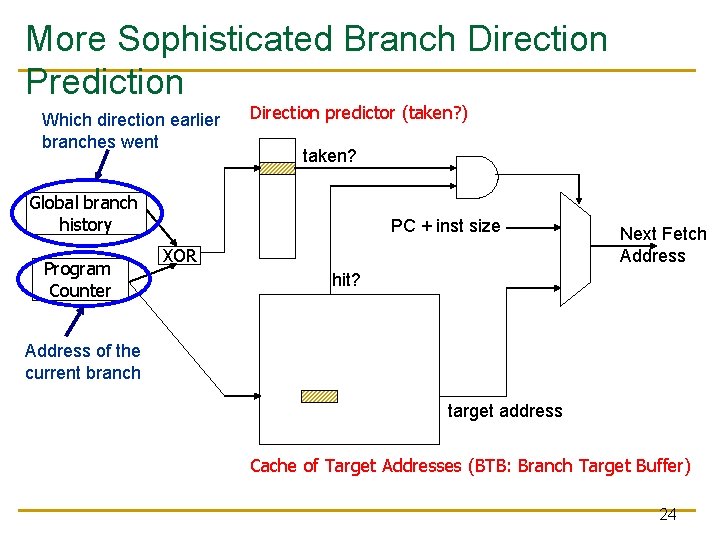
More Sophisticated Branch Direction Prediction Which direction earlier branches went Direction predictor (taken? ) taken? Global branch history Program Counter PC + inst size XOR Next Fetch Address hit? Address of the current branch target address Cache of Target Addresses (BTB: Branch Target Buffer) 24

Three Things to Be Predicted n Requires three things to be predicted at fetch stage: 1. Whether the fetched instruction is a branch 2. (Conditional) branch direction 3. Branch target address (if taken) n Third (3. ) can be accomplished using a BTB Remember target address computed last time branch was executed q n First (1. ) can be accomplished using a BTB If BTB provides a target address for the program counter, then it must be a branch q Or, we can store “branch metadata” bits in instruction cache/memory partially decoded instruction stored in I-cache q n Second (2. ): How do we predict the direction? 25
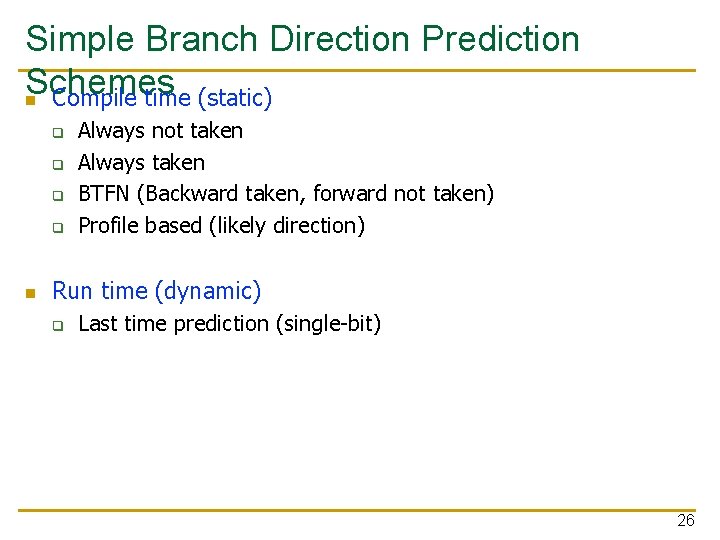
Simple Branch Direction Prediction Schemes n Compile time (static) q q n Always not taken Always taken BTFN (Backward taken, forward not taken) Profile based (likely direction) Run time (dynamic) q Last time prediction (single-bit) 26
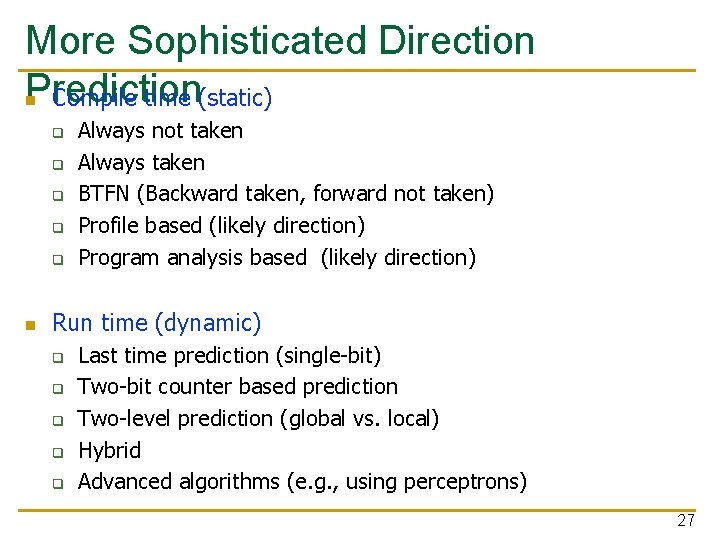
More Sophisticated Direction Prediction n Compile time (static) q q q n Always not taken Always taken BTFN (Backward taken, forward not taken) Profile based (likely direction) Program analysis based (likely direction) Run time (dynamic) q q q Last time prediction (single-bit) Two-bit counter based prediction Two-level prediction (global vs. local) Hybrid Advanced algorithms (e. g. , using perceptrons) 27

Static Branch Prediction (I) n Always not-taken q q q n Simple to implement: no need for BTB, no direction prediction Low accuracy: ~30 -40% (for conditional branches) Remember: Compiler can layout code such that the likely path is the “not-taken” path more effective prediction Always taken q q No direction prediction Better accuracy: ~60 -70% (for conditional branches) n n n Backward branches (i. e. loop branches) are usually taken Backward branch: target address lower than branch PC Backward taken, forward not taken (BTFN) q Predict backward (loop) branches as taken, others not-taken 28
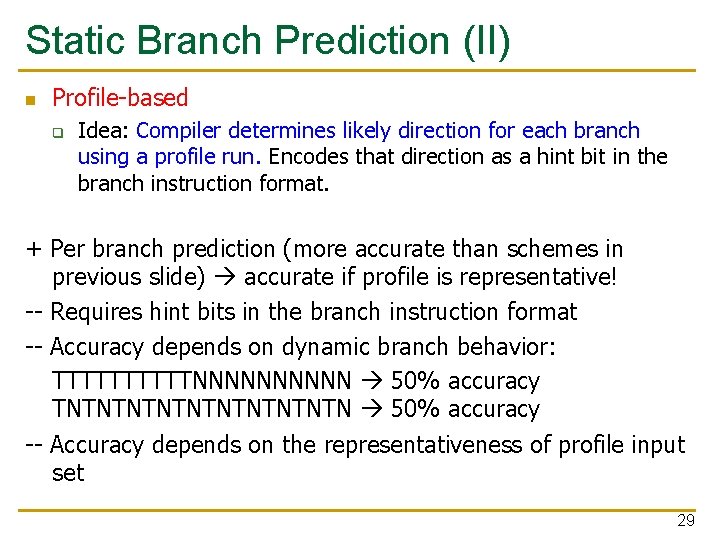
Static Branch Prediction (II) n Profile-based q Idea: Compiler determines likely direction for each branch using a profile run. Encodes that direction as a hint bit in the branch instruction format. + Per branch prediction (more accurate than schemes in previous slide) accurate if profile is representative! -- Requires hint bits in the branch instruction format -- Accuracy depends on dynamic branch behavior: TTTTTNNNNN 50% accuracy TNTNTNTNTN 50% accuracy -- Accuracy depends on the representativeness of profile input set 29
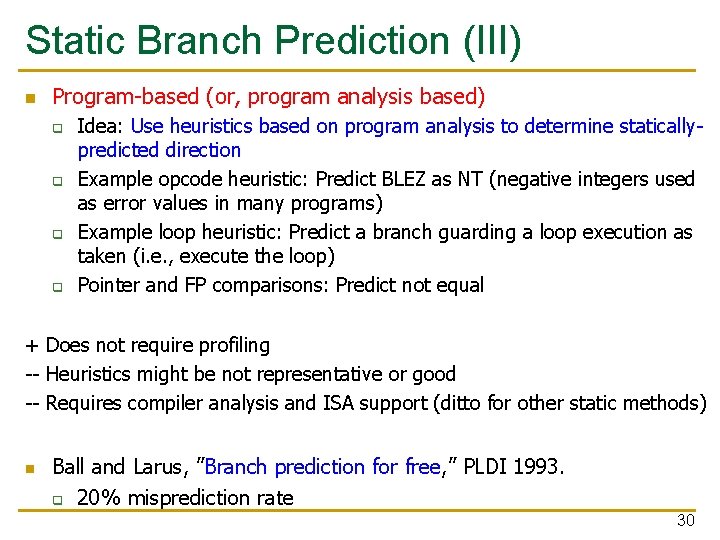
Static Branch Prediction (III) n Program-based (or, program analysis based) q q Idea: Use heuristics based on program analysis to determine staticallypredicted direction Example opcode heuristic: Predict BLEZ as NT (negative integers used as error values in many programs) Example loop heuristic: Predict a branch guarding a loop execution as taken (i. e. , execute the loop) Pointer and FP comparisons: Predict not equal + Does not require profiling -- Heuristics might be not representative or good -- Requires compiler analysis and ISA support (ditto for other static methods) n Ball and Larus, ”Branch prediction for free, ” PLDI 1993. q 20% misprediction rate 30
Static Branch Prediction (IV) n Programmer-based q q Idea: Programmer provides the statically-predicted direction Via pragmas in the programming language that qualify a branch as likely-taken versus likely-not-taken + Does not require profiling or program analysis + Programmer may know some branches and their program better than other analysis techniques -- Requires programming language, compiler, ISA support -- Burdens the programmer? 31
Pragmas n n Idea: Keywords that enable a programmer to convey hints to lower levels of the transformation hierarchy if (likely(x)) {. . . } if (unlikely(error)) { … } Many other hints and optimizations can be enabled with pragmas q q q E. g. , whether a loop can be parallelized #pragma omp parallel Description n The omp parallel directive explicitly instructs the compiler to parallelize the chosen segment of code. 32
Static Branch Prediction n All previous techniques can be combined q q q Profile based Programmer based n How would you do that? n What is the common disadvantage of all three techniques? q Cannot adapt to dynamic changes in branch behavior n n This can be mitigated by a dynamic compiler, but not at a fine granularity (and a dynamic compiler has its overheads…) What is a Dynamic Compiler? q q A compiler that generates code at runtime: Remember Transmeta? Java JIT (just in time) compiler, Microsoft CLR (common lang. runtime) 33
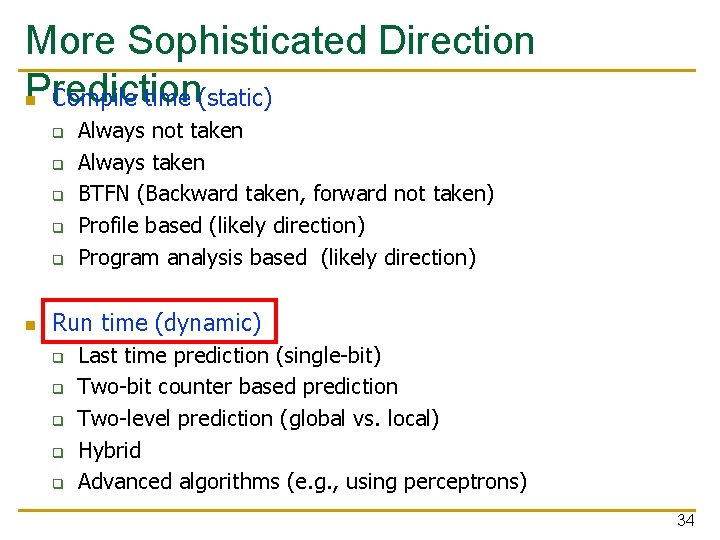
More Sophisticated Direction Prediction n Compile time (static) q q q n Always not taken Always taken BTFN (Backward taken, forward not taken) Profile based (likely direction) Program analysis based (likely direction) Run time (dynamic) q q q Last time prediction (single-bit) Two-bit counter based prediction Two-level prediction (global vs. local) Hybrid Advanced algorithms (e. g. , using perceptrons) 34
Dynamic Branch Prediction n n Idea: Predict branches based on dynamic information (collected at run-time) Advantages + Prediction based on history of the execution of branches + It can adapt to dynamic changes in branch behavior + No need for static profiling: input set representativeness problem goes away n Disadvantages -- More complex (requires additional hardware) 35
Last Time Predictor n Last time predictor q q n Single bit per branch (stored in BTB) Indicates which direction branch went last time it executed TTTTTNNNNN 90% accuracy Always mispredicts the last iteration and the first iteration of a loop branch q Accuracy for a loop with N iterations = (N-2)/N + Loop branches for loops with large N (number of iterations) -- Loop branches for loops will small N (number of iterations) TNTNTNTNTN 0% accuracy 36
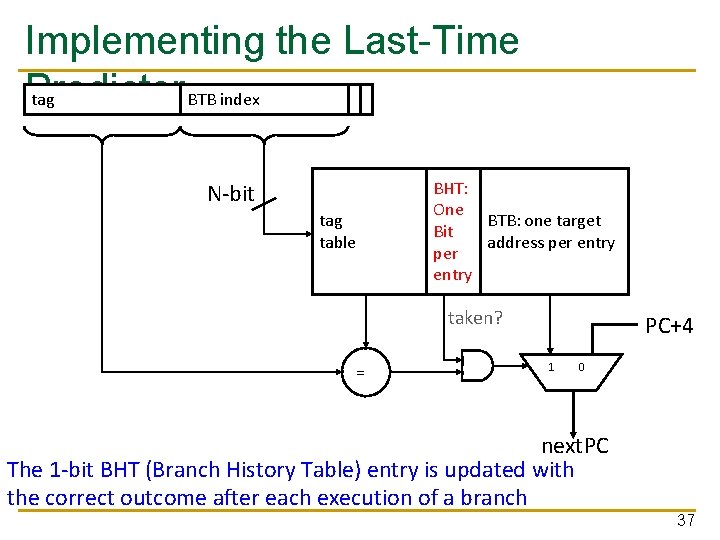
Implementing the Last-Time Predictor tag BTB index N-bit tag table BHT: One BTB: one target Bit address per entry taken? = PC+4 1 0 next. PC The 1 -bit BHT (Branch History Table) entry is updated with the correct outcome after each execution of a branch 37
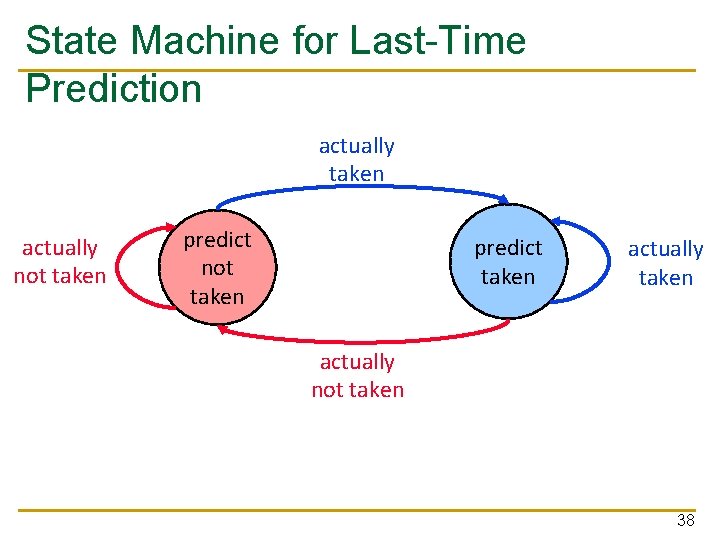
State Machine for Last-Time Prediction actually taken actually not taken predict taken actually not taken 38
Improving the Last Time Predictor n Problem: A last-time predictor changes its prediction from T NT or NT T too quickly q n Solution Idea: Add hysteresis to the predictor so that prediction does not change on a single different outcome q q n even though the branch may be mostly taken or mostly not taken Use two bits to track the history of predictions for a branch instead of a single bit Can have 2 states for T or NT instead of 1 state for each Smith, “A Study of Branch Prediction Strategies, ” ISCA 1981. 39
Two-Bit Counter Based Prediction n n Each branch associated with a two-bit counter One more bit provides hysteresis A strong prediction does not change with one single different outcome Accuracy for a loop with N iterations = (N-1)/N TNTNTNTNTN 50% accuracy (assuming counter initialized to weakly taken) + Better prediction accuracy -- More hardware cost (but counter can be part of a BTB entry) 40
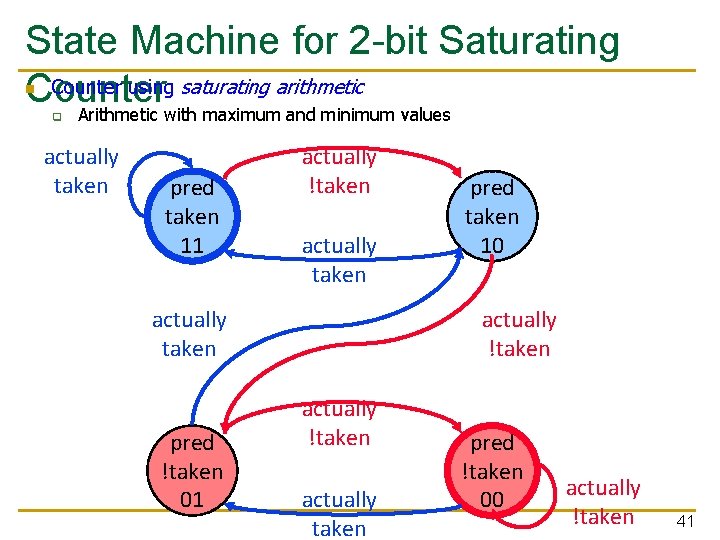
State Machine for 2 -bit Saturating Counter using saturating arithmetic Counter Arithmetic with maximum and minimum values n q actually taken pred taken 11 actually !taken actually taken pred !taken 01 pred taken 10 actually !taken actually taken pred !taken 00 actually !taken 41
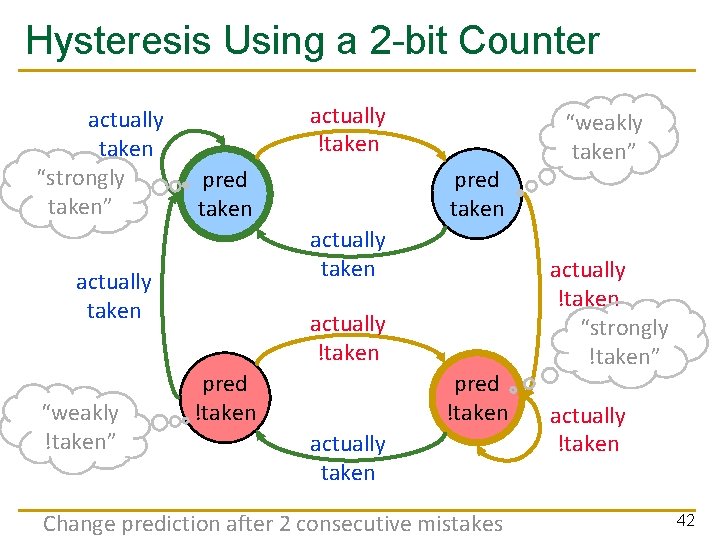
Hysteresis Using a 2 -bit Counter actually taken “strongly taken” actually !taken pred taken actually taken “weakly !taken” pred taken actually !taken pred !taken actually taken Change prediction after 2 consecutive mistakes “weakly taken” actually !taken “strongly !taken” actually !taken 42
Is This Good Enough? n ~85 -90% accuracy for many programs with 2 -bit counter based prediction (also called bimodal prediction) n Is this good enough? n How big is the branch problem? 43
Let’s Do the Exercise Again n Assume N = 20 (20 pipe stages), W = 5 (5 wide fetch) Assume: 1 out of 5 instructions is a branch Assume: Each 5 instruction-block ends with a branch n How long does it take to fetch 500 instructions? n n q 100% accuracy n n q 90% accuracy n n q 100 (correct path) + 20 * 10 (wrong path) = 300 cycles 200% extra instructions fetched; IPC = 500/300 85% accuracy n n q 100 cycles (all instructions fetched on the correct path) No wasted work; IPC = 500/100 (correct path) + 20 * 15 (wrong path) = 400 cycles 300% extra instructions fetched; IPC = 500/400 80% accuracy n n 100 (correct path) + 20 * 20 (wrong path) = 500 cycles 400% extra instructions fetched; IPC = 500/500 44
Can We Do Better: Two-Level Prediction n Last-time and 2 BC predictors exploit “last-time” predictability n Realization 1: A branch’s outcome can be correlated with other branches’ outcomes q n Global branch correlation Realization 2: A branch’s outcome can be correlated with past outcomes of the same branch (other than the outcome of the branch “last-time” it was executed) q Local branch correlation Yeh and Patt, “Two-Level Adaptive Training Branch Prediction, ” MICRO 1991. 45
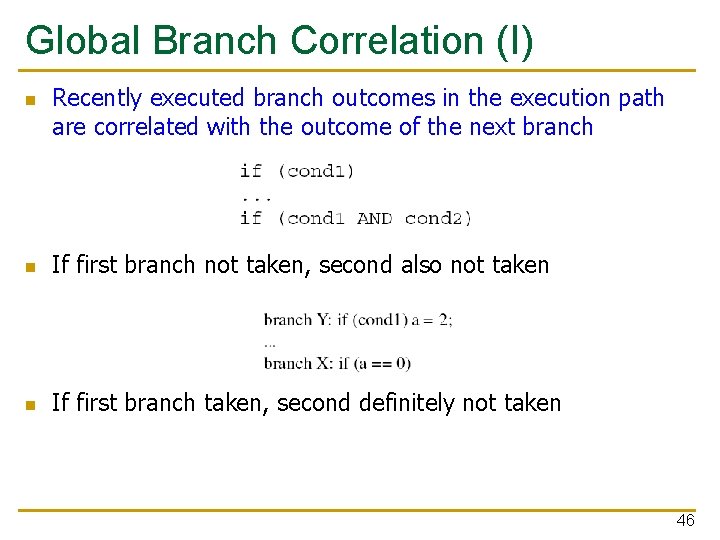
Global Branch Correlation (I) n Recently executed branch outcomes in the execution path are correlated with the outcome of the next branch n If first branch not taken, second also not taken n If first branch taken, second definitely not taken 46
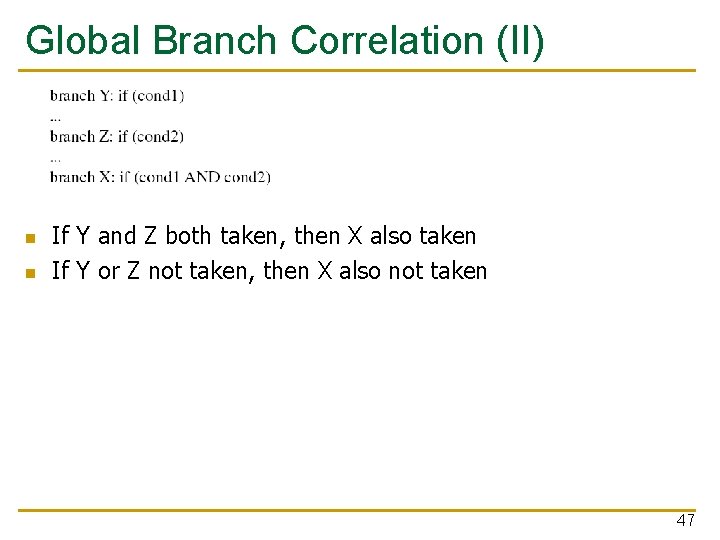
Global Branch Correlation (II) n n If Y and Z both taken, then X also taken If Y or Z not taken, then X also not taken 47
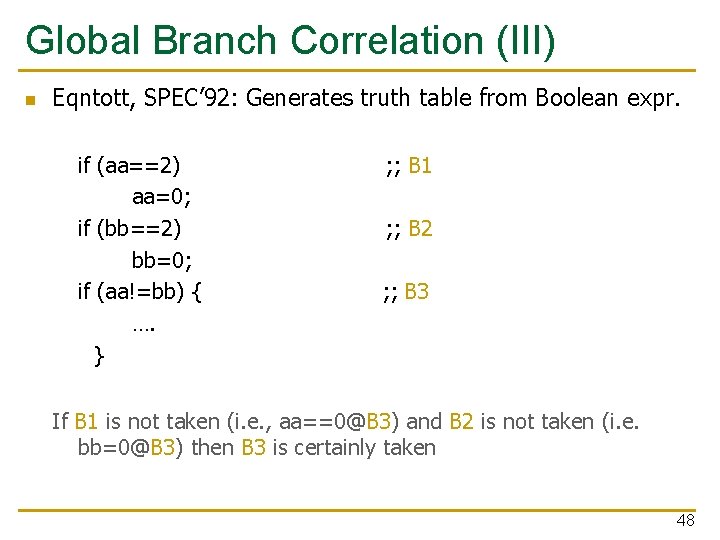
Global Branch Correlation (III) n Eqntott, SPEC’ 92: Generates truth table from Boolean expr. if (aa==2) aa=0; if (bb==2) bb=0; if (aa!=bb) { …. } ; ; B 1 ; ; B 2 ; ; B 3 If B 1 is not taken (i. e. , aa==0@B 3) and B 2 is not taken (i. e. bb=0@B 3) then B 3 is certainly taken 48
Capturing Global Branch Correlation n Idea: Associate branch outcomes with “global T/NT history” of all branches Make a prediction based on the outcome of the branch the last time the same global branch history was encountered Implementation: q q n n Keep track of the “global T/NT history” of all branches in a register Global History Register (GHR) Use GHR to index into a table that recorded the outcome that was seen for each GHR value in the recent past Pattern History Table (table of 2 -bit counters) Global history/branch predictor Uses two levels of history (GHR + history at that GHR) Yeh and Patt, “Two-Level Adaptive Training Branch Prediction, ” MICRO 1991. 49

Two Level Global Branch Prediction n n First level: Global branch history register (N bits) q The direction of last N branches Second level: Table of saturating counters for each history entry q The direction the branch took the last time the same history was seen Pattern History Table (PHT) 00 …. 00 1 1 …. . 1 0 GHR (global history register) previous branch’s direction 00 …. 01 00 …. 10 index 2 3 0 1 11 …. 11 Yeh and Patt, “Two-Level Adaptive Training Branch Prediction, ” MICRO 1991. 50
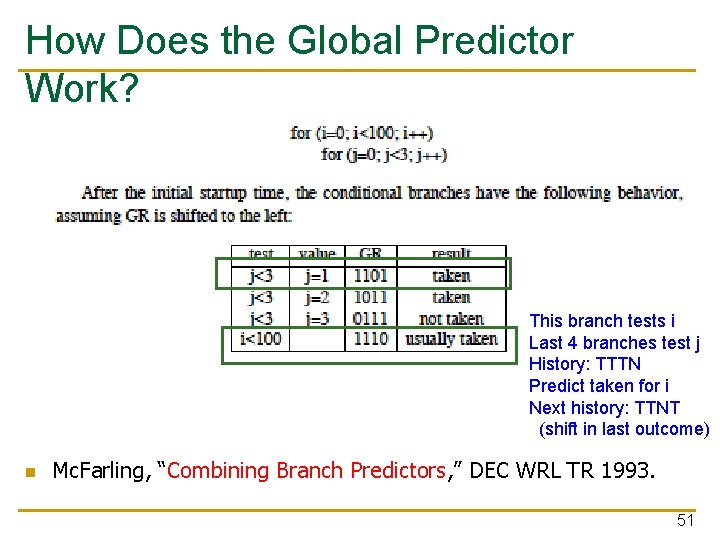
How Does the Global Predictor Work? This branch tests i Last 4 branches test j History: TTTN Predict taken for i Next history: TTNT (shift in last outcome) n Mc. Farling, “Combining Branch Predictors, ” DEC WRL TR 1993. 51
Intel Pentium Pro Branch Predictor n n n Two level global branch predictor 4 -bit global history register Multiple pattern history tables (of 2 bit counters) q Which pattern history table to use is determined by lower order bits of the branch address 52
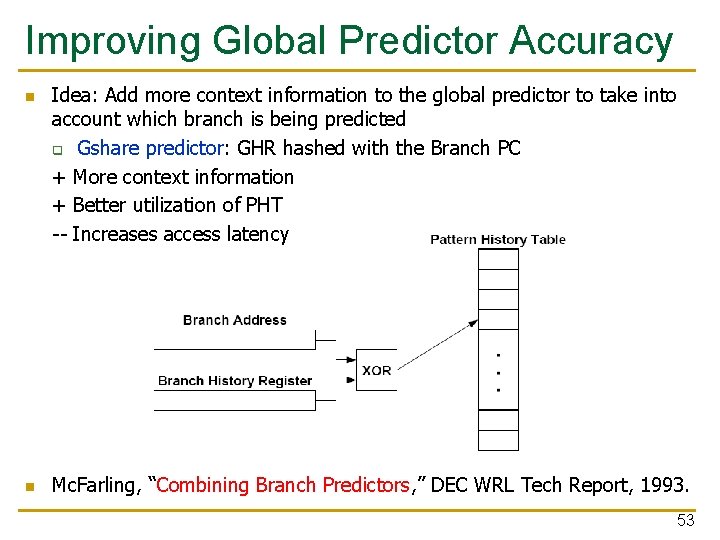
Improving Global Predictor Accuracy n n Idea: Add more context information to the global predictor to take into account which branch is being predicted q Gshare predictor: GHR hashed with the Branch PC + More context information + Better utilization of PHT -- Increases access latency Mc. Farling, “Combining Branch Predictors, ” DEC WRL Tech Report, 1993. 53

Review: One-Level Branch Predictor Direction predictor (2 -bit counters) taken? PC + inst size Program Counter Next Fetch Address hit? Address of the current instruction target address Cache of Target Addresses (BTB: Branch Target Buffer) 54
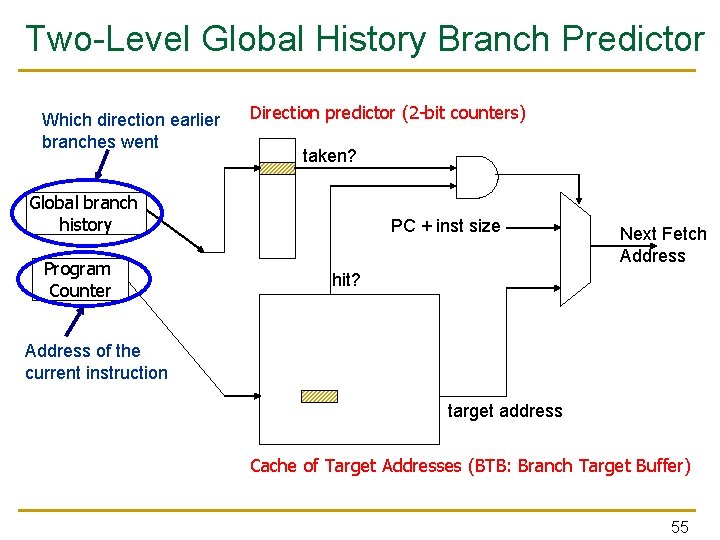
Two-Level Global History Branch Predictor Which direction earlier branches went Direction predictor (2 -bit counters) taken? Global branch history Program Counter PC + inst size Next Fetch Address hit? Address of the current instruction target address Cache of Target Addresses (BTB: Branch Target Buffer) 55
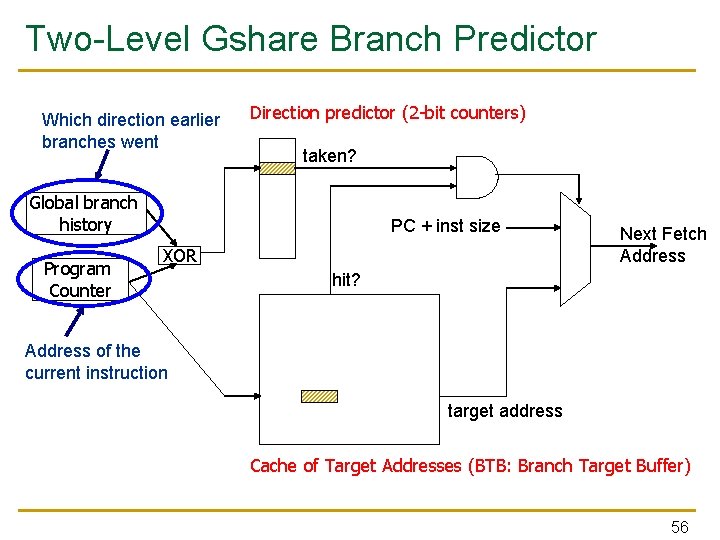
Two-Level Gshare Branch Predictor Which direction earlier branches went Direction predictor (2 -bit counters) taken? Global branch history Program Counter PC + inst size XOR Next Fetch Address hit? Address of the current instruction target address Cache of Target Addresses (BTB: Branch Target Buffer) 56
Can We Do Better: Two-Level Prediction n Last-time and 2 BC predictors exploit only “last-time” predictability for a given branch n Realization 1: A branch’s outcome can be correlated with other branches’ outcomes q n Global branch correlation Realization 2: A branch’s outcome can be correlated with past outcomes of the same branch (in addition to the outcome of the branch “last-time” it was executed) q Local branch correlation Yeh and Patt, “Two-Level Adaptive Training Branch Prediction, ” MICRO 1991. 57
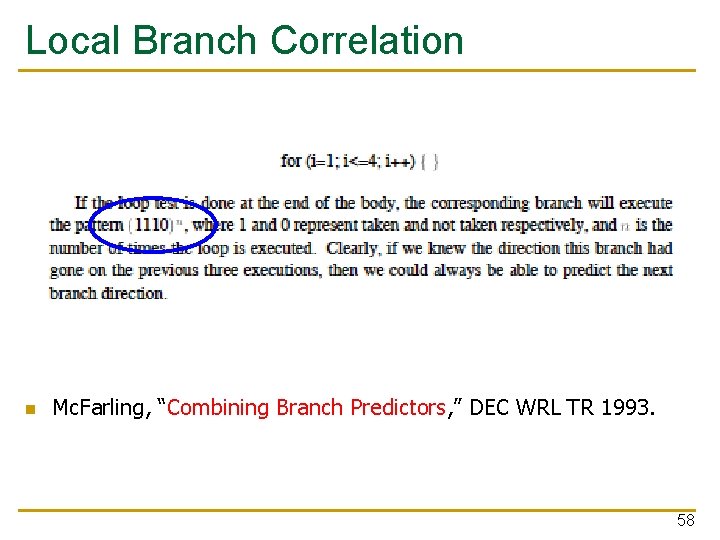
Local Branch Correlation n Mc. Farling, “Combining Branch Predictors, ” DEC WRL TR 1993. 58
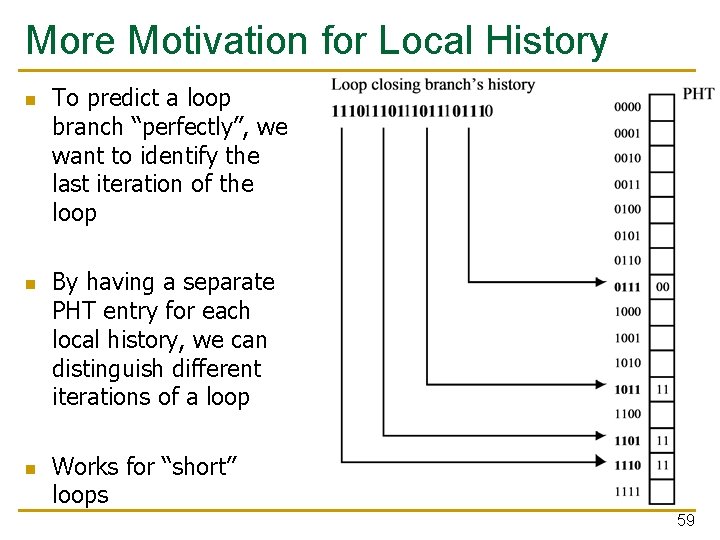
More Motivation for Local History n n n To predict a loop branch “perfectly”, we want to identify the last iteration of the loop By having a separate PHT entry for each local history, we can distinguish different iterations of a loop Works for “short” loops 59
Capturing Local Branch Correlation n Idea: Have a per-branch history register q n n n Associate the predicted outcome of a branch with “T/NT history” of the same branch Make a prediction based on the outcome of the branch the last time the same local branch history was encountered Called the local history/branch predictor Uses two levels of history (Per-branch history register + history at that history register value) 60
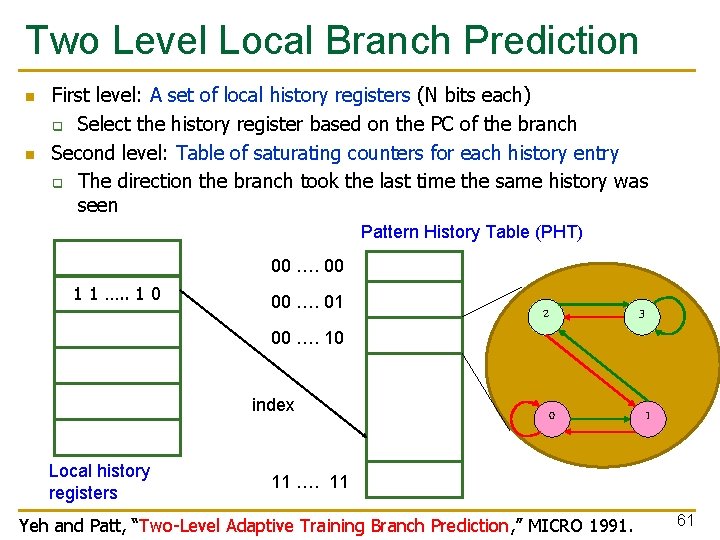
Two Level Local Branch Prediction n n First level: A set of local history registers (N bits each) q Select the history register based on the PC of the branch Second level: Table of saturating counters for each history entry q The direction the branch took the last time the same history was seen Pattern History Table (PHT) 00 …. 00 1 1 …. . 1 0 00 …. 01 00 …. 10 index Local history registers 2 3 0 1 11 …. 11 Yeh and Patt, “Two-Level Adaptive Training Branch Prediction, ” MICRO 1991. 61
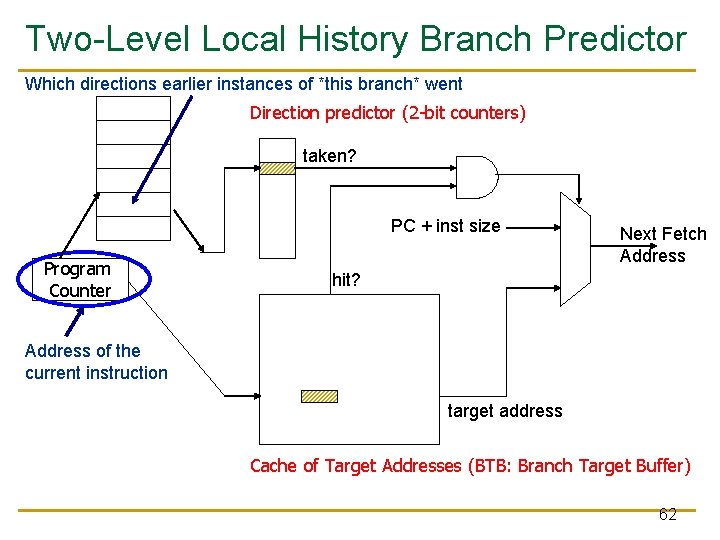
Two-Level Local History Branch Predictor Which directions earlier instances of *this branch* went Direction predictor (2 -bit counters) taken? PC + inst size Program Counter Next Fetch Address hit? Address of the current instruction target address Cache of Target Addresses (BTB: Branch Target Buffer) 62
Can We Do Even Better? n n n Predictability of branches varies Some branches are more predictable using local history Some using global For others, a simple two-bit counter is enough Yet for others, a bit is enough Observation: There is heterogeneity in predictability behavior of branches q n No one-size fits all branch prediction algorithm for all branches Idea: Exploit that heterogeneity by designing heterogeneous branch predictors 63
Hybrid Branch Predictors n Idea: Use more than one type of predictor (i. e. , multiple algorithms) and select the “best” prediction q n E. g. , hybrid of 2 -bit counters and global predictor Advantages: + Better accuracy: different predictors are better for different branches + Reduced warmup time (faster-warmup predictor used until the slower -warmup predictor warms up) n Disadvantages: -- Need “meta-predictor” or “selector” -- Longer access latency q Mc. Farling, “Combining Branch Predictors, ” DEC WRL Tech Report, 1993. 64
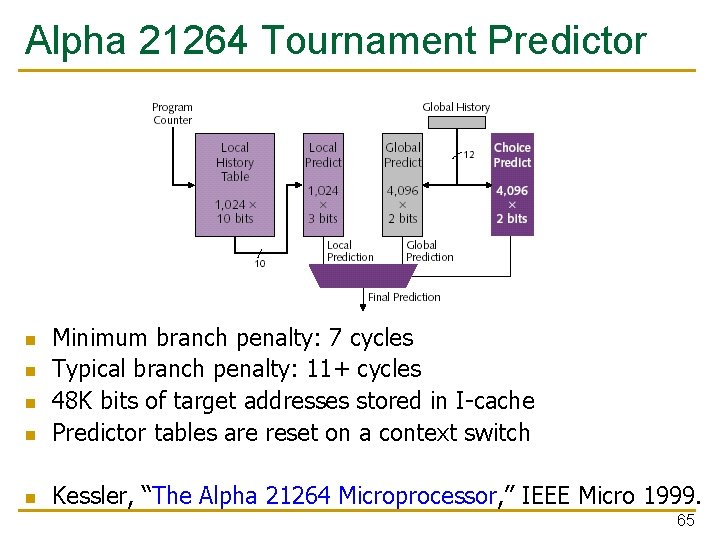
Alpha 21264 Tournament Predictor n Minimum branch penalty: 7 cycles Typical branch penalty: 11+ cycles 48 K bits of target addresses stored in I-cache Predictor tables are reset on a context switch n Kessler, “The Alpha 21264 Microprocessor, ” IEEE Micro 1999. n n n 65
Are We Done w/ Branch Prediction? n Hybrid branch predictors work well q n E. g. , 90 -97% prediction accuracy on average Some “difficult” workloads still suffer, though! q q q E. g. , gcc Max IPC with tournament prediction: 9 Max IPC with perfect prediction: 35 66

Design of Digital Circuits Lecture 18: Branch Prediction Prof. Onur Mutlu ETH Zurich Spring 2018 3 May 2018

We did not cover the following slides in lecture. These are for your benefit and curiosity.
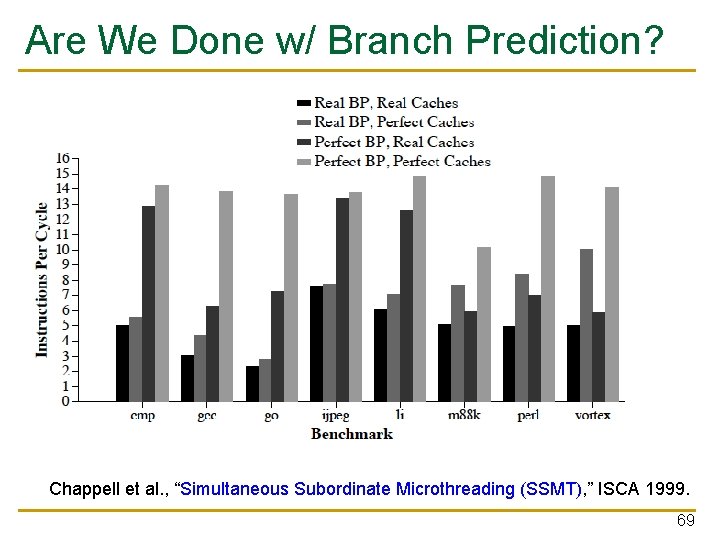
Are We Done w/ Branch Prediction? Chappell et al. , “Simultaneous Subordinate Microthreading (SSMT), ” ISCA 1999. 69
Some Other Branch Predictor Types n Loop branch detector and predictor q q q n Perceptron branch predictor q Learns the direction correlations between individual branches q q n Loop iteration count detector/predictor Works well for loops with small number of iterations, where iteration count is predictable Used in Intel Pentium M Assigns weights to correlations Jimenez and Lin, “Dynamic Branch Prediction with Perceptrons, ” HPCA 2001. Hybrid history length based predictor q q Uses different tables with different history lengths Seznec, “Analysis of the O-Geometric History Length branch predictor, ” ISCA 2005. 70
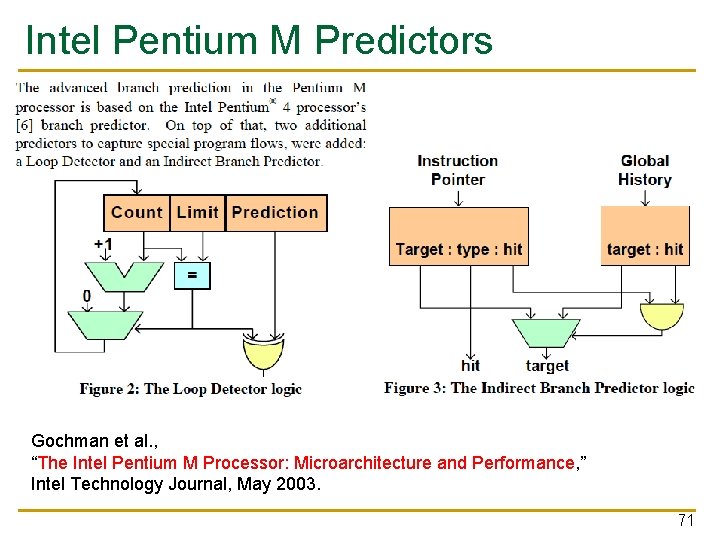
Intel Pentium M Predictors Gochman et al. , “The Intel Pentium M Processor: Microarchitecture and Performance, ” Intel Technology Journal, May 2003. 71
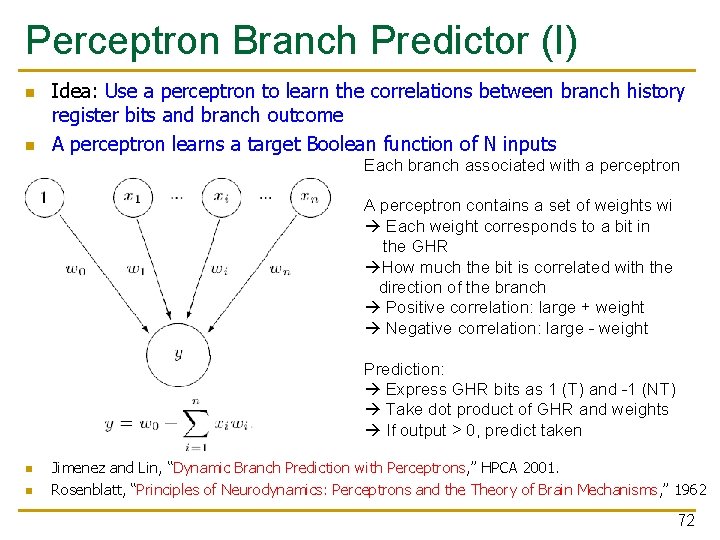
Perceptron Branch Predictor (I) n n Idea: Use a perceptron to learn the correlations between branch history register bits and branch outcome A perceptron learns a target Boolean function of N inputs Each branch associated with a perceptron A perceptron contains a set of weights wi Each weight corresponds to a bit in the GHR How much the bit is correlated with the direction of the branch Positive correlation: large + weight Negative correlation: large - weight Prediction: Express GHR bits as 1 (T) and -1 (NT) Take dot product of GHR and weights If output > 0, predict taken n n Jimenez and Lin, “Dynamic Branch Prediction with Perceptrons, ” HPCA 2001. Rosenblatt, “Principles of Neurodynamics: Perceptrons and the Theory of Brain Mechanisms, ” 1962 72
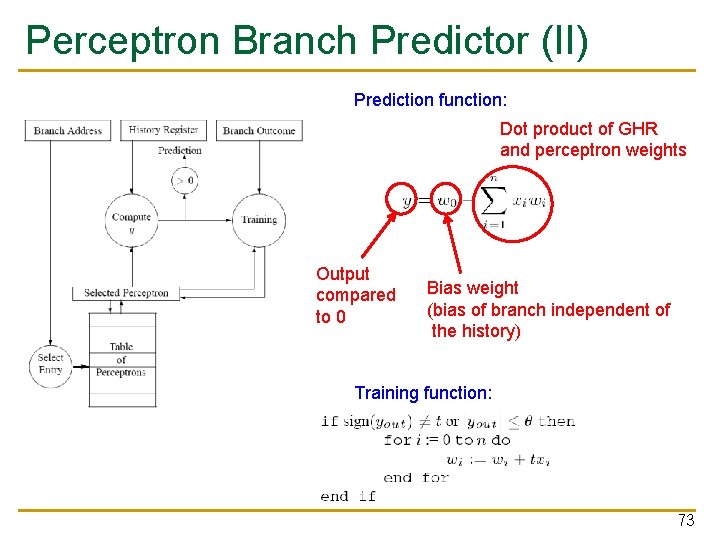
Perceptron Branch Predictor (II) Prediction function: Dot product of GHR and perceptron weights Output compared to 0 Bias weight (bias of branch independent of the history) Training function: 73
Perceptron Branch Predictor (III) n Advantages + More sophisticated learning mechanism better accuracy n Disadvantages -- Hard to implement (adder tree to compute perceptron output) -- Can learn only linearly-separable functions e. g. , cannot learn XOR type of correlation between 2 history bits and branch outcome 74
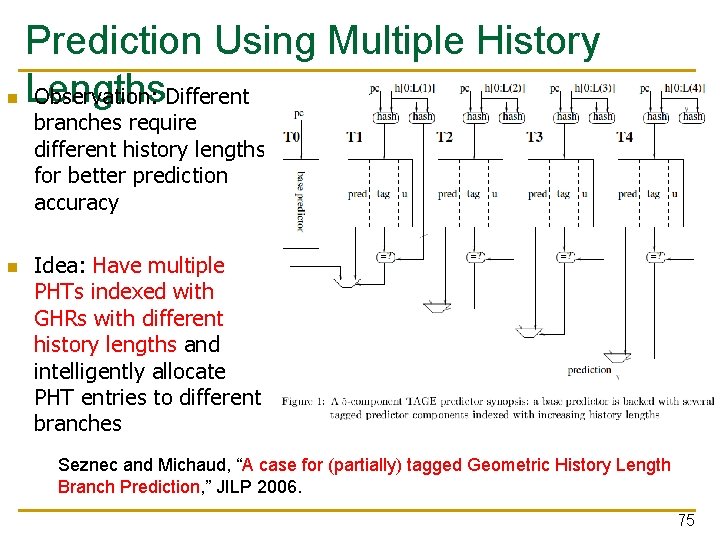
n Prediction Using Multiple History Lengths Observation: Different branches require different history lengths for better prediction accuracy n Idea: Have multiple PHTs indexed with GHRs with different history lengths and intelligently allocate PHT entries to different branches Seznec and Michaud, “A case for (partially) tagged Geometric History Length Branch Prediction, ” JILP 2006. 75
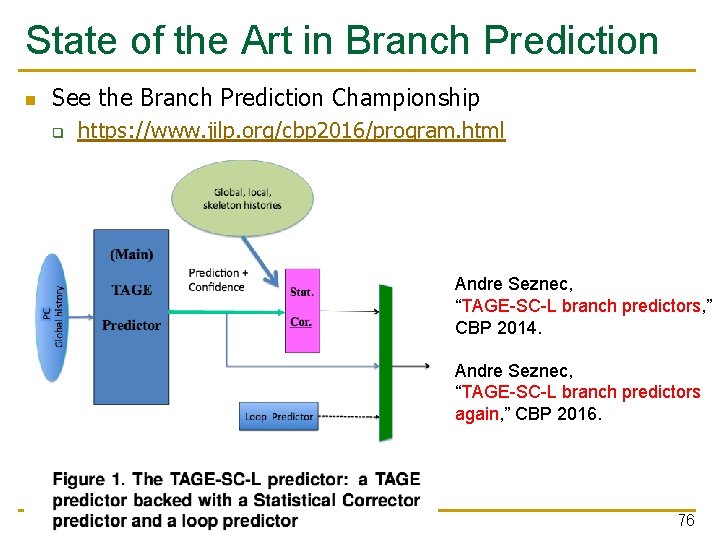
State of the Art in Branch Prediction n See the Branch Prediction Championship q https: //www. jilp. org/cbp 2016/program. html Andre Seznec, “TAGE-SC-L branch predictors, ” CBP 2014. Andre Seznec, “TAGE-SC-L branch predictors again, ” CBP 2016. 76
Branch Confidence Estimation n Idea: Estimate if the prediction is likely to be correct q n i. e. , estimate how “confident” you are in the prediction Why? q Could be very useful in deciding how to speculate: n n n What predictor/PHT to choose/use Whether to keep fetching on this path Whether to switch to some other way of handling the branch, e. g. dual-path execution (eager execution) or dynamic predication … Jacobsen et al. , “Assigning Confidence to Conditional Branch Predictions, ” MICRO 1996. 77
- Slides: 77