
DESIGN OF BUILTIN TESTS FOR ROBUST ACTIVE FAULT

DESIGN OF BUILT-IN TESTS FOR ROBUST ACTIVE FAULT DETECTION AND ISOLATION OF DISCRETE FAULTS IN UNCERTAIN SYSTEMS William T. Hale*, Kyle A. Palmer, Matthew D. Stuber, and George M. Bollas *Ph. D. Candidate – Chemical & Biomolecular Engineering School of Engineering – University of Connecticut Phone: +1 (860) 486 -6580 Email: william. hale@uconn. edu American Control Conference, Milwaukee, WI, June 29, 2018
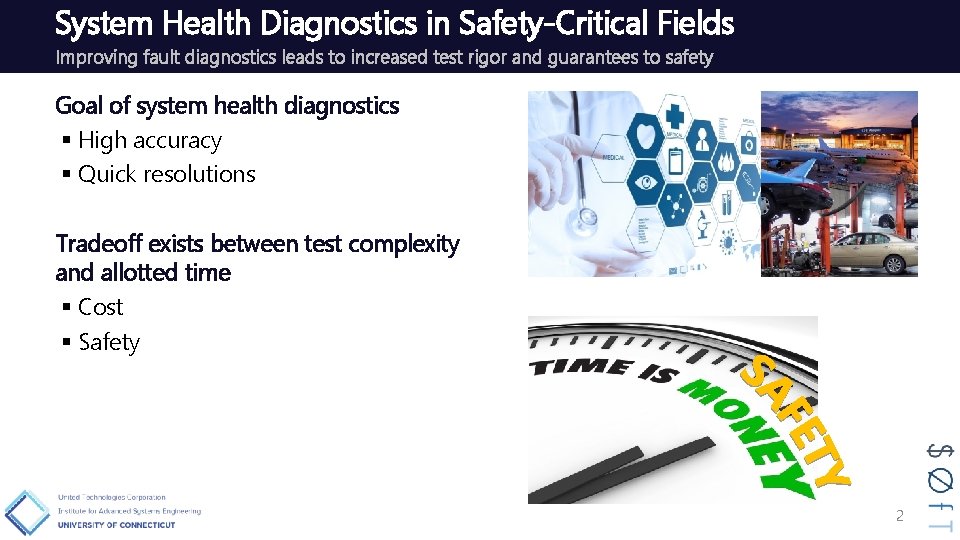
System Health Diagnostics in Safety-Critical Fields Improving fault diagnostics leads to increased test rigor and guarantees to safety Goal of system health diagnostics ◾ High accuracy ◾ Quick resolutions Tradeoff exists between test complexity and allotted time ◾ Cost ◾ Safety 2
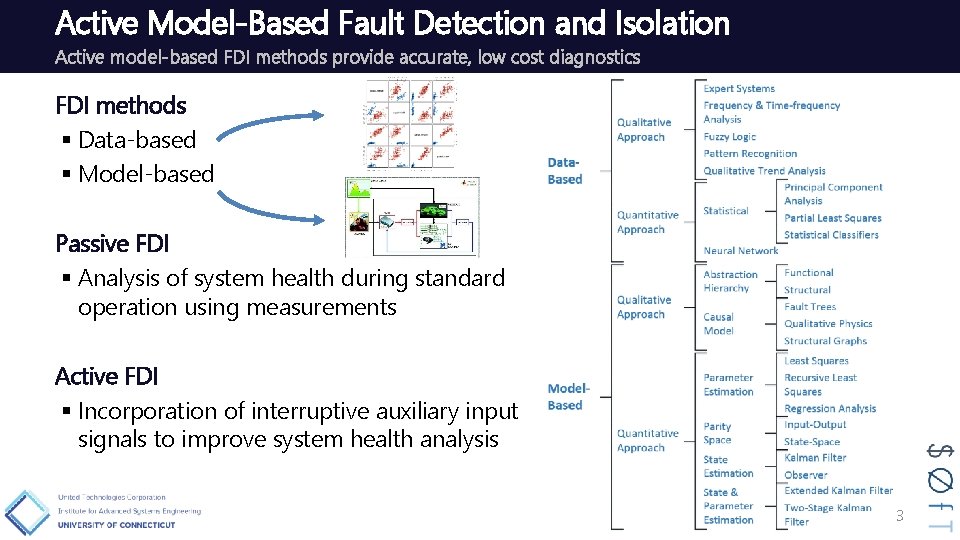
Active Model-Based Fault Detection and Isolation Active model-based FDI methods provide accurate, low cost diagnostics FDI methods ◾ Data-based ◾ Model-based Passive FDI ◾ Analysis of system health during standard operation using measurements Active FDI ◾ Incorporation of interruptive auxiliary input signals to improve system health analysis 3
Impact of Uncertainty on Maintenance Costly no fault found, false alarm, and non-detection events occur frequently during maintenance Uncertainty negatively impacts system health diagnostics ◾ Major cause of false alarms and no fault founds ◾ Increases cost and maintenance time and decreases safety No fault found events (NFFs) increase the potential of inserting a faulty system back into operation ◾ 30 -50% of LRUs removed for maintenance in the aerospace industry are tagged as NFF [1]–[3] ◾ Over 90% of aircraft electronics maintenance costs can be attributed to NFFs [4] Problem: The absence of faults due to uncertainty during illdesigned maintenance tests is a main cause for NFFs [2], [5] [1] P. Söderholm, “A system view of the no fault found (NFF) phenomenon, ” Reliab. Eng. Syst. Saf. , vol. 92, pp. 1– 14, Jan. 2007. [2] S. Khan, P. Phillips, I. Jennions, and C. Hockley, “No fault found events in maintenance engineering part 1: Current trends, implications and organizational practices, ” Reliab. Eng. Syst. Saf. , vol. 123, pp. 183– 195, Mar. 2014. [3] I. James, D. Lumbard, I. Willis, and J. Goble, “Investigating no fault found in the aerospace industry, ” in Proceedings of Annual Reliability and Maintainability Symposium (Cat. No. 03 CH 37415), pp. 441– 446, IEEE, Jan. 2003. [4] R. Williams, J. Banner, I. Knowles, M. Dube, M. Natishan, and M. Pecht, “An investigation of ‘cannot duplicate’ failures, ” Qual. Reliab. Eng. Int. , vol. 14, pp. 331– 337, Sep. 1998. [5] S. Khan, P. Phillips, C. Hockley, and I. Jennions, “No fault found eventsin maintenance engineering part 2: Root causes, technical developments and future research, ” Reliab. Eng. Syst. Saf. , vol. 123, pp. 196– 208, Mar. 2014. 4
Global Optimization for Built-In Test Input Design For safety-critical systems, the conservative approach for BIT design suffices Goal: Develop a maintenance test (Built-In Test (BIT)) that produces unique system responses for a fault-free system and all of its fault scenarios even at its worst-case scenario of uncertainty Method: Utilize global optimization techniques to solve a max-min program, reformulated as a semi-infinite program, involving the system inputs and uncertainty The max-min approach is often considered to be sub-optimal due to its conservative nature of “raising the floor”, i. e. finding the best worst-case However, for safety-critical systems with strict regulations such as in the aerospace industry, this approach is sufficient due to its guarantees 5
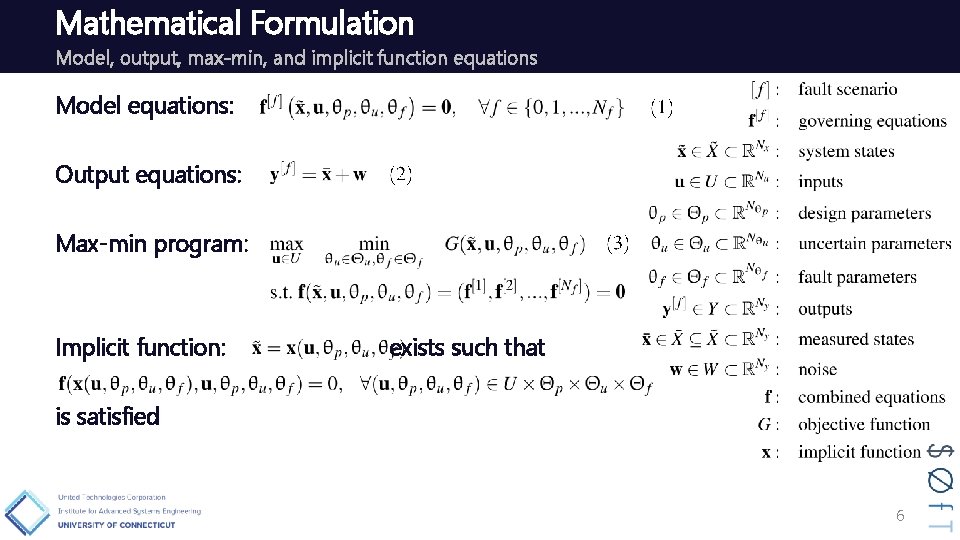
Mathematical Formulation Model, output, max-min, and implicit function equations Model equations: Output equations: Max-min program: Implicit function: exists such that is satisfied 6
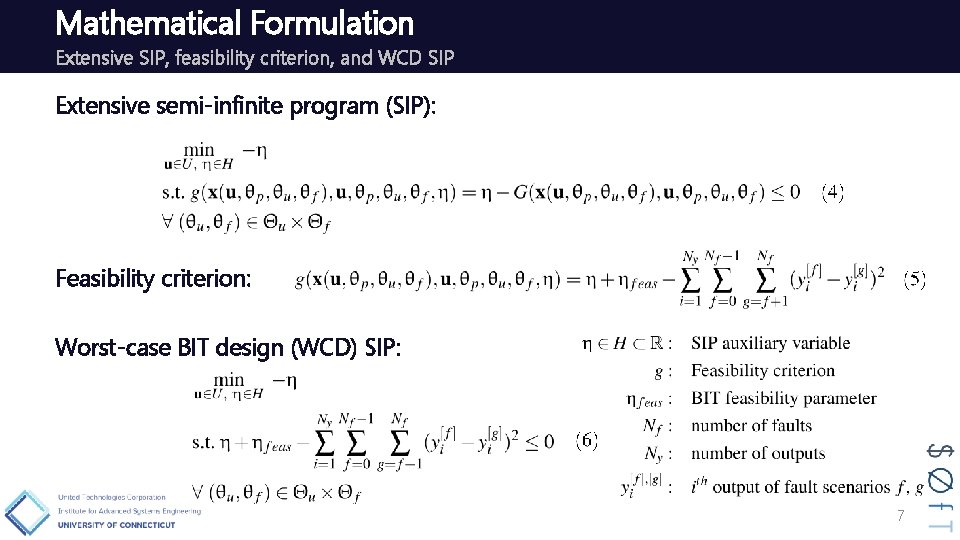
Mathematical Formulation Extensive SIP, feasibility criterion, and WCD SIP Extensive semi-infinite program (SIP): Feasibility criterion: Worst-case BIT design (WCD) SIP: 7
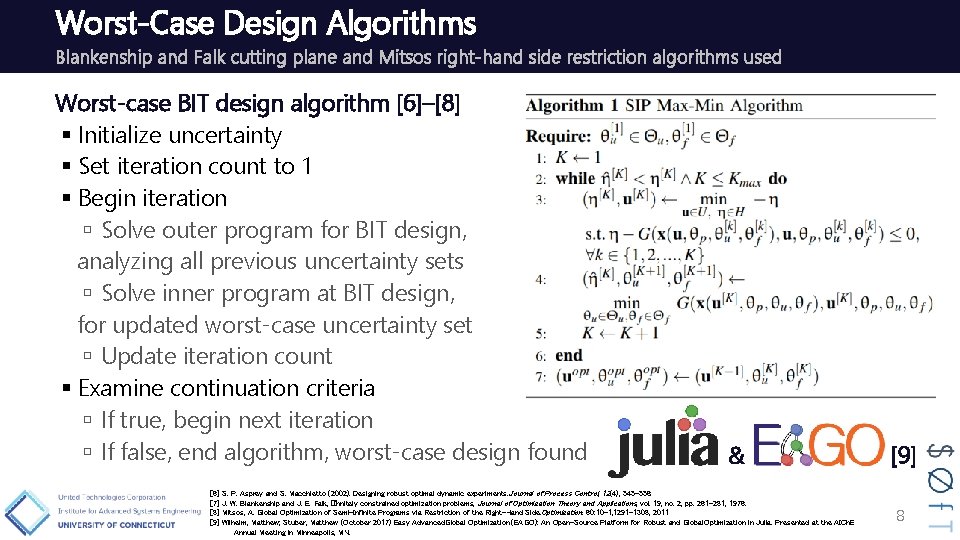
Worst-Case Design Algorithms Blankenship and Falk cutting plane and Mitsos right-hand side restriction algorithms used Worst-case BIT design algorithm [6]–[8] ◾ Initialize uncertainty ◾ Set iteration count to 1 ◾ Begin iteration ◽ Solve outer program for BIT design, analyzing all previous uncertainty sets ◽ Solve inner program at BIT design, for updated worst-case uncertainty set ◽ Update iteration count ◾ Examine continuation criteria ◽ If true, begin next iteration ◽ If false, end algorithm, worst-case design found & [6] S. P. Asprey and S. Macchietto (2002). Designing robust optimal dynamic experiments. Journal of Process Control, 12(4), 545– 556. [7] J. W. Blankenship and J. E. Falk, � Innitely constrained optimization problems, Journal of Optimization Theory and Applications, vol. 19, no. 2, pp. 261 -281, 1976. [8] Mitsos, A. Global Optimization of Semi-Infinite Programs via Restriction of the Right-Hand Side. Optimization. 60: 10 -1, 1291 -1308, 2011 [9] Wilhelm, Matthew; Stuber, Matthew (October 2017) Easy Advanced Global Optimization (EAGO): An Open-Source Platform for Robust and Global Optimization in Julia. Presented at the AICh. E Annual Meeting in Minneapolis, MN. [9] 8
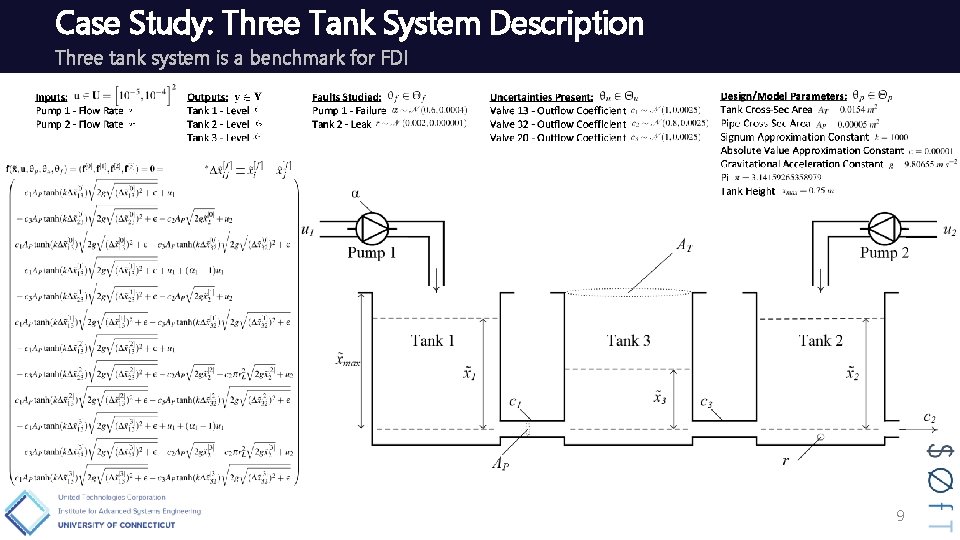
Case Study: Three Tank System Description Three tank system is a benchmark for FDI 9
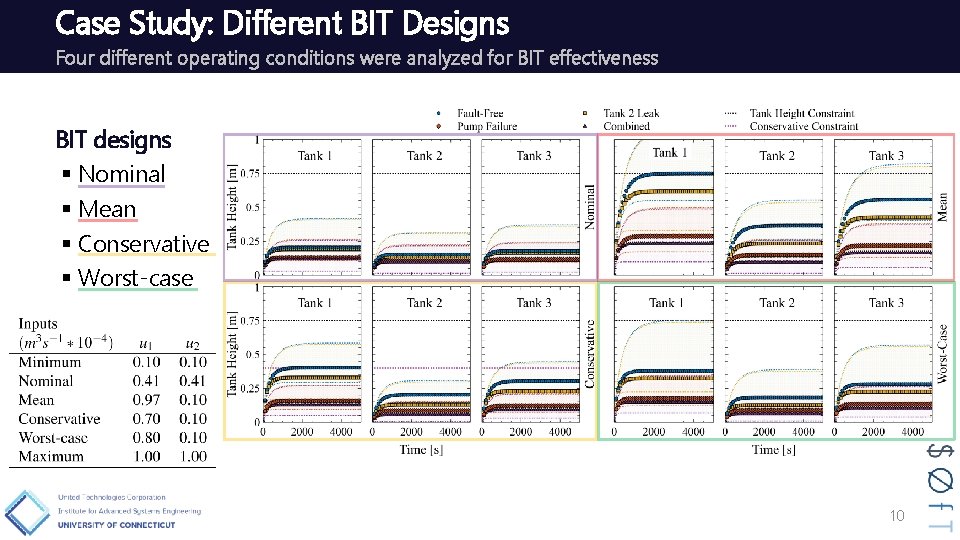
Case Study: Different BIT Designs Four different operating conditions were analyzed for BIT effectiveness BIT designs ◾ Nominal ◾ Mean ◾ Conservative ◾ Worst-case 10
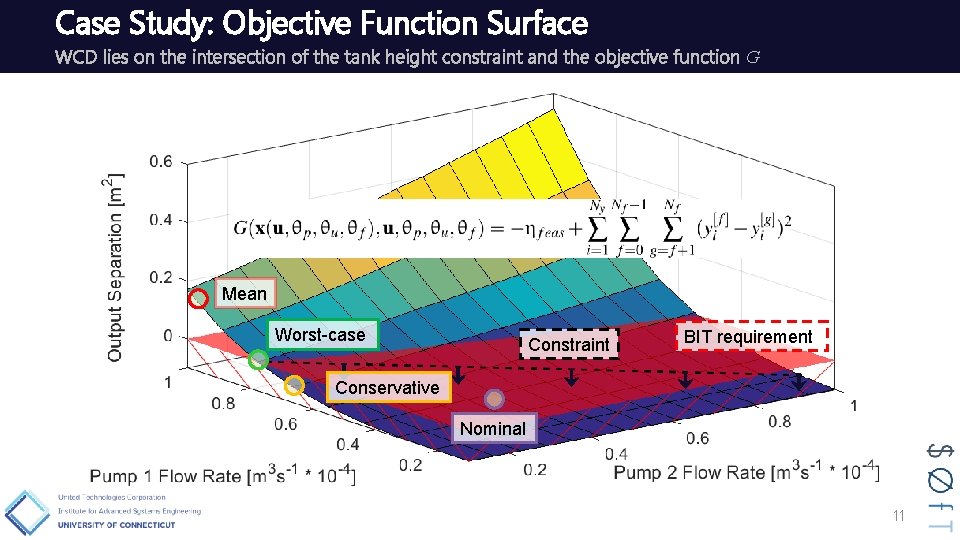
Case Study: Objective Function Surface WCD lies on the intersection of the tank height constraint and the objective function G Mean Worst-case Constraint BIT requirement Conservative Nominal 11
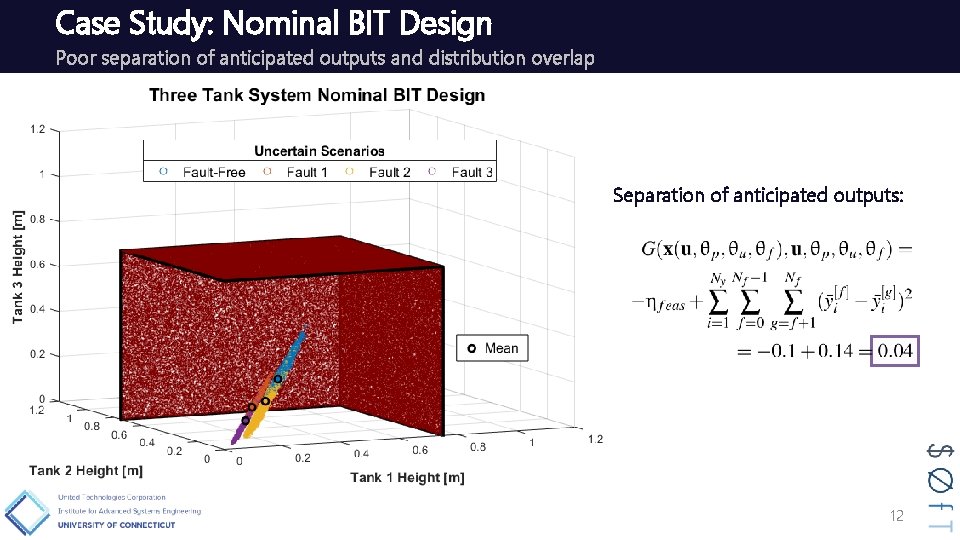
Case Study: Nominal BIT Design Poor separation of anticipated outputs and distribution overlap Separation of anticipated outputs: 12
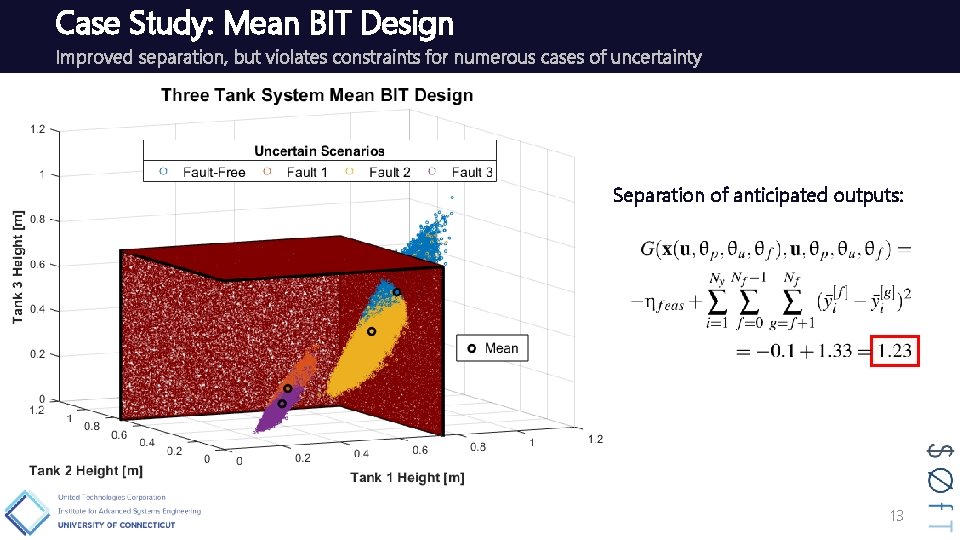
Case Study: Mean BIT Design Improved separation, but violates constraints for numerous cases of uncertainty Separation of anticipated outputs: 13
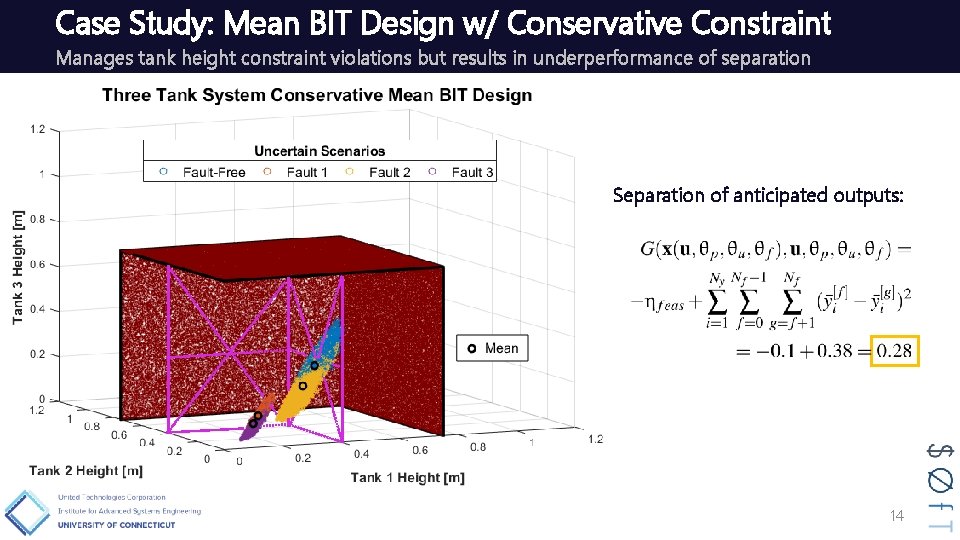
Case Study: Mean BIT Design w/ Conservative Constraint Manages tank height constraint violations but results in underperformance of separation Separation of anticipated outputs: 14
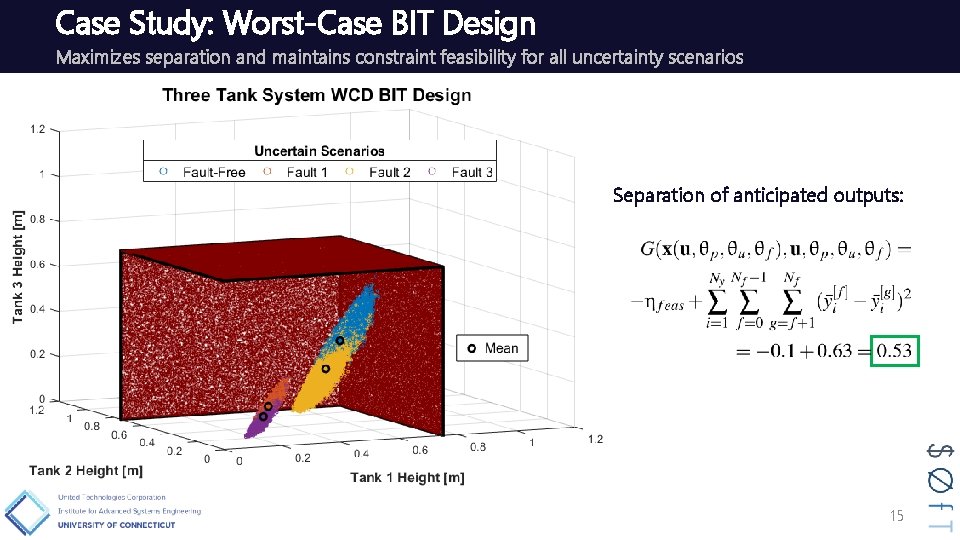
Case Study: Worst-Case BIT Design Maximizes separation and maintains constraint feasibility for all uncertainty scenarios Separation of anticipated outputs: 15
Conclusions Method developed aims at improving fault detection and isolation at the worstcase scenario(s) of uncertainty BIT design at the worst-case scenario of uncertainty shows improvement in output separation in comparison to the nominal, mean, and conservative mean BIT designs Global feasibility provided, guaranteeing robustness of the BIT design which is important for safety-critical systems 16

Acknowledgements This work was sponsored by the United Technologies Corporation Institute for Advanced Systems Engineering (UTC-IASE) of the University of Connecticut. Any opinions expressed herein are those of the authors and do not represent those of the sponsor. The authors would like to express their gratitude to Matthew Wilhelm for his help with obtaining a global solution in the Julia programming language using the developed package Easy-Advanced Global Optimization (EAGO) [9] Wilhelm, Matthew; Stuber, Matthew (October 2017) Easy Advanced Global Optimization (EAGO): An Open-Source Platform for Robust and Global Optimization in Julia. Presented at the AICh. E Annual Meeting in Minneapolis, MN. 17
Web: http: //utc-iase. uconn. edu/ In-collaboration with: Linked. In: https: //www. linkedin. com/groups/8512041 Twitter: https: //twitter. com/uconniase Facebook: https: //www. facebook. com/UTCIASE/ You. Tube: https: //www. youtube. com/channel/UCy. ID a 1 n. LXJE 4 Jzv. A 039 fm. AA Engage Participate Help Lead Find Collaborators Reach Out Web: https: //psor. uconn. edu/ Teach Get funded Learn
- Slides: 18