
DESIGN OF BORDER BASIN IRRIGATION PRABHU M BTE06

DESIGN OF BORDER & BASIN IRRIGATION PRABHU. M BTE-06 -024
BORDER IRRIGATION • With border irrigation, water is diverted in a pre-constructed border, which is between 100 and 1 000 m long and 3 to 30 m wide. • The borders have a uniform slope away from the water canal so that the water flows into the borders by means of gravity while it infiltrates into the soil
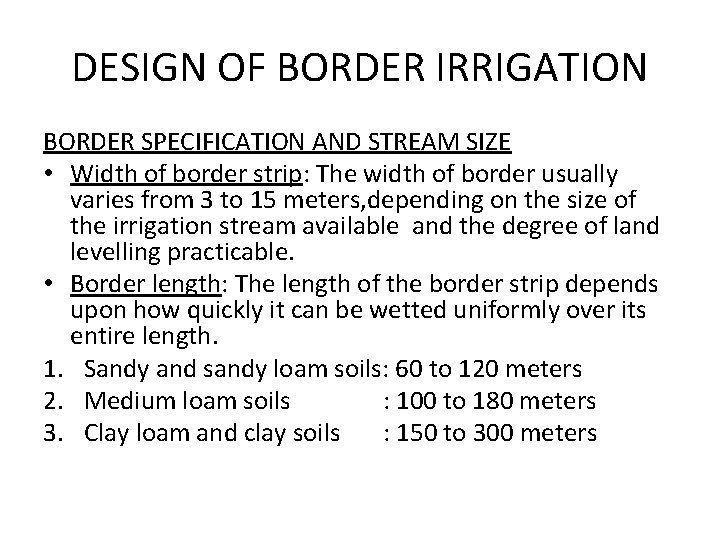
DESIGN OF BORDER IRRIGATION BORDER SPECIFICATION AND STREAM SIZE • Width of border strip: The width of border usually varies from 3 to 15 meters, depending on the size of the irrigation stream available and the degree of land levelling practicable. • Border length: The length of the border strip depends upon how quickly it can be wetted uniformly over its entire length. 1. Sandy and sandy loam soils: 60 to 120 meters 2. Medium loam soils : 100 to 180 meters 3. Clay loam and clay soils : 150 to 300 meters
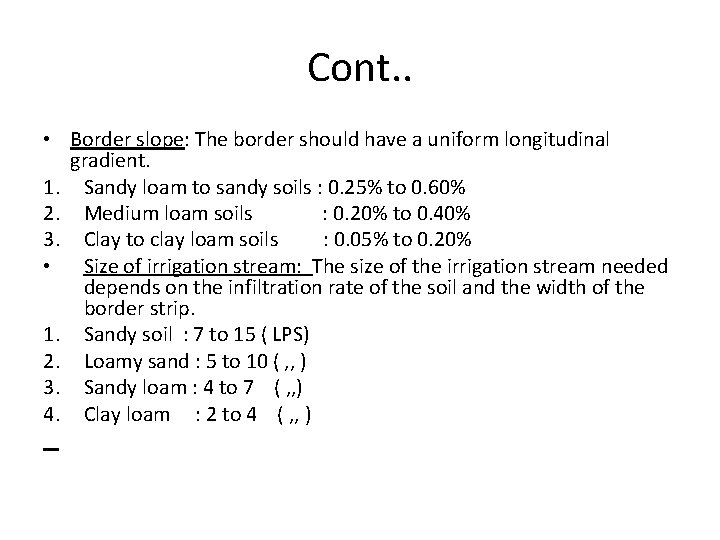
Cont. . • Border slope: The border should have a uniform longitudinal gradient. 1. Sandy loam to sandy soils : 0. 25% to 0. 60% 2. Medium loam soils : 0. 20% to 0. 40% 3. Clay to clay loam soils : 0. 05% to 0. 20% • Size of irrigation stream: The size of the irrigation stream needed depends on the infiltration rate of the soil and the width of the border strip. 1. Sandy soil : 7 to 15 ( LPS) 2. Loamy sand : 5 to 10 ( , , ) 3. Sandy loam : 4 to 7 ( , , ) 4. Clay loam : 2 to 4 ( , , )
Design • When border irrigation design as 2 types; 1. design of open end border system 2. design of blocked end border system
Cont. . 1. Design of open end border system • The first four design steps for open-ended borders are the same as those outlined under for traditional furrow systems (1) assemble input data; (2) compute maximum flows per unit width; (3) compute advance time; and (4) compute the required intake opportunity time
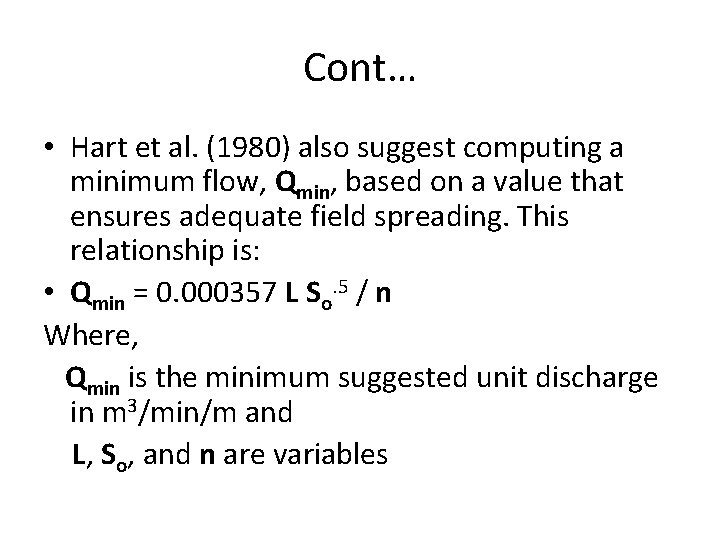
Cont… • Hart et al. (1980) also suggest computing a minimum flow, Qmin, based on a value that ensures adequate field spreading. This relationship is: • Qmin = 0. 000357 L So. 5 / n Where, Qmin is the minimum suggested unit discharge in m 3/min/m and L, So, and n are variables
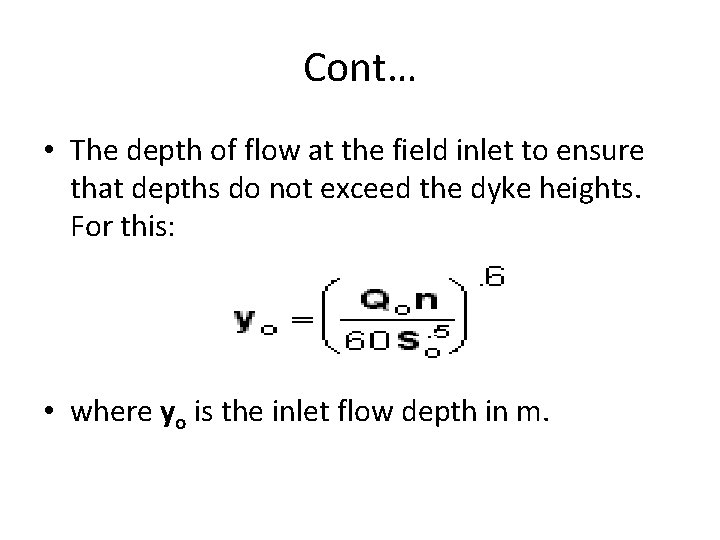
Cont… • The depth of flow at the field inlet to ensure that depths do not exceed the dyke heights. For this: • where yo is the inlet flow depth in m.
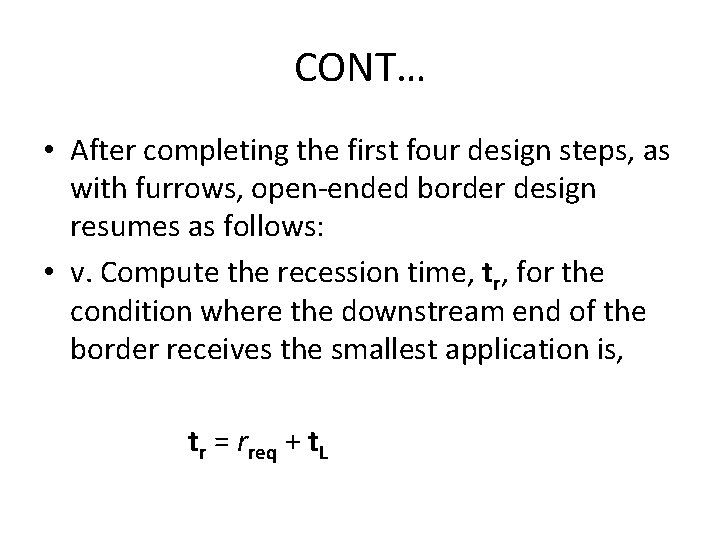
CONT… • After completing the first four design steps, as with furrows, open-ended border design resumes as follows: • v. Compute the recession time, tr, for the condition where the downstream end of the border receives the smallest application is, tr = rreq + t. L
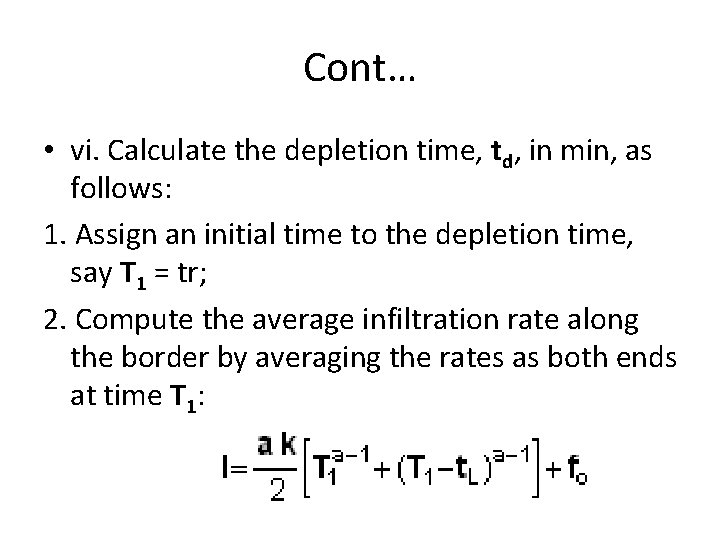
Cont… • vi. Calculate the depletion time, td, in min, as follows: 1. Assign an initial time to the depletion time, say T 1 = tr; 2. Compute the average infiltration rate along the border by averaging the rates as both ends at time T 1:
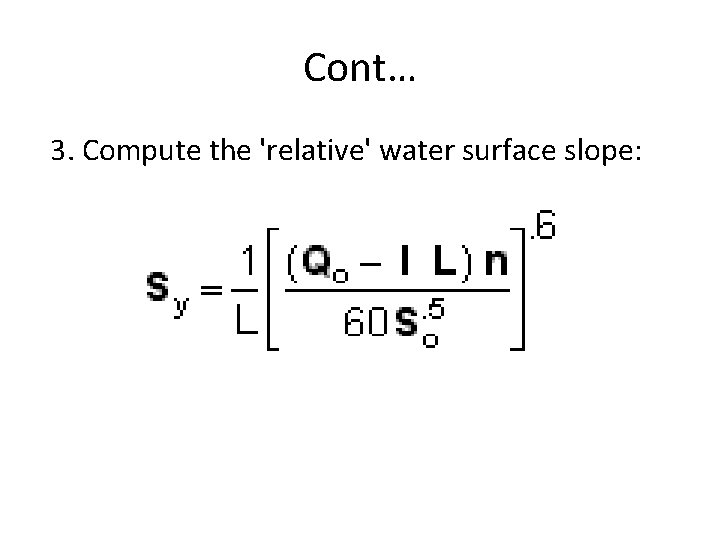
Cont… 3. Compute the 'relative' water surface slope:
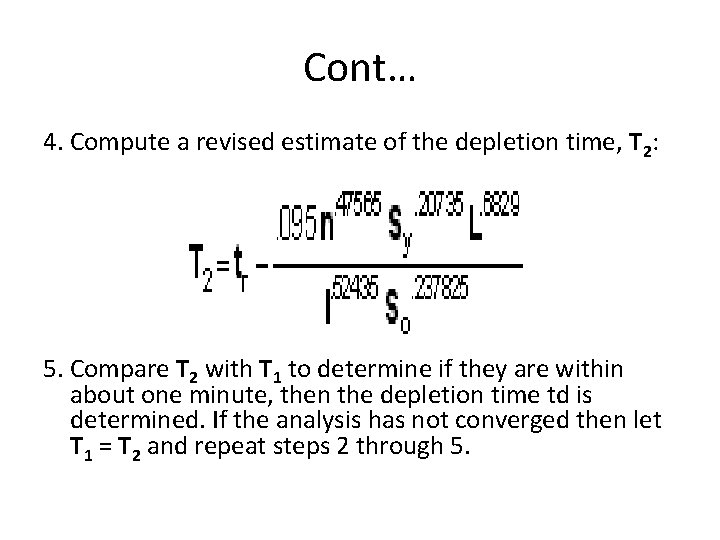
Cont… 4. Compute a revised estimate of the depletion time, T 2: 5. Compare T 2 with T 1 to determine if they are within about one minute, then the depletion time td is determined. If the analysis has not converged then let T 1 = T 2 and repeat steps 2 through 5.
Cont… • The computation of depletion time given above is based on the algebraic analysis reported by Strelkoff (1977). vii. Compare the depletion time with the required intake opportunity time. Because recession is an important process in border irrigation, it is possible for the applied depth at the end of the field to be greater than at the inlet. If td > rreq, the irrigation at the field inlet is adequate and the application efficiency, Ea can be calculated using the following estimate of time of cutoff: tco = td - yo L / (2 Qo)
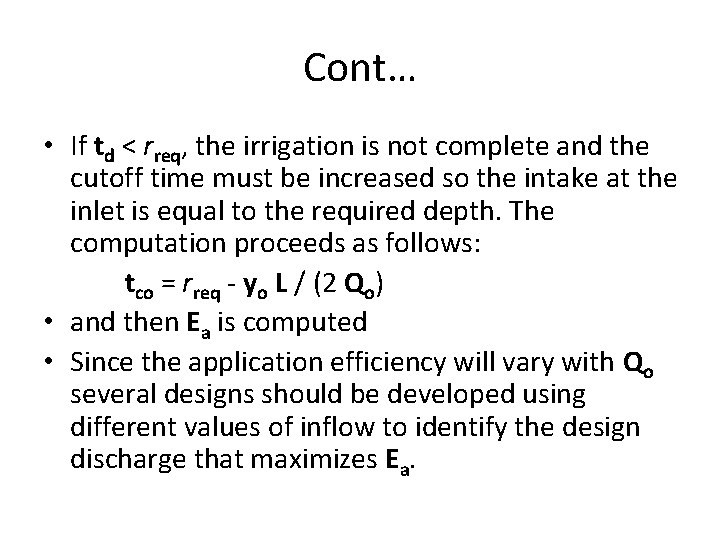
Cont… • If td < rreq, the irrigation is not complete and the cutoff time must be increased so the intake at the inlet is equal to the required depth. The computation proceeds as follows: tco = rreq - yo L / (2 Qo) • and then Ea is computed • Since the application efficiency will vary with Qo several designs should be developed using different values of inflow to identify the design discharge that maximizes Ea.
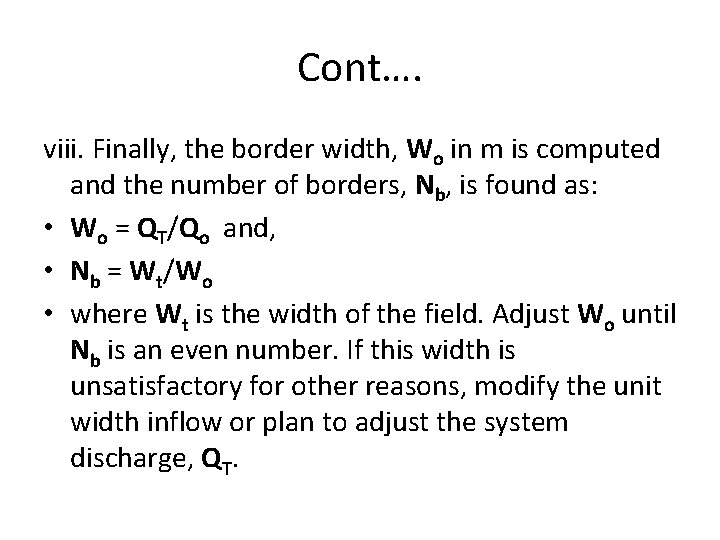
Cont…. viii. Finally, the border width, Wo in m is computed and the number of borders, Nb, is found as: • Wo = QT/Qo and, • Nb = Wt/Wo • where Wt is the width of the field. Adjust Wo until Nb is an even number. If this width is unsatisfactory for other reasons, modify the unit width inflow or plan to adjust the system discharge, QT.
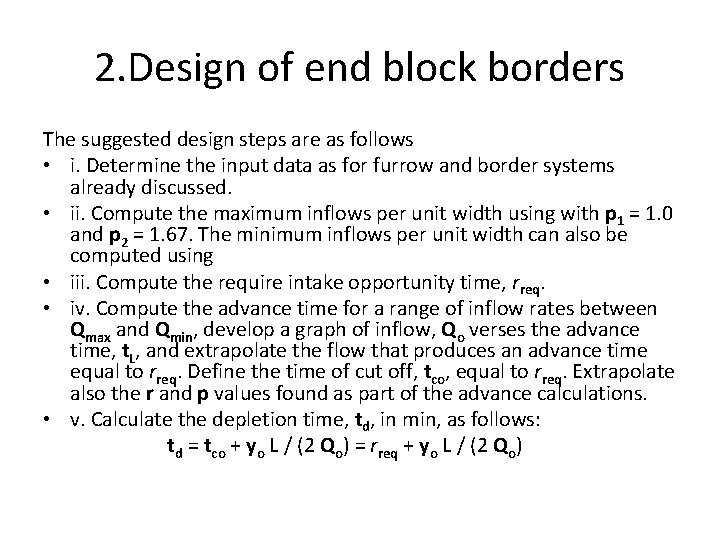
2. Design of end block borders The suggested design steps are as follows • i. Determine the input data as for furrow and border systems already discussed. • ii. Compute the maximum inflows per unit width using with p 1 = 1. 0 and p 2 = 1. 67. The minimum inflows per unit width can also be computed using • iii. Compute the require intake opportunity time, rreq. • iv. Compute the advance time for a range of inflow rates between Qmax and Qmin, develop a graph of inflow, Qo verses the advance time, t. L, and extrapolate the flow that produces an advance time equal to rreq. Define the time of cut off, tco, equal to rreq. Extrapolate also the r and p values found as part of the advance calculations. • v. Calculate the depletion time, td, in min, as follows: td = tco + yo L / (2 Qo) = rreq + yo L / (2 Qo)
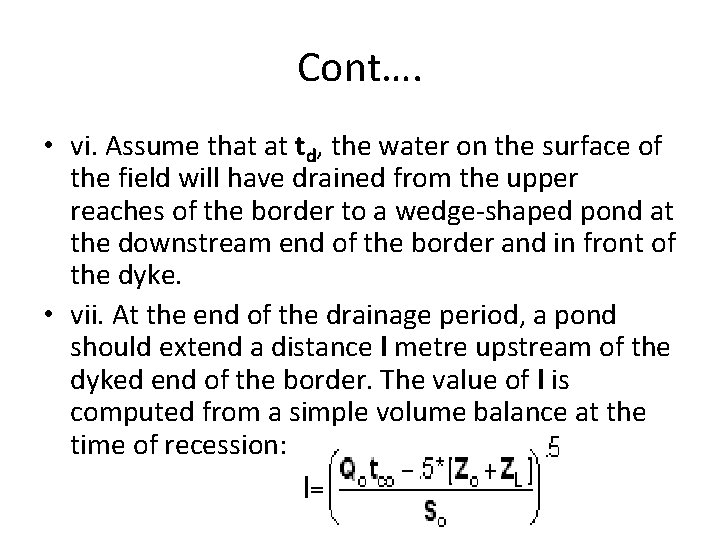
Cont…. • vi. Assume that at td, the water on the surface of the field will have drained from the upper reaches of the border to a wedge-shaped pond at the downstream end of the border and in front of the dyke. • vii. At the end of the drainage period, a pond should extend a distance l metre upstream of the dyked end of the border. The value of l is computed from a simple volume balance at the time of recession:
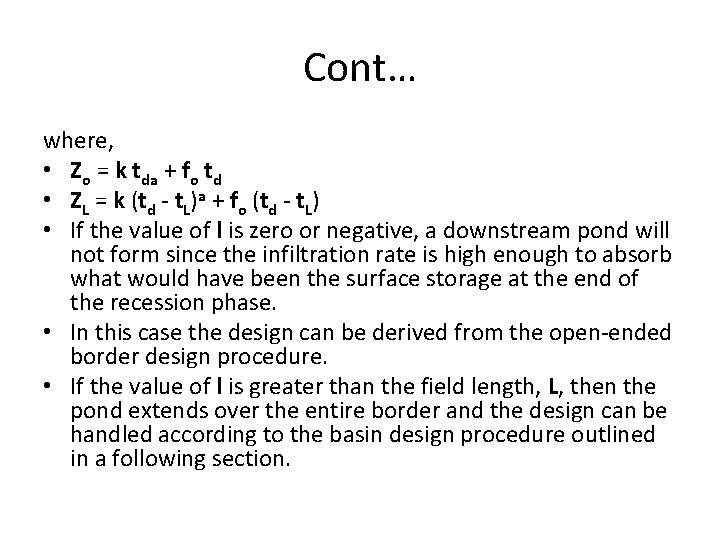
Cont… where, • Zo = k tda + fo td • ZL = k (td - t. L)a + fo (td - t. L) • If the value of l is zero or negative, a downstream pond will not form since the infiltration rate is high enough to absorb what would have been the surface storage at the end of the recession phase. • In this case the design can be derived from the open-ended border design procedure. • If the value of l is greater than the field length, L, then the pond extends over the entire border and the design can be handled according to the basin design procedure outlined in a following section.
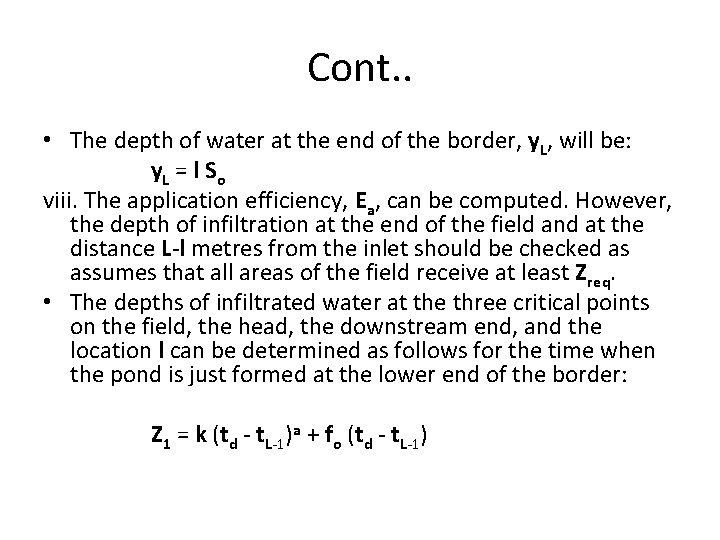
Cont. . • The depth of water at the end of the border, y. L, will be: y. L = l So viii. The application efficiency, Ea, can be computed. However, the depth of infiltration at the end of the field and at the distance L-l metres from the inlet should be checked as assumes that all areas of the field receive at least Zreq. • The depths of infiltrated water at the three critical points on the field, the head, the downstream end, and the location l can be determined as follows for the time when the pond is just formed at the lower end of the border: Z 1 = k (td - t. L-1)a + fo (td - t. L-1)
![Cont… where, t. L-1 = [(L-l) / p]1/2 • It should be noted again](http://slidetodoc.com/presentation_image_h/88f9701adc60fd8bd36fe0d99fec8a14/image-20.jpg "Cont… where, t. L-1 = [(L-l) / p]1/2 • It should be noted again")
Cont… where, t. L-1 = [(L-l) / p]1/2 • It should be noted again by way of reminder that one of the fundamental assumptions of the design process is that the root zone requirement, Zreq, will be met over the entire length of the field. • If, therefore, in computing Ea, one finds ZL-1 or ZL less than Zreq, then either the time of cutoff should be extended or the value of Zreq used should be reduced. • Likewise, if the depths applied at l and L significantly exceed Zreq, then the inflow should be terminated before the flow reaches the end of the border.
Design of basin irrigation Basin irrigation • Basin irrigation is as good choice in cases where the natural gradient is relatively flat and even. • Permanent orchards and grazing crops are especially well suited to basin irrigation. • The farmer has to be prepared, however, to check that all the basin remain level throughout the season
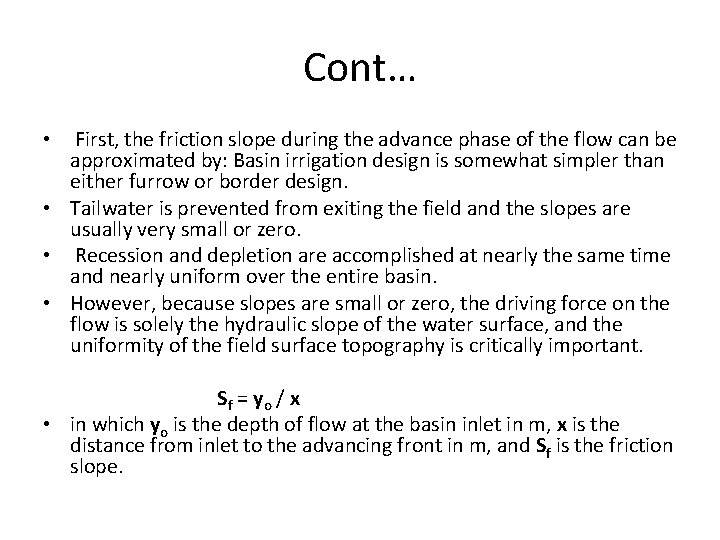
Cont… • First, the friction slope during the advance phase of the flow can be approximated by: Basin irrigation design is somewhat simpler than either furrow or border design. • Tailwater is prevented from exiting the field and the slopes are usually very small or zero. • Recession and depletion are accomplished at nearly the same time and nearly uniform over the entire basin. • However, because slopes are small or zero, the driving force on the flow is solely the hydraulic slope of the water surface, and the uniformity of the field surface topography is critically important. Sf = yo / x • in which yo is the depth of flow at the basin inlet in m, x is the distance from inlet to the advancing front in m, and Sf is the friction slope.
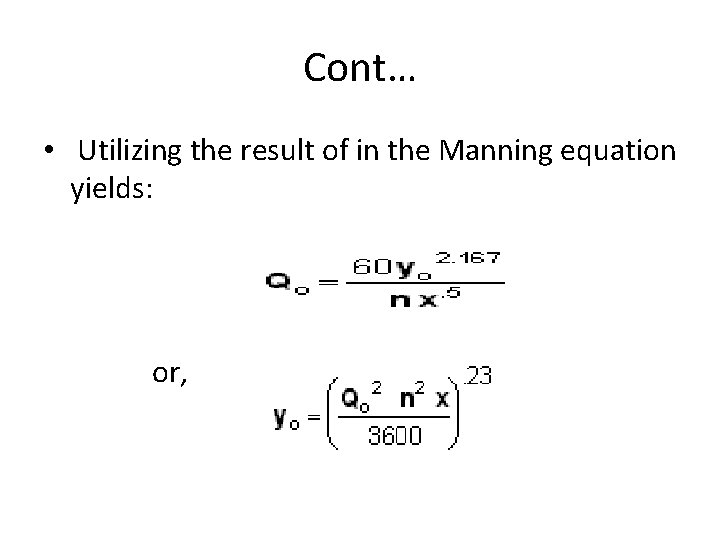
Cont… • Utilizing the result of in the Manning equation yields: or,
C ont… • The second assumption is that immediately upon cessation of inflow, the water surface assumes a horizontal orientation and infiltrates vertically. • In other words, the infiltrated depth at the inlet to the basin is equal to the infiltration during advance, plus the average depth of water on the soil surface at the time the water completes the advance phase, plus the average depth added to the basin following completion of advance. • At the downstream end of the basin the application is assumed to equal the average depth on the surface at the time advance is completed plus the average depth added from this time until the time of cutoff.
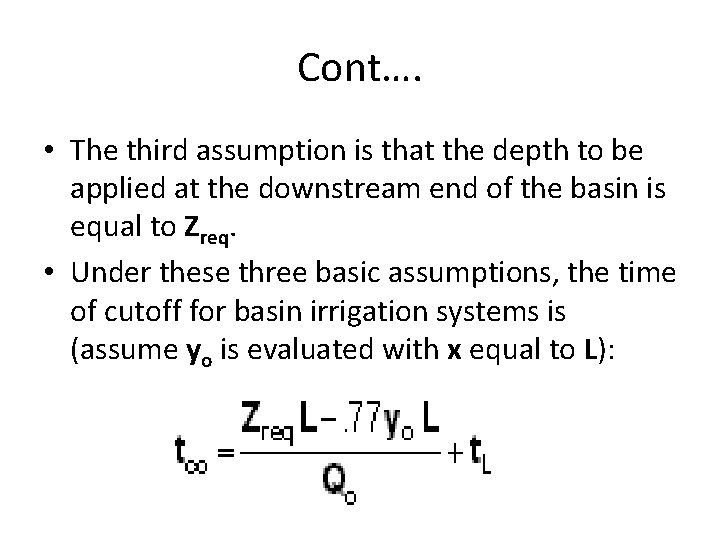
Cont…. • The third assumption is that the depth to be applied at the downstream end of the basin is equal to Zreq. • Under these three basic assumptions, the time of cutoff for basin irrigation systems is (assume yo is evaluated with x equal to L):
Cont… • The time of cutoff must be greater than or equal to the advance time. • Basin design is much simpler than that for furrows or borders. • Because there is no tail water problem, the maximum unit inflow also maximizes application efficiency.
Cont… As a guide to basin design, the following steps are outlined: • i. Input data common to both furrows and borders must first be collected. Field slope will not be necessary because basins are usually 'dead level'. • ii. The required intake opportunity time, rreq, can be found as demonstrated in the previous examples.
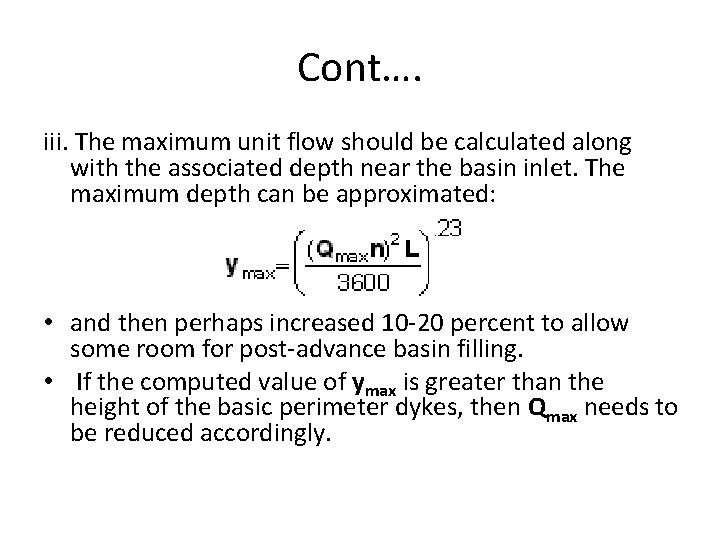
Cont…. iii. The maximum unit flow should be calculated along with the associated depth near the basin inlet. The maximum depth can be approximated: • and then perhaps increased 10 -20 percent to allow some room for post-advance basin filling. • If the computed value of ymax is greater than the height of the basic perimeter dykes, then Qmax needs to be reduced accordingly.
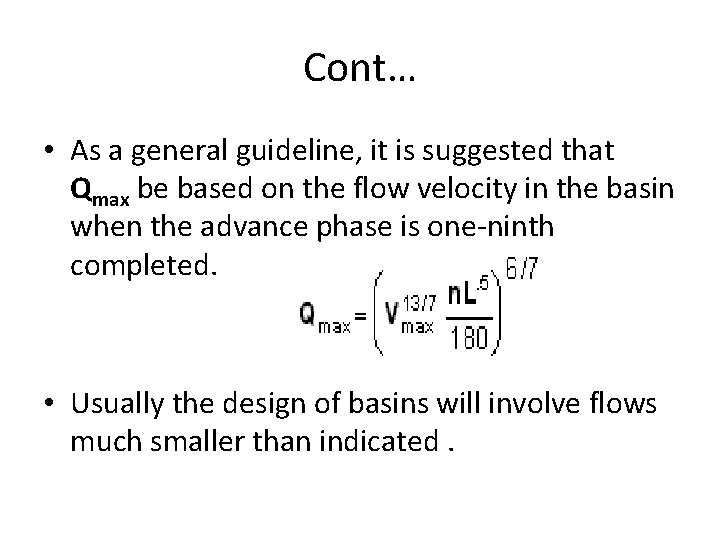
Cont… • As a general guideline, it is suggested that Qmax be based on the flow velocity in the basin when the advance phase is one-ninth completed. • Usually the design of basins will involve flows much smaller than indicated.
Cont…. iv. Select several field layouts that would appear to yield a well organized field system and for each determine the length and width of the basins. Then compute the unit flow, Qo for each configuration as: Qo = QT / Wb • where Wb is the basin width in m. As noted above, the maximum efficiency will generally occur when Qo is near Qmax so the configurations selected at this phase of the design should yield inflows accordingly. v. Compute the advance times, t. L, for each field layout as discussed. the cutoff time, tco, from (if tco < t. L, set tco = t. L), and the application efficiency. • The layout that achieves the highest efficiency while maintaining a convenient configuration for the irrigator/farmer should be selected.

Thank u

Cont…

Cont…


Cont. .
- Slides: 35