
Design of Big Data Reference Architectures for Use
Design of Big Data Reference Architectures for Use Cases in the Insurance Sector Vladimir Elvov, Bachelor’s Thesis – Initial Presentation, 23. 10. 2017 Chair of Software Engineering for Business Information Systems (sebis) Faculty of Informatics Technische Universität München wwwmatthes. in. tum. de
Outline 1. Motivation • Problem Statement • Research Questions and Methodology 2. Use Cases 3. Next steps • Deriving Requirements for Operationalizing the Use Cases • Comparison of existing Reference Architectures • Design of a new Reference Architecture Vladimir Elvov, Bachelor’s Thesis – Initial Presentation, 23. 10. 2017 © sebis 2
1. Motivation: Problem Statement • Large volume of data generated, partially in real-time (Big Data) • Vast potential for businesses through data analysis – in the German P&C Insurance Sector up to 18 Billions € • However: • Many Big Data projects do fail • Only 5 out of 25 analyzed DAX companies have Big Data projects or applications deployed (2015) Vladimir Elvov, Bachelor’s Thesis – Initial Presentation, 23. 10. 2017 3
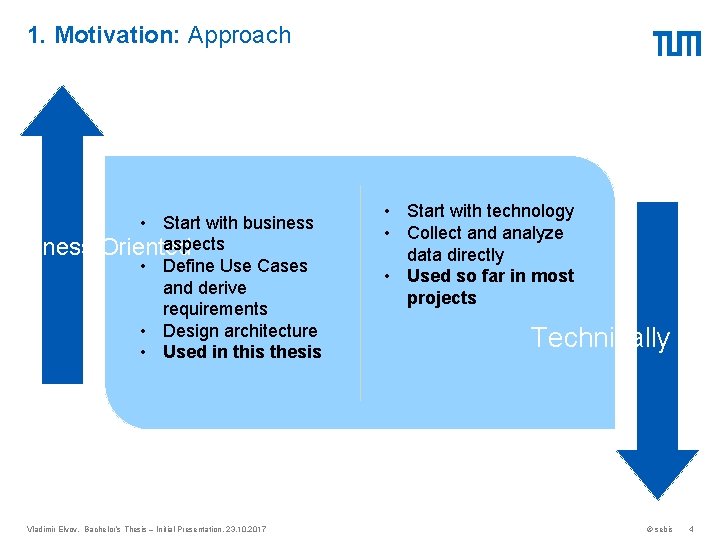
1. Motivation: Approach Business • Start with business aspects Oriented • Define Use Cases and derive requirements • Design architecture • Used in this thesis Vladimir Elvov, Bachelor’s Thesis – Initial Presentation, 23. 10. 2017 • Start with technology • Collect and analyze data directly • Used so far in most projects Technically Orie © sebis 4
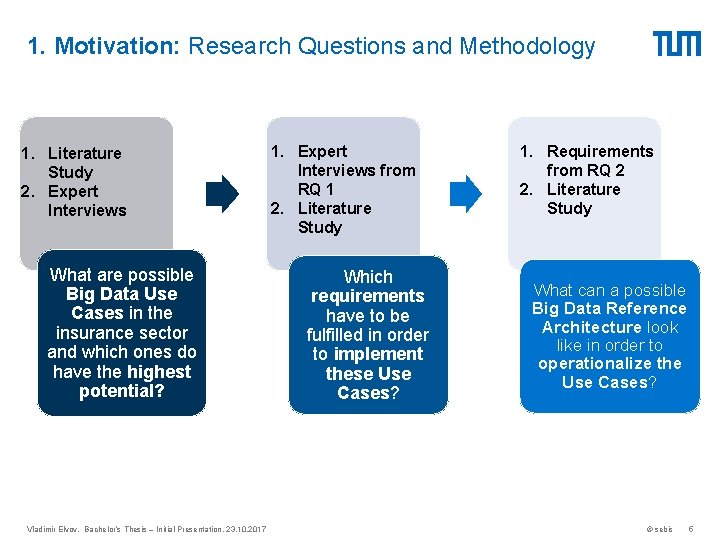
1. Motivation: Research Questions and Methodology 1. Literature Study 2. Expert Interviews What are possible Big Data Use Cases in the insurance sector and which ones do have the highest potential? Vladimir Elvov, Bachelor’s Thesis – Initial Presentation, 23. 10. 2017 1. Expert Interviews from RQ 1 2. Literature Study Which requirements have to be fulfilled in order to implement these Use Cases? 1. Requirements from RQ 2 2. Literature Study What can a possible Big Data Reference Architecture look like in order to operationalize the Use Cases? © sebis 5
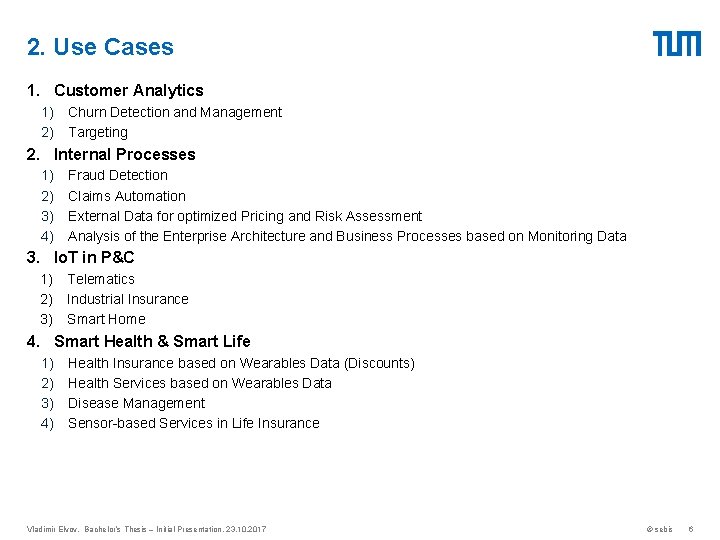
2. Use Cases 1. Customer Analytics 1) Churn Detection and Management 2) Targeting 2. Internal Processes 1) 2) 3) 4) Fraud Detection Claims Automation External Data for optimized Pricing and Risk Assessment Analysis of the Enterprise Architecture and Business Processes based on Monitoring Data 3. Io. T in P&C 1) Telematics 2) Industrial Insurance 3) Smart Home 4. Smart Health & Smart Life 1) 2) 3) 4) Health Insurance based on Wearables Data (Discounts) Health Services based on Wearables Data Disease Management Sensor-based Services in Life Insurance Vladimir Elvov, Bachelor’s Thesis – Initial Presentation, 23. 10. 2017 © sebis 6
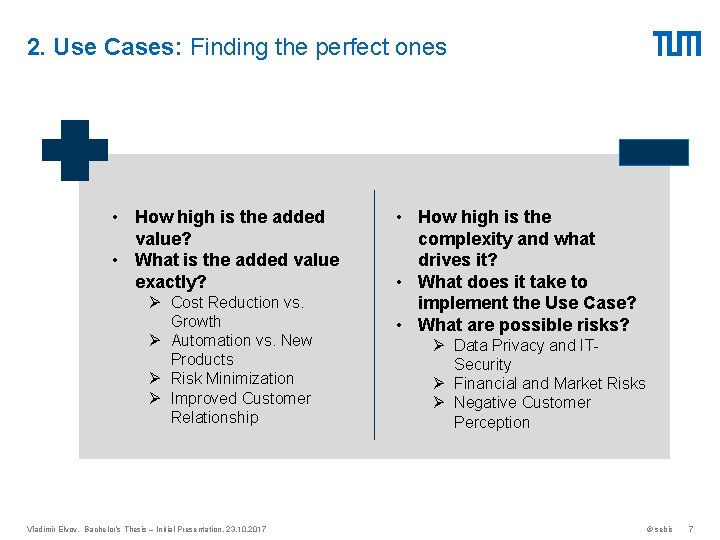
2. Use Cases: Finding the perfect ones • How high is the added value? • What is the added value exactly? Ø Cost Reduction vs. Growth Ø Automation vs. New Products Ø Risk Minimization Ø Improved Customer Relationship Vladimir Elvov, Bachelor’s Thesis – Initial Presentation, 23. 10. 2017 • How high is the complexity and what drives it? • What does it take to implement the Use Case? • What are possible risks? Ø Data Privacy and ITSecurity Ø Financial and Market Risks Ø Negative Customer Perception © sebis 7
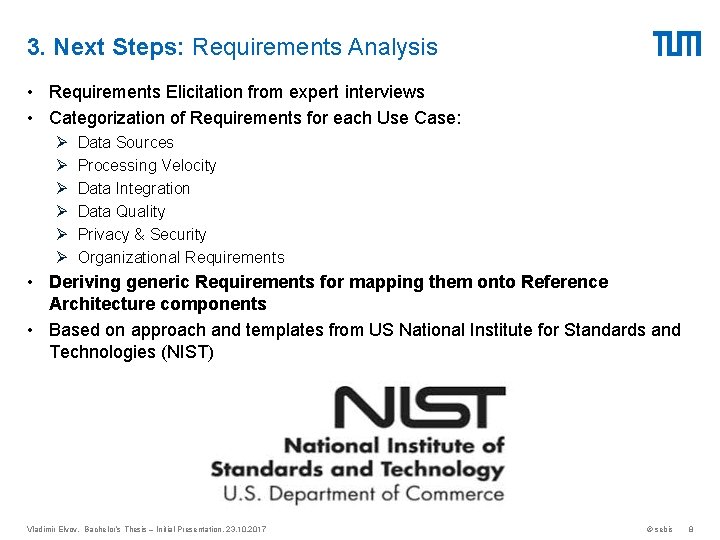
3. Next Steps: Requirements Analysis • Requirements Elicitation from expert interviews • Categorization of Requirements for each Use Case: Ø Ø Ø Data Sources Processing Velocity Data Integration Data Quality Privacy & Security Organizational Requirements • Deriving generic Requirements for mapping them onto Reference Architecture components • Based on approach and templates from US National Institute for Standards and Technologies (NIST) Vladimir Elvov, Bachelor’s Thesis – Initial Presentation, 23. 10. 2017 © sebis 8

3. Next Steps: Comparing Existing Reference Architectures • Analysis of existing Big Data Reference Architectures from different companies • Goal: Derive common components: Ø Ø Ø Resource Management Data Lake Data Streaming Data Batch-Loading Machine Learning Vladimir Elvov, Bachelor’s Thesis – Initial Presentation, 23. 10. 2017 © sebis 9
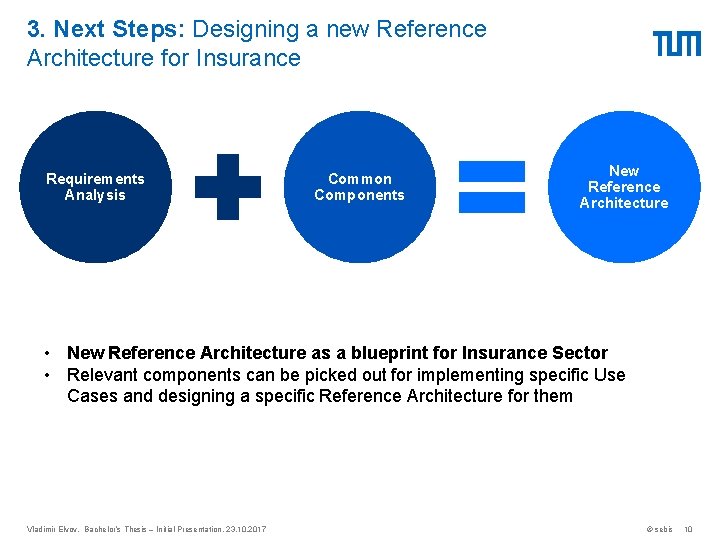
3. Next Steps: Designing a new Reference Architecture for Insurance Requirements Analysis Common Components New Reference Architecture • New Reference Architecture as a blueprint for Insurance Sector • Relevant components can be picked out for implementing specific Use Cases and designing a specific Reference Architecture for them Vladimir Elvov, Bachelor’s Thesis – Initial Presentation, 23. 10. 2017 © sebis 10
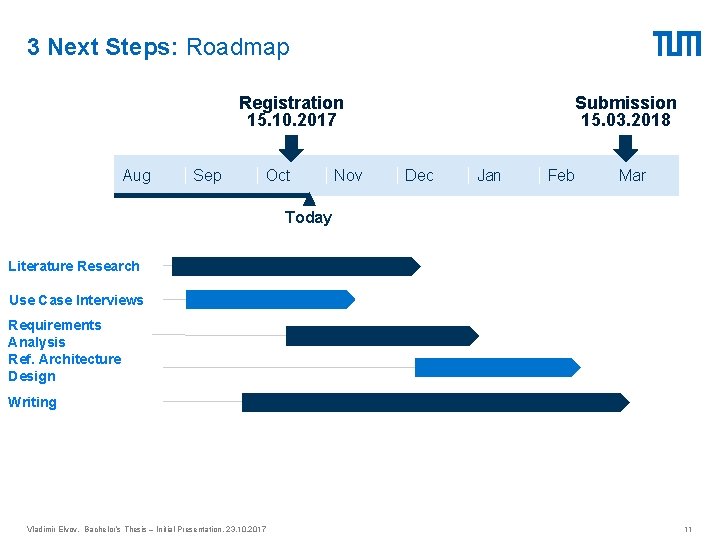
3 Next Steps: Roadmap Registration 15. 10. 2017 Aug Sep Oct Nov Submission 15. 03. 2018 Dec Jan Feb Mar Today Literature Research Use Case Interviews Requirements Analysis Ref. Architecture Design Writing Vladimir Elvov, Bachelor’s Thesis – Initial Presentation, 23. 10. 2017 11
? Any Questions? Vladimir Elvov, Bachelor’s Thesis – Initial Presentation, 23. 10. 2017 12
Sources (Selection) Matthes, F. & Kazman, R. (2015): Demystifying Big Data Adoption: Beyond IT Fashion and Relative Advantage Google & Bain&Company (2016): Digitalisierung der Versicherungswirtschaft: Die 18 -Milliarden-Chance Marr, B. (2015): Using SMART Big Data, Analytics and Metrics To Make Better Business Decisions and Improve Performance Lanquillon, C. & Mallow, H (2015): Praxishandbuch Big Data: Referenzarchitekturen National Institute on Standards and Technologies (2015): NIST Big Data Interoperability Framework: Volume 6, Reference Architecture Fox, G. & Chang, W. (2015): Big Data Use Cases and Requirements Clarke, R. & Libarikian, A. (2014): Unleashing the value of advanced analytics in insurance Digital Mc. Kinsey (2017): Digital disruption in insurance: Cutting through the noise Vladimir Elvov, Bachelor’s Thesis – Initial Presentation, 23. 10. 2017 © sebis 13
- Slides: 13