
DESIGN OF AQUEDUCT STEP 1 Determination of maximum
- Slides: 4
DESIGN OF AQUEDUCT STEP 1 – Determination of maximum flood discharge STEP 2 – Fixing the waterway requirements for aqueduct and syphon aqueduct. This can be obtained by using lacey’s equations Where P = wetted perimeter Q = Total discharge in cumecs. Height of bay( drain barrel) = HFL of drain – DBL of drain STEP 3 – Afflux and head loss through syphon barrels The velocith through syphon barrels is limited to a scouring value of 2 to 3 m/s. STEP 4 – Fluming of canal – The contraction in the waterway of the canal will reduce the length of barrel or the width of the aqueduct. This for economy, fluming is not done in earthen bank canals. So for Type I and Type II no fluming required.
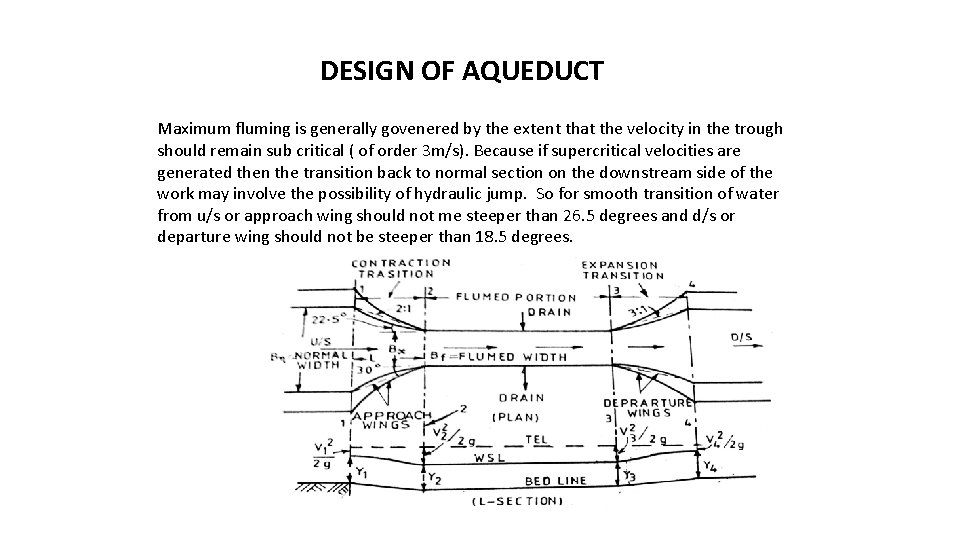
DESIGN OF AQUEDUCT Maximum fluming is generally govenered by the extent that the velocity in the trough should remain sub critical ( of order 3 m/s). Because if supercritical velocities are generated then the transition back to normal section on the downstream side of the work may involve the possibility of hydraulic jump. So for smooth transition of water from u/s or approach wing should not me steeper than 26. 5 degrees and d/s or departure wing should not be steeper than 18. 5 degrees.
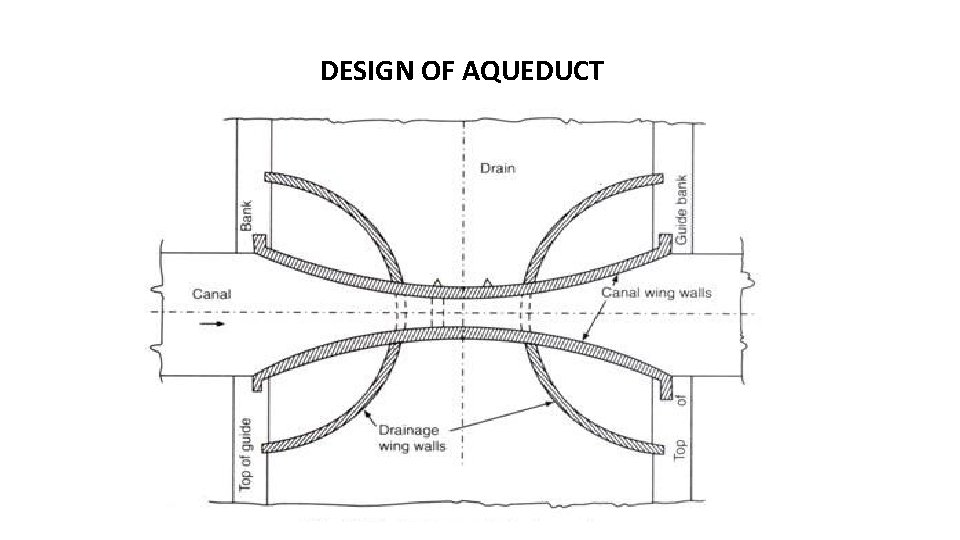
DESIGN OF AQUEDUCT Following methods used to design Mitra’s method Chaturvedi’s method Hind’s method STEP 5 – Design of pucca canal trough STEP 6 – Design of bottom floor of aqueduct and syphon aqueduct. STEP 7 – Design of bank connections Canal wings or land wings Drainage wings or water wings
DESIGN OF AQUEDUCT