
Design of a Simple Test Fixture for a
- Slides: 9
Design of a Simple Test Fixture for a Powered Foot-Ankle Prosthesis By: Isaac Romero Faculty Mentor: John T. Tester, Ph. D.
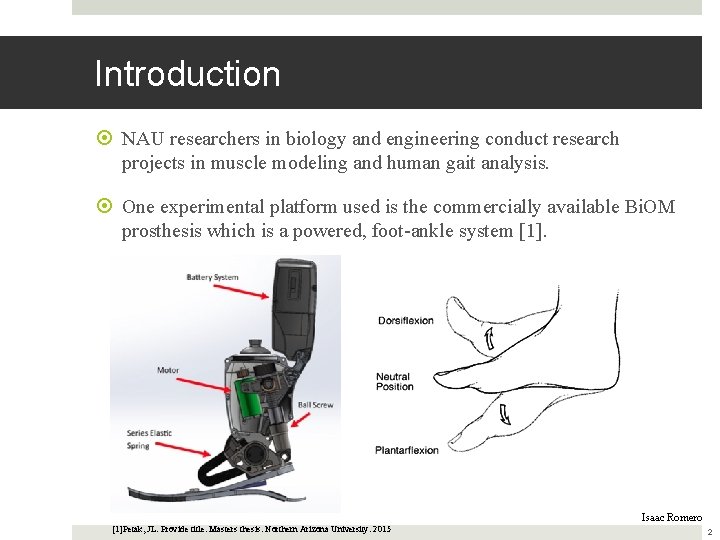
Introduction NAU researchers in biology and engineering conduct research projects in muscle modeling and human gait analysis. One experimental platform used is the commercially available Bi. OM prosthesis which is a powered, foot-ankle system [1]. Isaac Romero [1]Petak, JL. Provide title. Masters thesis. Northern Arizona University. 2015 2
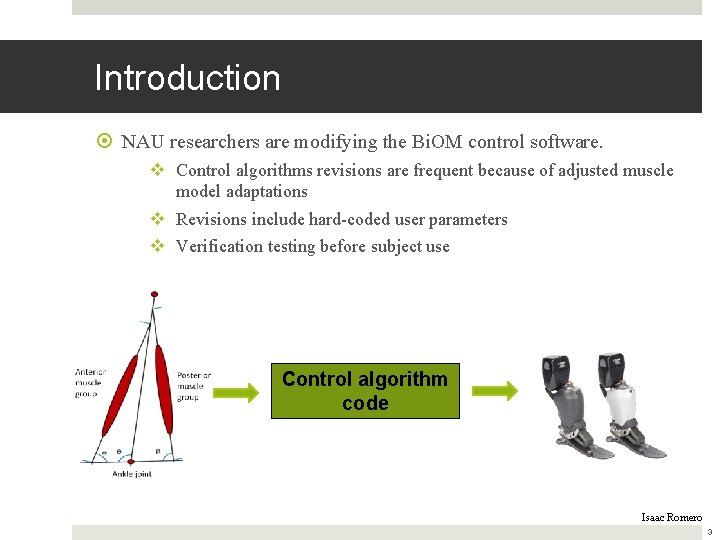
Introduction NAU researchers are modifying the Bi. OM control software. v Control algorithms revisions are frequent because of adjusted muscle model adaptations v Revisions include hard-coded user parameters v Verification testing before subject use Control algorithm code Isaac Romero 3
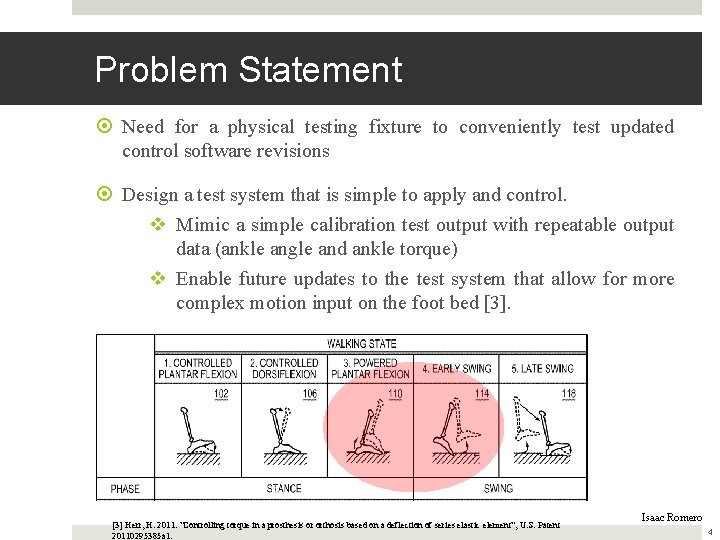
Problem Statement Need for a physical testing fixture to conveniently test updated control software revisions Design a test system that is simple to apply and control. v Mimic a simple calibration test output with repeatable output data (ankle angle and ankle torque) v Enable future updates to the test system that allow for more complex motion input on the foot bed [3] Herr, H. 2011. ”Controlling torque in a prosthesis or orthosis based on a deflection of series elastic element”, U. S. Patent 20110295385 a 1. Isaac Romero 4
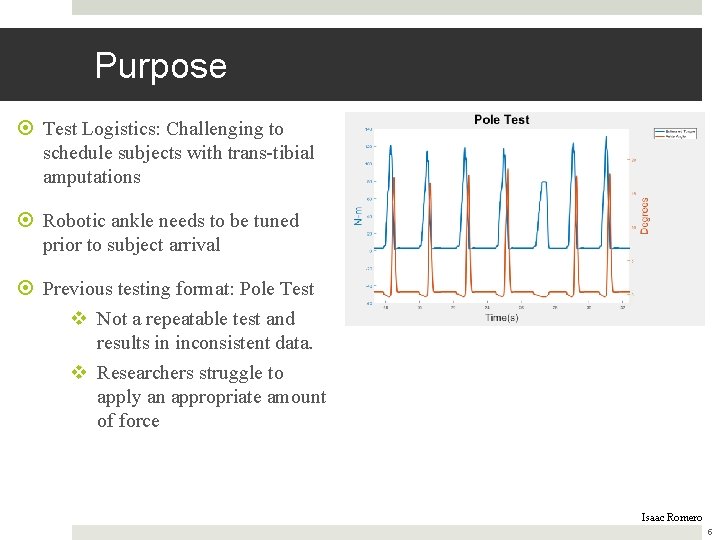
Purpose Test Logistics: Challenging to schedule subjects with trans-tibial amputations Robotic ankle needs to be tuned prior to subject arrival Previous testing format: Pole Test v Not a repeatable test and results in inconsistent data. v Researchers struggle to apply an appropriate amount of force Isaac Romero 5
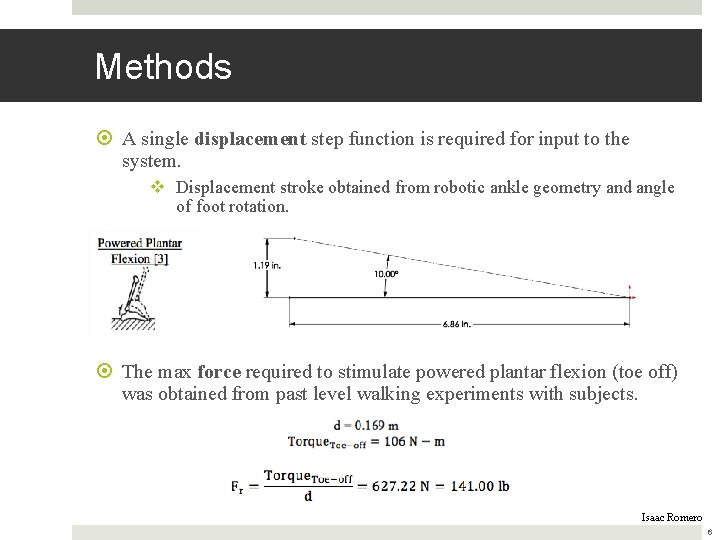
Methods A single displacement step function is required for input to the system. v Displacement stroke obtained from robotic ankle geometry and angle of foot rotation. The max force required to stimulate powered plantar flexion (toe off) was obtained from past level walking experiments with subjects. Isaac Romero 6
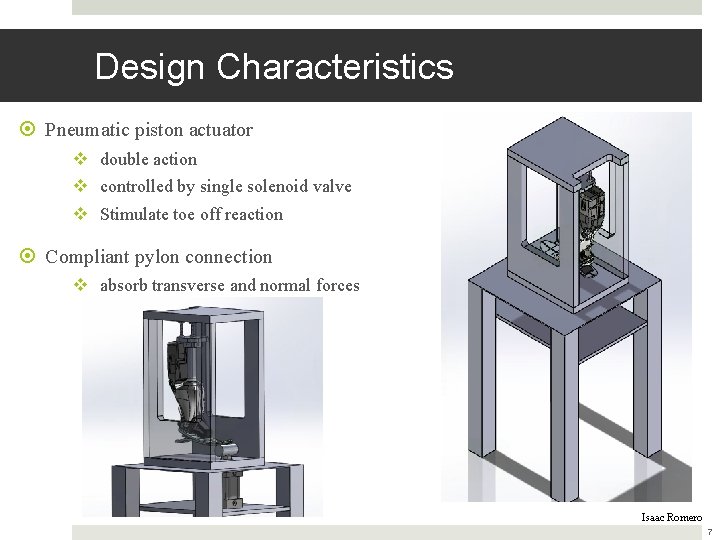
Design Characteristics Pneumatic piston actuator v double action v controlled by single solenoid valve v Stimulate toe off reaction Compliant pylon connection v absorb transverse and normal forces Isaac Romero 7
Anticipated Results Robust experimental platform v Record repeatable output data Provide a variable force to simulate different subject parameters v weight v foot size v limb length Allow for test fixture updates v All five stages of level walking Isaac Romero 8
Acknowledgements Faculty mentor: Dr. John Tester Arizona NASA Space Grant Consortium v Dr. Nadine Barlow v Kathleen Stigmon RAPIDLab at Northern Arizona University NAU Center for Bio Engineering Innovation Isaac Romero 9