
Design of a Rocket Engine Thrust Augmentation Ejector
- Slides: 11
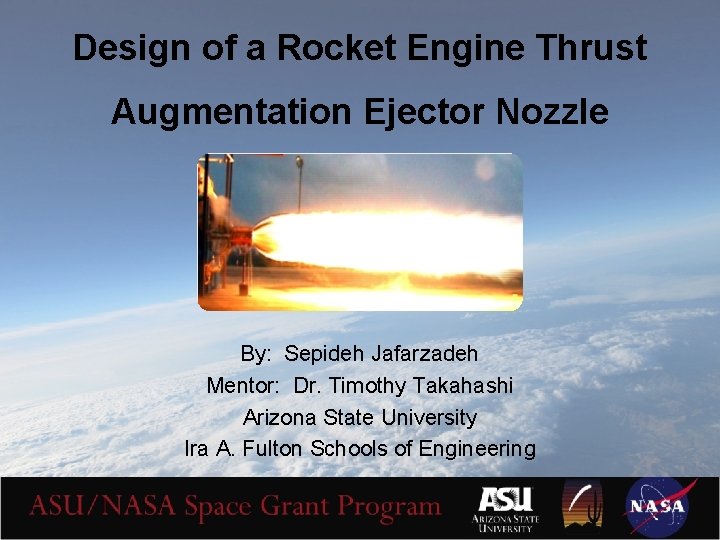
Design of a Rocket Engine Thrust Augmentation Ejector Nozzle By: Sepideh Jafarzadeh Mentor: Dr. Timothy Takahashi Arizona State University Ira A. Fulton Schools of Engineering
Background § The use of rocket propulsion to power various types of winged, high-speed vehicles during takeoff and cruise § Augment the thrust produced by the rocket engine § By obtaining maximum production of mass flow while minimizing fuel consumption § Following previous work, a numerical procedure was developed to design a high-performance ejector nozzle optimized to specific flight conditions
Objective § To test this numerical method for its validity and real world boundary conditions § Conduct cold flow testing to better understand the mass flow and the pressure distribution throughout the system § The resultant boundary conditions will be used to modify and improve the nozzle design § Once an ideal nozzle design is achieved, a hybrid rocket engine will be used to simulate flight environments
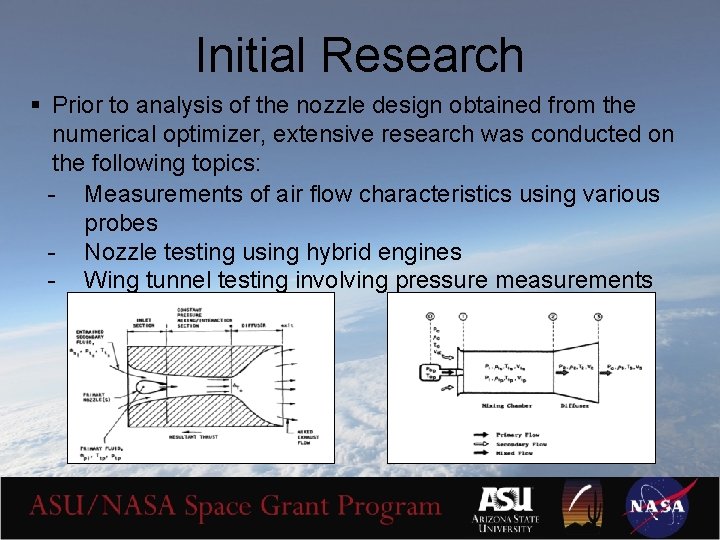
Initial Research § Prior to analysis of the nozzle design obtained from the numerical optimizer, extensive research was conducted on the following topics: - Measurements of air flow characteristics using various probes - Nozzle testing using hybrid engines - Wing tunnel testing involving pressure measurements
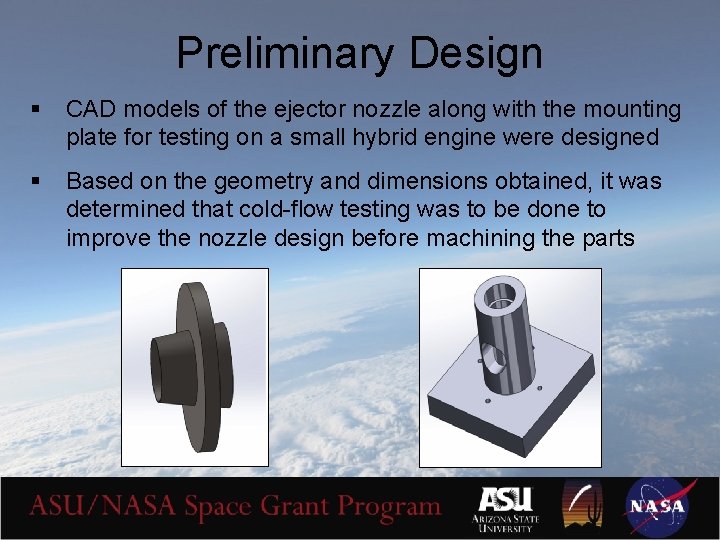
Preliminary Design § CAD models of the ejector nozzle along with the mounting plate for testing on a small hybrid engine were designed § Based on the geometry and dimensions obtained, it was determined that cold-flow testing was to be done to improve the nozzle design before machining the parts
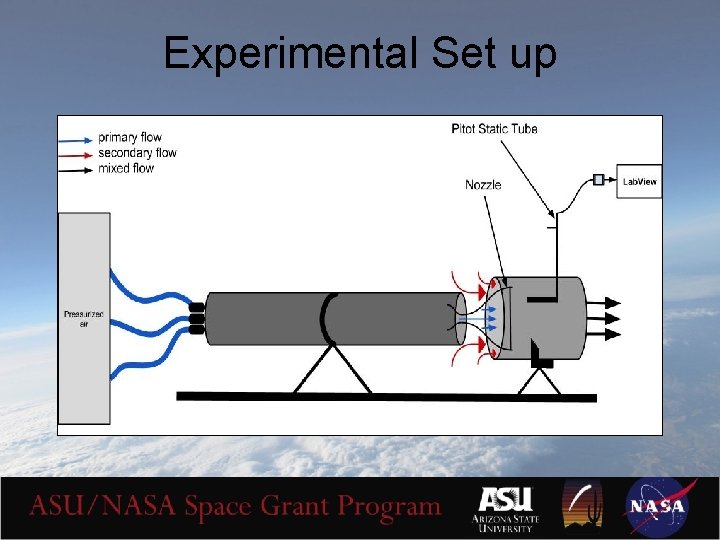
Experimental Set up
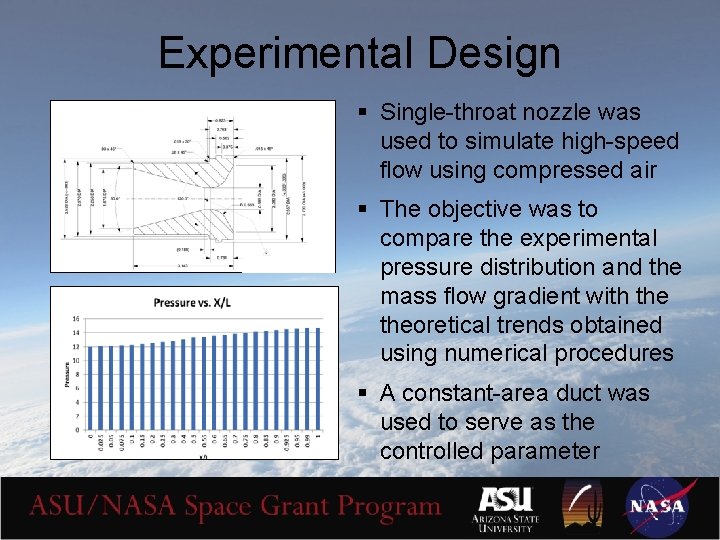
Experimental Design § Single-throat nozzle was used to simulate high-speed flow using compressed air § The objective was to compare the experimental pressure distribution and the mass flow gradient with theoretical trends obtained using numerical procedures § A constant-area duct was used to serve as the controlled parameter
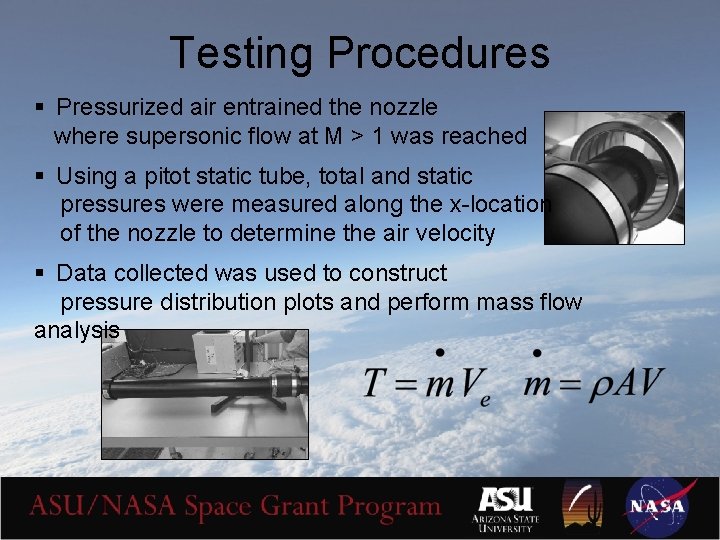
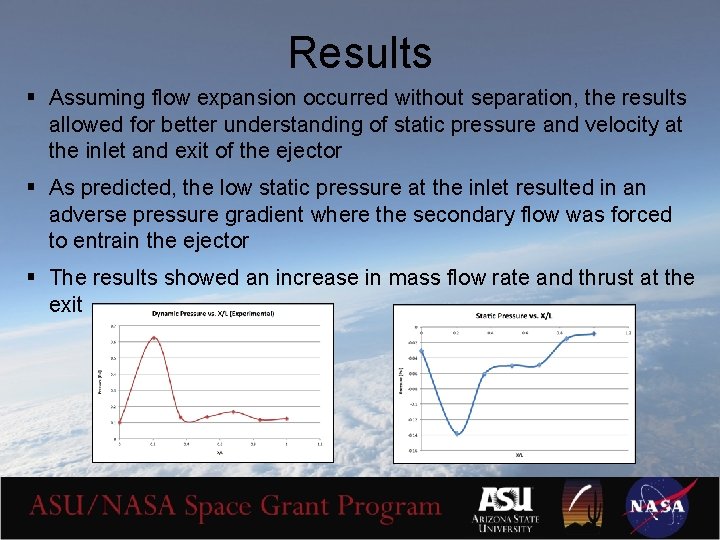
Testing Procedures § Pressurized air entrained the nozzle where supersonic flow at M > 1 was reached § Using a pitot static tube, total and static pressures were measured along the x-location of the nozzle to determine the air velocity § Data collected was used to construct pressure distribution plots and perform mass flow analysis
Results § Assuming flow expansion occurred without separation, the results allowed for better understanding of static pressure and velocity at the inlet and exit of the ejector § As predicted, the low static pressure at the inlet resulted in an adverse pressure gradient where the secondary flow was forced to entrain the ejector § The results showed an increase in mass flow rate and thrust at the exit
Project Outline § The experimental data provided the basis for understanding compressible air flow as it entrains the ejector and how it contributes to the increase in overall thrust of the rocket engine § The boundary conditions obtained will be used to design a nozzle geometry which prevents flow separation and takes into account compressibility § Ducts with varying cross-sectional geometry are to be tested for further analysis of mass flow behavior at the inlet and outlet § After modifying and improving the design, a hybrid engine will be used to further test various geometry nozzles and establish the basis for future work and flight applications
Thank you! Special Thanks to: Dr. Timothy Takahashi Gaines Gibson Dr. Bruce Steele