
Design of a Permanent Magnet Dipole For NTof

- Slides: 18
Design of a Permanent Magnet Dipole For N-Tof Experimental Area 1 to replace the existing M 200 electromagnet 31/10/2017 Pierre-Alexandre Thonet TE-MSC-MNC
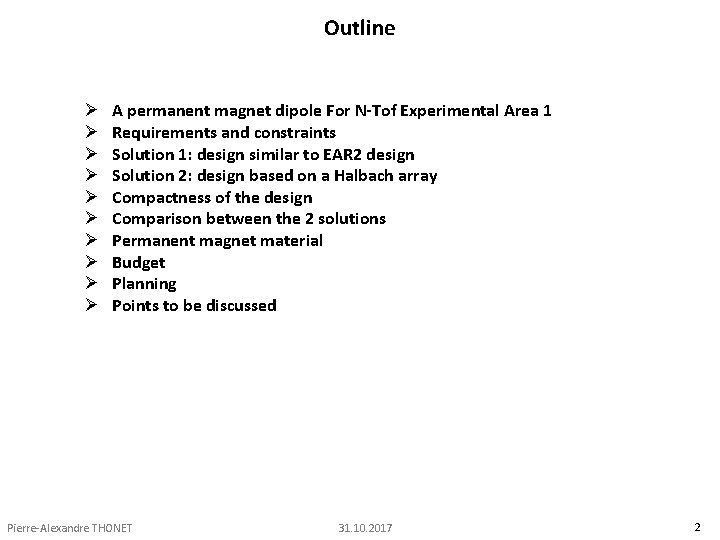
Outline Ø Ø Ø Ø Ø A permanent magnet dipole For N-Tof Experimental Area 1 Requirements and constraints Solution 1: design similar to EAR 2 design Solution 2: design based on a Halbach array Compactness of the design Comparison between the 2 solutions Permanent magnet material Budget Planning Points to be discussed Pierre-Alexandre THONET 31. 10. 2017 2
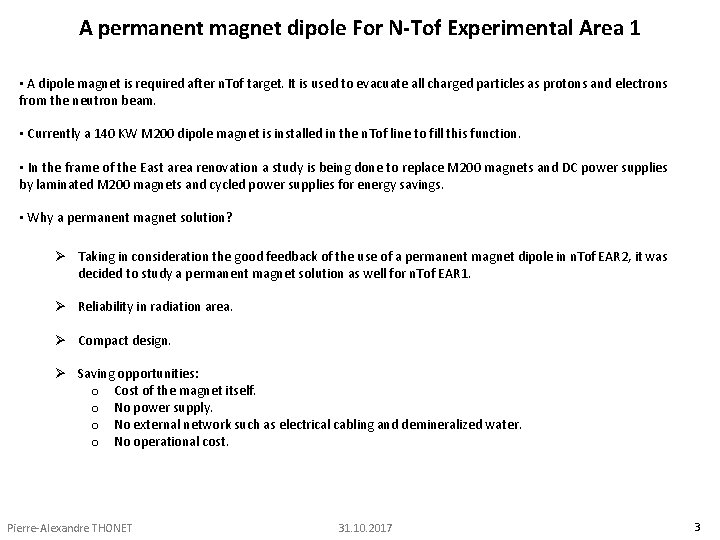
A permanent magnet dipole For N-Tof Experimental Area 1 • A dipole magnet is required after n. Tof target. It is used to evacuate all charged particles as protons and electrons from the neutron beam. • Currently a 140 KW M 200 dipole magnet is installed in the n. Tof line to fill this function. • In the frame of the East area renovation a study is being done to replace M 200 magnets and DC power supplies by laminated M 200 magnets and cycled power supplies for energy savings. • Why a permanent magnet solution? Ø Taking in consideration the good feedback of the use of a permanent magnet dipole in n. Tof EAR 2, it was decided to study a permanent magnet solution as well for n. Tof EAR 1. Ø Reliability in radiation area. Ø Compact design. Ø Saving opportunities: o Cost of the magnet itself. o No power supply. o No external network such as electrical cabling and demineralized water. o No operational cost. Pierre-Alexandre THONET 31. 10. 2017 3
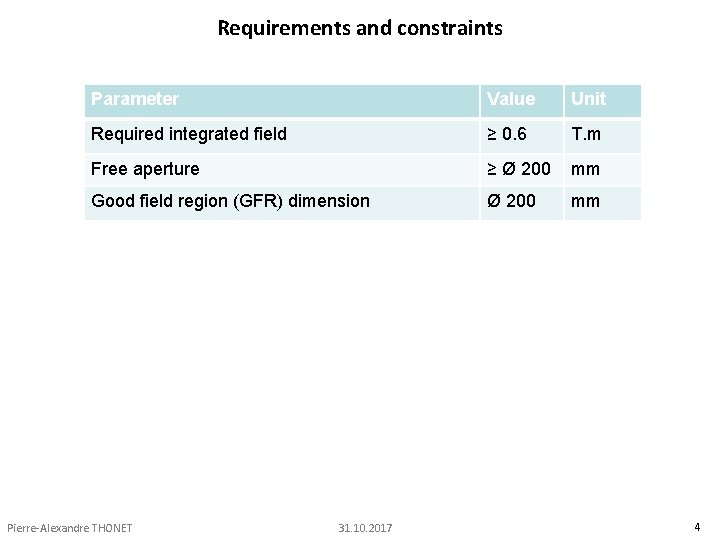
Requirements and constraints Parameter Value Unit Required integrated field ≥ 0. 6 T. m Free aperture ≥ Ø 200 mm Good field region (GFR) dimension Ø 200 mm Pierre-Alexandre THONET 31. 10. 2017 4
2 solutions are possible Ø SOLUTION 1: Based on the experience of n. Tof EAR 2, it is possible to make a similar design of this dipole, scaled with a smaller aperture. Ø SOLUTION 2: In order to reduce the overall weight of the dipole, it is also possible to make a design based on a Halbach array. Pierre-Alexandre THONET 31. 10. 2017 5
SOLUTION 1: Design similar to EAR 2 dipole Pierre-Alexandre THONET 31. 10. 2017 6
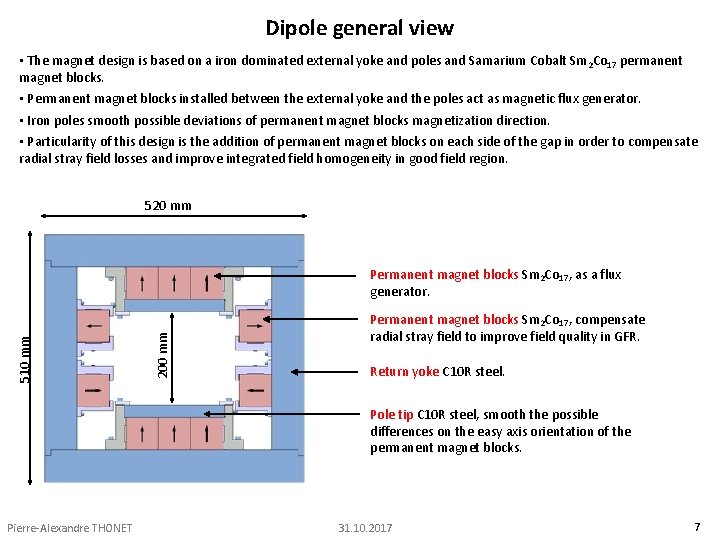
Dipole general view • The magnet design is based on a iron dominated external yoke and poles and Samarium Cobalt Sm 2 Co 17 permanent magnet blocks. • Permanent magnet blocks installed between the external yoke and the poles act as magnetic flux generator. • Iron poles smooth possible deviations of permanent magnet blocks magnetization direction. • Particularity of this design is the addition of permanent magnet blocks on each side of the gap in order to compensate radial stray field losses and improve integrated field homogeneity in good field region. 520 mm 200 mm 510 mm Permanent magnet blocks Sm 2 Co 17, as a flux generator. Permanent magnet blocks Sm 2 Co 17, compensate radial stray field to improve field quality in GFR. Return yoke C 10 R steel. Pole tip C 10 R steel, smooth the possible differences on the easy axis orientation of the permanent magnet blocks. Pierre-Alexandre THONET 31. 10. 2017 7
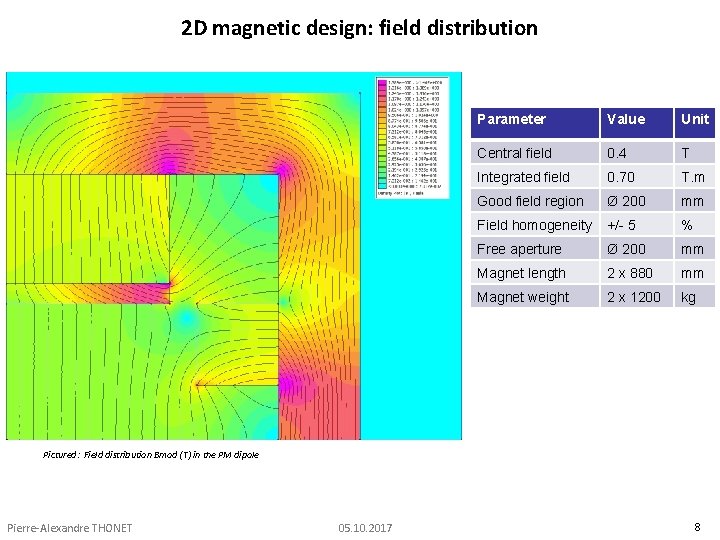
2 D magnetic design: field distribution Parameter Value Unit Central field 0. 4 T Integrated field 0. 70 T. m Good field region Ø 200 mm Field homogeneity +/- 5 % Free aperture Ø 200 mm Magnet length 2 x 880 mm Magnet weight 2 x 1200 kg Pictured: Field distribution Bmod (T) in the PM dipole Pierre-Alexandre THONET 05. 10. 2017 8
SOLUTION 2: Design based on a Halbach array Pierre-Alexandre THONET 31. 10. 2017 9
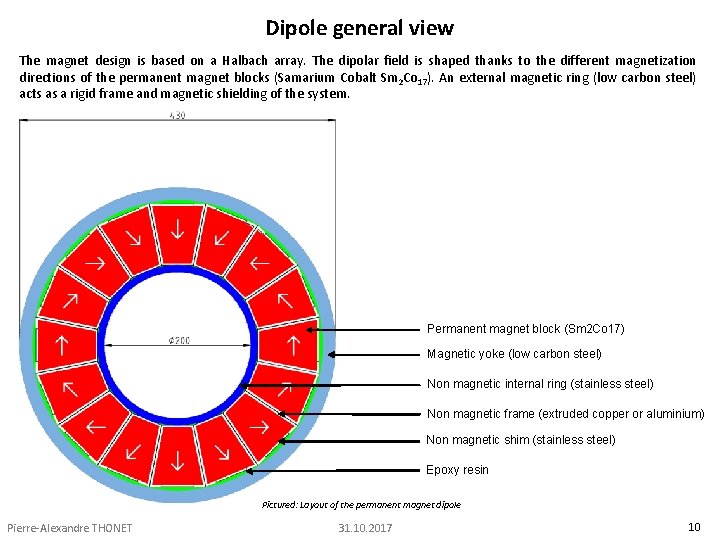
Dipole general view The magnet design is based on a Halbach array. The dipolar field is shaped thanks to the different magnetization directions of the permanent magnet blocks (Samarium Cobalt Sm 2 Co 17). An external magnetic ring (low carbon steel) acts as a rigid frame and magnetic shielding of the system. Permanent magnet block (Sm 2 Co 17) Magnetic yoke (low carbon steel) Non magnetic internal ring (stainless steel) Non magnetic frame (extruded copper or aluminium) Non magnetic shim (stainless steel) Epoxy resin Pictured: Layout of the permanent magnet dipole Pierre-Alexandre THONET 31. 10. 2017 10
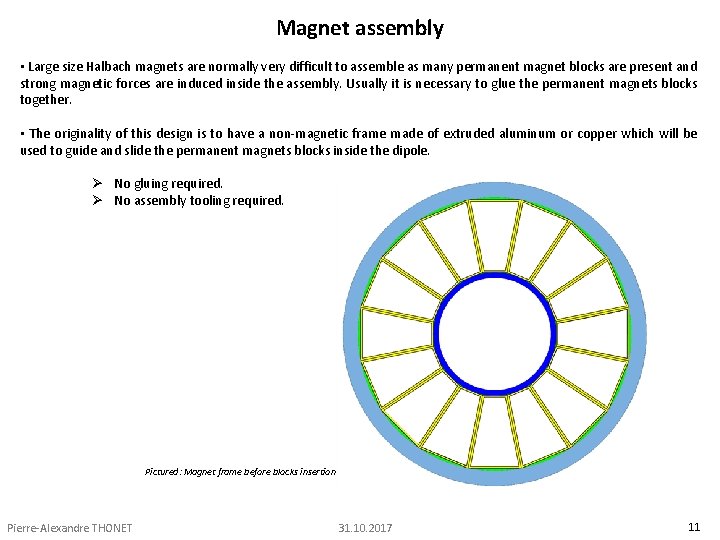
Magnet assembly • Large size Halbach magnets are normally very difficult to assemble as many permanent magnet blocks are present and strong magnetic forces are induced inside the assembly. Usually it is necessary to glue the permanent magnets blocks together. • The originality of this design is to have a non-magnetic frame made of extruded aluminum or copper which will be used to guide and slide the permanent magnets blocks inside the dipole. Ø No gluing required. Ø No assembly tooling required. Pictured: Magnet frame before blocks insertion Pierre-Alexandre THONET 31. 10. 2017 11
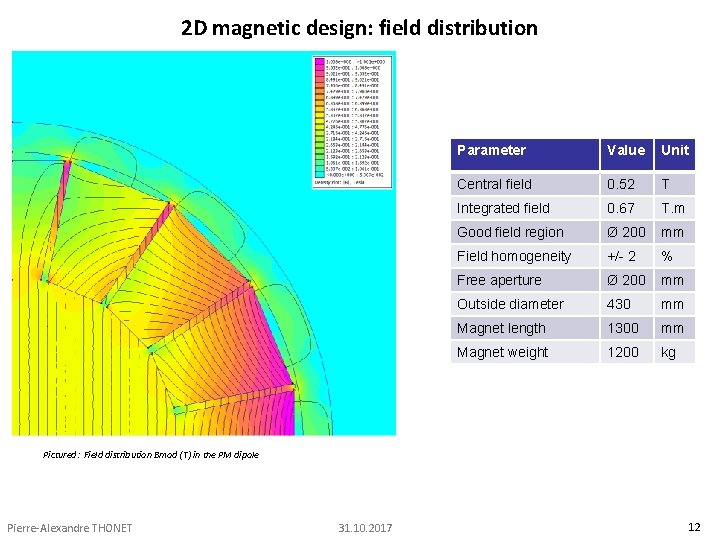
2 D magnetic design: field distribution Parameter Value Unit Central field 0. 52 T Integrated field 0. 67 T. m Good field region Ø 200 mm Field homogeneity +/- 2 % Free aperture Ø 200 mm Outside diameter 430 mm Magnet length 1300 mm Magnet weight 1200 kg Pictured: Field distribution Bmod (T) in the PM dipole Pierre-Alexandre THONET 31. 10. 2017 12
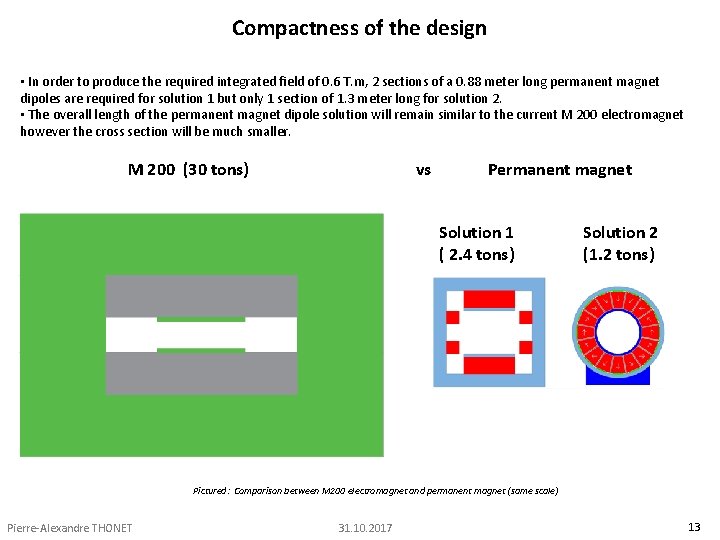
Compactness of the design • In order to produce the required integrated field of 0. 6 T. m, 2 sections of a 0. 88 meter long permanent magnet dipoles are required for solution 1 but only 1 section of 1. 3 meter long for solution 2. • The overall length of the permanent magnet dipole solution will remain similar to the current M 200 electromagnet however the cross section will be much smaller. M 200 (30 tons) vs Permanent magnet Solution 1 ( 2. 4 tons) Solution 2 (1. 2 tons) Pictured: Comparison between M 200 electromagnet and permanent magnet (same scale) Pierre-Alexandre THONET 31. 10. 2017 13
Comparison between the 2 solutions Advantages of solution 1: • We have the experience of a similar design with EAR 2 and we know how to assemble this magnet. • The permanent magnet blocks are all the same with an easy shape for manufacturing. Advantages of solution 2: • Very efficient design. • Design compact and light. • In theory the assembly would be easier as the dipole frame is used as the assembly tooling. • This design could become a good option for the assembly of large Halbach magnets. Pierre-Alexandre THONET 31. 10. 2017 14
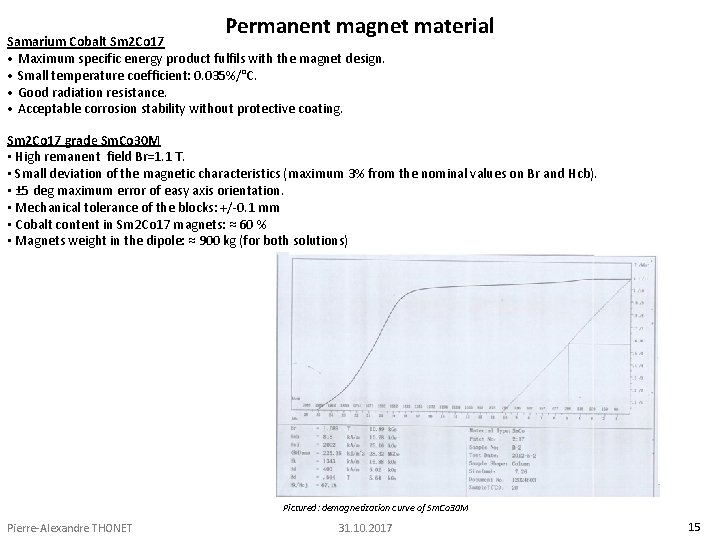
Permanent magnet material Samarium Cobalt Sm 2 Co 17 • Maximum specific energy product fulfils with the magnet design. • Small temperature coefficient: 0. 035%/°C. • Good radiation resistance. • Acceptable corrosion stability without protective coating. Sm 2 Co 17 grade Sm. Co 30 M • High remanent field Br=1. 1 T. • Small deviation of the magnetic characteristics (maximum 3% from the nominal values on Br and Hcb). • ± 5 deg maximum error of easy axis orientation. • Mechanical tolerance of the blocks: +/-0. 1 mm • Cobalt content in Sm 2 Co 17 magnets: ≈ 60 % • Magnets weight in the dipole: ≈ 900 kg (for both solutions) Pictured: demagnetization curve of Sm. Co 30 M Pierre-Alexandre THONET 31. 10. 2017 15
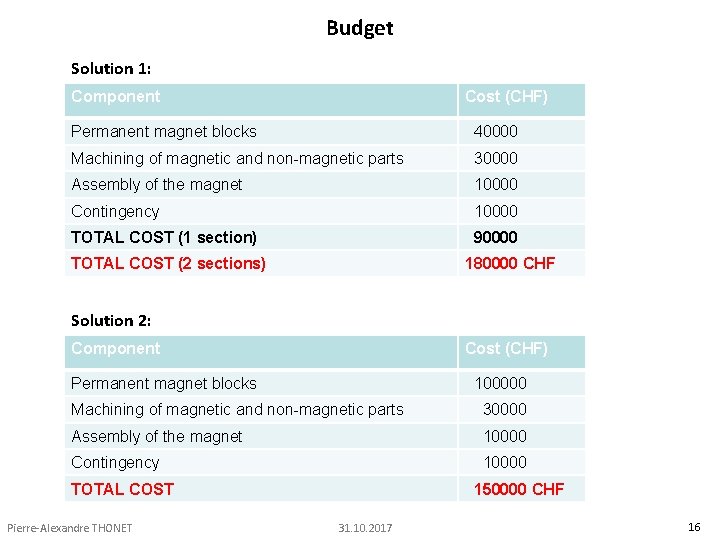
Budget Solution 1: Component Cost (CHF) Permanent magnet blocks 40000 Machining of magnetic and non-magnetic parts 30000 Assembly of the magnet 10000 Contingency 10000 TOTAL COST (1 section) 90000 TOTAL COST (2 sections) 180000 CHF Solution 2: Component Cost (CHF) Permanent magnet blocks 100000 Machining of magnetic and non-magnetic parts 30000 Assembly of the magnet 10000 Contingency 10000 TOTAL COST Pierre-Alexandre THONET 150000 CHF 31. 10. 2017 16
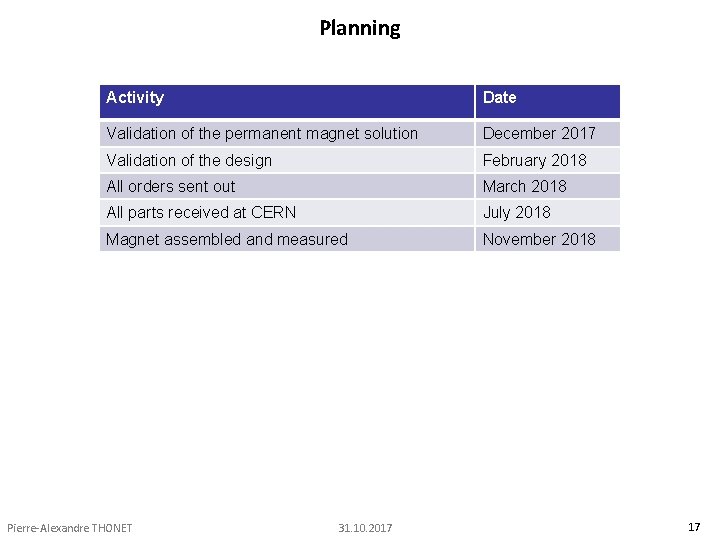
Planning Activity Date Validation of the permanent magnet solution December 2017 Validation of the design February 2018 All orders sent out March 2018 All parts received at CERN July 2018 Magnet assembled and measured November 2018 Pierre-Alexandre THONET 31. 10. 2017 17
Points to be discussed • Confirmation that an integrated field of 0. 6 T. m is sufficient. • Confirmation that an aperture of 200 mm is sufficient. • Confirmation of the required integrated field homogeneity. • Discussion and choice between solution 1 and solution 2. • Definition of suitable protection covers. • Verification that vacuum chamber insertion procedure is compatible with magnet assembly. • Discussion with transport about the removal of the existing M 200 magnet. • Budget and planning. Pierre-Alexandre THONET 31. 10. 2017 18