
Design of a Human Hand Prosthesis Paul Ventimiglia
- Slides: 1
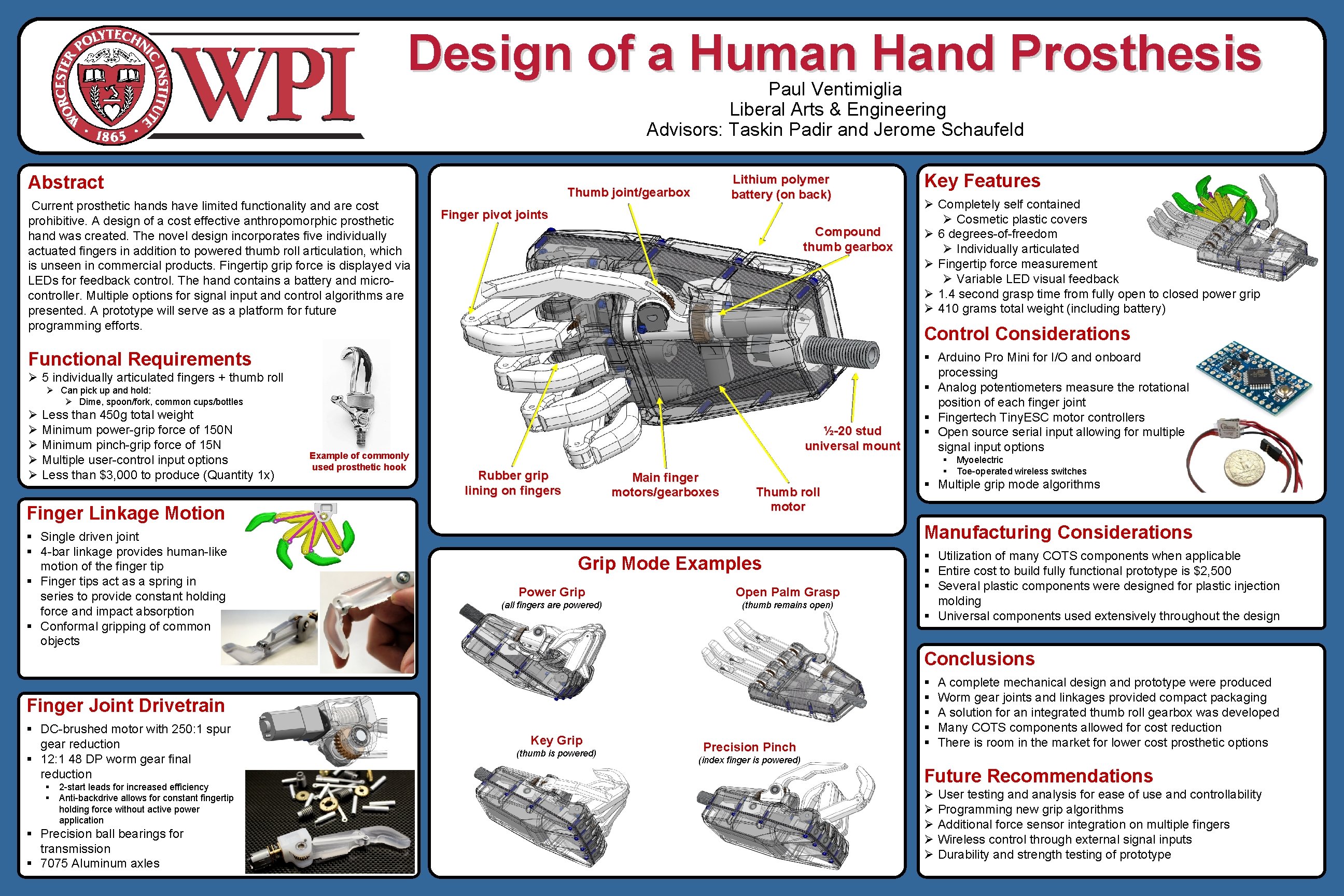
Design of a Human Hand Prosthesis Paul Ventimiglia Liberal Arts & Engineering Advisors: Taskin Padir and Jerome Schaufeld Abstract Current prosthetic hands have limited functionality and are cost prohibitive. A design of a cost effective anthropomorphic prosthetic hand was created. The novel design incorporates five individually actuated fingers in addition to powered thumb roll articulation, which is unseen in commercial products. Fingertip grip force is displayed via LEDs for feedback control. The hand contains a battery and microcontroller. Multiple options for signal input and control algorithms are presented. A prototype will serve as a platform for future programming efforts. Lithium polymer battery (on back) Thumb joint/gearbox Finger pivot joints Compound thumb gearbox Ø 5 individually articulated fingers + thumb roll Ø Can pick up and hold: Ø Dime, spoon/fork, common cups/bottles Less than 450 g total weight Minimum power-grip force of 150 N Minimum pinch-grip force of 15 N Multiple user-control input options Less than $3, 000 to produce (Quantity 1 x) Example of commonly used prosthetic hook ½-20 stud universal mount Rubber grip lining on fingers Main finger motors/gearboxes Finger Linkage Motion § Single driven joint § 4 -bar linkage provides human-like motion of the finger tip § Finger tips act as a spring in series to provide constant holding force and impact absorption § Conformal gripping of common objects Ø Completely self contained Ø Cosmetic plastic covers Ø 6 degrees-of-freedom Ø Individually articulated Ø Fingertip force measurement Ø Variable LED visual feedback Ø 1. 4 second grasp time from fully open to closed power grip Ø 410 grams total weight (including battery) Control Considerations Functional Requirements Ø Ø Ø Key Features § Arduino Pro Mini for I/O and onboard processing § Analog potentiometers measure the rotational position of each finger joint § Fingertech Tiny. ESC motor controllers § Open source serial input allowing for multiple signal input options § § Thumb roll motor Myoelectric Toe-operated wireless switches § Multiple grip mode algorithms Manufacturing Considerations Grip Mode Examples Power Grip Open Palm Grasp (all fingers are powered) (thumb remains open) § Utilization of many COTS components when applicable § Entire cost to build fully functional prototype is $2, 500 § Several plastic components were designed for plastic injection molding § Universal components used extensively throughout the design Conclusions Finger Joint Drivetrain § DC-brushed motor with 250: 1 spur gear reduction § 12: 1 48 DP worm gear final reduction § § 2 -start leads for increased efficiency Anti-backdrive allows for constant fingertip holding force without active power application § Precision ball bearings for transmission § 7075 Aluminum axles Key Grip (thumb is powered) Precision Pinch § § § A complete mechanical design and prototype were produced Worm gear joints and linkages provided compact packaging A solution for an integrated thumb roll gearbox was developed Many COTS components allowed for cost reduction There is room in the market for lower cost prosthetic options (index finger is powered) Future Recommendations Ø Ø Ø User testing and analysis for ease of use and controllability Programming new grip algorithms Additional force sensor integration on multiple fingers Wireless control through external signal inputs Durability and strength testing of prototype