
Design of a Hadamard Transform Spectral Imaging System
- Slides: 1
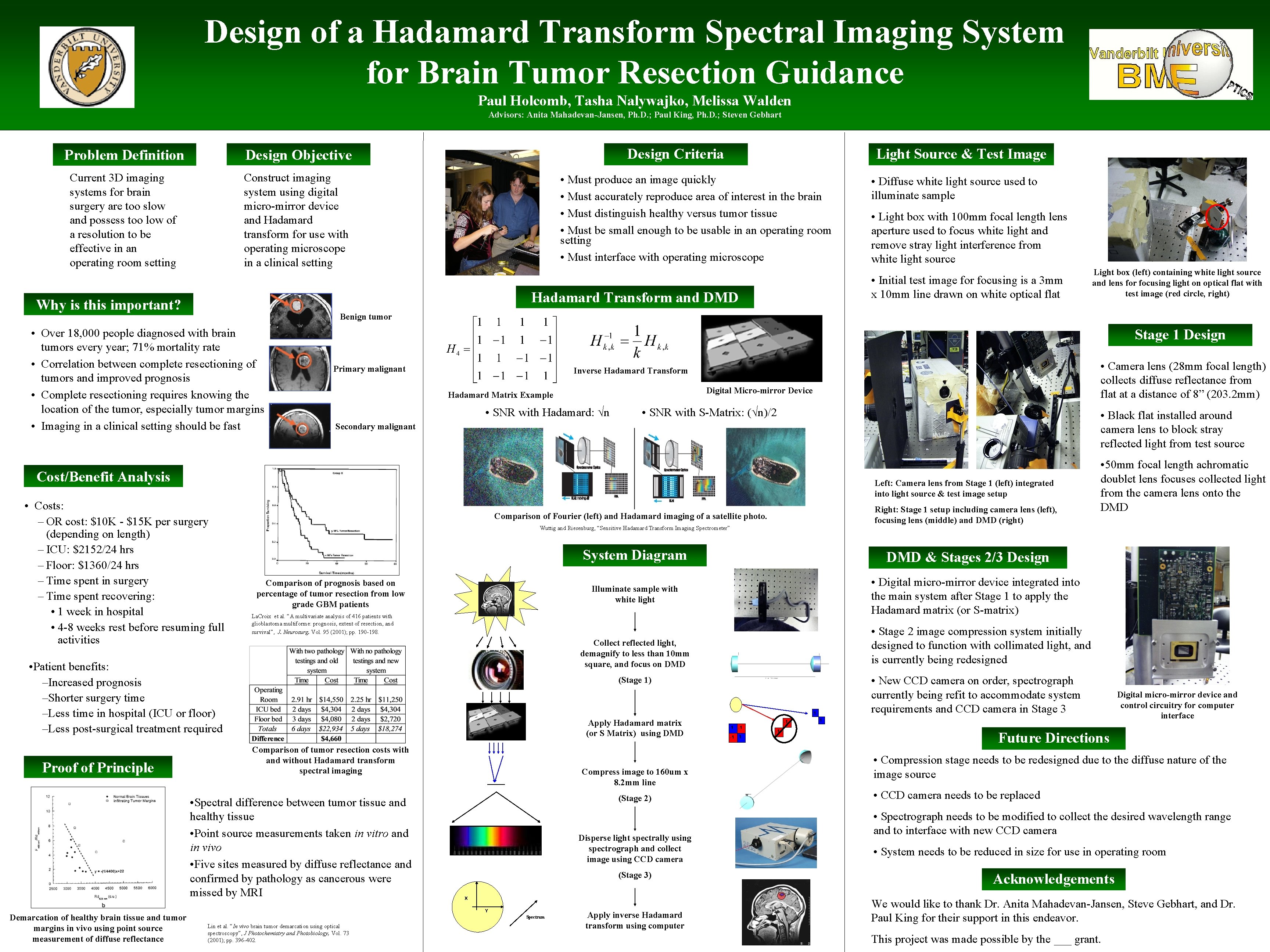
Design of a Hadamard Transform Spectral Imaging System for Brain Tumor Resection Guidance Paul Holcomb, Tasha Nalywajko, Melissa Walden Advisors: Anita Mahadevan-Jansen, Ph. D. ; Paul King, Ph. D. ; Steven Gebhart Problem Definition Design Objective Current 3 D imaging systems for brain surgery are too slow and possess too low of a resolution to be effective in an operating room setting Construct imaging system using digital micro-mirror device and Hadamard transform for use with operating microscope in a clinical setting Design Criteria Light Source & Test Image • Must produce an image quickly • Must accurately reproduce area of interest in the brain • Must distinguish healthy versus tumor tissue • Must be small enough to be usable in an operating room setting • Must interface with operating microscope Stage 1 Design Primary malignant • Camera lens (28 mm focal length) collects diffuse reflectance from flat at a distance of 8” (203. 2 mm) Inverse Hadamard Transform Digital Micro-mirror Device Hadamard Matrix Example • SNR with Hadamard: √n • SNR with S-Matrix: (√n)/2 • Black flat installed around camera lens to block stray reflected light from test source Secondary malignant Cost/Benefit Analysis Left: Camera lens from Stage 1 (left) integrated into light source & test image setup • Costs: – OR cost: $10 K - $15 K per surgery (depending on length) – ICU: $2152/24 hrs – Floor: $1360/24 hrs – Time spent in surgery – Time spent recovering: • 1 week in hospital • 4 -8 weeks rest before resuming full activities Right: Stage 1 setup including camera lens (left), focusing lens (middle) and DMD (right) Comparison of Fourier (left) and Hadamard imaging of a satellite photo. • 50 mm focal length achromatic doublet lens focuses collected light from the camera lens onto the DMD Wuttig and Riesenburg, “Sensitive Hadamard Transform Imaging Spectrometer” System Diagram Comparison of prognosis based on percentage of tumor resection from low grade GBM patients DMD & Stages 2/3 Design • Digital micro-mirror device integrated into the main system after Stage 1 to apply the Hadamard matrix (or S-matrix) Illuminate sample with white light La. Croix et al. “A multivariate analysis of 416 patients with glioblastoma multiforme: prognosis, extent of resection, and survival”, J. Neurosurg. Vol. 95 (2001); pp. 190 -198. • Stage 2 image compression system initially designed to function with collimated light, and is currently being redesigned Collect reflected light, demagnify to less than 10 mm square, and focus on DMD • Patient benefits: –Increased prognosis –Shorter surgery time –Less time in hospital (ICU or floor) –Less post-surgical treatment required • New CCD camera on order, spectrograph currently being refit to accommodate system requirements and CCD camera in Stage 3 (Stage 1) 1 Apply Hadamard matrix (or S Matrix) using DMD Comparison of tumor resection costs with and without Hadamard transform spectral imaging • Spectral difference between tumor tissue and healthy tissue • Point source measurements taken in vitro and in vivo • Five sites measured by diffuse reflectance and confirmed by pathology as cancerous were missed by MRI Demarcation of healthy brain tissue and tumor margins in vivo using point source measurement of diffuse reflectance Light box (left) containing white light source and lens for focusing light on optical flat with test image (red circle, right) Benign tumor • Over 18, 000 people diagnosed with brain tumors every year; 71% mortality rate • Correlation between complete resectioning of tumors and improved prognosis • Complete resectioning requires knowing the location of the tumor, especially tumor margins • Imaging in a clinical setting should be fast Proof of Principle • Light box with 100 mm focal length lens aperture used to focus white light and remove stray light interference from white light source • Initial test image for focusing is a 3 mm x 10 mm line drawn on white optical flat Hadamard Transform and DMD Why is this important? • Diffuse white light source used to illuminate sample Compress image to 160 um x 8. 2 mm line (Stage 2) Disperse light spectrally using spectrograph and collect image using CCD camera (Stage 3) X Y Spectrum Lin et al. “In vivo brain tumor demarcation using optical spectroscopy”, J Photochemistry and Photobiology, Vol. 73 (2001); pp. 396 -402. Apply inverse Hadamard transform using computer -1 1 Digital micro-mirror device and control circuitry for computer interface Future Directions • Compression stage needs to be redesigned due to the diffuse nature of the image source • CCD camera needs to be replaced • Spectrograph needs to be modified to collect the desired wavelength range and to interface with new CCD camera • System needs to be reduced in size for use in operating room Acknowledgements We would like to thank Dr. Anita Mahadevan-Jansen, Steve Gebhart, and Dr. Paul King for their support in this endeavor. This project was made possible by the ___ grant.