
Design of a FRETbased assay for detection of
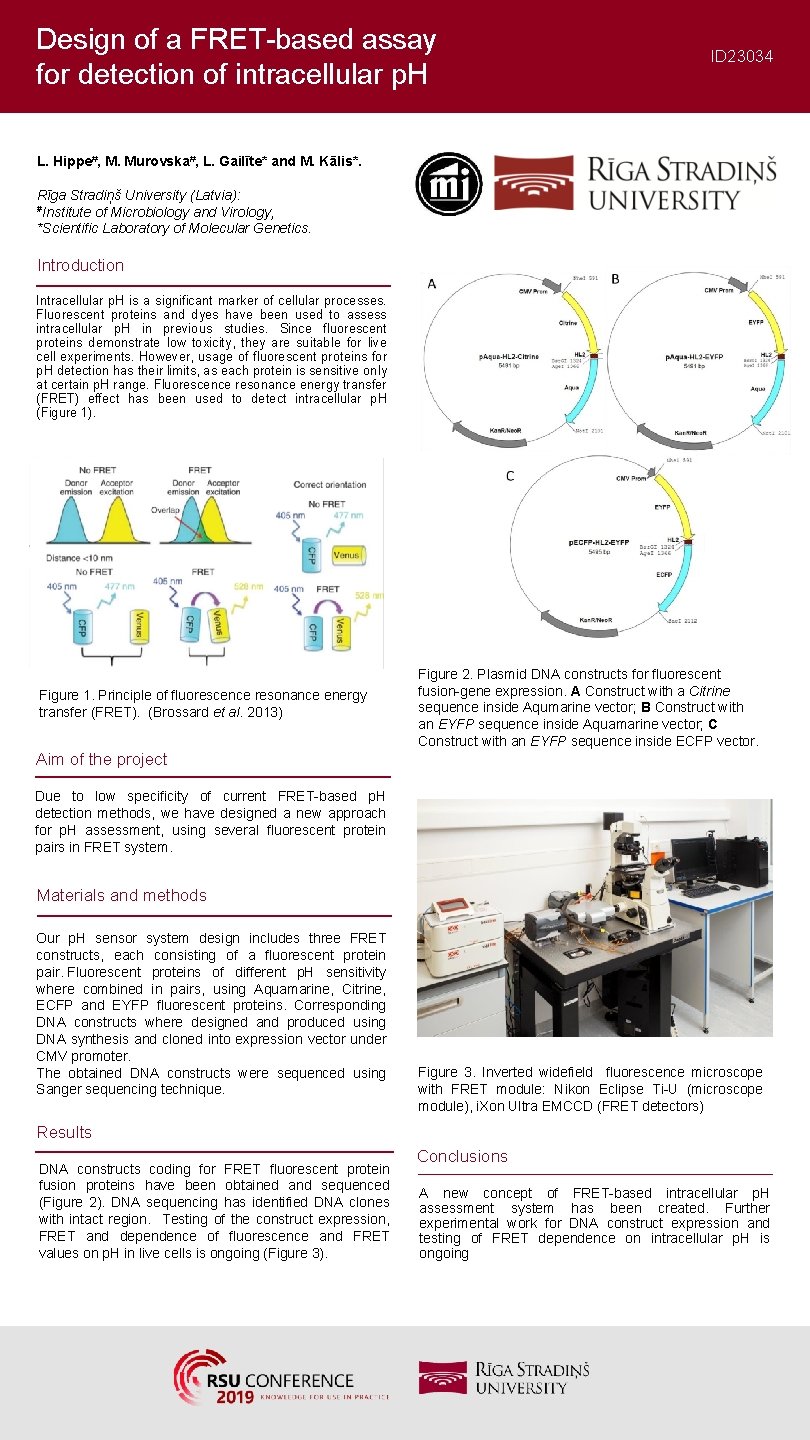
Design of a FRET-based assay for detection of intracellular p. H ID 23034 L. Hippe#, M. Murovska#, L. Gailīte* and M. Kālis*. Rīga Stradiņš University (Latvia): #Institute of Microbiology and Virology, *Scientific Laboratory of Molecular Genetics. Introduction Intracellular p. H is a significant marker of cellular processes. Fluorescent proteins and dyes have been used to assess intracellular p. H in previous studies. Since fluorescent proteins demonstrate low toxicity, they are suitable for live cell experiments. However, usage of fluorescent proteins for p. H detection has their limits, as each protein is sensitive only at certain p. H range. Fluorescence resonance energy transfer (FRET) effect has been used to detect intracellular p. H (Figure 1). Figure 1. Principle of fluorescence resonance energy transfer (FRET). (Brossard et al. 2013) Figure 2. Plasmid DNA constructs for fluorescent fusion-gene expression. A Construct with a Citrine sequence inside Aqumarine vector; B Construct with an EYFP sequence inside Aquamarine vector; C Construct with an EYFP sequence inside ECFP vector. Aim of the project Due to low specificity of current FRET-based p. H detection methods, we have designed a new approach for p. H assessment, using several fluorescent protein pairs in FRET system. Materials and methods Our p. H sensor system design includes three FRET constructs, each consisting of a fluorescent protein pair. Fluorescent proteins of different p. H sensitivity where combined in pairs, using Aquamarine, Citrine, ECFP and EYFP fluorescent proteins. Corresponding DNA constructs where designed and produced using DNA synthesis and cloned into expression vector under CMV promoter. The obtained DNA constructs were sequenced using Sanger sequencing technique. Figure 3. Inverted widefield fluorescence microscope with FRET module: Nikon Eclipse Ti-U (microscope module), i. Xon Ultra EMCCD (FRET detectors) Results DNA constructs coding for FRET fluorescent protein fusion proteins have been obtained and sequenced (Figure 2). DNA sequencing has identified DNA clones with intact region. Testing of the construct expression, FRET and dependence of fluorescence and FRET values on p. H in live cells is ongoing (Figure 3). Conclusions A new concept of FRET-based intracellular p. H assessment system has been created. Further experimental work for DNA construct expression and testing of FRET dependence on intracellular p. H is ongoing
- Slides: 1