
Design of a Coatingless Optical Cavity based on
Design of a Coating-less Optical Cavity based on Total Internal Reflection Deep Chatterjee IISER Kolkata Mentors: Koji Arai; Matthew Abernathy LIGO-G 1300821 -v 1 Form F 0900043 -v 1
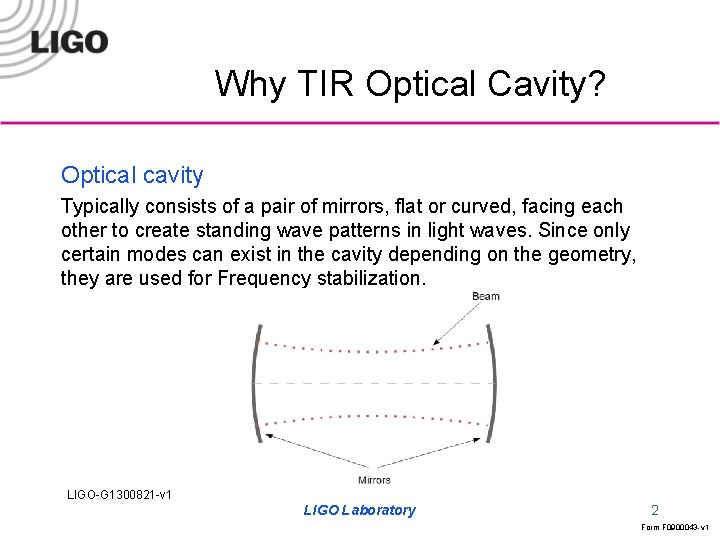
Why TIR Optical Cavity? Optical cavity Typically consists of a pair of mirrors, flat or curved, facing each other to create standing wave patterns in light waves. Since only certain modes can exist in the cavity depending on the geometry, they are used for Frequency stabilization. LIGO-G 1300821 -v 1 LIGO Laboratory 2 Form F 0900043 -v 1
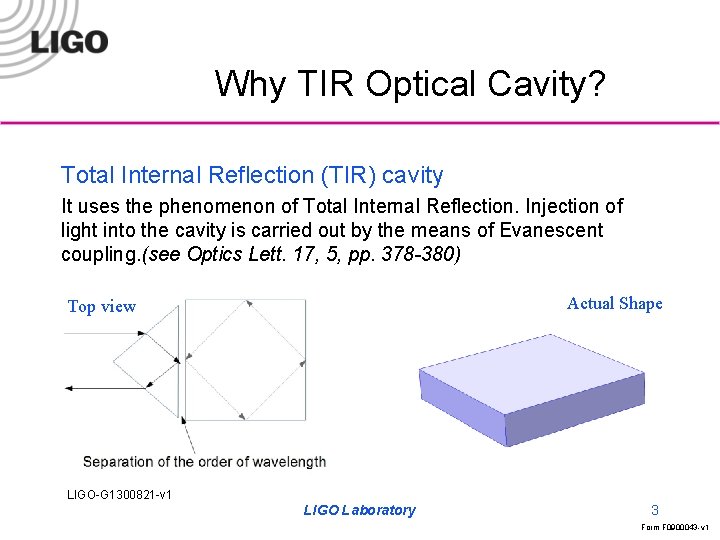
Why TIR Optical Cavity? Total Internal Reflection (TIR) cavity It uses the phenomenon of Total Internal Reflection. Injection of light into the cavity is carried out by the means of Evanescent coupling. (see Optics Lett. 17, 5, pp. 378 -380) Actual Shape Top view LIGO-G 1300821 -v 1 LIGO Laboratory 3 Form F 0900043 -v 1
Why TIR Optical Cavity? • • • No mirrors used and hence no reflection coatings Brownian Thermal Noise from coatings is a big issue Coating removal is better for frequency stabilization High reflectivity without coatings can be achieved with TIR Cancelling other Thermal Noise sources is a possibility. TIR cavity is expected to be more “quiet” and is suitable for frequency stabilization LIGO-G 1300821 -v 1 LIGO Laboratory 4 Form F 0900043 -v 1
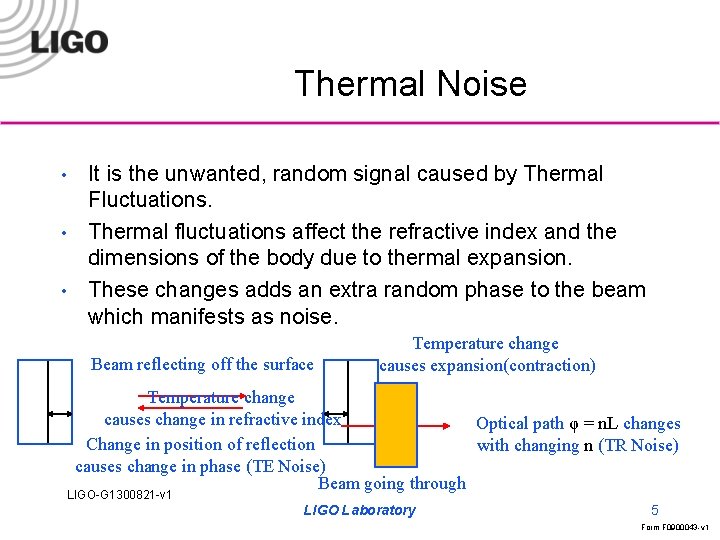
Thermal Noise • • • It is the unwanted, random signal caused by Thermal Fluctuations. Thermal fluctuations affect the refractive index and the dimensions of the body due to thermal expansion. These changes adds an extra random phase to the beam which manifests as noise. Beam reflecting off the surface Temperature change causes expansion(contraction) Temperature change causes change in refractive index Optical path φ = n. L changes Change in position of reflection with changing n (TR Noise) causes change in phase (TE Noise) Beam going through LIGO-G 1300821 -v 1 LIGO Laboratory 5 Form F 0900043 -v 1
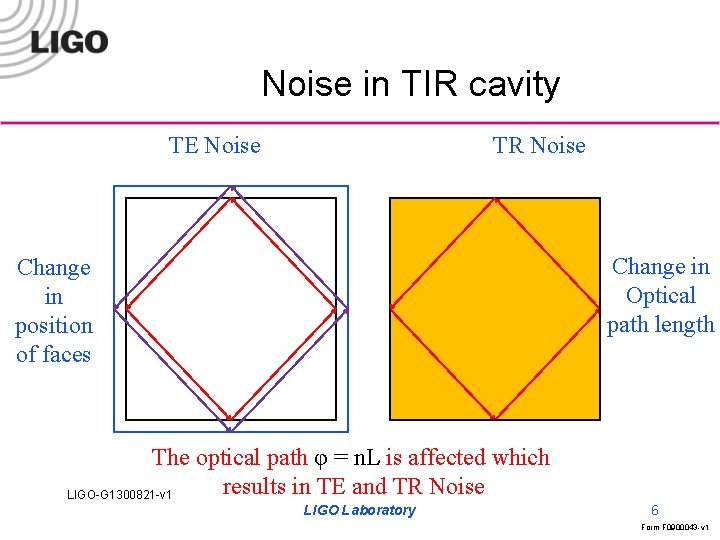
Noise in TIR cavity TE Noise TR Noise Change in Optical path length Change in position of faces The optical path φ = n. L is affected which results in TE and TR Noise LIGO-G 1300821 -v 1 LIGO Laboratory 6 Form F 0900043 -v 1
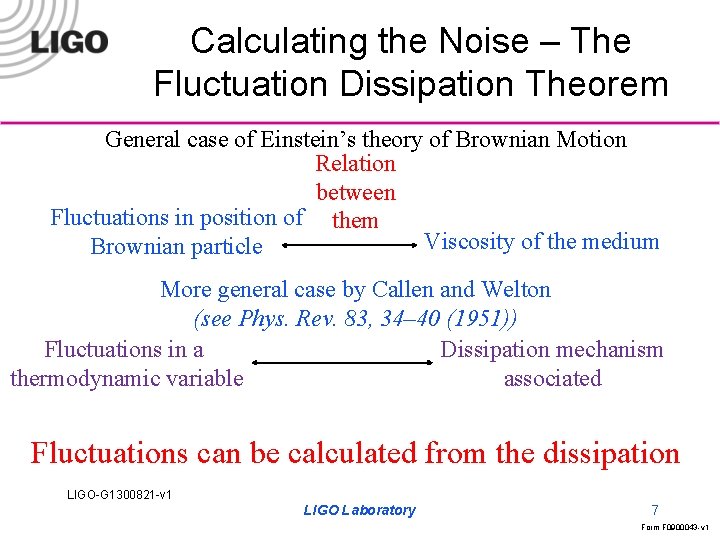
Calculating the Noise – The Fluctuation Dissipation Theorem General case of Einstein’s theory of Brownian Motion Relation between Fluctuations in position of them Viscosity of the medium Brownian particle More general case by Callen and Welton (see Phys. Rev. 83, 34– 40 (1951)) Fluctuations in a Dissipation mechanism thermodynamic variable associated Fluctuations can be calculated from the dissipation LIGO-G 1300821 -v 1 LIGO Laboratory 7 Form F 0900043 -v 1
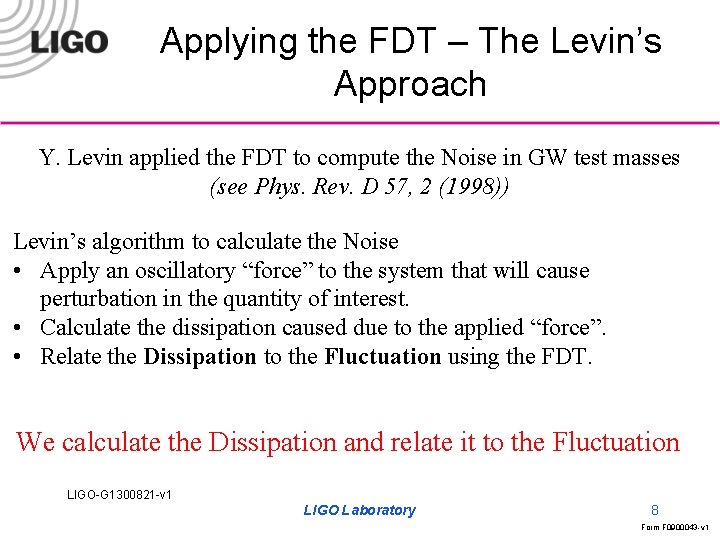
Applying the FDT – The Levin’s Approach Y. Levin applied the FDT to compute the Noise in GW test masses (see Phys. Rev. D 57, 2 (1998)) Levin’s algorithm to calculate the Noise • Apply an oscillatory “force” to the system that will cause perturbation in the quantity of interest. • Calculate the dissipation caused due to the applied “force”. • Relate the Dissipation to the Fluctuation using the FDT. We calculate the Dissipation and relate it to the Fluctuation LIGO-G 1300821 -v 1 LIGO Laboratory 8 Form F 0900043 -v 1
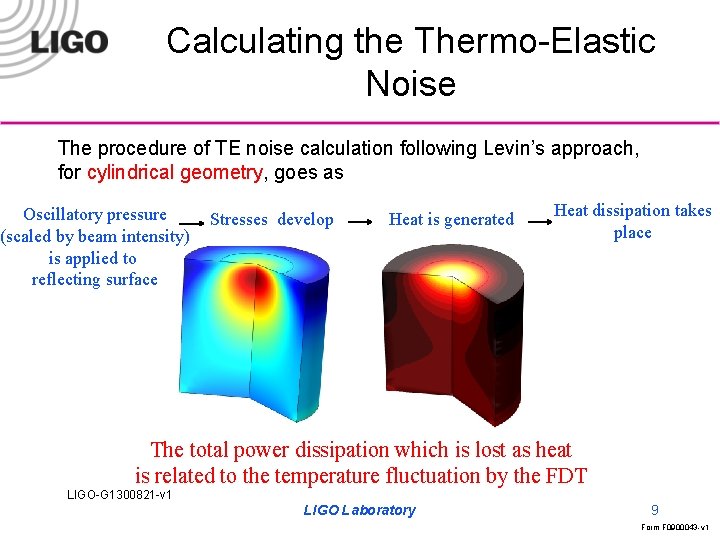
Calculating the Thermo-Elastic Noise The procedure of TE noise calculation following Levin’s approach, for cylindrical geometry, goes as Oscillatory pressure (scaled by beam intensity) is applied to reflecting surface Stresses develop Heat is generated Heat dissipation takes place The total power dissipation which is lost as heat is related to the temperature fluctuation by the FDT LIGO-G 1300821 -v 1 LIGO Laboratory 9 Form F 0900043 -v 1
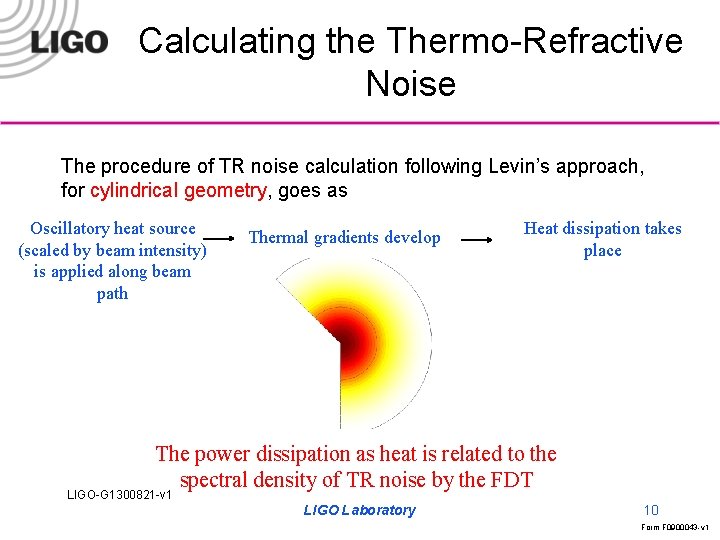
Calculating the Thermo-Refractive Noise The procedure of TR noise calculation following Levin’s approach, for cylindrical geometry, goes as Oscillatory heat source (scaled by beam intensity) is applied along beam path Thermal gradients develop Heat dissipation takes place The power dissipation as heat is related to the spectral density of TR noise by the FDT LIGO-G 1300821 -v 1 LIGO Laboratory 10 Form F 0900043 -v 1
Finite Element Calculation of TE and TR Noise • • • Finite Element Analysis (FEA) was performed using COMSOL and MATLAB. Simpler case of cylindrical cavity was tested out first. Results were compared to the analytic cases. Aim to find suitable material properties that minimizes the total TE and TR noise. Expect to look towards cancellation of TE and TR Noise. LIGO-G 1300821 -v 1 LIGO Laboratory 11 Form F 0900043 -v 1
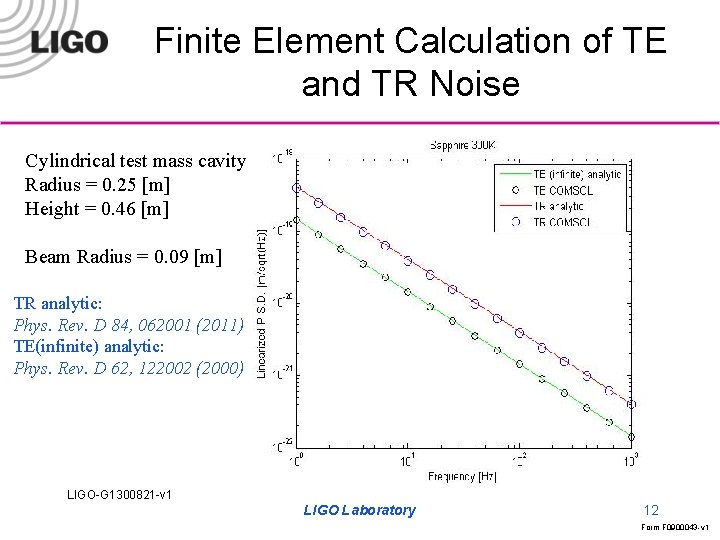
Finite Element Calculation of TE and TR Noise Cylindrical test mass cavity Radius = 0. 25 [m] Height = 0. 46 [m] Beam Radius = 0. 09 [m] TR analytic: Phys. Rev. D 84, 062001 (2011) TE(infinite) analytic: Phys. Rev. D 62, 122002 (2000) LIGO-G 1300821 -v 1 LIGO Laboratory 12 Form F 0900043 -v 1
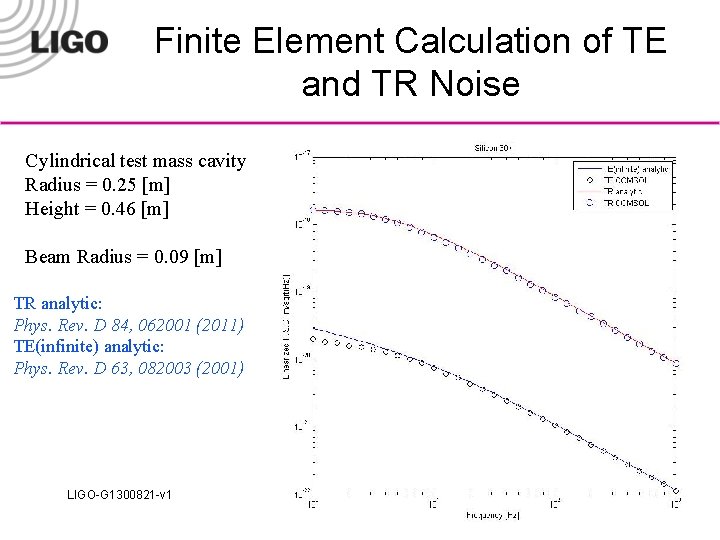
Finite Element Calculation of TE and TR Noise Cylindrical test mass cavity Radius = 0. 25 [m] Height = 0. 46 [m] Beam Radius = 0. 09 [m] TR analytic: Phys. Rev. D 84, 062001 (2011) TE(infinite) analytic: Phys. Rev. D 63, 082003 (2001) LIGO-G 1300821 -v 1 LIGO Laboratory 13 Form F 0900043 -v 1
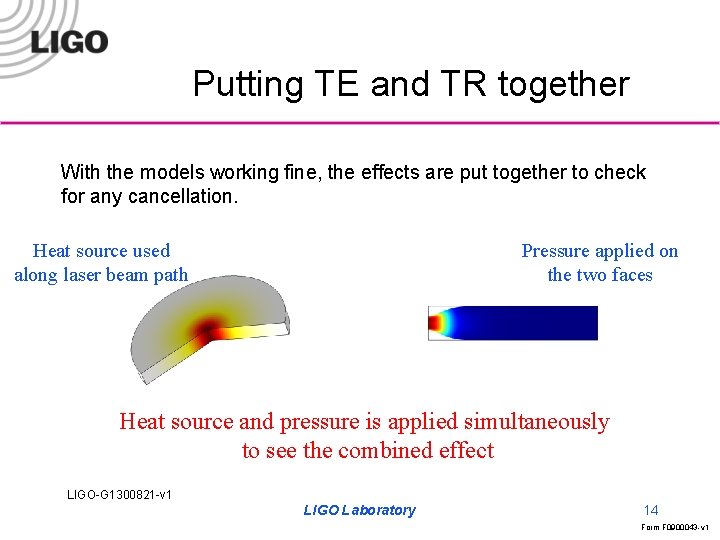
Putting TE and TR together With the models working fine, the effects are put together to check for any cancellation. Heat source used along laser beam path Pressure applied on the two faces Heat source and pressure is applied simultaneously to see the combined effect LIGO-G 1300821 -v 1 LIGO Laboratory 14 Form F 0900043 -v 1
![Putting TE and TR together Cylindrical test mass cavity Radius = 0. 25 [m]](http://slidetodoc.com/presentation_image_h2/f7d65d850e629de89b710c59b2fc9b59/image-15.jpg "Putting TE and TR together Cylindrical test mass cavity Radius = 0. 25 [m]")
Putting TE and TR together Cylindrical test mass cavity Radius = 0. 25 [m] Height = 0. 46 [m] Beam Radius = 0. 09 [m] TR analytic: Phys. Rev. D 84, 062001 (2011) TE(infinite) analytic: Phys. Rev. D 62, 122002 (2000) LIGO-G 1300821 -v 1 LIGO Laboratory 15 Form F 0900043 -v 1
![Putting TE and TR together Cylindrical test mass cavity Radius = 0. 25 [m]](http://slidetodoc.com/presentation_image_h2/f7d65d850e629de89b710c59b2fc9b59/image-16.jpg "Putting TE and TR together Cylindrical test mass cavity Radius = 0. 25 [m]")
Putting TE and TR together Cylindrical test mass cavity Radius = 0. 25 [m] Height = 0. 1 [m] Beam Radius = 0. 09 [m] TR analytic: Phys. Rev. D 84, 062001 (2011) TE(infinite) analytic: Phys. Rev. D 63, 082003 (2001) LIGO-G 1300821 -v 1 LIGO Laboratory 16 Form F 0900043 -v 1
Future Work • • • Parametric study to bring TE and TR noise close. Cancellation occurs when TE and TR are of same order Building the correct model for TIR cavity Calculate Noise using FEA for the same Noise Cancellation – Can it be achieved? If not cancelled, can the noise be minimized? LIGO-G 1300821 -v 1 LIGO Laboratory 17 Form F 0900043 -v 1
Summary and Conclusion • • Simpler model has been built successfully. Special Analytic cases have been tested. Model is expected to work well for the TIR cavity Noise cancellation has to be thought about. LIGO-G 1300821 -v 1 LIGO Laboratory 18 Form F 0900043 -v 1
Thank you LIGO-G 1300821 -v 1 Form F 0900043 -v 1
- Slides: 19