
Design It MGMT 20140 Problem Lack of Motivation
Design It : MGMT 20140 Problem : Lack of Motivation to exercise Design thinking : “Design thinking is an orientation toward learning that encompasses active problem solving and believing in one’s ability to create impactful change” (Caroll, 2015). Submitted by: Basant Kumar K C 12035198 Chandra Bahadur Thapa 12030555 Nabina Maharjan 12045397 Tonmoy Deb 12043755
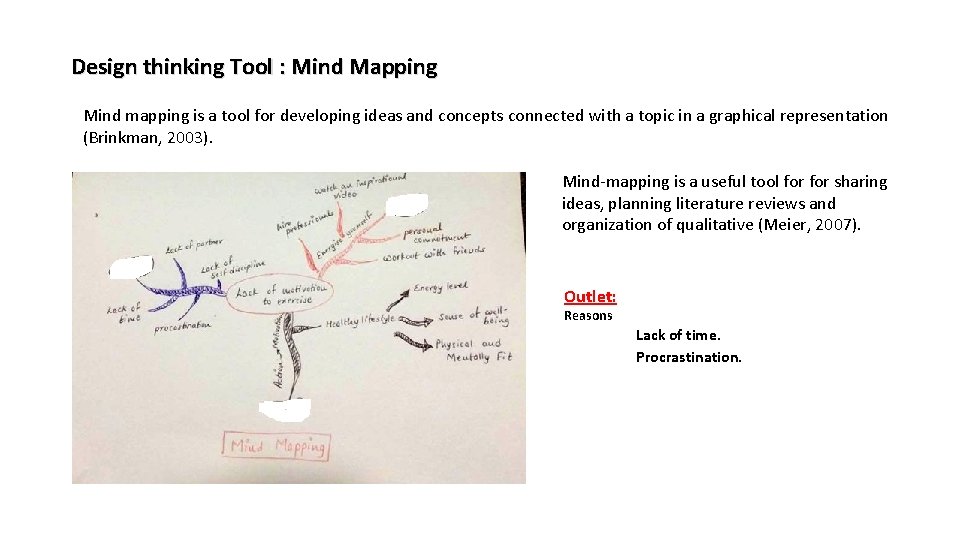
Design thinking Tool : Mind Mapping Mind mapping is a tool for developing ideas and concepts connected with a topic in a graphical representation (Brinkman, 2003). Mind-mapping is a useful tool for sharing ideas, planning literature reviews and organization of qualitative (Meier, 2007). Outlet: Reasons Lack of time. Procrastination.
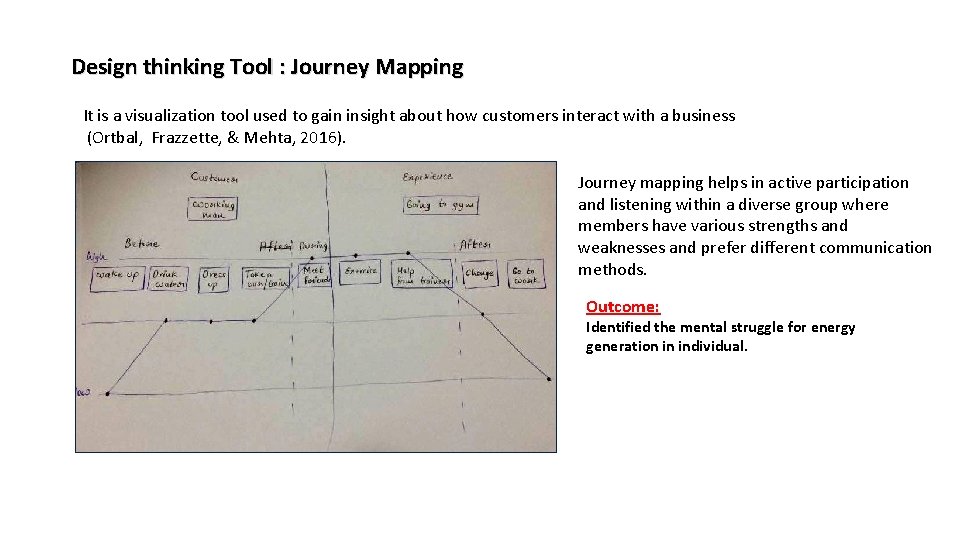
Design thinking Tool : Journey Mapping It is a visualization tool used to gain insight about how customers interact with a business (Ortbal, Frazzette, & Mehta, 2016). Journey mapping helps in active participation and listening within a diverse group where members have various strengths and weaknesses and prefer different communication methods. Outcome: Identified the mental struggle for energy generation in individual.
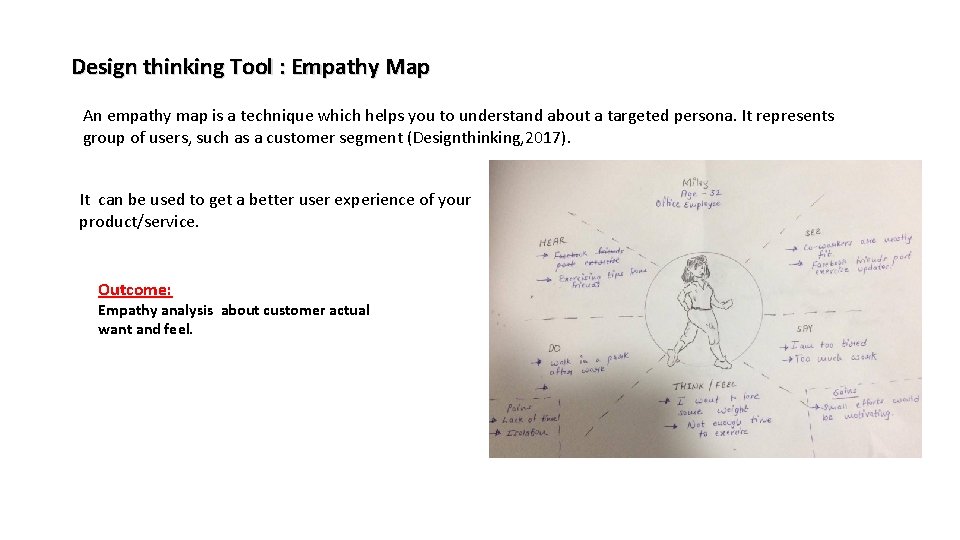
Design thinking Tool : Empathy Map An empathy map is a technique which helps you to understand about a targeted persona. It represents group of users, such as a customer segment (Designthinking, 2017). It can be used to get a better user experience of your product/service. Outcome: Empathy analysis about customer actual want and feel.
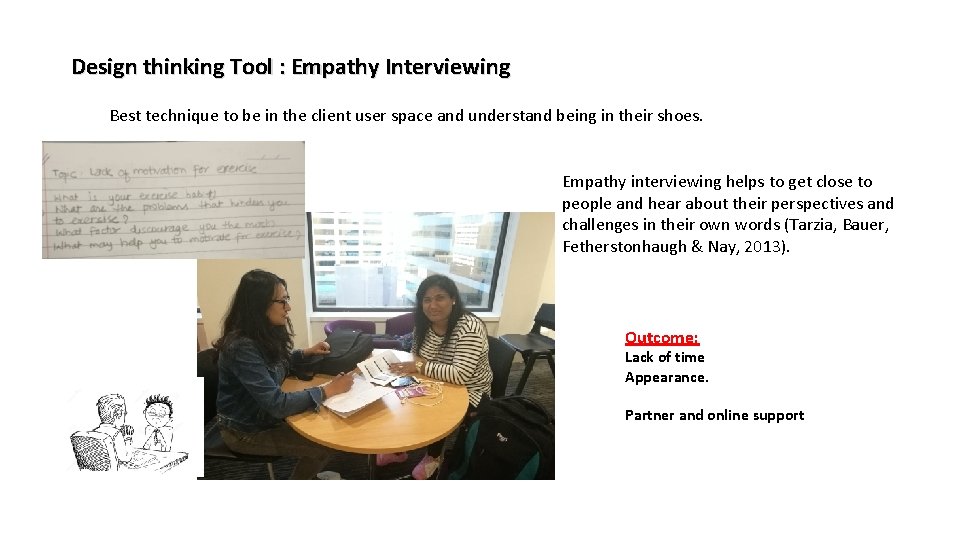
Design thinking Tool : Empathy Interviewing Best technique to be in the client user space and understand being in their shoes. Empathy interviewing helps to get close to people and hear about their perspectives and challenges in their own words (Tarzia, Bauer, Fetherstonhaugh & Nay, 2013). Outcome: Lack of time Appearance. Partner and online support
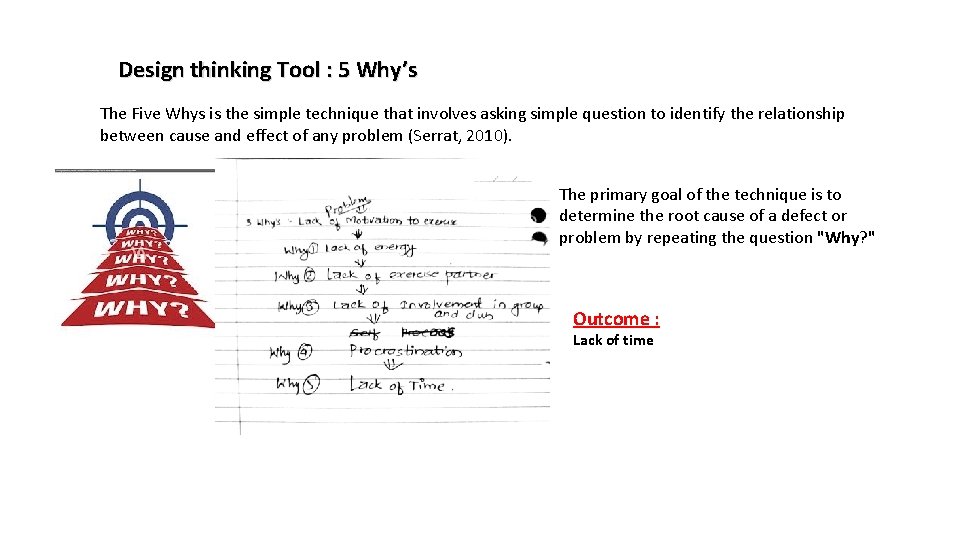
Design thinking Tool : 5 Why’s The Five Whys is the simple technique that involves asking simple question to identify the relationship between cause and effect of any problem (Serrat, 2010). The primary goal of the technique is to determine the root cause of a defect or problem by repeating the question "Why? " Outcome : Lack of time
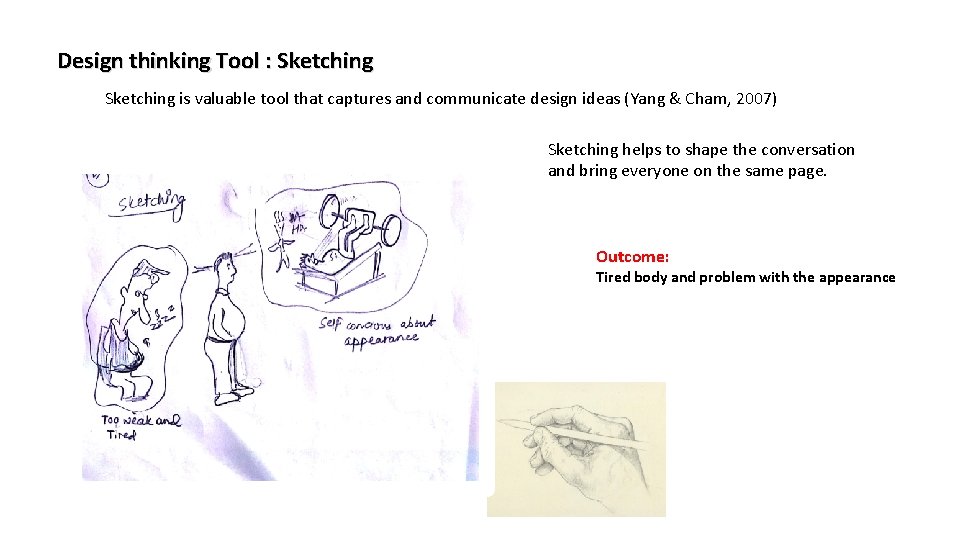
Design thinking Tool : Sketching is valuable tool that captures and communicate design ideas (Yang & Cham, 2007) Sketching helps to shape the conversation and bring everyone on the same page. Outcome: Tired body and problem with the appearance
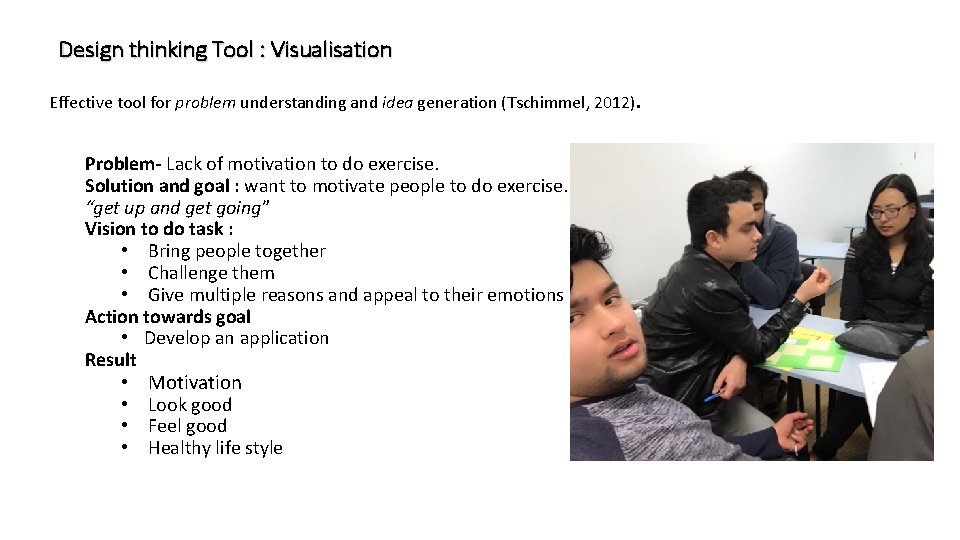
Design thinking Tool : Visualisation Effective tool for problem understanding and idea generation (Tschimmel, 2012). Problem- Lack of motivation to do exercise. Solution and goal : want to motivate people to do exercise. “get up and get going” Vision to do task : • Bring people together • Challenge them • Give multiple reasons and appeal to their emotions Action towards goal • Develop an application Result • • Motivation Look good Feel good Healthy life style
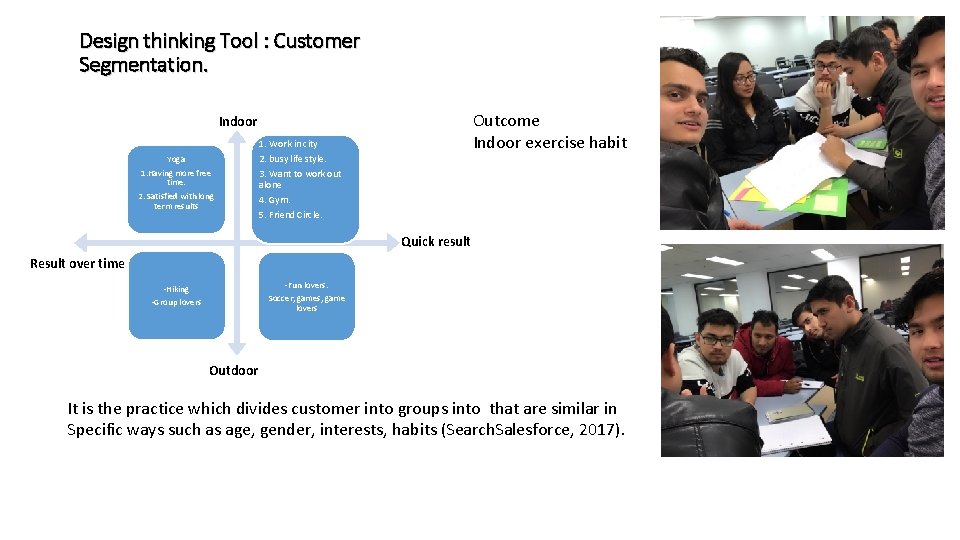
Design thinking Tool : Customer Segmentation. Indoor Outcome Indoor exercise habit 1. Work in city Yoga 1. Having more free time. 2. Satisfied with long term results 2. busy life style. 3. Want to work out alone 4. Gym. 5. Friend Circle. Quick result Result over time -Fun lovers. Soccer, games, game lovers -Hiking -Group lovers Outdoor It is the practice which divides customer into groups into that are similar in Specific ways such as age, gender, interests, habits (Search. Salesforce, 2017).
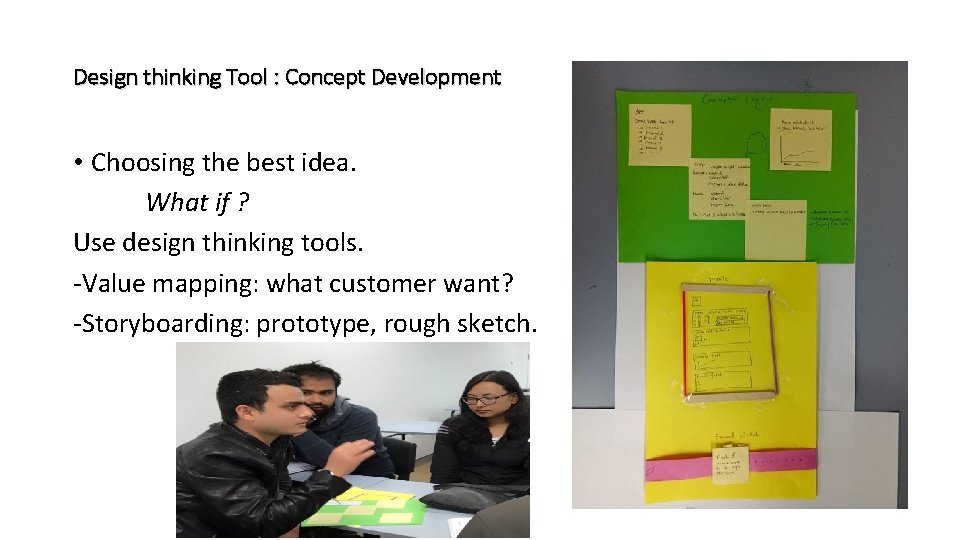
Design thinking Tool : Concept Development • Choosing the best idea. What if ? Use design thinking tools. -Value mapping: what customer want? -Storyboarding: prototype, rough sketch.
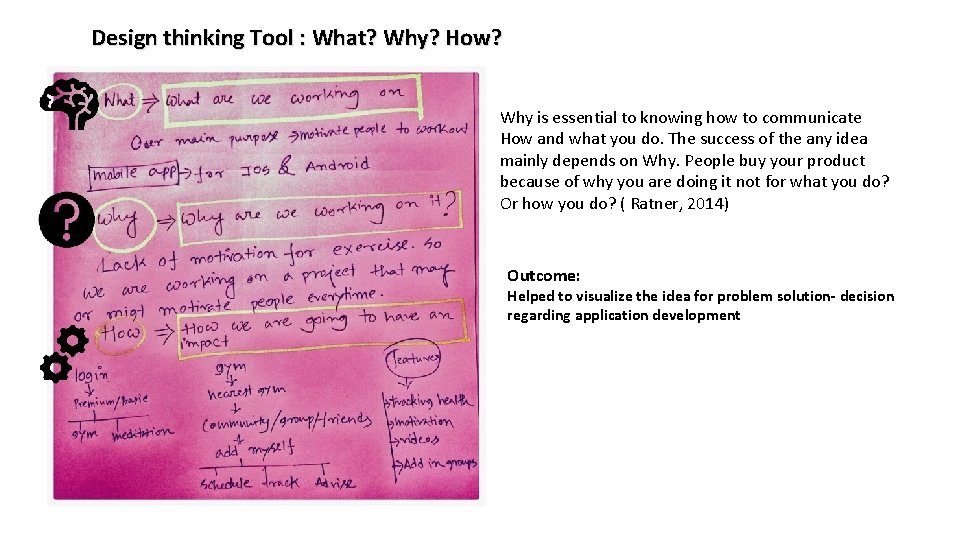
Design thinking Tool : What? Why? How? Why is essential to knowing how to communicate How and what you do. The success of the any idea mainly depends on Why. People buy your product because of why you are doing it not for what you do? Or how you do? ( Ratner, 2014) Outcome: Helped to visualize the idea for problem solution- decision regarding application development
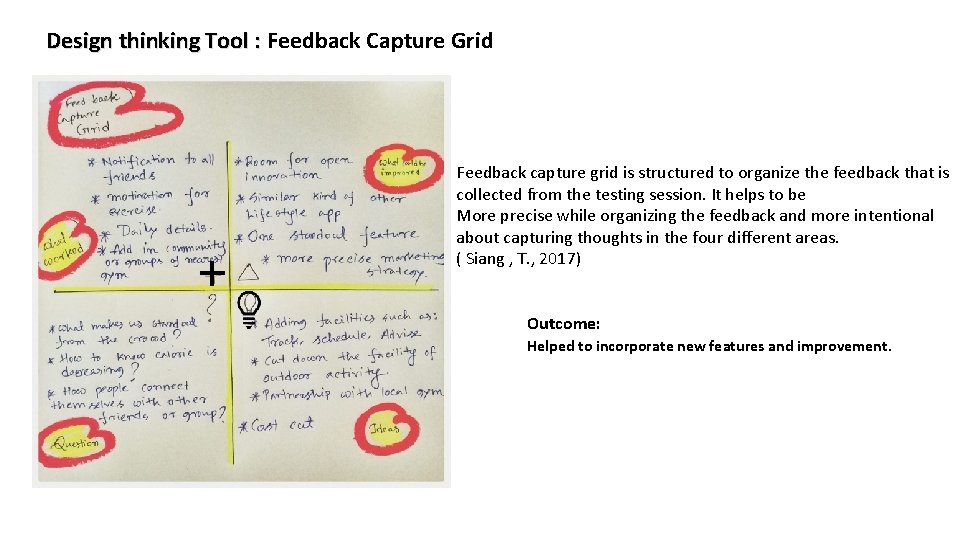
Design thinking Tool : Feedback Capture Grid Feedback capture grid is structured to organize the feedback that is collected from the testing session. It helps to be More precise while organizing the feedback and more intentional about capturing thoughts in the four different areas. ( Siang , T. , 2017) Outcome: Helped to incorporate new features and improvement.
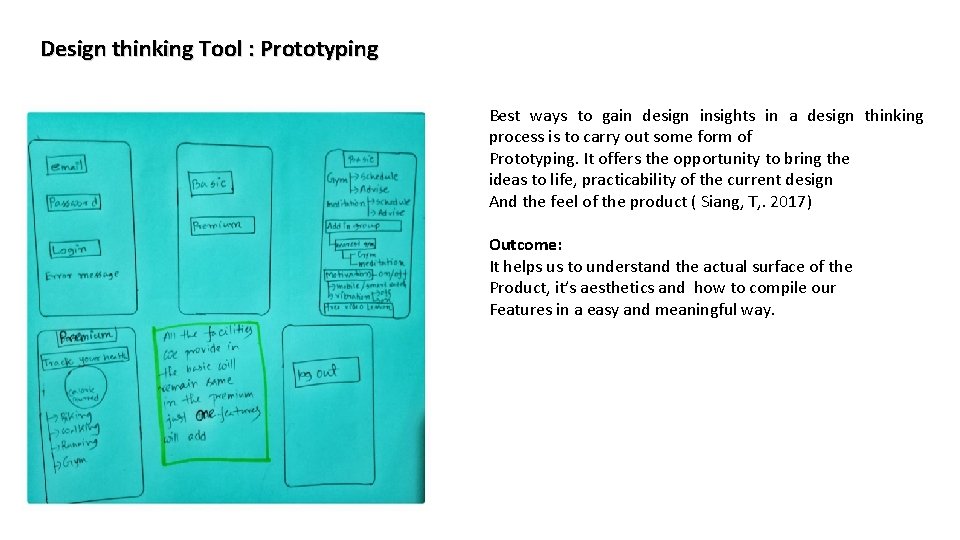
Design thinking Tool : Prototyping Best ways to gain design insights in a design thinking process is to carry out some form of Prototyping. It offers the opportunity to bring the ideas to life, practicability of the current design And the feel of the product ( Siang, T, . 2017) Outcome: It helps us to understand the actual surface of the Product, it’s aesthetics and how to compile our Features in a easy and meaningful way.

References Brinkman, A. (2003). Mind mapping as a tool in mathematics education. The Mathematics Teacher, 96(2), 96 Design Thinking (2017) , Retrieved from http: //www. designthinkinguk. com/empathy-mapping/ Meier, P. S. (2007). Mind-mapping: a tool for eliciting and representing knowledge held by diverse informants. Social Research Update, 52, 1 -4. Ortbal, K. , Frazzette, N. , & Mehta, K. (2016). Stakeholder Journey Mapping: An Educational Tool for Social Entrepreneurs. Procedia Engineering, 159, 249 -258. Ratner, (2014). 3 KEY MARKETING TAKEAWAYS FROM SIMON SINEK'S "START WITH WHY". Retrieved from: https: //blog. hubspot. com/customers/3 -takeaways-from-start-withwhy. Search. Salesforce. (2017). What is customer segmentation? - Definition from What. Is. com. Retrieved 21 September 2017, from http: //searchsalesforce. techtarget. com/definition/customer-segmentation Serrat, O. (2010). The five ways technique. Washington, DC: Asian Development Bank. Siang, T. , (2017) Stage 4 in the Design Thinking Process: Prototype. Retrieved from: https: //www. interaction-design. org/literature/article/stage-4 -in-the-design-thinkingprocess-prototype. Siang, T. , (2017). Test Your Prototypes: How to Gather Feedback and Maximise Learning. Retrieved from: https: //www. interaction-design. org/literature/article/test-yourprototypes-how-to-gather-feedback-and-maximise-learning. Tarzia, L. , Bauer, M. , Fetherstonhaugh, D. , & Nay, R. (2013). Interviewing older people in residential aged care about sexuality: Difficulties and challenges. Sexuality And Disability, 31(4), 361 -371. Tschimmel, K. (2012). Design Thinking as an effective Toolkit for Innovation. In: Proceedings of the XXIII ISPIM Conference: Action for Innovation: Innovating from Experience. Barcelona Yang, M. C. , & Cham, J. G. (2007). An analysis of sketching skill and its role in early stage engineering design. Transaction Of ASME, 476 -482.
- Slides: 15