
Design Issues and Challenges in P 2 P


- Slides: 28
Design Issues and Challenges in P 2 P Media Streaming # Idowu Samuel O. # Kashif Shahzad # Arif Kamal M 7001 E - Multimedia systems [ltu. se] © 2011
Media Streaming � Media using streaming transmission on the Internet ◦ Media streaming don’t have to download whole file before playing. � Approach ◦ Separates media files into different sections by time sequence. ◦ Sends these sections to clients. ◦ Client can watch images and hear sounds continuously by playing these sections
Forms of Media Streaming � Live streaming Video of an ongoing event delivered as a stream in real-time. After an initial buffer period, client starts to watch the stream. � Video on-Demand (Vo. D) streaming Client searches a video from some catalogue, after initial buffer, client starts to play the video from the beginning. E. g youtube, Vimeo. You. Tube: client-server protocols
Media Streaming and Models 1/3 � Client/server architecture. ◦ Confines the development of operation of media streaming because �Streaming consumes large bandwidth of network and resources of server. �Most servers’ capability can’t satisfy this need. ◦ Quick-Fix �increase the number of server to increase the bandwidth. Requires huge cost and expenditure. There is a need for a better technology.
Media Streaming and Models 2/3 � IP Multicast. ◦ Solves the problem of using large number of bandwidth for multiplex transmission of media streaming. ◦ Send data to specific group of clients at the same time by using multicast; avoids sending data repeatedly. ◦ Saves bandwidth, hence suitable for network media streaming transmission. ◦ Draw-back �Internet is a heterogeneous network, �Different hardware platform; interconnecting equipment that supports multicast is also different.
Media Streaming and Models 3/3 � CDN(Content Delivery Network) ◦ Solution for the media streaming network on large scale. ◦ Adds a new network frame in the Internet so as to publish contents of Center Server to the Edge Server of the nearest client. �Improve the speed of response �CDN can increase information’s transmitting efficiency on the Internet. ◦ Draw-back �Increases the cost and makes the system more complex. Need too many Edge Servers.
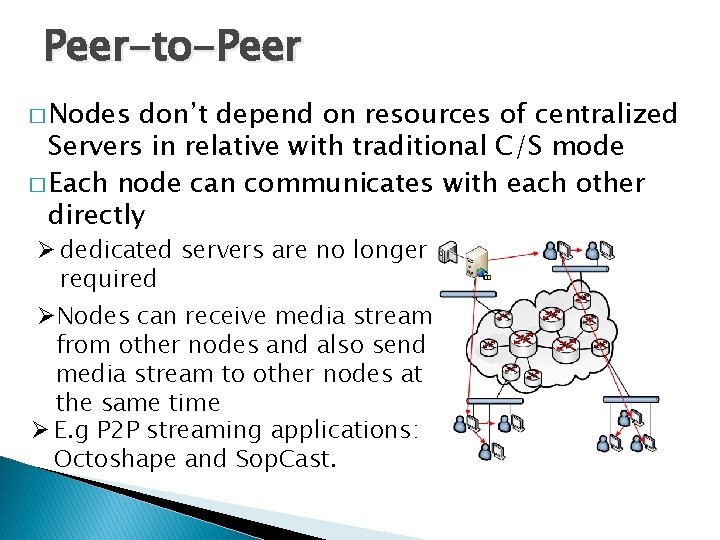
Peer-to-Peer � Nodes don’t depend on resources of centralized Servers in relative with traditional C/S mode � Each node can communicates with each other directly Ø dedicated servers are no longer required ØNodes can receive media stream from other nodes and also send media stream to other nodes at the same time Ø E. g P 2 P streaming applications: Octoshape and Sop. Cast.
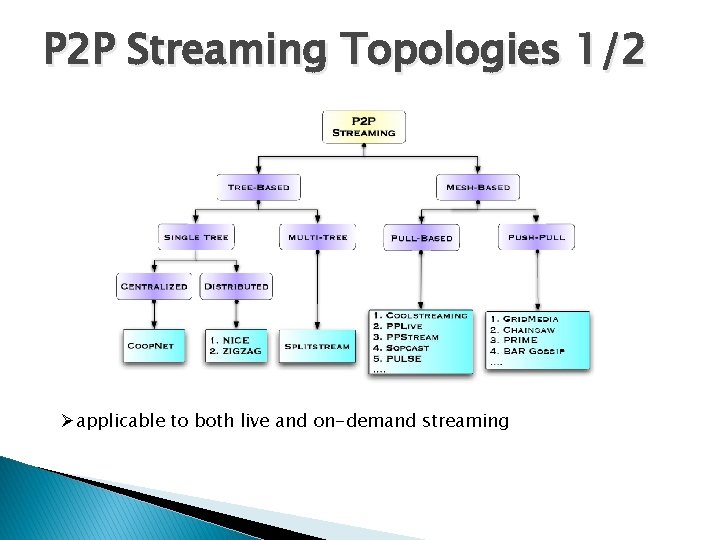
P 2 P Streaming Topologies 1/2 Øapplicable to both live and on-demand streaming
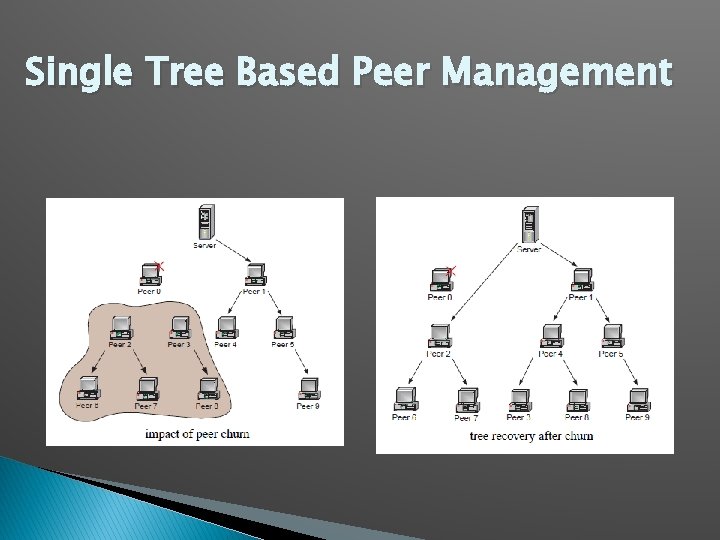
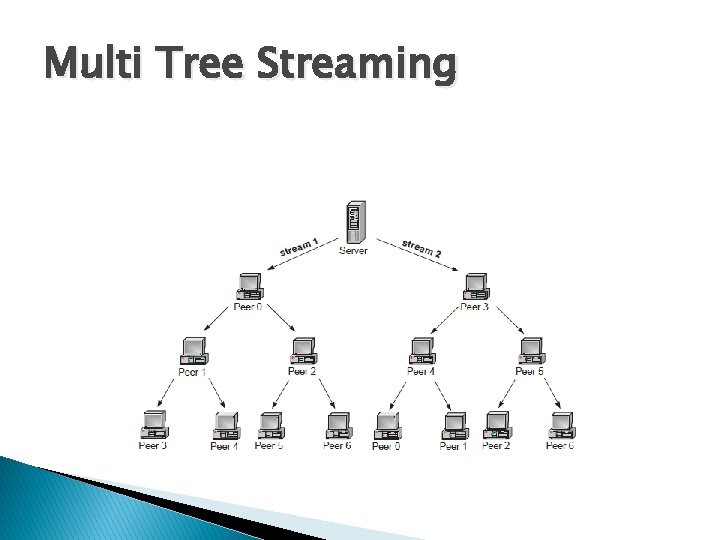
P 2 P Streaming Topologies 2/2 � Tree-based system ◦ Hierarchical system, in which media packets originate from a root node, and are forwarded by internal peers to all the nodes in the tree � mesh-based system ◦ Organizes peers in a dynamic mesh, where a peer receives media chunks from multiple nodes.
P 2 P Media Streaming Design Issues � Larger amount of Buffering Storage � Components of the system (Servers, Trackers, Loggers and Peers) � Segmentation-divide a video into multiple pieces � Replication strategy associated with issues such as MVC or SVC, Prefetch or not and Which to remove � Segments Scheduling focuses on dealing with dispatching and transmitting segments, Prefetching and content discovery may also be included in this topic
P 2 P Media Streaming Design Issues. . . � Piece selection strategy considers factors like sequential, rarest first, achor based, network coding, worst-seeded-first, � Peer heterogeneity may be caused either by different access networks or willingness of contribution � Overlay building mainly focus at proper network topology building algorithms � Managing of peer dynamicity requires robust and adaptive algorithms to manage change
P 2 P Media Streaming Design Issues. . . � Best peer selection strategy � Monitoring of network conditions to maximize utilization of available resources and to minimize the packet drop ratios at certain links � Incentives for participating peers otherwise P 2 P network starts behaving like client-server architecture and it fails due to increasing number of client peers
Single Tree Based Peer Management
Multi Tree Streaming
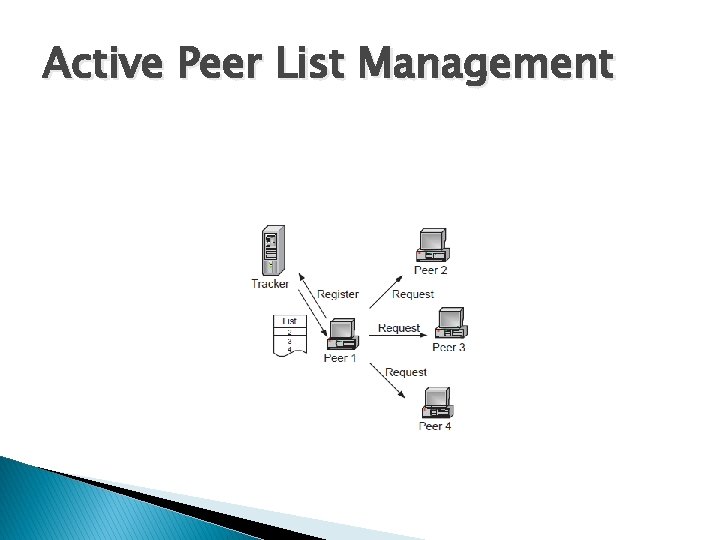
Active Peer List Management
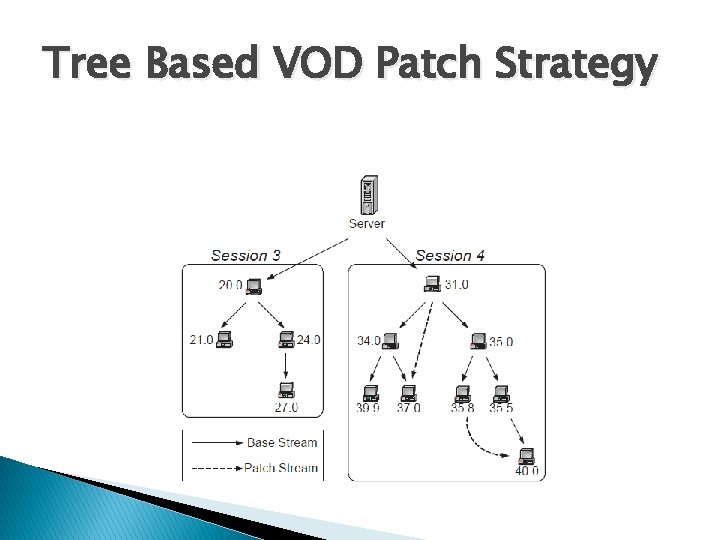
Tree Based VOD Patch Strategy
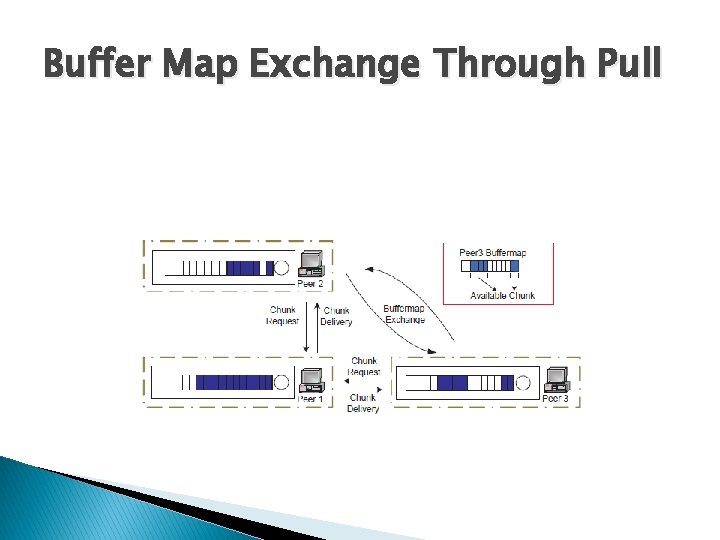
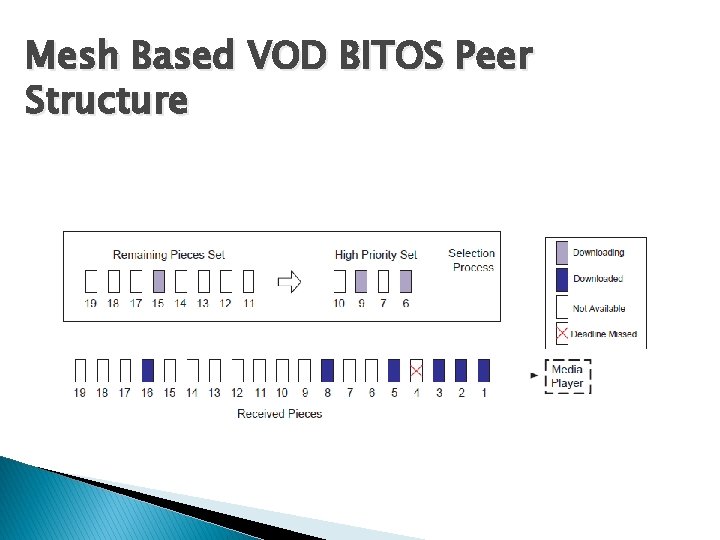
Buffer Map Exchange Through Pull
Mesh Based VOD BITOS Peer Structure
Design Issues in P 2 P media sharing Appropriate video coding scheme Managing Peer dynamicitiy Peer heterogeneity Monitoring of network conditions
Appropriate video coding scheme The prone-error nature of multimedia content makes it highly sensible to the transmission over networks offering non -guaranteed transmission.
Managing Peer dynamicitiy Since the peers (network nodes) are end -users terminal, their behaviour remains unpredictable. Due to dynamic nature of P 2 P networks, they are free to join and leave the service at any time without making any prior notification to other nodes.
Peer heterogeneity Heterogeneity may be caused either by different access networks connecting the peers, or by difference in the willingness of the peers to contribute. Each sender peers can have a different available bandwidth and that too might fluctuate after the connection is established.
Monitoring of network conditions The network condition during streaming phase can be changed dramatically due to the dynamic nature of P 2 P architecture. So, along with the dynamicity management, it is important to monitor the current network conditions regularly.
Challenges in P 2 P Challenges faced in P 2 P network Distribution of copyrighted files Security Issues Bandwidth Consumption
Distribution of Copyrighted Files Several P 2 P networks sued by music companies and private organizations Users are also targeted Copyright laws limited to few countries
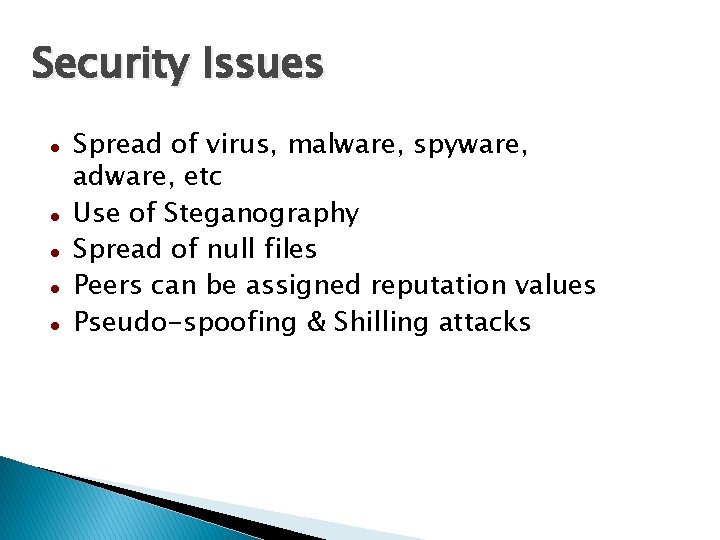
Security Issues Spread of virus, malware, spyware, adware, etc Use of Steganography Spread of null files Peers can be assigned reputation values Pseudo-spoofing & Shilling attacks
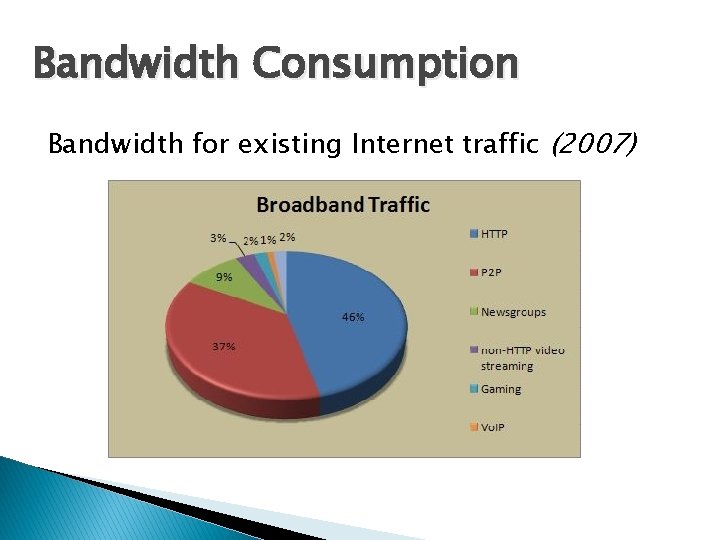
Bandwidth Consumption Bandwidth for existing Internet traffic (2007)
Questions