
Design implementation and evaluation of a robust multimicrophone
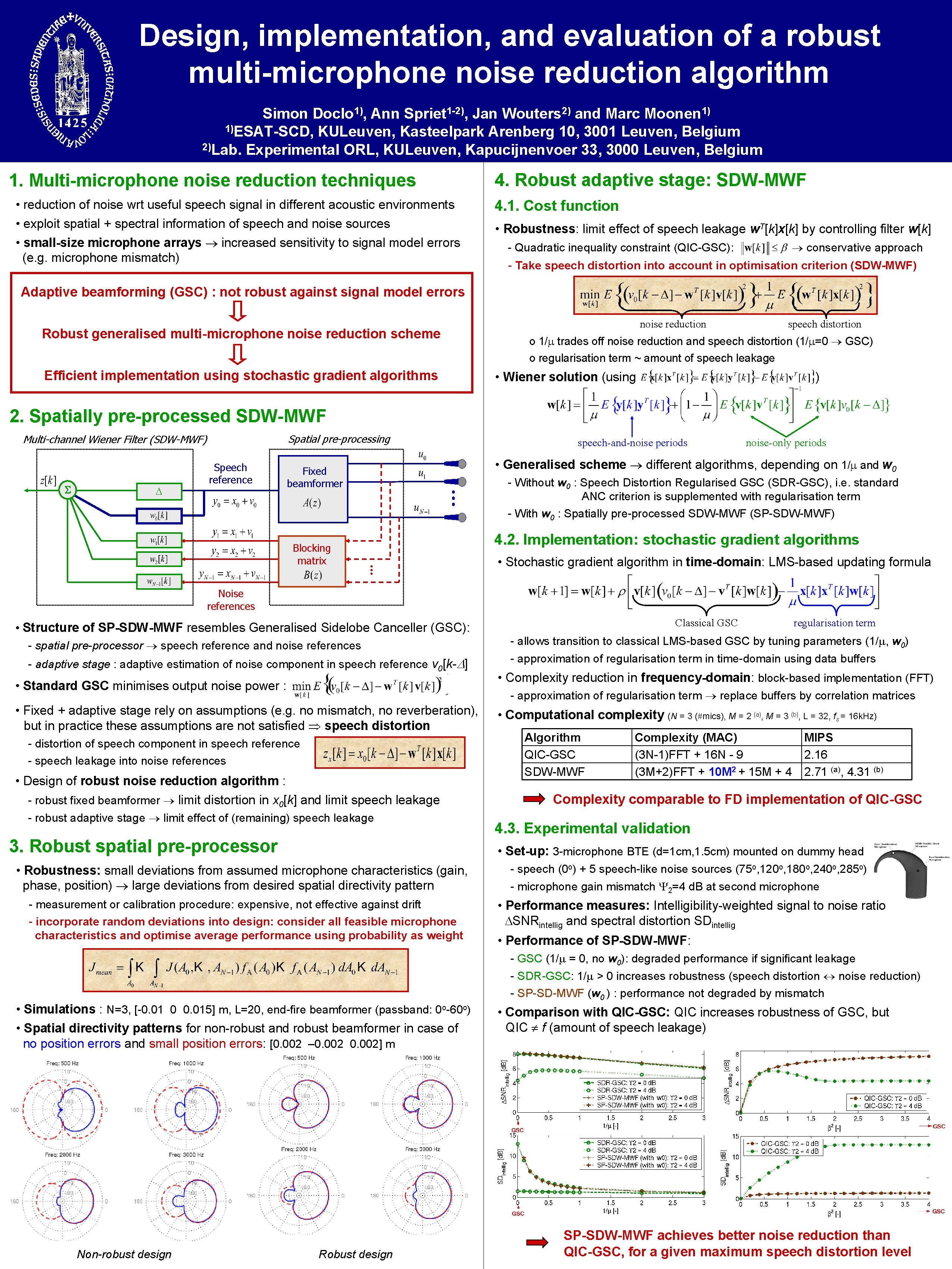
Design, implementation, and evaluation of a robust multi-microphone noise reduction algorithm Simon Doclo 1), Ann Spriet 1 -2), Jan Wouters 2) and Marc Moonen 1) 1)ESAT-SCD, KULeuven, Kasteelpark Arenberg 10, 3001 Leuven, Belgium 2)Lab. Experimental ORL, KULeuven, Kapucijnenvoer 33, 3000 Leuven, Belgium 1. Multi-microphone noise reduction techniques • reduction of noise wrt useful speech signal in different acoustic environments • exploit spatial + spectral information of speech and noise sources • small-size microphone arrays increased sensitivity to signal model errors (e. g. microphone mismatch) 4. Robust adaptive stage: SDW-MWF 4. 1. Cost function • Robustness: limit effect of speech leakage w. T[k]x[k] by controlling filter w[k] conservative approach - Quadratic inequality constraint (QIC-GSC): - Take speech distortion into account in optimisation criterion (SDW-MWF) Adaptive beamforming (GSC) : not robust against signal model errors Robust generalised multi-microphone noise reduction scheme Efficient implementation using stochastic gradient algorithms noise reduction speech distortion o 1/ trades off noise reduction and speech distortion (1/ =0 GSC) o regularisation term ~ amount of speech leakage • Wiener solution (using ) 2. Spatially pre-processed SDW-MWF Spatial pre-processing Multi-channel Wiener Filter (SDW-MWF) S Speech reference Fixed beamformer Blocking matrix speech-and-noise periods noise-only periods • Generalised scheme different algorithms, depending on 1/ and w 0 - Without w 0 : Speech Distortion Regularised GSC (SDR-GSC), i. e. standard ANC criterion is supplemented with regularisation term - With w 0 : Spatially pre-processed SDW-MWF (SP-SDW-MWF) 4. 2. Implementation: stochastic gradient algorithms • Stochastic gradient algorithm in time-domain: LMS-based updating formula Noise references • Structure of SP-SDW-MWF resembles Generalised Sidelobe Canceller (GSC): - spatial pre-processor speech reference and noise references - adaptive stage : adaptive estimation of noise component in speech reference v 0[k- ] • Standard GSC minimises output noise power : Classical GSC regularisation term - allows transition to classical LMS-based GSC by tuning parameters (1/ , w 0) - approximation of regularisation term in time-domain using data buffers • Complexity reduction in frequency-domain: block-based implementation (FFT) - approximation of regularisation term replace buffers by correlation matrices • Fixed + adaptive stage rely on assumptions (e. g. no mismatch, no reverberation), but in practice these assumptions are not satisfied speech distortion - distortion of speech component in speech reference - speech leakage into noise references • Design of robust noise reduction algorithm : - robust fixed beamformer limit distortion in x 0[k] and limit speech leakage - robust adaptive stage limit effect of (remaining) speech leakage 3. Robust spatial pre-processor • Computational complexity (N = 3 ( mics), M = 2 (a), M = 3 (b), L = 32, fs = 16 k. Hz) Algorithm QIC-GSC SDW-MWF Complexity (MAC) (3 N-1)FFT + 16 N - 9 (3 M+2)FFT + 10 M 2 + 15 M + 4 MIPS 2. 16 2. 71 (a), 4. 31 (b) Complexity comparable to FD implementation of QIC-GSC 4. 3. Experimental validation • Set-up: 3 -microphone BTE (d=1 cm, 1. 5 cm) mounted on dummy head • Robustness: small deviations from assumed microphone characteristics (gain, phase, position) large deviations from desired spatial directivity pattern - measurement or calibration procedure: expensive, not effective against drift - incorporate random deviations into design: consider all feasible microphone characteristics and optimise average performance using probability as weight - speech (0 o) + 5 speech-like noise sources (75 o, 120 o, 180 o, 240 o, 285 o) - microphone gain mismatch 2=4 d. B at second microphone • Performance measures: Intelligibility-weighted signal to noise ratio SNRintellig and spectral distortion SDintellig • Performance of SP-SDW-MWF: - GSC (1/ = 0, no w 0): degraded performance if significant leakage - SDR-GSC: 1/ > 0 increases robustness (speech distortion noise reduction) - SP-SD-MWF (w 0 ) : performance not degraded by mismatch • Simulations : N=3, [-0. 01 0 0. 015] m, L=20, end-fire beamformer (passband: 0 o-60 o) • Spatial directivity patterns for non-robust and robust beamformer in case of no position errors and small position errors: [0. 002 – 0. 002] m Non-robust design Robust design • Comparison with QIC-GSC: QIC increases robustness of GSC, but QIC f (amount of speech leakage) SP-SDW-MWF achieves better noise reduction than QIC-GSC, for a given maximum speech distortion level
- Slides: 1