
Design Guidelines Presented by Aleksandr Khasymski Usable Security
Design: Guidelines Presented by: Aleksandr Khasymski Usable Security – CS 6204 – Fall, 2009 – Dennis Kafura – Virginia Tech
Papers n Design for privacy in ubiquitous computing environments q n Privacy by Design – Principles of Privacy-Aware Ubiquitous Systems q n Marc Langheinrich, 2001 Security in the wild: user strategies for managing security as an everyday, practical problem q n Victoria Bellotti, and Abigail Sellen, 1993 Dourish, P. , Grinter, E. , Delgado de la Flor, J. , and Joseph, M. 2004 Personal privacy through understanding and action: five pitfalls for designers q Lederer, S. , et al. 2004 Usable Security – CS 6204 – Fall, 2009 – Dennis Kafura – Virginia Tech
Presentatio Outline n n Overview Contributions Outline of the framework/case study Conclusion x 4 n Class Discussion Usable Security – CS 6204 – Fall, 2009 – Dennis Kafura – Virginia Tech
Design for privacy in ubiquitous computing environments Victoria Bellotti Abigail Sellen Euro. PARC, Cambridge, UK Usable Security – CS 6204 – Fall, 2009 – Dennis Kafura – Virginia Tech
Overview n One of the classic papers in privacy in ubiquitous computing q n n Cited 132 times (including the last two papers) Proposes one of the first design frameworks for privacy in ubiquitous computing. Framework is applied to RAVE a Computer supported cooperative work (CSCW) environment. Usable Security – CS 6204 – Fall, 2009 – Dennis Kafura – Virginia Tech
RAVE n n RAVE is a media space RAVE nodes in every office q n n Cameras, monitors, microphones, and speakers (think Skype) Cameras in public spaces Features q q q Glance V-phone call Office-share Usable Security – CS 6204 – Fall, 2009 – Dennis Kafura – Virginia Tech

Principles and Problems in RAVE n Principles q q n Control – over who gets what information Feedback – of what information is captured by whom Problems q Disembodiment – when conveying information n q You cannot present your self as effectively as in a face-to-face setting Dissociation - when gaining information n n Only the results of you actions are conveyed, “actions themselves are invisible”. (think touch) Results from the disembodied presence of the person you are trying to interact with. Usable Security – CS 6204 – Fall, 2009 – Dennis Kafura – Virginia Tech
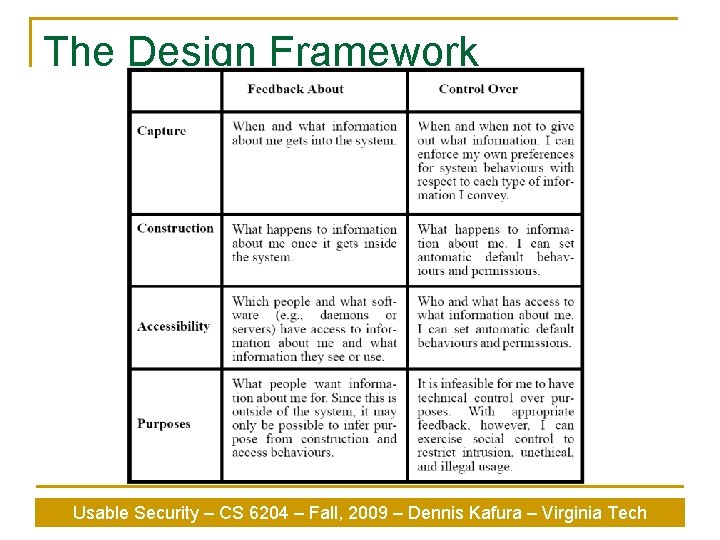
The Design Framework Usable Security – CS 6204 – Fall, 2009 – Dennis Kafura – Virginia Tech

Design Criteria n n n Trustworthiness Appropriate Timing Perceptibility Unobtrusiveness Minimal intrusiveness Fail-safety Flexibility Low effort Meaningfulness Learnability Low Cost Usable Security – CS 6204 – Fall, 2009 – Dennis Kafura – Virginia Tech
Applying the Framework n Evaluated existing solution based on the criteria and propose new solutions if necessary q Eg. A confidence monitor next to a camera n q Mannequin with camera n q Trustworthy, meaningful appropriately timed Less obtrusive, but less meaningful Viewer display of people watching n Expensive, intrusive Usable Security – CS 6204 – Fall, 2009 – Dennis Kafura – Virginia Tech
Conclusion n n Constructed a framework for design for privacy in a ubiquitous environment It can be used to: q q q n Clarify existing state of affairs Clarify shortcomings of existing solutions Assess proposed solutions as well! There needs to be delicate balance between awareness and privacy q Too much feedback can be intrusive. Usable Security – CS 6204 – Fall, 2009 – Dennis Kafura – Virginia Tech
Privacy by Design – Principles of Privacy-Aware Ubiquitous Systems Marc Langheinrich Swiss Federal Institute of Technology, Zurich Swtizerland Usable Security – CS 6204 – Fall, 2009 – Dennis Kafura – Virginia Tech
Overview n n An introductory reading to privacy issues in ubiquitous computing Brief history of privacy protection and its legal status q q n n US Privacy Act of 1974 EU’s Directive 95/46/EC Does privacy matter? Is Ubiquitous computing different? Six principles guiding design Outlook Usable Security – CS 6204 – Fall, 2009 – Dennis Kafura – Virginia Tech
A Brief History n Privacy has been on peoples minds as early as the 19 th century. q n n Samuel Warren and Louis Brandeis paper “The Right to Privacy”, in response to the advent of modern photography and print press. Hot topic again in 1960 s in response to governmental electronic data processing. US Privacy Act of 1974 created the notion of fair information practices. Usable Security – CS 6204 – Fall, 2009 – Dennis Kafura – Virginia Tech
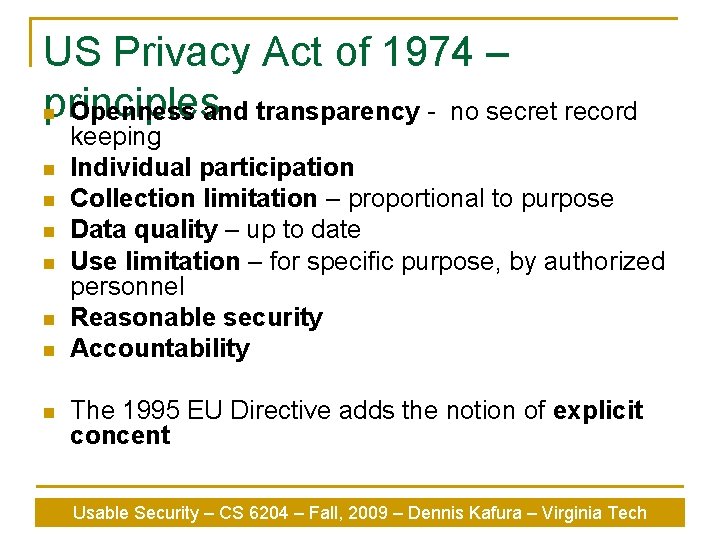
US Privacy Act of 1974 – principles n Openness and transparency - no secret record n n n n keeping Individual participation Collection limitation – proportional to purpose Data quality – up to date Use limitation – for specific purpose, by authorized personnel Reasonable security Accountability The 1995 EU Directive adds the notion of explicit concent Usable Security – CS 6204 – Fall, 2009 – Dennis Kafura – Virginia Tech
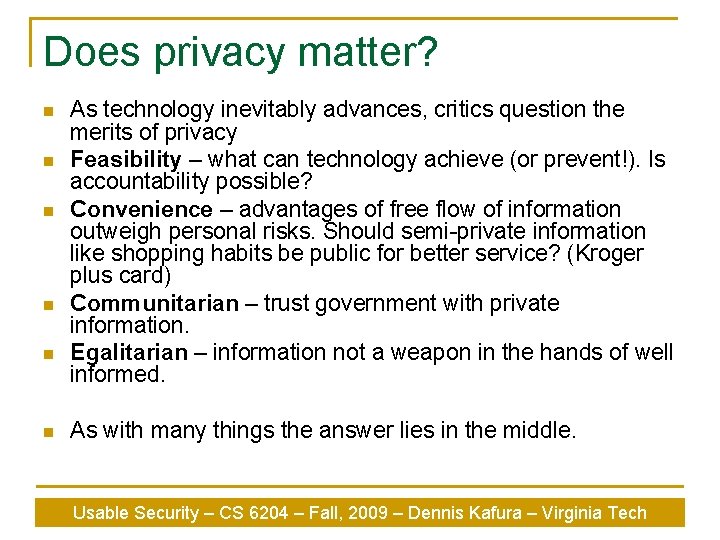
Does privacy matter? n n n As technology inevitably advances, critics question the merits of privacy Feasibility – what can technology achieve (or prevent!). Is accountability possible? Convenience – advantages of free flow of information outweigh personal risks. Should semi-private information like shopping habits be public for better service? (Kroger plus card) Communitarian – trust government with private information. Egalitarian – information not a weapon in the hands of well informed. As with many things the answer lies in the middle. Usable Security – CS 6204 – Fall, 2009 – Dennis Kafura – Virginia Tech
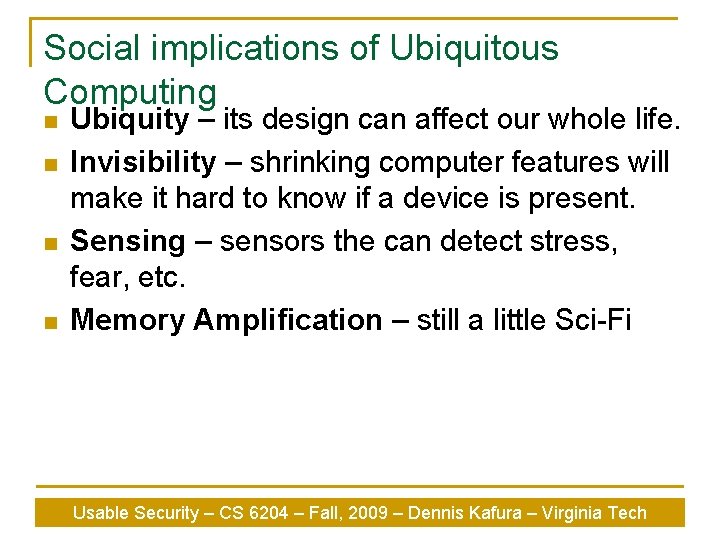
Social implications of Ubiquitous Computing n n Ubiquity – its design can affect our whole life. Invisibility – shrinking computer features will make it hard to know if a device is present. Sensing – sensors the can detect stress, fear, etc. Memory Amplification – still a little Sci-Fi Usable Security – CS 6204 – Fall, 2009 – Dennis Kafura – Virginia Tech
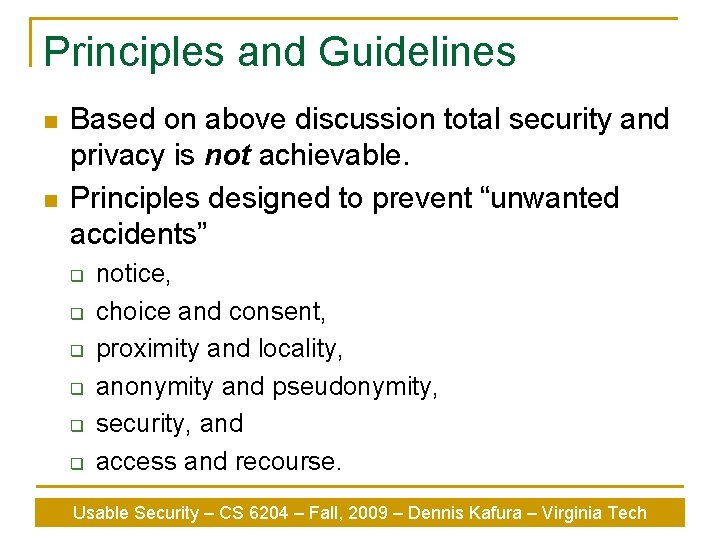
Principles and Guidelines n n Based on above discussion total security and privacy is not achievable. Principles designed to prevent “unwanted accidents” q q q notice, choice and consent, proximity and locality, anonymity and pseudonymity, security, and access and recourse. Usable Security – CS 6204 – Fall, 2009 – Dennis Kafura – Virginia Tech
Principles and Guidelines cont. n Notice – employ technologies like RFID tags, and P 3 P on the Web. q q n Choice and Consent q q n Examples of the “smart mug” that inadvertently spies on a colleague. Notice should apply to the type of data collection. Providing consent needs to be efficient or risk to be annoying. Only one choice = blackmail! Anonymity and Pseudonymity q q Anonymity is hard in the context of ubiquitous computing. Data-mining can be threat as well. Usable Security – CS 6204 – Fall, 2009 – Dennis Kafura – Virginia Tech
Principles and Guidelines cont. n Proximity and Locality q q n Adequate Security q q n Devices activate only in the presence of owner. Locality – modeled by a “small rural community”. Can be hard to implement. Maybe its not a panacea, if we consider alternatives like locality and proximity. Access and Recourse q q Define access requirements. Sufficient technology, eg. P 3 P. Usable Security – CS 6204 – Fall, 2009 – Dennis Kafura – Virginia Tech
Outlook and Conclusion n There is a lot to be done in ubiquitous computing or we risk a Orwellian nightmarecome-true Some principles are readily implementable, while others like anonymity can be quite hard. The paper highlights that some principles can be chosen over others. q eg. Locality vs. Security Usable Security – CS 6204 – Fall, 2009 – Dennis Kafura – Virginia Tech
Security in the wild: user strategies for managing security as an everyday, practical problem Paul Dourish Rebecca E. Grinter Jessica Delgado de la Flor Melissa Joseph Usable Security – CS 6204 – Fall, 2009 – Dennis Kafura – Virginia Tech
Overview n n n A study of how people experience security in their daily lives. How do people answer the question: “is this system secure enough for what I want to do? ” Exploring the human factor in security and shed some light why users can become the “weakest link”. q n n Observer and interview people in a academic institution and an industrial research lab. Reframe security for ubiquitous computing. Conclusion Usable Security – CS 6204 – Fall, 2009 – Dennis Kafura – Virginia Tech

The experience of Security n Attitude towards security: q q q n n Frustration – older vs. younger people. Pragmatism – identify cost vs. benefit. Futility – the “hackers” always one step ahead. Security as a barrier - for “everything”. Security online and offline – practicing security is not a purely online matter, it extends in the physical world. Usable Security – CS 6204 – Fall, 2009 – Dennis Kafura – Virginia Tech
Practice of Security n Delegating security to a : q q q n Security actions q q n Encryption vs. “Cryptic” messages. Media switching, eg. E-mail vs phone call. Holistic security management q n Individual, eg. knowledgeable colleague. Organization, eg. Helpdesk. Institution, eg. Expectation of a financial institution. Physical arrangement of space, eg. Computer monitor in an office Managing identity q q Maintaining multiple online identities. Problem when an individual turns out to be a group, eg. A person’s email is automatically forwarded to their assistant. Usable Security – CS 6204 – Fall, 2009 – Dennis Kafura – Virginia Tech
Security for Ubiquitous Computing n Instead of focusing on mathematical and technical guarantees, we need to address security as a practical problem. q n n Provide the resources so that people can answer the question – “is this computer system secure enough for what I want to do now? ” Place security decision (back) in the context of a practical matter or goal. Instead of transparent security technology needs to be highly visible. Usable Security – CS 6204 – Fall, 2009 – Dennis Kafura – Virginia Tech
Conclusion n The “penultimate slide” problem. q q n n Success of ubiquitous computing relies on designing for security and privacy. Both are currently poorly understood. This study highlight some of the importance of HCI research. Protection and sharing of information are to aspects of the same task. Usable Security – CS 6204 – Fall, 2009 – Dennis Kafura – Virginia Tech
Personal privacy through understanding and action: five pitfalls for designers Scott Lederer Jason I. Hong Anind K. Dey James A. Landay Usable Security – CS 6204 – Fall, 2009 – Dennis Kafura – Virginia Tech
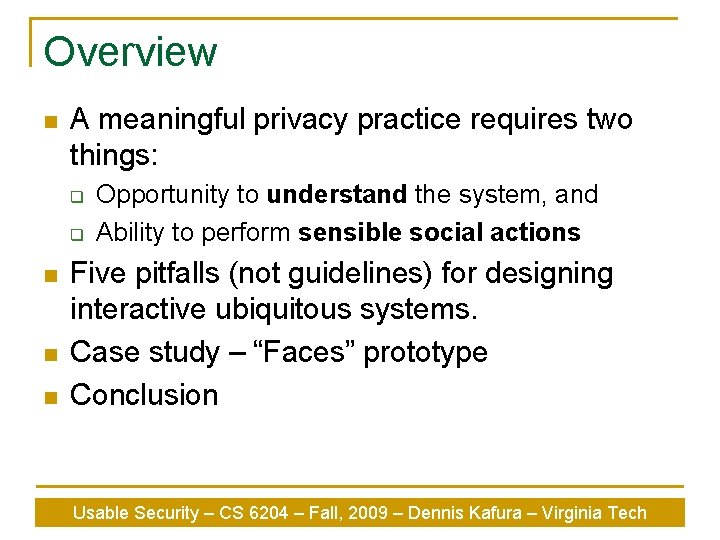
Overview n A meaningful privacy practice requires two things: q q n n n Opportunity to understand the system, and Ability to perform sensible social actions Five pitfalls (not guidelines) for designing interactive ubiquitous systems. Case study – “Faces” prototype Conclusion Usable Security – CS 6204 – Fall, 2009 – Dennis Kafura – Virginia Tech
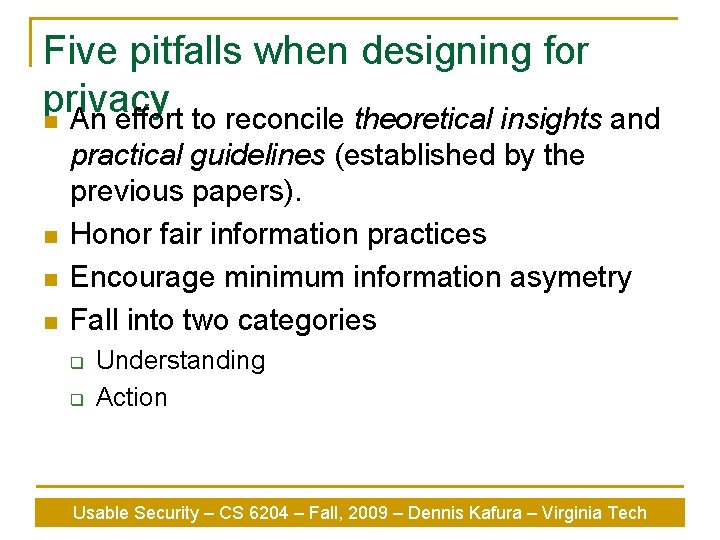
Five pitfalls when designing for privacy n An effort to reconcile theoretical insights and n n n practical guidelines (established by the previous papers). Honor fair information practices Encourage minimum information asymetry Fall into two categories q q Understanding Action Usable Security – CS 6204 – Fall, 2009 – Dennis Kafura – Virginia Tech
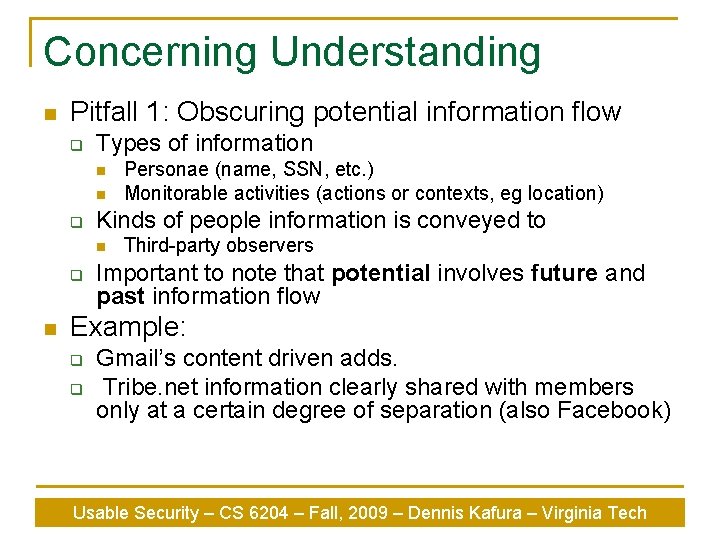
Concerning Understanding n Pitfall 1: Obscuring potential information flow q Types of information n n q Kinds of people information is conveyed to n q n Personae (name, SSN, etc. ) Monitorable activities (actions or contexts, eg location) Third-party observers Important to note that potential involves future and past information flow Example: q q Gmail’s content driven adds. Tribe. net information clearly shared with members only at a certain degree of separation (also Facebook) Usable Security – CS 6204 – Fall, 2009 – Dennis Kafura – Virginia Tech
Concerning Understanding n Pitfall 2: obscuring actual information flow q n What information is conveyed to whom, as the interaction with the system occurs. Examples q q Websites obscure information storage in cookies. Symmetric design in IM systems. Usable Security – CS 6204 – Fall, 2009 – Dennis Kafura – Virginia Tech
Concerning action n Pitfall 3: emphasizing configuration over action q q n Privacy management should be a natural consequence of ordinary use of system; it should not rely on extensive (prior) configuration. In real settings user manage privacy semiintuitively. Examples q q E-mail encryption software, P 2 P file-share. Embedding configuration in a meaningful action within the system. Usable Security – CS 6204 – Fall, 2009 – Dennis Kafura – Virginia Tech
Concerning action n Pitfall 4: lacking coarse-grained control q q Design should offer obvious, top-level mechanism for halting and resuming disclosure. Users are remarkably adept at wielding coarsegrained controls to yield nuanced results n n Setting door ajar, using invisible mode in IM, etc. Examples q q Cannot exclude a purchase from an online history Cell-phones, IM Usable Security – CS 6204 – Fall, 2009 – Dennis Kafura – Virginia Tech
Concerning action n Pitfall 5: inhibiting established practices q q q n People manage privacy through a range of established, often nuanced, practices. Plausible deniability – was lack of disclosure intentional Disclosing ambiguous information Examples q q Location-tracking systems IM Usable Security – CS 6204 – Fall, 2009 – Dennis Kafura – Virginia Tech
Faces n n n Ubicomp environment that can display a person’s location Privacy maintained by configuring 3 -tuples of inquirer, situations, faces. Faces determines the precision of information disclosed, eg. None, vague, precise, etc. Faces particularly suffered from the action pitfalls. Converted to precision dial. Usable Security – CS 6204 – Fall, 2009 – Dennis Kafura – Virginia Tech
Class Discussion n Do these guidelines actually apply to ubiquitous computing, given that it didn’t really exist at the time that they are created? q n Are the design solutions already there as the last paper suggest? q n The last paper comes closest. IM and Cell phones are well accepted. Does a system need to support existing practices? Aren’t practices significantly changed by some systems? Usable Security – CS 6204 – Fall, 2009 – Dennis Kafura – Virginia Tech
- Slides: 37