
Design for the Environment Program Emerging Chemicals Df
- Slides: 10
Design for the Environment Program Emerging Chemicals & Df. E Tools October 25, 2005
Df. E Themes Df. E provides access to OPPT technical tools and expertise that serve as an incentive for business participation in our work. Df. E projects: • are multi-stakeholder; • are driven by a business “client”; • have the potential to result in lasting change; and • benefit business and the environment. Df. E promotes reduction of priority chemicals. Df. E Projects have touched more than 200, 000 business facilities and approximately 2 million workers.
Coordination Framework for Emerging Chemicals Development driven by penta. BDE communication issues Purpose • Coordinate • Make improvements available • Provide avenues for addressing emerging chemical issues (e. g. TCNC workgroup) Group meets periodically • Information dissemination • Consider “candidate” chemicals Regions, HQ & States
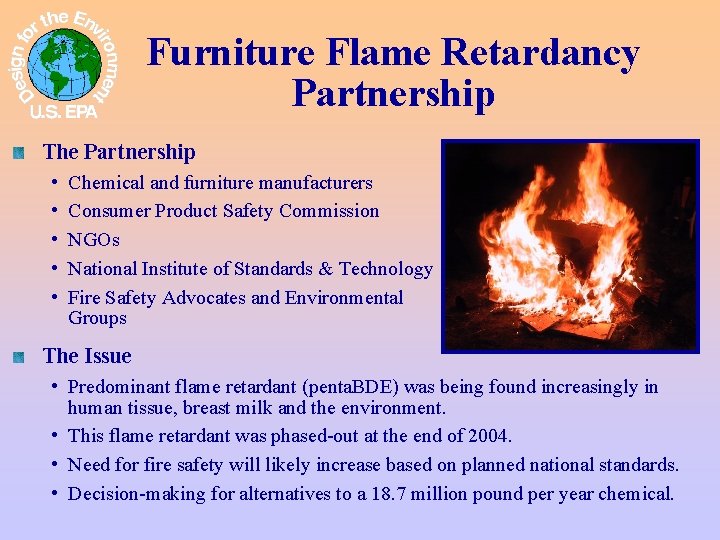
Furniture Flame Retardancy Partnership The Partnership • • • Chemical and furniture manufacturers Consumer Product Safety Commission NGOs National Institute of Standards & Technology Fire Safety Advocates and Environmental Groups The Issue • Predominant flame retardant (penta. BDE) was being found increasingly in human tissue, breast milk and the environment. • This flame retardant was phased-out at the end of 2004. • Need for fire safety will likely increase based on planned national standards. • Decision-making for alternatives to a 18. 7 million pound per year chemical.
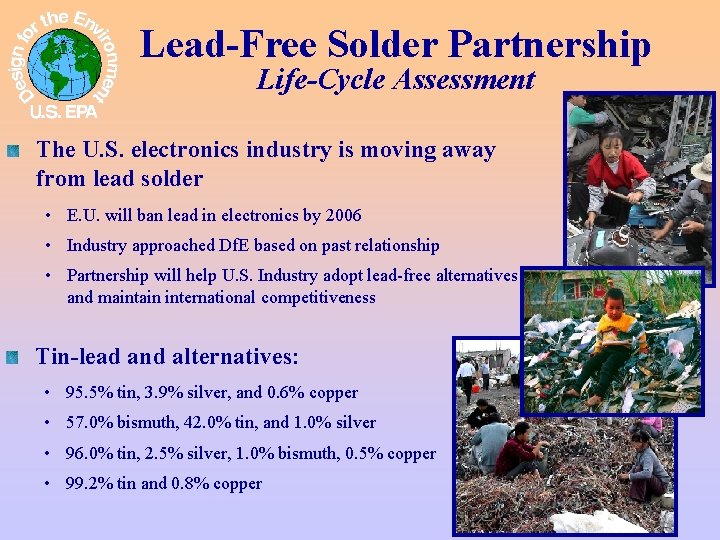
Lead-Free Solder Partnership Life-Cycle Assessment The U. S. electronics industry is moving away from lead solder • E. U. will ban lead in electronics by 2006 • Industry approached Df. E based on past relationship • Partnership will help U. S. Industry adopt lead-free alternatives and maintain international competitiveness Tin-lead and alternatives: • 95. 5% tin, 3. 9% silver, and 0. 6% copper • 57. 0% bismuth, 42. 0% tin, and 1. 0% silver • 96. 0% tin, 2. 5% silver, 1. 0% bismuth, 0. 5% copper • 99. 2% tin and 0. 8% copper
Lead-Free Solder Partnership (cont’d) Life-Cycle Assessment Significant potential • Annual lead solder use in electronics estimated at 176 million pounds Key Findings • extraction of silver • energy use in manufacture Final Report on Df. E website
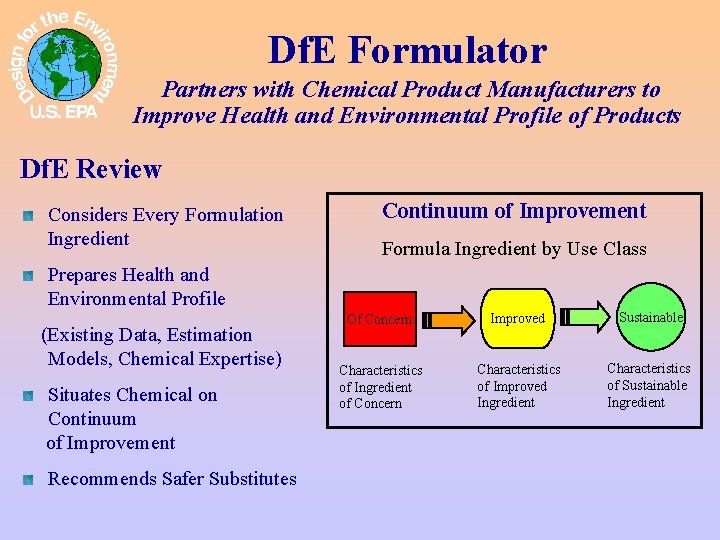
Df. E Formulator Partners with Chemical Product Manufacturers to Improve Health and Environmental Profile of Products Df. E Review Considers Every Formulation Ingredient Continuum of Improvement Formula Ingredient by Use Class Prepares Health and Environmental Profile (Existing Data, Estimation Models, Chemical Expertise) Situates Chemical on Continuum of Improvement Recommends Safer Substitutes Of Concern Improved Sustainable Characteristics of Ingredient of Concern Characteristics of Improved Ingredient Characteristics of Sustainable Ingredient
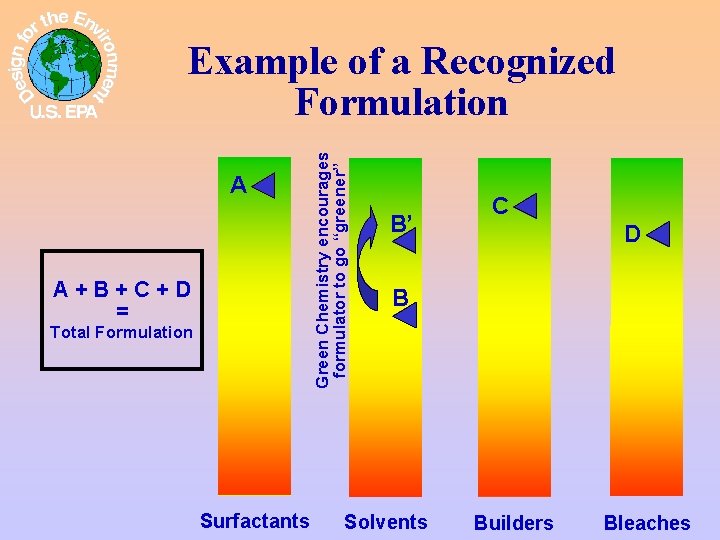
A A+B+C+D = Total Formulation Surfactants Green Chemistry encourages formulator to go “greener” Example of a Recognized Formulation B’ C D B Solvents Builders Bleaches
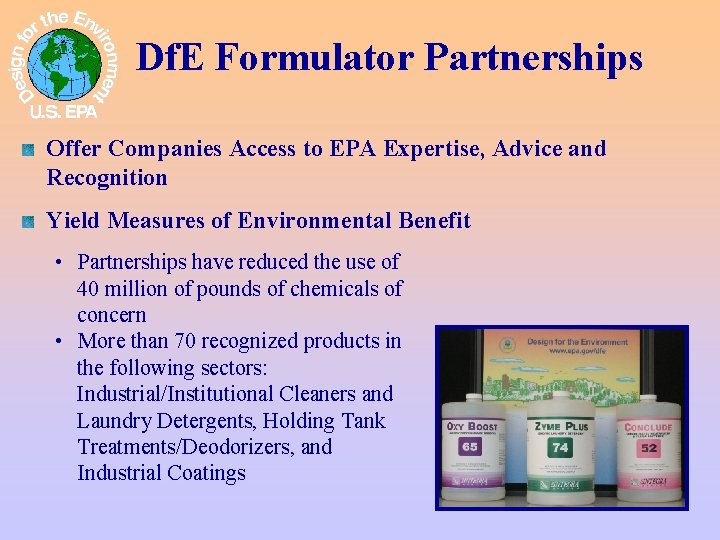
Df. E Formulator Partnerships Offer Companies Access to EPA Expertise, Advice and Recognition Yield Measures of Environmental Benefit • Partnerships have reduced the use of 40 million of pounds of chemicals of concern • More than 70 recognized products in the following sectors: Industrial/Institutional Cleaners and Laundry Detergents, Holding Tank Treatments/Deodorizers, and Industrial Coatings
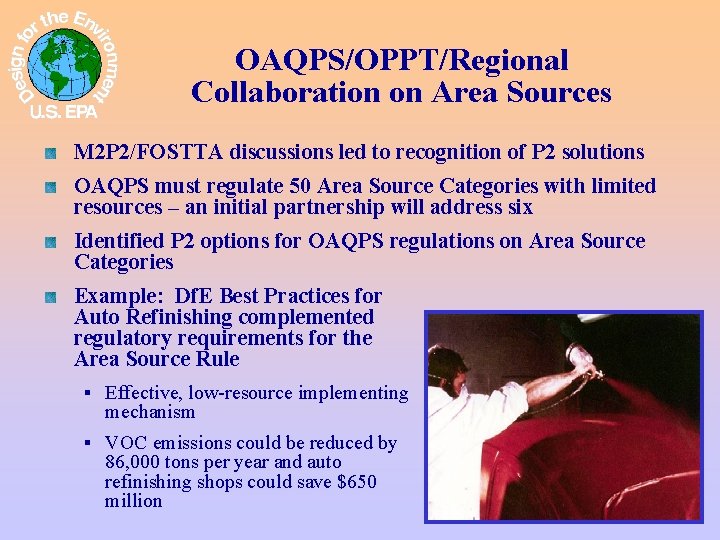
OAQPS/OPPT/Regional Collaboration on Area Sources M 2 P 2/FOSTTA discussions led to recognition of P 2 solutions OAQPS must regulate 50 Area Source Categories with limited resources – an initial partnership will address six Identified P 2 options for OAQPS regulations on Area Source Categories Example: Df. E Best Practices for Auto Refinishing complemented regulatory requirements for the Area Source Rule § Effective, low-resource implementing mechanism § VOC emissions could be reduced by 86, 000 tons per year and auto refinishing shops could save $650 million