
Design for Production in Existing Facilities DPEF Richard
- Slides: 27
Design for Production in Existing Facilities (DPEF) Richard A. Wysk The Pennsylvania State University IE 550 Manufacturing Systems IE 550 9/9/2020
Design for Production in Existing Facilities (DPEF) l Given: » a product design, » the expected production requirements for the new product, » a set of production resources and the current configuration (production lines, cells, etc. ), and » the expected requirements for the products currently being produced, IE 550 9/9/2020
Design for Production in Existing Facilities (con’t) l IE 550 Answer the following questions: » Can the new product be produced in the required quantities given the current production allocation? – if so, what are the expected production costs ? – if not, can the current production be reallocated such that all of the production requirements can be met? – if not, can the design be modified to enable production within the current resource structure? – if not, how should additional resources be acquired to meet the production requirements? 9/9/2020
How it’s done today: Parametric-based Feature Information l Feature information (Intra-feature specifics) » Dimensions » Size Tolerances » Surface Finishes » Geometric Tolerances IE 550 9/9/2020
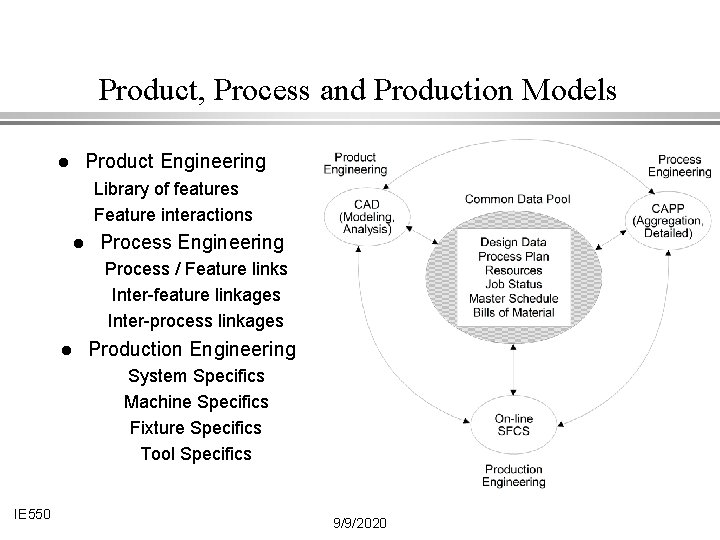
Product, Process and Production Models Product Engineering l Library of features Feature interactions l Process Engineering Process / Feature links Inter-feature linkages Inter-process linkages l Production Engineering System Specifics Machine Specifics Fixture Specifics Tool Specifics IE 550 9/9/2020
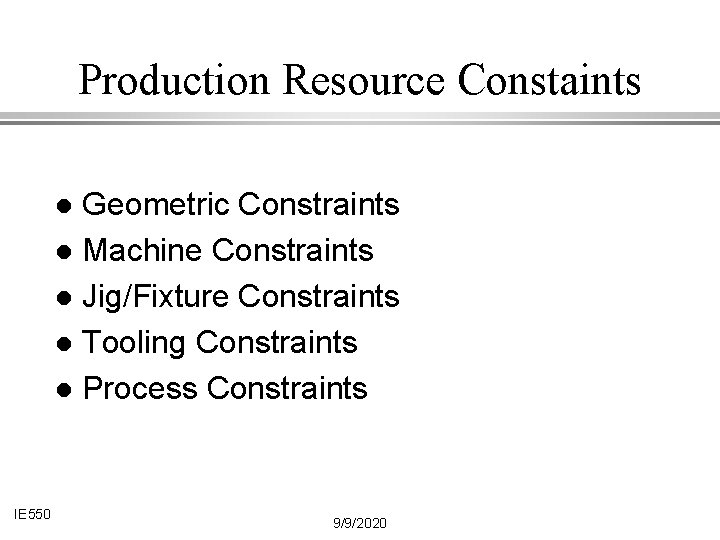
Production Resource Constaints Geometric Constraints l Machine Constraints l Jig/Fixture Constraints l Tooling Constraints l Process Constraints l IE 550 9/9/2020
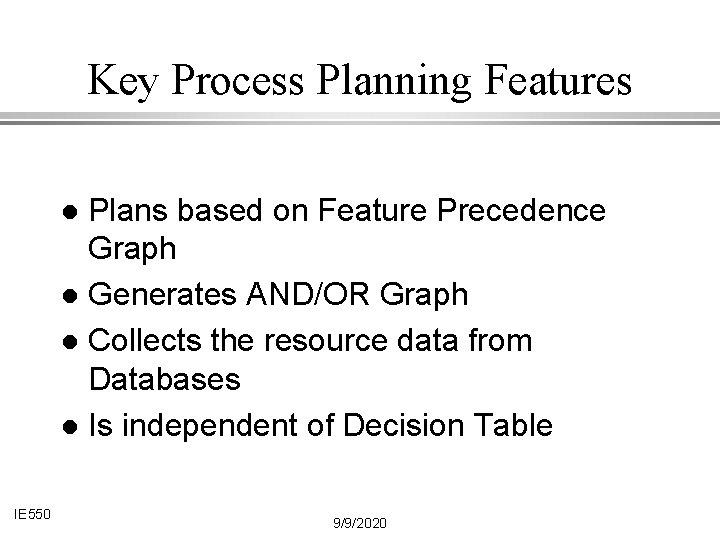
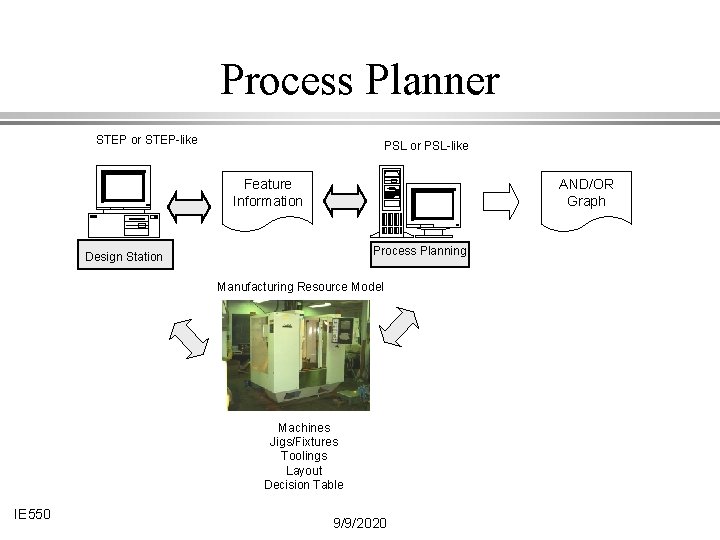
Key Process Planning Features Plans based on Feature Precedence Graph l Generates AND/OR Graph l Collects the resource data from Databases l Is independent of Decision Table l IE 550 9/9/2020
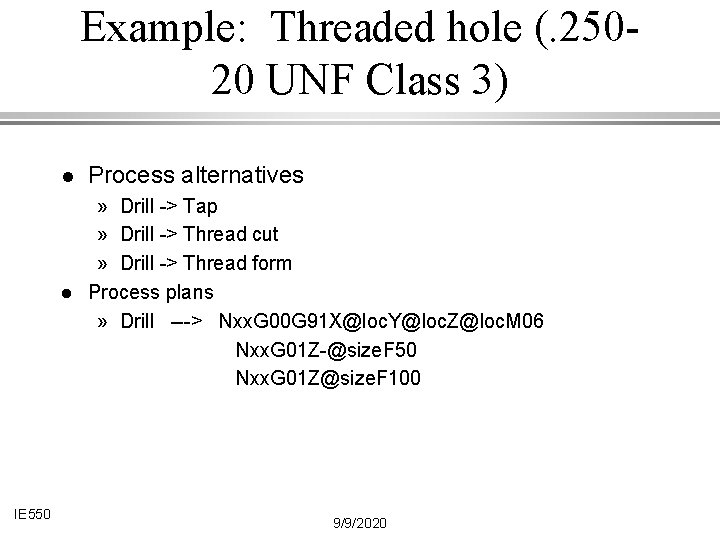
Example: Threaded hole (. 25020 UNF Class 3) IE 550 l Process alternatives l » Drill -> Tap » Drill -> Thread cut » Drill -> Thread form Process plans » Drill ---> Nxx. G 00 G 91 X@loc. Y@loc. Z@loc. M 06 Nxx. G 01 Z-@size. F 50 Nxx. G 01 Z@size. F 100 9/9/2020
Process Planner Design Station IE 550 Process Planning 9/9/2020
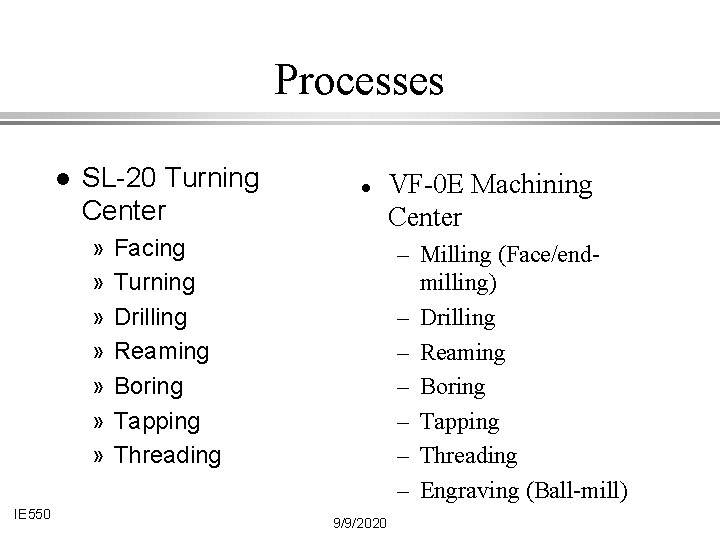
Processes l SL-20 Turning Center » » » » IE 550 l Facing Turning Drilling Reaming Boring Tapping Threading VF-0 E Machining Center – Milling (Face/endmilling) – Drilling – Reaming – Boring – Tapping – Threading – Engraving (Ball-mill) 9/9/2020
AND/OR Graph Generator Creates an AND/OR Graph Representation of a process plan l Fills out Processing Node Information l » PNI is used by NC code Generator l IE 550 Covers MP, MT, MH and AS/RS nodes 9/9/2020
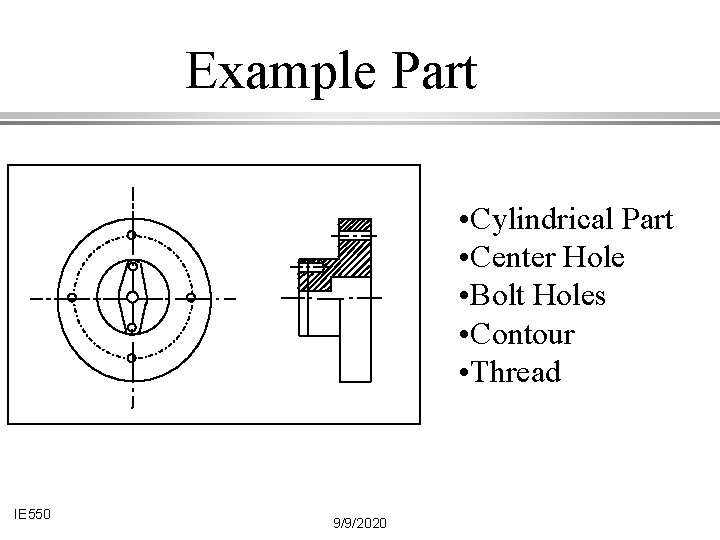
Example Part • Cylindrical Part • Center Hole • Bolt Holes • Contour • Thread IE 550 9/9/2020
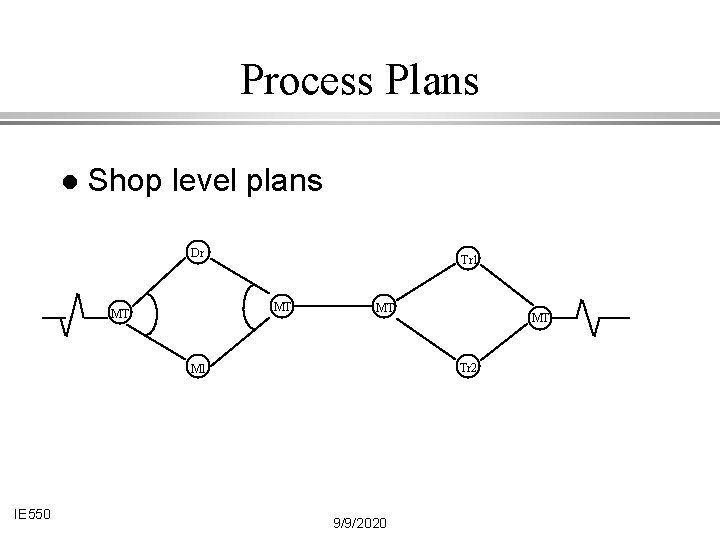
Process Plans l Shop level plans Dr Tr 1 MT MT MT Tr 2 Ml IE 550 MT 9/9/2020
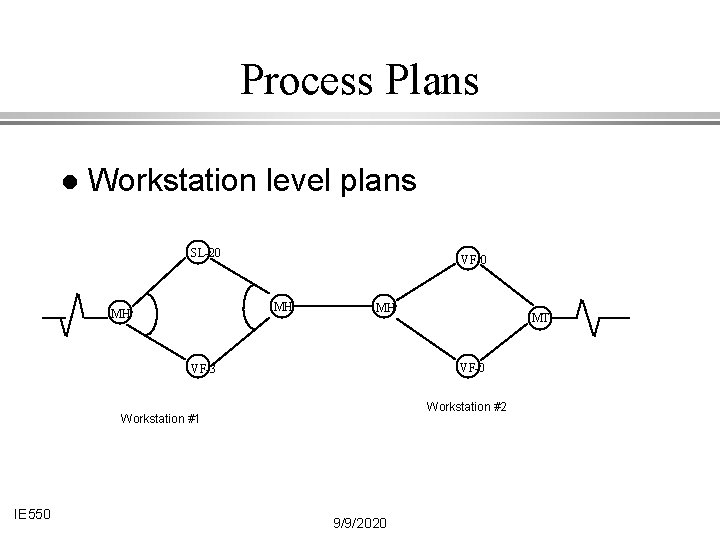
Process Plans l Workstation level plans SL-20 VF-0 MH MH MH VF-0 VF-3 Workstation #2 Workstation #1 IE 550 MT 9/9/2020
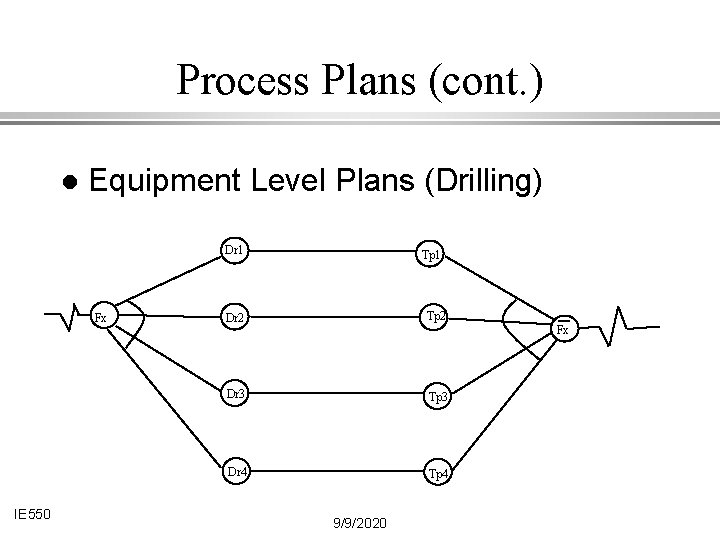
Process Plans (cont. ) l Equipment Level Plans (Drilling) Dr 1 Fx IE 550 Tp 1 Dr 2 Tp 2 Dr 3 Tp 3 Dr 4 Tp 4 Fx 9/9/2020
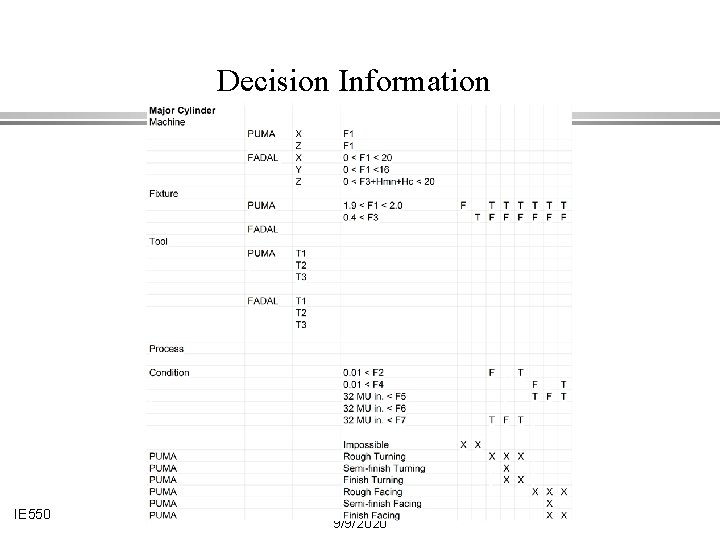
Decision Maker l Contains the hierarchical constraints » » » l IE 550 Machine Fixture Tool Process Feature Can be updated indendent of Process Planner 9/9/2020
Decision Information IE 550 9/9/2020
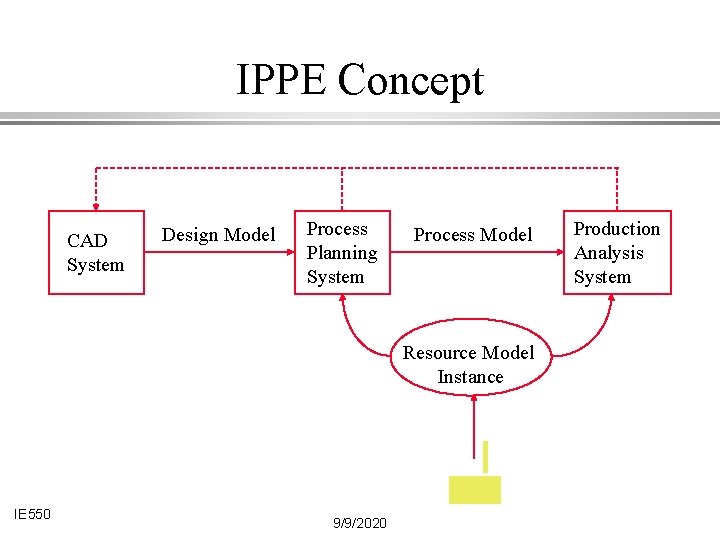
IPPE Concept CAD System Design Model Process Planning System Process Model Resource Model Instance IE 550 9/9/2020 Production Analysis System
Process Planner STEP or STEP-like PSL or PSL-like Feature Information AND/OR Graph IBM Compatible Design Station IBM Compatible Process Planning Manufacturing Resource Model Machines Jigs/Fixtures Toolings Layout Decision Table IE 550 9/9/2020
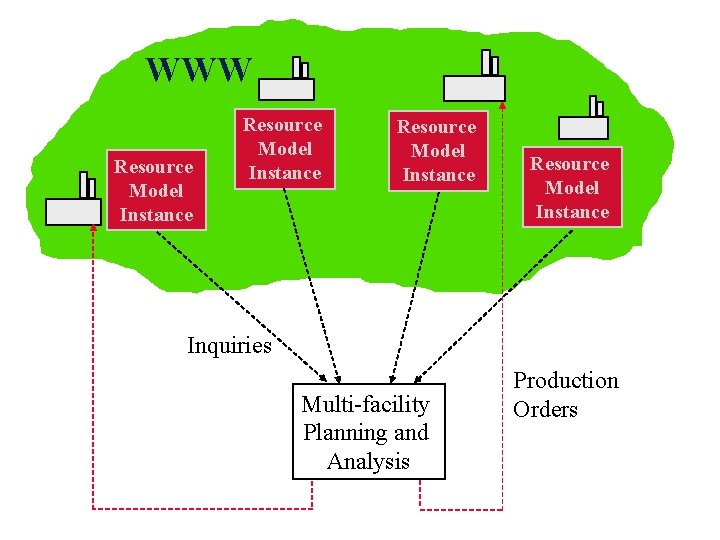
WWW Resource Model Instance Inquiries Multi-facility Planning and Analysis Production Orders
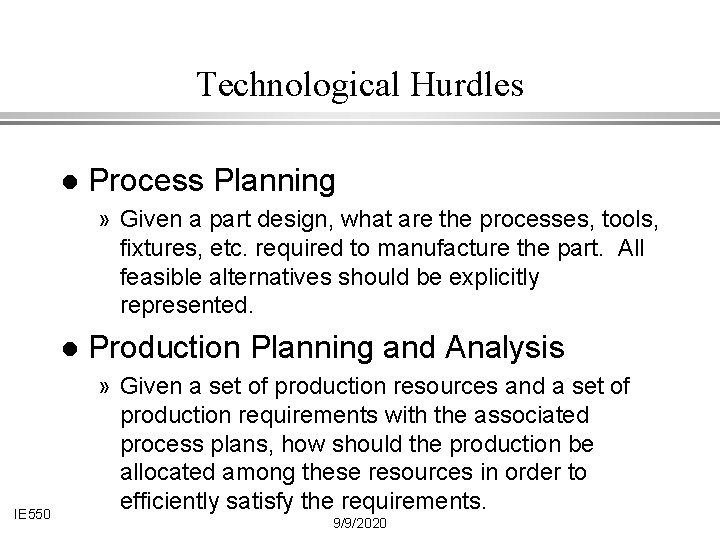
Technological Hurdles l Process Planning » Given a part design, what are the processes, tools, fixtures, etc. required to manufacture the part. All feasible alternatives should be explicitly represented. l IE 550 Production Planning and Analysis » Given a set of production resources and a set of production requirements with the associated process plans, how should the production be allocated among these resources in order to efficiently satisfy the requirements. 9/9/2020
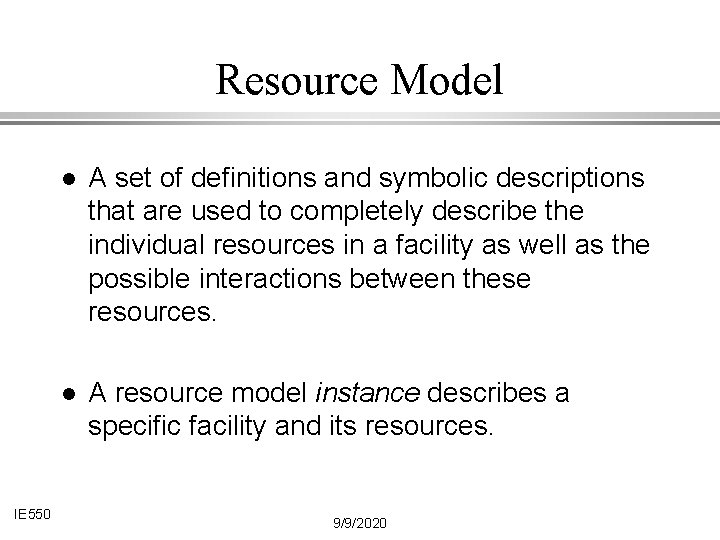
Resource Model IE 550 l A set of definitions and symbolic descriptions that are used to completely describe the individual resources in a facility as well as the possible interactions between these resources. l A resource model instance describes a specific facility and its resources. 9/9/2020
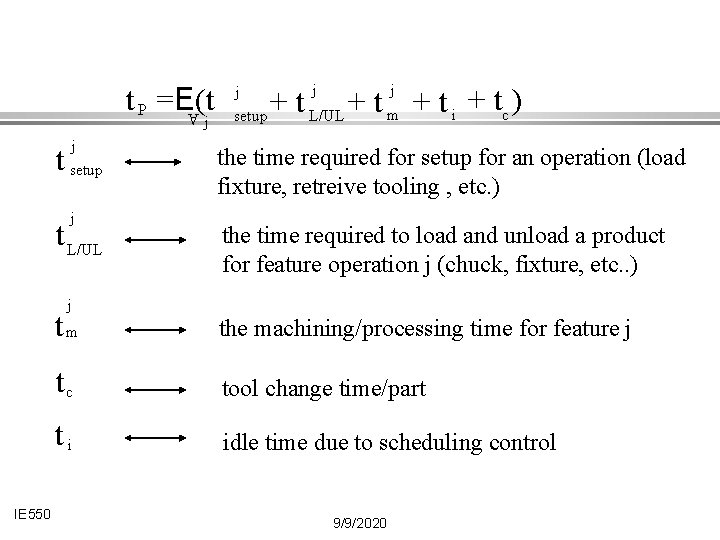
t P =E(t A t j setup j t L/UL j j setup j j + t L/UL + t m + t i + tc ) the time required for setup for an operation (load fixture, retreive tooling , etc. ) the time required to load and unload a product for feature operation j (chuck, fixture, etc. . ) j IE 550 tm the machining/processing time for feature j tc tool change time/part ti idle time due to scheduling control 9/9/2020
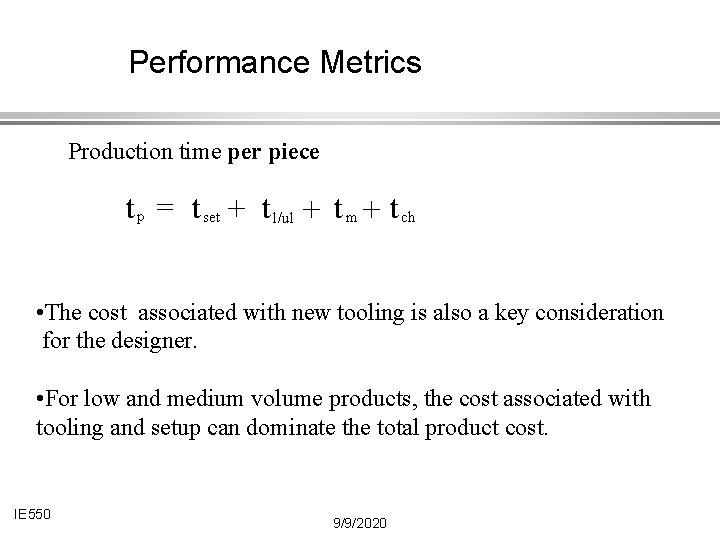
Performance Metrics Production time per piece t p = t set + t l/ul + t m + t ch • The cost associated with new tooling is also a key consideration for the designer. • For low and medium volume products, the cost associated with tooling and setup can dominate the total product cost. IE 550 9/9/2020
l Concept of a manufacturing system resource model [ Wysk, R. A. , Peters, B. A. , and Smith, J. S. , “ A Formal Process Planning Schema for Shop Floor Control ” ] » Resource Model - set of definitions and symbolic descriptions that are required to completely describe all of the individual resources in a facility as well as the necessary interactions between these resources IE 550 9/9/2020
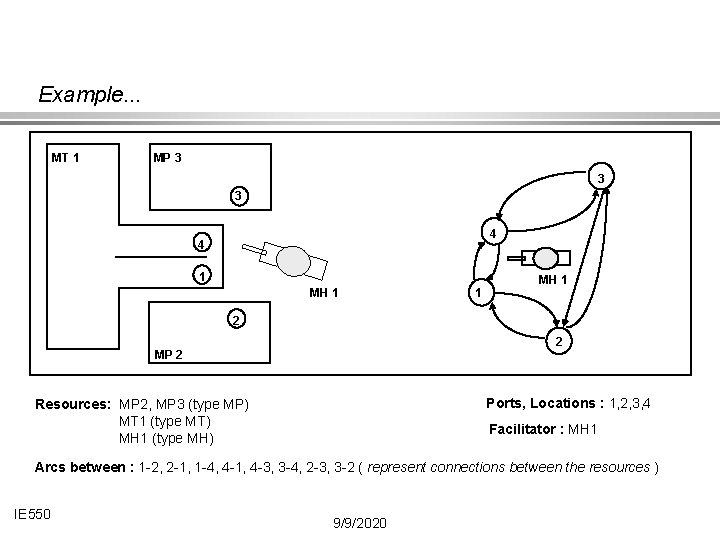
Terminology IE 550 l Resources (R) : Collection of assets in the facility directed towards the manufacture of the products. Includes equipment, tools, fixtures, transporters, and instruction sets l Locations (L): A precise physical location associated with a port and a part. Locations are used to link the transfer of parts between equipment types. Each location has an owner and a set of clients that can address that location l Ports (P): Ports are nodes in the graph defining the paths parts can follow through the facility (note: Graph shows the connections between the resources in the facilities l Arcs: Show which ports can be directly accessed from a particular port l Facilitator: A device than can move transporters between different ports on the MT system or move parts between a port on a MT system and a port on a MP 9/9/2020
Example. . . MT 1 MP 3 3 3 4 4 1 MH 1 2 2 MP 2 Ports, Locations : 1, 2, 3, 4 Resources: MP 2, MP 3 (type MP) MT 1 (type MT) MH 1 (type MH) Facilitator : MH 1 Arcs between : 1 -2, 2 -1, 1 -4, 4 -1, 4 -3, 3 -4, 2 -3, 3 -2 ( represent connections between the resources ) IE 550 9/9/2020